The Compliance Of Silence

Listen to the podcast of this post by clicking on the player below, and you can also subscribe on AppleSpotify, or Audible.

A couple of weeks ago I shared a recap from my sermon called Eloquent Silence. Jesus serenely remained silent when He was being falsely accused by those who wanted Him out of the way. Yet, His silence was eloquent and convicting. 

We would do well to learn this lesson from our Savior. 

There is a flip side to this: Sometimes our silence can signal compliance or acceptance of those who are speaking or perpetrating evil. 

David wrote, “Do you indeed speak righteousness, you silent ones? Do you judge uprightly, you sons of men? No, in heart you work wickedness; you weigh out the violence of your hands in the earth” (Psalm 58:1-2 NKJV). 

Commenting on this psalm, Charles Spurgeon wrote, “It would be well, if people would sometimes pause and candidly consider this: ‘Do you indeed speak righteousness, you silent ones?’ Some of those who surrounded Saul were passive rather than active persecutors—they held their tongues when the object of royal hate was slandered. In the original, this first sentence appears to be addressed to them, and they are asked to justify their silence. Silence gives consent. People who refrain from defending the right are themselves accomplices in the wrong.”  

Silence does have its place. King Solomon wrote, “He who despises his neighbor lacks sense, but a man of understanding keeps silent. He who goes about as a talebearer reveals secrets, but he who is trustworthy conceals a matter” (Proverbs 11:12-13 NASB1995). But to remain silent in the face of evil or falsehood could also be a sin. 

Consider a few other wise words:

“No one wants to be thought of as holding to a ‘minority position’ on anything, so, rather than speak up in the face of many who are doing so, most will remain silent. This is where the Christian community finds itself at this time, trapped in a spiral of silence before a blustering but empty secular and unbelieving worldview. So it is very important that believers in Jesus Christ make the best use of every opportunity to talk about what is good and pleasing to God.” —T.M. Moore 

“Don’t be a bystander, be on stand by. I will not allow a bully to bully others. I will not laugh at his jokes, I will not remain silent. I will stand up and say ‘Enough is enough.’” —Nick Vujicic 

“As Christians we are tempted to make unnecessary concession to those outside the Faith. We give in too much. Now, I don’t mean that we should run the risk of making a nuisance of ourselves by witnessing at improper times, but there comes a time when we must show that we disagree. We must show our Christian colors, if we are to be true to Jesus Christ. We cannot remain silent or concede everything away.” —C.S. Lewis 

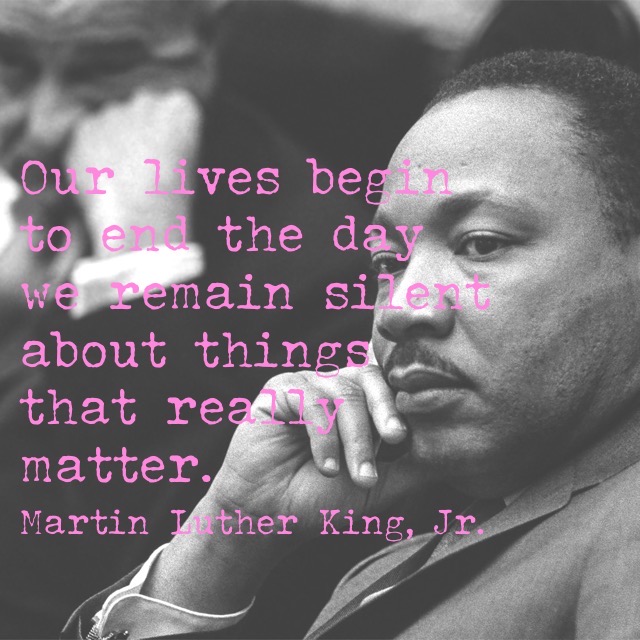
“Our lives begin to end the day we remain silent about things that really matter.” —Martin Luther King, Jr.

When to speak up and when to remain silent is a huge issue for Christians. This is why we need to be sensitive to the Holy Spirit telling us when to hold our tongues and when to speak out boldly.

►► Would you please prayerfully consider supporting this ministry? My Patreon supporters get behind-the-scenes access to exclusive materials. ◀︎◀︎

Links & Quotes

I have a series of nearly 70 posts on the topic of godly leadership. Here is the latest installment about going all in. Be sure to check out all of my videos on my YouTube channel.

T.M. Moore writes persuasively to Christians to encourage them to build for the future. He wrote, “For most Christians today, the Kingdom which Daniel saw, Jesus proclaimed and brought near, and the Spirit inaugurated on that first Christian Pentecost—that Kingdom is little more than a theological idea, or a distant hope. It is not a daily reality to be sought, seized, shared, and strengthened in every nook and cranny of our Personal Mission Fields. Christians today are trapped in their past or mired in their present, and they have little or no sense of what it means to build for the future so that righteousness, peace, and joy in the Spirit increase wherever they live, move, and have their being.”

Whether you know it as the Mesha Inscription, the Mesha Stele, or the Moabite Stone, this 1868 discovery is another piece of archeological evidence lending proof to the historicity of the Bible.

And another piece of research from both paleontologists and entomologists points to the Flood described in the Bible as historically viable. Researchers discovered fossilized giant ants in Canada where evolutionists claim they shouldn’t be. The Institute for Creation Research commented, “There is no need to postulate ants trekking across the Arctic to explain the distribution. Nor is there a need to inject short ‘hyperthermal’ episodes to allow passage from one continent to another. The global Flood explains what we observe the best. The warmer pre-Flood conditions and likely higher oxygen levels explain the large size of the ants. And their fossil distribution is best explained by their transport off the highest pre-Flood hills as the waters were receding.”

“If we were to look at Jesus’s death merely as a result of a betrayer’s deceit and the Sanhedrin’s envy and Pilate’s spinelessness and the soldiers’ nails and spear, it might seem very involuntary. And the benefit of salvation that comes to us who believe might be viewed as God’s way of making a virtue out of a necessity. But once you read Luke 9:51, all such thoughts vanish. Jesus was not accidentally entangled in a web of injustice. The saving benefits of His death for sinners were not an afterthought. God planned it all out of infinite love to sinners like us, and He appointed a time.” —John Piper, Love To The Uttermost reading plan on YouVersion

Links & Quotes

There is something very important that mature leaders need to remind themselves of so that they can help emerging leaders become successful. You can watch out this full conversation about mulligans and do-overs on the most recent episode of The Craig and Greg Show. Be sure to check out all of my videos on my YouTube channel.

In my sermon on Sunday, I talked about the sovereignty of God over world affairs and world leaders. This is a great reminder from John Newton:

Merat Sultan was born in the shah of Iran’s palace in 1876. He became the chief of police and of the army in Tabriz, Iran. When the Russians invaded and occupied that area, they made plans to execute Sultan. How he escaped actually led him to a relationship with Jesus as Sultan became a Christian. Check out this fascinating story from the website Praying For Muslims. I would also urge you to check out their weekly prayer guide.

My wife and I are reading through the He Gets Us devotional series on YouVersion. I love this picture of Jesus that comes from He Gets Us #3: Questions Jesus Asked

“No voice. No contribution. No significance. No meaning.

“Invisible.

“That’s the way many women probably felt at the time Jesus lived. And every person with an illness—cancer, leprosy, epilepsy, mental disabilities—every one of those people were marginalized. In Jesus’ day, what careers were on the lowest rung of the corporate ladder?—fishermen and shepherds. Yet when you read every account of Jesus, who do you see Him hanging around? Fishermen, shepherds, women, and people dealing with health issues.

“Jesus wanted it that way. He took every opportunity He had to bring people in from the fringes and give them His full attention. He saw them. He listened to them. He loved them in ways they’ve never been loved before. They had never experienced anything like it.”

T.M. Moore wrote, “We are becoming so accustomed to the forsaking of traditional values, the undermining and fragmenting of long-established institutions, and the breakdown of morality and civility that we can begin to think that these conditions are the new normal, the best we can hope for in an age in flight from God. Everywhere we look in our day, the prophetic words of William Butler Yeats, in his 1919 poem, ‘The Second Coming,’ seem to be coming true: ‘Things fall apart; the centre cannot hold;/Mere anarchy is loosed upon the world./The blood-dimmed tide is loosed, and everywhere/the ceremony of innocence is drowned.’ But the appearances, which press upon us daily, are only a matter of perspective.” Check out the rest of his post.

When things are going well, how can we talk about our success in a way that glorifies God? John Piper had a thoughtful answer to a businessman who asked how he could talk about the success of his business and make God look great while he was doing so.

Links & Quotes

Pastors, on Monday morning, as you debrief how things went on Sunday, if you are feeling a bit discouraged, I want you to consider something Jesus said. Your success in ministry is not exclusively seen in the harvest you reap, but in the seeds you are sowing. Keep sowing good seed faithfully and then let God help it grow.

Many people turn to pornography when they are feeling bad about themselves. Sadly, watching porn can actually diminish a person’s self-esteem. Check out this post from Fight The New Drug.

“We ought above all things to desire a heavenly happiness; to be with God and dwell with Jesus Christ. Though surrounded with outward enjoyments, and settled in families with desirable friends and relations; though we have companions whose society is delightful, and children in whom we see many promising qualifications; though we live by good neighbors, and are generally beloved where known; we ought not to take our rest in these things as our portion. We should be so far from resting in them, that we should desire to leave them all, in God’s due time. We ought to possess, enjoy and use them, with no other view but readily to quit them, whenever we are called to it, and to change them willingly and cheerfully for heaven.” —Jonathan Edwards

“Jesus didn’t preach to tell you to turn over a new leaf, but to turn you to a new life.” —Reinhard Bonnnke

Steven Lee has an excellent post entitled Good leaders are easy to follow. I wholeheartedly concur! “A church’s willingness to obey and submit affects the joy and the care they receive from their leaders. But the reverse is true as well. Leaders can lead in a way that makes obedience and submission easy and happy, or difficult and frustrating. Shepherds shape the habits of the sheep.”

T.M. Moore has a series of posts on apologetics, which I encourage you to check out. In one post he writes, “God is not a capricious Deity. He does not act in ways that make it difficult to know Him or His will. His purposes are carefully considered and prudentially engaged, and in such a way that human beings can understand what He is about. … God shows us that He Himself is reasonable in that He makes known Himself and His will in a wide range of rational ways—through types and symbols and teachings and verbal exchanges of many different sorts. Anyone who takes the time to read the Bible can understand it. Its stories are stories about people like us. The teachings of Scripture are not shrouded in arcane or mystical language. What God has done and what God requires can be clearly discerned by any reasonable person, because God reveals Himself and His will in terms amenable and accessible to reason.”

Links & Quotes

I’m really excited for this! On March 9, I will be a guest on The Church Lobby podcast with Karl Vatters! Check it out wherever you get your podcasts.

T. M. Moore has been presenting an outstanding series of posts in the series To Stop The Lie. In his most recent post, he wrote, “Winds of false doctrine blow across the sails of the Church continuously, bringing lies against the ship of truth to drive it off its Kingdom course. Wafting in from worldly thinking, these false doctrines downplay the Word of God, make the needs of people rather than the glory of God the focal point of religion, introduce alien practices to worship and church life, and becalm the Body of Christ into complacency. Such lies must be exposed, deconstructed, and stopped.” Check out the post from which this quote came by clicking here, and then you can follow the thread to read the other posts in this series.

“We are more fulfilled when we are involved in something bigger than ourselves.” —John Glenn

NASA has a really cool interactive map that allows you to track the flight of asteroids and comets as they orbit around the sun. You can go forward or backward in time, zoom in or out, and angle the solar system to see the flights and orbits from a different perspective.

John Stonestreet has a good history lesson for us of past revivals on American soil, and the transformation that came about as a result. If you are a pastor and would like to join other pastors once per week for prayer for revival, please check out this prayer group.

Doug Clay has a reassuring post about the blessed hope Christians should have concerning Christ’s Second Coming. He writes, “Will Jesus return in 2023? That question stirs hope in some and anxiety in others. … The Rapture should calm anxious Christians rather than causing anxiety. No matter how bad things get, we know that our Blessed Hope is imminent!”

Too many people in leadership positions think that leadership means that others do things for them. In actuality, godly leaders view their elevated position as an opportunity to serve more—to do more things for more people. I dive deeper into this in my book Shepherd Leadership: The Metrics That Really Matter.

Links & Quotes

I am really looking forward to a new series of sermons that I am launching this Sunday. This will be a once-per-month series for the remainder of the year and it’s simply called A Christian’s Mental Health. If you don’t have a home church in the west Michigan area, I would love for you to join me in person, but the sermons will also be posted on my YouTube channel.

T.M. Moore has an outstanding post called The Essence of the Lie. In one part, Moore writes, “Thus the lie claims to be the truth, but, at the same time, it insists that truth is personal, relative, pragmatic, and utilitarian. Truth, from this perspective, is not absolute, but dynamic, changeable rather than fixed. It is conditioned by circumstances of time and place. At the end of the day, people are the final arbiters of truth, and truth is whatever they find to be useful for their purposes. Ultimate truth is that which people impose on others by one or another kind of force, whether intellectual, political, or physical.” Check this one out!

Harvard University has been studying a group of individuals since 1938 to try to determine the main factors that contribute to a long and healthy life. The director and assistant director of this study just published an article that sums up what they have learned over all these years—“[If] we had to take all 85 years of the Harvard Study and boil it down to a single principle for living, one life investment that is supported by similar findings across a variety of other studies, it would be this: Good relationships keep us healthier and happier. Period. If you want to make one decision to ensure your own health and happiness, it should be to cultivate warm relationships of all kinds.”

“The battle for control and leadership of the world has always been waged most effectively at the idea level. An idea, whether right or wrong, that captures the minds of a nation’s youth will soon work its way into every area of society, especially in our multimedia age. Ideas determine consequences.” — The American Covenant 

“The storms of life are no longer our point of reference when [Jesus] is our focal point.” —Dutch Sheets

John Stonestreet was intrigued by a street reporter asking, “What are men good for?” There were a lot of soft, ambiguous answers given, but John quipped, “Men are good for fathering, protecting, loving, providing, leading, fighting for what’s right with their lives if need be, and obeying, in a masculine way, the creation mandate of the God who made us male and female and declared both ‘very good.’ Was that so hard?” Amen!

Dan Reiland identifies four common mistakes that will cause your church to struggle.

When leaders quit growing, they in essence have “quiet quit” on their team. If the leader’s not growing, what is the incentive for anyone else in the organization to improve themselves or work hard? Leaders quiet quit long before their teammates do! Check out the full conversation Greg Heeres and I had on avoiding quiet quitting by clicking here.

Links & Quotes

When Jesus says, “I need you,” will you be able to say, “I’m ready for You”? Here is a great example of a man who stayed ready year after year for that precise moment when Jesus said, “It’s time.” Please subscribe to my YouTube channel.

Pastors, I was challenged by the insight from T.M. Moore, and I hope you will take a couple of minutes to read the full post and even subscribe to his regular emails. “John Calvin explained that one of the marks of a true church is that the Word of God is faithfully proclaimed and heard. He did not consider a church to be fulfilling its mission simply by sound preaching. Sound preaching had to be coupled with sound hearing and obedience, for only as believers do the Word to they receive it as God intends.

“In this, Calvin and Columbanus are in agreement: ‘While we preach often we improve slowly; often are we offended, seldom patient, often conquered, seldom conquerors, often led astray, seldom wise. Then what will help us, like weak and unskilled fighters whose weapons turn and wound them, while it is no credit to hear these things, but to accomplish them? For the law does not make holy by hearing, but doubtless by performance; each should honour the Lord, not simply by words and bodily toil, but by ripeness of character and purity of heart’ (Sermon II).”

Links & Quotes

Every Monday I share a 1-minute thought to get your week started. It’s my weekly Monday Motivation series of videos. Check out this week’s video that I posted the day after Christmas, and please subscribe on YouTube.

T.M. Moore wrote one of the endorsements for my book Shepherd Leadership. In an interview I then did on his Fellowship of Ailbe podcast, I shared my dismay over unbiblical ideas and practices that have crept into the church. Both T.M. and I share a passion to see our church leadership return to our secure biblical foundation. 

In a recent blog post, T.M wrote, “From the days of the apostles onward, a tendency has existed among church leaders to drift from the plain teaching of the Word of God into forms of Christian life and ministry that derive from sources other than Scripture. Or that stretch the meaning of Scripture to fit the shape of certain cultural forms.” Please check out T.M.’s post “Do not go beyond.”

In a fascinating post from Rabbi Benjamin Blech, I read these thoughts about the power of a name: “The Hebrew word for soul is neshamah. Central to that word, the middle two letters, shin and mem, make the word shem, Hebrew for ‘name.’ Your name is the key to your soul. … When the Torah says, ‘God created,’ it doesn’t suggest that He worked with what He fashioned by labor, but merely that He spoke—and the very words describing the object came into being. God said, ‘Let there be light and there was light.’ The Almighty merely gave it a name, and the very letters defined its atomic structure.” Check out the full post here.

And once again archeologists discover evidence that corroborates the biblical accounts. In this case, more evidence is found from King Hezekiah. As I have said numerous times, the historicity of the Bible is amply verified.

“Success” doesn’t always mean bigger numbers. King David got into trouble with God when he wanted to measure his success by how many fighting men he had under his command. Consistently throughout the Bible God’s measure of success is our trust in Him. This thought was a key part of the sub-title of my book Shepherd Leadership: The Metrics That Really Matter.

Cold-case detective J. Warner Wallace tackles an important topic: Does objective truth exist, and how can it be defined? This is a quite lengthy post but it is well worth your time.

“Pain nourishes courage. You can’t be brave if you’ve only had wonderful things happen to you.” —Mary Tyler Moore

Book Reviews From 2022

Listen to the podcast of this post by clicking on the player below, and you can also subscribe on AppleSpotify, or Audible.

I love reading, and I love sharing my love of good books with others! Here is a list of the books I read and reviewed in 2022. Click on a title to be taken to that review.

Autobiography of Calvin Coolidge

Cary Grant

Contending For Our All

Father Sergius

Hank Greenberg: The Story Of My Life

Living In A Gray World

Out Of The Depths

Roots Of Endurance

Simple Truths Of Leadership

Spurgeon And The Psalms

Susanna Wesley

The Holy War

The Legacy Of Sovereign Joy

The Poetry Of Prayer

The Self-Aware Leader

Who Says Elephants Can’t Dance?

Who’s Pushing Your Buttons?

Here are my book reviews for 2011.

Here are my book reviews for 2012.

Here are my book reviews for 2013.

Here are my book reviews for 2014.

Here are my book reviews for 2015.

Here are my book reviews for 2016.

Here are my book reviews for 2017.

Here are my book reviews for 2018.

       Here are my book reviews for 2019.

Here are my book reviews for 2020.

Here are my book reviews for 2021.

►► Would you please prayerfully consider supporting this ministry? My Patreon supporters get behind-the-scenes access to exclusive materials. ◀︎◀︎

Links & Quotes

Every Monday I share a 1-minute thought to get your week started. It’s my weekly Monday Motivation series of videos. Check out this week’s video and subscribe on YouTube.

“The Lord Jesus Christ is always ready to take the most imperfect prayer and perfect it for us. If our prayers had to go up to heaven as they are, they would never succeed; but they find a Friend on the way, and therefore they prosper.” —Charles Spurgeon

I love this thought from T.M. Moore: “We sometimes use the word reflect to express what we want to see happen in our lives as Christians. We say we want to reflect Jesus to the world, like a mirror reflects an image. As agents of Jesus Christ and His Kingdom, believers are not so much like mirrors as they are like prisms. Mirrors reflect light. The light strikes them and bounces off, without bringing anything of the mirror with it. Prisms refract light.” Please take a couple of minutes to read Moore’s post Prisms of the Light.