Eugene Peterson may be best known for his work on The Message: a paraphrase of the Bible in more modern English. But before he worked on The Message, he was already putting the Bible into modern English in his weekly sermons. As Kingfishers Catch Fire is a collection of 49 of these sermons.
Peterson says, “When I prepare and preach a sermon, I need constant reminding that I am part of a company that has a rich and varied genealogy. I do not start from scratch. I do not make up something new.” These sermons are divided into seven categories, in which Peterson states he is “preaching in the company of Moses, David, Isaiah, Solomon, Peter, Paul, and John.”
To be honest with you, this collection of sermons was a bit of a disappointment to me. I was anticipating sermons that were much more expositional in nature, but instead I read sermons which were Peterson’s poetic thoughts about a passage of Scripture. I found this curious since Peterson himself says in the introduction to this book that “the Christian life is the lifelong practice of attending to the details of congruence…between preaching and living, congruence between the sermon and what is lived in both preacher and congregation” (emphasis mine). And yet I found in these sermons very few details to actually attend to and live out.
If you prefer poetic discussions of Scripture in which you will have to find your own way of applying biblical principles to your life, you will probably enjoy this collection. But if you are looking for a meatier walk through the Bible, these sermons will probably leave you—as they did me—a bit flat.
Have you ever had a really bad job? How about a job that you said, “This job is killing me”? They probably weren’t as bad as the job Ernest Shackleton advertised for:
“Men Wanted for Hazardous Journey. Small wages, bitter cold, long months of complete darkness, constant danger, safe return doubtful. Honor and recognition in case of success.”
And probably not as bad as the help wanted ad for the Pony Express:
“Wanted. Young, skinny, wiry fellow not over 18. Must be expert riders, willing to risk death daily. Orphans preferred.”
Several times in his letter to Christians, the Apostle Peter tells Christians that living in a Christ-honoring way on earth is going to be tough. So are Christians just supposed to grin and bear it? Are they just supposed to slap a smile on their face and hang on until the end?
In a word: No!
Instead, Peter points out seven ways Christians can live so that they will point others to Jesus.
Live in reverent fear of an All-Righteous Judge who doesn’t miss a thing we say or do (1:17)
Live such good lives that consistently glorify God (2:12)
Live as the best of citizens, respecting those in leadership (2:13-17)
Live as good employees (2:18)
Live as Christ’s ambassadors by following the example of Jesus (2:19-24)
Live with your spouse faithfully and submissively (3:1, 7)
When the first Christians lived this way, everyone spoke well of them and held them in high regard because Christians…
Transformed life for women
Built the first hospitals
Founded the first free medical dispensaries
Established orphanages and homes for the aged
Made life better for children
Brought a dignity to marriage
“Anyone who asks the question: ‘What has Christianity done for the world?’ has delivered himself into a Christian debater’s hands. There is nothing in history so unanswerably demonstrable as the transforming power of Christianity and of Christ on the individual life and on the life of society.” —William Barclay
Bottom line—We need to live so that people will say “I♥ those Christians!”
There was a story circulating that a physicist once claimed that the bumblebee was defying the laws of physics and aerodynamics in its flight. Apparently, he calculated that the ratio of the bumblebee’s wing size in comparison to his body size just didn’t make the math work.
But entomologists and physicists quickly jumped in to say, “Hey, look, the bumblebee is flying, so clearly it works!” And then they went to work to try to explain it. They figured out that the bumblebee flaps its wings more back-and-forth than up-and-down, creating tiny hurricanes the propel them through the air. But then that created a whole new set of problems, like how does the bumblebee control a hurricane so precisely as it turns, stops, dives, and climbs. So then they had to create a new explanation, which they named dynamic stall.
All the while, the bumblebee is flapping its too-small wings 230 times per second(!), and going about its daily activities without being able to explain tiny hurricanes, the laws of physics or aerodynamics, or even knowing what dynamic stall is. It simply flies!
The ultimate argument for anything is doing something that critics say is impossible.
Peter tells Christians to be prepared to answer anyone for the reason for the hope that they have (1 Peter 3:15-16). The Greek word for “give an answer” is apologia, from which we get our word apologetic. Here are three apologetics for Christians to use for the hope that they have.
It really comes down to this: My hope is based on the resurrection from the dead of Jesus Christ, which I believe because of the Bible AND because of the change in my life.
The Bible’s authenticity
“No other work in all literature has been so carefully and accurately copied as the Old Testament. The particular discipline and art of the Jewish scribes came out of a class of Jewish scholars between the fifth and third centuries BC. They were called the Sopherim, from a Hebrew word meaning ‘scribes.’ The sopherim, who initiated a stringent standard of meticulous discipline, were subsequently eclipsed by the Talmudic scribes, who guarded, interpreted, and commented on the sacred texts from AD 100 to AD 500. In turn, the Talmudic scribes were followed by the better-known and even more meticulous Masoretic scribes (AD 500-900).” —Josh McDowell, God-Breathed
“No other ancient text is substantiated by such a wealth of ancient textual witnesses as is the New Testament. Roughly 5,500 separate manuscripts are available, variously containing anything from the entire New Testament corpus to a slight fragment of a single verse. … This textual support is far superior to that available for any other ancient documents, such as the classical texts from Greek and Roman writers (e.g., Plato, Aristotle, and Cicero). Only partial manuscripts have survived for many works of antiquity, and it is not unusual to find that the only complete manuscript for some ancient writing is a copy dating from 1,000 years after its composition.” —Archaeological Study Bible, “The New Testaments Texts” (page 1859)
“The biblical Dead Sea Scrolls are up to 1,250 years older than the traditional Hebrew Bible, the Masoretic text. We have been using a one-thousand-year-old manuscript to make our Bibles. We’ve now got scrolls going back to 250 BC. … Our conclusion is simply this—the scrolls confirm the accuracy of the biblical text by 99 percent.” —Dr. Peter Flint
I have shared other apologetic evidence for the authenticity of Scripture here and here.
Christ’s resurrection
In1 Corinthians 15:1-8 Paul lists all of the eyewitnesses to Christ’s resurrection, giving critics ample opportunity to challenge these witnesses in person. If these witnesses would have been perpetrating a hoax, skeptics of their day would have been able to uncover the inconsistencies in their story. If the account of Christ’s resurrection was made-up, it’s doubtful the early Christian martyrs would have “stuck to their story” as they were being tortured, but none recanted.
Josh McDowell notes, “By AD 100, the apostles had died, but the Christian Church was still in its infancy, with fewer than twenty-five thousand proclaimed followers of Christ. But within the next two hundred years, the fledgling church experienced explosive multiplication of growth, to include as many as twenty million people. This means the church of Jesus Christ quadrupled every generation for five consecutive generations!”
My personal experience
“I am a changed person. I am not who I was before I met Jesus” and “My life tends to go better when I live by biblical principles” are both excellent apologetics!
Let others argue that God doesn’t exist, or that you shouldn’t have hope, and then you—like the bumblebee—just keep flying with Jesus! (see 2 Timothy 3:14)
God’s plan has always been for His leaders to organize and oversee His ministry.
The important thing for us to distinguish is “His.” It’s not a man or woman saying, “I will be a leader,” or even a God-appointed leader saying, “I am going to build up my ministry.”
The New Testament gives us a fourfold purpose for the Body of Christ:
Mobilizing for evangelism
Organizing for more meaningful ministry
Making disciple-makers
Caring for one another
We see God’s leaders involved in all of these aspects—
Mobilizing for evangelism—Peter pointed out the need for an apostle to be appointed to replace Judas, thus returning their ranks to the 12 apostles just as Jesus had originally said (Acts 1:15-22).
Organizing for more meaningful ministry—Everywhere Paul founded a church, he also appointed leaders to oversee and shepherd that church.
Making disciple-makers—Paul tells us that God appointed five offices of leaders in the church who had the specific task of preparing church members to do the ministry of building maturity in the church (Ephesians 4:11-16).
Caring for one another—The First Church set the pace for providing care for all who were in need, including organizing leaders to oversee specific care ministries (Acts 6:1-5).
What about a church congregation’s responsibility to their leaders? I see five areas:
Hold them accountable to the Word (Acts 17:11). The Bible has to be THE standard to which leaders are held.
Give them your confidence and submission after they have shown accountability to their biblical mandate (Hebrews 13:17).
Christians are citizens of Heaven who are merely passing through Earth, so this isn’t a Christian’s final home. Because of this, it’s not unusual for Earthlings to mistreat, insult, and even persecute these “aliens and strangers.”
How are Christians supposed to respond to this?
First off, let’s make sure the persecution is for the right reason. Jesus said, “Blessed are you when people insult you, persecute you and falsely say all kinds of evil against you because of Me” (Matthew 5:11).
Jesus also told us that this persecution has a blessing in it: we would be able to share our faith in Jesus Christ at the highest levels on Earth: “On account of Me you will stand before governors and kings as witnesses to them” (Mark 13:9).
In 1 Peter 3:8, the apostle tells us how to live with everyone, Christian and Earthling alike:
Harmoniously—keep The Main Thing the main thing; don’t get caught up in petty arguments
Empathetically—put yourself in others’ shoes
Kindly—treat everyone like a sibling that shares the same parents with you
Compassionately—be strong enough to handle other people’s stuff
Courteously—remember this: manners matter!
This list may be easy to live out when people are friendly to you, but what about when unfriendly Earthlings are downright mean to you? In the very next verse Peter gives us two Don’ts and one Do:
Don’t repay evil with evil—Jesus is our example of this (see 1 Peter 2:21-23)
Don’t insult the insulters—treat others as you want them to treat you (Luke 6:31)
Do bless those who slander and persecute you—Jesus says we get absolutely no credit if we only treat kind people kindly (see Luke 6:32-33)
In Psalm 35 David is dealing with people who are fighting against him. They are saying mean things and trying to do even meaner things. This prayer shows both God’s part and our part…
God’s part—defend me against the evildoers … remind me of Your salvation … pursue those who are falsely pursuing me … stay close to me.
My part—listen to God’s voice of assurance … live quietly … don’t give others cause to mistreat me … pray for those who persecute me … continually turn my thoughts and praise to God.
Peter wraps up this thought with these words—Who is going to harm you if you are eager to do good? But even it you should suffer for what is right, you are blessed (1 Peter 3:13-14).
Don’t give in to mistreatment and lash out in anger. Trust God to handle things. Keep on living a good life that is focused on bringing God all the glory due His name!
Listen to the podcast of this post by clicking on the player below, and you can also subscribe on Apple, Spotify, or Audible.
Before ascending back to Heaven, Jesus commissioned His followers. He gave them a mission that Christians often refer to as The Great Commission.
Jesus said, “All authority in heaven and on earth has been given to Me. Therefore go and make disciples of all nations, baptizing them in the name of the Father and of the Son and of the Holy Spirit, and teaching them to obey everything I have commanded you. And surely I am with you always to the very end of the age.”
There are several pictures in the New Testament of how the Church could live out this Great Commission, but one of the pictures that I find the most helpful is that of a Body.
The human body is an amazing creation! Just to accomplish the simple task of picking up something between our thumb and forefinger is a miracle in itself. The structure of bones and ligaments and tendons, the interaction of nerves in the fingers coordinating with the optical nerve, not to mention the enzymes and blood vessels that are all doing their part.
Yet if any part is not functioning properly, that simple action becomes more difficult. Maybe it even becomes impossible.
The Church is the same way. Every part of the Church Body has to be functioning in healthy order for the whole Body to be effective.
Here are four aspects of a healthy Church Body that the Apostle Paul lists in Ephesians 4:
Caring for one another
Mobilizing for evangelism
Making disciple-makers
Helping organize for more meaningful ministry
If every part of the Body is doing its part, we’re Living out the Great Commission.
If some parts are missing or unhealthy, we’re Wallowing in the Great Omission.
It’s not about your church (small “c”) or my church. It’s about all Christian disciples being a part of one Church—one Body—going into all the world and making disciples of all peoples. That’s what the Church is supposed to be doing!
If I were to ask five different Christians to give me a definition of sanctification, I just might get five different definitions!
Part of this comes from incorrect either-or thinking. However, Jesus seems to tell us that sanctification requires a both-and thinking.
In Christ’s prayer for His followers in John 17, He uses the word sanctified three times (see verses 17-19). Although He is using the same Greek word each time, He uses a different “flavor” of the word to make it really clear what He means.
First of all, the Greek word for sanctified means the process of being made into a saint. So sometimes I like to say the word this way: SAINT-ified.
Check out Christ’s prayer. First He says, “I sanctify Myself,” and then He says, “that they too may be truly sanctified.” Same Greek word, but each time is slightly tweaked.
Jesus uses a “flavor” of Greek which means sanctification is something that He has done completely and totally on His own once and for all. In other words, Christians are completely and totally sanctified at the very moment they surrender their life to Him.
But when He talks about His followers, the “flavor” of Greek means sanctification is something that is an ongoing process. In other words, we are being SAINT-ified.
So which is it? Sanctified once, or sanctified through an ongoing process?
It’s not either-or. It’s both-and!
Think about a married couple. From the moment the pastor says, “I now pronounce you husband and wife” they are married. It is done; fully completed. There is nothing the bride or groom can do to become more married.
However, the groom can begin to look at the marriage through his bride’s eyes. Then he can serve her in a way that helps her feel more joy, more satisfaction, and more fulfillment within the marriage. Neither of them becomes more married, but they can get more enjoyment within the marriage.
The same thing for Christians. At the moment we ask Jesus to be our Lord and Savior we are saved from the penalty of our sins. We can’t be more saved. But through the process of SANIT-ificiation we can experience more joy, more satisfaction, and more fulfillment within our relationship with Jesus.
My paraphrase of 1 Peter 1:15-16—But just as He who called you has paid for your once-for-allsaint-ification, sokeep on beingsaint-ifiedin all you do; for it is written: “Be holy, because I am holy.”
What about you? Are you satisfied with just being saved, or are you striving for a joy-filled, more fulfilling, increasingly satisfied relationship with Jesus Christ? It can truly be a wonderful both-and relationship!
Without exception, all human beings have exactly 168 hours in a week. No one gets any bonus time and no one has any hours taken away. We’re supposed to get 8 hours of sleep a night, and most of us work about 40 hours each week. So let’s do the math…
168 hours per week
– 56 hours for sleeping
– 40 hours for work
=72 discretionary hours
In those 72 hours there must be time for eating and taking care of chores. But what about going to church? The problem for many people is looking at church attendance as just another “chore” or item on their “To Do” list.
But instead of thinking of going to church as “I have to,” how about if you looked at all of the “I get to” benefits?
Here are 10 great reasons for going to church regularly. I get to…
…draw closer to my Heavenly Father, just like Jesus did (Luke 2:49)
…avoid becoming isolated and possibly lost (Proverbs 18:1)
“Sometimes we make it sound like we’re making a sacrifice to go to church, but think about the very real sacrifice Jesus made so that we could meet together as brothers and sisters!” —Scott Troost
How about it? Do you think you could invest an hour or two of your 72 discretionary hours in a local church this week?
My thanks to my brother, Scott Troost, for sharing such a timely message!
To my dear pastor friends, please ponder carefully these wise words from Oswald Chambers:
“As preachers and teachers we are powerless to make saints. Our duty is to put the seed into the right place and leave the rest to God. …
“Modern evangelism makes the mistake of thinking that a worker must plough his field, sow the seed, and reap the harvest in half-an-hour. Our Lord was never in a hurry with the disciples, He kept on sowing the seed and paid no attention to whether they understood Him or not. He spoke the truth of God, and by His own life produced the right atmosphere for it to grow, and then left it alone, because He knew well that the seed had in it all the germinating power of God and would bring forth fruit after its kind once it was put in the right soil. …
“Sow the Word of God, and as sure as God is God, it will bring forth fruit. …
“Sow emotions, and the human heart will not get beyond you. There are men and women at work for God who steal hearts from God, not intentionally, but because they do not preach the Word of God. They say, ‘I don’t want anyone to think about me’; that should never need to be said. If the thought of ourselves is lurking anywhere as we preach, we are traitors to Jesus Christ. Our duty is to get people through to God. … See that you sow the real seed of the Word of God, and then leave it alone.” —Oswald Chambers, in The Servant As His Lord
These words prompt me to take a close look into God’s mirror to see if I’m preaching in a way that God can bless. How about you?



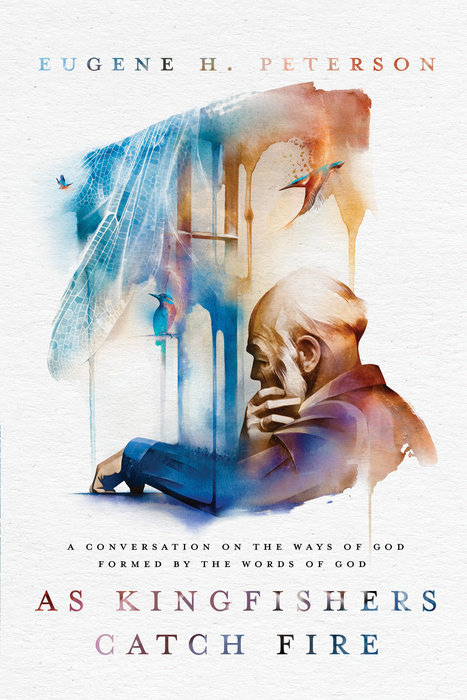 Eugene Peterson may be best known for his work on The Message: a paraphrase of the Bible in more modern English. But before he worked on The Message, he was already putting the Bible into modern English in his weekly sermons. As Kingfishers Catch Fire is a collection of 49 of these sermons.










 Craig T. Owens