
9 Quotes From “Shepherding God’s Flock”

T.M. Moore has given pastors a phenomenal training resource in Shepherding God’s Flock. Please be sure to check out my full book review by clicking here. 

“The work of church leaders today—and especially of that class of leaders called elders, with which this study is concerned—has been shaped and conditioned more by the temper of our times than by the teaching of God’s Word.” 

“According to Paul, any church that does not have in place elders—and other leaders working with them—who are functioning as shepherds is a church that is not in order.… A church without a strong ministry of shepherding is a flock without genuine pastoral care, oversight, and equipping. It may be very active, even happy, and may be ‘growing’ in what some consider impressive ways. But without shepherding as the framework and integrating dynamic, such a church will always be something less than what God intends.” 

“Where the work of shepherding is being faithfully pursued, the gospel goes forth with power, lost sheep are located, and the flocks of God grow as He adds new souls to the fold.” 

“Where faithful shepherds are at work, the Lord’s sheep will be well fed. Both milk and the meat of the Word will be their daily diet, according to the needs and callings of each. Well-fed sheep are healthy, strong, and fruitful in their own contributions.” 

“The work of shepherding begins in relationships of mutual love and trust, spiritual friendships where sheep and shepherd know, love, and care about one another.” 

“Only when the people feel known and loved, and only when they know and love those who are called to lead them—only then will they be willing to follow where the shepherds of the church are seeking to take them.” 

“In the Christian life, people tend to live up to or achieve, not the level of their abilities, for their abilities are virtually limitless, given the presence of the indwelling Spirit of God. Rather, they tend to live up to the level of their vision—of what they see for their lives in Christ. Unless we are leading them into God’s vision for their lives, the people of God will settle for something less than the prize of the upward call of God in Christ Jesus.” 

“When temptation arises we can follow one of two courses. Either we will fall through temptation into sin, or we will grow through temptation into a higher stage of sanctification. … The shepherd’s task is twofold: first, he must help the Lord’s sheep to recognize temptation, by grounding them firmly in the law and Word of God; second, he must equip and encourage them in finding the way of escape from temptation, so that they may grow as the Lord intends.” 

“Jesus’ approach to bearing witness was thus energetic, proactive, continuous, compassionate, and pioneering. Should we expect anything less from the shepherds He has left to bring other lost sheep into His fold?”
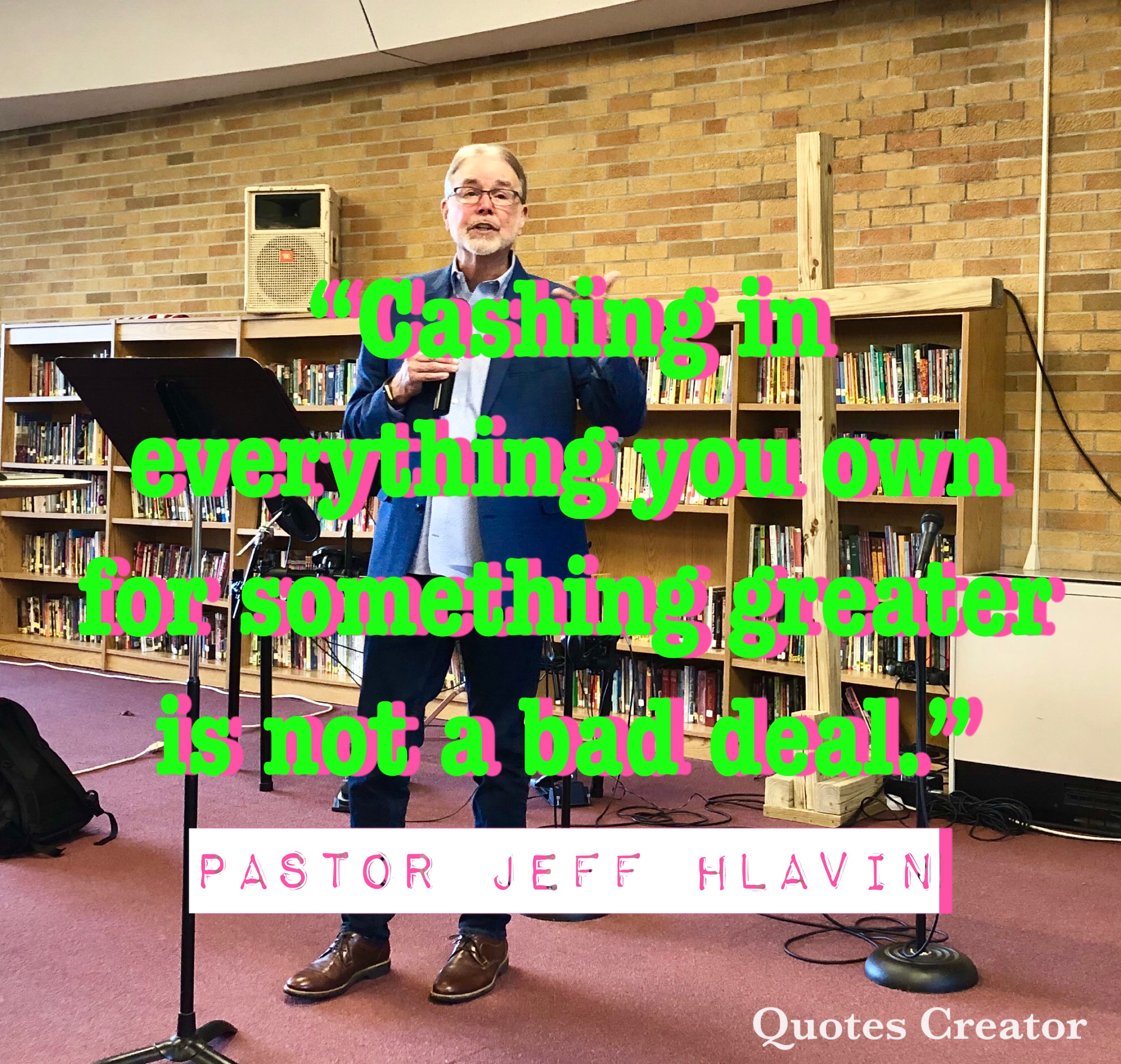
Hidden Treasure And One Valuable Pearl

I am always blessed to sit under the ministry of Jeff Hlavin! These are some of my notes from his message Calvary Assembly of God on Sunday, but you really should watch the whole message. 

The kingdom of heaven is like a treasure hidden in the field, which a man found and hid; and from joy over it he goes and sells all that he has, and buys that field.  Again, the kingdom of heaven is like a merchant seeking fine pearls, and upon finding one pearl of great value, he went and sold all that he had, and bought it. (Matthew 13:44-46)

There are at least two possible perspectives about the meaning and the application of these two parables:

First Perspective: Jesus is the One who finds and seeks. 

The field is the world, and Jesus paid the price for the whole field/world to be His. 

Second Perspective: We are the ones doing the discovering. 

Jesus provides Himself as the Treasure of treasures. So taking up our cross to follow Him is not a morbid thing. There is overwhelming joy because of the extravagant treasure that is ours when we do so! 

1. It’s about our response to discovering His Kingdom.

2. It’s about our appropriate response to His Kingdom.

3. It’s about the whole-hearted appropriate response which the Kingdom of God requires.

4. It’s about the value of His Kingdom.

5. It’s about the primacy of His Kingdom.

Three Observations:

Both individuals are alike in that…

  1. Both of them know there is more to life than what they have. Neither one of them considers what they’re doing as a sacrifice because of what they’re gaining! 
  2. Both of them recognize what is missing when they find it.
  3. Both of them recognize that what they have found is of far more inestimable value than everything else they have.

Thursdays With Spurgeon—Our Fight For Faith

This is a weekly series with things I’m reading and pondering from Charles Spurgeon. You can read the original seed thought here, or type “Thursdays With Spurgeon” in the search box to read more entries.

Our Fight For Faith

     Our faith at times has to fight for its very existence. The old Adam within us rages mightily, and the new spirit within us, like a young lion, disdains to be vanquished; and so these two strong ones contend, till our spirit is full of agony. …

     Christ alone was tempted in all points as we are, though without sin. No one man is tempted in all points exactly like another man, and each one has certain trials in which he must stand alone amid the rage of war, with not even a book to help him, or a biography to assist him—no man ever having gone that way before except that one Man whose trail reveals a nail-pierced foot. He alone knows all of the devious paths of sorrow. Yet even in such byways, the Lord is with us, helping us, sustaining us, and giving us grace to conquer at the close. … 

     So satan, loath to leave a soul, pursues it hotfoot. He will have it back if he can; and often, soon after conversion, there comes a time of dreadful conflict, when the soul seems as if it could not live. … 

     Once, when the tempter had grievously assailed me, I went to see my dear old grandfather. I told him about my terrible experience, and then I wound up by saying, “Grandfather, I am sure I cannot be a child of God, or else I should never have such evil thoughts as these.” 

     “Nonsense, Charles,” answered the good old man. “It is just because you are a Christian that you are thus tempted. These blasphemies are no children of yours; they are the devil’s brats, which he delights to lay at the door of a Christian. Don’t you own them as yours; give them neither house-room or heart-room.” 

From The Autobiography Of Charles Spurgeon

The apostle Peter says our adversary the devil continually prowls around looking for a follower of Jesus that he can devour. This shouldn’t be surprising to us since Jesus said that the devil’s agenda was to steal, kill, and destroy. (See 1 Peter 5:8-9; John 10:10.)

But the apostle Paul also tells us that we aren’t supposed to be unaware of the devil’s schemes. Instead, we are to capture every thought and make them obedient to Jesus (2 Corinthians 10:5). That means, as Spurgeon’s grandfather counseled him, we recognize those evil thoughts as the devil’s brats and don’t allow them to take up room in our house nor our heart. 

Stand firm—those who are in Christ are more than conquerors! 

Thursdays With Spurgeon—How satan Attacks

This is a weekly series with things I’m reading and pondering from Charles Spurgeon. You can read the original seed thought here, or type “Thursdays With Spurgeon” in the search box to read more entries.

How satan Attacks

     Our faith at times has to fight for its very existence. The old Adam within us rages mightily, and the new spirit within us, like a young lion, disdains to be vanquished; and so these two strong ones contend, till our spirit is full of agony. …

     Christ alone was tempted in all points as we are, though without sin. No one man is tempted in all points exactly like another man, and each one has certain trials in which he must stand alone amid the rage of war, with not even a book to help him, or a biography to assist him—no man ever having gone that way before except that one Man whose trail reveals a nail-pierced foot. He alone knows all of the devious paths of sorrow. Yet even in such byways, the Lord is with us, helping us, sustaining us, and giving us grace to conquer at the close. … 

     So satan, loath to leave a soul, pursues it hotfoot. He will have it back if he can; and often, soon after conversion, there comes a time of dreadful conflict, when the soul seems as if it could not live. … 

     Once, when the tempter had grievously assailed me, I went to see my dear old grandfather. I told him about my terrible experience, and then I wound up by saying, “Grandfather, I am sure I cannot be a child of God, or else I should never have such evil thoughts as these.”

     “Nonsense, Charles,” answered the good old man. “It is just because you are a Christian that you are thus tempted. These blasphemies are no children of yours; they are the devil’s brats, which he delights to lay at the door of a Christian. Don’t you own them as yours; give them neither house-room or heart-room.” 

From The Autobiography of Charles Spurgeon 

The spiritual attacks—especially on new Christians—can be intense. Even “veteran” Christians aren’t immune to such attacks. 

Although every Christian shares some commonality in the ways in which we are tempted, no one experiences an identical attack. The devil is a cunning schemer and he can tailor-make his attacks to each individual. Gratefully, there is One who knows every minute detail of our temptation. Jesus was tempted in every way that we are, and He overcame those temptations without sinning. Now our victorious Savior stands before God’s throne interceding on our behalf as we battle the tempter. 

Spurgeon’s grandfather was right—don’t own these satanic blasphemies as your own! Remind yourself that you are in a war. Then say with the apostle Paul, “Thanks be to God that Jesus Christ has rescued me from all these. There is now no condemnation for me because I am in Christ Jesus, and there is absolutely nothing that can separate me from that love!” (see Romans 7:25; 8:1, 31-39)

Thursdays With Spurgeon—Blessed Assurance

This is a weekly series with things I’m reading and pondering from Charles Spurgeon. You can read the original seed thought here, or type “Thursdays With Spurgeon” in the search box to read more entries.

Blessed Assurance

     The Holy Spirit, who enabled me to believe, gave me peace through believing. I felt as sure that I was forgiven as before I felt sure of condemnation. I had been certain of my condemnation because the Word of God declared it, and my conscience bore witness to it; but when the Lord Jesus justified me, the same witnesses made me equally certain. The Word of the Lord in the Scripture says, “He who believes in Him is not condemned” (John 3:18), and my conscience bore witness that I believed, and that God in pardoning me was just. Thus I had the witness of the Holy Spirit and also of my own conscience, and these two agreed in one. …  

     I find the apostle Paul speaking by the Holy Spirit and saying, “Having been justified by faith, we have peace with God” (Romans 5:1). If I know that my trust is fixed on Jesus only, and that I have faith in Him, were it not ten thousand times more absurd for me not to be at peace than for me to be filled with joy unspeakable? It is but taking God at His Word, when the soul knows as a necessary consequence of its faith that it is saved. …  

     Has Jesus saved me? I dare not speak with any hesitation here; I know He has. His word is true; therefore I am saved. My evidence that I am saved does not lie in the fact that I preach, or that I do this or that. All my hope lies in this, that Jesus Christ came to save sinners. I am a sinner, I trust Him, then He came to save me, and I am saved. I live habitually in the enjoyment of this blessed fact, and it is long since I have doubted the truth of it, for I have His own Word to sustain my faith.

From The Autobiography Of Charles Spurgeon

The joy that Spurgeon recounts in his conversion is the same joy that is available to all who call on Jesus in faith. As Spurgeon was prone to quoting passages of hymns in his sermons and books, these words of his remind me of a favorite hymn as well—

Blessed assurance, Jesus is mine;
Oh, what a foretaste of glory divine! 
Heir of salvation, purchase of God,
Born of His Spirit, washed in His blood. 
This is my story, this is my song,
Praising my Savior all the day long!

Thursdays With Spurgeon—Keep The Focus On The Savior

This is a weekly series with things I’m reading and pondering from Charles Spurgeon. You can read the original seed thought here, or type “Thursdays With Spurgeon” in the search box to read more entries.

Keep The Focus On The Savior

     I have heard men tell the story of their conversion, and of their spiritual life, in such a way that my heart has loathed them and their story, too, for they have told of their sins as if they did boast in the greatness of their crime, and they have mentioned the love of God, not with a tear of gratitude, not with the simple thanksgiving of the really humble heart, but as if they as much exalted themselves as they exalted God. Oh! When we tell the story of our own conversion, I would have it done with great sorrow, and with great joy and gratitude, remembering how little we deserve these things. … 

     My Master, I cannot understand how You stoop Your awful head to such a death as the death of the Cross, how You could take from Your brow the coronet of stars that from old eternity had shone resplendent there. But how You should permit the thorn-crown to gird Your temples astonishes me far more. That You should cast away the mantle of Your glory, the azure of Your everlasting empire, I cannot comprehend. But how You should have become veiled in the ignominious purple for a while and then be mocked by impious men who bowed to You as a pretended king; and how You should be stripped naked to Your shame, without a single covering, and die a felon’s death. This is still more incomprehensible. But the marvel is that You should have suffered all this for me! … 

     I, a lad, found the Lord of glory. I, a slave to sin, found the great Deliverer. I, the child of darkness, found the Light of Life. I, the uttermost of the lost, found my Savior and my God. I, widowed and desolate, found my Friend, my Beloved, my Husband. Oh, how I wondered that I should be pardoned! It was not the pardon that I wondered at so much; the wonder was that it should come to me. 

From The Autobiography Of Charles Spurgeon

How sad that many times the story of our salvation focuses more on how bad we were, and gives so little glory to how amazing our Savior’s rescue was. 

Just as the Apostle Paul called himself the chief of sinners, and stood in amazement that Christ’s love would reconcile him to God, so Spurgeon stood amazed that Jesus would stoop to die for “the uttermost of the lost.” 

It’s fine to tell people what used to be, but please make sure your story focuses more on how amazing it is that God’s love saved you from those sins. Amazing love! How can it be that You, my King, would die for me? 

Let’s keep the focus on the Savior! 

Don’t Stop At Salvation

The Holy Spirit is vital in everything concerning a Christian’s life. Dr. Donald Stamps emphatically said it this way: 

“It is essential that believers recognize the importance of the Holy Spirit in God’s redemptive purpose. Many Christians have no idea what difference it would make if there were no Holy Spirit in this world. Without the Holy Spirit there would be no creation, no universe, no human race (Genesis 1:2; Job 33:4). Without the Holy Spirit there would be no Bible (2 Peter 1:21), no New Testament (John 14:26; 15:26-27; 1 Corinthians 2:10-14), no power to proclaim the gospel (Acts 1:8). Without the Holy Spirit there would be no faith, no new birth, no holiness, no Christians at all in the world.” 

Sometimes I think we have in our mind that the “old” in Old Testament somehow means outdated or no longer applicable to our lives, and the “new” in New Testament should be our sole focus. But Jesus affirmed again and again that all of the Scriptures—what we now refer to as the Old Testament—all point to Him. 

The outpouring of the Holy Spirit on that Pentecost Sunday was not something new to the New Testament Christians. He was always a part of a believer’s life. Even 1000 years before Christ’s public ministry, David knew the importance of the Holy Spirit in both salvation, and in living a consistently holy lifestyle (Psalm 51:10-12, 143:10). 

The role of the Holy Spirit in Christ’s public ministry was foretold in the Old Testament Scriptures and then fulfilled in the New Testament era (see Isaiah 11:1-2; Luke 3:21-22; Isaiah 61:1-2; Luke 4:18-21). 

If Jesus needed the baptism in the Spirit to empower Him, direct Him, and give Him success, how much more do we need this?! That’s why Jesus imparted the Holy Spirit to His followers at their moment of salvation, but then admonished them to eagerly expect the baptism in the Holy Spirit as well (John 20:22; Luke 24:49; Acts 1:8). 

Quite simply Jesus is sayingDON’T STOP AT SALVATION

Jesus didn’t, the apostles didn’t, Paul didn’t, Apollos didn’t, the Ephesian Christians didn’t, I didn’t, and you shouldn’t either! 

Keep on going…

  1. Ask Jesus to forgive you of your sins
  2. Eagerly desire the baptism in the Spirit 
  3. Ask God to baptize you in His Spirit
  4. Expect that He will answer that prayer (Acts 2:38; Isaiah 44:3; John 7:37-39; Luke 11:13; Mark 11:24)

Join me again this Sunday as we continue to learn what it means for Christians today to be Pentecostal. 

If you missed any of the messages in this series, you can access the full list of messages by clicking here.

Growth Problems

…the number of disciples was increasing… (Acts 6:1).

Growth is a nice problem to have. But it is still a problem that needs to be addressed, or else the growth can implode an organization. 

In this instance, the early Christian church was growing rapidly and attempting to address the need for getting food to widows. Apparently, some of the widows were being overlooked in that food distribution. 

To start the ball rolling on solving this growth problem, the apostles gave some simple parameters: We will focus on preaching, the rest of you should select administrators to oversee the food ministry (vv. 2-4). The job description was pretty simple too—they must have a good reputation, be full of the Holy Spirit, be wise, and (this is implied) be willing to serve.

Notice the trust the church leaders placed in that congregation: 

  • seek out from among you
  • they chose
  • they set them [the candidates] before the apostles

The congregation was pleased by both the apostles’ plan and the level of trust that was conferred on them. It appears that seven men were the unanimous selection of both the congregation and the church leaders. 

After these men were installed in their new administrative roles, look at the results:

  • more preaching
  • more salvations
  • more inroads into the Jewish religious leadership sect
  • more people fed
  • more miracles performed
  • and more persecution from those threatened by the church’s rapid growth

It’s interesting to note that Luke uses the word added to talk about the church’s growth in chapters 1-5, but after this growth problem is successfully resolved, Luke stops using added and only uses multiplication terminology. 

When handled the right way, growth problems—or any problems, for that matter—lead to more growth. 

A mark of a godly leader is one who handles growth problems correctly. 

This is part 36 in my series on godly leadership. You can check out all of my posts in this series by clicking here.

Undeniableness

…we cannot deny it (Acts 4:16)

The healing of a 40-year-old man who has been lame from birth is truly undeniable! But the Sadducees (the truly religious elite) took issue with the fact that Peter and John were then telling people about God’s resurrection power (which they did not believe).

It was undeniable that…

  • … the lame man was healed
  • … Peter spoke boldly with the help of the Holy Spirit
  • … Peter and John’s eloquence in spiritual matters was not bookish learning but divine illumination
  • … Peter and John had been with Jesus
  • … Peter and John could not be silenced by threats
  • … the admiration of the crowd following the healing and Peter’s sermon
  • … God was glorified

So what did the church do? They prayed for more “undeniableness” to be demonstrated by God through their lives!

They knew none of these threats took God by surprise, but they all happened as God had “determined before to be done” (v. 28). So they said, “We are Your servants in this—do more undeniable things through us. Enable us to speak Your Word boldly, and empower us to do signs and wonders in the name of Jesus” (vv. 29, 30).

And God answered that prayer!

What about us? Are we willing to pray that prayer today? Will we allow God to do undeniable things through us? Persecution may follow, but so will God’s glory, and saved souls, and healed people!

For more evidence of the unmistakable evidence that follows Spirit-baptized Christians, check out this post.

Poetry Saturday—Christ Jesus Lay In Death’s Strong Bands

Christ Jesus lay in death’s strong bands,
For our offenses given;
But now at God’s right hand He stands
And brings us life from heaven;
Therefore let us joyful be
And sing to God right thankfully
Loud songs of hallelujah.
Hallelujah! 

It was a strange and dreadful strife
when life and death contended;
the victory remained with life,
the reign of death was ended;
Holy Scripture plainly saith
that death is swallowed up by death,
his sting is lost forever. 
Hallelujah!

Here the true Paschal Lamb we see,
whom God so freely gave us;
He died on the accursed tree—
so strong His love!—to save us.
See, His blood doth mark our door;
faith points to it, death passes o’er,
and satan cannot harm us. 
Hallelujah! —Martin Luther