7 Tips For A Better Night’s Sleep

Psalm 4.8It’s no secret that being tired can lead to a lot of not-so-nice consequences. Everything from automobile crashes, to poor work performance, to foot-in-mouth statements, to giving in to temptations, to health issues are all traced back to not getting enough peaceful sleep.

But did you know that sweet sleep is something God wants to give you?

Psalm 127 says, “God grants sleep to those He loves.” Guess what? God loves you, and wants you to have a peaceful night’s sleep!

Here are some benefits to getting solid sack time:

  1. Muscles are repaired—the body “turns off” muscles during sleep so they can repair themselves.
  2. The hormone leptin, that regulates your appetite, is adjusted.
  3. Your blood pressure is lowered.
  4. Your heart rate is lowered.
  5. The energy-producing cells we all need are restocked.
  6. Your immune system is re-energized.
  7. Memories are consolidated from short-term memory banks to long-term memories.
  8. The hormones that allow you to concentrate are replenished.
  9. Your “database” of decision-making options is re-calibrated.
  10. Bottom line—you get healthier physically, mentally, emotionally, relationally, and spiritually.

All of this God wants to give to those He loves. “God loves me, so I’m going to sleep peacefully tonight!”

The problem is we often sabotage God’s blessing of sweet sleep by our own poor decisions during the day. So here are seven things you can do to cooperate with God’s blessing of sleep:

  1. Reduce stress. Stress causes your body to release cortisol, which prepares your body for fight-or-flight. This means when you’re trying to quiet down for the night, your body is still screaming, “Go, go go!” Stress is mainly triggered by worrying over things outside of our control, so check out what Jesus said to us about not worrying—Matthew 6:25-34.
  2. Reduce late-day caffeine. Caffeine has a half-life of six hours, so if you are pouring it into your body late in the date, you might fall into bed exhausted but the caffeine is keeping your brain buzzing. As a result, you don’t have the normal deep sleep patterns.
  3. Eliminate emotional caffeine. Arguments with other people release cortisol and adrenaline in your bloodstream. If these disagreements are happening later in the day, your body is fighting against God’s plan for your tranquil sleep. So take care of any disagreements quickly (Ephesians 4:26).
  4. Exercise. Getting some movement into your daily routine flushes cortisol and adrenaline from your bloodstream.
  5. Go to bed and get up at the same time. There’s a reason God made the sun to rise and set at predictable times. Your body also functions best on a predictable schedule.
  6. Reduce “blue lights” close to bed time. The blue light waves of dawn tell our bodies to stop releasing melatonin, the sleepy hormone. The red light waves of dusk tell our bodies to increase melatonin so we can go to sleep. But when we’re staring into the blue light of our phones and tablets, our body is being sent a conflicting signal.
  7. Pray. Two great passages you can pray before bedtime are Psalm 4:8 and Proverbs 3:24. Claim those promises of sweet sleep!

God loves you. He wants to give you the blessing of peaceful sleep. If you’re going to sleep peacefully tonight, make sure you are not sabotaging what God wants to give you.

If you’ve missed any of the messages in this series, you can access the complete list by clicking here

Jim Daly On Forgiveness

Jim Daly“Have you noticed? It can be a challenge to say, ‘I’m sorry.’ Oh, it’s not hard to speak the words, but it can be tough to say them with sincerity. Why? Probably because we understand that to apologize is to accept responsibility for ill-spoken words or misbehavior. It requires humility on our part, which can often be confused with giving someone else the upper hand over us. That’s why apologies tend to be viewed as a weakness.

“It’s also why people offer apologies that have been stripped of any real meaning. We minimize the severity of our actions; we blame our behavior on others; or maybe we say all the right words, but dilute them with sarcasm or humor. Whatever the method, we recognize a false act of contrition when we see it because the result is always the same: the appearance of an apology without the substance of one. And rather than healing, shallow platitudes often deepen a loved one’s wounds. Like a doctor’s empty syringe, an empty apology pierces the soul but offers nothing that can bring healing.

“That’s why, far from being a weakness, a heart-felt apology requires strength because it demands deep sincerity on behalf of the person offering it. That inner strength and humility often requires God’s grace to express. The Lord’s role is crucial because mending a relationship-gone-wrong has little to do with the specific words we use to express our contrition. The healing comes from the authenticity we pour into our words and actions.” —Jim Daly

Notes From The Global Leadership Summit

I had an amazing time last week at the Willow Creek Global Leadership Summit. Every year I came away with some many thoughts, and a brand new passion for the various leadership roles in which I get to serve.

Below are just a few of my notes that I jotted down during an intense two days.

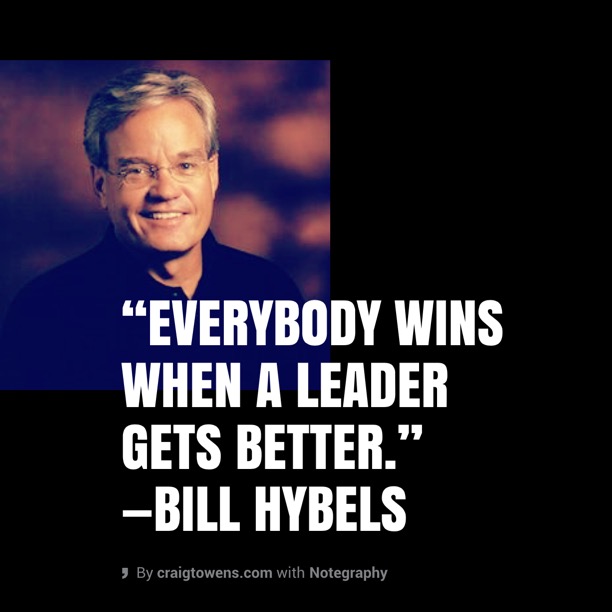
Hybels - everybody winsBill Hybels—The Lens Of Leadership

“Everybody wins when a leader gets better.”

“Armed with enough humility, leaders can learn from anyone.”

Hybels discussed four leadership lenses:

1.   Passionate leader (depicted by vibrant bright red frames)

  • They understand unbridled passion in leadership.
  • “Passion is like protein for the team.”
  • A motivated worked will outperform an unmotivated worker by 40%.
  • People are more motivated by working for a passion-filled leader than they are by compensation or perks.
  • Passion comes from a mountain-top dream, or a valley-deep frustration of current settings.

2.   People leader (cool frames, but cracked lenses)

  • An organization will only be as healthy as the top leader wants it to be.
  • This world needs more pastors of businesses, factories, medical offices, military units, etc.

3.   Performance leader (self-adjusting glasses)

  • Leaders ask: what progress should be made? how do we measure this? what doesn’t need to be measured?
  • Every worker wants to know how they are doing. For the leader, it’s cruel to hire someone and never let them know how they’re doing. Every staff member should get an update at least every six months.

4.   Legacy leader (sunglasses with a rearview mirror [cyclist])

  • Every once in awhile we need to look behind to see what legacy we’re leaving behind.
  • Leaders should reflect on this annually.
  • If my leadership assignment were to end today, what legacy would I leave?

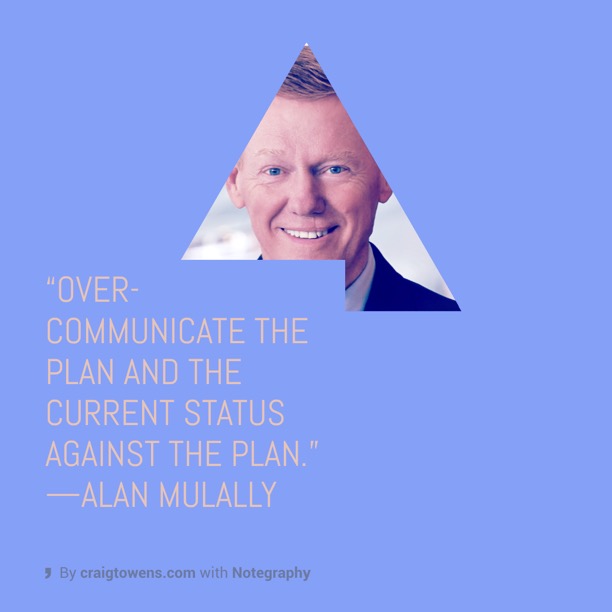
Mulally - overcommunicateAlan Mulally—CEO Boeing and Ford Motor Company

An average commercial airline has 4 million parts!

  • People first
  • Include everyone
  • Create a compelling vision
  • Present a workable strategy
  • Set clear performance goals
  • Relentless implementation
  • Share lots of data
  • “Over-communicate the plan and the current status against the plan.”
  • Instill a positive can-do attitude
  • Keep your emotional resilience
  • Have fun


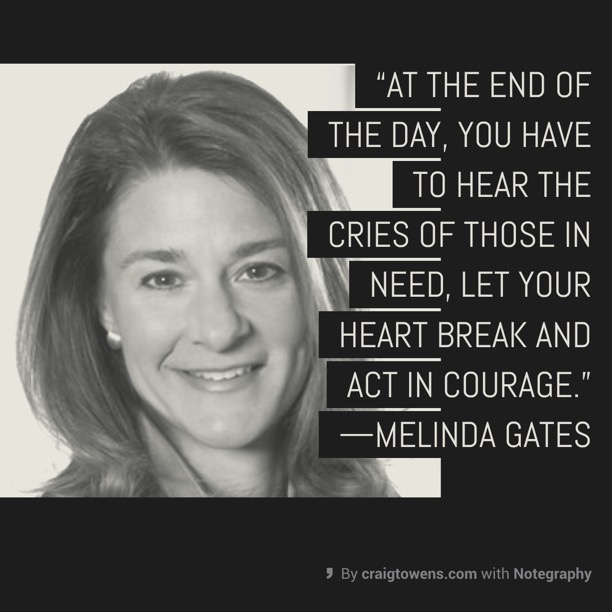
Melinda Gates - hear the criesMelinda Gates—Gates Foundation

Melinda says of herself, “I am an impatient optimist. We are changing the world, but we need to change it faster.”


“At the end of the day, you have to hear the cries of those in need, let your heart break and act in courage.”

Jossy Chacko—Empart

“All of us have been entrusted with something. What are we doing to leverage it?”

In thinking about the parable of the talents … “To Jesus, faithfulness is not just sitting with what you have been given, but multiplying what you have been given. God’s mission is not maintaining.”

“Playing it safe is not enough for a follower of Jesus Christ.”

Three principles for expanding our leadership reach:

Jossy Chacko - faithfulness1. Enlarge your vision

  • “When people hear my vision, they should know the size of my God.”
  • “An enlarged vision should keep us driven.”
  • “Do not be confused about what people say about your vision; trust what God has said to you.”

2. Empower your people

  • “Leadership is about taking wise chances and giving people opportunities.”
  • “Your leadership reach will be determined by your empowerment choices.”
  • Three things to keep in mind: (1) Focus on building their character before empowering them; (2) Empowerment has to be through relationship; and (3) Make sure we have agreed on the right outcomes, and have the right way to measure them.

3. Embrace risk

  • Faith = risk. Without faith it is impossible to please God = without taking risks it is impossible to please God.
  • Paradigms to be changed: (1) See risk as your friend to love, not as your enemy to be feared; (2) See comfort and safety as your enemies; and (3) Increase your pain threshold.
  • “Your leadership capacity is in direct relationship to your pain threshold.”
  • “Don’t allow the fear of losing what we have to lose what God has in store for you.”
  • “By me not taking risks, who is missing out?”
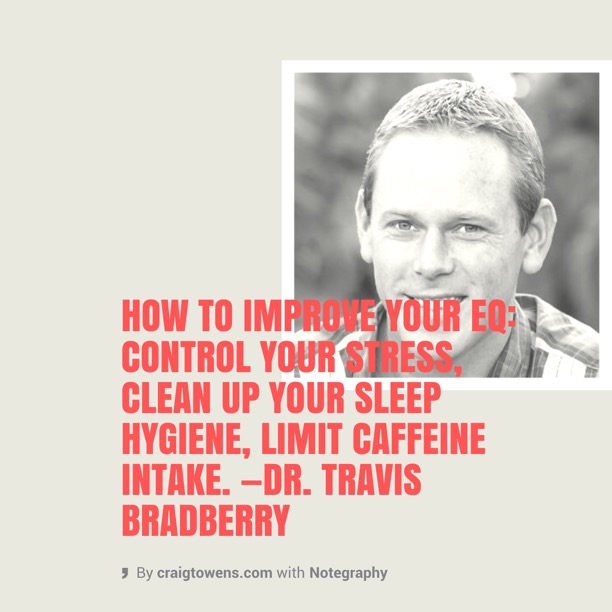
Bradberry - EQDr. Travis Bradberry—TalentSmart

All inputs into the brain travel through the limbic system first (emotional center) before the inputs travel to the frontal cortex. The EI (emotional intelligence) center is in the front of the brain, just above the left eye.

Only 36% of people are able to accurately identify their emotions as they happen.

EQ (the Emotional Quotient that measures emotional intelligence) is not IQ.

EQ can be improved all throughout life.

Four components of emotional intelligence:

 1. Self-awareness: knowing my emotions, and knowing my tendencies. I need to lean into my discomfort if I want to improve.

   2. Self-management: what I do with this increased self-awareness. This is not “stuffing” my feelings. The biggest mistake is only trying to manage negative emotions; positive emotions need to be managed too.

   3. Social awareness: focusing more on others than on myself.

   4. Relationship management: using the first three skills in concert. Seeing how my behavior is affecting the other person, and then adjusting accordingly.


How to increase my EQ:

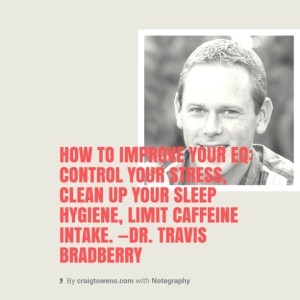
  1. Control stress—stress under control is healthy; chronic stress is unhealthy. Gratitude reduces the stress hormone cortisol.
  2. Clean up my sleep hygiene—sleep cleans up toxic hormones in the brain. To get better sleep: (1) Don’t take any kind of sleeping pill; and (2) Reduce “blue lights” in the evening.
  3. Reduce my caffeine input—especially after noon.
Ideal team playerPatrick Lencioni—Author

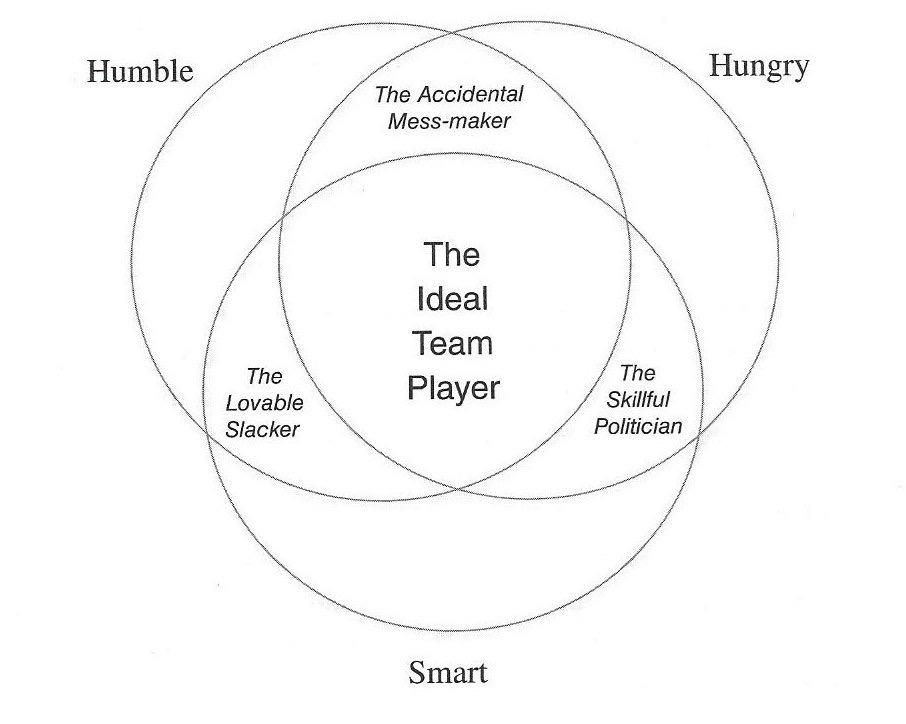
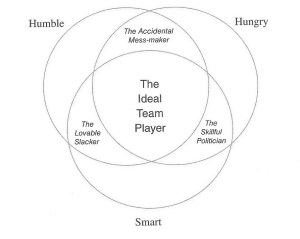
Three qualities of an ideal team player:

1.   Humble

  • Lacking self-confidence is not humility.
  • “Denying skills and downplaying abilities is not humility.”

2.   Hungry

  • Strong work ethic
  • Driving hard

3.   Smart

  • Not intellectual smarts, but people smarts = EQ

“To develop people, we have to have the courage to humbly and constantly talk to people about their ‘stuff.’”

McChesney - execution disciplinesChris McChesney—Franklin Covey

Rahm Charan asked:

  • Q: Do leaders struggle more with strategy or execution? A: Execution.
  • Q: Are leaders more educated in strategy or execution? A. Strategy.

“The hardest thing a leader will ever do is drive a strategy that changes someone’s behavior.”

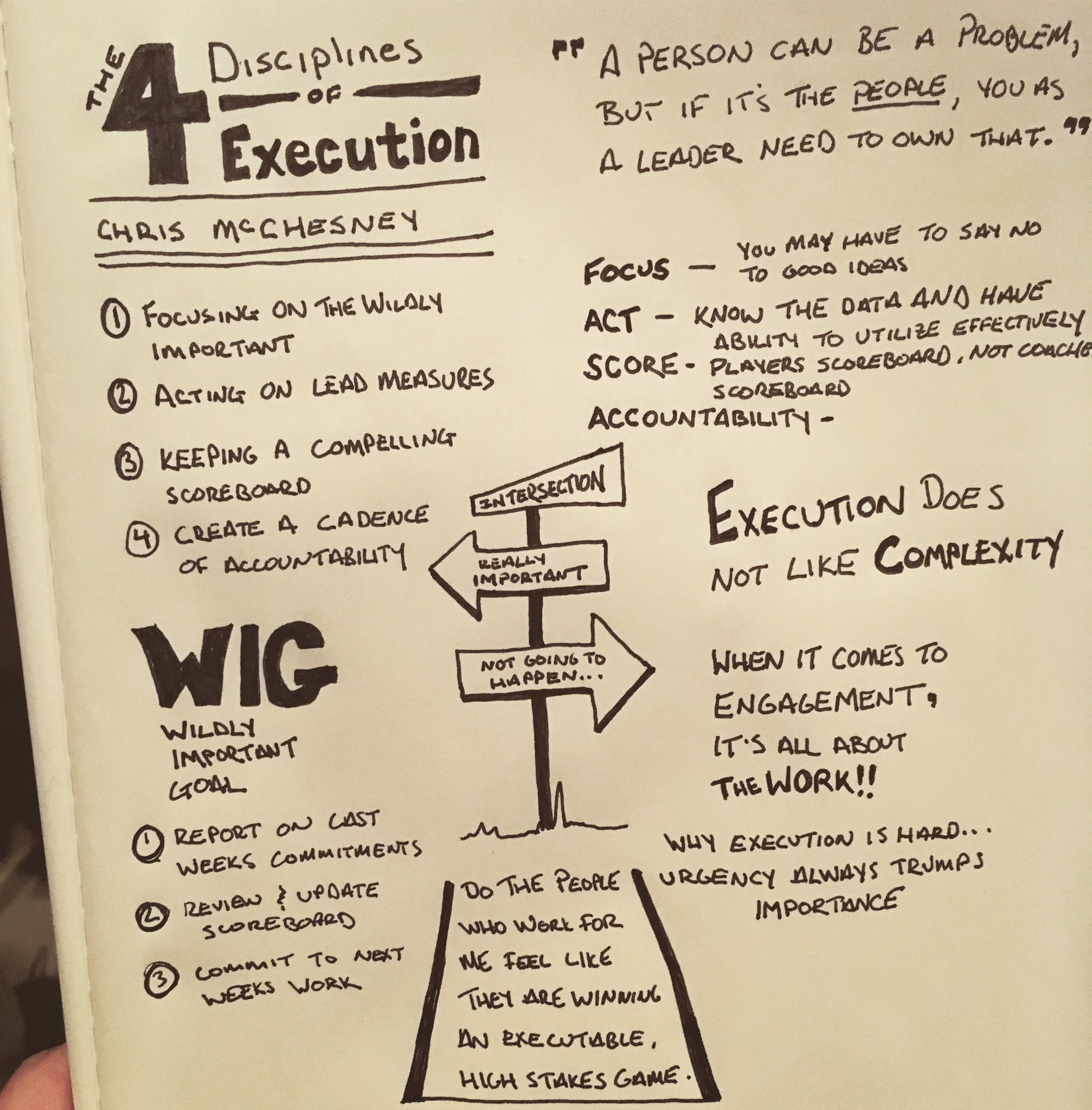
There are four disciplines for making changes in human behavior:

1.  Focus

  • “Focus on the wildly important.”
  • If a team focuses on 2-3 goals, they are likely to get them done. But if there are 4-10 goals, momentum is killed. At 11+ goals, the team is going backward.
  • We narrow the focus by coming up with a WIG: wildly important goal (this lives at the intersection of ‘really important’ and ‘not going to happen’).

2.  Leverage

  • “What are the fewest number of battles necessary to win the war?”
  • “When you want to go big, don’t think big, think narrow.”
  • One WIG per team at the same time. Everything else is in sustainment mode.
  • Make goals like this—“From x to y by when.”

3.  Engagement

  • “The biggest driver of engagement is when people feel like they’re winning.”
  • “Do the people who work for me feel like they’re playing a winnable game?”

4.  Accountability

  • Everyone needs to answer: “What are the things I do that have the biggest impact on the WIG?”
  • After sharing the scoreboard, allow people to determine what they need to do next. The people need to determine their own next moves, not the leader. The leader pulls this out of people.

Erin Meyer - contextErin Meyer—INSEAD

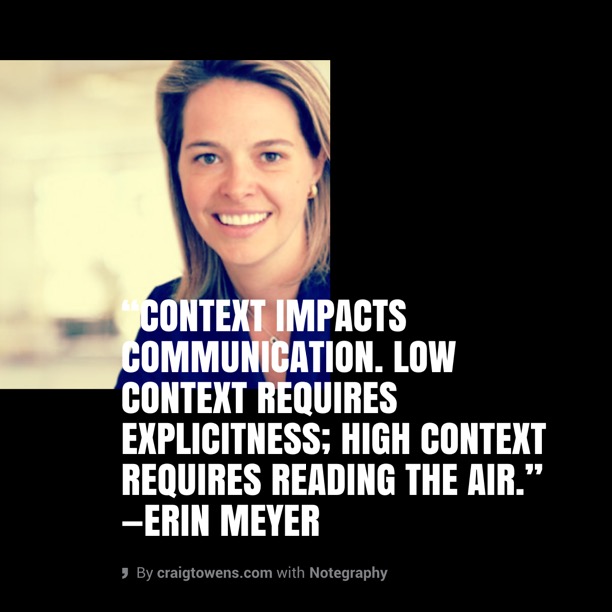
On The Culture Map communication is divided into Low vs. High Context:

  • Low = feel we don’t have the same context or relationship. We feel we need to explain things very simply and explicitly.
  • High = we assume we have a larger body of shared reference points. We feel communication is more implicit or nuanced.

Anglo-Saxon countries are typically low context.

Latin American are mid-low.

Asian countries are usually high context.

In low context we tend to nail things down in writing, where in high context we leave things more open to later interpretation.

“Context impacts communication. … We need to read both the messages ‘in the air’ as well as the explicitly stately messages.”

“In a high context culture, repeat things less, ask more questions, learn to ‘read the air.’”
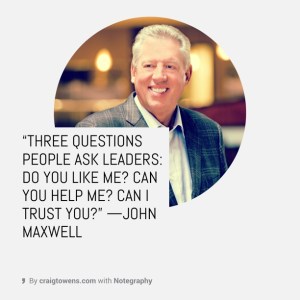
 

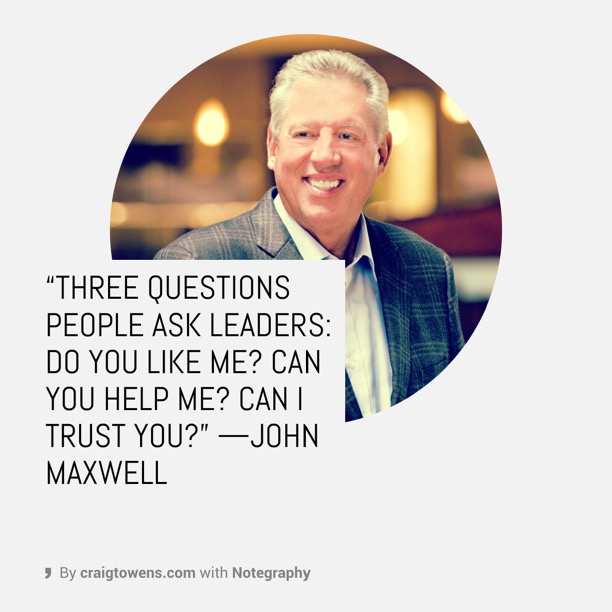
Maxwell - 3 questionsJohn Maxwell—Author 

“Good leaders lift.”

“You have to find the people before you lead the people.”

“The one thing leaders have to get right—they must intentionally add value to people every day.”


Five things that intentionally adds value to people:

  1. Value people—“God values people I don’t know; He even value people I don’t like.” “Are we going to spend our lives connecting with people, or correcting them?”
  2. Think of ways to add value to people—“Intentional living is thinking upfront on how to help people.”
  3. Look for ways to add value to people.
  4. Do things that add value to people.
  5. Encourage others to add value to people.

If you attended the GLS, please share in the comments below something amazing / challenging / paradigm-busting that you learned. Let’s all keep on learning!

20 More Useful Maxims

Useful MaximsI have already shared two sets of maxims from Brian Ridolfi’s great book Useful Maxims (you can read them here and here). These are some additional maxims targeting particular topics…

Maxims On Sex & Relationships

  1. When two lovers give, they each receive.
  2. Loveless sex is listless sex, and commoditized sex is lobotomized sex.
  3. Women are the gatekeepers of virtue; lost women make lost civilizations.

Maxims On Science & Philosophy

  1. The difference between science and philosophy: science attempts to answer the how questions, and philosophy the why questions.
  2. The difference between sound and unsound philosophy: good philosophy justifies itself, bad philosophy justifies the philosopher.
  3. When science becomes a god, science becomes a fraud.
  4. Atheistic theories are not necessarily scientific, and theistic theories are not necessarily unscientific.
  5. In science, the facts make the case, but in evolution, the case makes the facts.
  6. What came first, the cell or the DNA?
  7. Creationism is the enemy of scientists, not science.
  8. The theory of evolution evolved from moral devolution.

Maxims On satan & Evil

  1. A godless world is a joyless world.
  2. All is rotten after God is forgotten, and all goes sour that is under satanic power.
  3. satan is no threat to God, he is a threat to man. He is not God’s adversary, he is man’s adversary.
  4. The devil cannot make you do anything; he just makes you believe you can do anything.
  5. The way to spot satan is to know Christ.
  6. satan is not to be feared, he is to be avoided.
  7. Evil which appears godly is the most insidious form of evil.
  8. The difference between evil spirits and evil men: evil spirits know they are dead, and evil men are dead because they do not know.
  9. Allowing evil to continue is the most evil act of all.

To read some of the other quotes from Useful Maxims that I am sharing, be sure to follow me on Twitter and on Tumblr, and check out my review of Useful Maxims here.

6 Quotes On Peacemakers From “The Blessing Of Humility”

The Blessing Of HumilityAs I stated in my review of Jerry Bridges’ book The Blessing Of Humility, reading through these thoughts slowly—Beatitude by Beatitude—would bring about the most life-changing impact. In that spirit, I will be sharing some noteworthy quotes one Beatitude at a time. Here are some quotes on blessed are the peacemakers (Matthew 5:9)…

“Jesus was speaking of making peace when we ourselves are involved in conflict with others.”

“It is often the sinful use of our tongues that cause conflict. But the tongue is only an instrument. The real problem is the heart. … To become peacemakers, then, we must begin with ourselves. We must ask ourselves, ‘Why do I make cutting remarks to another person? Why do I make demeaning remarks about them?’ We must also ask us ourselves, ‘What causes my resentment toward that person?’ or ‘Why do I continue to nurse hurts by that person instead of forgiving them? What is it that causes me to be envious or jealous of that person?’ In order to even ask those questions, we have to admit that we have those attitudes. But because we know they are sinful, we tend to live in denial that we have them.”

“Peacemaking where there is conflict with someone else is not an option for us. It is God’s commandment. We are to strive for peace with everyone (Hebrews 12:14). The word strive is a translation of the Greek word dioko. It is a very intense word and is most often used for the word pursue. (See also Philippians 3:12, 14; 2 Timothy 2:22; 1 Peter 3:11.)”

“Jesus tells us, ‘Love your enemies and pray for those who persecute you’ (Matthew 5:44). Are we willing to pray for those who have hurt us, that God will bless them? To be a peacemaker, then, means we absorb the hurtful words or actions of others without becoming resentful, retaliating, or even cutting off a relationship with the person.”

“To be a peacemaker means taking the initiative to restore such broken or damaged relationships, even when the major cause of the rupture lies with the other person.”

“To be a peacemaker means we must seek to be delivered from self-interest and not look at everything in terms of how it affects us. Instead we must be concerned about the glory of God and how we can best promote that glory in situations of conflict.”

 I have previously shared quotes on:

Quotes on the final Beatitude will be posted soon. Stay tuned…

5 Quotes To Protect Your Marriage From Pornography

Focus On The FamilyI recently finished reading a Focus On The Family reading plan on YouVersion called Infidelity: Protecting Your Marriage From Pornography. This is one part of a multi-part reading plan on healthy sexuality. I encourage you to check out all of these plans.

Here are some of the quotes I appreciated from this reading plan.

“Porn is powerful primarily because it offers a counterfeit form of intimacy and attachment—a replacement for the one-flesh bond between man and woman that God designed to function as the glue that holds the marriage relationship together (Genesis 2:24).”

“Mental health professionals report that the road to recovery is likely to be much longer and far more complicated for an individual engaged in an ongoing interpersonal cyber-affair than it is for a porn addict. That’s because ‘relationship’ at any level implies a degree of emotional entanglement. When the heart gets drawn into that web, the potential for pathology is inevitably raised.”

“Many porn addicts are sexually anorexic when it comes to normal marital relations. That’s because, through habit and practice, their sexual impulses have been alienated from their natural context—i.e., a healthy, committed personal relationship—and re-oriented around impersonal objects or illicit lusts or fetishes.”

“[Pornography] addiction is based on neurochemical changes that occur in the brain as a result of prolonged exposure to stimulating sexual imagery. Because of its neuro-chemical basis, it’s tenacious, progressive and destructive in nature.”

“Don’t assume that normal marital sexual relations will take the place of porn in [an addict’s] life. No living, breathing, thinking woman can possibly fill that role without doing untold damage to herself as a person. That’s because pornography addiction, in the final analysis, is not about sex. It’s a symptom of an intimacy disorder—a comprehensive psychological illness that compels an individual to avoid deep, meaningful interaction with another flesh-and-blood human being and to replace it with impersonal sensual imagery. Unless this disorder is addressed and rectified, your relationship cannot move forward on a healthy footing. Marriage will not fix the problem. It will only complicate matters and increase your pain.”

For more help, visit pureintimacy.org or Focus on the Family’s Help Center.You can also call the ministry’s Counseling Department for a free consultation at 855-771-HELP (4357).

5 Quotes On Love’s Endurance From “The Seven Laws Of Love”

The Seven Laws Of Love

In The Seven Laws Of Love, Dave Willis gives us some highly practical, biblically-based counsel for investing in all of our relationships. Normally when I share quotes from books, I share all of them at once, but for this book I felt like it would be good to share these quotes a bit more slowly, to give you time to read them and apply them.

The seven laws Dave identifies are:

  1. Love requires commitment (read the quotes here)
  2. Love selflessly sacrifices (read the quotes here)
  3. Love speaks truth (read the quotes here)
  4. Love conquers fear (read the quotes here)
  5. Love offers grace (read the quotes here)
  6. Love brings healing (read the quotes here)
  7. Love lives forever

From law #7, here are some quotes on how love lives forever—

“Make a deliberate decision right now to stop wasting time and start putting first things first. Give the very best of yourself to your loved ones, not the leftovers after you’ve given your best to everyone and everything else.”

“Don’t take yourselves too seriously, but don’t take your commitments too lightly. Live life with conviction and purpose, but make plenty of room for fun. Laughter should be the soundtrack of your relationships.”

“Fight for each other, but never fight against each other. In every disagreement, remember that your relationship is much more important than whatever you’re arguing about.”

“Love isn’t a story with a happy ending. Love is a story with no ending!”

“Don’t treat others the way they treat you; treat others the way God treats you.”

Check out my review of The Seven Laws Of Love by clicking here.

7 Quotes On Healing From “The Seven Laws Of Love”

The Seven Laws Of Love

In The Seven Laws Of Love, Dave Willis gives us some highly practical, biblically-based counsel for investing in all of our relationships. Normally when I share quotes from books, I share all of them at once, but for this book I felt like it would be good to share these quotes a bit more slowly, to give you time to read them and apply them.

The seven laws Dave identifies are:

  1. Love requires commitment (read the quotes here)
  2. Love selflessly sacrifices (read the quotes here)
  3. Love speaks truth (read the quotes here)
  4. Love conquers fear (read the quotes here)
  5. Love offers grace (read the quotes here)
  6. Love brings healing
  7. Love lives forever

From law #6, here are some quotes on healing—

“Love requires vulnerability, and when we feel like we’ve been in an exposed position and then experienced rejection, our defense mechanisms can actually work against us and sabotage our current relationships. We tend to militantly safeguard certain parts of ourselves in order to prevent the same kind of humiliation or rejection we have felt in the past.”

“The more you love someone, the more ability that person will have to hurt you; but until you give a person the ability to hurt you (vulnerability), you’ll never be able to truly experience love. This reality keeps some people from wholeheartedly committing to a relationship, because they’re trying to protect their hearts from being wounded again. But if were not careful, our wounds from the past can create new wounds in the present. It is a catch-22 that can keep us in perpetual dysfunction in our relationships until we become intentional about healing from the past and moving forward in a healthy way.”

“Sometimes we can subconsciously do things to make ourselves seem ugly or intimidating to drive people away, because were afraid if we let others close to us, we’ll only be hurt again. This kind of behavior might give us the illusion of power and safety that comes from isolation, but it will also hold us captive in a prison of solitude where we never experience true love. Whatever you may have done or whatever may have been done to wound you in the past, healing is possible. God wants you to live a life of love. He wants you to experience rich, meaningful relationships. He wants to bring you to a place of healing so you can experience life and love in all of its fullness.”

“Healing from a broken heart isn’t the result of mere time and effort. It comes when we put our trust in the Healer of our hearts.”

“Don’t let your love be an unspoken assumption. Make sure your loved ones know exactly how much you love them because your words and actions make it clear.”

“An encounter with Jesus always has the power to bring healing. When love is present, healing is present. It won’t always look miraculous, but it will always make a difference.”

“Sometimes God uses prayer to change the situation, and sometimes He uses prayer to change our own perspective about the situation, but either way, He’s always doing something positive through prayer.”

Check out my review of The Seven Laws Of Love by clicking here.

Watch for the last set quotes from the other laws of love explained in this book later this week.

5 Quotes On Grace From “The Seven Laws Of Love”

The Seven Laws Of LoveIn The Seven Laws Of Love, Dave Willis gives us some highly practical, biblically-based counsel for investing in all of our relationships. Normally when I share quotes from books, I share all of them at once, but I felt like it would be good to share these quotes a bit more slowly, to give you time to read them and apply them.

The seven laws Dave identifies are:

  1. Love requires commitment (read the quotes here)
  2. Love selflessly sacrifices (read the quotes here)
  3. Love speaks truth (read the quotes here)
  4. Love conquers fear (read the quotes here)
  5. Love offers grace
  6. Love brings healing
  7. Love lives forever

From law #5, here are some quotes on grace—

“If we deserved forgiveness, it wouldn’t be called grace. If we can earn it, it wouldn’t be real love.”

“Jesus was the perfect embodiment of both love and truth. He never told a lie, but at the same time He was never cruel or judgmental with the truth. Every word He spoke was wrapped in love, so even when the truth hurt, He never broke anyone’s trust. Jesus not only modeled how to speak the truth in love, but He also showed us how to offer grace when trust is broken. … Jesus loved Peter enough to give him the opportunity to be forgiven and rebuild trust. That opportunity for grace wasn’t an exclusive offer for Peter; it’s an opportunity God freely extends to all of us who have broken trust (which is everybody). It’s also a command. We can’t receive God’s grace without being willing to extend grace to others.”

“Some people get stuck in a cycle of grudges and mistrust because they wrongly assume that forgiveness and trust are the same thing. It’s vital that we understand their distinctions. Forgiveness can’t be earned; it can only be given freely. That’s why it’s called grace. Trust, however, can’t be given freely; it can only be earned. When someone breaks your trust, you should give your forgiveness instantly, but give your trust slowly as it is earned through consistency of actions by whoever broke your trust. During this period of rebuilding, fight the urge to punish or retaliate. Those actions won’t do anything to promote healing, and healing always needs to be our ultimate objective. Love, after all, is a healing force. You don’t have to trust someone in order to forgive, but you do have to forgive someone in order to make trust possible again.”

“When you’ve broken trust, you must be willing to take immediate action to rebuild it. When someone has broken your trust, you must be willing to provide that person the opportunity to rebuild. Giving someone the chance to reestablish trust is one of the most loving acts you can do for someone.”

“Our responses to present difficulties will often determine our level of future opportunities.”

Check out my review of The Seven Laws Of Love by clicking here.

Watch for the last few quotes from the other laws of love over the next couple of days.

6 Quotes On Speaking Truth From “The Seven Laws Of Love”

The Seven Laws Of LoveIn The Seven Laws Of Love, Dave Willis gives us some highly practical, biblically-based counsel for investing in all of our relationships. Normally when I share quotes from books, I share all of them at once, but I felt like it would be good to share these quotes a bit more slowly, to give you time to read them and apply them.

The seven laws Dave identifies are:

  1. Love requires commitment (read the quotes here)
  2. Love selflessly sacrifices (read the quotes here)
  3. Love speaks truth
  4. Love conquers fear
  5. Love offers grace
  6. Love brings healing
  7. Love lives forever

From law #3, here are some quotes on truth speaking—

“The truth isn’t always comfortable, but it’s always necessary.”

“Honesty always paves the way to intimacy.”

“Selective honesty is the same as dishonesty.”

“The truth might be expensive at times, but it’s always worth it.”

“We all tend to craft a self-focused view of the world where we emerge as either a hero or a victim in every scene. We’re never the villains in the story. The truth is, though, that we’ve all been the bad guy more often then we’d like to admit. A life of love requires that we look in the mirror and give an honest and humble self-assessment.”

“What kind of legacy do you want for your own life? What stories do you want people telling about you a generation after your death? The decisions you are making right now are shaping future generations. Your legacy will be measured by your relationships, and your relationships will only be as strong as the trust your loved ones have in you.”

Check out my review of The Seven Laws Of Love by clicking here.

Watch for more quotes from the other laws of love explained in this book throughout the next few days.