Flatten The Rollercoaster

Listen to the podcast of this post by clicking on the player below, and you can also subscribe on AppleSpotify, or Audible. 

I’m not a fan of rollercoasters, but I know a lot of people who really like them. Some even travel all over the world to experience unique rollercoasters. The anticipation as the cars climb slowly up the big hill, knowing that there’s no stopping this thing now! Then the rush of emotions, a deep breath and a laugh at the end (usually laughing at our friends’ responses while on the ride), and then we just walk away. The moment of anticipation leading up to the big drop was usually longer and more intense than the ride itself. 

Not only do people travel all over to find rollercoasters, some people seem to have their emotions perpetually on rollercoasters. 

One of the telltale signs of someone with an immature mental health is the way every situation gets blown out of proportion before anything even happens. Then as an event unfolds, their exaggerations continue: the molehills are mountains, every valley is the valley of the shadow of death, the night is a nightmare, the “crisis” is lasting forever, no one has ever gone through what they’re going through, and the list goes on. 

To break out of this habit requires us developing emotional capacity. John Maxwell describes it like this: “Emotional capacity is the ability to handle adversity, failure, criticism, change, and pressure in a positive way.” Just as athletes have to develop lung capacity or muscle capacity, developing emotional capacity takes time, patience, and diligence. 

Increased emotional capacity is not escaping from our problems or even learning coping skill. Escapism never allows us to confront the things that are keeping our emotional capacity immature. On the other hand, maturing emotional capacity is learning to pause to get perspective so that we can avoid turning every mountain into a molehill, and every challenge into a do-or-die battle.  

Mentally healthy people don’t try to escape, but they learn how to de-escalate by getting a new perspective. Or to use the language of our first mental health strategy, they get off their old, well-worn paths. 

Let me illustrate this by looking at two emotions which seem to be the most rollercoaster-ish. 

(1) The first rollercoaster emotion is anger 

Out-of-proportion anger can either burn everyone around us when we explode, or it can eat away inside us if we hold it in. Neither of these are healthy emotional responses. Jesus got angry at the religious crowd that was keeping people away from God’s kingdom, but He didn’t ride the rollercoaster that led to a sinful expression of His anger. 

God asked Jonah a very helpful question: Have you any right to be angry? (Jonah 4:4). When we feel the Holy Spirit asking us this question, our defiant first response is almost always, “Yes! I didn’t do anything wrong! It was all him!” Solomon would counsel us to cross-examine that thought (Proverbs 18:17). 

Sometimes God will bring someone else across our path to help us pause to get perspective—to flatten the rollercoaster. For instance, God used Abigail to help David (see the story in 1 Samuel 25). However the Holy Spirit cross-examines us, we need to learn to truly listen. James told us: 

My dear brothers and sisters, take note of this: Everyone should be quick to listen, slow to speak and slow to become angry, because human anger does not produce the righteousness that God desires. (James 1:19-20)

(2) The second rollercoaster emotion is fear 

Fear usually causes us to fight or flight. Those are the natural responses, but the supernatural response is to pause to evaluate. I love the reminder that F.E.A.R. means false evidence appearing real. 

As with anger, our first pause to get perspective on this potential rollercoaster that can plunge us into a deep, dark valley should be to cross-examine the false evidence of fear. 

When the group of ladies came to the tomb of Jesus on the Sunday following His crucifixion, they were already battered and bruised in their emotions. Finding an empty tomb brought even more fear in their hearts. But there is a keyword in this account that will help us: 

In their fright the women bowed down with their faces to the ground, but the men [angels] said to them, “Why do you look for the living among the dead? He is not here; He has risen! Remember how He told you, while He was still with you in Galilee: ‘The Son of Man must be delivered over to the hands of sinners, be crucified and on the third day be raised again.’” Then they remembered His words. (Luke 24:5-8)

The Holy Spirit can help us remember the truth in God’s Word to counteract the fear-inducing false evidence (2 Timothy 1:7; John 14:26), but we must pause to listen to this evidence before this rollercoaster emotion picks up speed. 

The bottom line: Don’t try to escape your strong emotions. Pause. Cross-examine the evidence with the help of God’s Word, the Holy Spirit, and a friend to get a healthy perspective. This can help you flatten the rollercoaster before your emotions run away with you. 

If you’ve missed any of the other mental health strategies we’ve already covered in this series, you can find the full list by clicking here. 

►► Would you please prayerfully consider supporting this ministry? My Patreon supporters get behind-the-scenes access to exclusive materials. ◀︎◀︎

Sin Is Never Manageable

Listen to the podcast of this post by clicking on the player below, and you can also subscribe on AppleSpotify, or Audible. 

King Herod Antipas was the son of King Herod the Great. Herod the Great is the one who tried to kill Jesus shortly after He was born, and in the process murdered numerous infant boys in and around Bethlehem (Matthew 2:16). 

Herod Antipas seduced his sister-in-law Herodias (who was married to his brother Philip), who then divorced her husband to marry Antipas, who had also divorced his own wife (Matthew 14:3). This is also the Herod who so desperately wanted to see Jesus perform a miracle (Luke 9:7-9, 23:6-10). 

Antipas was no choir boy! And yet he had a strange fascination with spiritual matters. Not only did he want to see Jesus, but he liked hearing John the Baptist preach. At the same time, he hated John’s message that said he was living in sin (Mark 6:17-18; Leviticus 20:21). Herod wanted John dead, but he also feared the backlash from the people who thought John was God’s prophet. Later on, he tried to protect John from death, but in trying to save face with his guests, he had to have John killed (Mark 6:26; Matthew 14:5). 

Herod Antipas continually flirted with sin—never killing it, never running away from it. And this eventually caught up with him.

The Gospel of Mark records, “Finally the opportunity came” (Mark 6:21). Herodias’ daughter performed a seductive dance for Herod on his birthday, which cause him to say in front of everyone, “I’ll give you whatever you want.” Prompted by her mother, this young lady seized the opportunity and said, “I want the head of John the Baptist on a platter!” Following in his father’s footsteps, Herod Antipas became a murderer. 

If sin is left close, it will kill you. The Bible tells us sin is crouching nearby, always looking for an opportunity, always a part of the devil’s scheming plan to destroy us (Genesis 4:7; Luke 4:13; Ephesians 6:11; 1 Peter 5:8). 

Sin is never manageable. The little compromises eventually strengthen and blossom, and we are undone by our sin. No matter how “little” we may think our sin is, “little sins” are anything but harmless indiscretions. That’s why as soon as any sin comes to light, it must be killed instantly!

Let us not make the same fatal mistake that Herod Antipas made by flirting with our sin instead of killing it. Paul wrote, “So put to death the sinful, earthly things lurking within you. Have nothing to do with sexual immorality, impurity, lust, and evil desires. … [N]ow is the time to get rid of anger, rage, malicious behavior, slander, and dirty language” (Colossians 3:5, 8).

Or, as John Owen put it, “Be killing sin, or it will be killing you.” 

►► Would you please prayerfully consider supporting this ministry? My Patreon supporters get behind-the-scenes access to exclusive materials, like this recent post about building trust. ◀︎◀︎

The Seed Of Revival

Listen to the podcast of this post by clicking on the player below, and you can also subscribe on AppleSpotify, or Audible.

The London Times asked, “What’s wrong with the world today?”

In his characteristic wit and candor, G.K. Chesterton responded with a letter:

“Dear Sir,

I am. 

Yours, G.K. Chesterton”

I hear the same humble honesty in Ezra’s prayer:

O my God, I am ashamed and embarrassed to lift up my face to You, my God, for our iniquities have risen above our heads and our guilt has grown even to the heavens. … Now, our God, what shall we say after this? For we have forsaken Your commandments (Ezra 9:6, 10). 

This isn’t a word for “back then” or exclusively for Israelites—this is still a word for all of us today. 

Several years ago I was asked to sign a joint letter from local pastors condemning a couple of headline-making heinous activities. In part of my response to these pastors, I wrote,

“I’m not sure if a letter to the editor is an appropriate response or not. But if this is the correct response for us, I am very hesitant to sign my name to a letter that calls out merely one of many sins. The problem we face is a singular one: sin. 

“The solution is also a singular one: Jesus. 

“A response that merely denounces evil acts is not, in my mind, effective. Such a letter is only highlighting sins, but not the solution.”

This, also, is what I see Ezra doing. It may have been one particular sin that got his attention (in this case, intermarriage with non-believers) but he then confesses their universal condition: the sin of departing from God’s commandments. 

It’s so easy to spot sins in society, shake our heads in disgust, and say, “They should know better! What’s wrong with the world today? Someone should do something about that!” 

Instead, any and every sinful expression we observe should send us to our knees saying, “But for the grace of God, I would be guilty of the same thing. God, be merciful to me, a sinner. I confess my sin and plead for Your mercy and forgiveness.” 

Revival will never be a widespread response until it is first an individual response.

When we began as individuals to confess “my sin,” others will soon join with us in confessing “our sin” (see Ezra 9:4). That attitude is the seed of revival.

If you are a pastor and would like to join other pastors in a weekly prayer time for revival, please email T.M. Moore to get plugged into this strategic online gathering.

Check out some other thoughts I have shared about revival here.

►► Would you please prayerfully consider supporting this ministry? My Patreon supporters get behind-the-scenes access to exclusive materials. ◀︎◀︎

Don’t Fight Fire With Fire

Listen to the podcast of this post by clicking on the player below, and you can also subscribe on AppleSpotify, or Audible. 

The events in the Bible are rooted in history. These are actual events in which real people lived in a moment in recorded history. The songs of ascent were sung both pre-exile and post-exile. The post-exile pilgrims were returning to Jerusalem after the edict of King Cyrus (2 Chronicles 36:22-23). 

The first pilgrims to go up to Jerusalem after the exile were the rebuilders of both Jerusalem and the temple, and they faced heavy opposition (Ezra 4:1-5; Nehemiah 4:1-3, 7-8). In light of these events, I think the song of ascent in Psalm 125 is especially pertinent to this situation. 

The middle verse of Psalm 125 contains a warning to godly people. God’s followers may be tempted to grab earthly political power to try to make things right—to “fight fire with fire.” The phrase “the scepter of the wicked” symbolizes the royal authority of a foreign conqueror. In other words, we might justify using the scepter of the wicked because we think “the ends justify the means.” But notice the warning if we do: “the righteous might use their hands to do evil.” 

You can see this in a couple of other biblical translations. The Amplified Bible says, “lest the righteous (God’s people) stretch forth their hands to iniquity and apostasy,” and the New Living Translation says, “the godly might be tempted to do wrong.” 

Instead, we are called to look to God for our security. Psalm 125:1-2 sounds like an echo of Psalm 121, in which we are reminded that our God is unshakable, unrivaled, and eternal. Political parties come and go, even evil dictators and tyrannical regimes come and go, but the Sovereign God remains forever. All of History is His story! 

Chuck Colson used to frequently remind his audiences, “Salvation does not arrive on Air Force One!” 

The motto on our US currency is still accurate: In God we trust! Psalm 125:4 says the same thing: God does good to those who trust Him. 

Earlier I mentioned the opposition that Ezra and Nehemiah recorded. Let me also share with you how these God-fearing men instructed the Jewish people to respond. Ezra says that the prophets called them to remember “the name of the God of Israel, who was over them,” and three times Nehemiah records that their response was prayer to God (Ezra 5:1; Nehemiah 4:4, 9; 6:9). 

In God we trust, not in political power. On the flip side, Psalm 125:5 warns us that God treats as evildoers those who look to the worldly scepter to try to get ahead. 

So when opposition and even persecution come, we should pray to God and ask for Him to remove the scepter of the wicked. Let’s pray for God to put His favor in the hearts of even ungodly leaders. Ezra recognized this when he said—

Praise be to the Lord, the God of our ancestors, who has put it into the king’s heart to bring honor to the house of the Lord in Jerusalem in this way and who has extended His good favor to me before the king and his advisers and all the king’s powerful officials. Because the hand of the Lord my God was on me, I took courage and gathered leaders from Israel to go up with me. (Ezra 7:27-28)

The New Testament calls on Christians to pray for those in governmental leadership over us (1 Timothy 2:1-2). But perhpas you ask, “What exactly are we to pray for these leaders?” Solomon wrote, “The king’s heart is like channels of water in the hand of the Lord; He turns it wherever He wishes” (Proverbs 21:1). So perhaps a God-honoring prayer is to ask for our leaders’ hearts to be moved as King Cyrus’ heart was. 

Commenting on this verse from Proverbs 21, Dick Brogden wrote:

“God is King of kings and ultimately always wins, always gets His way. Even when it seems that earthly authorities continually rebel against the Lord and His Anointed, the reality is that even their most heinous acts are turned against them. It must be very frustrating to be the devil and to constantly see how God turns situations to gospel good and God’s unique glory. God is so wise that He turns the hearts of authorities without them knowing it. Smug on their decaying thrones, the power brokers of this world revel in their supposed autonomy and imagined resistance, never realizing how foolish they look to the angel hosts who are privy to God’s unmatched strategic dominance.”

Let’s never try to fight fire with fire, but let’s turn repeatedly to God in prayer whenever opposition arises against God-fearing people anywhere. 

If you’ve missed any of the messages in our Ascending series, you can find all of the previous messages here. 

►► Would you please prayerfully consider supporting this ministry? My Patreon supporters get behind-the-scenes access to exclusive materials. ◀︎◀︎

Quieting The Angry Rhetoric

Listen to the podcast of this post by clicking on the player below, and you can also subscribe on AppleSpotify, or Audible. 

When the culture becomes increasingly angry and loud, how are Christians to respond? 

Check out this episode of The Podcast. 

Resources I mentioned in this podcast:

►► Would you please prayerfully consider supporting this ministry? My Patreon supporters get behind-the-scenes access to exclusive materials. ◀︎◀︎

Healthy Leaders Ask For Help

Listen to the podcast of this post by clicking on the player below, and you can also subscribe on AppleSpotify, or Audible. 

Confidence can become a detriment to a leader’s growth when our confidence keeps us in a place where we refuse to ask for help. Nick Vujicic wisely noted, “An arrogant person does not ask for help and thus is helpless. An arrogant person claims to know everything and thus is clueless. A humble person attracts helpers and teachers.” 

Sadly, too many leaders think that if they admit they don’t know something, that will diminish their standing in the minds of those around them. I’ll be the first to confess that this is how I used to view myself in my leadership roles. 

But a huge breakthrough for me was in humbly admitting my need and seeing how others delighted to come alongside me to help. 

During a training time with some other pastors, I was asked what I thought about “self-help books.”  

There are many leaders that believe the lie that God helps those who help themselves. In reality, God delights in those who admit their need for help. The Bible says, “God opposes the proud, but shows favor to the humble” (James 4:6). Unhealthy or insecure leaders don’t admit their need for help, and as a result they put a lid on their leadership potential.

Swallow your pride … humbly admit your need for help … receive the help of God and others … and then watch your leadership influence grow! 

►► Would you please prayerfully consider supporting this ministry? My Patreon supporters get behind-the-scenes access to exclusive materials. ◀︎◀︎

Respectful Boldness

Listen to the podcast of this post by clicking on the player below, and you can also subscribe on AppleSpotify, or Audible. 

As we near the crucifixion of Jesus, we begin to see how politics plays a role in so many decisions. The Sanhedrin is trying to balance their popularity with the Jewish people and their standing with powerful leaders in the Roman government. Pontius Pilate is trying to balance how the Sanhedrin portrays him to the Jewish people and what those in Rome are telling Caesar Tiberius about him. King Herod Antipas also has issues with balancing the pressure from the Sanhedrin with the popularity of Jesus. 

Luke gives us a very telling statement about the politics of the day when he writes, “That day Herod and Pilate became friends—before this they had been enemies” (Luke 23:12). How did they become friends over this issue of what to do with Jesus? Remember that the Sanhedrin is a common thorn-in-the-side for both of them, and the political axiom that still holds to this day says, “The enemy of my enemy is my friend.” 

I point out all of the political maneuverings during this pivotal time because these political balancing acts are still being played out today and Christians will end up in the crosshairs. 

Pilate was trying to appease the Sanhedrin but there was no Roman law that Jesus had broken that was deserving of the death penalty they were demanding. So twice Pilate tells these religious leaders, “I will punish Him and then release Him.” In fact, without waiting for their approval, Pilate subjects Jesus to the tortuous punishment known as flagellation (Luke 23:13-22; John 19:1-11). 

I think Pilate believed that if they saw Jesus so humiliated and beaten down they would back off from their desire for His death. But Pilate miscalculated their commitment to seeing Jesus eliminated from the scene. 

Pilate finally gives in and says, “You take Him and crucify Him. As for me, I find no basis for a charge against Him.” But the Jewish religious leaders insisted, “We have a law, and according to that law He must die, because He claimed to be the Son of God.” 

If you have ever watched a movie about the gladiatorial games in the Roman Colosseum, you’ve probably viewed the scene where one combatant is disarmed and helpless. Before the victor strikes his deathblow he will look to Caesar in the stands. The Roman Caesar will either give a thumbs-up signal to pardon the victim or he will give a thumbs-down signal to send the defeated one to their death. 

Pilate has this same authority here in the region of Judea. The Sanhedrin knew Pilate had the power of life and death, so did the convicted prisoner Barabbas, and so did Jesus. 

Pilate asks Jesus, “Don’t You realize I have power either to free You or to crucify You?” 

There was another king who called himself “king of kings” but God called him “My servant.” He was King Nebuchadnezzar of Babylon. Daniel, an exile from Israel who was Nebuchadnezzar’s prime minister, reminded him where his authority originated, “The Most High is sovereign over all kingdoms on earth and gives them to anyone He wishes” (Daniel 4:17). 

In the same way, Jesus addressed Pilate, “You would have no power over Me if it were not given to you from above.” 

John Piper wrote: “This does not intimidate Jesus because Pilate’s authority over Jesus is subordinate to God’s authority over Pilate. Jesus gets His comfort at this moment not because Pilate’s will is powerless, but because Pilate’s will is guided. Not because Jesus isn’t in the hands of Pilate’s fear, but because Pilate is in the hands of Jesus’s Father.” 

Jesus shows us an important principle: Should we respect our leaders (even the ungodly ones)? Yes! Should we fear them? No! 

We don’t fear them because their power is limited to just this life and is under the control of the Most High God (Luke 12:4). Peter and John learned this lesson well, as we see in their interaction with the same Sanhedrin that turned Jesus over to Pilate (see Acts 4:1-10). What Jesus and these apostles demonstrate for us is respectful boldness.

In light of this, here are five things Christians should keep in mind. When persecution comes against us, we should respond like this: 

  1. Be prepared—Matthew 5:11-12; John 15:20
  2. Be respectful—1 Peter 2:17 
  3. Be loving—Matthew 5:44
  4. Be prayerful—Acts 4:27-30
  5. Be bold—Acts 4:18-20

(Check out all of the above Scriptures by clicking here.)

Jesus taught us there is a time for eloquent silence, but when the Holy Spirit needs us to speak, He will give us the respectfully bold words to share. Jesus said, 

On My account you will be brought before governors and kings as witnesses to them and to the Gentiles. But when they arrest you, do not worry about what to say or how to say it. At that time you will be given what to say, for it will not be you speaking, but the Spirit of your Father speaking through you. (Matthew 10:18-20)

Respectful? Yes. Fearful? No. Respectful, loving, prayerful boldness is how we will glorify the Most High God in the face of persecution. 

If you’ve missed any of the other messages in our series of Bold Claims, you can find them all here. 

►► Would you please prayerfully consider supporting this ministry? My Patreon supporters get behind-the-scenes access to exclusive materials. ◀︎◀︎

Well-Worn Paths

Listen to the podcast of this post by clicking on the player below, and you can also subscribe on AppleSpotify, or Audible.  

I don’t think there’s any arguing that Jesus must have been the healthiest Person to ever live. Dr. Luke records His growth in just one succinct verse: “And Jesus grew in wisdom and stature, and in favor with God and man” (Luke 2:52). Every word of Scripture is inspired, right down to the order the words are penned. So when Luke says first that “Jesus grew in wisdom,” that is our indication that a healthy mind is the foundation for every other aspect of health. 

I recently received an email from a Christian brother asking for prayer and counseling in overcoming lust and pornography. I naturally agreed to pray with him, but I also said, “Before I offer you any strategies to try, let me ask you a quick question: What have you already tried to get victory over this?” 

He replied, “I’ve tried praying, watching videos on it, and basically saying no to the devil. But the temptation comes when I am weak and I think, ‘I can just try again tomorrow!’ And then I fall into it. I am just tempted at times throughout the day, and sometimes I fight it with prayer, but other times I just fall right into it basically without even trying.” 

What my friend is dealing with here is a natural, unconscious response. Our brains like well-worn paths because it’s very easy and comfortable for our minds to automatically respond as they have responded before. As in the case of my friend, it may be heading down a path of lust that leads to pornography. For others, it may be unhealthy choices made in response to certain triggers, or it may be the anger that flares up into biting words when a certain someone pushes your buttons. 

We head down that well-worn path unconsciously and automatically. Our immediate response might bring some temporary relief, but usually, we’re not very happy with where we’ve ended up once again. 

If we are going to make a new path—or a new, healthier response—we first need to become aware of the well-worn path we automatically go to. So my counsel to my friend who emailed me for help was to start keeping a journal. I wrote back:

Your willpower alone isn’t going to cut it (as you’ve probably realized). Here’s the first step I would suggest: keep a journal of every time you are tempted to lust or porn. Write down what you were feeling, was it day or evening, what was happening just before that, did you have time in prayer and Bible reading that day or not, how did you fight the temptation, were you successful or not? I think as you keep track of these things you will begin to see some triggers and some patterns. Maybe you were physically tired, or lonely, or hungry. Maybe it was a certain person you talked with or a show you watched. Maybe it was after checking your social medias or after a super-hard day at work. When you start to see patterns of what is causing you to go to porn for relief, you can recognize them earlier and head them off before they grip your mind so strongly. 

Psychologists call it metacognition when we think about what we’re thinking about—when we think about why we are taking a certain well-worn path again. 

We don’t think about our thinking very frequently. We keep thinking along those well-worn paths out of habit, not because we want to go down those paths. This is where the Holy Spirit is invaluable: He helps us see those well-worn paths, identify which paths are unhealthy or unproductive, and then help us begin to carve out a new path. 

It’s not just thinking about right things, but thinking rightly about all things—even the painful things or the triggering things. 

In Ephesians 4:22-25, Paul counsels us to take off the “old self” and “put on the new self, created to be like God in true righteousness and holiness. Therefore” (and this is an important conclusion) “each of you must put off falsehood and speak truthfully to his neighbor.” 

Do you remember that Jesus taught us to love our neighbor as ourselves (Mark 12:28-31)? Paul says we are to speak truthfully to our neighbor, so doesn’t that mean that we have to first speak truthfully to ourselves? Yes, we do! If we are going to make new paths for our mind, we are going to have to talk to ourselves differently. 

My cousin Dick Brogden wrote, “A primary theater of spiritual warfare is in our heads and thoughts. The primary weapon of the enemy is deceit. He starts with attractive little lies and half-truths, and works his way up to blatant, ridiculous, perverted nonsense. Winning the battle for truth in the mind is critical to winning the war. If we lose enough of the little skirmishes, we can believe and do any wicked thing. If we daily combat lies with light and truth, we will stand firm.” 

The “little lies and half-truths” will keep us trapped on our old, well-worn paths. But identifying those lies, and speaking the truth to them, will help us travel down new paths that lead to health and freedom. 

Let the Holy Spirit be your Counselor. Let the Holy Spirit help you think about what you’re thinking about when you’re triggered to unconsciously head down the unhealthy well-worn path. Let the Holy Spirit help you see a new path. And then let the Holy Spirit empower you to stick with it—to keep doing the hard work of blazing a new path. 

I am going to build on this series of messages about a Christian’s mental health, but let’s start with this simple prayer: 

Holy Spirit, help me make new paths. 

As you pray this, listen to how the Holy Spirit will guide you away from the unhealthy, unconscious, well-worn paths, and will then lead you into the new, healthy path that brings you freedom. 

If you would like to download the graphic of this prayer for your phone, simply leave me a comment with the model of the phone, and I’ll get the right-sized graphic right out to you. And you can also follow along with all of the messages in this series by clicking here. 

►► Would you please prayerfully consider supporting this ministry? My Patreon supporters get behind-the-scenes access to exclusive materials. ◀︎◀︎

Come To God As A Father

Listen to the podcast of this post by clicking on the player below, and you can also subscribe on AppleSpotify, or Audible. 

Jesus told us numerous times that we can come to God as our Father. 

Have you ever played a word association game? For instance, if I said “winter” you might say “shoveling” (or kids might say “sledding”). If I said “summer” you might say “vacation.” But I think the word “father” may bring up a lot of very different feelings or images. Some may have fond memories of the word “father” while others may think:

  • playful but not a good provider 
  • disciplinarian 
  • hard to please 
  • absent
  • unavailable 

Even if our human fathers were good, they were still flawed. Jesus said this about us, “If you parents, that even know how to give good things to your kids are evil, how much more amazing is the goodness and love of God” (Matthew 7:11). But Jesus had something entirely different in mind for us when He told us we could come to God as our Father. And, sadly, it’s a level of intimacy that many have never known. 

All of us could only experience limited intimacy with our earthly fathers, but with our Heavenly Father we can have unlimited and unimaginable intimacy! 

When Jesus was teaching us to pray in Matthew 6:6-9, there are two thoughts that stand out to me about coming to God as our Father. First, Jesus tells us that we don’t have to use any special language. When He said some people babble in prayer, Jesus was saying they were using a language that was unnatural to them—they weren’t being themselves. 

Our Heavenly Father wants us to come to Him as children: full of innocence, and wonder, and expectation, and imagination!

Second, I notice that three times Jesus calls God “your Father,” but when He begins His model prayer He says, “Our Father.” Think of that: Jesus is saying we can approach God the same way He approached His Father! 

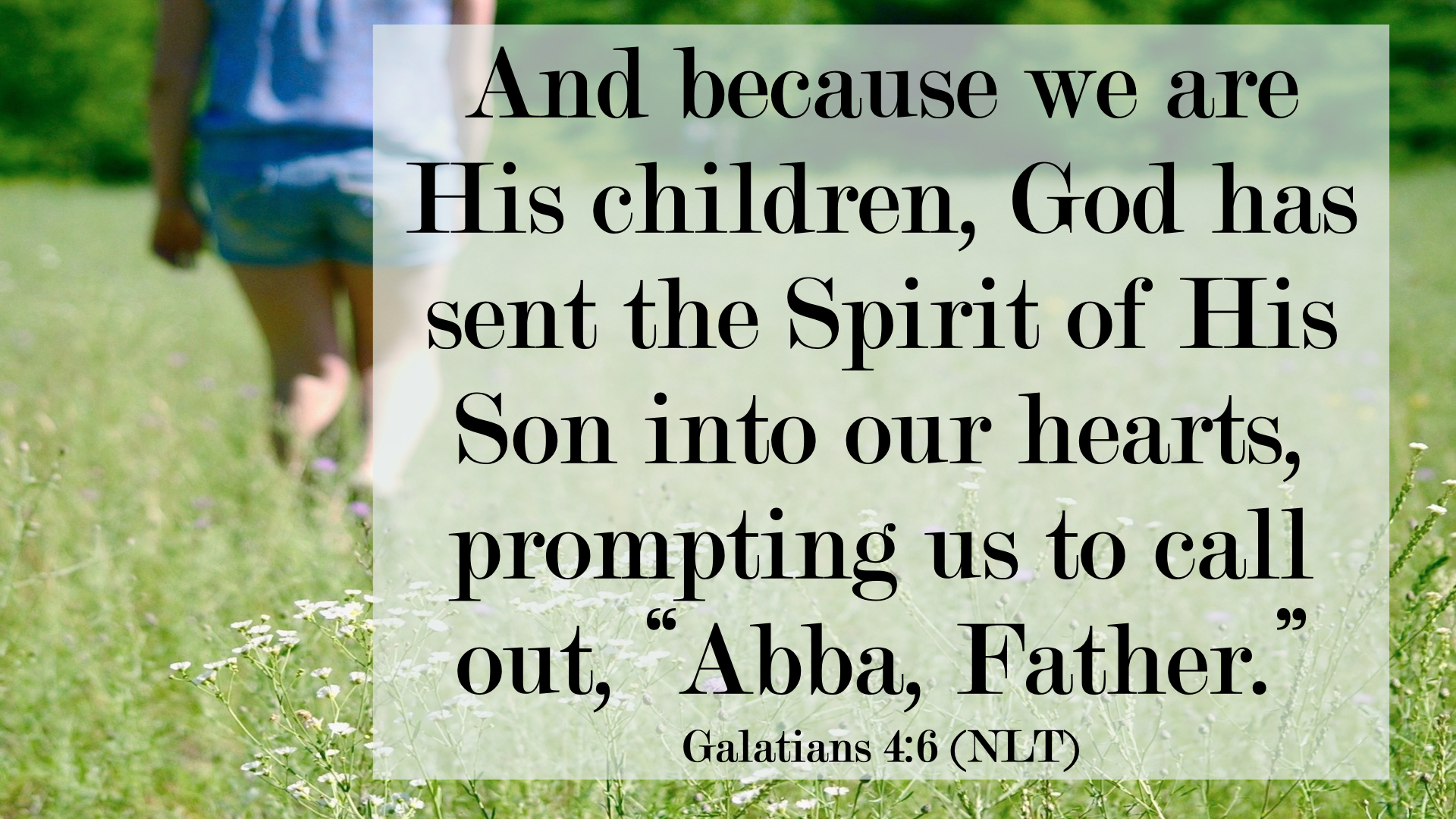
In His intense prayer time just before His crucifixion, Jesus used the phrase “Abba Father” to express His intimacy. This phrase is used two other times in the New Testament. Both of these times it’s telling us that we can approach our Heavenly Father the same way Jesus did (see Mark 14:36; Galatians 4:6; Romans 8:15). 

The Romans understood the weight that was associated with the practice of adoption. They knew that a father chose that child to be a part of his family, giving that child full acceptance into the family. Marvin Vincent noted,

“We have but a faint conception of the force with which such an illustration would speak to one familiar with the Roman practice; how it would serve to impress upon him the assurance that the adopted son of God becomes, in a peculiar and intimate sense, one with the heavenly Father.”

In writing to the Romans, Paul reminds them that for those who are in Christ Jesus, there is no condemnation—nothing holding them back from God’s presence. He also said that God has fully adopted us into His family, and that the Holy Spirit was now in us, encouraging us to call God “Abba Father” just as Jesus did (Romans 8:1, 14-16). 

Check out these two final thoughts from Jesus: He encourages us to approach God as innocent children, and He praises Our Father for then intimately confiding in His children—

“Truly I tell you, unless you change and become like little children, you will never enter the kingdom of heaven. … I praise You, Father, Lord of heaven and earth, because You have hidden these things from the wise and learned, and revealed them to little children.” (Matthew 18:3, 11:25) 

No matter what your relationship was with your earthly father, Jesus encourages us to approach our Heavenly Father in innocence, wonder, expectation, imagination, and intimacy. This is what God desires in His relationship with you! 

If you’ve missed any of the messages in our series Intimate Conversation, you can find them all by clicking here. 

►► Would you please prayerfully consider supporting this ministry? My Patreon supporters get behind-the-scenes access to exclusive materials. ◀︎◀︎
God Is Infinitely Logical

Listen to the podcast of this post by clicking on the player below, and you can also subscribe on AppleSpotify, or Audible. 

Plato said, “Arguments, like men, are often pretenders.” This is both true and a logical syllogism. It is true because men often pretend, and they design their arguments to support their pretenses. 

One of my favorite classes in college was “Introduction to Logic.” In fact, it is one of my few college textbooks that is still in my personal library today. It always struck me that God created logic. That means He is infinitely logical.

So we can restate Plato’s quote like this, “God’s arguments, like God Himself, are always authentic, logical, and valid.” 

In my Bible study time, I often highlight the words that denote premisses and conclusions. In just Ezekiel 36 alone I find: 

  • therefore (6x)
  • because (2x) 
  • then (6x)
  • for (1x) 
  • so that (1x) 

We can argue against God’s logic, and we can even try to invalidate His arguments. But to do so makes me illogical. God not only gives the premisses and the conclusion, but He makes them both logical and valid. God told Jeremiah, “I am watching to see that My word is fulfilled” (Jeremiah 1:12).

So any of my attempts to redefine or re-order or invalidate what God has logically presented ultimately brings disorder, collapse, and frustration. It is far better for me to simply follow the premisses and trust God to bring about His promised—and logical—conclusion. 

I encourage you to look for these logic statements as you read the Bible yourself. Here is a Bible study from Proverbs 2 that can help get you started.

►► Would you please prayerfully consider supporting this ministry? My Patreon supporters get behind-the-scenes access to exclusive materials. ◀︎◀︎