“God expects of us the one thing that glorifies Him—and that is to remain absolutely confident in Him. …
“Can you trust Jesus Christ where your common sense cannot trust Him? ‘Abide in Me,’ says Jesus, in spiritual matters, in money matters, in every one of the matters that make life what it is.” —Oswald Chambers, in Run Today’s Race
“I am convinced that we don’t get a double portion of God’s Spirit by watching Elijah walk away while standing at Jericho. When we choose to remain behind, we also leave behind all that God desires to do in us and for us and through us. If we want to inherit a double portion of the spirit of Elijah, we need to walk in the steps of Elijah until he leaves no more footprints. …
“Don’t wait to be asked—volunteer. Volunteer to go forward. Volunteer to go further. Volunteer to go harder. You cannot pioneer out of obligation. It is not an adventure if it is not your choice. You have to want it. You have to want more. If you are going to be greedy, this is the right place to be greedy. Want everything God has for you. Want more than others think you can obtain. Why settle for a single portion if a double portion can be yours for the asking? …
“Perhaps the reason so few of us have received a double portion of God’s Spirit is that the lives we have chosen require so little of God because they require so little of us. … I want to live the kind of life that cannot be lived without the fullness of Christ in my life.” —Erwin McManus, in The Last Arrow (emphasis added)
“People don’t lose intimacy when they stop talking, but when they stop listening. Leaders seldom realize how much their listening empowers the other person. Because they are leaders, the sheer act of listening speaks volumes that even a great speech can’t communicate.” —John Maxwell
“One of the nuanced skills of people who maximize their capacity and optimize their impact on the world is that they know which battles not to fight. They know which ground to give up. They know where to settle. This is not because they’re postured for compromise; it’s because they have a clarity about what really matters to them. They know what their lives are about. They have profound intention, and that intention informs every arena of their lives. Those who care about everything actually care about nothing. …
“In the end, the one thing where you must never settle for less is the calling that God has on your life, the purpose for which He has created you, the impact He designed you to make in the world. …
“Is it possible that God is waiting to do more then we could ever ask or imagine and is looking throughout the earth for someone who refuses to settle?” —Erwin McManus, in The Last Arrow
“God’s name marks Him out; by it will we address Him; it embodies His character. … This name that is written all over the Bible, but specially exhibited in Christ Jesus, Who came to declare to us the Father’s name, is a name—
Of greatness. Jehovah, God, Creator, El-Shaddai; all expressive of majesty and power and glory. The Lord God omnipotent.
Of grace. It is the declaration of free love. Merciful and gracious. He to whom it belongs must be the fountain-head of love. God is love. In Him is infinity of compassion and longsuffering.
Of forgiveness. He pardons iniquity, transgression, and sin; all sin, great and small; there is forgiveness with Him, that He may be feared; forgiveness to the uttermost.
Of righteousness and holiness. It is holy love that is to be found in Him; righteous grace to the unrighteous; righteous pardon to the guilty.” —Horatius Bonar, in Light & Truth—The Old Testament
Then Miriam and Aaron spoke against Moses because of the Ethiopian woman whom he had married; for he had married an Ethiopian woman. (Numbers 12:1)
Leaders can bank on two truths. First, they will be criticized. Second, criticism always changes the leader. Unhappy people tend to attack the point person.
Moses’ only family criticized him. Notice what God and Moses teach us on how to handle criticism (Numbers 12):
Maintain your humility. (v. 3)
Face the criticism squarely. (v. 4)
Be specific about the issue. (vv. 5-8)
Lay out consequences. (vv. 9, 10)
Pray for the criticizers. (vv. 12, 13)
Restore them when appropriate. (v. 14)
Beyond that, consider the ways leaders should handle criticism:
Understand the difference between constructive and destructive criticism.
Look beyond the criticism to see the critic.
Guard your own attitude toward the critic.
Keep yourself spiritually in shape. Associate with people of faith.
Wait for time to prove the critic wrong.
Concentrate on your mission; change your mistakes.
Let’s get some insight into the Greco-Roman and Jewish mindsets of the first century AD. Specifically, the mindset of men.
There is a well-known letter written June 17, 1 BC, from a man named Hilarion, who was gone off to Alexandria, to his wife Alis, whom he has left at home. He writes to her: “If—good luck to you—you bear a child, if it is a boy, let it live; if it is a girl, throw it out.” This letter captures the male-dominated mindset in the Roman world concerning women and children. In a word: inferior or even disposable.
This mindset wasn’t limited to the world the Jews called “pagan,” but it was prevalent in Judaism too. Every day Jewish men began their morning prayer time with, “God, I thank You that You did not make me a Gentile, a slave, or a woman.”
With this background, it makes it startling that a Jewish man (who prayed that prayer thousands of times) writing to people in Rome (who undoubtedly had the same mindset as Hilarion), begins his list of thank you notes with gratitude to two women! Paul goes on to list no less than 8 women, even giving preferential treatment to a wife (Priscilla) over her husband (Aquila) when he mentions her name first! (see Romans 16:1-4, 6, 12).
William Barclay wrote, “Anyone who asks the question: ‘What has Christianity done for the world?’ has delivered himself into a Christian debater’s hands. There is nothing in history so unanswerably demonstrable as the transforming power of Christianity and of Christ on the individual life and on the life of society.”
Indeed Christians changed the lives of at least four groups:
Women (especially in the role of marriage)—divorce was so common that it was neither unusual nor particularly blameworthy for a woman to have a new husband every year. Yet Christians taught men to esteem their wives and for marriage to be honored by everyone (Ephesians 5:28; Hebrews 13:4).
Children—who weren’t even considered a part of the family until they had grown up and proven their worth to the father. Yet Christians taught fathers to nurture their children (Ephesians 6:4).
Senior citizens—the pragmatic Romans had little to do with those they considered less valuable. But the first blind asylum was founded by Thalasius, a Christian monk; the first free medical dispensary was founded by Apollonius, a Christian merchant; the first hospital of which there is any record was founded by Fabiola, a Christian lady.
The weak and sick—when a plague hit Rome, all the young, healthy people left the sick and elderly behind. They ran away, but the Christians stayed to help. The Christians taught that everyone (regardless of age, sex, or wealth) was valuable (1 Timothy 5:1-2).
That was just the start of Christianity. Men like William Wilberforce and Abraham Lincoln were Christians who opposed slavery; Clara Barton was nicknamed “the angel of the battlefield” and founded the Red Cross; Paul Brand was a doctor who ran to leprosy patients when everyone else shunned them; Mother Teresa loved those poor, dying souls whom others ignored.
So what’s your conclusion? Throughout history Christians have been martyred for their faith, but not only are they willing to die for their belief that Jesus is alive, but they continue to do good to those who persecute them. Would people do this to perpetuate a hoax? Or does this sound more like the real deal?
Please check out the other evidence I have presented for the resurrection of Jesus:
“We naturally tend to interpret Scripture in the light (or shadow) of our own temperament and let our peculiar mental cast decide the degree of importance we attach to various religious doctrines and practices. …
“The minister above all others should look deep into his own heart to discover the reason for his more pronounced views. It is not enough to draw himself up and declare with dignity that he preaches the Bible and nothing but the Bible. That claim is made by every man who stands in sincerity to declare the truth; but truth has many facets and the man of God is in grave danger of revealing only a limited few to his people, and those the ones he by disposition favors most. …
“The Scriptures, critical self-discipline, honesty of heart and increased trust in the inward operations of the Holy Spirit will save us from being too greatly influenced by temperament.” —A.W. Tozer, in Man—The Dwelling Place Of God
Throughout history, lots of martyrs have died for what they believe. But only One had been resurrected from the dead to prove that what He believed and taught was true.
Jesus, however, is not a martyr. His life and His work weren’t cut short. Calvary didn’t happen to Jesus, but He came specifically to die on a Cross. He knew what was going to happen to Him. Check this out…
Jesus predicted not only His death but His resurrection too (John 10:7-18)
Jesus knew exactly how He would die, which was not by stoning at the hands of the Jews, but by crucifixion at the hands of the Romans (John 10:22-33; Mark 8:31; Matthew 26:2)
Later, knowing that everything had now been finished, and so that Scripture would be fulfilled, Jesus said, “I am thirsty.” … When He had received the drink, Jesus said,“It is finished.”
Actually His “It is finished” wasn’t just a statement, it was a yell that reverberated throughout the countryside. The Greek words Mark uses are megas phōnē, which sounds a lot like our word megaphone. Jesus wanted to make sure everyone heard Him, and then look at the result:
Then Jesus uttered another loud cry and breathed His last. And the curtain in the sanctuary of the Temple was torn in two, from top to bottom.
The curtain that separated God’s presence from mankind was torn in two. The writer of Hebrews notes, “Our High Priest offered Himself to God as a single sacrifice for sins, good for all time. Then He sat down in the place of honor at God’s right hand.”
What do you conclude from all this? C.S. Lewis offered this challenge:
“A man who was merely a man and said the sort of things Jesus said would not be a great man or a moral teacher. He would either be a lunatic—on the level with the man who says he is a poached egg—or else he would be the devil of hell. You must take your choice. Either this was, and is, the Son of God; or else a madman or something worse. You can shut Him up for a fool… or you can fall at His feet and call Him Lord and God. But let us not come with any patronizing nonsense about His being a great human teacher. He has not left that open to us.”
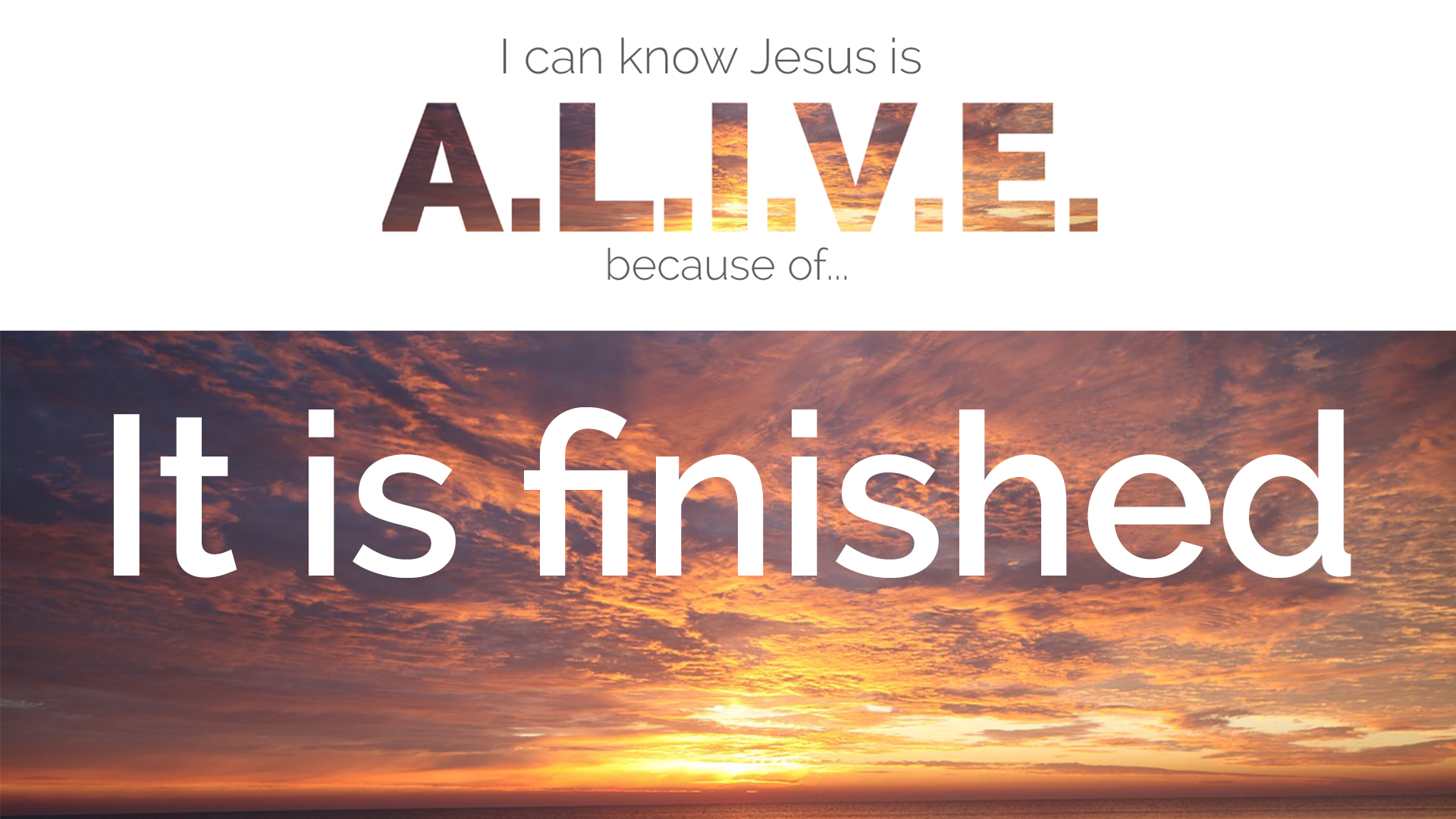
Jesus told us that He would die, how He would die, when He would die, why He would die, and that He would be resurrected. If you heard all of these claims before His crucifixion, you might think He was a lunatic or a braggart. But after His It Is Finished! declaration, we have only one logical conclusion: Jesus is exactly who He said He was. It was out of love for you that Jesus laid down His life and picked it up again. Will you put your faith in Him today?
We are working our way through 5-parts of this series: “I can know Jesus is A.L.I.V.E. because of….” We’ve already covered:
“Those Christians who belong to the evangelical wing of the church (which I firmly believe is the only one that even approximates New Testament Christianity) have over the last half-century shown an increasing impatience with things invisible and eternal and have demanded and got a host of things visible and temporal to satisfy their fleshly appetites. Without Biblical authority, or any other right under the sun, carnal religious leaders have introduced a host of attractions that serve no purpose except to provide entertainment for the retarded saints.
“It is now common practice in most evangelical churches to offer the people, especially the young people, a maximum of entertainment and a minimum of serious instruction. It is scarcely possible in most places to get anyone to attend a meeting where the only attraction is God. One can only conclude that God’s professed children are bored with Him, for they must be wooed to meeting with a stick of striped candy in the form of religious movies, games and refreshments. …
“Any objection to the carryings on of our present golden-calf Christianity is met with the triumphant reply, ‘But we are winning them!’ And winning them to what? To true discipleship? To cross-carrying? To self-denial? To separation from the world? To crucifixion of the flesh? To holy living? To nobility of character? To a despising of the world’s treasures? To hard self-discipline? To love for God? To total committal to Christ? Of course the answer to all these questions is no.
“We are paying a frightful price for our religious boredom. And that at the moment of the world’s mortal peril.”



 “God expects of us the one thing that glorifies Him—and that is to remain absolutely confident in Him. …








 Craig T. Owens