When You’re Unfairly Attacked

Listen to the podcast of this post by clicking on the player below, and you can also subscribe on Apple or Spotify.

Contend, Lord, with those who contend with me; fight against those who fight against me. (Psalm 35:1). 

This psalm is in a category called an imprecatory psalm, which is the theological way of saying, “Get ‘em, God!” 

Does it sound unusual to your ears to pray a prayer like that? After all, aren’t we as Christians commanded to forgive those who offend us? How do we square that teaching of Jesus with these brutally honest prayers that David offers up? 

Always remember that imprecatory psalms are spoken exclusively to God, not to our enemies. So when we pray these prayers, we are really turning the matter over to God. God does the contending and the vindicating—He knows best how to dispense the appropriate judgment. 

David also shares with us several introspective prayers throughout the Book of Psalms, where he asks the Holy Spirit to search him. This heart-searching is interwoven in this imprecatory prayer of Psalm 35, as it should be with our prayers too. 

Notice that David can only say these things with integrity because he had already allowed the Spirit to search his heart, and then he had asked forgiveness and he had repented from any sin (see Psalm 139:23-24; Matthew 5:22-24; 6:12, 14-15). David could point out with a clear conscience what his enemies were doing because David was innocent of these actions himself. Things like… 

  • their attack was without cause (v. 7) 
  • their accusations were purposefully designed to entrap him (v. 11) 
  • they were repaying David’s good work with evil deeds (v. 12) 
  • David had attempted to treat them well (vv. 13-14) 
  • they gleefully piled on more slander when David stumbled (v. 15) 
  • the enemy’s mocking was malicious (v. 16) 
  • they hated me without reason (v. 19) 
  • they invented false accusations against David (v. 20)

After his imprecatory prayer, David resolves to turn his eyes from the bad guys to God. He declares that worship of God will be his comfort (v. 28). What a great example for us still today! 

When you are falsely, unfairly attacked, take these three actions: 

  1. Introspection. Ask the Holy Spirit to search your heart, and then quickly take action where necessary: Ask forgiveness, and repent from sinful thoughts, words, and actions. 
  2. Pray. Remember to share your hurts with God alone. There is no need to unleash your anger on those who have attacked you. 
  3. Worship. As long as my focus is on my trespassers, my focus is off my God. I cannot be consumed by thoughts of “them” because then I rob myself of thoughts of Him! 

Please keep these God-honoring action steps in mind the next time you are unfairly attacked. 

►► Would you please prayerfully consider supporting this ministry? ◀︎◀︎

“My God, My God”

Listen to the podcast of this post by clicking on the player below, and you can also subscribe on Apple or Spotify.

Jesus has been hanging on the Cross silently for three hours. And now He gathers His strength for four final statements that all come in pretty close proximity. His first three dying declarations have been declarations of love:

But now comes a word of sheer, unparalleled agony. A word from a heart that is experiencing the depths of betrayal and pain that has never been known—or even approached—in all of human history: Eloi, Eloi, lama sabachthani! (Matthew 27:45-46; Mark 15:33-34)

Does this sound like a good Friday message: My God, My God, why have You forsaken Me? 

This is the only one of the seven dying declarations of Jesus that Matthew and Mark record, and they do it nearly identically: 

  • It’s spoken in the everyday language of the people: Aramaic 
  • It’s translated into the worldwide language of business and literature: Greek 
  • It’s a direct quotation of Hebrew Scripture 

This is a word for everyone: Jews and Greek, nobles and commoners, religious people and pagans. 

This dying declaration comes from words taken directly from Psalm 22. David wrote this psalm 1000 years before the crucifixion of Jesus, but note the amazing accuracy in the despicable treatment of Jesus, gambling for Christ’s clothes, even the crucifixion itself (which was unknown in David’s time), and then there’s the heart-wrenching cry My God, My God, why have You forsaken Me?  

Matthew and Mark say Jesus “cried out.” This can mean a cry of joy or a cry of pain. They also record that He cried out with “a loud voice.” The Greek words here will sound very familiar even to English ears—“loud” is the word megas, and “voice” is the word phoné. Literally: Jesus raised a megaphone voice to make sure everyone heard His cry! 

Remember that cried out can either be a cry of joy or of pain? Which one was it? You could make the case that it is both of these meanings. But there is a third way of using this word: a cry for help. 

Jesus is about to take a plunge. He is about to descend deeper than anyone else ever has. He is about to voluntarily go into Hell itself. This megaphone cry is His battlecry before storming the gates of Hell! 

Christ’s megaphone battlecry was heard in Hell and in Heaven as Jesus descended to decisively defeat hell, death, and the grave! Make no mistake, Jesus undoubtedly won that battle! That same descriptive word megas is also used for… 

  • …the stone in front of His grave is a megas stone 
  • …the earthquake that rolled away that stone on Resurrection morning was a megas earthquake 
  • …the joy of Christ’s friends at seeing the tomb empty was a megas joy 
  • …the trumpet sound at Christ’s Second Coming when He returns to earth as the Conquering King will be a megas blast, and His shout a megaphone cry (Matthew 24:31; 1 Thessalonians 4:16)! 

Jesus went to the deepest depths to take us to the highest heights! 

His megaphone declaration from the Cross on Good Friday was a cry of pain over our sin, a battlecry as He stormed the gates of Hell, and a cry of joy over His coming victory! 

So now we can say, “Where, O Death, is your victory? Oh yeah, you don’t have one because my Savior has totally defeated you!” 

If you’ve missed any of the other dying declarations of Jesus from the Cross, you may access the full list by clicking here.

►► Would you please prayerfully consider supporting this ministry? ◀︎◀︎

The Fame Of God’s Name

Listen to the podcast of this post by clicking on the player below, and you can also subscribe on Apple or Spotify.

In You, Lord, I have taken refuge … Be strong and take heart, all you who hope in the Lord (Psalm 31:1, 24). 

The bookend verses of Psalm 31 speak to the security we have when we are IN God: “IN You and all you who hope IN the Lord.” 

Jesus taught us to pray for Our Father’s name to be hallowed—for His fame to be as great on earth as it is in heaven. Those who are called CHRISTians literally carry the name of Christ IN themselves everywhere they go. Granted, there are some who will carry the name but not the character of Christ. To those people, Jesus will one day say, “Depart from Me. I never knew you.”  

But for those Jesus does know—those who carry IN themselves both the name and the character of Christ, those who have made their place IN God their utter dependence—there are amazing blessings that hallow God’s name. David lists blessings like:

  • being free from shame
  • answers to prayer
  • guidance 
  • deliverance from entrapments 
  • stores of abundantly good things 
  • protection from slander
  • preserved for all of eternity

God will cause His name to be hallowed and glorified through those who remain IN Him. We are not only recipients of His favor, but we also become conduits of His favor that make His name as great on earth as it is in Heaven! 

Thanks be to Jesus who has made us accepted in the Beloved, and has taken us IN Himself so that we can remain IN the Father (Ephesians 1:6; John 14:20)! Father, I pray that You will always find me IN You so that You can glorify Your name THROUGH me. Amen! 

►► Would you please prayerfully consider supporting this ministry? ◀︎◀︎

Soul-Calming Peace

Listen to the podcast of this post by clicking on the player below, and you can also subscribe on Apple or Spotify.

…the Lord blesses His people with peace (Psalm 29:11). 

Please forgive me for the use of so many exclamation points in this post, but it’s the only way I can even begin to come close to portraying the awesomeness of our God!  

What brings peace to God’s people? David says it is the glimpse of God’s awesome power—

  • the God of glory thunders! 
  • His voice is powerful! 
  • His voice is majestic! 
  • His voice splits cedar trees! 
  • lightning and thunder cannot compare to His voice! 
  • His voice shakes the deserts! 
  • His voice twists oak trees and strips forests! 
  • He is enthroned as the King over all forever and ever!

Count all of the ways God is awesome! Give Him praise that is equally great! Tremble at His weighty, majestic holiness! Be filled with the awe of His strength! And let this bring you peace.

Why? 

Because this awesome, glorious, omnipotent, majestic, powerful, unrivaled, holy God wants to be in a relationship with you! He cares about you! He will unleash His power against any enemy that comes against you! What brings peace to your trembling soul? A glimpse of this awesome God! 

The awesome strength of your God IS your soul-calming peace! 

►► Would you please prayerfully consider supporting this ministry? ◀︎◀︎

Whom To Fear

Listen to the podcast of this post by clicking on the player below, and you can also subscribe on Apple or Spotify.

When I am afraid, I put my trust in You. In God, whose word I praise, in God I trust; I will not be afraid. … In God, whose word I praise, in the Lord whose word I praise—in God I trust; I will not be afraid. What can man do to me? (Psalm 56:3-4, 10-11). 

Have you ever been afraid of someone? Have you ever experienced the fear of God?

Interestingly, it’s the same Hebrew word (yaré) for both. This word can mean either something that causes me to fight or flight, or it can mean reverential respect. David is saying, “When I begin to feel the fear of man, I instead turn to the fear of God, and I am no longer afraid.”

Or to put it another way: “When I think I have to fight or flight on my own, I instead choose to reverence God and He takes care of my fear.” 

In both verses 4 and 10, the word “praise” is the Hebrew word for “Hallelujah!” When David feels fear of man creeping in, he looks to God’s Word, finds a promise on which to stand, and reverentially begins to worship God: “Hallelujah! With this promise, I no longer need to fear man!” The Amplified Bible says, “On God I lean, rely, and confidently put my trust; I will not fear.” 

There is one other difference in the Hebrew language that is not readily apparent in the English translation. In verse 4, David uses the name Elohiym for God. This means the Mighty God who is Supreme over all. In verse 10, he uses God’s covenant name Yahweh or Jehovah. To me, this sounds like David knew that the fear of God could combat everything from general fears of human philosophies to a specific fear of a specific mortal. His conclusion is a good one: What can man—a mere mortal—or any of his worldly philosophies do to rattle me? Absolutely nothing because I am secure in God! 

We all become fearful at times. If we choose to fight or flight the fear, we do it in our own strength. This may result in temporary relief, but the fear will come back around again. However, if we decide to fear God—to say “Hallelujah!” to His promises—He is able to completely remove our fear. 

The choice is ours: fear man or fear God. 

To paraphrase the declaration of Joshua: “Choose this day whom you will fear. As for me, I choose to fear God!” 

►► Would you please prayerfully consider supporting this ministry? ◀︎◀︎

“Today You Will Be With Me In Paradise”

Listen to the podcast of this post by clicking on the player below, and you can also subscribe on Apple or Spotify.

Dying declarations are powerful statements!

As Jesus was nailed to the Cross, His first dying declaration prompted such a change of heart in a hardened criminal that the criminal’s own dying declaration caused Jesus to say, “Amen!” The story is found in Luke 23:32-43.

But first, we need to ask, why were criminals crucified alongside Jesus? An obvious answer is that it fulfilled a First Testament prophecy—He poured out His life unto death, and He let Himself be regarded as a criminal and be numbered with the transgressors (Isaiah 53:12). 

How did this come about? Maybe…

  • Pilate was trying to justify his actions? 
  • the Sanhedrin had used these criminals as “evidence” that Jesus was stirring up a rebellion against the crown? 
  • a Roman centurion suggested, “Let’s kill three birds with one stone”? 

Whatever the case, they couldn’t have been very happy about this, especially since Barabbas (a fellow criminal) had just been released. They probably blamed Jesus for their awful predicament, so they naturally joined in the mockery. 

And what cruel mockery it was! 

  • the people stood watching these crucifixions and, since Luke uses the word for a sports spectator, it appears they were cheering the bloodshed they were observing
  • the Pharisees and Sadducees derided Jesus
  • the Roman soldiers continued the inhuman mockery and abuse that they had begun hours before 
  • the criminals crucified on either side of Jesus blasphemed Him 

Luke kindly records that only one criminal was hurling insults at Jesus, but Matthew and Mark make it clear that both criminals were blaspheming Jesus (Matthew 27:44; Mark 15:32). 

It appears that one criminal, although at first a blasphemer, had a change of heart. 

Perhaps it was because He heard this Jesus, who was being so horribly mistreated, ask His Father to forgive His tormentors instead of asking for retribution. The apostle Peter says that when we follow Christ’s example in this it can actually make people become ashamed of their slander against us (1 Peter 2:23; 3:14, 16). 

Or perhaps this criminal had been in the crowd earlier that week on Monday when Jesus taught about the Kingdom of God all day. If he was, he would have heard Jesus talk about the rewards for the righteous and the punishment for the wicked, and he would have heard Jesus talk about how even criminals like himself could be allowed into God’s Kingdom (Matthew 21:28-32). 

All of this was working on him until his own slander against Jesus stuck in his throat and he rebuked his companion for his blasphemy. He said, “We are guilty and deserve this death sentence. But this Man is totally innocent!” 

Then turning to Jesus, he delivers his faith-filled declaration, “LORD Jesus, remember me when You come into Your kingdom.” He called Him Lord, asked for a reward, and acknowledged that Christ’s Kingdom was not of this earth. This dying declaration was more faith-filled than even the disciples of Jesus could make, since all but one of them had fled in fear!

Jesus is so moved by this man’s declaration that His first word to him is Amen: “I tell you the truth [literally: Amen!], today you will be with Me in paradise. 

King David taught us that the sacrifice that God accepts is a broken heart, and the apostle Paul agrees by saying that it is the heart change and the confession of our mouth that brings our salvation (Psalm 51:16-17; Romans 10:4-11). 

My friend, Jesus has opened the way to Paradise for you by His death on the Cross. When our humbled hearts speak the truth about God’s Kingdom, Jesus says, “Amen!” and God welcomes us into His presence for ever and ever! Don’t wait another day, but cry out to Jesus today: tell Him that you are guilty, but you believe He has paid for your sins. He will then say the same word to your heart: “Amen! You will spend eternity in Paradise with Me!” 

If you would like to follow along as we look at all seven of the dying declarations Jesus made from the Cross, please click here. 

►► Would you please prayerfully consider supporting this ministry? ◀︎◀︎

Poetry Saturday—My Blessing, My Proof

Listen to the podcast of this post by clicking on the player below, and you can also subscribe on Apple or Spotify.

I will not be dissuaded from my view
that we shall see revival not long hence;
there’s just too much persuasive evidence
to make me think God’s promise is not true.
The many and abundant blessings, new
each day, with which we are surrounded—dense
with love divine, portending heaven, whence
they come to us, and which they witness to—
betoken greater, worldwide blessings, due
when God is pleased that they their sweet descents
should make. Our daily bounty thus presents
fresh hope that soon revival will ensue.
   My daily blessings coalesce in you,
   my Proof and foretaste of what God will do. —T.M. Moore (based on Psalm 67:6-7)

This poem is from T.M. Moore’s enjoyable book of poetry Bricks and Rungs.

►► Would you please prayerfully consider supporting this ministry? ◀︎◀︎

Thursdays With Spurgeon—Our Daily Doctrine Of Experience

This is a weekly series with things I’m reading and pondering from Charles Spurgeon. You can read the original seed thought here, or type “Thursdays With Spurgeon” in the search box to read more entries.

Listen to the podcast of this post by clicking on the player below, and you can also subscribe on iTunes or Spotify.

Our Daily Doctrine Of Experience 

[God] alone is my rock and my salvation (Psalm 62:2).

     Doctrine is nothing unless it is proved in our experience. Most of God’s doctrines are only to be learned by practice—by taking them out into the world and letting them bear the wear and tear of life. …  

     Think how many enemies you have. How many rivers you have to cross, how many mountains to climb, how many dragons to fight, how many lions’ teeth to escape, how many fires to pass through, how many floods to wade. … Can your salvation be of anything except God? … 

     I beseech you, remember this. I hope you know it by experience in the past, but try to remember it in the future—wherever you go, ‘Salvation is of the Lord.’ Do not get to looking at your heart; do not get to examining to see whether you have anything to recommend you; just remember, salvation is of the Lord. ‘He alone is my rock and my salvation.’ … 

     I say, Christian, your highest and noblest experience is not to be groaning about your corruption, is not to be crying about your wanderings, but is to say, ‘With all my sin and care and woe, His Spirit will not let me go.’ ‘Lord, I believe; help my unbelief!’ (Mark 9:24). …  

     Now we must have the great duty. The great duty is this: If God only is our rock and we know it, are we not bound to put all our trust in God, to give all our love to God, to set all our hope upon God, to spend all our life for God, and to devote our whole being to God? … Trace your mercies to God and say perpetually, ‘He alone is my rock and my salvation.’

From God Alone The Salvation Of His People

If you will look through the pages of the Bible, you will see that people struggled when they forgot what God had done for them and therefore they began to take matters into their own hands. In the Old Testament, the prophets called this idolatry and adultery; in the New Testament, Jesus called this a lack of faith. 

An old hymn reminds us:

Oh, to grace how great a debtor
Daily I’m constrained to be!
Let Thy goodness, like a fetter
Bind my wandering heart to Thee
Prone to wander, Lord, I feel it
Prone to leave the God I love
Here’s my heart, Oh, take and seal it
Seal it for Thy courts above (Robert Robinson, Come Thou Fount)

I think this is the reason why Jesus taught us to pray, “Give us today our daily bread.” We need to be perpetually reliant on God’s grace—a perpetual debtor. This posture reminds us, “He alone is my rock and my salvation,” and guards us against the spirit of self-reliance that would lead us astray. 

Let our doctrine be proven in our daily experience of coming to God as our one and only Source again and again and again.

►► Would you please prayerfully consider supporting this ministry? ◀︎◀︎


Thursdays With Spurgeon—Security

This is a weekly series with things I’m reading and pondering from Charles Spurgeon. You can read the original seed thought here, or type “Thursdays With Spurgeon” in the search box to read more entries.

Listen to the podcast of this post by clicking on the player below, and you can also subscribe on iTunes or Spotify.

Security 

[God] alone is my rock and my salvation (Psalm 62:2).

     I do not reckon that is salvation that regenerates me and then puts me in such a position that I may fall out of the covenant and be lost. I cannot call that a bridge that only goes halfway over the stream. I cannot call that salvation that does not carry me all the way to heaven, wash me perfectly clean, and put me among the glorified who sing constant hosannas around the throne. … 

     Do I live to God a holy life? It is not I, but Christ who lives in me. Am I sanctified? I did not sanctify myself. God’s Holy Spirit sanctifies me. Am I weaned from the world? I am weaned by God’s chastisements. Do I grow in knowledge? The great Instructor teaches me.

From God Alone The Salvation Of His People


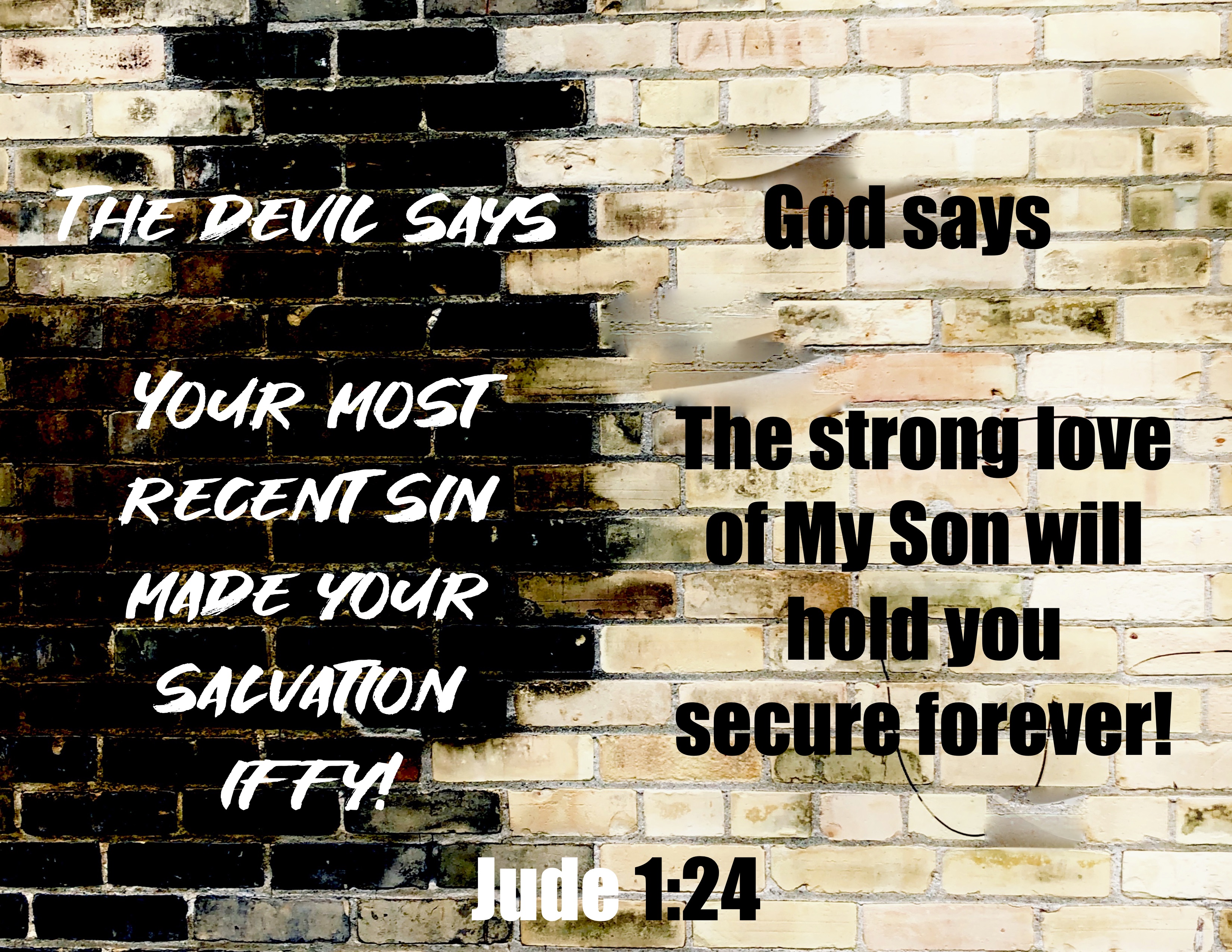
A few months ago I began designing a series of graphics under the heading, “Says who?” I took some of the lies of satan and put them side-by-side with the truth from God’s Word. 

When God is our Savior, we are secure. The devil would love to make us think that our salvation is hanging by a thread, that we have to work harder to make sure we don’t miss out, that a single sin can disqualify us from God’s favor, and a hundred other lies. But they are all just that: lies! 

We have to learn to capture each of these thoughts, and if they are thoughts that don’t align with God’s Word, then we need to confront them with the truth. I have found it very helpful to speak these truths out loud. To see some of the ways I suggested thinking differently about the devil’s lies, check out this post on reversing your thinking.

As the old hymn says, “Jesus paid it all, all to Him I owe.” You don’t have to earn your salvation or make your position secure—your salvation has been paid-in-full and you are perfectly secure! Now what you owe to Jesus is to allow Him to take you safely home. 

►► Would you please prayerfully consider supporting this ministry? ◀︎◀︎

The Mercyseat

Listen to the podcast of this post by clicking on the player below, and you can also subscribe on Apple or Spotify.

Hear my cry for mercy … He has heard my cry for mercy (Psalm 28:2, 6).

For David, his cry for mercy was never a one-and-done action. The verb in verse 2 makes this verse read more like, “Hear my cry for mercy as I am continually calling to You for help, as I am continually lifting up my hands toward Your Most Holy Place.” 

Why the Most Holy Place? What was there? Inside the Most Holy Place was the ark of the covenant of the Lord which represented the presence of God. 

What was on top of the ark of the covenant, covering and superseding the Law that was inside the ark? It was the mercyseat (or the “atonement cover” in some translations). The mercyseat is where the high priest sprinkled the blood of the sacrificial lamb every year to make atonement for sins.

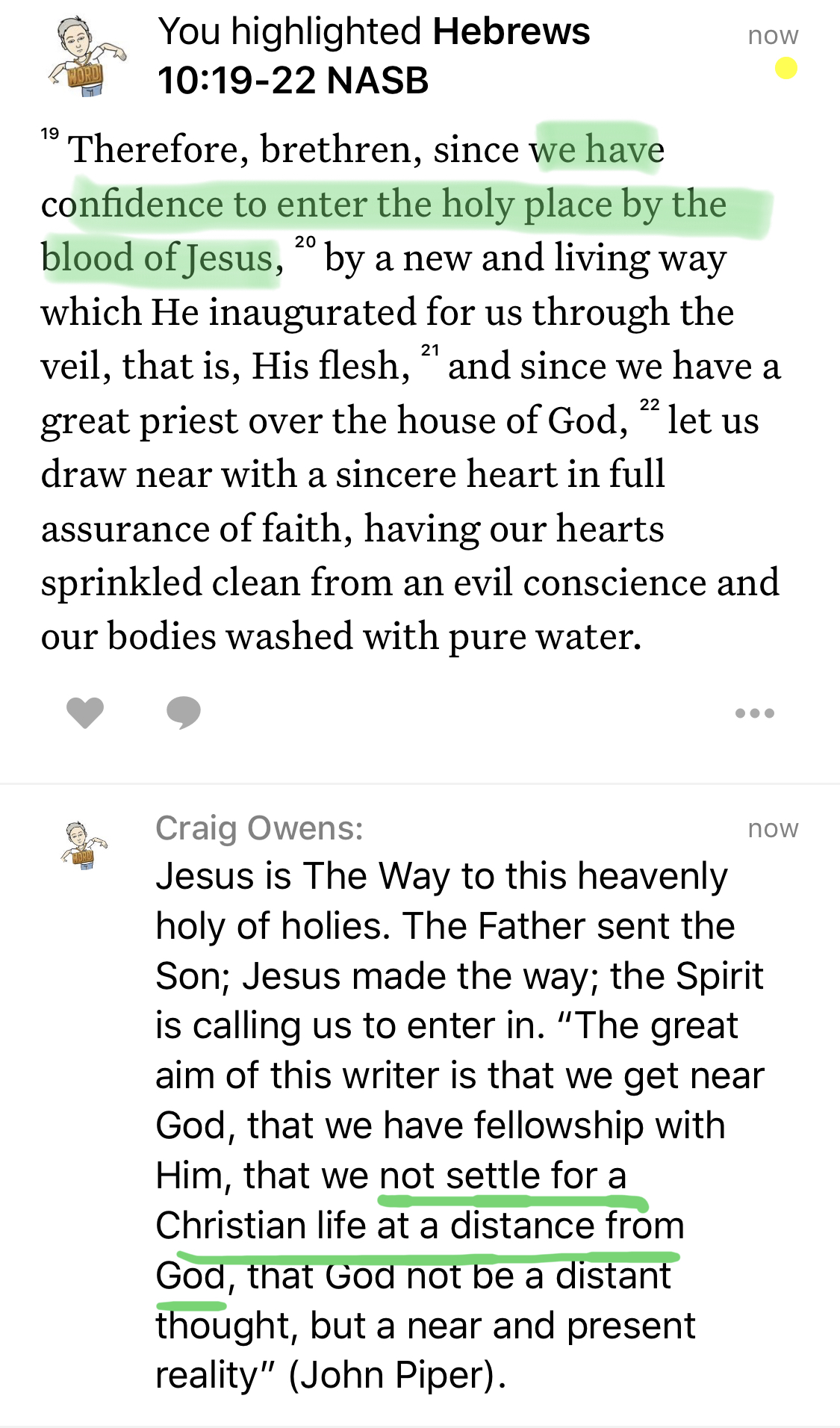
Jesus became the once-for-all sacrificial Lamb to make ultimate atonement for all who would believe in Him. When Jesus had finished His work on the Cross, the curtain separating us from the Most Holy Place was torn in two. The ark of the covenant of the Lord with its covering mercyseat—the presence of God—was now accessible to all of us! It was accessible because it was in Jesus, and when I have taken Jesus as my atonement, He is in me and He takes me in to the Father. The mercyseat of my heart has been sprinkled with the blood of the Lamb (see Hebrews 9:1-5, 11-14; 10:19-22). 

Whether David was saying, “Hear my cry,” or “He has heard my cry,” the Hebrew word means to listen with interest and full attention. Whenever you pray, God listens to you with interest and full attention because you are praying right in His presence! Your very breath can be a continual crying, a continual lifting of your voice toward the mercyseat where God meets with you! 

God is not far away from us. He is closer than we usually think. That’s why David says, “My heart leaps for joy, and with my song I praise Him”! 

Keep this in mind the next time you are asking God to hear your cry: He listens to you with full attention because Jesus has taken you right into His presence.

Would you please prayerfully consider supporting this ministry?