This is a weekly series with things I’m reading and pondering from Charles Spurgeon. You can read the original seed thought here, or type “Thursdays With Spurgeon” in the search box to read more entries.
Listen to the podcast of this post by clicking on the player below, and you can also subscribe on iTunes or Spotify.
Our Daily Doctrine Of Experience
[God] alone is my rock and my salvation (Psalm 62:2).
Doctrine is nothing unless it is proved in our experience. Most of God’s doctrines are only to be learned by practice—by taking them out into the world and letting them bear the wear and tear of life. …
Think how many enemies you have. How many rivers you have to cross, how many mountains to climb, how many dragons to fight, how many lions’ teeth to escape, how many fires to pass through, how many floods to wade. … Can your salvation be of anything except God? …
I beseech you, remember this. I hope you know it by experience in the past, but try to remember it in the future—wherever you go, ‘Salvation is of the Lord.’ Do not get to looking at your heart; do not get to examining to see whether you have anything to recommend you; just remember, salvation is of the Lord. ‘He alone is my rock and my salvation.’ …
I say, Christian, your highest and noblest experience is not to be groaning about your corruption, is not to be crying about your wanderings, but is to say, ‘With all my sin and care and woe, His Spirit will not let me go.’ ‘Lord, I believe; help my unbelief!’ (Mark 9:24). …
Now we must have the great duty. The great duty is this: If God only is our rock and we know it, are we not bound to put all our trust in God, to give all our love to God, to set all our hope upon God, to spend all our life for God, and to devote our whole being to God? … Trace your mercies to God and say perpetually, ‘He alone is my rock and my salvation.’
From God Alone The Salvation Of His People
If you will look through the pages of the Bible, you will see that people struggled when they forgot what God had done for them and therefore they began to take matters into their own hands. In the Old Testament, the prophets called this idolatry and adultery; in the New Testament, Jesus called this a lack of faith.
An old hymn reminds us:
Oh, to grace how great a debtor
Daily I’m constrained to be!
Let Thy goodness, like a fetter
Bind my wandering heart to Thee
Prone to wander, Lord, I feel it
Prone to leave the God I love
Here’s my heart, Oh, take and seal it
Seal it for Thy courts above (Robert Robinson, Come Thou Fount)
I think this is the reason why Jesus taught us to pray, “Give us today our daily bread.” We need to be perpetually reliant on God’s grace—a perpetual debtor. This posture reminds us, “He alone is my rock and my salvation,” and guards us against the spirit of self-reliance that would lead us astray.
Let our doctrine be proven in our daily experience of coming to God as our one and only Source again and again and again.
This is a weekly series with things I’m reading and pondering from Charles Spurgeon. You can read the original seed thought here, or type “Thursdays With Spurgeon” in the search box to read more entries.
Listen to the podcast of this post by clicking on the player below, and you can also subscribe on iTunes or Spotify.
Security
[God] alone is my rock and my salvation (Psalm 62:2).
I do not reckon that is salvation that regenerates me and then puts me in such a position that I may fall out of the covenant and be lost. I cannot call that a bridge that only goes halfway over the stream. I cannot call that salvation that does not carry me all the way to heaven, wash me perfectly clean, and put me among the glorified who sing constant hosannas around the throne. …
Do I live to God a holy life? It is not I, but Christ who lives in me. Am I sanctified? I did not sanctify myself. God’s Holy Spirit sanctifies me. Am I weaned from the world? I am weaned by God’s chastisements. Do I grow in knowledge? The great Instructor teaches me.
From God Alone The Salvation Of His People
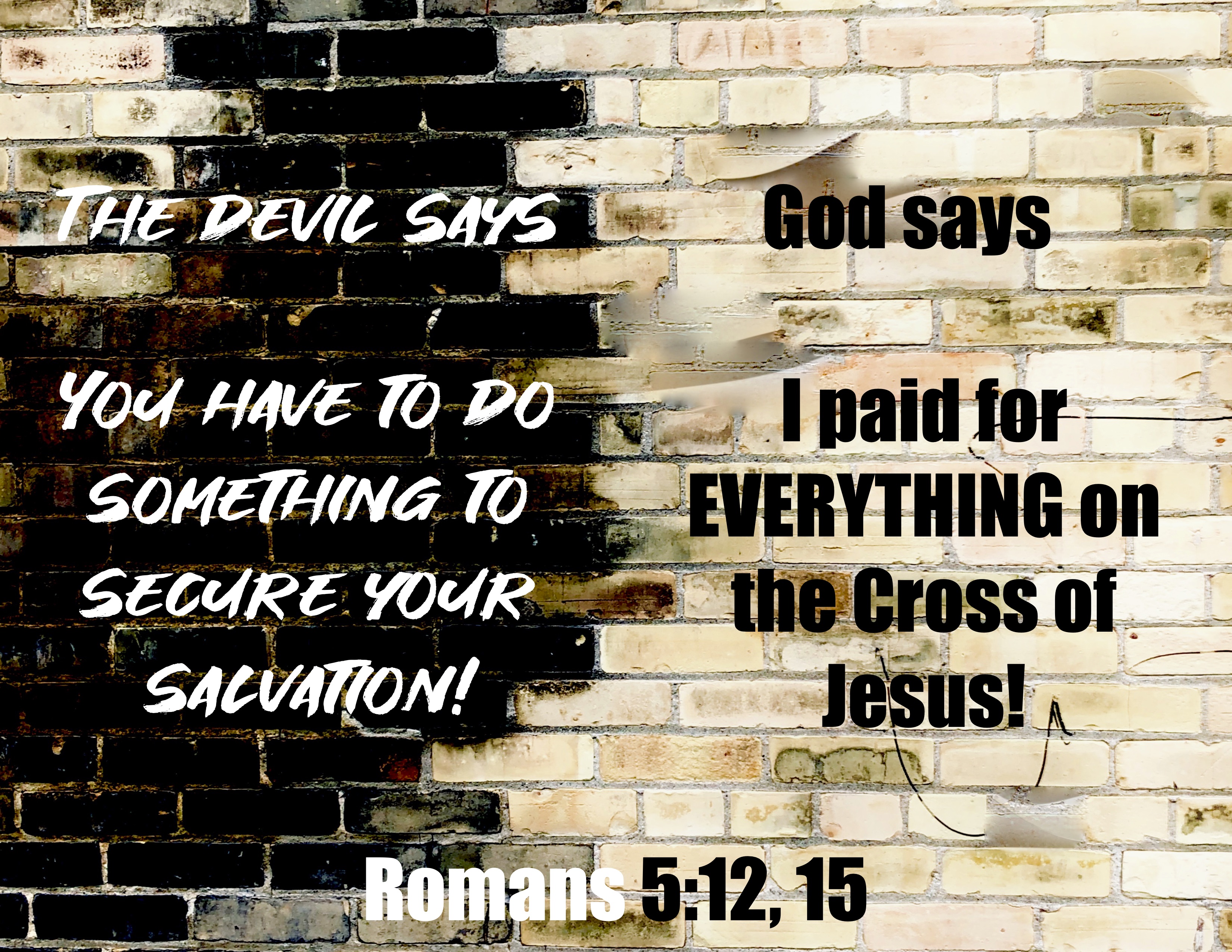
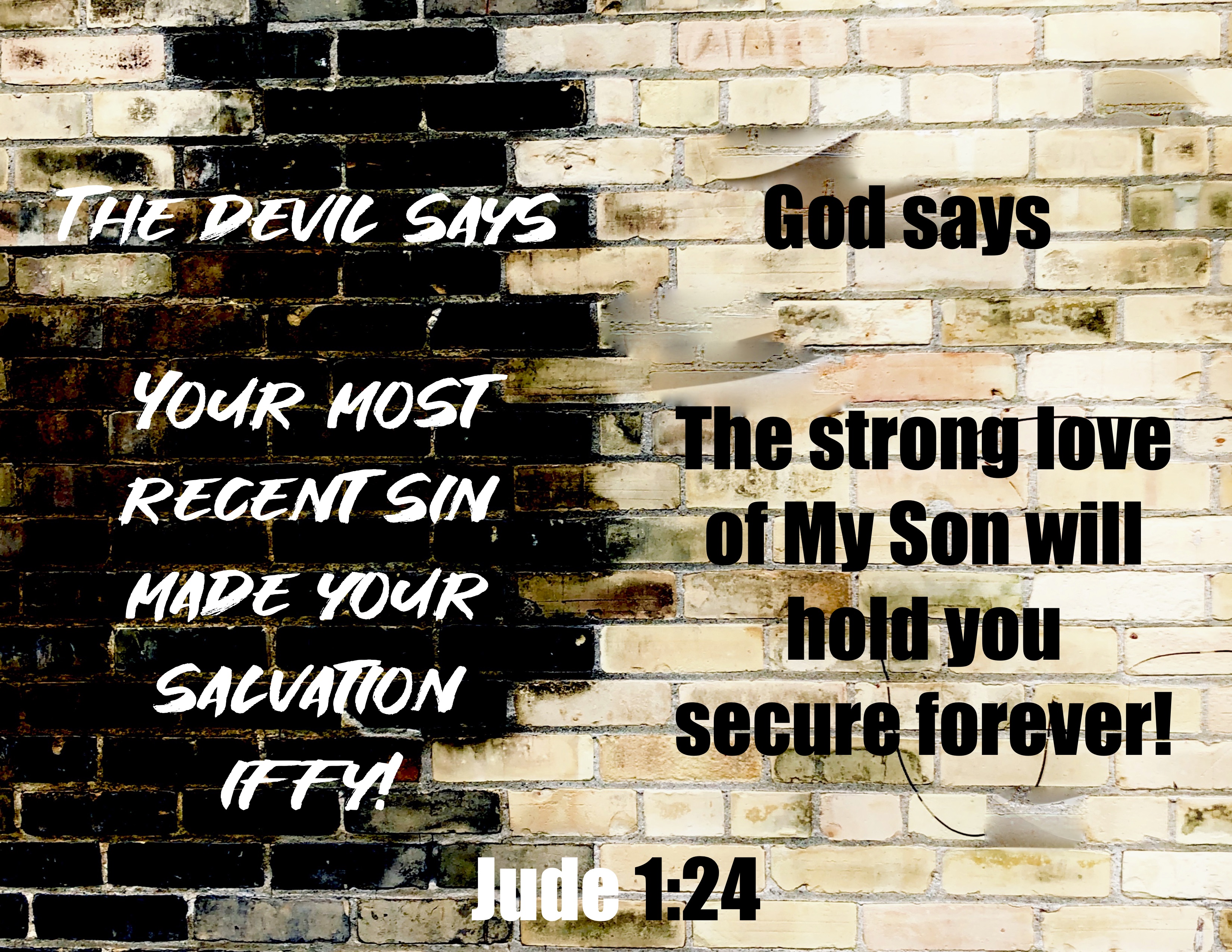
A few months ago I began designing a series of graphics under the heading, “Says who?” I took some of the lies of satan and put them side-by-side with the truth from God’s Word.
When God is our Savior, we are secure. The devil would love to make us think that our salvation is hanging by a thread, that we have to work harder to make sure we don’t miss out, that a single sin can disqualify us from God’s favor, and a hundred other lies. But they are all just that: lies!
We have to learn to capture each of these thoughts, and if they are thoughts that don’t align with God’s Word, then we need to confront them with the truth. I have found it very helpful to speak these truths out loud. To see some of the ways I suggested thinking differently about the devil’s lies, check out this post on reversing your thinking.
As the old hymn says, “Jesus paid it all, all to Him I owe.” You don’t have to earn your salvation or make your position secure—your salvation has been paid-in-full and you are perfectly secure! Now what you owe to Jesus is to allow Him to take you safely home.
Listen to the podcast of this post by clicking on the player below, and you can also subscribe on Apple or Spotify.
Hear my cry for mercy … He has heard my cry for mercy (Psalm 28:2, 6).
For David, his cry for mercy was never a one-and-done action. The verb in verse 2 makes this verse read more like, “Hear my cry for mercy as I am continuallycalling to You for help, as I am continuallylifting up my hands toward Your Most Holy Place.”
Why the Most Holy Place? What was there? Inside the Most Holy Place was the ark of the covenant of the Lord which represented the presence of God.
What was on top of the ark of the covenant, covering and superseding the Law that was inside the ark? It was the mercyseat (or the “atonement cover” in some translations). The mercyseat is where the high priest sprinkled the blood of the sacrificial lamb every year to make atonement for sins.
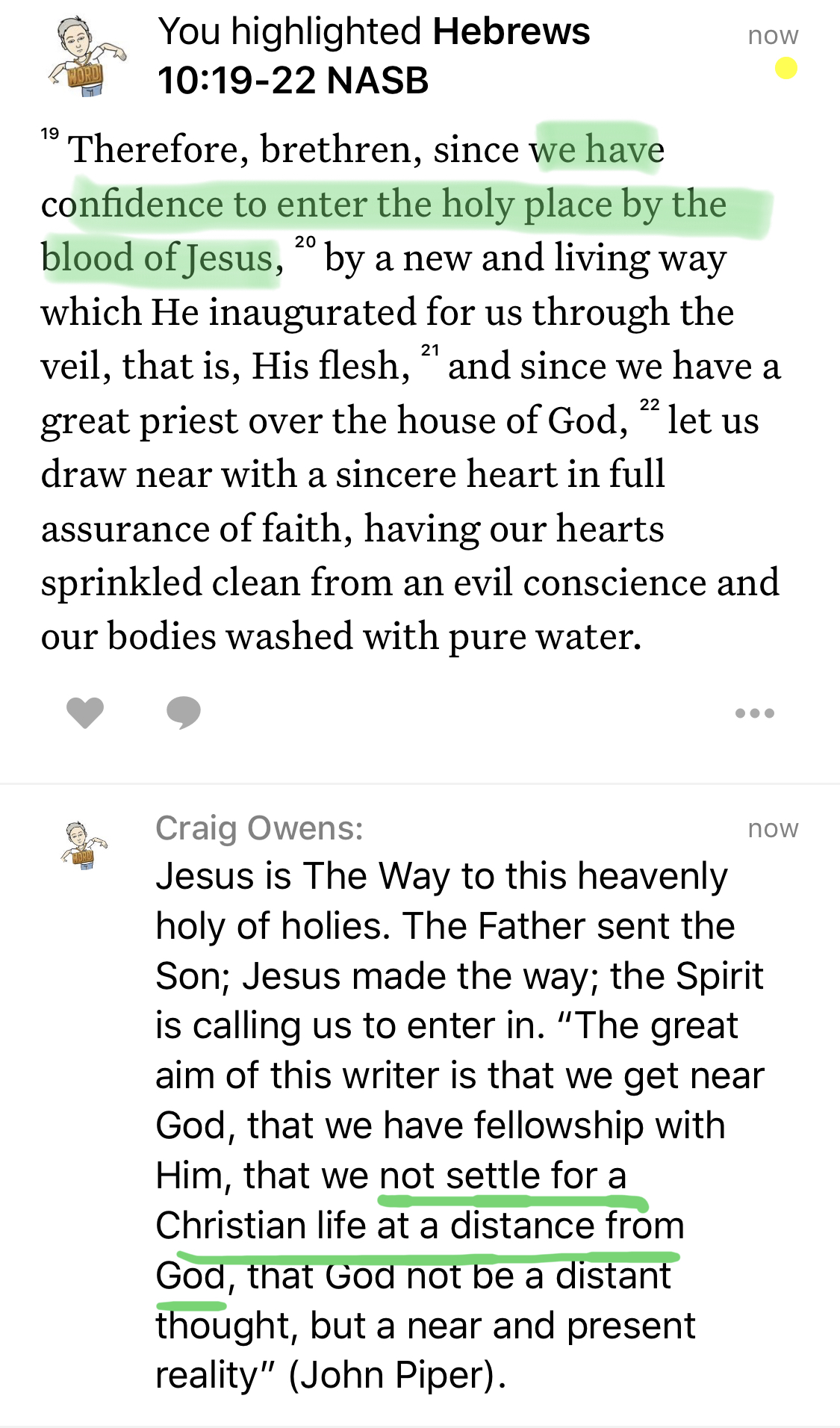
Jesus became the once-for-all sacrificial Lamb to make ultimate atonement for all who would believe in Him. When Jesus had finished His work on the Cross, the curtain separating us from the Most Holy Place was torn in two. The ark of the covenant of the Lord with its covering mercyseat—the presence of God—was now accessible to all of us! It was accessible because it was in Jesus, and when I have taken Jesus as my atonement, He is in me and He takes me in to the Father. The mercyseat of my heart has been sprinkled with the blood of the Lamb (see Hebrews 9:1-5, 11-14; 10:19-22).
Whether David was saying, “Hear my cry,” or “He has heard my cry,” the Hebrew word means to listen with interest and full attention. Whenever you pray, God listens to you with interest and full attention because you are praying right in His presence! Your very breath can be a continual crying, a continual lifting of your voice toward the mercyseat where God meets with you!
God is not far away from us. He is closer than we usually think. That’s why David says, “My heart leaps for joy, and with my song I praise Him”!
Keep this in mind the next time you are asking God to hear your cry: He listens to you with full attention because Jesus has taken you right into His presence.
This is a weekly series with things I’m reading and pondering from Charles Spurgeon. You can read the original seed thought here, or type “Thursdays With Spurgeon” in the search box to read more entries.
Listen to the podcast of this post by clicking on the player below, and you can also subscribe on iTunes or Spotify.
My Rock
[God] alone is my rock and my salvation (Psalm 62:2).
How noble a title; it is so sublime, suggestive, and overpowering. ‘My rock.’ It is a figure so divine that to God alone will it ever be applied. …
Unchangeable He is in His being, firm in His own sufficiency. He keeps Himself immutably the same. And ‘therefore you are not consumed, O sons of Jacob’ (Malachi 3:6). … So is our God a sure defense, and we will not be moved if He has set our feet upon a rock and established our goings (see Psalm 40:2). …
‘He is my rock.’ How glorious a thought! How safe am I and how secure and how may I rejoice in the fact that when I wade through Jordan’s stream He will be my rock! I will not walk upon a slippery foundation, but I will tread on Him who cannot betray my feet. And I may sing when I am dying, ‘He is my rock, and there is no unrighteousness in Him’ (Psalm 92:15).
From God Alone The Salvation Of His People
Spurgeon mentioned singing about God our Rock even when we come to death’s door. Immediately a couple of songs from my childhood sprang to mind.
Rock of Ages, cleft for me,
Let me hide myself in Thee;
Let the water and the blood,
From Thy wounded side which flowed,
Be of sin the double cure,
Save from wrath and make me pure.
While I draw this fleeting breath,
When my eyes shall close in death,
When I rise to worlds unknown,
And behold Thee on Thy throne,
Rock of Ages, cleft for me,
Let me hide myself in Thee. (Augustus Toplady)
Where do I go when there’s nobody else to turn to?
Who do I turn to when nobody wants to listen?
Who do I lean on when there’s no foundation stable?
I go to the Rock, I know He’s able, I go to the Rock.
I go to the Rock of my salvation,
I go to the Stone that the builders rejected,
I run to the Mountain and the Mountain stands by me.
When the earth all around me is sinking sand
On Christ, the Solid Rock, I stand
When I need a shelter, when I need a friend, I go to the Rock. (Dottie Rambo)
My friend, no matter how unstable things may seem, no matter how uncertain the future may appear, remember the One and Only Rock. He alone is my rock and my salvation! Jesus is the same yesterday, today, and forever. Don’t try to make your own secure place, but run to the Rock of Ages, and this immovable Mountain will stand by you and keep you secure for all of eternity!
Listen to the podcast of this post by clicking on the player below, and you can also subscribe on Apple or Spotify.
The Lord is my light and my salvation—whom shall I fear? The Lord is the stronghold of my life—of whom shall I be afraid? (Psalm 27:1)
How many of my daily choices are affected by fear?
whether to try something new or to stick with what’s familiar?
should I confront a friend on a bad choice or let him figure it out on his own?
to spend money or to invest it for later? what do I buy? where do I invest?
what if people don’t like what I do or say? what if they talk behind my back?
David begins this psalm with the same kinds of questions, as he battles enemies surrounding him, the possibility of his family rejecting him, false witnesses speaking lies against him, and foes closing in from every side.
In the middle of all of these swirling issues, David exhibits a confidence that starkly stands out:
whom shall I fear?
of whom shall I be afraid?
my heart will not fear
I will be confident
I am still confident
How can David respond this way? He kept turning his thoughts from the temporal to the eternal—
It may seem dark now, but God is light.
People may be fickle, but God is unchanging.
Foes may be strong, but God is the strongest.
People are mean, but God is good.
Both David’s opening and closing thoughts in this psalm are really a conversation with himself: The Lord is my light and my salvation—whom shall I fear? The Lord is the stronghold of my life—of whom shall I be afraid? … I am still confident of this: I will see the goodness of the Lord in the land of the living. Wait for the Lord; be strong and take heart and wait for the Lord. (vv. 1, 13, 14)
My friends, don’t let fear drive your decisions. Let confidence in God drive your decisions. Talk back to your fearful thoughts like David did and remind them of the great and loving God that cares for you. Don’t take matters into your own hand, but wait for the Lord; be strong and take heart and wait for the Lord.
I used Psalm 27 as a teaching example of how to turn passages from the Bible into our own personalized prayers. Check out this 5-minute video here:
There is another thing both David and Jesus agree upon. They both tell us that there is one thing that can block our prayer: unconfessed, unrepented sin.
David wrote, “If I regard iniquity in my heart, the Lord will not hear.” The Hebrew word translated “regard” means to be aware of something. David teaches us that we have to be made aware of our sin in order to confess our sin and ask forgiveness. We become aware of our sin through prayer and reading the Bible (Psalm 139:23; James 1:25; Romans 7:7-12).
The NIV translates the same Hebrew word in Psalm 66:18 as “cherished.” After becoming aware of our sin, we have to be careful not to make excuses or justifications for it. And then the NLT translates the same word “not confessed.” After becoming aware of our sin and accepting responsibility for it, then we can confess it to God.
In teaching us to pray, Jesus said our forgiveness of others had a direct correlation to the forgiveness we would receive from our Heavenly Father (Matthew 6:12, 14-15). Jesus further expounds this thought when He tells Peter to forgive others “seventy times seven times”; in other words: countless times.
Think of it this way: Have you asked God’s forgiveness more than seven times? How about more than seven times for the same sin? I have! So Jesus is really asking Peter, “Do you want God to put a limit on how many times He will forgive you? If not, then don’t you put a limit on how many times you will forgive others.”
The Amplified Bible has a great definition of forgiveness in Matthew 6:12—left, remitted, let go of the debts, and have given up resentment against. The Hebrew word David uses in Psalm 32:1 has a similar feel—lifted up, taken away, carried off.
Our forgiven sins are forgotten sins. Every time we come to God for forgiveness, it’s like it is the first time. And Jesus says this is the same way we need to treat others.
Let’s all strive to be first responders in confessing our own debts to God so we can be forgiven, AND then let’s also be first responders in forgiving the debts others have incurred against us.
As I’ve said before: A mark of a maturing saint is one who is closing the gap between awareness of his sin and making his confession of that sin.
But this is just as true:
A mark of a maturing saint is one who is closing the gap between being injured and forgiving the offender.
We do this again and again and again—countless times!—because that’s how often our Heavenly Father forgives us.
Be a first responder in both asking for forgiveness and giving forgiveness.
Don’t let your debts block your prayers.
Don’t let your unreceived forgiveness weigh you down.
Don’t let your ungiven forgiveness weigh others down.
Listen to the podcast of this post by clicking on the player below, and you can also subscribe on Apple or Spotify.
I have always been mindful of Your unfailing love…. (Psalm 26:3).
The dictionary defines “mindful” as simply being aware. Unfortunately, many psychologists today have constricted this term to mean simply being aware of the present moment, especially one’s own emotions in the present moment.
In the New Living Translation, this verse has David saying to God, “I am alwaysaware of Your unfailing love.” God’s unfailing love is an eternal attribute of God, and David says he is perpetually contemplating this attribute. But notice how David applies mindfulness not just to his present moment, but to his past and future as well. In fact, David invites God to examine his heart and mind to verify that David is always properly mindful of God’s love.
Notice the past, present, and future tenses David uses—
Past (v. 1):
I have led a blameless life
I have trusted in the Lord without wavering
Present (vv. 3, 7, 11):
Your love is ever before me
I walk continually in Your truth
I proclaim aloud your praise
I lead a blameless life
Future (v. 12):
In the great assembly I will praise the Lord
Notice that between David’s claim that he has led a blameless life and that he isstill leading a blameless life, we read his request for God to, “Test me, O Lord, and try me, examine my heart and my mind.” David was perpetually mindful of God’s awareness of both his thoughts and his lifestyle.
Being mindful of God’s love means looking back in gratitude to recall God’s past provision, looking around in worship to see God’s ongoing involvement, and looking ahead in hope to anticipate God’s unending grace.
Unlike modern-day psychology which tells us mindfulness is a narrowing of our thoughts, biblical mindfulness is an expanding of our thoughts. Biblical mindfulness sees God’s past work and His future grace, and brings those to bear on our present circumstances.
DON’T #1: Don’t be a hypocrite. That word literally means a play-actor. More than anyone else ever will, God sees who we really are. We cannot fool Him so there is no reason to fake it. For proof, check out some of the gut-level-honest prayers David records in the psalms!
DON’T #2: Don’t babble. The Greek word here is unique: It’s made up of the name of a poet named Battus who was needlessly wordy, and the Greek word for word. In Greek, the word battologeō is an onomatopoeic word (like our English words that sound like what they really are describing: words like whoosh, buzz, or smack). It means rambling with our mouth, but our hearts and heads simply aren’t engaged as well.
“When prayer has become secondary, or incidental, it has lost its power. Those who are conspicuously men of prayer are those who use prayer as they use food, or air, or light, or money.” —M.E. Andross
My friend’s trainer recently told him, “You cannot out-exercise a bad diet.” I think this is just as true in the realm of prayer: You cannot out-________ a bad prayer diet. You cannot…
…out-religion a bad prayer diet, as though your religious exercises can make up for a lack of prayerful food.
…out-talk a bad prayer diet, or “babble,” as Jesus said.
…out-strategize a bad prayer diet, as one successful man attempted to do (see Luke 12:16-20).
Jesus said our heavenly Father is just waiting for us to ask Him for what we need. In Psalm 5, David explained how attentive God is, even understanding our cries, our sighs, and our groans. So David’s conclusion was: “Lord, every morning You hear my voice. Every morning, I tell You what I need, and I wait for Your answer.”
Friends, we need to be first responders in prayer. Make it a habit every morning to let God hear your voice before anyone else does. DON’T make a show out of it or babble some words you don’t really feel, but DO talk with your loving heavenly Father about what you need for this upcoming day. He has already prepared a good, healthy diet for you, so ask Him to give you this day what you need, and then be expectant all day long in the ways your Father will answer you.
Listen to the podcast of this post by clicking on the player below, and you can also subscribe on Apple or Spotify.
…whoever does these things will never be shaken (Psalm 15:5).
David says “these things” are what allow us to come into God’s presence, but we cannot consistently nor completely do “these things” without the help that can only come from being in God’s presence. So I have to already be doing “these things” in order to get into His presence in order to get empowered to do “these things”?!
That seems like a classic, no-win, Catch-22!
So… how do I get into God’s presence in the first place?
Simple: I can’t.
Only Jesus can.
Thankfully, He made it possible for me to come in: He became the Door!
Only by Jesus can I come in. Only in Jesus can I be empowered. Only with Jesus can I consistently do “these things.”
What are “these things” that David listed that both allow me to come into God’s presence and then keep me in God’s presence? David said we must…
…speak truthfully: from the heart, no slander on my tongue, no unkind words in my mouth, no gossip on my lips.
…live courageously: honoring what is good and opposing what is evil.
…keep my oaths: making my yes mean yes, not making any excuses, helping others to do the same.
“These things” both glorify God and keep me in God’s presence. And “these things” attract others to His presence too. But I don’t try to do “these things” in my own strength—that would make me God—nor just as a religious To-Do List—that would make me a Pharisee. But I take a cue from the apostle Paul—
But whatever I am now, it is all because God poured out His special favor on me—and not without results. For I have worked harder than any of the other apostles; yet it was not I but God who was working through me by His grace (1 Corinthians 15:10).
It is grace—a free gift of God—that enables me to do “these things” not in my own strength, but in His strength!
I don’t try harder to do “these things” that keep me secure in God’s presence, but I trust more profoundly in His grace that continually empowers me to successfully do “these things” every single day.



 I will not be dissuaded from my view






 Craig T. Owens