Links & Quotes

I love the humanitarian work of Convoy of Hope wherever there is a need. They are on the front lines of Ukraine right now. If you are looking for a good organization to support financially, please check out their current efforts and click the Donate button on their page.

“[God] does not need us. If we stay away He is not impoverished. He does not need us in order to be happy in the fellowship of the Trinity. But He magnifies His mercy by giving us free access through His Son, in spite of our sin, to the one Reality that can satisfy us completely and forever, namely, Himself. ‘You make known to me the path of life; in Your presence there is fullness of joy; at Your right hand are pleasures forevermore’ (Psalm 16:11).” —John Piper 

“Good preachers are good learners, and not just of the Scriptures. They need to understand the times and the ways the times impact the people they are called to serve. Preachers who know their sheep well, as our Good Shepherd exemplified for us, will hear their concerns, understand their thoughts, discern their hopes and fears, and be able to preach in a way that speaks directly to their souls with transforming grace and power. Let us strive to be sons of Issachar when it comes to the ministry of God’s Word.” —T.M. Moore 

I love the Babylon Bee! Here is something that should make every pastor say, “Aha!”—Scholars Discover Introductory Notes To Paul’s Epistles That Dismissed The Children To Youth Ministry So The Adults Could Hear The Message

This week I shared another exclusive video with my Patreon supporters. Please consider supporting this ministry at just $5 per month. I also shared this public video especially for my fellow pastors:

John Stonestreet wrote about our amazing brain. What a marvelous thing our Creator has given us! Here is just one example: “In 2013, a collaboration between Japanese and German scientists created one of the most realistic brain simulations ever attempted. They used what was, at that time, the world’s fourth-largest computer, containing over 700,000 processor cores and producing an eye-popping 1.4 million gigabytes of RAM. The machine worked at top speed, crunching numbers for over 40 minutes. In the end, it produced just one second of simulated brain activity.”
Which Engine Drives You?

Listen to the podcast of this post by clicking on the player below, and you can also subscribe on AppleSpotify, or Audible. 

There’s a little song that makes me chuckle every time I hear it, and I may have even sung this song a couple of times myself. It goes like this, “I had a lot to do today, but you know what I did instead? I took a nap. It was a very good nap.” 

We’ve all been there. There are things we know that we should do, but we simply don’t feel like doing them. We let our feelings drive our actions. There are several seemingly innocent things that we can handle this way, with no apparent problems created for ourselves. 

The real problem comes in when our feelings continually drive our actions. Because the caboose which must follow that engine can easily become “my truth.” It goes like this:

  • I let my feelings take the lead
  • I act on my feelings
  • I now believe what I felt was truthful

This could be called pragmatism—allowing a positive outcome to determine what I believe to be truth. 

But our feelings may lie to us. Our feelings can make us believe something is harmless, when in fact it may be putting us on a path from which it may be extremely difficult to recover. 

Jesus taught us a different way. He prayed this way to His Father, “Your Word is truth” (John 17:17). He may have had in mind these words from the psalmist:

The sum of Your word is truth—the total of the full meaning of all Your individual precepts; and every one of Your righteous decrees endures forever. (Psalm 119:160 AMP) 

When we let truth drive our actions, we are performing those actions in faith that good feelings will follow. Now the progression goes like this:

  • I let what I know to be true take the lead
  • I act on that truth
  • I feel good for doing the right thing

I may not feel like exercising, but I know it’s good for me. So I do it and then I feel good for doing it, and my body is healthier for doing it. 

I may not feel like forgiving the one who wronged me, but I know God says I should. So I do it and then I feel good for doing it, and my emotions are healthier for doing it. 

I may not feel like speaking the tough word in love to my friend, but I know the Bible says I should. So I do it and then I feel good for doing it, and my relationship is healthier for doing it.

Letting God’s truth be the engine that drives our actions will result in healthiness and good feelings. But letting my emotions be the engine that drives my actions may sometimes result in temporary good feelings, but the longterm consequences may not be healthy or God-honoring. 

We should not say, “God, please bless what I’m doing so that I can feel good about it,” but instead we should say, “God please help me to do what You say is right, and I know I will feel good because Your blessing will be on it.” 

►► Would you please prayerfully consider supporting this ministry? My Patreon supporters get behind-the-scenes access to exclusive materials. ◀︎◀︎

Thursdays With Spurgeon—The Natural Out-Gushing

This is a weekly series with things I’m reading and pondering from Charles Spurgeon. You can read the original seed thought here, or type “Thursdays With Spurgeon” in the search box to read more entries.

Listen to the podcast of this post by clicking on the player below, and you can also subscribe on AppleSpotify, or Audible. 

The Natural Out-Gushing

If you remain in Me and My words remain in you, ask whatever you wish, and it will be done for you. (John 15:7) 

   He does not say, ‘If you abide in Me, and My words abide in you, you will do spiritual things,’ but ‘you will ask.’ By prayer you will be enabled to do. But before all attempts to do, you will ask. The choice privilege here given is a mighty prevailing prayerfulness. Power in prayer is very much the gauge of our spiritual condition. …  

     Prayer comes spontaneously from those who abide in Jesus. … Prayer is the natural out-gushing of a soul in communion with Jesus. Just as the leaf and the fruit will come out of the vine without any conscious effort on the part of the branch but simply because of its living union with the stem, so prayer buds and blossoms and produces fruit out of souls abiding in Jesus. … They do not say to themselves, ‘Now is the time for us to get to our task and pray.’ No, they pray as wise men eat—namely, when the desire for it is upon them. …  

     Habitual asking comes out of abiding in Christ. You will not need urging to pray when you are abiding with Jesus. … 

     ‘If you abide in Me, and My words abide in you, you will ask’—and you will not wish to cease from asking. He has said, ‘Seek My face,’ and your heart will answer, ‘Your face, Lord, I will seek’ (Psalm 27:8). … 

     This power in prayer is like the sword of Goliath. Wisely may every David say, ‘There is none like it; give it to me’ (1 Samuel 21:9). This weapon of all-prayer beats the enemy and at the same time enriches its possessor with all the wealth of God.

 From The Secret Of Power In Prayer

When I first met the beautiful young lady that would eventually become my wife, we spent hours and hours and hours talking with each other. It was how I got to know her heart, and how she got to know mine. My conversations with Betsy are still some of the most cherished times I have. 

But what if after we got married I said to Betsy, “I love you, my darling, and I’m so looking forward to a lifetime with you! I will make it a priority to give you my undivided attention for 90 minutes every Sunday morning. Other than that, I’ll be thinking about you while I go about my busy life.” How intimate is this relationship going remain? 

Sadly, this is how many Christians treat their relationship with Jesus. “Thank You for saving me from the penalty of my sin, Jesus! I love You and I’m so looking forward to an eternity with You in Heaven. I will make it a priority to give You my undivided attention every week at church. Other than that, I’ll be thinking about You while I go about my busy life.” 

This is not abiding. 

No branch can remain healthy and produce any fruit if it is only occasionally attached to the vine. In order for the branch to be fruitful, it must be continually abiding in the life-giving sap of the vine. 

Intimacy with Jesus means abiding with Him at all times. It means engaging in conversation with Him at all times. Brother Lawrence commented, “The time of business does not with me differ from the time of prayer; and in the noise and clatter of my kitchen, I possess God in as great tranquility as if I were upon my knees at the blessed sacrament.” 

My friend, let’s all seek to become more aware of the closeness of Jesus. Let us “take delight in the Lord” (Psalm 37:4) and continually engage Him in intimate conversation. As we do, the fruitfulness of our prayer life cannot help but blossom into beautiful things that give God great joy and glory.

►► Would you please prayerfully consider supporting this ministry? My Patreon supporters get behind-the-scenes access to exclusive materials. ◀︎◀︎

The Incomparable Jesus

Listen to the podcast of this post by clicking on the player below, and you can also subscribe on AppleSpotify, or Audible. 

C.S. Lewis, like many atheists, wondered if the God of the Bible might be an egomaniac because He is always encouraging people to praise Him. In his book Reflections on the Psalms, Lewis wrote a thoughtful response to this after he had become a Christian: 

“Just as men spontaneously praise whatever they value, so they spontaneously urge us to join them in praising it. ‘Isn’t she lovely? Wasn’t it glorious? Don’t you think that magnificent?’ … I think we delight to praise what we enjoy because the praise not merely expresses but completes the enjoyment; it is its appointed consummation. It is not out of compliment that lovers keep on telling one another how beautiful they are; the delight is incomplete till it is expressed. … This is so even when our expressions are inadequate, as of course they usually are. But how if one could really and fully praise even such things to perfection—utterly ‘get out’ in poetry or music or pain the upsurge of appreciation which almost bursts you? Then indeed the object would be fully appreciated and our delight would have attained perfect development. The worthier the object, the more intense this delight would be.” 

His phrase, “our expressions are inadequate” is especially true when we are attempting to appreciate and praise the Infinite, the Eternal, the Omnipresence, the Omnipotence of our God and Savior! But the biblical authors call for Christians to mature in this—we want to keep praising, keep expressing, until we finally find the perfect fulfillment in His presence. 

Paul talks about the maturing nature of love—when I was a child, I talked like a child, I thought like a child, I reasoned like a child (1 Corinthians 13:11)—but then he prays for us to grow in both our understanding and our expressions of our Savior’s love (Ephesians 1:17-19). 

I like the wording of Ephesians 1:19 in the King James Version: the exceeding greatness of His power to us-ward. The word “exceeding” means God pours out in a way that is beyond human imagining. The Greek word that Paul uses for “greatness” is only used here, and it reinforces the truth that God is beyond our full comprehension. And then Paul adds that this overflowing, incomparable power is directed “to us-ward”! 

Paul then prays for us to be able to understand ever-increasing new dimensions of this transcendent power and ability that God directs to us through His Son Jesus, and for us to be able to express it (Ephesians 3:14-19). In other words, we are to grow in our experience of Jesus so that we can grow in our praise to Jesus. 

The incomparable Jesus means at least four things for us. It means Jesus is…

  1. …beyond comparison. Isaiah, God Himself, and the psalmists ask rhetorically, “Who is like God? Who could ever compare to Him?” (Isaiah 40:13-14, 18, 25; Psalm 89:5-8).  
  1. …matchless in His power. Isaiah 40:12 says God holds the waters of the world in the hollow of His hand. How much water is this? Scientists estimate the Earth’s water supply to be 326 quintillion gallons of water (that’s 326 followed by 18 zeros)! Not only does God hold all of the water, but He directs its activities on behalf of His children (Exodus 15:11-13). 
  1. …unequaled in knowledge. Isaiah 40:12, 26 tell us that all of the stars in our universe fit onto God’s outstretched hand, and that He knows all of the stars by name. How many stars is this? Astronomers calculate the heavens to contain 10 septillion stars (that’s 10 followed by 24 zeros)! Not only does God know each star by name, He knows each human by name, and the smallest of details about each of them (Isaiah 49:16; Matthew 10:29-31). 
  1. …inimitable in His care. We humans can get to the end of our strength, but God never does. He cares for us unlike anyone else or anything else ever can (Isaiah 40:28-31). The Lord hears His people when they call to Him for help. He rescues them from all their troubles (Psalm 34:17). 

Knowing we have a Savior like this, why would you ever settle for anything less The Genuine?! 

Our incomparable Jesus wants us to pray in His incomparable name so that our incomparable Father can answer in a way that brings Him incomparable glory! We’re helped, He’s lifted up, and others are drawn to Him. 

►► Would you please prayerfully consider supporting this ministry? My Patreon supporters get behind-the-scenes access to exclusive materials. ◀︎◀︎

If you’ve missed any of the messages in this series on prayer, you can find a list of all of the messages by clicking here. 

Links & Quotes

John Piper wrote to pastors, “That is the main task of preaching, and the main purpose of small groups and all the ministries of the church: helping people see the greatness of what Christ has purchased for everyone who will value it above the world. Helping people see it and savor it, so that God’s superior worth shines in their satisfaction and in the sacrifices that come from such a heart.”

“The gospel of Christ, what is it? We look at the last two words, ‘of Christ.’ Indeed, if you understand Christ, you understand the gospel. Christ is the Author of it. He, in the council chamber of eternity, proposed to become the Surety for poor fallen man! He, in the fullness of time, worked out eternal redemption for as many as His Father had given Him. He is the Author of it as its Architect and Builder. We see in Christ Jesus the Alpha and the Omega of the gospel. He has provided in the treasury of grace all that is necessary to make the gospel the gospel of our salvation. And as He is the Author of it, so He is the matter of it. It is impossible to preach the gospel without preaching the Person, the work, the office, and the character of Christ. If Christ is preached, the gospel is promulgated, and if Christ is put in the background, then there is no gospel declared.” —Charles Spurgeon

Would you prayerfully consider supporting my Patreon page at only $5 per month?

Josh McDowell addresses the question, “Did Jesus say He is God?

Marshall Seagal wrote an insightful article about patience. He notes, “Patience exists only in a world of disruption, delays, and disappointment. It grows only on the battlefield. We cannot practice patience unless our circumstances call for it—and the circumstances that call for it are the kinds of circumstances we wouldn’t choose for ourselves.”

The Biblical Archeological Report has a history of Egyptian Pharaoh Hophra that is quite fascinating. It’s always so interesting to me to watch how these archeological finds square with the historical records contained in the Bible.

The Human Jesus

Listen to the podcast of this post by clicking on the player below, and you can also subscribe on AppleSpotify, or Audible. 

We saw that our beautiful Jesus became grotesque—taking our ugly sin on Himself so that He could clothe us with His perfectly righteous robe. In so doing, He became even more resplendent. His friend John saw Him in such radiant beauty that he crumbled to his knees at the sight of His majesty (Revelation 1:12-16)! 

Just like John and others in the Bible, when we see ourselves in contrast to His awesome beauty, we often feel shabby and unworthy to be in His presence. Job expressed his desire to somehow get away from this Perfection (Job 7:11-21). Ultimately, in his desperation, Job utters something prophetic—

God is not a mere mortal like me that I might answer Him, that we might confront each other in court. If only there were someone to mediate between us, someone to bring us together, someone to remove God’s rod from me, so that His terror would frighten me no more. Then I would speak up without fear of Him, but as it now stands with me, I cannot. (Job 9:32-35) 

When we are confronted with the perfection of God, we all want “someone to arbitrate”—someone who will fairly represent both sides. We need someone both God and man. Since man cannot become God, only God can become man. Isaiah prophesied it this way, “God saw that there was no one, He was appalled that there was no one to intervene; so His own arm achieved salvation for Him” (Isaiah 59:16). 

This Arbitrator or Mediator is Jesus the Christ! 

Jesus means “help from Jehovah.” This is His human name given to Him at His birth (Luke 1:31; Matthew 1:21, 25; Luke 2:21). 

Christ or Messiah means “anointed by God” and is His divine title. Often His title is used with the definite article “the” to signify that Jesus is the One and Only Messiah (Luke 2:26-27; John 1:41; Matthew 16:16; Acts 10:38). 

William Barclay commented on this: “Peter states [that Jesus was a human descendent of David] in the first recorded sermon of the Christian Church (Acts 2:29-36). Paul speaks of Jesus Christ descended from David according to the flesh (Romans 1:3). The writer of the Pastoral Epistles urges men to remember that Jesus Christ, descended from David, was raised from the dead (2 Timothy 2:8). The writer of the Revelation hears the Risen Christ say: ‘I am the root and the offspring of David’ (Revelation 22:16).” 

Many times this human name and divine title are linked together. In Hebrews, the name Jesus is used more times than any other title (19x), and Christ is the second-most used title (15x).

(For my Patreon supporters, I’ve shared a list of all of the titles for Jesus used in the book of Hebrews.)

Hebrews makes it perfectly clear how important it is that Jesus was made fully human just like us. We read phrases like

  • “made a little lower than the angels,” which was David’s way of talking about humans (see Psalm 8:4-6) 
  • “made perfect through suffering”—only humans can suffer 
  • “flesh and blood” 
  • “made like His brothers in every way” 
  • “His life on earth”

Remember that I said the most-used titles in Hebrews were Jesus and Christ. The third-most used title in Hebrews is high priest (14x). Only the Human Jesus and the Divine Jesus could be the perfect High Priest and Mediator that Job longed for, and that you and I have to have!

This post is a part of a bigger series on prayer with the subtitle: “Learning to pray in the awesome name of Jesus.” So what does it mean that we can pray in the human name of Jesus? 

It means we don’t have to pray majestic prayers in order for God to take notice. We can pray very human prayers, we can groan with real human pain, we can growl with real human anger. Our totally human Jesus understands us, and the totally divine Christ runs to help us! 

Don’t try to sanitize your prayers to make them sound acceptable. Jesus didn’t! How awesome it is to have a High Priest who is both fully human and fully divine! 

If you’ve missed any of the other messages in this series on prayer, you can find a link to all of them by clicking here. 

►► Would you please prayerfully consider supporting this ministry? My Patreon supporters get behind-the-scenes access to exclusive materials. ◀︎◀︎

Links & Quotes

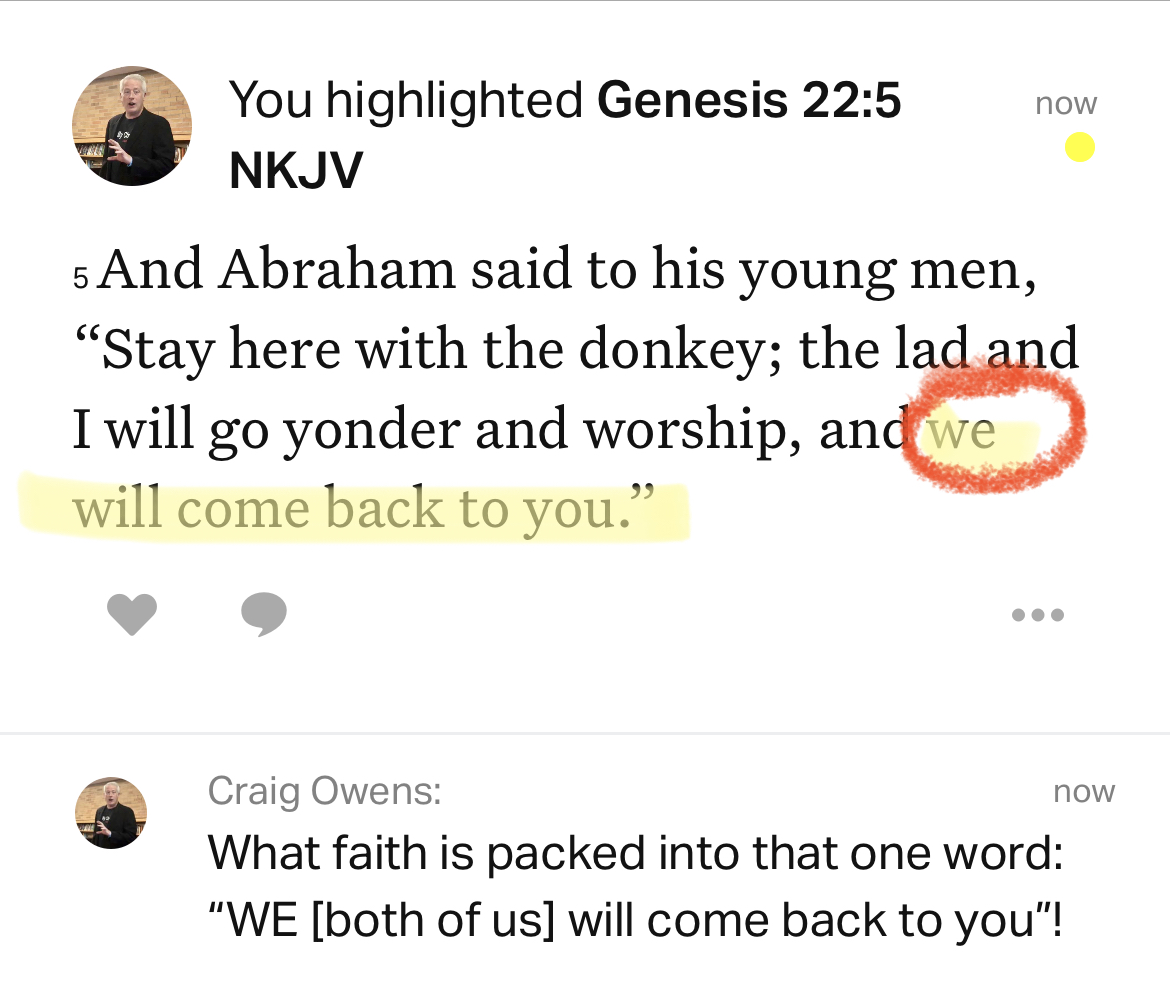
Abraham is commanded by God to sacrifice his son Isaac. Look at Abraham’s faith in just one word: “WE will come back to you.”

Follow me on YouVersion so we can share more thoughts on God’s Word with each other.

Wil Robinson shares a fable from Leo Tolstoy with the three most important questions everyone should ask themselves. The three questions are: How can I learn to do the right thing at the right time? Who are the people I most need, and to whom should I, therefore, pay more attention than to the rest? And, what affairs are the most important and need my first attention?

T.M. Moore reminds us how the promises of God can build courage in us. Check out all of the posts in his series called Brave Heart.

“Faithfulness is displayed in both word and deed—seen best by combining the Great Commission’s instruction to ‘make disciples’ with the second greatest commandment to ‘love thy neighbor.’ The beauty of the Gospel is found in both proclamation and demonstration. Neither comes first; neither comes second. Like the perfect marriage, it’s the duty of the Christians to take on each, giving 100 percent effort to both.” —Gabe Lyons, The Next Christians 

Fight The New Drug shared the results of a study of over 11,000 releationships, the five things the happiest couples have in common, and how pornography can undermine those relationships.

“Oh, that the eyes of sinners may be speedily opened—that they may see the difference of things, the beauty which is in holiness, and the astonishing madness that is in sin!” —Thomas Watson

Science is an important component in seeking truth. The Institute for Creation Research has an excellent perspective on the role of science for a Christian: “While the pursuit of science is certainly noble, it should be situated in its proper context and tackle matters within its empirically defined framework.”

John Piper observes, “The number-one reason why people in such seemingly hopeless situations purchase scratch-offs is because things already look so hopeless for improvement that the so-called ‘stupidity’ of wasting this dollar won’t really make anything worse.” This post elaborates on how the lottery preys on the poor.

The Awesome Jesus

Listen to the podcast of this post by clicking on the player below, and you can also subscribe on AppleSpotify, or Audible.

Comedian Brian Regan tells a story about people trying to one-up others with their stories. He explains that he has a “social fantasy” that he wishes he was one of the 12 people who have walked on the moon. How nice it must be, he says, that they can top any story!  

It’s one thing to read things, hear things, and even believe things, but it’s something completely different when you experience those things for yourself. 

The one with an experience…

  1. …is never at the mercy of the one with an argument 
  2. …gains the ear of others 
  3. …inspires others to desire a similar experience for themselves 

In the case of prayer, I feel bad for those who have heard that God no longer answers prayer, or no longer does the miraculous for His children. I have personally experienced God’s healing power as a direct result of someone praying for me. In fact, I’m alive today because of the prayers of my two grandmothers! 

When God answers prayer, it is awesome! 

The dictionary defines awesome with three main words: reverence, admiration, and fear. I think we can be a bit more specific with these definitions—

  • for saints: reverence 
  • for seekers: admiration 
  • for sinners: fear 

It is so important for Christians to personally experience the awesome deeds our God has done because we have prayed in the awesome name of Jesus! 

A.W. Tozer wrote, “There’s an awesomeness about God which is missing in our day altogether; there’s little sense of admiring awe in the Church of Christ these days.” 

I think this is because our prayers are too tame. 

The writer of Hebrews tells us about the powerful personal relationship we can have to Almighty God through Jesus Christ. His conclusion is, “Therefore, since we are receiving a kingdom that cannot be shaken, let us be thankful, and so worship God acceptably with reverence and awe, for our ‘God is a consuming fire’” (Hebrews 12:28-29). 

When Christians pray in the awesome name of Jesus, and God does awesome things in response, the saints stand in reverent worship of Him. God told Moses, “The people you live among will see how awesome is the work that I, the Lord, will do for you,” and David exclaimed, “You answer us with awesome and righteous deeds” (Exodus 34:10; Psalm 65:5). 

These awesome answers that we personally experience gain the attention and admiration of seekers. Again, David said, “Come and see what God has done, His awesome deeds for mankind!” (Psalm 66:5). 

But God showing up in His awesome strength will also create fear in sinners. The prophet Joel said, “The day of the Lord is an awesome, terrible thing” (Joel 2:11). The righteous judgment of God is awesome, but so is the love of God: “Lord, the God of heaven, the great and awesome God, who keeps His covenant of love with those who love Him and keep His commandments” (Nehemiah 1:5). We need to use the awesomeness of God as a means to tell both sinners and seekers how they can know the awesome love of God.  

Remember that Tozer said “there’s little sense of admiring awe in the Church of Christ these days.” So I think we need to pray this, “God, forgive us for expectations of You that are too low.” 

I challenge you: 

  • Let’s pray bolder prayers this year to our awesome God. 
  • Let’s worship in reverence of His awesome deeds. 
  • Let’s create a sense of admiration in seekers which will lead them to reverence as saints. 
  • Let’s address the fear of sinners, and lead them to admiration as seekers, and to reverence as saints. 

If you’ve missed any of the messages in our series on prayer called Awesome, you can find all of the messages by clicking here. 

►► Would you please prayerfully consider supporting this ministry? ◀︎◀︎

Thursdays With Spurgeon—No Fear Of Inspection

This is a weekly series with things I’m reading and pondering from Charles Spurgeon. You can read the original seed thought here, or type “Thursdays With Spurgeon” in the search box to read more entries.

Listen to the podcast of this post by clicking on the player below, and you can also subscribe on AppleSpotify, or Audible. 

No Fear Of Inspection

Having a form of godliness but denying its power. Have nothing to do with such people. (2 Timothy 3:5) 

     Paul warns us of certain characters that will appear in the last times. It is a terrible list. The like have appeared in other days, but we are led by his warning to apprehend that they will appear in greater numbers in the last days than in any previous age. ‘People will be lovers of themselves, lovers of money, boastful, proud, abusive, disobedient to their parents, ungrateful, unholy, without love, unforgiving, slanderous, without self-control, brutal, not lovers of the good, treacherous, rash, conceited, lovers of pleasure rather than lovers of God’ (2 Timothy 3:2-4). … 

     The raw material of a devil was an angel bereft of holiness. You cannot make a Judas except out of an apostle. The eminently good in outward form, when without inward life, decays into the foulest thing under heaven. You cannot wonder that these are called perilous times, in which such characters abound. … 

     Those who constantly associate in worship, unite in church fellowship, and work together for sacred purposes have a form of godliness, and a very useful and proper form it is. Alas, it is of no value without the power of the Holy Spirit. 

     Some go farther than public worship. They use a great deal of religious talk. They freely speak of the things of God in Christian company. They can defend the doctrines of Scripture, they can plead for its precepts, and they can narrate the experience of a believer. …

     That religion that comes from the lips outward but does not well up from the deep fountains of the heart is not that living water that will spring up to eternal life. Tongue godliness is an abomination if the heart is destitute of divine grace.  

     When we have done all the work our position requires of us, we may only have displayed the form of godliness. Unless we harken to our Lord and from His presence derive power, we will be as a sounding brass and a tinkling cymbal. Brethren, I speak to myself and to each one of you in solemn earnestness. If much speaking, generous giving, and constant occupation could win heaven, we might easily make sure of it. But more than these are needed. … 

     O my active and energetic brother, remember the word, ‘Therefore let him who thinks he stands take heed lest he fall’ (1 Corinthians 10:12). If any of you dislikes this searching sermon, your dislike proves how much you need it. He that is not willing to search himself should stand self-incriminated by that unwillingness to look at his affairs. If you are right, you will not object to being weighed in the balances. If you are indeed pure gold, you may still feel anxiety at the sight of the furnace, but you will not be driven to anger at the prospect of the fire. Your prayer will always be, ‘Search me, God, and know my heart; test me and know my anxious thoughts. See if there is any offensive way in me, and lead me in the way everlasting’ (Psalm 139:23-24).

From The Form Of Godliness Without The Power

Those who are in right standing with God—in other words, those who are not merely godly in outward appearance only—should have no fear of their lives being inspected. Accountability among fellow Christians is a liberating thing because it keeps us in a place of safety. But even better is when we pray, “Search me, Lord” and then we quickly, and without offering any excuses, correct whatever the Holy Spirit reveals to our hearts. 

In these last days, let us be even more attentive to this!

►► Would you please prayerfully consider supporting this ministry? ◀︎◀︎

Year-End Review (2021 Edition)

I have the privilege of pastoring Calvary Assembly of God. One of the things I am honored to do is share a message from God’s Word with our church each week. And nor just teaching, but reminding folks of whatwe have learned too. The apostles Peter and Paul both saw the value in this as well.

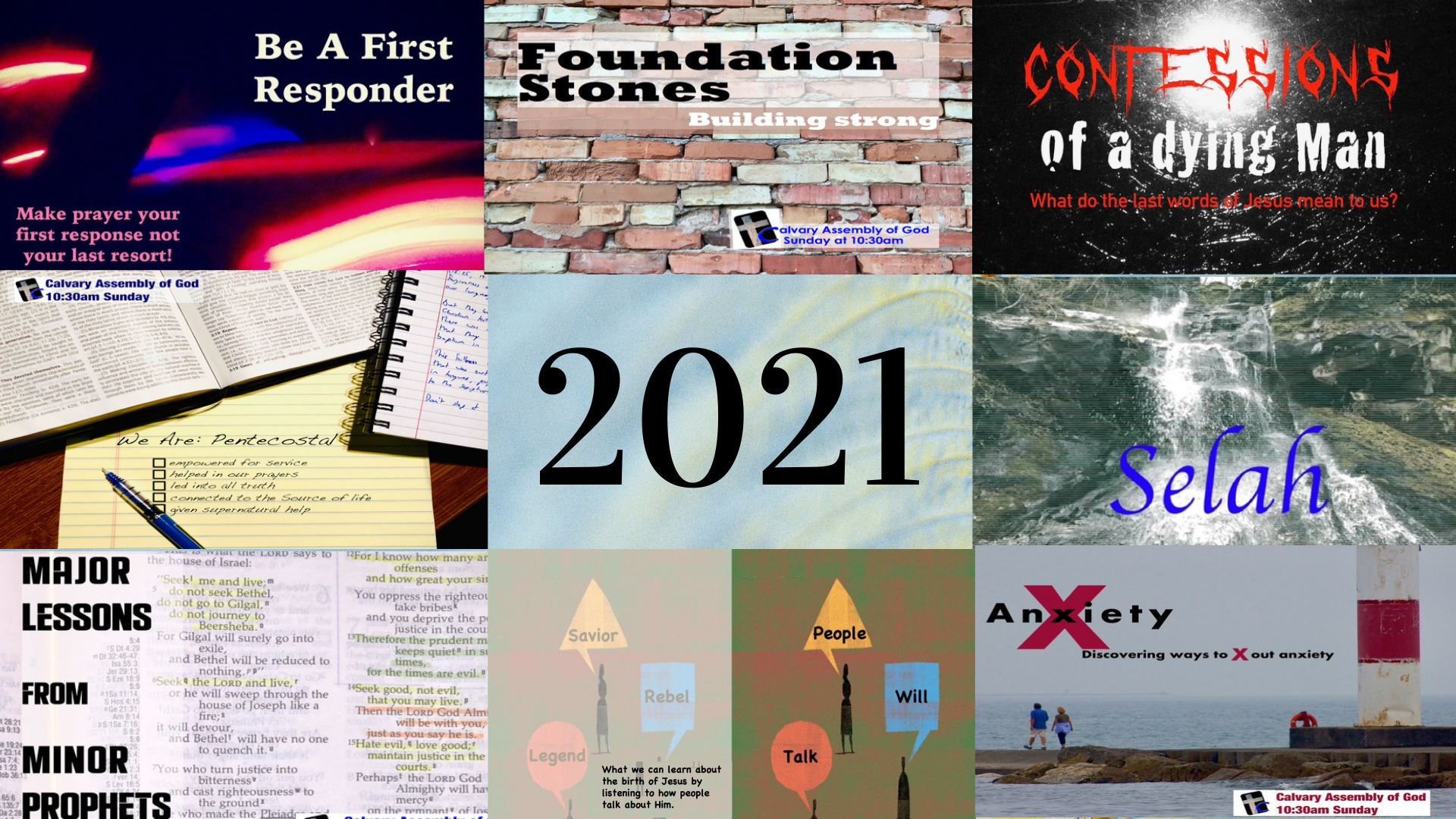
So here are all of the sermon series that I shared in 2021. Clicking on each series title will take you to a list of all of the sermons in that series. 

Foundation Stones—Any architect will tell you: You can’t build a great building on a weak foundation. This is just as true in the spiritual realm, which is why John Calvin warned, “Those who are strong only in fervor and sharpness, but are not fortified with solid doctrine, weary themselves in their vigorous efforts, make a great noise…[and] make no headway because they build without foundation.” We have had on the Calvary website since Day 1 a link to “What we believe,” but more than just having them listed there, it is important to discuss them.

Be A First Responder—There is a line in an old hymn that convicts me every time I sing it: “Oh, what peace we often forfeit; Oh, what needless pain we bear all because we do not carry everything to God in prayer.” Why are we so slow to drop to our knees in prayer when trouble strikes? It seems we fool ourselves into thinking the problem is small enough to handle on our own, or we think God isn’t concerned with something that may seem trivial, or we’ve been-here-done-this before and know the way to go. But this isn’t what our Heavenly Father desires; instead, He wants us to come to Him before we try anything else. Instead of making prayer our last resort, why don’t we strive to make it our first response!

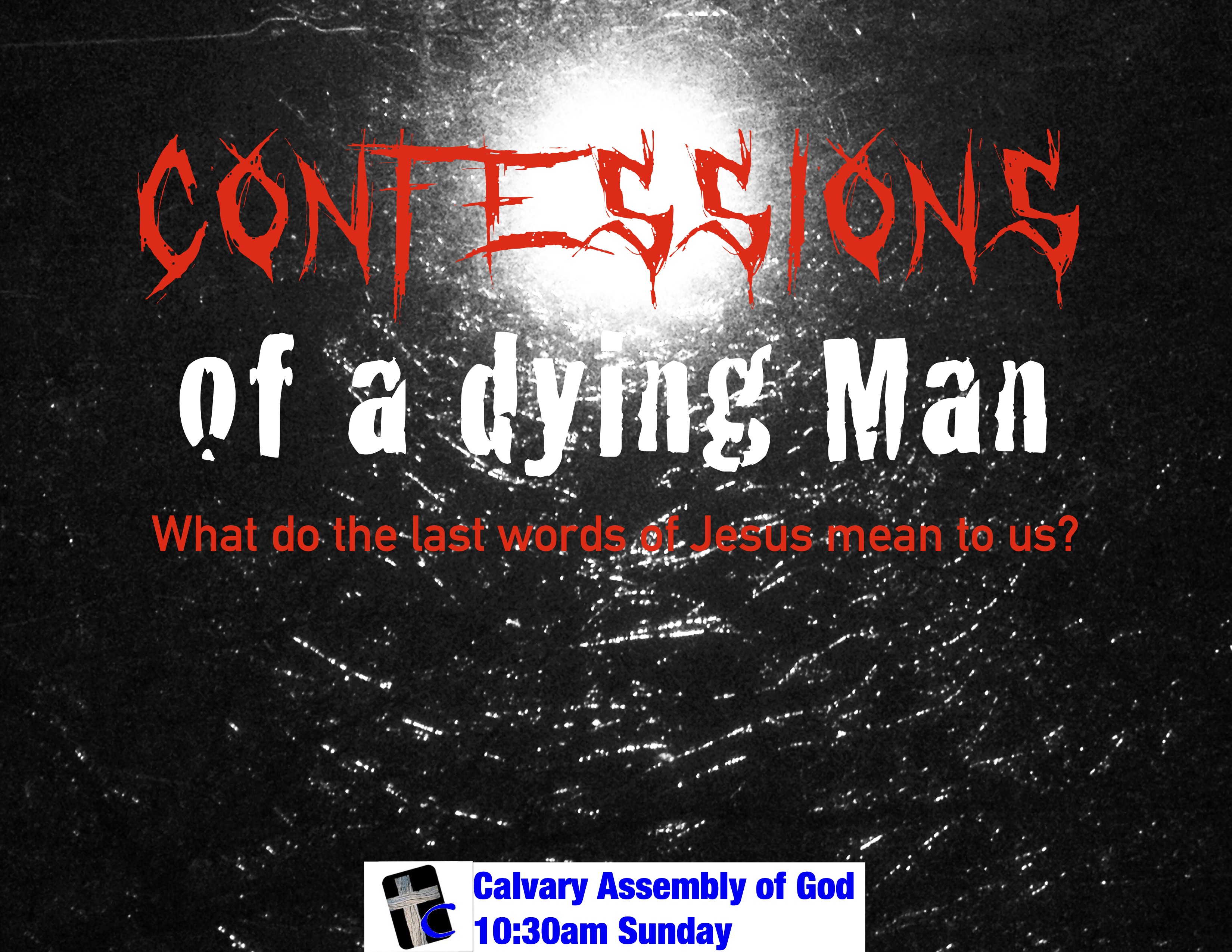
Confessions Of A Dying Man—In our justice system, rarely will a judge allow hearsay testimony to be introduced in court. But there is one notable exception: a dying declaration. A dying declaration is the statement of a mortally injured person who is aware he or she is about to die. This statement is admissible testimony in court on the theory that a dying person has no reason not to tell the truth. Jesus was nailed to a Cross. Mortally injured, unable to escape, He had no reason to lie. In His dying moments, struggling to get enough air in His lungs to be able to speak, Jesus choked out seven statements that still have a profound impact on us today.

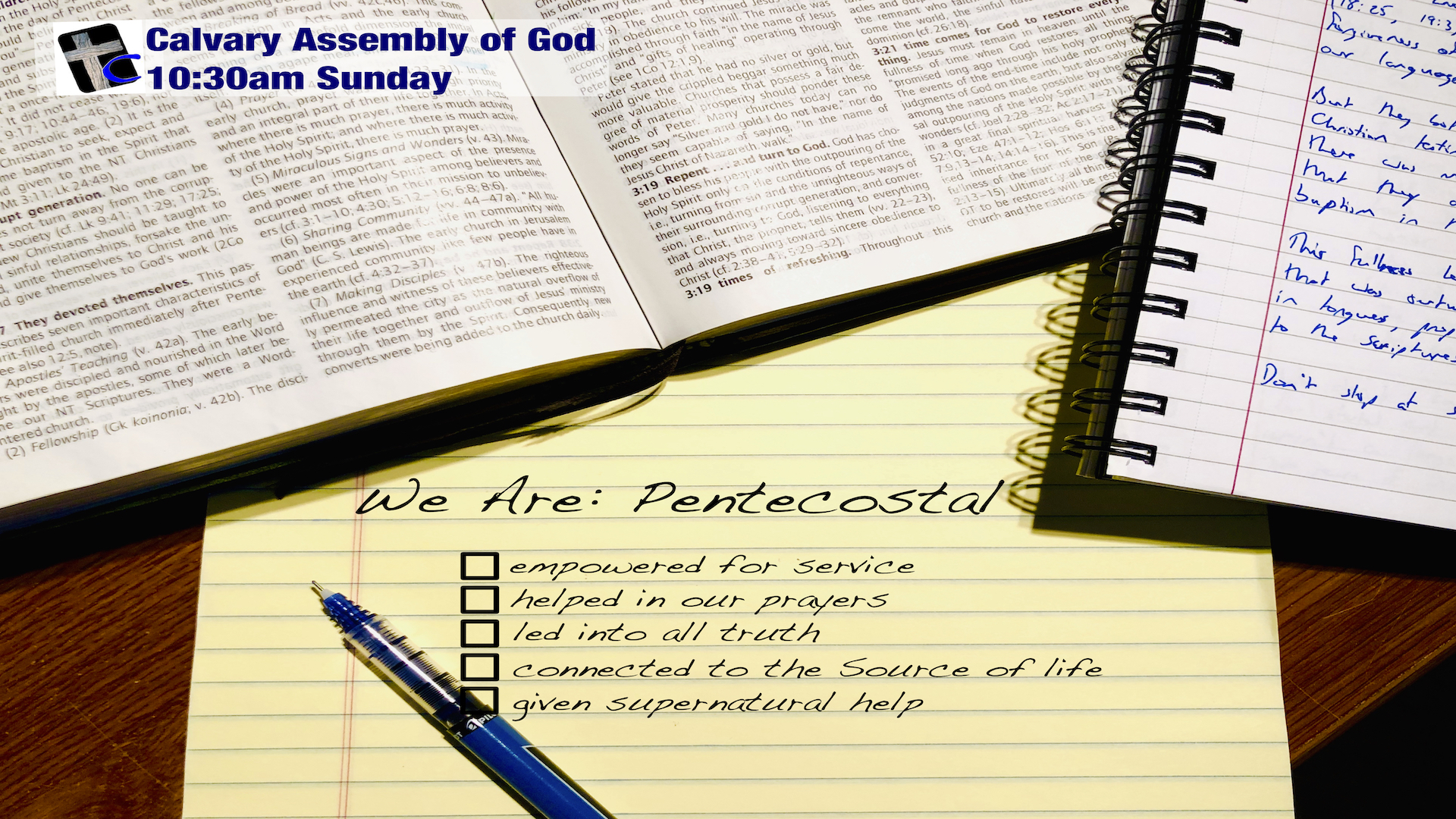
We Are: Pentecostal—Pentecost for over 1500 years was a celebration in Jerusalem that brought in Jews from all over the world. But on the Day of Pentecost that came just ten days after Jesus ascended back into heaven, the meaning of Pentecost was forever changed! Followers of Jesus—now empowered by an infilling of the Holy Spirit—began to take the good news of Jesus all over the world. These Spirit-filled Christians preached the Gospel and won converts to Christ even among hostile crowds, performed miracles and wonders, stood up to pagan priests and persecuting governmental leaders, and established a whole new way of living as Christ-followers. We, too, can be Pentecostal followers of Jesus Christ today. 

Selah—The word Selah appears nearly 70 times in the Bible, almost exclusively in the Psalms. Although it is primarily a musical term, it applies beautifully to our summer series. It means a pause. Throughout the Psalms, Selah appears at the end of a verse, at the end of the psalm, or sometimes even mid-sentence. But each one of them is perfectly placed by the Spirit-inspired authors to get us to take a breath and deeply contemplate what we just read or sang. 

Major Lessons From Minor Prophets—Sometimes the naming of things gives us an inaccurate picture of the thing being named. For instance, many people think the “old” in Old Testament means outdated or perhaps updated by the “new” in the New Testament. When in fact, both Testaments are needed to give us the full picture of God’s love and glory. A similar thing happens with the headings “major prophets” and “minor prophets.” It makes it sound like the major prophets have something major to say to us, while we could take or leave the minor messages of the minor prophets. In reality, they were given these headings simply because of the volume of writing—the five major prophets consist of 182 chapters, whereas the 12 minor prophets only have 67 chapters. The volume of their writing may be minor, but their content carries major messages of meteoric power! 

X-ing Out Anxiety—Two brothers—one a doctor and one a pastor—addressed the prevalence of anxiety in our culture. They wrote, “A recent survey of primary care physicians in the United States revealed that at least one-third of office visits were prompted by some form of anxiety.” Anxiety can negatively impact our relationships, our ability to think creatively, our physical health, and even our relationship with God. Thankfully, one of the titles given to Jesus is The Prince of Peace. Join us for this freeing series called X-ing Out Anxiety, where we will be learning what God’s Word says about getting free from the anxiety that is robbing us of life, and replacing that anxiety with His peace.

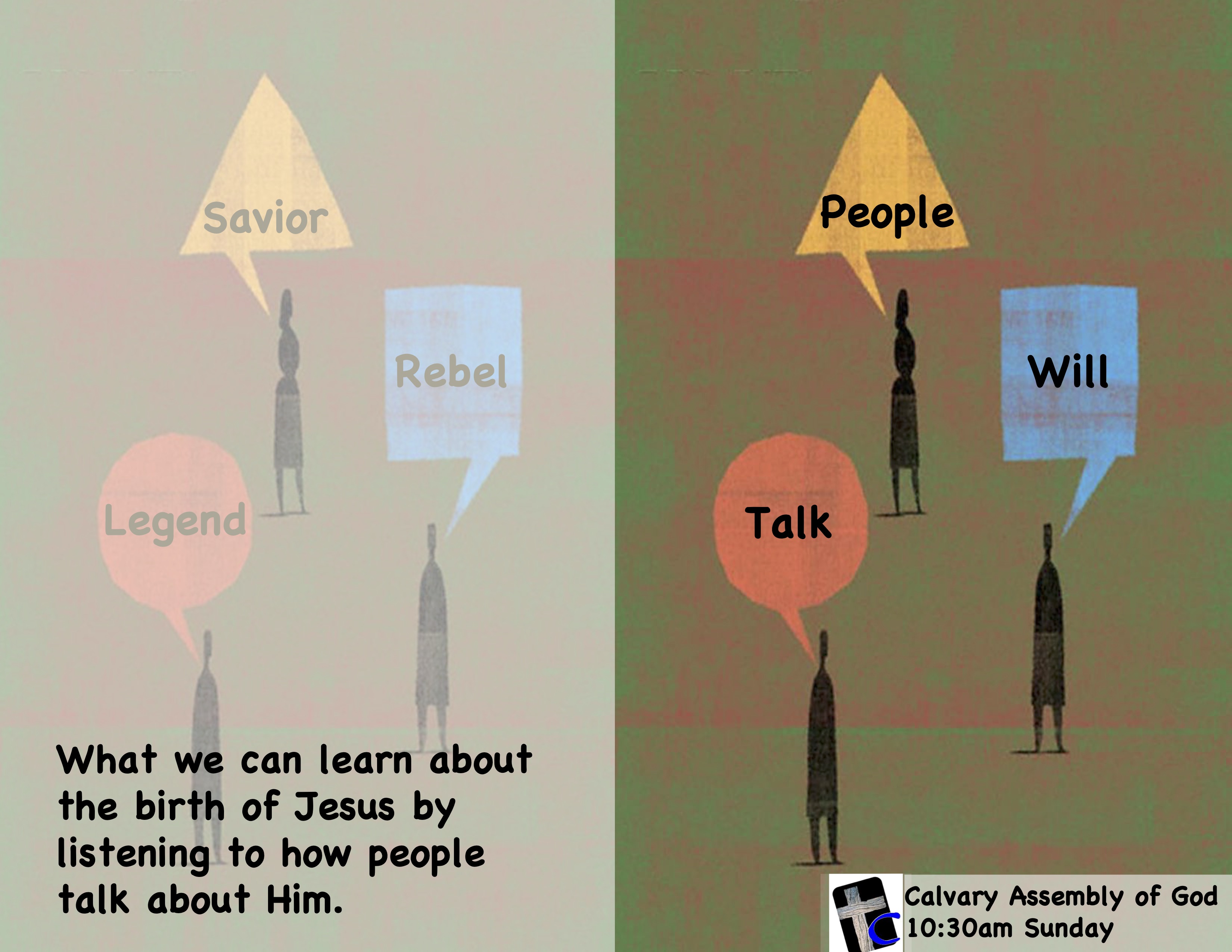
People Will Talk—Sometimes celebrities and other people in the public spotlight will hire a publicist to help promote their cause, build their brand, or present them in the best possible light. If you wanted to stretch the terms, you could say that some of the Old Testament prophets and the New Testament disciples could have been viewed as the “publicists” for Jesus. At least, that’s what critics might point to. But despite the best efforts and high salaries of publicists—both ancient and modern—they cannot control the “word on the street.” What people are actually saying about the one in the spotlight is usually the best evidence of who that person truly is. As we celebrate this Advent season, we are going to look at what the people on the street were saying about Jesus at the time of His birth. Before He ever performed a miracle or presented a parable—before any of His “publicists” could try to make Him look good—people were already talking. And what they said about Him is truly enlightening.

We will be returning to a couple of these series in 2022, and we’ll be launching some brand new ones as well. In either case, if you don’t have a home church in the northern Kent County area, I would love to have you join us!