Links & Quotes

Leaders would do well to remember that they lead a group of unique individuals. Let the unique gifts of those unique people be used in unique ways, and watch both the individuals and the organization grow! 

I have a lot of new video content on my YouTube channel every week. Please check it out and subscribe so you don’t miss anything.

“As Tyler Cowen wrote in The Free Press, ‘Whether or not you work in the AI sector, if you put any kind of content on the internet, or perhaps in a book, you are likely helping to train, educate, and yes, morally instruct the next generation of what will be this planet’s smartest entities. You are making them more like you—for better or worse.’ Now, maybe someone thinks, ‘I’ve hardly got any followers, who cares what I post? It probably won’t matter.’ But the principle means we should care. The philosopher Immanuel Kant famously offered his ‘categorical imperative’ as a test for ethical decisions: ‘Act only according to that maxim whereby you can at the same time will that it should become a universal law.’ In other words, we should only do what we think would be good for everyone to do.” —Axis.org

How much good inside a day?
Depends how good you live ’em.
How much love inside a friend?
Depends how much you give ’em. —Shel Silverstein

A fantastic mini-biography of Otto J. Klink who went from being a Christian, to an atheist socialist, to failed presidential assassin, to a Pentecostal author and evangelist. Wow!

“My acceptance of the universe is not optimism, it is more like patriotism. It is a matter of primary loyalty. The world is not a lodging-house at Brighton, which we are to leave because it is miserable. It is the fortress of our family, with the flag flying on the turret, and the more miserable it is the less we should leave it. The point is not that this world is too sad to love or too glad not to love; the point is that when you do love a thing, its gladness is a reason for loving it, and its sadness a reason for loving it more.” —G.K. Chesterton 

Marshall Segal said this about our daily Bible reading time, “I want to walk through a five-step prayer you could pray when you sit down with your Bible to meet with God. The five steps are built on an acronym for FEAST. Focus my mind; Enlighten my eyes; Address my sin; Satisfy my soul; Train my hands.”

“A man of character will make himself worthy of any position he is given.” —Mahatma Gandhi 

“A retentive memory may be a good thing, but the ability to forget is the true token of greatness. Successful people forget. They know the past is irrevocable. They’re running a race. They can’t afford to look behind. Their eye is on the finish line. Magnanimous people forget. They’re too big to let little things disturb them. They forget easily. If anyone does them wrong, they consider the source and keep cool. It’s only the small people who cherish revenge. Be a good forgetter. Business dictates it, and success demands it.” —Elbert Hubbard 

“Leadership is not about being in charge, but about taking care of the people in your charge.” —Simon Sinek 

Flowing Data has a fascinating look at how people spend their time during the day. Their adjustable chart shows activities by age, sex, and time of day. It reminds me of a blog post I shared about time management, where I noted, “You cannot add more Tick, Tocking! time to your day, but you can keep more of your day from Drip, Dropping! away.”

“We might think, ‘Well, hey, if I’m devoting myself all the time to looking out for others’ needs, who’s going to be looking out for mine?’ The Lord, of course, because He knows what you need even before you ask Him, and He has ways of meeting your needs that are more wonderful than you in your cleverness or strength could ever conjure or provide (cf. Matthew 6:25-34).” —T.M. Moore 

“We all know that exercise makes us feel better, but most of us have no idea why. We assume it’s because we’re burning off stress or reducing muscle tension or boosting endorphins, and we leave it at that. But the real reason we feel so good when we get our blood pumping is that it makes the brain function at its best, and in my view, this benefit of physical activity is far more important—and fascinating—than what it does for the body. Building muscles and conditioning the heart and lungs are essentially side effects. I often tell my patients that the point of exercise is to build and condition the brain.” —Dr. John Ratey 

T.M. Moore has a hard but good word for Christians: “If this day, and this expectation and hope [when we heard King Jesus say, ‘Well done, good and faithful servant’], are not the driving force for every aspect of our lives and work, then it is doubtful we have really understood the Good News of the Kingdom or received the salvation freely offered to us by the King. I say this again: If we are not motivated and driven, day by day, by the prospect of hearing ‘Well done, good and faithful servant,’ then we need to examine ourselves, whether we truly know the Lord of glory. That’s pretty hard language, I know, but let’s face the reality: If we have not submitted to Jesus as Lord of every area of our life, all the work we’ve been given to do, then we are still living for ourselves, not Him.” —T.M. Moore

Links & Quotes

On our 100th episode, Greg and I talk about how important it is for leaders to let people learn through their struggle, so we need to reject the temptation to jump in to help them too soon. Check out the full conversation The Struggle is Real (but Necessary).

I have a lot of new video content on my YouTube channel every week. Please check it out and subscribe so you don’t miss anything.

John Piper was asked how to identify false teachers or prophets, and he gives four biblical tests to determine this. But I also appreciate this admonition: “Don’t set the bar so low that you only stop listening to people if they can be properly called false teachers. Lots of people are teachers who are simply misguided and unhelpful in many ways but might not come under the ban of being called a false teacher. Set your standards high. Listen to people who are truly God-centered, Christ-exalting, Bible-saturated, Spirit-dependent, who bear the marks in their lives of authenticity.” 

In imploring Christians to not shrink back from difficult trials but to rise and conquer in the strength of the Spirit, Greg Morse makes this observation: “When the risen Christ walked among His early churches (as He walks among them still), His eye was very keen to observe and His heart very ready to address a particular kind of person in every assembly: ‘the one who conquers’ (Revelation 2:7, 11, 17, 26; 3:5, 12, 21). To each of the seven churches, He summons and strengthens the one who would overcome, prevail, hold fast, keep strong, stand firm, and move forward—the victors in Christ amid a larger group in the church who only profess to know Him.”

Two separate geological studies found a period in history where rock formations were impacted by massive amounts of water. ICR adds, “Because conventional geologists deny the historical accuracy of Genesis, they operate at a loss. They see evidence of massive erosion and tremendous water flow at the end of the Tejas Megasequence and just prior to the Ice Age but are hampered by their uniformitarian thinking to explain it. But the Bible gives us answers. Genesis describes a global flood that peaked on Day 150. The sedimentary rocks across all of the continents confirm this peak occurred at the end of the Zuni Megasequence (at the K-Pg). And the rocks confirm that the Tejas Megasequence records the subsequent receding phase.”

There was a Man who
dwelt in the east centuries ago,
And now I cannot look at a
sheep or a sparrow,
A lily or a cornfield,
a raven or a sunset,
A vineyard or a mountain,
without thinking of Him. —G.K. Chesterton


Clinton Manley addresses the place of physical exercise in the life of a Christian. Before sharing three astute observations about this interaction, he notes, “Body or soul is a false dichotomy. As Paul makes clear in 1 Corinthians 9:24–27, physical fitness and spiritual fitness don’t have to be either-or; they’re best as both-and. The body and soul have an inseparably reflexive relationship: the body affects the soul, and the soul affects the body. God created us to glorify Him by enjoying Him, and the body is the soul’s training partner in the pursuit of spiritual pleasures.”

“Who will trust me with a spiritual body if I cannot control even an earthly body?”  —C.S. Lewis 

Links & Quotes

You and I will learn lessons in the hard times that we could learn no other way. Then God will use those lessons so we can help minister to others in their hard times. Check out my sermon about interceding for other saints.

I have a lot of new video content on my YouTube channel every week. Please check it out and subscribe so you don’t miss anything.

Because the Bible is God-breathed, it is as historically accurate as it is applicable to our daily lives. I love these archeological biographies that the Bible Archeology Report presents. This one is about Babylonian king Merodach-Baladan II. 

ICR’s Dr. Randy Guliuzza says, “Convergent evolution is the fabricated conjecture evolutionists invoke to explain very similar characteristics between creatures that could not have been inherited from a common ancestor and that evolutionists will never accept as having been produced by an intelligently designed internal programming that is specified for common purposes.” This particular article is about bats which have always had the ability to fly. Not one fossil record shows any flightless bats because God created them as flying mammals. 

In the early 1900s, Albert Norris was a missionary in India, observing firsthand the spiritual and physical hardships the people faced there. In an article in the Pentecostal Evangel, Norris wrote, “A Christianity that coldly sits down, and goes on its routine of formal work, and allows its fellowmen to starve, or to be obliged to go through all the hard sufferings and exposure connected with famine, without effort to help them, might as well quit its preaching.”

In answering a question about using AI to write a sermon, John Piper answers with an emphatic “no.” I agree! One of the reasons Piper shares: “One of the qualifications for being an elder-pastor-preacher in the Bible is the gift or the ability to teach, didaktikos (1 Timothy 3:2). That means you must have the ability, the gift, to read a passage of Scripture, understand the reality it deals with, feel the emotions it is meant to elicit, be able to explain it to others clearly, illustrate and apply it for their edification. That’s a gift you must have. It’s your number-one job. If you don’t have it, you should not be a pastor.”

“You don’t try to forget the mistake, but you don’t dwell on it. Don’t let it have any of your energy, or any of your time, or any of your space.” —Johnny Cash 

Let’s Grow Together

Listen to the podcast of this post by clicking on the player below, and you can also subscribe on AppleSpotify, or Audible. 

We’ve now learned about all three circles that help us discover our God-implanted gifts: 

  • Passion—what thrills you? 
  • Pain—what kills you? 
  • Proficiency—what fulfills you? 

What do you do with these gifts? What’s the whole purpose in learning about them? I think the goal as saints is to help the Body of Christ mature in ways that brings God glory (Ephesians 4:12-16). 

(Check out all of the Scriptures in this post by clicking here.) 

Solomon also gives a great word picture of friends using their gifts for each other—“As iron sharpens iron, so a friend sharpens a friend” (Proverbs 27:17 NLT). 

In an earlier message in this series, I talked about the thousands of enzymes in our human bodies. Each enzyme has just one task, and each task is indispensable to the health of the whole body. It is exactly the same in the Body of Christ—your gift-in-action is indispensable to the health of the whole Body.

How do you squander your grace gift? I think these are five basic ways:

  1. Not discovering it—“I have a gift?” 
  2. Devaluing it—“My gift is nothing special.” 
  3. Overvaluing it—“My gift is super-important.” 
  4. Laziness—“My gift is fine just the way it is.” 
  5. Selfishness—“My gift is just for me.” 

We need to discover our own gifts, but then we need to work on making the switch from “me” to “we.” I want to excel in using my gift so that I can help you excel in using your gift so that we can help another brother or sister excel in using their gift. 

Oswald Chambers said, “The Book of God is insistent on this: we cannot develop a holy life alone, it would be a selfish life, without God in it and wrong. … Beware of isolation; beware of the idea that you have to develop a holy life alone. It is impossible to develop a holy life alone, you will develop into an oddity and a peculiarism, into something utterly unlike what God wants you to be. The only way to develop spiritually is to go into the society of God’s own children, and you will soon find how God alters your set.” 

Frequently we need another brother or sister in Christ to help nudge us into discovering and using our gifts. For example, look how…

  • Mordecai assured Esther (Esther 4:13-14) 
  • Matthias was chosen by those in the upper room (Acts 1:21-26) 
  • The first deacons were unanimously chosen by the Church (Acts 6:3-6) 
  • Barnabas and Saul were chosen by the Holy Spirit and confirmed by other prophets and teachers in the church (Acts 13:1-3) 
  • Paul encouraged his proteges to appoint elders who were recognized by others in the church (Titus 1:5; 1 Timothy 3:1f) 

Consider this poem—

For want of a horseshoe nail the shoe was lost.
For want of a shoe the horse was lost.
For want of a horse the rider was lost.
For want of a rider the message was lost.
For want of a message the battle was lost.
For want of a battle the kingdom was lost.
And all for the want of a horseshoe nail.


Listen to the Holy Spirit. Listen to the confirming words from fellow saints—words like “You are gifted,” “You are so good at…,” and “How did you know how to do that?” Then step out of your comfort zone and soar into your gift zone! 

If you’ve missed any of the other messages in our Living in your gift zone series, you can check them all out here. 

►► Would you please prayerfully consider supporting this ministry? My Patreon supporters get behind-the-scenes access to exclusive materials. ◀︎◀︎

Links & Quotes

No one wants what the gloomy person has. Joy is a Christian’s testimony—it’s what attracts others to Jesus! Check out this full message from my series on the Songs of Ascent.

I have lots of new content every week, which you can check out on my YouTube channel.

“At first glance, people may not see how these different forms of sexual violence connect to each other. But, in fact, experts are increasingly recognizing that they may all stem from one common source—sexual objectification. Sexual objectification occurs when people perceive others as sex objects rather than complex human beings deserving of dignity and respect.” Pornography is a major contributor to the sexual objectification which leads to sexual violence.

Dr. Brian Thomas describes why fossils are found where they are and why land animals may even be found near marine animals: “This fossil discovery [a bone from a South American megaraptor found near Cape Otway, Australia] fits well with a biblical history, which goes something like this: Around 2348 BC, a worldwide flood crushed and reshaped the earth’s surface, breaking up a single landmass (Pangaea) into continents and fossilizing countless living things. Prior to the Flood megaraptors roamed Pangaea, during the Flood they were fossilized, and in the late Flood stages the boundaries of new continents (along with their fossils) were roughly shaped. Unlike the standard story, the outlines of this history have been testified to by reliable eyewitnesses, and this testimony has been faithfully preserved in Genesis.”

“The more we let God take over us, the more truly ourselves we become—because He made us.” —C.S. Lewis

J. Warner Wallace shares two trends in American society that are contributing to the decline of religious adherence in America.

“There is no way around hard work. Embrace it.” —Roger Federer

Shame on my thoughts, how they stray from me!
During the Psalms, they wander on a path that is not right; they run, they distract…
One moment they follow the ways of loveliness, and the next the ways of riotous shame…
Swiftly they leap in one bound from earth to heaven…
O beloved Christ… may the grace of the sevenfold Spirit come to keep them in check!
Rule this heart of mine, O swift God of the elements, that You may be my love, and I may do Your will! —Anonymous, On the Flightiness of Thought, Irish, 8th-9th century

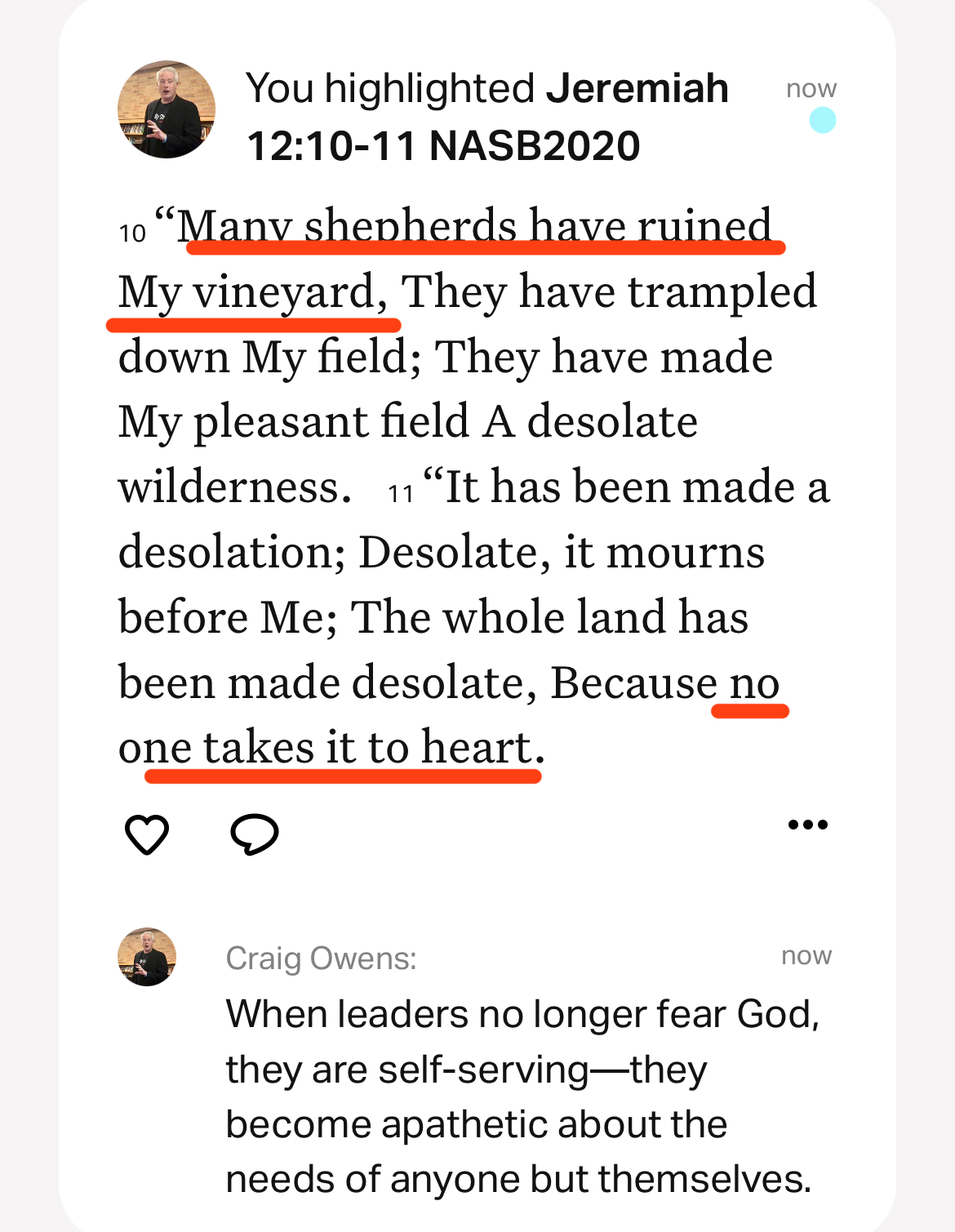
Ungodly leaders become more and more selfish, while shepherd leaders become more and more God-fearing and more and more attentive to the needs of others (Jeremiah 12:10-11). Check out my series of posts for godly leaders and my book Shepherd Leadership.

Links & Quotes

Don’t let fear keep you standing still. Take a swing and give yourself or your coach something to tweak. Check out this full conversation hereI have lots of new content every week, which you can check out on my YouTube channel.

“Our human minds cannot comprehend the immensity of [Christ’s] task and His sacrifice. We simply know that it was to save us, and that Jesus’ suffering is the most blessed influence the world has ever known.” —Dr. Henry Halley, Halley’s Study Bible 

The Hill, though high, I covet to ascend,
The Difficulty will not me offend;
For I perceive the Way to life lies here.
Come, pluck up Heart, let’s neither faint nor fear;
Better, though difficult, the Right Way to go,
Than wrong, though easy, where the End is Woe. —Christian in John Bunyan’s The Pilgrim’s Progress 

“Nearly half the Law of God is devoted to directing God’s people in how to worship Him. And while the specific practices of that portion of God’s Law have been replaced (Hebrews 7:11-18), the emphasis on worship and the idea that worship and life are related remains. The more faithful we are in worshiping the Lord the more we will love our neighbors with the justice His Law prescribes.” —T.M. Moore

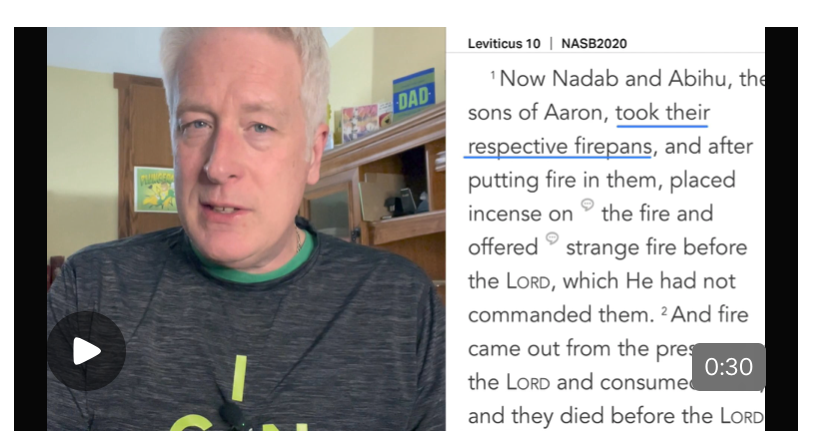
The deaths of Nadab and Abihu is a tragic story, but I think there are some important leadership insights to be gleaned from it. I shared an exclusive video with my Patreon supporters. Will you prayerfully consider joining?

Links & Quotes

God’s blessings are not primarily for me, but they are through me for His glory. This is a short clip from an exclusive video I shared with my Patreon supporters. Become a supporter todayI have lots of new content every week, which you can check out on my YouTube channel.

“What to do with a mistake: recognize it, admit it, learn from it, forget it.” —Dean Smith

Until the mid-1800s, the historicity of King Sargon II (mentioned by Isaiah) was in doubt. Not only has archeology again affirmed the historical statements made in Scripture, but “the way Isaiah spelled Sargon’s name is an indicator that the prophet lived at the time of Sargon II, and that the book was not penned hundreds of years later.” Check out this archeological biography of Sargon II.

And then there is this archeological report about the destruction of Sodom and Gomorrah. Fascinating!

How sweet and gracious even in common speech,
Is that fine sense which men call Courtesy!
Wholesome as air and genial as the light,
Welcome in every clime as breath of flowers—
It transmutes aliens into trusting friends,
And gives its owner passport round the globe. —James T. Fields

“A person always doing his or her best becomes a natural leader, just by example.” —Joe DiMaggio

Not using the spiritual gift God has given you is selfish. He gave you these gifts on purpose so that His kingdom could be made more visible and desirable.

The King Of Glory

Listen to the podcast of this post by clicking on the player below, and you can also subscribe on AppleSpotify, or Audible. 

I did a series of Advent messages a few years ago called “The Carols of Christmas” with the premise that many of our old familiar carols had become too familiar and we had lost the true meaning in those beautiful songs. 

I think the same is true with the sentiment of wanting to experience the glory of God. Sometimes you will hear people say, “We just want to see God’s glory!” but I’m not sure they really mean this or really want it. 

Throughout the Bible, “glory” comes from the Hebrew word which means weightiness. When God appears—or even one of His angels glowing with His glorious presence—people collapse under the weight of His glory. Look at the examples of Moses, Isaiah, Daniel, and even John the beloved disciple of Jesus (Exodus 3:6; Isaiah 6:3-5; Daniel 8:15-17; Revelation 1:12-17). 

In the light of Christ’s glory everything is exposed. We have no excuses for our sin. We are seen exactly as we are, and the fear of God’s judgment causes us to collapse under that weight. 

But the First Advent story is filled with the phrase “Fear not.” Let me show you two examples. First, notice the strong emotions when the angels appear to the shepherds— 

An angel of the Lord appeared to them, and the glory of the Lord shone around them, and they were terrified. But the angel said to them, “Do not be afraid. I bring you good news that will cause great joy for all the people.” (Luke 2:9-10)

What was this good news that would turn their fear into joy? Listen to the angelic message to Joseph—

Joseph son of David, do not be afraid to take Mary home as your wife, because what is conceived in her is from the Holy Spirit. She will give birth to a Son, and you are to give Him the name Jesus, because He will save His people from their sins. (Matthew 1:20-21) 

Notice the phrase, “HE will save His people from their sins.” Part of what contributes to our fear of God’s glorious presence is knowing that we are helpless to remove our sins. The fact that Jesus would do this for us was foretold in prophecies like Isaiah 25:7-9 and 59:15-16.

How will Jesus do this? In 1 Corinthians 15:53, Paul says that in order to enter into God’s presence our perishable, mortal lives have to be exchanged for something imperishable and immortal. We are unable to do this, but in the Incarnation, the immortal God put on mortal flesh!  

Paul goes on in 1 Corinthians 15 to say, “When the perishable has been clothed with the imperishable, and the mortal with immortality, then the saying that is written will come true: “Death has been swallowed up in victory.” Where, O death, is your victory? Where, O death, is your sting?” (1 Corinthians 15:54-55)! 

If our sins were still clinging to us, spending eternity in the presence of the King of Glory would be torturous! Our fear of His weighty glory is only changed into joy when we accept that He has saved us from the penalty of our sins. Now our fear of His glory isn’t a crippling fear, but as we worship Him for His salvation our fear becomes reverential worship. 

Or we could say it this way—When we fear the King of Glory we fear nothing else! 

Charitie Lees Bancroft captures that idea in these stanzas of her poem:

When satan tempts me to despair
And tells me of the guilt within,
Upward I look and see Him there
Who made an end of all my sin.
Because the sinless Savior died,
My sinful soul is counted free;
For God the Just is satisfied
To look on Him and pardon me. 

Behold Him there! The risen Lamb,
My perfect, spotless righteousness;
The great unchangeable “I AM,”
The King of glory and of grace!
One with Himself I cannot die,
My soul is purchased by His blood;
My life is hid with Christ on high,
With Christ, my Savior and my God.

With our sins forgiven by our faith in Jesus, we can now enjoy an eternity in the weighty, awesome presence of the King of Glory! 

If you’ve missed any of the other messages in our series Long Live the King of Kings, you can find them all by clicking here. 

►► Would you please prayerfully consider supporting this ministry? My Patreon supporters get behind-the-scenes access to exclusive materials. Like this video where I talk about the logic in Psalm 119. ◀︎◀︎

Micro-Adjustments

Listen to the podcast of this post by clicking on the player below, and you can also subscribe on AppleSpotify, or Audible. 

I had a great time on the Leading From Alignment podcast with Jim Wiegand and John Opalewski. 

One of the loudest, most persistent advertising messages is about speed: Take action now, get immediate results as soon as you sign up, don’t miss out, act today! Because of this sentiment that appears all around us, many people often think that any life changes they make should bring about immediate and lasting results. 

I’ve often joked that I wish I had the superpower to zap myself or a friend—“<Poof!> There, you’ve got it now. You’re all set!” Unfortunately, that’s usually not how it works. 

Instead, we need to be ready for a lengthy process—possibly even a lifelong process—of the Holy Spirit helping us to make the micro-adjustments that are necessary. 

Check out this part of my conversation with Jim and John as we discussed this idea. 

 I like this line from Henry Wadsworth Longfellow:

The heights of great men reached and kept,
Were not attained by sudden flight,
But they, while their companions slept,
Were toiling upwards in the night.

The Holy Spirit knows exactly where we need to change and how much we need to change. Let’s trust Him in this process. Then take some time to look back and celebrate how far the Holy Spirit has matured us so that we can be re-energized to stay in this lifelong process.  

If you would like to watch this full interview on the Leading From Alignment podcast, please go here.

I’ll be sharing more clips from this interview soon, so please stay tuned. My book Shepherd Leadership: The Metrics That Really Matter is available in print or ebook, and in audiobook through either Audible or Apple. 

►► Would you please prayerfully consider supporting this ministry? My Patreon supporters get behind-the-scenes access to exclusive materials. ◀︎◀︎

The Biblical Metric Of Success

Listen to the podcast of this post by clicking on the player below, and you can also subscribe on AppleSpotify, or Audible.

I was asked to share an article on the Converge Coaching blog.

There is no shortage of books that define “success” in our business or ministry endeavors, but as Christians, let’s try to get a more precise definition—a biblical definition.

I did a quick search for the words “success” or “successful” in just the New International Version of the Bible, and I was somewhat surprised by two things. First of all, the relatively few times this word is used: Only 25 times in the entire Scripture. We read of prayers offered for a successful journey, or a king’s reign, or a building project, success that comes to someone because of God’s favor on their life, or success in battle.

The second thing that surprised me: The word “success” isn’t used in the New Testament. The reason this surprised me is because without there being even a close second, Jesus has to be the most successful person who ever walked this planet. No one ever taught like He did, performed the miracles He did, or willingly laid down His life and was resurrected like He was. And yet the word “success” is never attached to His life.

This means we are left to draw some Holy Spirit-illuminated inferences from the Bible on how to define success. You may ask, “Why do we even need to know what ‘success’ is?” I would say we need a biblical definition for success to avoid the inevitable feelings of failure that come if things aren’t going as well as we thought they should.

In business, we often define success as revenue growth or a healthy net profit. In ministry, we typically measure success by church attendance, the number of people launched into ministry, or the amount of money given to missions work.

But what happens if we apply these metrics to the work Jesus did while He was on Earth? We see His disciples fretting over not having enough money to buy food for the congregation, and Jesus mentioning He often didn’t have a bed to sleep in, or the fact that Jesus only had one set of clothes. As a businessman, Jesus wouldn’t be considered successful by any current metrics. Even as a ministry leader, the congregation that gathered after Jesus was resurrected back to life only numbered 120 people. So if we consider Jesus as a pastor, His church wasn’t exactly thriving according to modern metrics.

After Peter’s sermon on the day of Pentecost (Acts 2) and his sermon following the healing of the lame man (Acts 3), we don’t hear much about quantitative growth throughout the rest of the Book of Acts. But in the balance of the Book of Acts, in the teachings of Jesus, and in the instructions in the epistles, we do hear substantially more about qualitative growth.

I think the clear message is that qualitative metrics are much more important to God than quantitative measurements. Specifically, I think we see the emphasis on two important qualities for godly leaders: faithfulness and excellence.

Solomon wrote, “Whatever you do, do well” (Ecclesiastes 9:10 NLT), and Paul told us, “Whatever you do, do it all for the glory of God” (1 Corinthians 10:31 NIV). These things tell us that our best effort is always required—no cutting corners, no half-measures, no bare-minimum effort. Instead, we should always do the best that we can, always striving for excellence.

My Grandma drilled a poem into my memory whenever I wanted to stop at “good enough.” She would say—

Good, better, best
Never let it rest
Until your good is better
And your better is best

How long do we do this excellent work? Until our Master returns.

Jesus said, “Who then is the faithful and wise manager, whom the master puts in charge of his servants to give them their food allowance at the proper time? It will be good for that servant whom the master finds doing so when he returns” (Luke 12:42-43 NIV).

Our devotion to these qualitative metrics of faithfulness and excellence can only truly be judged by listening to the Holy Spirit each day. He alone can speak to each of our hearts about our level of excellence and faithfulness for that day. He alone can help us know what true success is. We need to listen to His voice so that we don’t get distracted, disillusioned, and possibly even de-railed by trying to measure up to others’ quantitive metrics of success.

After all, ultimate success for any leader is to hear the applause from nail-scarred hands as our Master says, “Well done—excellently and faithfully done—My good and faithful servant!”

I can think of no better definition of success.

►► Would you please prayerfully consider supporting this ministry? My Patreon supporters get behind-the-scenes access to exclusive materials. ◀︎◀︎