Gratitude Is A Shield

Listen to the podcast of this post by clicking on the player below, and you can also subscribe on AppleSpotify, or Audible. 

Gratitude is a great attitude. It sets you apart from the crowd of complainers, and it causes people to ask, “What do you know that we don’t know?”      

Wouldn’t you just love to silence the complainers in your life? Maybe you can relate to this poem by Shel Silverstein called Complainin’ Jack

This morning my old jack-in-the-box
Popped out—and wouldn’t get back-in-the-box.
He cried, “Hey, there’s a tack-in-the-box,
And it’s cutting me through and through.
“There also is a crack-in-the-box,
And I never find a snack-in-the-box,
And sometimes I hear a quack-in-the-box,
‘Cause a duck lives in here too.”
Complain, complain is all he did—
I finally had to close the lid.

Since, as Christians, we can’t really “close the lid” on the complaining people around us, maybe there’s something else we can do. I can think of three possibilities. 

  1. We could entirely avoid complaining people. But to do this wouldn’t allow us to live our lives as the salt and light Jesus called us to (Matthew 5:13-16). After all, in order for salt to season or light to drive away darkness, the salt and light have to be in close proximity to those they are helping. 
  1. We could simply ignore the negativity. Be around it, but do nothing about it. But both Paul and Jesus call us to engage with people in a way that points them to the Good News of the Gospel (Philippians 2:14-16; Matthew 28:19). 
  1. If we cannot avoid complainers nor remain apathetic about them, we must find a way to engage them but protect our hearts in the process. 

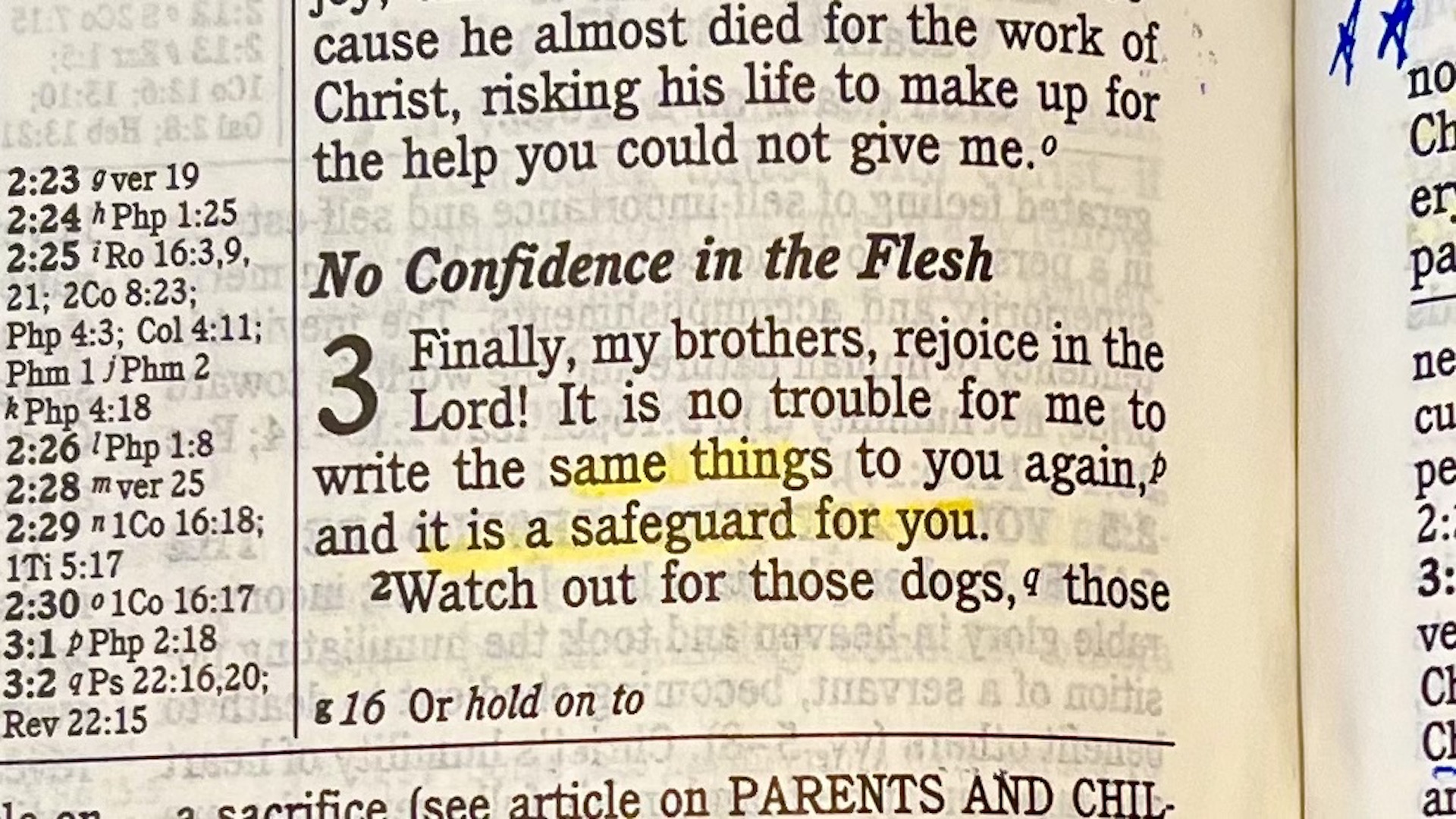
We learn from the apostle Paul’s letter to Philippi that gratitude is our shield against anything that would seek to steal our joy! “Further, my brothers and sisters, rejoice in the Lord! It is no trouble for me to write the same things to you again, and it is a safeguard for you” (Philippians 3:1). 

In the Greek, the root word for “safeguard” means “fail.” But when we add the prefix it becomes cannot fail! So rejoicing makes us secure, firm, reliable.

Quite simply that means that gratitude is our attitude protector because gratitude is our shield against anything that would seek to steal our joy!

Jesus used the same word for rejoicing even when we are facing insults, exclusion, and persecution—

Blessed are you when people hate you, when they exclude you and insult you and reject your name as evil, because of the Son of Man. Rejoice in that day and leap for joy, because great is your reward in heaven. For that is how their ancestors treated the prophets. (Luke 6:22-23) 

Both Jesus in this passage and Paul in Philippians 3:1 remind us that our rejoicing is IN the Lord. We are not expected to rejoice in our circumstances, but in who God is for us. Matthew Henry noted, “The more we rejoice in Christ the more willing we shall be to do and to suffer for Him, and the less danger we shall be in of being drawn away from Him.” 

I also like both the proactive and reactive use of rejoicing that John Henry Jowett identifies when he says, “Gratitude is a vaccine, an antitoxin, and an antiseptic.” Rejoicing is never supposed to be a one-and-done action, but it is an ongoing lifestyle. As Paul wrote to the Christians in Philippi just a few verses later, “Rejoice in the Lord always. I will say it again: Rejoice!” (Philippians 4:4). 

Gratitude is a shield—a vaccine, an antitoxin, and an antiseptic—but it doesn’t protect us unless we use it!

In order to use this shield whenever it’s needed, we have to be constantly reminded to be grateful. This is where we can leverage the power of our brain’s reticular activating system. I shared a short video about how to do this on The Podcast last week—check it out here. 

Gratitude is a great attitude, and grateful people are a winsome testimony of God’s love and provision to those “complainin’ Jacks” we all encounter. Try it and see what a difference it will make with those you are around this week. 

To check out all of the sermons in this series, please click here. 

►► Would you please prayerfully consider supporting this ministry? My Patreon supporters get behind-the-scenes access to exclusive materials, like this exclusive video in which I take my supporters behind the scenes of my thought process in designing my confrontation flowchart. ◀︎◀︎

Loving Fighters

Listen to the podcast of this post by clicking on the player below, and you can also subscribe on AppleSpotify, or Audible. 

I’ve always loved this stanza from a William Cowper poem:

Restraining prayer, we cease to fight
Prayer makes the Christian’s armor bright
And satan trembles when he sees
The weakest saint upon his knees.

Prayer is indispensable in spiritual warfare! Prayer is where we fight best for those we love. 

Have you ever heard the question, “Are you a lover or a fighter?” I don’t believe this is an either-or answer, both both-and. I’m a fighter because I’m a lover. I love Jesus and I am loved by Jesus.  This fuels my passion to fight for His glory to be seen. This drives me to fight against the powers that keep others from knowing this love for themselves. 

T.M. Moore wrote, “If we want God to bring revival and save the world from its many and increasing troubles, we must give ourselves to extraordinary efforts in prayer before we enter the conflict.” Prayer isn’t preparation for the fight; prayer is the fight that has been lovingly empowered. This is why our fifth spiritual discipline of prayer is so vital. 

As we have seen with giving and fasting, Jesus also has some don’ts and dos for us about praying (Matthew 6:5-8):

  • don’t pray publicly for earthly recognition or human applause (v. 5) 
  • do pray privately (v. 6) 
  • don’t pray robotically—And when you pray, do not heap up phrases—multiply words, repeating the same ones over and over—as the Gentiles do, for they think they will be heard for their much speaking (v. 7 AMP) 
  • do pray intimately (v. 8) 

Jesus practiced what He preached about praying in secret: Jesus was praying in private (Luke 9:18). He must have prayed so differently than anyone else the disciples had ever heard because they asked Him, “Lord, teach us to pray” (Luke 11:1). 

Remember that prayer is the battle—things are happening while I’m praying. 

There is a way I speak to my wife in private that I don’t typically say in public. If I didn’t speak intimately to her in private, others would notice a difference in public. When I do have intimate, private, regular conversations with her, it also shows publicly. 

So too with prayer. The New Testament doesn’t record very many of the prayers of Jesus for us. In fact, many of things we might think of as prayers sound more like commands from Jesus—“Lazarus, come forth,” “Little girl, get up,” “Be clean,” and similar phrases. We see the public display of power because Jesus had been empowered in private by His Father. 

Private prayer is noticed publicly in the lives of the followers of Jesus too (see Acts 4:13; 6:15). 

I don’t pray privately so that I can show off publicly. I pray in intimate privacy so that I can publicly show off Jesus! 

All of our spiritual disciplines are for us individually so that we have something to give corporately. For instance—

As we are built up in private prayer, there is a greater unity in corporate prayer, and Jesus is lifted up for the world to see. We love Jesus and we love others, so we fight for the glory of God and the strengthening of our brothers and sisters. We are loving fighters! 

So let me encourage you to make private, intimate conversation with Jesus a priority in your life. 

If you’ve missed any of the previous spiritual disciplines we’ve covered in this series, you can check them all out here. 

►► Would you please prayerfully consider supporting this ministry? My Patreon supporters get behind-the-scenes access to exclusive materials, like this recent video where I explain how God reveals previously-unknown truths to us. ◀︎◀︎

Micro-Adjustments

Listen to the podcast of this post by clicking on the player below, and you can also subscribe on AppleSpotify, or Audible. 

I had a great time on the Leading From Alignment podcast with Jim Wiegand and John Opalewski. 

One of the loudest, most persistent advertising messages is about speed: Take action now, get immediate results as soon as you sign up, don’t miss out, act today! Because of this sentiment that appears all around us, many people often think that any life changes they make should bring about immediate and lasting results. 

I’ve often joked that I wish I had the superpower to zap myself or a friend—“<Poof!> There, you’ve got it now. You’re all set!” Unfortunately, that’s usually not how it works. 

Instead, we need to be ready for a lengthy process—possibly even a lifelong process—of the Holy Spirit helping us to make the micro-adjustments that are necessary. 

Check out this part of my conversation with Jim and John as we discussed this idea. 

 I like this line from Henry Wadsworth Longfellow:

The heights of great men reached and kept,
Were not attained by sudden flight,
But they, while their companions slept,
Were toiling upwards in the night.

The Holy Spirit knows exactly where we need to change and how much we need to change. Let’s trust Him in this process. Then take some time to look back and celebrate how far the Holy Spirit has matured us so that we can be re-energized to stay in this lifelong process.  

If you would like to watch this full interview on the Leading From Alignment podcast, please go here.

I’ll be sharing more clips from this interview soon, so please stay tuned. My book Shepherd Leadership: The Metrics That Really Matter is available in print or ebook, and in audiobook through either Audible or Apple. 

►► Would you please prayerfully consider supporting this ministry? My Patreon supporters get behind-the-scenes access to exclusive materials. ◀︎◀︎

The Biblical Metric Of Success

Listen to the podcast of this post by clicking on the player below, and you can also subscribe on AppleSpotify, or Audible.

I was asked to share an article on the Converge Coaching blog.

There is no shortage of books that define “success” in our business or ministry endeavors, but as Christians, let’s try to get a more precise definition—a biblical definition.

I did a quick search for the words “success” or “successful” in just the New International Version of the Bible, and I was somewhat surprised by two things. First of all, the relatively few times this word is used: Only 25 times in the entire Scripture. We read of prayers offered for a successful journey, or a king’s reign, or a building project, success that comes to someone because of God’s favor on their life, or success in battle.

The second thing that surprised me: The word “success” isn’t used in the New Testament. The reason this surprised me is because without there being even a close second, Jesus has to be the most successful person who ever walked this planet. No one ever taught like He did, performed the miracles He did, or willingly laid down His life and was resurrected like He was. And yet the word “success” is never attached to His life.

This means we are left to draw some Holy Spirit-illuminated inferences from the Bible on how to define success. You may ask, “Why do we even need to know what ‘success’ is?” I would say we need a biblical definition for success to avoid the inevitable feelings of failure that come if things aren’t going as well as we thought they should.

In business, we often define success as revenue growth or a healthy net profit. In ministry, we typically measure success by church attendance, the number of people launched into ministry, or the amount of money given to missions work.

But what happens if we apply these metrics to the work Jesus did while He was on Earth? We see His disciples fretting over not having enough money to buy food for the congregation, and Jesus mentioning He often didn’t have a bed to sleep in, or the fact that Jesus only had one set of clothes. As a businessman, Jesus wouldn’t be considered successful by any current metrics. Even as a ministry leader, the congregation that gathered after Jesus was resurrected back to life only numbered 120 people. So if we consider Jesus as a pastor, His church wasn’t exactly thriving according to modern metrics.

After Peter’s sermon on the day of Pentecost (Acts 2) and his sermon following the healing of the lame man (Acts 3), we don’t hear much about quantitative growth throughout the rest of the Book of Acts. But in the balance of the Book of Acts, in the teachings of Jesus, and in the instructions in the epistles, we do hear substantially more about qualitative growth.

I think the clear message is that qualitative metrics are much more important to God than quantitative measurements. Specifically, I think we see the emphasis on two important qualities for godly leaders: faithfulness and excellence.

Solomon wrote, “Whatever you do, do well” (Ecclesiastes 9:10 NLT), and Paul told us, “Whatever you do, do it all for the glory of God” (1 Corinthians 10:31 NIV). These things tell us that our best effort is always required—no cutting corners, no half-measures, no bare-minimum effort. Instead, we should always do the best that we can, always striving for excellence.

My Grandma drilled a poem into my memory whenever I wanted to stop at “good enough.” She would say—

Good, better, best
Never let it rest
Until your good is better
And your better is best

How long do we do this excellent work? Until our Master returns.

Jesus said, “Who then is the faithful and wise manager, whom the master puts in charge of his servants to give them their food allowance at the proper time? It will be good for that servant whom the master finds doing so when he returns” (Luke 12:42-43 NIV).

Our devotion to these qualitative metrics of faithfulness and excellence can only truly be judged by listening to the Holy Spirit each day. He alone can speak to each of our hearts about our level of excellence and faithfulness for that day. He alone can help us know what true success is. We need to listen to His voice so that we don’t get distracted, disillusioned, and possibly even de-railed by trying to measure up to others’ quantitive metrics of success.

After all, ultimate success for any leader is to hear the applause from nail-scarred hands as our Master says, “Well done—excellently and faithfully done—My good and faithful servant!”

I can think of no better definition of success.

►► Would you please prayerfully consider supporting this ministry? My Patreon supporters get behind-the-scenes access to exclusive materials. ◀︎◀︎

Poetry Saturday—Hasty Foolishness

Listen to the podcast of this post by clicking on the player below, and you can also subscribe on AppleSpotify, or Audible.

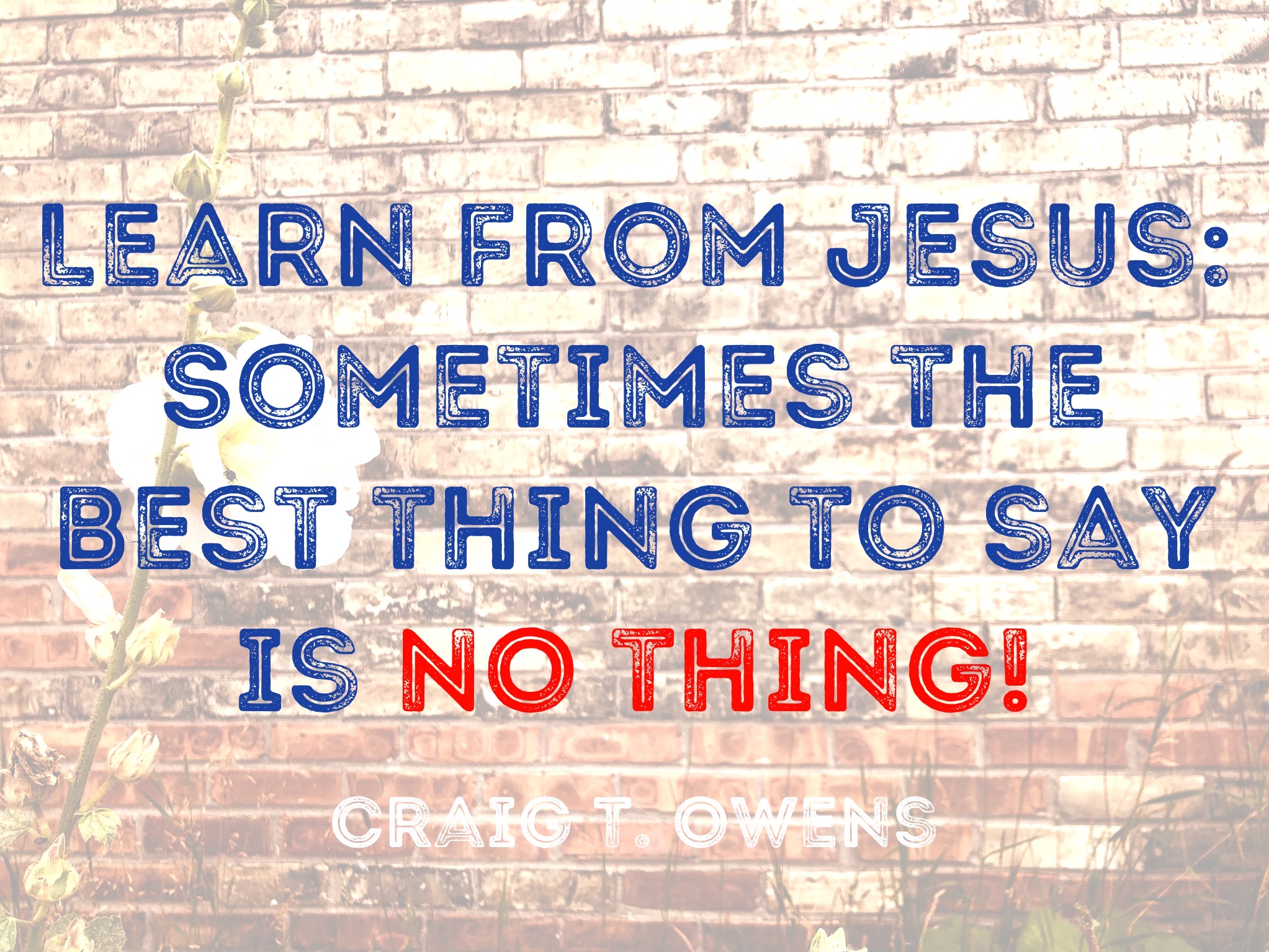
This is a poem I wrote for my congregation after we talked about the eloquent silence of Jesus as His response to foolish heckling.

Learn a lesson from our Lord
Often silence cuts like a sword
When we stand upon the Rock
We needn’t bother when fools mock
Bantering with fools just won’t do
Unless you want to be foolish too
To the wisest words they won’t listen
But joy in airing their own opinion
Our Lord knew just what to do
When mockers hurled words untrue
He entrusted things to the King
Who perfectly records everything
Help us follow the example You gave
To not engage with those who rave
May not our hasty words undo
The loving way we shine for You —Craig T. Owens

►► Would you please prayerfully consider supporting this ministry? My Patreon supporters get behind-the-scenes access to exclusive materials. ◀︎◀︎

Book Reviews From 2022

Listen to the podcast of this post by clicking on the player below, and you can also subscribe on AppleSpotify, or Audible.

I love reading, and I love sharing my love of good books with others! Here is a list of the books I read and reviewed in 2022. Click on a title to be taken to that review.

Autobiography of Calvin Coolidge

Cary Grant

Contending For Our All

Father Sergius

Hank Greenberg: The Story Of My Life

Living In A Gray World

Out Of The Depths

Roots Of Endurance

Simple Truths Of Leadership

Spurgeon And The Psalms

Susanna Wesley

The Holy War

The Legacy Of Sovereign Joy

The Poetry Of Prayer

The Self-Aware Leader

Who Says Elephants Can’t Dance?

Who’s Pushing Your Buttons?

Here are my book reviews for 2011.

Here are my book reviews for 2012.

Here are my book reviews for 2013.

Here are my book reviews for 2014.

Here are my book reviews for 2015.

Here are my book reviews for 2016.

Here are my book reviews for 2017.

Here are my book reviews for 2018.

       Here are my book reviews for 2019.

Here are my book reviews for 2020.

Here are my book reviews for 2021.

►► Would you please prayerfully consider supporting this ministry? My Patreon supporters get behind-the-scenes access to exclusive materials. ◀︎◀︎

Poetry Saturday—Undying Love

Listen to the podcast of this post by clicking on the player below, and you can also subscribe on AppleSpotify, or Audible.

God hath not promised skies always blue,
   Flower-strewn pathways all our lives through;
God hath not promised sun without rain,
   Joy without sorrow, peace without pain.
God hath not promised we shall not know
   Toil and temptation, trouble and woe;
He hath not told us we shall not bear
   Man a burden, many a care.
But God hath promised strength for the day,
   Rest for the laborer, light for the way,
Grace for the trials, help from above,
   Unfailing sympathy, undying love. —Annie Johnson Flint

►► Would you please prayerfully consider supporting this ministry? My Patreon supporters get behind-the-scenes access to exclusive materials. ◀︎◀︎

5 Quotes From “The Poetry Of Prayer”

In The Poetry Of Prayer, T.M. Moore not only introduces us to the imaginative poetry of George Herbert, but he also shows us what Herbert was trying to portray: There’s an undiscovered world in our prayer time! You can check out my full book review by clicking here. 

“The imagination is a wonderful if much-neglected resource. It is that place in the soul where mind, heart, and conscience, most fruitfully overlap to enhance, enrich, and enlarge each other. 

“When our imaginations are functioning as God intends, they can open the windows of refreshment into our souls, so that we think bigger and more clearly and excitedly; we feel with more urgency and delight; and we establish new priorities and values. 

“Poetry stretches the imagination by inviting it on to familiar ground and then changing the nature of that ground, right under our feet. Images, metaphors, rhyme, rhythm, and in an agreeable form can lead us, through our imaginations, into seeing familiar things in new and exciting ways.” 

“Prayer fixes the focus of our minds on unchanging spiritual realities. Prayer engages our imaginations—what Paul calls ‘the eyes of your understanding’—with visions of unseen glories and wonders. …

“At the same time, as we gaze in prayer upon the beauty of Christ, and commune with Him in His glory, we find that our hearts are enlarged in love for the Lord. The sheer beauty, majesty, and immensity of God can suck the breath out of us and fill us with the Spirit of the Lord at the same time. Lesser things lose their thrall as we drink in the vision of Christ and pour out heartfelt words of worship, adoration, and praise. These, in turn, exercise our heart in love for the Lord, just as our physical muscles are exercised during a workout.” 

“We feed our souls in prayer when, having entered His presence, we fill our minds with the vision of His glory, our hearts with the joy and pleasure of His presence, and our wills with iron resolve to serve this glorious God at every moment.” 

“Even now, as the Apostle Paul indicates [2 Corinthians 4:6], we who feast at the banquet table of prayer can glimpse the glory of God in the face of Jesus Christ and know daily revival and renewal in His grace.” 

“Prayer brings us from earth to heaven, and then brings heaven to earth in our transformed souls and renewed commitments for the day ahead.”

My Patreon supporters have been given all the rest of the quotes I pulled from this book. If you would like to have access to all of the content I regularly share with my Patreon team, please click here. 

The Poetry Of Prayer (book review)

Wow, talk about a win-win for me: The Poetry Of Prayer combines one of my go-to theologians (T.M. Moore) with one of my favorite poets (George Herbert)! In another win, this book opens up a new richness for a Christian’s prayer life. 

George Herbert’s poems hold a unique place in the world of literature[*]. Of the 167 poems in the collection of his poems called The Temple, 116 of them are written with meters that are not repeated. In several instances, Herbert created meters that no poet had used before. In his poem “Poetry (1),” Herbert leans into his poetic prowess to try to capture adequate descriptions of prayer. 

T.M. Moore thinks deeply and writes clearly about how Christians should be saturated in the Bible and prayer. In The Poetry Of Prayer he dissects Herbert’s poem phrase by phrase and invites us to see the awesome potential in prayer that far too often goes untapped. 

In each chapter, Moore helps us examine each of Herbert’s poetic phrases, explore the scriptural references that apply, and consider some “next steps” for applying these principles to our personal prayer time. As you progress through the book, Herbert’s poem takes on deeper and richer meaning so that you should become enthralled with cultivating your own rich prayer time.  

I cannot recommend this book to you strongly enough—a true gem in developing a greater appreciation for the intimacy and power in prayer.

For my Patreon supporters, get ready for a treasure-trove of quotes from this book!

[*] If you would like to know more about George Herbert’s poetry, check out my book review of Seeing Beauty And Saying Beautifully.

Poetry Saturday—T.L.A.C.

Listen to the podcast of this post by clicking on the player below, and you can also subscribe on AppleSpotify, or Audible. 

Twisting trunks twirled together
Against all odds, one forever
Limitless love lacks lust
Daily patience is a must
Always affectionate after an accident
What’s the secret? I’ll give a hint
Conceptual curiosity, constant caring compassion
You strive for One, saving no rations
Giving it your all everyday
And to that “Bravo!” I say —Brandon Owens

My son both wrote this poem and painted this piece of artwork.

►► Would you please prayerfully consider supporting this ministry? My Patreon supporters get behind-the-scenes access to exclusive materials. ◀︎◀︎