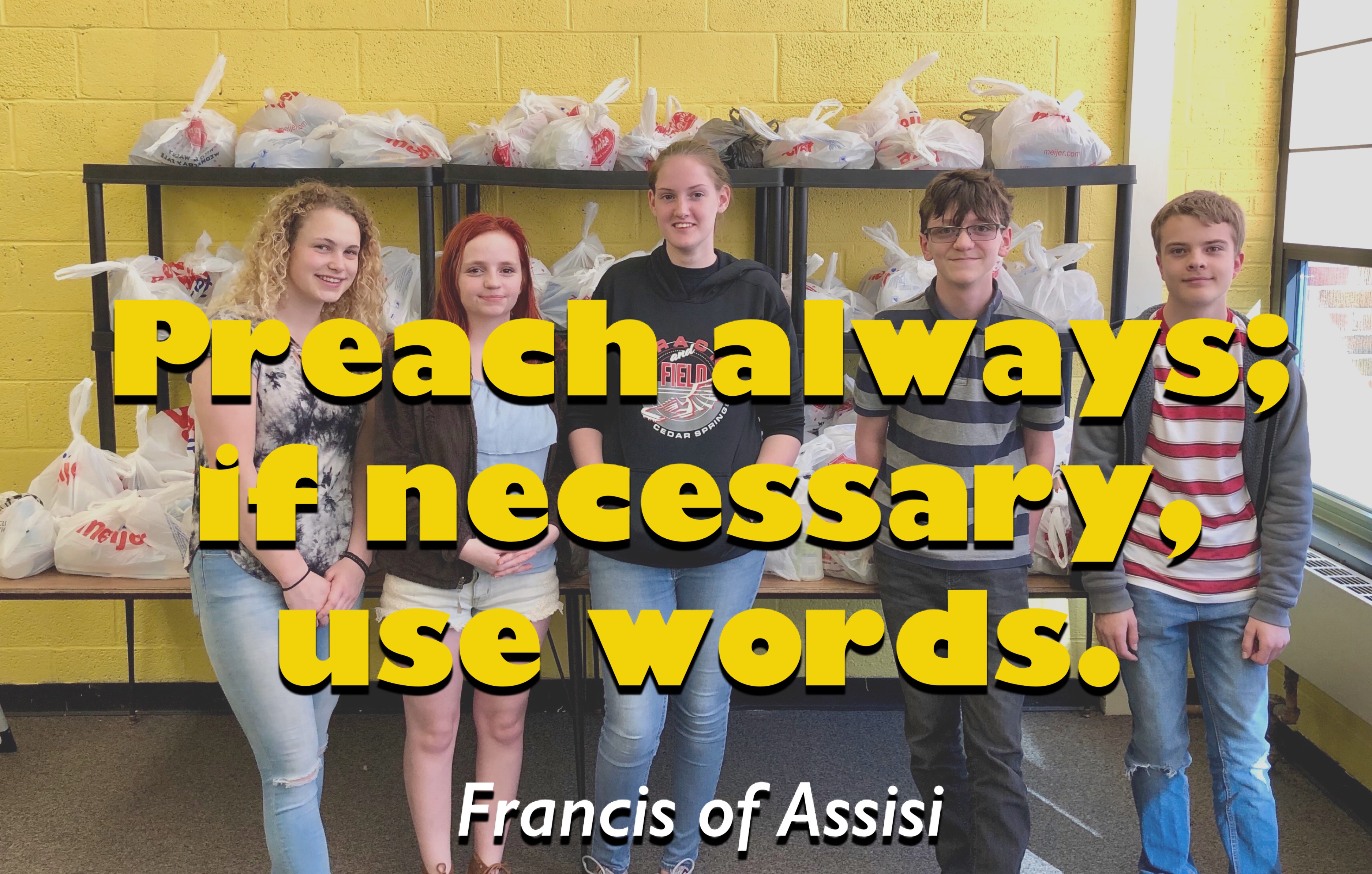
A Life Worthy Of The Gospel

Only let your conduct be worthy of the gospel of Christ… (Philippians 1:27).

The apostle Paul wanted the Philippians’ living to be their preaching. Much like Francis of Assisi said years later: “Preach always; if necessary, use words.”

The big question is—what does conduct “worthy of the gospel of Christ” look like? I believe Paul identifies at least 15 characteristics in just the next 20 or so verses

  1. It is not a people-pleasing lifestyle. It is a God-honoring, Spirit-lead, Christ-glorifying lifestyle.
  2. It is steadfast, which means it perseveres even through the trials and difficulties.
  3. It is a heart and mind unified with other Christians.
  4. It is bold—“without being frightened in any way by those who oppose you.” 
  5. It is strengthened in Christ and it is in constant fellowship with the Holy Spirit. 
  6. It overflows with loving comfort, affection, and mercy to those around it.
  7. It humbly serves others while confidently refreshing itself in Christ.
  8. It strives to live as Jesus did, seeking always for God to be glorified.
  9. It is obedient to the conviction and direction of the Holy Spirit.
  10. It finds pleasure in doing God’s will.
  11. It doesn’t complain.
  12. It is a blameless and harmless life.
  13. It shines a light that attracts others to God’s love.
  14. It holds fast to the Word of life for the long haul.
  15. It is a rejoicing, contented lifestyle.

Heavenly Father, may it always be said of my life that it is one that is worthy of the gospel of Christ. May I always be sensitive to the nudges of the Holy Spirit to keep my life aligned in this way. In Jesus’ name I pray, Amen! 

Uphill Or Downhill?

…And because of this I rejoice. Yes, and I will continue to rejoice (Philippians 1:18).

Paul is in prison, yet he tells his friends that he is choosing to rejoice. Wow! 

Not only that, but this same imprisoned man also reminds his friends to…

  • … let their joy in Jesus overflow 
  • … conduct themselves in a manner worthy of the gospel of Christ
  • … continue to have a servant’s attitude like Jesus
  • … don’t give in to complaining or arguing 
  • … look out for the interests of other people 
  • … rejoice in the Lord
  • … don’t rest on their laurels
  • … forget the past and press on toward the future 

John Maxwell has noted that most people have uphill dreams but downhill habits. That is definitely not a winning combination! 

Paul is making his friends aware of the possible downhill habits that may hold them back from their uphill dreams, and using himself as an example. This first step—awareness—is vital if we are going to break free of the things that are pulling us away from our God-given dreams. 

Solomon wrote, “The path of life leads UPWARD for the prudent to keep them from GOING DOWN to the realm of the dead” (Proverbs 15:24). 

Being prudent is saying, “I’m always on the lookout for what’s best.” 

None of us can go UP by ignoring our downhill habits, or even trying to coast through life. The only way to achieve our uphill dreams is to ask the Holy Spirit to reveal our downhill habits so that we can make a plan to turn those around. 

Check out these characteristics that Paul shares—

Downhill Habit              Uphill Habit
Complaining                    Rejoicing (4:4)
Selfishness                      Gentleness (4:5)
Worrying                         Praying (4:6a)
Grumbling                       Giving thanks (4:6b)
Fixing it myself                Giving it to God (4:6c)
Idle thoughts                   Thinking about my thinking (4:8)
Making my own way         Getting a mentor / partner (4:9)
Being discontent              Being content (4:11-12)
Trying to be self-made     Striving to be Christ-reliant (4:13)

A good prayer for all of us who have uphill dreams that we want to achieve—Holy Spirit, reveal to me my downhill habits. I acknowledge that I need Your help to see and break these habits. Then help me to replace them with Christ-honoring uphill habits that will allow me to achieve the purpose God has for my life.

Serving By Praying

Paul and Timothy, bondservants of Jesus Christ, to all the saints in Christ Jesus who are in Philippi, with the bishops and deacons (Philippians 1:1). 

In just his opening line, Paul lists three types of servant-leaders: bondservants, bishops, deacons. 

The servant-leaders are all called to put the needs of the saints ahead of their own needs. They all serve so the saints can shine! And as the saints shine, they attract others to Jesus Christ. 

Jesus is our example of the Ultimate Servant (Philippians 2:5-8), and we are called to follow His example (John 13:12-17). 

One thing that clearly kept Paul, Timothy, and the other servant-leaders in Philippi in this servant’s posture was prayer. Even the physical posture of kneeling in prayer is a posture of a servant who is actively serving. 

  • Paul prayed for the Philippians frequently—In all my prayers for all of you, I always pray with joy (1:4). 
  • He prayed for them to grow in love and knowledge—I pray that your love will overflow more and more, and that you will keep on growing in knowledge and understanding (1:9). 
  • Paul was grateful for the prayers of the saints—I know that as you pray for me and the Spirit of Jesus Christ helps me, this will lead to my deliverance (1:19). 
  • And he closed his letter with a call for them to continue to pray about everything—Don’t worry about anything; instead, pray about everything. Tell God what you need, and thank Him for all he has done (4:6). 

Here are four powerful lessons for all Christians to live out…

(1) Leaders need to pray for the saints, and leaders need the saints to pray for them. 

(2) Leaders need to be prayerful to keep their posture right as servants. 

(3) Saints need to be prayerful for their leaders so that their leaders can continue to serve them in God-honoring ways. 

(4) We all serve best when we are diligent to keep our prayer life vibrant and healthy. 

Awesome God, Awesome Praise

Last I week I told you how Hebrew poetry often puts the climax in the middle. In Psalm 47 that middle climax is in verse 5—God has ascended. This is one of seven “psalms of enthronement” in the Psalter. Since all of the Scripture points to Jesus, let’s look at the definition of this word ascend and see how it fits with Jesus: 

When a king is coronated—when he is heading toward his throne—we can expect the people to be happy. So the psalmist tells us that in God’s case the people are clapping and shouting (v. 1), telling God how awesome He is (v. 2), thanking Him for subduing their enemies (v. 3), and expressing their gratitude that He has established them as His people (v. 4). 

Then comes the Selah / Pause—what is happening during this pause? The King is being crowned. He has ascended to His rightful throne. So this is selah/pause is really a deep breath that’s about to explode in a crescendo of praise! 

Now there are shouts of joy (v. 5a). In our earthly understanding, it would be something like: “LONG LIVE THE KING!!” There is also a sounding of trumpets (v. 5b) which literally means a thundering of trumpets. And then there’s the singing—lots and lots of singing. In fact, the word sing appears five times in the next two verses. 

From The Infographic Bible (click the image for more)

There are so many ways to say LONG LIVE THE KING—singing, dancing, raising our hands, falling down on our knees. shouting.  

Our God is praise-worthy. He is clap-worthy! He is sing-worthy! He is dance-worthy! He is shout-worthy! He is bowing-worthy! 

Our awesome God deserves awesome praise! 

Why does it seem that we are prone to worship so quietly? Perhaps we need to take it up a notch or two (or three or four). Perhaps we haven’t gazed into His awesome beauty enough to realize just how incredible He is! 

Do you think shouting praises to the King of kings is too undignified? Did you know that when the King of kings returns, He is going to shout and there is also going to be a thundering trumpet? For the Lord Himself shall descend from heaven with a shout, with the voice of an archangel, and with the trumpet of God (1 Thessalonians 4:16)! 

Here are 4 important lessons from this Psalm of Enthronement—

  1. God is the King of all kings, enthroned on the Throne above all thrones. He is worthy of your “undignified” praise and acclamation. 
  2. God should always get your best praise. In verse 7 the phrase sing praises with understanding really means to sing with insight and skill. 
  3. God deserves a holy vocabulary. We see the word awesome in verse 2. Every time this word is used in the Scripture, it’s speaking of God. So why would we use a word like this for something like a hamburger!?!
  4. All nations and kings and peoples and tribes will bow before God at the end. They will bow in either acclamation for their King, or in abject terror of the All-Righteous Judge. Let’s remain missional so more people in the end are crowning Him as their All-Merciful King. 

I hope you can join me this next Sunday as we continue our series looking at the Selahs in the Psalms. 

Thursdays With Spurgeon—God’s Faithful Provision

This is a weekly series with things I’m reading and pondering from Charles Spurgeon. You can read the original seed thought here, or type “Thursdays With Spurgeon” in the search box to read more entries.

God’s Faithful Provision

     My witness is, and I speak it for the honor of God, that He is a good provider. … My first income as a Christian minister was small enough in all conscience, never exceeding forty-five pounds a year, yet I was as rich then as I am now, for I have enough; and I had no more cares, nay, not half as many then as I have now; and when I breathed my prayer to God then, as I do now, for all things temporal and spiritual, I found Him ready to answer me at every pinch, and for many pinches I have had. … My faith has been often tried, but God has always been faithful and sent supplies in hours of need. If any should tell me that prayer to God is a mere piece of excitement, and that the idea of God answering human cries is absurd, I should laugh the statement to scorn, for my experience is not that of one or two singular instances, but that of hundreds of cases in which the Lord’s interposition, for the necessities of His work, has been as manifest as if He had rent the clouds and thrust fourth His own naked arm and bounteous hand to supply the needs of His servant. 

From The Autobiography Of Charles Spurgeon 

I, too, can declare with Spurgeon how many times God has faithfully provided for us just in time. Every instance of true need has been met by miraculous provision as we have prayed to Him. 

It’s a lie to think that God doesn’t care about your need, or that He is too busy with bigger matters, or that He only helps those who help themselves. 

God loves to help those who cannot help themselves, so that He receives all of the glory. 

Do not be anxious about anything, but in every situation, by prayer and petition, with thanksgiving, present your requests to God (Philippians 4:6). 

Does Self-Help Get God’s Help?

This is part 1 in our series looking at phrases that sound biblical and then asking, “Is that in the Bible? 

Statement #1—God helps those who help themselves. Is that in the Bible? No, it is not! 

The reason why I think people have accepted this as biblical is an incorrect view of God. 

  1. Humanism says God is us, which makes us believe, “If it’s going to be, it’s up to me.” 
  2. Fatalism says there is no God and therefore no meaning to life, which makes us believe, “The outcome is what it is and no one has any say in the matter.” 
  3. Deism says there is a God, but it’s hard to get His attention, which makes us believe “He is either disinterested in me or unapproachable. He’s only available for the ‘big’ things.” 

The Bible flat-out rejects all three of these isms. 

Instead, we see a loving, approachable God. One who is both all-powerful and all-loving. He says things like…

  • I made you and know everything about you, and I remain infinitely interested and intimately involved in your life 
  • Come to Me and I will give you rest
  • I want you to cast all your anxieties on Me
  • Don’t be anxious about anything, but tell Me about everything that troubles you (Psalm 139:1-18; Matthew 11:28-29; 1 Peter 5:7; Philippians 4:6)

Not only is “God helps those who help themselves” untrue, but the exact opposite is also true—God helps those who cannot help themselves! 

In Isaiah 40:28-29, we read that God gives strength to the weary and increases the power of the weak. 

“Yes, it is our strength, not our weakness, that is our hindrance and stumbling block.” —Horatius Bonar 

God gives power to the weak. He gives strength to those with no might of their own. God does NOT help those who think they can help themselves! God helps those who cannot help themselves! This is what Jesus came to do, and why we should rejoice in the fact that He does indeed help those who could never rescue themselves (Isaiah 53:4-5; 2 Corinthians 12:9)!

It is our can’ts that God uses as His opportunities to show how limitless He is. Our limitations magnify His love and His power. 

One of the best prayers you could ever pray is simply, “God, help!” This simple prayer acknowledges in just two words that you can’t but He most assuredly can! 

But those who wait for the Lord—who expect, look for, and hope in Him—shall change and renew their strength and power; they shall lift their wings and mount up close to God as eagles mount up to the sun; they shall run and not be weary, they shall walk and not faint or become tired. (Isaiah 40:31 AMP) 

Join me next week as we continue to explore various statements and ask, “Is that in the Bible? 

God + Nothing

You cannot serve God and _____________.

What goes in the blank? Not wealth, health, position, prestige, popularity, success. We turn all those good and legitimate things into God’s rival when our focus is on any one of them. 

Bottom line—NOTHING can go in that blank. All we need is God. 

“Your Father knows what you need” (Matthew 6:8). If you need wealth to complete His purpose for your life, He will give it to you. If you don’t, He will withhold it. But He will always give you your daily bread. 

If you need a prominent position, He will place you there; if you don’t, He will withhold that position. In either place, we still submit as faithful servants to holy God. 

If success will allow me to bring glory to God, He will give me success; if falling flat on my face will allow me to bring glory to God, He will knock me down.

If physical health will allow me to share the Gospel with others, God will keep me healthy; if I can serve Him best from a place of physical limitation, I can still do all things through Christ who strengthens me.

“My God is able to supply all your needs” (Philippians 4:19). He gives me all that I need to fulfill His plans for me. “So do not worry” about your bank balance, your standing in the community, your health, your family, or anything else. His grace is sufficient for you.

What goes in the blank? Nothing. 

God + Nothing = Everything you need!

Be The 1-In-10

“…ten men who were lepers…” (Luke 17:12). 

Lepers were outcasts in society. Unable to participate in normal daily activities, unable to go to the temple to worship God, even unable to be with their family. These ten lepers encountered Jesus and did two positive things. But 9-of-10 lepers also did two sad things. 

(+) They knew to call on Jesus for help—“Jesus, Master, have pity on us!” 

(+) They took Jesus at His word. Their healing happened as they obeyed Christ’s words—“‘Go, show yourselves to the priests.’ And as they went, they were cleansed.” 

(-) Only one cleansed leper came back to praise God for his healing. 

(-) Only one was pronounced “well” by Jesus. All ten lepers were “cleansed,” which simply meant they were ceremonially clean and could once again participate in daily life and temple worship. But only one was made completely “well.” The Greek word is sozo, which means saved from eternal destruction. The same word is used to describe what Jesus came to do for us: “You shall call His name Jesus, for He shall save [sozo] His people from their sins” (Matthew 1:21). 

“What a rare thing is thankfulness.… ‘Were there not ten cleansed? But where are the nine?’ The lesson before us is humbling, heart-searching, and deeply instructive. The best of us are far too like the nine lepers. We are more ready to pray than to praise, and more disposed to ask God for what we have not, than to thank Him for what we have. … If we would be anxious for nothing, we must make our requests known to God not only with prayer and supplication, but with thanksgiving (Philippians 4:6).” —J.C. Ryle (emphasis mine) 

Probably all of us experience daily blessings from our good God, yet many of us never acknowledge Him as the Source of those blessings. We just accept the blessing and then keep on walking. 

Let’s be the 1-in-10! 

Let’s be quick to recognize God’s blessings. Let’s always remember that He does more than give us strength for today, but He saves [sozo] us entirely from eternal destruction. Let’s be the ones who always return—day after day after day—to give glory to God! 

Come And See What Our God Has Done

Check out the opening verses of Psalm 66—

Shout joyful praises to God, all the earth!
Sing about the glory of His name!
Tell the world how glorious He is.
Say to God, “How awesome are Your deeds!
    Your enemies cringe before Your mighty power.
    Everything on earth will worship You;
    they will sing Your praises,
    shouting Your name in glorious songs.” Interlude 
Come and see what our God has done,
    what awesome miracles He performs for people! (66:1-5 NLT)

I’d like to explore with you this phrase—come and see what our God has done. 

In so many of the Psalms we get at least a little context. We might be told the type of song it is or the kinds of musical instruments to be sung. We might know who wrote the psalm or at least why he wrote it. We might even hear what was happening in the psalmist’s world at the time he wrote the song or maybe at what event he wanted the song to be sung. All of these things would give us context clues into when/where to use the song—when I’m afraid? when I’m under attack? when I’m happy? when I’m depressed? 

For this psalm all the context we know is—For the choir director: A song. A psalm. 

But let me ask you: does it really matter? If you’re up or down, flush with cash or barely hanging on, winning the fight or feeling like you’re being beaten down—in any circumstance, can you still say come and see what our God has done? 

I think the answer is yes. I think this is the reason why no context is given us, because this psalm is appropriate regardless of the circumstances.

Just as the apostle Paul wrote, “I know how to live on almost nothing or with everything. I have learned the secret of living in every situation, whether it is with a full stomach or empty, with plenty or little. For I can do everything through Christ, who gives me strength” (Philippians 4:12-13).

As Christians, we’ve been called to step alongside people in their messy, broken lives. Yes, we are to weep with those who weep, but we’re not to keep them there but to take them to the One who can heal their messy, broken lives. 

The reasons to say, “Come and see what our God has done” are all around us. 

Earth’s crammed with heaven, 
And every common bush afire with God; 
But only he who sees, takes off his shoes, 
The rest sit round it and pluck blackberries, 
And daub their natural faces unaware. —Elizabeth Barrett Browning

Don’t just pluck blackberries; realize that those berries are the produce of a loving Creator. Don’t miss the opportunities to give God glory. Good times are wonderful opportunities to start. But those are just the starting points. Find the reasons even in hard times—I have learned the secret of being content in any and every situation, whether well fed or hungry, whether living in plenty or in want.

Anywhere … everywhere … no matter the context … HE IS STILL GOD. He is still worthy to be praised. There is still ample reason for us to say, “Come and see what our God has done!” 

Living Between The Advents

We live in an amazing time—the First Advent of Jesus has already happened in Bethlehem, and yet we are eagerly anticipating Christ’s Second Advent at any moment! 

The fourth stanza of Charles Wesley’s classic Christmas carol Hark! The Herald Angels Sing is a wonderful between-the-Advents look at what happened at the First Advent, and what we have to look forward to in the Second Advent. The key thing to note in this stanza is the verbs: come, fix, rise, bruise, efface, stamp, and reinstate. 

COME, Desire of nations—What is the “desire of nations”? It’s the restoration of God’s glory on earth, so it’s not really a what but a Who. The prophet Haggai informs us that our Desire is realized in the Advent of Jesus (2:1-9).  

FIX in us Thy humble home—At His First Advent, Jesus came and humbly made His home among us, even dying to pay the penalty for our sins (Hebrews 2:14, 17; Philippians 2:7-8). 

RISE, the woman’s conquering seed—Although Jesus was obedient to death—even death on a Cross, He didn’t stay dead but was resurrected (Philippians 2:8-9; Revelation 1:18)! 

BRUISE in us the serpent’s head—With His death and resurrection, Jesus took away the sting of death from satan, fulfilling one of God’s first prophesies (Genesis 3:15; 1 Corinthians 15:19-26, 54-57).  

Adam’s likeness now EFFACE—That means to wipe out, do away with, expunge. That’s exactly what God does with our forgiven sins (Psalm 103:1-4, 10-12)! 

STAMP Thine image in its place—Although our sin has been effaced, God doesn’t leave us as blank slates, but instead He allows the image of His Son Jesus to be stamped onto our lives (2 Corinthians 1:21-22; 2 Corinthians 3:18). 

REINSTATE us in Thy love—The relationship we longed for is now reborn in us (1 Corinthians 15:49)! 

The Desire of Nations HAS come, and yet He WILL come again! We’re living between the Advents now, so a good question for Christians to ask is: “How are we to live?” I think there are three key things—

  1. In celebration that Jesus came at His First Advent to be our Savior
  2. In anticipation of the Second Advent
  3. In obedience to God’s Word (Revelation 22:7)

To take a look at the other stanzas of this Christmas carol, please click here.