Overcoming Anxiety

God's answersI remember visiting Denver, Colorado. The scenery was so breathtaking, so I decided to go for an early morning hike. Quickly I discovered that my hike became breathtaking in more than one way! Even though I was in good shape, I had a hard time getting my breath because of the mile-high atmosphere.

I learned later that this is why many top athletes train in high elevation: it increases their lung capacity and endurance so that they now have an advantage when they compete against others.

God trains us on His mountains, but He made us to live and minister in the valleys. Our ascent into God’s mountaintop presence is so important for godly maturity!

In the first song of ascent, I noticed something unusual in the very first verse. Some Bibles translate the verbs in the present tense (I call on the Lord and He answers me), but some translations use the past tense (I called on the Lord and He answered me). Which is correct? Actually both of them are correct!

The verbs are written in the perfect tense—something done at a specific point in the past, but still relevant and powerful in the present. In other words, we can say it like this, “I called on the Lord in the past and He most definitely answered me. That gives me confidence to call on the Lord today, knowing that He will answer me again.”

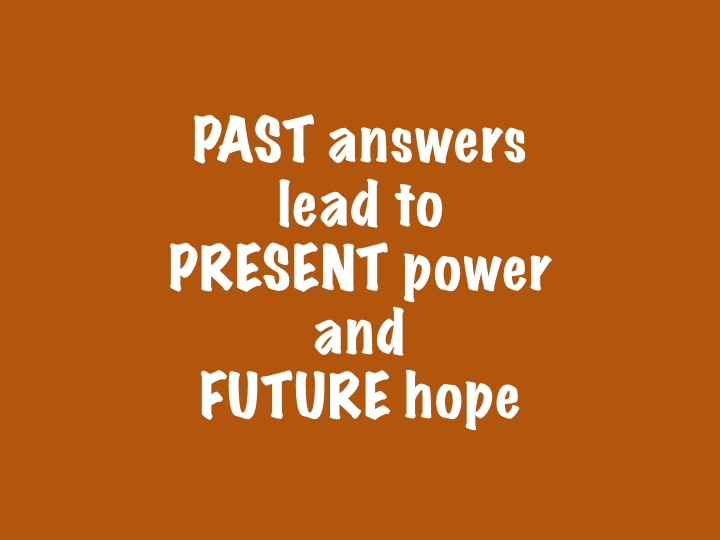
Past answers lead to present power and future hope.

But—oh wow!!—check out how God answers us! The word literally means that God answers us in song. God so loves it when you trust Him enough to bring all your cares to Him, that He sings His answer to you. For the Lord your God is living among you. He is a mighty Savior. He will take delight in you with gladness. With His love, He will calm all your fears. He will rejoice over you with joyful songs (Zephaniah 3:17).

If we don’t continue to recall how God has answered us in the past, we’re missing out on the blessing of hearing Him sing His answers over us again today. As a result, we begin to live in the world’s valley-level turmoil and anxiety.

Peace is longed for in verses 6 and 7. The Christian wants to live in peace, but the world loves turmoil. Want proof? Just look at what makes the headlines today! The solution is to keep going back to God again and again and again—

Do not be anxious about anything, but in everything, by prayer and petition, with thanksgiving, present your requests to God. And the peace of God, which transcends understanding, will guard your hearts and minds in Christ Jesus. (Philippians 4:6-7)

Check out the full message to find the peace you are longing for!

If you don’t have a home church, please join us this Sunday as we continue our look at the psalms of ascent, or you can tune in to our live Periscope broadcast from wherever you are.

If you’ve missed any of the messages in this series, you can access the complete list by clicking here.

Handling Life’s Pauses

John Ruskin“There is no music during a musical rest, but the rest is part of the making of the music. In the melody of our life, the music is separated here and there by rests. During those rests, we foolishly believe we have come to the end of the song. God sends us times of forced leisure by allowing sickness, disappointed plans, and frustrated efforts. He brings a sudden pause in the choral hymn of our lives, and we lament that our voices must be silent. We grieve that our part is missing in the music that continually rises to the ear of our Creator. Yet how does a musician read the rest? He counts the break with unwavering precision and plays his next note with confidence, as if no pause were ever there. God does not write the music of our lives without a plan. Our part is to learn the tune and not be discouraged during the rest. They are not to be slurred over or omitted, nor used to destroy the melody or to change the key. If we will only look up, God Himself will count the time for us. With our eyes on Him, our next note will be full and clear. If we sorrowfully say to ourselves, ‘There is no music in a rest,’ let us not forget that the rest is part of the making of the music.” —John Ruskin

O Holy Night & O Holy Day

O Holy NightIn 1847 an unnamed parish priest sent an unusual request to Placide Cappeau, the commissioner of wines in a small French town: “You are well known for your poems. Would you consider writing a poem for our Christmas mass?” Cappeau was both intrigued and honored, and he soon penned an essay called Cantique de Noel.

Cappeau felt that his poem was more worthy of a song, than just merely a poem, so he turned to his friend Adolphe Adams. Adams was a classically trained musician, but he was also a Jew. Adams said to Cappeau, “You’re asking me to write a melody for a poem that celebrates a Man I do not view as the Son of God, and a poem that celebrates a day I do not celebrate?” But because his friend Cappeau had requested it, he gave it his best effort. Three weeks later, Cantique de Noel was first heard at the Christmas Eve midnight mass.

Cantique de Noel quickly became popular throughout France. But when it was discovered that the lyricist Cappeau had left the church to become a socialist and that the musical composer Adams was a Jew, the Catholic Church banned the song from being sung in any of its churches. Still, the song grew in popularity.

During the build-up to the American Civil War, an abolitionist named John Dwight was especially moved by a line in Cantique de Noel: “Chains shall He break, for the slave is our brother, and in His name all oppression shall cease.” Dwight published his version of Cantique de Noel in his abolitionist magazine with the new title O Holy Night. The song quickly caught on in America.

The opening words of O Holy Night speak to our hearts today, as much as they did to those present at the First Advent—long lay the world in sin and error pining, till He appeared and the soul felt its worth. To pine for something means to long painfully for something just out of our reach. It’s what the psalmist in ancient Israel captured too when he wrote, My soul yearns, even faints, for the courts of the Lord; my heart and my flesh cry out for the living God (Psalm 84:2). There is a longing in all of us to know the Lord!

That’s why Christ’s First Advent is such a blessed, joyous event! In the second stanza we sing—In all our trials born to be our Friend; He knows our need, to our weakness is no stranger. Indeed the writer of Hebrews tells us why Jesus was born as a human (Hebrews 2:14-18), and why we can approach Him confidently (4:15-16).

Christ’s Incarnation allows us to put our faith in Him. When we do, we experience the Atonement. I like to remember this word by saying it at-onement. In other words, the Heavenly Father now sees me at-onement with His Son—when He looks at me, He sees Jesus. That’s why God forgets our forgiven sins (Hebrews 8:12)!

Then the third stanza of O Holy Night begins to tell us how we live out the at-onement every day by loving one another, enjoying His peace, living free and helping others get free too, singing joyfully to God day after night after day after night!

The First Advent was a holy night because Christ’s Atonement it makes us holy. So now all our nights are O holy nights, and all our days are O holy days, and all our work is O holy work, and all our relationships are O holy relationships!

Christ’s First Advent changes EVERYTHING for those who put their faith in Him. Is that you? Are you living in Christ’s at-onement? If not, you can be today by simply asking Him to come into your life.

You can check out some of the other Christmas carols we have looked at here. And check out the video of this message too—

If you have missed any of the messages in our series The Carols Of Christmas, you can find the full list by clicking here.

The Non-Christmas Christmas Carol

No more tearsImagine that I invited you to my house for a Christmas party. When you arrived, I greeted you at the door with a cheerful hello and warmly welcomed you into my home. But as you hung out with the other guests, you might begin to wonder if we were truly celebrating Christmas. After all, when you looked around my house, you saw no Christmas tree, no ornaments, no wrapped gifts, no mistletoe, no Christmas stockings, no manger scene. You might be tempted to say that you were invited to a non-Christmas Christmas party! (By the way: my house IS fully decorated for the season!)

One of our 300-year-old Christmas carols sounds remarkably like my make-believe party. Joy To The World has no mention of angels, no wisemen, no manger, no nativity scene, no virgin birth, no star in the east. It seems like a non-Christmas Christmas carol! 

That’s because at this time of year, Christians aren’t celebrating Christmas, but we’re celebrating Advent. Actually we’re celebrating both Advents. 

Jesus was born in a Bethlehem manger (His First Advent), but He is also coming again to bring all of earth’s history to a close (His Second Advent). So we celebrate the First Advent, and then look with hopeful anticipation to the Second Advent. That’s exactly what Joy To The World does!

Each of the stanzas of this well-known hymn looks forward with joy to Christ’s ultimate fulfillment of all the prophesies of the Bible. The final joy comes when He reigns as King of Kings and Lord of Lords. But we can still live with joy right now!

The third stanza of this hymn says that Christ has come to make His blessings known far as the curse is found. The Apostle Paul says the same thing—sin used to reign, but the grace of God far exceeds the thorns of sin (see Romans 5:19-21; 6:8-12).

Our ultimate joy comes at the Second Advent of Christ when “He will wipe away every tear from their eyes. There will be no more death or mourning or crying or pain, for the old order of things has passed away” (Revelation 21:4).

So the next time you hear the non-Christmas Christmas carol Joy To The World, be reminded that it’s not Christmas we are celebrating, but Christ’s First Advent. And it’s not some shapeless, indefinable future that awaits us, but we can live in the joy of anticipating Christ’s Second Advent.

Check this out—

If you have missed any of the messages in our series The Carols Of Christmas, you can find the full list by clicking here.

The Carols Of Christmas

Carols Of ChristmasI heard the bells on Christmas Day
Their old familiar carols play,
And wild and sweet the words repeat
Of peace on earth, goodwill to men. (Henry Wadsworth Longfellow)

How many “old familiar carols” have you heard Christmas after Christmas, until the words have almost lost their meaning? If we’re not careful, any song repeated too often can lose the richness of its original intent.

There are some amazing messages in many of our old familiar Christmas carols, because many of those messages are saturated with the old familiar story of Redemption that the Bible tells over and over again.

Please join me this Sunday as we once again take a new look at the old familiar messages in our Christmas carols. These messages will bring a new appreciation of God’s love that was sung at Christ’s First Advent, and reawaken the sweetness of meaning for this Christmas Day.

If you would like to check out some of the carols we have already looked at, check out these posts:

Links & Quotes

link quote

“That which astonishes, astonishes once; but whatever is admirable become more and more admired.” —Joseph Joubert

“Adoption is an act of God’s free grace, whereby we are received into the number, and have a right to all the privileges of the sons of God.” —Westminster Confession

“Adversity is the first path to trust.” —Lord Byron

“Adversity makes men, and prosperity makes monsters.” —Victor Hugo

“God’s corrections are our instructions; His lashes our lessons, and His scourges our schoolmasters.” —John H. Aughey

“Am I getting nobler, better, more helpful, more humble, as I get older? Am I exhibiting the life that men take knowledge of as having been with Jesus, or am I getting more self-assertive, more deliberately determined to have my own way? It is a great thing to tell yourself the truth.” —Oswald Chambers

“Press into God’s promises. When fears surface, respond with this thought: But God said … And when doubts arise, but God said… And when guilt overwhelms you, but God said…  Search the Scriptures like a miner digging for gold and trust the promises you find.” —Max Lucado

John Hendryx points out several similarities between Islamic and secular fundamentalism.

Josh McDowell reminds us that just teaching someone biblical truth is not enough.

If you would like to check out some devotional readings for Advent, click here.

The importance of belief in God for Issac Newton’s scientific discoveries.

[VIDEO] One of the most beautiful arrangements of Amazing Grace I’ve heard—

Links & Quotes

link quote

“satan is real and may have a hand in our calamities, but not the final hand, and not the decisive hand. James makes clear that God had a good purpose in all Job’s afflictions: ‘You have heard of the steadfastness of Job, and you have seen the purpose of the Lord, how the Lord is compassionate and merciful’ [James 5:11]. So satan may have been involved, but the ultimate purpose was God’s, and it was ‘compassionate and merciful.’” —John Piper

“God’s will is determined by His wisdom which always perceives, and His goodness which always embraces, the intrinsically good.” —C.S. Lewis

“Let us never suppose that there is any lack of charity in speaking of hell. Let us rather maintain that it is the highest love to warn men plainly of danger, and to beseech them to ‘flee from the wrath to come.’ It was satan, the deceiver, murderer, and liar, who said to Eve in the beginning, ‘You shall not surely die.’ (Genesis 3:4.) To shrink from telling men, that except they believe they will ‘die in their sins,’ may please the devil, but surely it cannot please God.” —J.C. Ryle

“You aren’t the only person with your skill. But you are the only person with your version of your skill.” —Max Lucado

“There is nothing natural about the Christian life. It is all supernatural. It’s a life dependent upon miracles from the very beginning (including your conversion). And it simply can’t be lived without faith in the supernatural.” —David Wilkerson

It is time for science to detach itself from an atheistic worldview. Douglas Rushkoff states, “By starting with Godlessness as a foundational principle of scientific reasoning, we make ourselves unnecessarily resistant to the novelty of human consciousness, its potential continuity over time, and the possibility that it has a purpose.”

Detroit Tigers fans (like me!) will love this: an interactive map that shows where every Tiger has been born.

John Stonestreet asks, “Why is pop music so angry?” Check out his answer in Bad Blood.

[VIDEO] John Maxwell challenges us to find someone we can inspire this weekend—

https://youtu.be/7OhH2mZUZc8


Links & Quotes

link quote

“I have learned now that while those who speak about one’s miseries usually hurt, those who keep silence hurt more.” —C.S. Lewis

“Jesus spilled His blood for you. You can spill your heart before God.” —Max Lucado

“Too often, when issues of sexual abuse come up, the Church simply stays silent. But a Gospel-centered response to sexual violation of anyone at any age begins with understanding that silence is not an option.” Read more in The Scandal Of Silence.

An abortion clinic in Michigan was shut down for numerous health and safety violations, but now it appears it may re-open.

[VIDEO] Here’s the truth of what abortion providers do—

Eric Metaxas shares the really cool story behind the Navy Hymn.

“You can be saved, Spirit-filled, and walking holy before God, yet still be guilty of unbelief. You may think, ‘I don’t have any unbelief.’ But do you get upset when things go wrong? Are you fearful of failing God? Are you restless, afraid of the future? The believer who has unconditional faith in God’s promise enjoys complete rest. What characterizes this rest? A full, complete confidence in God’s Word, and a total dependence on His faithfulness to that Word. Indeed, rest is the evidence of faith.” —David Wilkerson

Seth Godin discusses what starts to happen when our expectations slip.


23 Other Quotes From “15 Invaluable Laws Of Growth”

15 Invaluable Laws of GrowthJohn Maxwell is extremely well-read! It is obviously that he uses many sources to sharpen and refine the teaching principles he shares in his books. I recently finished reading 15 Invaluable Laws Of Growth, and as usual, Dr. Maxwell shared several quotes from others which I found very highlighter-worthy. Here are a few of them…

“What great accomplishments we’d have in the world if everybody had done what they intended to do.” —Frank Clark

“A mistake is simply another way of doing things.” —Warren Bennis

“You cannot change your destination overnight, but you can change your direction overnight.” —Jim Rohn

“Can there be a more insidious word? Later, as in ‘I’ll do it later.’ Or, ‘Later, I’ll have time to write that book that’s been on my mind for the past five years.’ Or, ‘I know I need to straighten out my finances… I’ll do it later.’ ‘Later’ is one of those dream-killers, one of the countless obstacles we put up to derail our chances of success. The diet that starts ‘tomorrow,’ the job hunt that happens ‘eventually,’ the pursuit of the life dream that begins ‘someday’ combine with other self-imposed roadblocks and lock us on autopilot.’ —Jennifer Reed

“No one can produce great things who is not thoroughly sincere in dealing with himself.” —James Russell Lowell

“Probably the most honest self-made man ever was the one we heard say: ‘I got to the top the hard way—fighting my own laziness and ignorance every step of the way.’ —James Thom

“It’s impossible to consistently behave in a manner inconsistent with how we see ourselves. We can do very few things in a positive way if we feel negative about ourselves.” —Zig Ziglar

“Follow effective action with quiet reflection. From the quiet reflection will come even more effective action.” —Peter Drucker

“The wise man questions himself, the fool others.” —Henri Arnold

“The successful person has the habit of doing the things that failures don’t like to do. The successful person doesn’t like doing them either, but his dislike is subordinated to the strength of his purpose.” —E. M. Gray

“Where many people go wrong in trying to reach their goals is in constantly looking for the big hit, the homerun, the magic answer that suddenly transforms their dreams into reality. The problem is that the big hit never comes without a great deal of little hits first. Success in most things comes not from some gigantic stroke of fate, but from simple, incremental progress.” —Andrew Wood

“A bad habit never goes away by itself. It’s always an undo-it-your self project.” —Abigail Van Buren

“The great composer does not set to work because he is inspired, but becomes inspired because he is working. Beethoven, Wagner, Mozart, and Bach all settled down, day after day, to the job at hand. They didn’t waste time waiting for inspiration.” —Ernest Newman

“Do not wait for a change of environment before you act. Cause a change of environment through action. You can act upon your present environment so as to cause yourself to be transferred to a better environment.” —Wallace D. Wattles

“Whatever course you decide upon, there is always someone to tell you that you are wrong. There are always difficulties arising which tempt you to believe that your critics are right. To map out a plan of action and follow it to the end requires some of the same courage which a soldier needs. Peace has its victories, but it takes brave men to win them.” —Ralph Waldo Emerson

“Someone’s opinion of you does not have to become your reality.” —Les Brown

“If you don’t design your own life plan, chances are you’ll fall into someone else’s plan. And guess what they may have planned for you? Not much.” —Jim Rohn

“An idealist believes the short run doesn’t count. A cynic believes the long run doesn’t matter. A realist believes that what is done or left undone in the short run determines the long run.” —Sydney J. Harris

“Every problem introduces a person to himself.” —John McDonnell

“Experience isn’t really the best teacher but it sure does serve as the best excuse for not trying to do the same silly thing again.” —Frank Hughes

“You will never stub your toe standing still. The faster you go, the more chance there is of stubbing your toe, but the more chance you have of getting somewhere.” —Charles F. Kettering

“Not everything that is faced can be changed. But nothing can be changed until it is faced.” —James Baldwin

“No pain, no palm; no thorns, no throne; no gall, no glory; no cross, no crown.” —William Penn

You can read my book review of 15 Invaluable Laws Of Growth and its companion book JumpStart Your Growth by clicking here.

To read quotes from John Maxwell in 15 Invaluable Laws, click here.

P.S. And watch for more quotes coming soon!

Links & Quotes

link quote

“Faith does not shirk the fight; she longs for it, because she foresees the victory.” —Charles Spurgeon

“Faith honors Him whom it trusts with the most reverent and highest regard, since it considers Him truthful and trustworthy.” ―Martin Luther

“A rejection, or in Scripture’s strong language, a crucifixion of the natural self is the passport to everlasting life. Nothing that has not died will be resurrected.” ―C.S. Lewis

“You didn’t sign up for this crash course in single parenting or caring for a disabled spouse, did you? No, God enrolled you. Why? So you can teach others what He has taught you. Rather than say, ‘God, why?’ ask, ‘God, what?’ What can I learn from this experience? Your mess can become His message!” —Max Lucado

I have often said that low expectations can sink someone’s future. Seth Godin agrees. Check out his post The Tragedy Of Small Expectations.

[VIDEO] Pentatonix is a very talented a cappella group! Check out this mash-up of Michael Jackson hits—