Are You Healthy Enough To Love Serving Others?

Jesus was wholly healthy. That is to say, He was healthy in every aspect of His life—mentally, physically, spiritually and emotionally (see Luke 2:52). This is important to note because Christians are called to be healthy in all of these same areas.

The phrase Dr. Luke uses about Christ’s growth is a telling one: Jesus grew in favor with men. People liked having Jesus around. The word for favor is from the same root word where we also get grace. So Jesus was a graceful man.

What does it mean when someone is graceful? It means they are pleasant to be around … you feel safe around them, knowing they will never belittle you or put you down … their focus is on your agenda, not their own … they are a “there you are!” person, not a “here I am!” person.

Bottom line: they are filled with love for others.

Jesus was healthy in His mind, His body, His spirit and His emotions, which allowed Him to be in a unique place where He fully knew how powerful He was, yet He chose to use His power not for His own benefit, but to serve others (see John 13:1-4).

Healthy love loves God and then serves God by loving and serving others. Only a wholly healthy person can truly serve with a right attitude…

  • People with unhealthy thoughts won’t serve because they don’t know they’re supposed to serve.
  • People with unhealthy bodies can’t serve because their disease won’t let them.
  • People with unhealthy spirits shouldn’t serve because they are promoting hypocrisy.
  • People with unhealthy emotions don’t serve because their attitude gets in the way.

Jesus not only told us His loving service was an example for us (John 13:15-17), but He went on to say that our loving service would be an example for others (vv. 34-35).

Healthy love loves God and then serves God by loving and serving others.

Do you have that kind of healthy love? Are you becoming wholly healthy enough to serve?

Ask yourself these questions:

  1. What do I know that I’m not yet doing?
  2. What will it take for me to turn knowing into doing?
  3. Can people tell I am growing wholly healthier year by year?

9 Quotes From “Take Your Life Back”

take-your-life-backStephen Arterburn and David Stoop have given us a great resource if we are struggling to free ourselves from the wounds that are trapping us in a reactive life. I truly believe Take Your Life Back will start many people on a journey of healing. Check out my full book review by clicking here, and then check out a few quotes from this helpful book.

“When we’re constantly looking at what’s happening with other people and measuring our satisfaction based on how fairly we feel we’ve been treated, we are forever at the mercy of what is going on over there. We’ve wired ourselves to react to whatever scale of comparison we’ve established.”

“The real self, quite simply, is the self that God sees. He sees it all, with all its flaws. He does not approve of or endorse everything He sees, but He loves the person He sees. He does not see an idealized self, free of sin. He sees the real self—sinful, doubtful, and flawed—and yet He accepts the reality of it and loves us in spite of it all.”

“Our reactions to pain and our adaptations to it are unique to ourselves; we are not all the same. But we have several things in common: In one way or another, we have turned our back on reality, and we have allowed all, or portions, of our lives to be controlled by another person, a destructive pattern, or unrealistic expectations. We live on the edge of almost. We are almost breaking free, or we are almost free. We are almost fed up or almost ready to take our lives back.” 

“Denial keeps us from addressing the things we can change, causing us to think that our inability to change everything means we can’t change anything. … Because we either don’t or won’t see how far we are from living the life that God intends for us, we stay in our denial and wait for the magic cure that never materializes. But when we admit that we’re in denial, and when we are willing to break through it, we can begin to move into recovery.”

“When we talk about the elephant in the room, we have a way of describing it as a small rodent. Our internal application for minimizing language automatically converts words like pain into irritation; devastating into difficult; abusive into insensitive; and horrific into unpleasant. Our self-talk is unrealistic, so whenever we communicate with someone else, we present our overwhelming problems as manageable situations that we have completely under control. Because we don’t acknowledge the full scope and intensity of our struggles, we don’t act in realistic ways to free ourselves and take our lives back. We minimize in order to give ourselves permission to do little or nothing to change.”

“Toxic shame undermines our will and our power to stand up for ourselves. … Toxic shame carves out a new normal for those who partake of its poisonous fruit. Rather than seeing themselves as human beings who have made a few mistakes—maybe even some really big mistakes—people who are saturated with toxic shame see their failures as an objective expression of who they are. Before long, they don’t even try to avoid future mistakes. They don’t learn from their errors because they don’t think they can, or need to, learn anything. Repeated mistakes are simply a self-fulfilling prophecy that their shame as written for them. …

“Toxic shame…blinds us to wisdom and insight. It prevents us from cleaning up after ourselves. We start to live in the debris of past mistakes, and that leads us to more debris-producing decisions. We fill our lives with problem after problem because we don’t think we can do any better.”

“There is such a thing as good shame. A better term for it might be godly sorrow. …

“Godly sorrow is a warning sign that we are on the wrong path and need to make some adjustments. Any mistakes we make are not seen as the inevitable result of who we are but as stark reminders that—because of who we are, created in the image of God—we can do better. We are genuinely sorry that we fell short, hurt ourselves or other people, or simply created a lot of hassle that has kept us from living in the good things that God has for us. However, our defective behavior is rightly seen as separate from our identity. Making a mistake doesn’t mean that we are a mistake; it’s simply evidence that we are like every other human being—completely capable of many things, including mistakes. …

“Godly sorrow is a prompt from God, and from a well-developed conscience, that we need something more to achieve all that we want to accomplish. We respond to healthy shame with the desire to get better or do better….”

“Tough love says that I will choose to not give you what you want if it prevents you from attaining what you need.”

“Taking your life back is not just about deciding to defend yourself. It is about finding and removing roadblocks, sinkholes, and dead ends that have disconnected you from other people and stopped your journey from going forward together.”

Love Re-members

love-re-membersChristians often talk about God in terms of the “Trinity.” That is, the One True God revealed in three Persons: Father, Son, and Holy Spirit.

This is sometimes a difficult concept to grasp, especially since the word Trinity doesn’t specifically appear in the Bible. But make no mistake, just because the word isn’t there doesn’t mean it’s not true. Consider…

  • God’s Three-in-One nature is first exhibited when man is created (Genesis 1:26).
  • When the prophesy is given about Jesus being born in human flesh, He is given all the titles of the three Persons of the Godhead (Isaiah 9:6).
  • At Christ’s baptism we see Jesus in human form, we see the Holy Spirit descending as a dove, and we hear the Father’s voice announcing His approval of His Son (Matthew 3:16-17).
  • Jesus Himself said He would ask the Father to send the Holy Spirit to the Christians (John 14:16).
  • And just as Jesus ascended into Heaven, He told His followers to baptize people into all three Persons of the Godhead (Matthew 28:19).

But I think the best expression of the Trinity is revealed in three simple words. John talks about how all three Persons of the Trinity are involved in the life of a Christian. And then he sums it all up in three words—

“GOD IS LOVE”

Each Person of the Godhead is encouraging and illuminating and pointing to the other Persons in the Trinity. Love is perpetually being received and given. We humans are created in God’s image … we are created to receive and to give God’s love. That’s why John tells us that we know and rely on the love God has for us (that’s the receiving part), and that whoever lives in love lives in God, and God in him (that’s the giving part).

When Adam and Eve sinned, they were dis-membered from God. As a result, every human in their natural state longs for connection with God and others, but feels separated, isolated, unloved, and even unlovable.

Love re-members! 

Jesus came to be broken and crushed and to feel the pain of separation from God. It was out of this brokenness that He could do the work of re-membering us to the fullness of the Trinity.

When Jesus shared His last supper with His disciples, He took bread (which is made from broken wheat kernels) and wine (which is made from crushed grapes). He told us as often as we eat the bread and drink the wine we are to remember how He was broken and crushed for us.

Remembering Christ’s work on the Cross re-members us to the fullness of the Trinity. 

Sin and satan want to keep us feeling separated, unloved, and unloveable. But when we were the least worthy of His love, God—Who IS love—was broken and crushed to re-member us to Him.

If you feel lonely, separated, isolated, unloved or unloveable, I urge you to remember what Jesus did for you. He loved you enough to be broken and crushed for your re-membering to all of God’s love.

Check out this video where I explain this amazing thought in more detail…

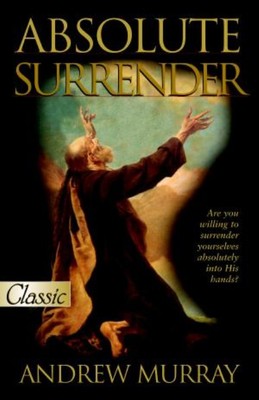
11 Quotes From “Absolute Surrender”

absolute-surrenderThis book is a challenging book for any Christian to read. Check out my review by clicking here, and then check out a few quotes that especially caught my heart.

“I have a pen in my pocket, and that pen is absolutely surrendered to the one work of writing, and that pen must be absolutely surrendered to my hand if I am to write properly with it. If another holds it partly, I cannot write properly. … Can God work His work, every day and every hour, unless you are entirely given up to Him? God cannot.”

“How much Christian work is being done in the spirit of the flesh and in the power of self! How much work, day by day, in which human energy—our will and our thoughts about the work—is continually manifested, and in which there is but little of waiting upon God, and upon the power of the Holy Ghost!”

“One of the great causes why God cannot bless His Church is the want of love. … It is only when God’s people stand as one body, one before God in the fellowship of love, one toward another in deep affection, one before the world in a love that the world can see—it is only then that they will have power to secure the blessing which they ask of God.”

“A great many of us try hard at times to love. We try to force ourselves to love, and I do not say that is wrong; it is better than nothing. But the end of it is always very sad. ‘I fail continually,’ such a one must confess. And what is the reason? The reason is simply this: Because they have never learned to believe and accept the truth that the Holy Spirit can pour God’s love into their heart.”

“You can deceive yourself with beautiful thoughts about loving God. You must prove your love to God by your love to your brother; that is the one standard by which God will judge your love to Him. If the love of God is in your heart you will love your brother.”

“God has a plan for His Church upon earth. But alas! we too often make our plan, and we think that we know what ought to be done. We ask God first to bless our feeble efforts, instead of absolutely refusing to go unless God go before us. God has planned for the work and the extension of His kingdom.”

“God can only reveal His will to a heart that is humble and tender and empty. God can only reveal His will in perplexities and special difficulties to a heart that has learned to obey and honor Him loyally in little things and in daily life.” 

“May God forgive me that I have allowed self and the flesh and the will actually to have the place that God wanted the Holy Ghost to have.”

“The cause of the weakness of your Christian life is that you want to work it out partly, and to let God help you. And that cannot be. You must come to be utterly helpless, to let God work, and God will work gloriously. … All God’s servants in the Old Testament counted upon the omnipotence of God doing impossibilities. And this God lives today, and this God is the God of every child of His. And yet we are some of us wanting God to give us a little help while we do our best, instead of coming to understand what God wants, and to say: ‘I can do nothing. God must and will do all.’”

“Ah, the great question for us to ask of God in self-examination is that we may be shown whether our religious life is lived more in the power of the flesh than in the power of the Holy Spirit.”

“Ah, yes; you failed because you do not accept the strength of God. God alone can work out His will in you. You cannot work out God’s will, but His Holy Spirit can; and until the Church, until believers grasp this, and cease trying to by human effort to do God’s will, and wait upon the Holy Spirit to come with all His omnipotent and enabling power, the Church will never be what God wants her to be, and what God is willing to make of her.”

I will be sharing more quotes from this book soon. To be notified immediately when these quotes are posted, fill in your email address in the field to the right and click “Sign me up!” Also be sure to follow me on Tumblr and Twitter for great quotes I share every day.

Has The Church Of Jesus Christ Become Slothful?

A sobering challenge from Horatius Bonar

light-and-truth-revelation“What say we to our self-indulgence, our sloth, our love of ease, our avoidance of hardship, our luxury our pampering of the body, our costly feasts, our silken couches, our brilliant furniture, our gay equipages, our braided hair, our jeweled fingers, our idle mirth, our voluptuous music, our jovial tables, loaded with every variety of wine and rich viands? Are we Christians? Or are we worldlings? Where is the self-denial of primitive days? Where is the separation from a self-pleasing luxurious world? Where is the cross, the true badge of discipleship, to be seen save in useless ornaments for the body, or worse than useless decorations for the sanctuary? … A self-indulgent religion has nothing in common with the Cross of the Lord Jesus Christ; or with that cross of ours which He has commanded us to take up and carry after Him, renouncing ease and denying self. …

“It is not so much our labour as our love that He asks; and with nothing less than love can He be satisfied. …

“It is not slothful service, or waning zeal, or failing liberality, or slackening warfare, that He complains. His remonstrance rather assumes the existence of much Christian fruitfulness; and even though there had been some failure in labour or endurance, that might have been more easily remedied; nor were these such a necessity to Him who filleth all in all. But it is over lost love that He laments. … Yet it is not love altogether lost; nor love turned into hatred. The failure has not got so far as this, nor descended to such a depth. It is of ebbing love He speaks, not love dried up wholly; it is love that has lost the freshness and the edge of other days; love that has sunk below the temperature at which it once stood. This is the substance of the complaint, the burden of the disappointment—the loss of half a heart!”

Is Love Touchy-Feely?

mowt-loveOne of my greatest joys is investing in people, and then watching them develop their God-given gifts. One such man is my friend Scott Troost.

I began a series at the beginning of the month talking about things I have come to appreciate, and I asked a couple of my friends to join with me. Last week Josh Schram shared his appreciation with wise counsel, and this week Scott shared what he’s come to appreciate about love.

Is “puppy love” real love? Is love even supposed to have a feeling? If there are no feelings associated with love, how can you know that you are indeed loving? Scott shares his personal journey on what he’s come to appreciate about love, and I sincerely hope you will watch this video of his message…

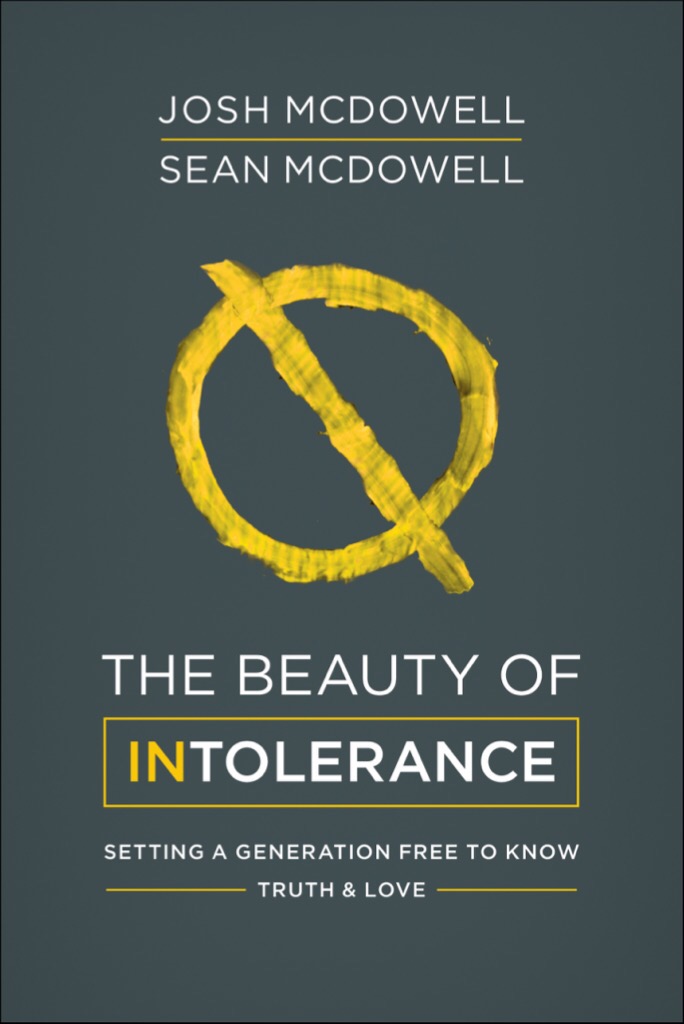
5 Quotes On Love, Sex & Marriage From “The Beauty Of Intolerance”

Beauty Of IntoleranceIn any modern-day discussion on the topic of “tolerance” the conversation is sure to come around to sexual dos and don’ts. Josh McDowell and Sean McDowell speak to this subject so well in their book The Beauty Of Intolerance.

“The reason we think there are such concepts as ‘fair’ and ‘unfair’ is because our Maker is a just God and we have been made in His image (Genesis 1:27). The reason love is a virtue and hatred a vice is because the God of relationships who formed us is a God of love. The reason honesty is right and deceit is wrong is because God is true. The reason fidelity in marriage is honorable and infidelity is not is because God is faithful. The reason chastity is moral and promiscuity is immoral is because God is pure. … All truth claims cannot be equal because Jesus didn’t claim to be ‘a’ truth—one among viable others. His claim was exclusive.”

“True love commits wholeheartedly. … When two lovers marry, they are making a public vow committing to provide for and protect each other through thick or thin. That kind of committed love compels a couple to wait to engage in sex until after marriage—which is the context in which love makes it right.”

“Purity is God’s boundary that provides for a maximum sex life and protects us from the negative consequences of sexual immorality.”

“What your children hear about the ‘gay versus Christian’ morality debate is often centered on how Christians allegedly discriminate against same-sex marriages and wrongfully label the gay community as sinful. We need to help them refocus the argument. It needs to shift away from who is accusing whom of judging or whether it’s right to legislate morality. We must focus our young peoples’ discussion on who has the right to define morality in the first place. … Be a student of God’s Word. Know why you believe sexual immorality is wrong—know the positive provision and protection that comes by following God’s instructions on morality. And then seek to speak the truth in love. Capture God’s heart, knowing that He wants only what is best for us. Share how your own obedience to God’s Word has brought you protection and provision.”

First, marriage is two human beings becoming one in every way possible. . . In marriage, two become one, united in mind and body and purpose. 

“Second, marriage is oriented toward procreation. The act of two becoming one flesh makes God’s intent, that humans should ‘fill’ and ‘form’ His world, possible. … Scripture sees marriage as being closely tied to procreation. . . . 

“Third, marriage comes with an expectation of permanence. The Genesis account implies marriage is a permanent relationship, [but] Jesus’ words are explicit: ‘What therefore God has joined together, let not man separate’ (Matthew 19:6). . . . 

“Therefore we shouldn’t think of marriage as a political institution that belongs to the state. It is a pre-political institution. The state doesn’t create marriage; it can only recognize it. The state, despite all its efforts, will never be able to redefine marriage. Marriage will always be what marriage was created to be, no matter what activist judges, runaway legislatures or majority of voters decide.” —John Stonestreet & Sean McDowell 

If you haven’t read my review of The Beauty Of Intolerance, you can read it here. I have also shared some other quotes from this book here and here.

Love Serves

love-serves-1I have blogged quite a bit about the tendency of our culture to be pragmatic. That is, people determine the rightness or wrongness of something based on how it feels to them. If it feels good,  or if they get something positive out of it, then it must be good; but if it feels bad, or if they don’t  get anything out of it, then it must be something they need to abandon.

True love is never pragmatic. Although culture tells us it is:

  • “You’ll know he’s the one by how he makes you feel.”
  • “We’ve fallen out of love.”
  • “There’s just no spark there any more.”
  • “He’s let me down one too many times.”
  • “You’ve lost that lovin’ feeling, oh that lovin’ feeling….”

“We dress ‘love’ in the fantasy of evening gowns and tuxedos, with silver and candelabras. But most of the time…love comes dressed in overalls—it is practical, down-to-earth, everyday hard work. It is really thinking of the other person and doing what the other person needs and being what the other person needs when he or she needs you to be there.” —Dr. Richard Dobbins

love-serves-2In writing to the church at Ephesus, Paul told them he became their servant—literally this means their waiter. But not so he could get something out of it. Instead it was a love completely focused on them…

  • the prisoner of Jesus Christ for the sake of you (Ephesians 3:1)
  • God’s grace was given to me for you (v. 2)
  • this grace was given to me to preach to [you] (v. 8)
  • my sufferings for you, which are your glory (v. 13)

Speaking to the Ephesian leaders as he was traveling to Jerusalem, he said…I served the Lord with great humility and with tears (Acts 20:19)

  • I never stopped warning each of you night and day with tears (v. 31)
  • I have not coveted anyone’s silver or gold or clothing (v. 33)
  • In everything I did, I showed you that by this kind of hard work we must help the weak (v. 35)

Dear Christian, is this the kind of love you demonstrate? Do you share God’s grace with the hurting? Do you walk alongside those who are limping or about to give up? Do you stand through the storms with those on the battlefield?

It’s not what I get out of it. 
Love focuses on the other person. 
Love is devoted by a solemn promise. 
Love doesn’t view “suffering” as something bad, but for the other person’s glory. 
Love doesn’t seek recognition or rewards. 
Love simply does what is important for the other person.

3 Quotes For Uncommen Husbands

Uncommen HusbandsI recently finished a reading plan on YouVersion called Uncommen Husbands. Here are some quotes that I especially appreciated from Brian Goins’ insights.

“Paul indicates there a came a time in his life when he grew out of an immature, boyish love and embraced a more mature, and dare we say, manly love [1 Corinthians 13:11]. If we’re going to love our wives like Christ loved the church, we must let the boy die. And in marriage, that’s far easier said than done. Check out the comparisons below:

  • Boys retaliate quickly when hurt; manly love is patient and kind.
  • Boys require constant affirmation; manly love is not arrogant or rude.
  • Boys stew, stammer, and hold grudges when they don’t get their way; manly love does not insist on its own way; it is not irritable or resentful.
  • Boys try to win every argument; manly love does not rejoice at wrongdoing, but rejoices with the truth.
  • Boys have a short fuse; manly love bears all things.
  • Boys write people off when wronged; manly love believes God’s best for the relationship.
  • Boys lose hope after they’re hurt; manly love always hopes for reconciliation regardless of the pain.
  • Boys expect to be served; manly love endures all things.”

“Paul says, ‘cherish’ our bride like we cherish our own bodies. The word means, ‘bring warmth to,’ and from which we derive our words, thermal and thermostat. … When Paul tells us to love our wives as we love our own bodies, he’s encouraging us to cherish their emotional needs in the same way we cherish our own physical needs. If she’s chilly, it’s our job to warm her up. If she’s steaming, then we help lower the mercury. In other words, the call to cherish means we have to engage when we’d rather shrink back.”

“I’m not sure Paul was the most popular men’s retreat speaker. When he spoke, some fell asleep…and then fell out a window (Acts 20:9). He admitted to the church at Corinth his messages were a bit convoluted (1 Corinthians 2:3-5). Even his buddy Peter threw him under the bus for his ivory tower verbiage (2 Peter 3:15-16).

“Then there was his unfortunate use of the word nourish in Ephesians 5:28. I’m pretty sure every guy in the audience cringed a bit when Paul said to husbands, ‘nourish’ your wife. We may think of nutritious foods, but in Paul’s day, the word often referred to nursing moms. Try and get that picture out of your head.

“When my wife used her God-given equipment to nourish our children I don’t ever remember a time when I asked her, ‘Honey, when was the last time you fed the baby?’ and she responded, ‘Oh, I don’t know, it’s been a few days.’ Because instinctively a mom knows her baby’s nourishment has to be consistent, catered to their tastes, and is crucial for their survival. In the same way, Paul calls husbands to nourish their brides. Is your love consistent? I don’t know about you, but I rarely miss a meal. Unless I’m fasting (for a very short time!), about every 4-5 hours I feed the beast. It’s all too common for our wives to go months between meals: a date night, taking a walk, go on an adventure, a simple text saying, ‘are you tired? You should be because you’ve been running through my mind all day long,’ or a well thought out letter. Nourishment must be ongoing. Is your love catered to her tastes? You’re not going to catch me at the all-you-can-eat tofu bar. Unless I’m on the mission field, I generally nourish my body with stuff I like. It’s common to give love the way we want to receive love. But your love language probably doesn’t match hers. Want to know if you are catering to her ‘love’ taste buds, ask this UNCOMMEN question: ‘Honey, do you feel the depth of my love? Not do you know it, but do you feel it? If not, how can I nourish your soul?’ Do you realize your love is crucial to her survival?”

5 Quotes On Love’s Endurance From “The Seven Laws Of Love”

The Seven Laws Of Love

In The Seven Laws Of Love, Dave Willis gives us some highly practical, biblically-based counsel for investing in all of our relationships. Normally when I share quotes from books, I share all of them at once, but for this book I felt like it would be good to share these quotes a bit more slowly, to give you time to read them and apply them.

The seven laws Dave identifies are:

  1. Love requires commitment (read the quotes here)
  2. Love selflessly sacrifices (read the quotes here)
  3. Love speaks truth (read the quotes here)
  4. Love conquers fear (read the quotes here)
  5. Love offers grace (read the quotes here)
  6. Love brings healing (read the quotes here)
  7. Love lives forever

From law #7, here are some quotes on how love lives forever—

“Make a deliberate decision right now to stop wasting time and start putting first things first. Give the very best of yourself to your loved ones, not the leftovers after you’ve given your best to everyone and everything else.”

“Don’t take yourselves too seriously, but don’t take your commitments too lightly. Live life with conviction and purpose, but make plenty of room for fun. Laughter should be the soundtrack of your relationships.”

“Fight for each other, but never fight against each other. In every disagreement, remember that your relationship is much more important than whatever you’re arguing about.”

“Love isn’t a story with a happy ending. Love is a story with no ending!”

“Don’t treat others the way they treat you; treat others the way God treats you.”

Check out my review of The Seven Laws Of Love by clicking here.