Thursdays With Spurgeon—Beautiful Homegoing

This is a weekly series with things I’m reading and pondering from Charles Spurgeon. You can read the original seed thought here, or type “Thursdays With Spurgeon” in the search box to read more entries.

Listen to the podcast of this post by clicking on the player below, and you can also subscribe on AppleSpotify, or Audible. 

Beautiful Homegoing

You shall come to the grave at full age, as a sheaf of grain ripens in its season. (Job 5:26) 

     The Christian’s death is always timely. ‘You shall come to the grave at full age. 

     ‘Ah,’ says one, ‘that is not true. Good people do not live longer than others. The most pious man may die in the prime of his youth.’ But look at my text. It does not say you will come to your grave in old age, but in a ‘full age.’ … All fruits do not get ripe and mellow at the same season. So it is with Christians. They are at a ‘full age’ when God chooses to take them home. … 

     There are two mercies to a Christian. The first is that he will never die too soon. And the second is that he will never die too late. … 

     ‘But,’ say some, ‘how useful might they have been had they lived.’ Ah, but how damaging they might have been! And were it not better to die than to do something afterward that would disgrace them and bring disgrace to the Christian character? Were it not better for them to sleep while their work was going on than to break it down afterward? … 

     Again, the Christian never dies too late. … God is too good a Husbandman to leave His wheat in the field too long and let it shale out. …  

     Now the last thing is that a Christian will die with honor. … I think there are two funerals for every Christian: one is the funeral of the body, and the other of the soul. Funeral, did I say, of the soul? No, I meant not so. I meant not so. It is a marriage of the soul. For as soon as it leaves the body, the angel reapers stand ready to carry it away. They may not bring a fiery chariot as they had for Elijah. But they have their broad spreading wings. I rejoice to believe that angels will come as convoys to the soul across the ethereal plains. … I think the most honorable and glorious thing we will ever behold, next to Christ’s entrance into heaven and His glory there, is the entrance of one of God’s people into heaven.

From The Death Of The Christian

As I mentioned last week, this sermon was so providential in its timing for me because my precious mother went Home to be with Jesus just days before I opened to this sermon from Charles Spurgeon. 

We are comforted by the promises Rev. Spurgeon shares because they are based on the truth in God’s Word. “Good people pass away; the godly often die before their time. But no one seems to care or wonder why. No one seems to understand that God is protecting them from the evil to come. For those who follow godly paths will rest in peace when they die” (Isaiah 57:1-2). 

At my Mom’s graveside committal service I shared this—

One of my favorite authors C.S. Lewis made a comment, “You don’t have a soul. You are a soul. You have a body.” 

This part that we called Claudia Owens was just the body that carried around who she really was. What a beautiful soul that we got to experience for 78 years. What shined through was so sweet and graceful and wonderful. What a glimpse we got! But a joy to know that it was only a glimpse. That the part of my Mom that was so beautiful that we got to see, was only a fraction of her full beauty! The part that was really her, that is at Home with her Savior Jesus now is shining in all its brilliance. … 

We will all miss her and we will grieve our loss. But as the apostle Paul reminded us, we don’t grieve as those who have no hope. We know that to be absent from the body is to be present with the Lord. We know that this body is sown perishable ravaged by the disease of cancer, but that my Mom is now in a place with no more tears or disease. We know that the same Savior that prepared a place for Claudia has prepared a place for us.

And we concluded with this prayer that can be offered up for every Christian who has died at their “full age”: 

Heavenly Father, 

We commit this body to the ground with the full assurance that her soul is in your everlasting presence. Holy Spirit, help us in our grief to be reminded of the hope of eternal life that we all share. Thank You, Jesus, for purchasing this hope on which we stand.

As I mentioned last week, if you don’t have this blessed assurance of the marriage of your soul when you take your last breath here on earth, please don’t hesitate to contact me.

►► Would you please prayerfully consider supporting this ministry? ◀︎◀︎

Unburdened

Listen to the podcast of this post by clicking on the player below, and you can also subscribe on AppleSpotify, or Audible.

Let’s get on the same page with a few facts: 

  • Nearly 1-of-5 adults in the United States age 18 and older battle some form of anxiety disorder. 
  • Being anxious is not a sin but we can grieve God’s heart if we don’t train ourselves to turn to Him as our First Source. Notice that David said, “When [not “if”] I am afraid, I put my trust in You” (Psalm 56:3). 

We’ve been looking at both the dictionary definitions and biblical definitions of anxiety. One definition is being disquieted, but we saw that coming close to Jesus Xs out the “dis-” and takes us to a place of quiet. A second definition is being insecure because we are so full of cares. Clinging to Jesus Xs out the “in-” and makes us secure when His strong arms are around us. 

A third definition of anxiety is found here: “Cast your cares on the Lord and He will sustain you; He will never let the righteous be shaken” (Psalm 55:22). This word for cares or anxieties is the only time this Hebrew word is used in the Bible. The idea is a heavy burden, which the Amplified Bible captures like this: “Cast your burden on the Lord—releasing the weight of it—and He will sustain you….”

We can be burdened because we pick up and carry things on our own. But the word for cares or burdens in Psalm 55:22 can mean not only things we pick up, but things given to us by God or allowed by God. You might ask, “Why would God give me a burden?” 

  • Sometimes it’s allowed—God allowed satan to afflict Job within limits, and He allowed Joseph’s brothers to ambush him (Job 1:8-12; 2:3-7; Genesis 50:20).  
  • Sometimes it’s given—God gave Jesus a bitter cup to drink, and He gave Paul a “thorn in the flesh” (Matthew 26:39-42; 2 Corinthians 12:7). 
  • In every instance, the limits are perfectly measured to accomplish what God wants to do. The way we respond glorifies Him and keeps us dependent on Him (Job 1:20; 2:10; Genesis 50:20; 2 Corinthians 12:8-10; Hebrews 10:10). 

(Check out all of the above biblical passages by clicking here.)

Still in the middle of this, the burdens can seem overwhelming and anxiety-inducing. That’s why God tells us what to do with these burdens: Cast them off! 

In Psalm 55:22, David gives us the word “cast” in the imperative mood, which means it’s a command. Literally, the word means to throw away or shed the burden. 

How often do we do this? David said he prayed “evening, morning, and noon” for God’s help (Psalm 55:16-17). 

What does God do when we cast off these burdens? He sustains and supports us—“He will sustain you; He will never let the righteous be shaken.” 

The apostle Peter quotes the opening words of this verse when he writes, “Cast all your anxiety on Him,” and then he tells us why we can do this: “Because He cares for you” (1 Peter 5:7). Just like David said he prayed for his burdens to be released “evening, morning, and noon,” the verb tense Peter uses implies the same thing. We don’t just release our burdens once, but we continue to do it again and again and again! 

The word Peter uses for “cast” is only used twice in all the New Testament. The word means not just to drop our burdens at our feet—where we may trip over them or be tempted to pick them up again—but to throw our burdens on someone else. The only other place this word is used is when on the day Jesus rode into Jerusalem the disciples “threw their cloaks on the colt and put Jesus on it” (Luke 19:35). 

Peter tells us that this casting off of our burdens requires us to humble ourselves before God. Pride makes us think we can handle it on our own, and that same pride robs God of the glory He would receive when He provides relief from our heavy load. We cast these burdens onto Jesus so that we can be alert to the enemy’s sneaky tactics, and help others who are also being attacked. And just as David said God supported and sustained him, Peter said the same thing (1 Peter 5:6-10). I especially like the wording from the King James Version—

But the God of all grace, Who hath called us unto His eternal glory by Christ Jesus, after that ye have suffered a while, make you perfect, stablish, strengthen, settle you. (1 Peter 5:10 KJV) 

Jesus can X-out the instability that comes with carrying heavy burdens and make us stablished, strengthened, and settled in Him. 

Don’t try to carry these anxiety-inducing burdens on your own, but cast them on Jesus every evening, morning, and noon. Let Him carry those burdens so you can live in a way that glorifies Him every single day. 

If you’ve missed any of the messages in our series X-ing Out Anxiety, you can find all of the messages by clicking here. 

►► Would you please prayerfully consider supporting this ministry? ◀︎◀︎

Thursdays With Spurgeon—The Assurance Of God’s Love

This is a weekly series with things I’m reading and pondering from Charles Spurgeon. You can read the original seed thought here, or type “Thursdays With Spurgeon” in the search box to read more entries.

Listen to the podcast of this post by clicking on the player below, and you can also subscribe on iTunes or Spotify.

The Assurance Of God’s Love

Tell me, O you whom I love, where you feed your flock, where you make it rest at noon. For why should I be as one who veils herself by the flocks of your companions? (Song of Solomon 1:7)

     It is well to be able to call the Lord Jesus Christ by this name without an ‘if’ or a ‘but.’ A very large proportion of Christian people can only say of Christ that they hope they love Him. They trust they love Him, but this is a very poor and shallow experience to be content to stay here. It seems to me that no one ought to give any rest to his spirit till he feels quite sure about a matter of such a vital importance. We are not content to have a hope of the love of our parents, or of our spouse, or of our children! We feel we must be certain there. And we are not to be satisfied with a hope that Christ loves us and with a bare trust that we love Him. … 

     ‘I know whom I have believed,’ says Paul (2 Timothy 1:12). ‘I know that my Redeemer lives,’ says Job (Job 19:25). ‘You whom I love,’ says Solomon in the Song as we have it here. Learn, dear friends, to get that positive knowledge of your love to Jesus, and be not satisfied till you can talk about your interest in Him as a reality that you have made infallibly sure by having received the witness of the Holy Spirit and His seal upon your soul by faith that you are born of God and belong to Christ. …  

     Why do we love Jesus? We have the best of answers: because He first loved us! … Why do we love Him? Because before this round earth was fashioned between the palms of the great Creator, before He had painted the rainbow or hung out the lights of the sun and moon, Christ’s delights were with us. He foresaw us through the glass of His prescience. He knew what we should be….

From The Church’s Love To Her Loving Lord

God wants you to know how much He loves you. He went first because we didn’t have any way to approach Him. But Jesus made it possible for us to come close to God through His substitutionary death on the Cross for our sins. And now the Holy Spirit is speaking clearly to your heart to trust that this is absolutely, irrevocably true: GOD LOVES YOU! 

As Spurgeon said, don’t be content with merely thinking this is true, but ask the Holy Spirit to help you know this is true! 

Listen to these words—This is how God showed His love among us: He sent His one and only Son into the world that we might live through Him. … This is how we know that we live in Him and He in us: He has given us of His Spirit. And we have seen and testify that the Father has sent His Son to be the Savior of the world. … We love because He first loved us. (1 John 4:9, 13-14, 19)

►► Would you please prayerfully consider supporting this ministry? ◀︎◀︎



“Father, Into Your Hands I Commit My Spirit”

Listen to the podcast of this post by clicking on the player below, and you can also subscribe on Apple or Spotify.

I have some sobering news for you: You are going to die. 

Death is the great equalizer. It comes for the rich and poor, the scholar and the illiterate, all races, all ages, the healthy as well as the sick. Unless you’re still alive when Jesus comes back again, your odds of dying are 1-in-1. 

What happens “on the other side”? What happens after this life is over? Since it seems dark and mysterious to most people, they tend to ignore it until it’s thrust upon them. That’s why I find the dying words of people interesting. Like P.T. Barnum asking, “How were the receipts today at Madison Square Garden?” or W.C. Fields reading a Bible on his deathbed and telling a friend, “I’m looking for a loophole.” 

Or the very last words of Jesus: “Father, into Your hands I commit My spirit.” 

Jesus is steeped in Scripture, so nearly everything He says in His final four declarations come directly from the Psalms, including His final phrase which comes from Psalm 31:5. 

When Jesus broke a three-hour silence with His cry, “My God, My God, why have You forsaken Me,” both Matthew and Mark use the Greek words megas phoné to describe how loudly Jesus spoke. And now with His final words, Luke uses the same megas phoné description. 

Notice in the first megaphone cry Jesus calls on God the All-Powerful Creator. And with His last megaphone declaration, He calls on His Father who is All-Loving. How comforting it is to know that God is both All-Powerful and All-Loving! Not only can He answer our cries, but He delights to answer them! 

The word Jesus uses for “commit” is in the future tense and it means “to entrust as a deposit.” Jesus believed that God was going to do more than just give Him life again, but that He would give life to all who would believe in Him. 

Unlike atheist Bertrand Russell who said, “I would never die for my beliefs because I might be wrong,” Jesus DID die for His beliefs, and by rising from the dead proved He was right in trusting God. 

Job saw an inescapable death for all mankind, but he also foresaw the forgiveness of God (Job 14:5, 16-17). Jesus died once for all mankind and was then resurrected, bringing about the death of death by making forgiveness accessible to anyone (Hebrews 9:27-28; 1 Corinthians 15:19-22). 

We can now have the peace that comes from trusting the only One to Whom we can safely entrust our souls. Because Jesus brought death to death, we can have the same peace when we die that Jesus had when He died. 

With faith in Jesus, you can…

…live today knowing you’re invincible until God calls you home 

…live today full of joy because your home in heaven is secure

…live your very last day in peace because you know to Whom your soul is entrusted 

Because Jesus died at peace with God, we can face death triumphantly! 

If you’ve missed any of the messages in our series on the dying declarations of Jesus, you can access the full list by clicking here.

►► Would you please prayerfully consider supporting this ministry? ◀︎◀︎

Don’t Give In To Pseudo-Wisdom

Listen to the podcast of this post by clicking on the player below, and you can also subscribe on iTunes or Spotify.

Dr. Craig Bartholomew wrote, “Wisdom is deeply experiential.” In other words, we can’t just have head knowledge and call it “wisdom,” but we have to have an experience in which we have learned a lesson in order for it to truly be called wisdom. 

In the three wisdom books of the Bible—Job, Proverbs, and Ecclesiastes—the wisdom that is shared is hard-won by people who personally experienced what they shared with us. Even if we consider the wisdom in the poetic books of Psalms and the Song of Solomon, we are still reading first-person, firsthand experiences. True wisdom can never be dispensed by someone who hasn’t “been there, done that” and learned a valuable lesson from that experience. 

In Job, we meet three of his friends who claim to have wisdom but don’t meet the criteria of personal experience. This pseudo-wisdom always comes in the form of, “I’ve heard that…,” or “It’s obvious from my observations…,” or “Everyone knows that….” 

That means that satan’s tactics fall into this pseudo-wisdom category too: he has no personal, first-hand experience of human situations that result in hard-won wisdom! The best he can offer is secondhand observations. 

Jesus, on the other hand, fully entered into the human experience. Jesus IS Wisdom. As a human He had first-hand experiences, and as God He doesn’t just see fragments of lessons, but He sees the whole, eternal picture into which all lessons fit. 

This is why Solomon wrote, “The fear of God is the beginning of wisdom.” This holy respect and willingness to heed the words of Wisdom Himself is the starting point and the conclusion of wisdom. This is also why the writer of Hebrews wrote that Jesus knows every situation that we are going through. He knows how to help us because He has personal, first-hand, experiential wisdom.

satan’s temptations are only suppositions. He can never say, “I know from personal experience.” Look at his temptations of Adam and Eve, Job, Jesus, and the apostle Paul:

  • Did God really say?
  • Does this suffering even make sense?
  • Doesn’t the Scripture tell us…?
  • I don’t think you deserve the thorn in the flesh. 

Don’t give in to the pseudo-wisdom that satan pushes!

Jesus was tempted in every human way possible. He learned wisdom by this personal experience. Jesus alone is qualified to be the only source of Wisdom that you and I need to successfully handle trials and temptations. 

Because He Himself in His humanity has suffered in being tempted, tested and tried, Jesus is able immediately to run to the cry of—to assist and relieve—those who are being tempted and tested and tried…. (Hebrews 2:18 AMP)

Godly Anger

Listen to the podcast of this post by clicking on the player below, and you can also subscribe on iTunes or Spotify.

…his anger was aroused… (Job 32:5).

Throughout the story of Job, there is very little insight from the story’s narrator. Other than the first two chapters which set up the story, and the epilogue in the last chapter, the narrator barely utters a word.

That is until a fourth man, who has been on the scene the whole time Job and his friends have been debating, finally cannot help but speak out. His name is Elihu. 

Elihu has been present the whole time Job has been speaking with his other friends, but because Elihu is the youngest, he has held his tongue, awaiting an opportunity to speak. Now the narrator tells us that Elihu “became very angry with Job for justifying himself rather than God. He was also angry with the three friends, because they had found no way to refute Job, and yet had condemned him. … When he saw that the three men had nothing more to say, his anger was aroused. 

The phrase “anger was aroused” is used 31 times in the Bible. Every single instance refers to God’s anger except here. In fact, God uses the same phrase in chapter 42 that Elihu uses here. 

Two things seem to arouse the anger of both God and Elihu (whose name, but the way, means “He is my God”): 

  1. Job justifying himself rather than God 
  2. Job’s friends condemning Job without evidence; in other words, they put themselves in the place of God the Judge  

Here’s what Elihu knew—

To not get angry at the things that anger God is itself a sin.

I need to pay attention to my anger, and I need to express my anger in a respectful, appropriate way. It is wrong to ignore or suppress godly anger, but it is equally wrong to sin in the way that I express godly anger. Remember that the apostle Paul doesn’t say, “Don’t get angry,” but he says, “When you get angry, do not sin” (Ephesians 4:26). 

When God finally speaks in this story, He expresses His anger at the same things Elihu addressed. Interestingly, God says to the oldest friend Eliphaz, “I am angry with you and your two friends,” but God doesn’t call out Elihu for any of his words.  

God gets angry, perhaps more than anyone else in the Bible does, but He never sins in the expression of His anger. We need to make sure that what makes us angry is also what makes God angry. And we need to make sure that our anger is never expressed sinfully. 

Do I Have Standing?

Listen to this post as a podcast by clicking here:

If it is true that I have gone astray, my error remains my concern alone (Job 19:4).

Why do we find it necessary to stick our noses in where they are not wanted? Why do we feel like the other person needs to hear our opinion? 

The law dictionary defines “standing” as the right to file a lawsuit or file a petition under the circumstances. In legal terms, Job’s three friends had no standing to bring charges against him. Job himself even said he didn’t want to hear their opinions. Instead, all Job asked for was, “Have pity on me, my friends, have pity.” He goes on to ask, “Why do you pursue me as God does? Will you never get enough of my flesh?” 

And then Job gives this warning: “If you say, ‘How we will hound him, since the root of trouble lies in him,’ you should fear the sword yourselves.” Despite this warning, Zophar still begins his argument by stating, “I hear a rebuke that dishonors me so I have to speak up.” 

There are indeed times when our friends may be going astray and the loving thing we can do for them is speak a word of truth, but that is something entirely different than feeling compelled to share an opinion or sticking our noses in where they don’t belong. A good question to ask ourselves before speaking: Do I have standing here?

Far better for us to apply the Golden Rule this way: Treat others in their condition the way I would want to be treated in the same condition. And if I do feel as though I have standing, and need to speak a loving word, I need to examine myself first.

Job tells his friends, “You are miserable comforters, all of you!” (16:2). One of the best things they did for him was to simply sit silently in mourning alongside him. It was when they felt compelled to argue that they not only disappointed Job, but they dishonored God too. 

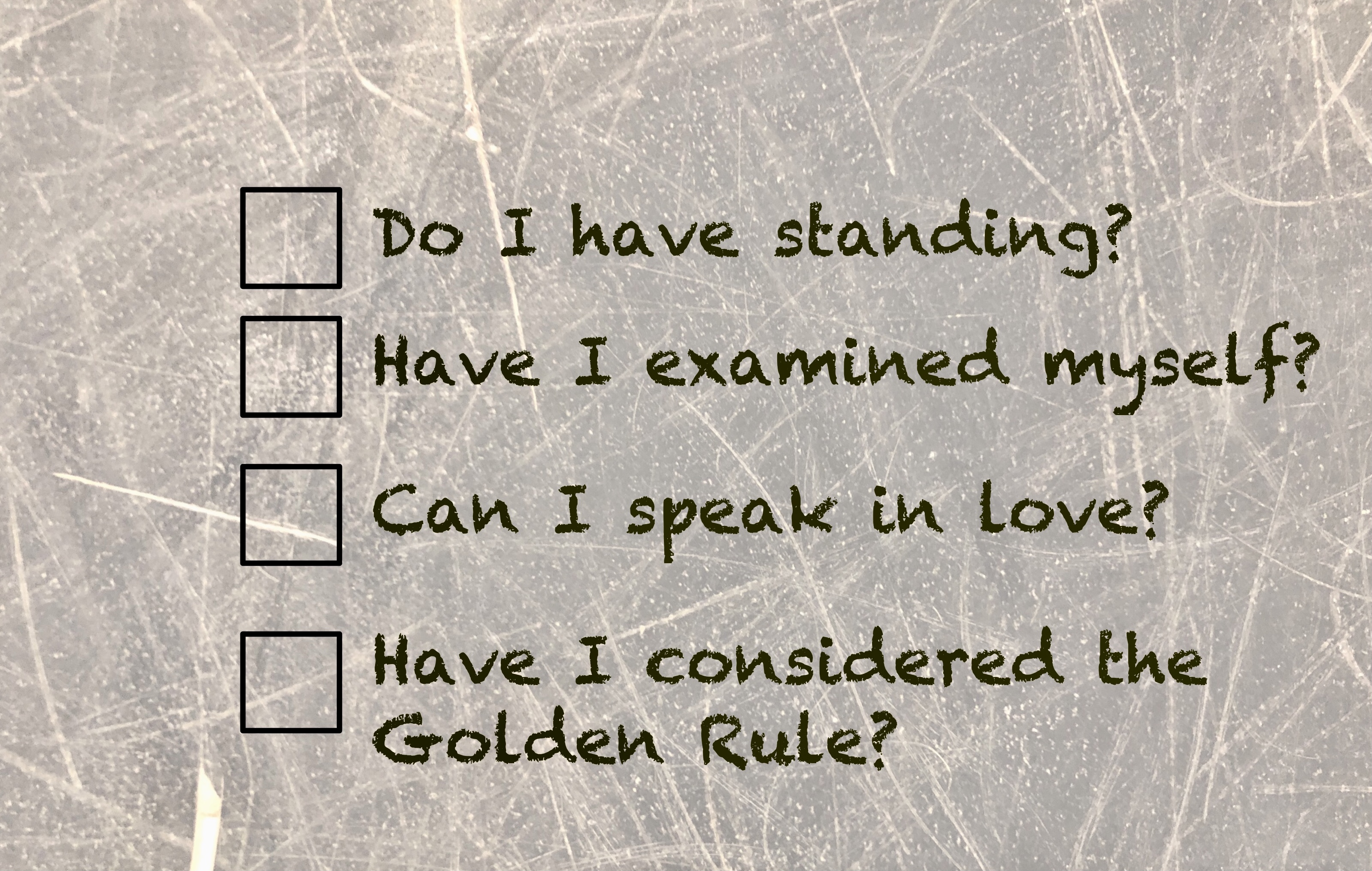
My checklist before speaking:

  1. Do I have standing? 
  2. Have I examined myself? 
  3. Can I speak truth in love (and not just air my opinion)? 
  4. Have I considered the Golden Rule? 

If I can answer “Yes” to all four questions, then speak; otherwise, it’s far more loving to remain silent. 

The God That Runs To You

I’m sure you’ve experienced what I’ve experienced. My nice, orderly world came crashing down all around me. It totally blindsided me! I got on my knees to do some serious soul searching and I prayed, “God I know you called me here. I know I’ve done what You’ve asked me to do. What’s happening? Why am I being attacked? Where are You, God?

I’m sure you’ve been there too. “Where’s God?” has been the cry of countless people from the oldest book of the Old Testament until this very day. In dark times our world seems to shrink, and the weight of the entire world seems to rest on our shoulders. We begin to at first sigh and say, “Why me?” and then those sighs become sobs of “God, where are You?!” 

“Left to ourselves we tend immediately to reduce God to manageable terms. We want to get Him where we can use Him, or at least know where He is when we need Him. We want a God we can in some measure control. We need the feeling of security that comes from knowing what God is like.…” —A.W. Tozer 

Here’s the truth: We are always in a spiritual battle. It’s just hard to see it in the “good ol’ days.” But in the “bad ol’ days” we realize we don’t have it all figured out! The dark days are simply the reality of spiritual warfare revealed. 

Answers don’t come easily because there are no easy answers!

One of Job’s friends named Zophar thought he had God all figured out. He concluded his easy answer that the wicked have a bad life and the righteous have a good life. So if things were going badly for Job, he must have messed up somewhere. Except Zophar was wrong! God Himself pronounced Job righteous (see Job 20:1-8; 1:8). Zophar’s easy answer now doesn’t seem so easy, does it? 

I’ll say it again: In the hard times, answers don’t come easily because there are no easy answers. 

In fact, Jesus told us, “I have told you these things, so that in Me you may have peace. In this world you will have trouble. But take heart! I have overcome the world” (John 16:33). 

How did Jesus overcome the world of hurt and pain? He did it by taking a hands-on approach—Since the children have flesh and blood, [Jesus] too shared in their humanity…. For this reason He had to be made like His brothers in every way…. Because He Himself suffered when He was tempted, He is able to help those who are being tempted (Hebrews 2:14, 17-18). 

The phrase “He is able to help” literally means that He runs to the cry! 

In order to be able to run to our cry, Jesus has to know what our cries sound like and what our pain feels like. He had to taste all our pain for Himself. He had to feel all of them in a human body. The Limitless God was incarnated in limited flesh to experience everything we would ever feel. 

Now that Jesus has died and been resurrected, our cries bring Him running to us with ALL of His LIMITLESS love and power and empathy! 

In the good ol’ days we may not recognize just how close God is to us. But when the bad days come and we cry out to Him, He comes running. Jesus may be closer when you say, “I don’t know where You are!” than He’s ever been before. 

Go ahead and cry out. Jesus knows those cries. He hears you, He knows your pain, He runs to your cries, He comes close to help.

Join me next week as we continue this series asking “Where’s God?” in the specific difficulties that we face. We’ll ask questions like, “Where’s God in my depression?” and “Where’s God in my divorce?” and “Where’s God in this national calamity?” Please don’t miss these encouraging messages! 

Fasting Power

We are always engaged in an intense spiritual battle. Sometimes we feel the intensity of the battle, sometimes we don’t. But it’s always happening. 

This is why we need to make prayer an ongoing discipline. If we do, we will be much more likely to turn to prayer when we feel the intense moments, and our faith in those intense moments will be strengthened and ready to respond. 

Every day we are either preparing or repairing. Prayer is either helping us prepare for the challenges we will be facing, or it’s helping us recover from the battle we just fought. Believe me: it’s much better to be preparing than it is to be repairing!

One time the disciples of Jesus got stymied in a spiritual battle. A father brought his demon-possessed son to them, asking that they cast out the demon. But this distraught father then had to report to Jesus, “They couldn’t do it” (see Matthew 17:14-21). 

Why couldn’t they? These men had been taught how to pray by Jesus Himself, and they already had experienced ministry success (Matthew 6:9-13; Mark 6:13). So were they stumped now? 

Jesus told them, “It’s because you have so little faith.” He went on to tell them that these intense spiritual battles require an ongoing lifestyle of prayer. Jesus wasn’t suggesting that they should have said to that father, “Come back in a few days after we have prayed and fasted.” 

But what Jesus was really saying was that all of us need to stay connected to the Source of our spiritual power at every single moment (John 15:5, 7). Sometimes this requires taking our eyes off ourselves and our own appetites. 

In a word: we need to fast. 

The word fasting means “to cover the mouth” or “to close the mouth.” 

  • often fasting is in response to calamity or as a sign of mourning 
  • sometimes it’s alongside an intense prayer 
  • ideally it should be a regular discipline in our lives. In Matthew 6:16-18, notice the phrase “when you fast.” Not “if you fast,” but when. Jesus assumed that we would do this, and since this teaching appears right after Jesus teaches us how to pray, it makes sense that prayer and fasting go well together.  

Fasting is not…

Fasting intensifies our focus on God in the quiet times so that we can keep our eyes on Him in the crashing storms. 

Fasting helps us tune in to the unmistakable Voice of the Holy Spirit in the peaceful moments so that we can still recognize His Voice in the tumult of battle. 

Is there a comfort food you tend to run to? Is there a coping activity that you typically use to de-stress? Is there someone or something other than God that is your go-to in times of trouble? Perhaps we should start there and fast from those things for a short period of time. 

Fasting in the quiet times will strengthen us for the intense battle times. 

Let’s prepare daily for victory, instead of having to repair after a failure.

4 + 4 Strategies To Eliminate Distractions To Your Prayer Time

There’s a quote that has been the theme for this series on prayer: “Prayer pursues joy in fruitful fellowship with Jesus, knowing that God is glorified when we bear fruit in answer to prayer. Why do God’s children so often fail to have consistent habits of happy, fruitful prayer? Unless I’m badly mistaken, one of the reasons is not so much that we don’t want to, but that we don’t plan to.” —John Piper 

And unless I’m badly mistaken, the most obvious thing we need to plan to eliminate is distractions. 

Some people say they can juggle a lot of things at once. “I’m a really good multitasker,” they say. But science says differently. MIT neuroscientist Earl Miller concluded that our brains are “not wired to multitask well…. When people think they’re multitasking, they’re actually just switching from one task to another very rapidly. And every time they do, there’s a cognitive cost.” What is that cognitive cost? “Multitasking can drop IQ as much as 15 points, essentially turning you into the cognitive equivalent of an 8-year-old” (Inc. Magazine). 

If the devil can make you think you can multitask prayer with other things, he has seriously inhibited the effectiveness of your prayers. 

Jesus was not a multitasker—but He was singularly focused on His Father’s plan. And yet He accomplished more in His three years of public ministry than anyone else in history! 

Here are 4 strategies to help you get ready to pray:

  1. Try to have your prayer time in the same place and at the same time. Your brain likes routine and it will help you zero-in during your scheduled prayer times. 
  2. Silence your cell phone or other noisy distractions. 
  3. Keep a notepad handy for random thoughts that pop into your head. Writing them down will keep your brain from switching back-and-forth to them.
  4. Focus on listening, not on talking—Eugene Peterson said, “Prayer is first of all a means of listening. Prayer is an act of attention.” 

When we get right down to it, prayer is spiritual warfare (2 Corinthians 2:11; Ephesians 6:10-18). In the context of warfare, the word strategy means the maneuvering that takes place prior to the battle. The devil is a masterful tactician, and he will do everything he can to keep you distracted. 

That’s why three times Peter tells us to be clear-minded and singularly-focused in our thoughts SO THAT we can pray without the hindrances of distractions (1 Peter 1:13-14; 4:7; 5:8-9). And Paul tells us to take all our thoughts captive, so that no un-Christlike thoughts are inhibiting our prayer time (2 Corinthians 10:4-5). 

Here are 4 strategies to help you stay focused in prayer:

  1. A—adoration. Enter into God’s presence with a Psalm or worship music. 
  2. C—confession. Deal with unconfessed sin, unforgiveness, or relationship strife as quickly as possible (Psalm 66:18; Matthew 5:21-24). 
  3. T—thanksgiving. Paul counseled us, “Do not be anxious about anything, but in everything, by prayer and petition WITH thanksgiving, present your requests to God” (Philippians 4:6).  
  4. S—supplication. Intercede for your brothers and sisters in the battles they are facing (James 5:16; Job 42:10; Ephesians 6:18).  

Remember—

Prayer isn’t preparation for the battle; prayer IS the battle! Let’s not be distracted from that!