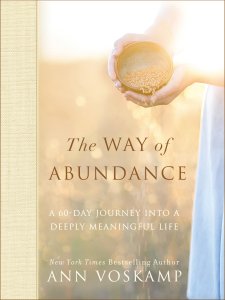
11 Quotes From “The Way Of Abundance”

Ann Voskamp speaks lovingly to the hurting and broken. She never condemns them for their brokenness, nor does she encourage them to stay in their difficult place. Instead, Ann brings a new perspective to the path of healing; a path that allows our brokenness to become our givenness to other broken and hurting people. This is The Way Of Abundance. Be sure to check out my full book review by clicking here. 

“Go fall in love with grace and mercy and the only One who has ever loved you to death—and back to the realest, abundant life. Because the world is begging us all to get out of bed and live given, get out of bed and sacrifice for someone hurting, for someone different, for someone forgotten or marginalized, to hold the hand of someone who doesn’t look like a us, to lean in and listen to someone angry and grieving and doubting the likes of us, to give a bit of ourselves to those who feel like they aren’t given much real space at the table.” 

“The real Jesus turns our questions of why—why this brokenness, why this darkness?—and says, ‘You’re asking the wrong question. You’re looking for someone to blame. There is no such cause-effect here.’ ‘This happened so the power of God could be seen in him’ [John 9:3]. There’s brokenness that’s not about blame. There’s brokenness that makes a canvas for God’s light to be lavishly splashed across the darkness. There’s brokenness that carves windows straight into our souls. Brokenness cracks open a soul so the power of God can crack the darkness in the world.” 

“When you aren’t afraid of being afraid, you transform fear into friend. … Feelings can accompany you, but they don’t get to control you. Feelings get to inform you, but they don’t get to form you. Feelings get to keep you company, but they don’t get to keep you in bondage. Only God keeps you.” 

“We are always lost until our heart makes its home inside of someone else. Our lives are unfulfilling if we only let our hearts fill us instead of filling other people’s broken places. The art of living is believing there is enough love in you, that you are loved enough by Him, to be made into love to give. Fulfilling lives happen when we give our hearts to fill other people’s empty spaces.” 

“There are really only two choices when begging temptation looks you square in your twitching eye: there is either the pain of self-denial, or the pain of self-destruction. … They’ll tell you there’s no such thing called temptation anymore, only repressed self-limitation. They’ll tell you temptation isn’t an issue for the sophisticated. And all I want to say: just don’t say you’re a follower of Christ if you’re actually following your own heart.” 

“Shame dies when stories are told in safe places. … Shame gets unspeakable power only if it’s unspeakable.” 

“The only way to live a truly remarkable life is not to get everyone to notice you, but to leave noticeable marks of His love everywhere you go.” 

“When you feel basically respectable, you want religion. And when you know you feel the brokenness of rejection, you want the gospel. In religion, it’s the ‘respectable’ who search for a God to impress. But in the Gospel, it’s God who searches for the brokenhearted rejected to save.” 

“Never fear the moments you imagine will freeze you: unexpected blasts of cold can be what draws you nearer to the flame of His love.” 

“The body of Christ must recapture its vision as the only collective in the world that exists for its nonmembers. … We are a community that will not dish out condemnation but courage, that will lean in and listen long and love large.” 

“You love as much as you are willing to be inconvenienced. … The brokenness of people is never truly an intrusion. Loving the broken people when it is inconvenient is the way to have fuller inclusion in the life of Christ.” 

The Way Of Abundance (book review)

About a year ago I read and reviewed The Broken Way by Ann Voskamp. And now that I share a review of her newest book—The Way Of Abundance—you might be tempted to think that brokenness and abundance sound contradictory, but you would be wrong! 

In The Broken Way, Ann wrote, “Unless we die, unless we surrender, unless we sacrifice, we remain alone. Lonely. But if we die, if we surrender, if we sacrifice, that is when we experience the abundance, that is when we dance in communion. The life that yields the most—yields the most” (emphasis mine). 

Now in The Way Of Abundance, she shares this opening thought, “What would happen if the scars you carry are what God uses to carry Christ to a scarred and broken world? Weak is the real strong. Brokenness is the real abundance” (emphasis mine). 

Brokenness cannot stop meaningfulness. God wants to work through your brokenness to do something abundantly more than you can even imagine. And He can and will do it if only you will yield your pain to Him. 

The Way Of Abundance is given to us in 60 shorter devotional-style chapters. It’s a two-month journey into getting to see our pain, disillusionment, brokenness, and questions in a new light. It’s a journey to get us to change the focus from our brokenness to Christ’s abundance, and in so doing, discovering how Christ can enrich the world through our yieldedness. 

What I wrote a year ago is just as true for this book: “This is a book of healing. A book that will remind you that you are not alone in your pain, in your questions, in your searching for answers. This book is a gift to anyone who feels broken, cut up, cut off, or beaten down.” 

Read this book for yourself. Read this book for other broken people. Read this book with other broken people. And then watch the abundance of Christ’s life explode like you’ve never imagined! 

I am a Zondervan book reviewer. 

The Blessing Of Quiet Humility

“When you’re full of yourself, God can’t fill you. But when you empty yourself, God has a useful vessel. Your Bible overflows with examples of those who did.

“In his gospel, Matthew mentions his own name only twice. Both times he calls himself a tax collector. In his list of apostles, he assigns himself the eighth spot.

John doesn’t even mention his name in his gospel. The twenty appearances of ‘John’ all refer to the Baptist. John the apostle simply calls himself ‘the other disciple’ or the ‘disciple whom Jesus loved.’

Luke wrote two of the most important books in the Bible but never once penned his own name.

Paul, the Bible’s most prolific author, referred to himself as ‘a fool’ (2 Corinthians 12:11).

King David wrote no psalm celebrating his victory over Goliath. But he wrote a public poem of penitence confessing his sin with Bathsheba (see Psalm 51).

“And then there is Joseph. The quiet father of Jesus. Rather than make a name for himself, he made a home for Christ. And because he did, a great reward came his way. ‘He called His name Jesus’ (Matthew 1:25).” —Max Lucado, in You!

Check out my book review of You! by clicking here, and you can read some other quotes from this book here.

Thursdays With Oswald—Jeremiah 10

Oswald ChambersThis is a weekly series with things I’m reading and pondering from Oswald Chambers. You can read the original seed thought here, or type “Thursdays With Oswald” in the search box to read more entries.

Jeremiah 10

[These are notes from Oswald Chambers’ lecture on Jeremiah 10.] 

     The ungodly disposition in a man makes him worship beings or things or ideas in order to render them powerless, and the same idea is apt to creep into the worship of God amongst Christians if not watched—“God will never let this or that come to me; I am a favorite of His.” Jesus Christ’s life is an illustration as to how God will deal with us, He will not shield us from the world, the flesh or the devil, they are allowed to do their worst because God has staked His all on what He has done in us (see John 16:33; 1 John 4:4). Trials and tribulations are trumpet calls to the witnesses to God. …  

     One moment’s realization that Almighty God is your Father through Jesus Christ, and I defy anything to terrify you again for long. If we realize, what these prophets realized, that nothing can happen without God’s permission, we are kept in peace. Worrying is wicked in a Christian. “Let not your heart be troubled.” How dare we be troubled if Almighty God Who made the world and everything in it, is our Father? … 

     We have got to be holy someday, why not be holy now? … No matter how moral we may be, every domain of our life that is not regulated by the direct application of the wisdom of God is brutish in God’s sight. … 

     The greatest obstruction to the working of God comes from those who give themselves to interpreting the words of God rather than doing them. … Obedience is superbly easy because we have Almightiness on our side. Acknowledge God’s voice, take the step in the right direction and obey, and you will be backed by omnipotence in every detail. 

From Notes On Jeremiah

We go wrong when…

  • …we try to make God in our image, telling others what God will or won’t do 
  • …see trials and temptations only as bad things 
  • …allow our fears to paralyze us to God’s strength
  • …think we are unworthy to call God our Father 
  • …worry obsessively 
  • …block the Holy Spirit from continuing to make us holy
  • …keep God out of certain areas of our life 
  • …hear God’s Word but don’t obey it

I love this question—“We have got to be holy someday, why not be holy now?” Well, why not?! 

9 More Quotes From “The Wisdom Of God”

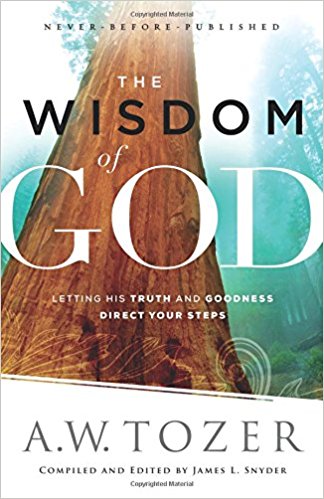
The Wisdom Of God is a collection of never-before-published sermons from A.W. Tozer, in which he makes the case that true Wisdom is a Person to be known not a quality to be gained. 

“Wisdom and power cannot be separated from the Cross. If we do not obey, we blind ourselves, and we become dependent upon our own intellect, which will be in no way sufficient to teach others.” 

“Today, Christians need to learn how to worship, and instead of having all this religious claptrap and modern entertainment to hold people together, have the fire of God and the presence of the Holy Spirit, which, by the way, will be enough.” 

“The one thing God has to offer us and the only thing we absolutely need is His wisdom. Flowing from that wisdom is the solution to all the problems that we could ever face. To know the wisdom of God in its fullness is to experience life as God intended it to be.” 

“Our relationship with God must be based upon God’s ways and not our ways.” 

“To fear God, out of which flows wisdom, is to submit myself to God unconditionally and without any personal agenda. When I come to God as He invites me to come, I will have what God intends for me to have.” 

“This effusion of superior wisdom is a gift imparted by God in addition to the gift of wisdom that He gives the birds so they know to fly south and that which He gives man to invent a spaceship or an electric light. This effusion of superior wisdom is something you either have or you don’t. It does not come gradually to anyone. So a man is either born or he is not. He is either born-again or he has not been born again; he cannot come into that gradually. The doctrine of gradualness is from the devil to keep the church of Christ from going forward.” 

“For wisdom dwells with God and He pours her out upon all His works in the degree they are able to absorb it, and the wisest man is the one who turns to the Lord in repentance and faith.” 

“Christ is that ancient, most excellent wisdom incarnated in our nature and making atonement for all our moral infamy. Any emphasis that makes sin less infamous than that is not biblical. Any interpretation of grace and mercy that allows sin to appear even reasonably excusable in the eyes of God is not a proper interpretation. Any doctrine, any view of sin that allows it to be excused in anyway is not biblical. It is not God’s way of looking at it, for God looks at sin as alienation. … God sent His only Son to make atonement for our infamy and saves those that turn to the wisdom of the just through repentance.” 

“We Christians are a strange crowd. We make a more of the invisible than the visible. We talk constantly to Someone we cannot see. We act as if thing were real that people do not believe are real and waive aside things that some people attach great value to. We sing about a Man who was rejected and crucified, and we say, ‘We find the yoke easy.’” 

You can read my review of The Wisdom Of God by clicking here. And be sure to check out some other quotes from this book here. 

Thursdays With Oswald—Jeremiah 9

Oswald ChambersThis is a weekly series with things I’m reading and pondering from Oswald Chambers. You can read the original seed thought here, or type “Thursdays With Oswald” in the search box to read more entries.

Jeremiah 9

[These are notes from Oswald Chambers’ lecture on Jeremiah 9.] 

    Jeremiah states that wisdom and enlightenment are not to be found among the infatuated people, they have been swept away from right judgment by false prophets who taught that everything develops along a natural rational line. That was the infatuation in Jeremiah’s day, and in our own day the proclaimers of the truth of God are in the minority; men won’t listen to them.

     There are those who say there is no such thing as the supernatural incoming of Jesus Christ, either in history or in the human heart. Our Lord Jesus Christ is not Someone Who has sprung from human nature by evolution: He is Someone Who has come crushing into the human nature by the superb miracle of the Incarnation. The supernatural is the only explanation of our lives if we are right with God, and at any moment God may tumble our lives up as He likes. The question is, are we willing to let Him? We have to maintain our personal relationship to God in Christ Jesus, no matter what happens. The one thing that is of value to God in a human life is a personal relationship of holiness to God, and every part of physical, mental, moral life and of Christian work that is not so related will be desolated and burnt as rubbish.

     The characteristic of life today is that the gospel of, ‘Cheer up, look on the bright side,’ is being preached on all sides. Our Lord says, in effect, that every happiness and peace and well-being that is based on the ignoring of a relationship to God will end in dirges and woes, disasters and terrors.

From Notes On Jeremiah

This statement arrested my attention—At any moment God may tumble our lives up as He likes. The question is, are we willing to let Him?

That is the true question for all followers of Jesus Christ: Am I willing to let Him have His way with my life?

Love Gives

For this is how God loved the world: He gave(John 3:16 NLT)

My beloved friends, let us continue to love each other sincelove comes from God. Everyone who loves is born of God and experiences a relationship with God. The person who refuses to love doesn’t know the first thing about God, because God is love—so you can’t know Him if you don’t love. This is how God showed His love for us: God sent His only Son into the world so we might live through Him. (1 John 4:7-9 MSG)

Thursdays With Oswald—Jeremiah 8

Oswald ChambersThis is a weekly series with things I’m reading and pondering from Oswald Chambers. You can read the original seed thought here, or type “Thursdays With Oswald” in the search box to read more entries.

Jeremiah 8

[These are notes from Oswald Chambers’ lecture on Jeremiah 8.] 

     Wherever I banish them, all the survivors of this evil nation will prefer death to life (Jeremiah 8:3). 

     Our Lord Jesus used these burning words, “The worms that eat them do not die, and the fire is not quenched,” [Mark 9:44, 46, 48] in reference to the condition of people who deprive themselves of right judgment by persistently going wrong (see also 2 Thessalonians 2:11). In the prophecies of Jeremiah we have the same great revelation, that eternal issues are involved in temporal living, but in a different connection. If we are going to remain true disciples of Jesus Christ, we will have to remain alien to the day we live in.

     Such terrible suggestions as these verses contain [verses 1-3] serve as a very wholesome awakening, and bring men to the understanding of the need of Redemption. …  

     The subject of the Second Coming is the one the average unholy Christian cannot stand, and the tendency is to listen, as the people did in Jeremiah’s day, to the false prophets (2 Peter 3:3-6). …  

     The modern scholar pretends to be expounding the Word of God, but in reality he is writing with a lying pen, he builds his wisdom out of his own rationalism, and takes out of the law of God only what agrees with it. …  

     Paul says the same to Timothy—“For the time will come when men will not put up with sound doctrine. Instead, to suit their own desires, they will gather around them a great number of teachers you say what their itching ears want to hear” (2 Timothy 4:3). 

     They dress the wound of My people as though it were not serious. “Peace, peace,” they say, when there is no peace (Jeremiah 8:11). That is the perpetual peril at all times, relieving present pain by a temporal fictitious cure, when what is needed for an effectual cure is a surgical operation. …  

     All Christians are not Christian workers, but those who are called to be workers need the courage of the Holy Ghost to face life from God’s standpoint. We have to keep our hearts and minds faced with the awful condition of human life apart from the Cross of Christ. We must get into our souls the iron of God which makes us strong enough to present Jesus Christ to men. …  

     The majority of us know nothing about shame and repentance, consequently we drift from the central point because we more easily get into sympathy with men than with God, and that is slander against God. To save the world cost Jesus Christ His life, and if we teach that the world can be saved in any other way we slander God.

From Notes On Jeremiah

Oh God, help us—all of us, but especially Your workers—to preach sound doctrine that would save lost people from an eternal Hell. 

No Pity Parties, Please

And do you seek great things for yourself? Do not seek them… (Jeremiah 45:5). 

Baruch faithfully obeyed God and faithfully stood by Jeremiah, but now that the heat was on he was having a bit of a pity party—“Woe is me now! For the Lord has added grief to my sorrows. I fainted in my sighing and find no rest.”

In essence, Baruch was saying, “Things are not working out as I had planned.” God reminds Baruch that His plans are much bigger, and He graciously assures him that He will protect his life where ever He sends Baruch. 

A mark of a godly leader is one who quickly leaves his pity parties.

Instead, my posture should always be: I will obey God and then say, “I am an unworthy servant who is simply doing my Master’s duty” (see Luke 17:7-10). 

This is part 24 in my series on godly leadership. You can check out all of my posts in this series by clicking here.

UPDATE: In my book Shepherd Leadership: The Metrics That Really Matter, I tell a story about a pity party I briefly hosted on my leadership journey in a chapter called “Stick-to-it-iveness.” I think you will really like it!

What Is Church?

All across the world on Sunday morning, people met for church? But what exactly is church? Is it a place we go to? Is it something that only happens on Sundays? 

The Greek word for church is ekklesia. It meant an assembly of citizens. Luke used the term when he recorded a government official saying, “If there is anything further you want to bring up, it must be settled in a legal assembly” (Acts 19:39). But in the New Testament, it came to mean “a community based on a special religious idea and established in a special way” (Dr. Marvin Vincent). It can also mean either a local group of Christians or “the whole body of Christians scattered throughout the earth” (Dr. James Strong). 

Church never means a building. Nowhere does the phrase “go to church” appear in the New Testament. Instead, church carried the idea of a living, growing organism because church was wherever a follower of Jesus was. Sometimes the church met collectively in one location, and sometimes individual believers were out in the community. But wherever the Spirit of God went, church was happening. 

If church is not something we go to, it’s also not something that takes place only one day per week. Look at what Jesus did on the Sabbath day: 

But we also see Jesus doing all of these things EVERY day of the week. 

For Jesus, neither the day of the week nor the location determined the way He lived. Peter summed it up this way, “God anointed Jesus of Nazareth with the Holy Spirit and with power. Then Jesus went around doing good and healing all who were oppressed by the devil, for God was with Him” (Acts 10:38). 

In fact, before they were called Christians the church was simply called “the Way” letting us know that the church was a way of life, not a day of the week. 

Based on how Jesus lived and how the Apostle taught, I think we can see the Church Way like this: 

In other words, EVERY day and in EVERY place the followers of Jesus were being enriched in their own lives so that they could reach out to the hurting so that they could come to know Jesus personally so that their lives could be enriched so that they too could reach out to others, and on, and on, and on it goes! 

Limiting “church” to a specific location or to a specific day of the week is way too small-minded. Church as Jesus intended it was a powerful force that would set people free EVERY day and in EVERY place from the power of the devil and introduce them to God’s eternal life!