Thursdays With Oswald—Jeremiah 7

Oswald ChambersThis is a weekly series with things I’m reading and pondering from Oswald Chambers. You can read the original seed thought here, or type “Thursdays With Oswald” in the search box to read more entries.

Jeremiah 7

[These are notes from Oswald Chambers’ lecture on Jeremiah 7.]

     To seek a place instead of a Person is the first peril in the spiritual life, and to sentimentalize over places where God has met you is the beginning of spiritual twist. Beware of relying on a principle saving you from moral wrong, for it never can. A personal relationship to a personal Savior is the only power that can shield the soul from moral peril. The golden rule is, my personal Savior in every place, not that in certain places I meet my Savior. …  

     Self-deception always arises by ignoring the personal relationship to God….

     Self-examination is the only exercise for a soul who would remain true to the light of God. … The hardest thing in a saint’s life is to maintain a simple belief in Jesus until he realizes the one relationship is—my Lord and I; then His joy will be fulfilled in us.

From Notes On Jeremiah 

We have to be very careful about making a special landmark out of a place, an experience, or even a passage of Scripture where God met us in a profound way. Those special encounters are intended for one specific purpose: to draw us more deeply into a relationship with the Person of Jesus Christ. 

We are on the road to self-deception if we keep seeking experiences. The road to spiritual health is paved with Spirit-inspired self-examination where we ask, “How did that experience lead me closer to Jesus?” When all the other stuff is stripped away, that’s where we will feel Christ’s joy fulfilled in us.

9 More Quotes From “Brothers, We Are Not Professionals”

Those in pastoral ministry are ministers; they are not professional, career-minded, corporate ladder-climbers. John Piper has written a book that I believe every pastor should read: Brothers, We Are Not Professionals. Here are a few more quotes from this excellent book. 

“Is not our most painful failure in the pastorate the inability to weep over the unbelievers in our neighborhoods and the carnal members of our churches? …  

“I must feel the truth of hell—that it exists and is terrible and horrible beyond imaginings forever and ever. ‘These will go away into eternal punishment’ (Matthew 25:46). Even if I try to make the ‘lake of fire’ (Revelation 20:15) or the ‘fiery furnace’ (Matthew 13:42) a symbol, I am confronted with the terrifying thought that symbols are not overstatements but understatements of reality. …

“I say to you, on the authority of Scripture, remember, remember, remember the horrid condition of being separated from Christ, without hope and without God, on the brink of hell. ‘Remember that you were at that time separated from Christ, alienated from the commonwealth of Israel and strangers to the covenants of promise, having no hope and without God in the world’ (Ephesians 2:12). … 

“When the heart no longer feels the truth of hell, the gospel passes from good news to simply news.” 

“Warning has value in stirring us up to take the glories of holiness and heaven seriously so that we come to see them for what they are and delight in them. But it is the delight in them that causes the true grief when we fall short.” 

“Pastors, you will know your people’s souls best by knowing your own. So try to be ruthlessly honest with yourself.” 

“If the heart is without passion, it will produce lifeless, jargon-laden spontaneity. And if the heart is aflame, no form will quench it.” 

“We ought to experience the deepest emotions about the deepest things. And we ought to speak often, and publicly, about what means most to us, in a way that shows its value.” 

“Eating, exercising, and sleeping are more spiritually relevant in the ministry than we may think. … The point is that we be intentional about how our eating affects the ability of our body to be a helpful partner in seeing the glory of God.” 

“When we say that what we do on Sunday morning is to ‘go hard after God,’ what we mean is that we are going hard after satisfaction in God, and going hard after God as our prize, and going hard after God as our treasure, our soul-food, our heart-delight, our spirit’s pleasure. Or to put Christ in His rightful place—it means that we are going hard after all that God is for us in Jesus Christ, crucified and risen.” 

“It will transform your pastoral leadership in worship if you teach your people that the basic attitude of worship on Sunday morning is not to come with your hands full to give to God but with your hands empty to receive from God.” 

“Brothers, we are leaders, and the burden of change lies most heavily on us.” 

You can read my full book review of Brothers, We Are Not Professionals by clicking here, and you can check out some other quotes from this book here. 

Cold-Case Christianity (book review)

From Perry Mason and Dragnet to Blue Bloods and Law & Order, I’ve always been a fan of watching detectives and attorneys sorting through all of the evidence to find the truth. I’m also passionate about Christian apologetics, so Cold-Case Christianity by J. Warner Wallace is totally in my wheelhouse! 

Wallace is a cold-case detective and he’s also a Christian, but criminal investigative work was a part of his life long before he had a relationship with Jesus. In fact, Wallace grew up as an avowed atheist and openly mocked Christians for their “faith.” That is until someone challenged him to investigate the claims of the Bible regarding Jesus as he would investigate one of his cases. 

The similarities are fascinating. In most cases, Wallace cannot interview eyewitnesses, but has to rely on other evidence. Slowly, diligently, he tracks down each lead to come to the most reasonable conclusion. It was exactly the same with the biblical claims about Jesus: the eyewitnesses have long since died. Using his talents for successfully solving crimes which had been left unsolved for years and years, Wallace one day told his wife, “I think it might be true. I think Jesus is who the Bible says He is.” 

Wallace now shares with his readers how they too can use the same skills to explain to skeptics why the biblical case for the authenticity of Jesus is reasonable. He takes us out to the crime scenes as we look for evidence, into the interview room to talk to witnesses, and into the jury box to weigh all of the evidence. 

Skeptics of Christianity will find this book eye-opening, and Christians will find this book informative and helpful to them as they become Christian case makers. This book reads like a detective story to me, and I think others will be just as fascinated with the content as I was.

Thursdays With Oswald—Jeremiah 5

This is a weekly series with things I’m reading and pondering from Oswald Chambers. You can read the original seed thought here, or type “Thursdays With Oswald” in the search box to read more entries.

Jeremiah 5

[These are notes from Oswald Chambers’ lecture on Jeremiah 5.] 

     The Bible is not so much a revelation about God as a revelation of God who is adequate to deal with the worst. …  

     The tumbling and turmoil in human history is caused everywhere by the consuming fire of God rather than by the futile rage of the devil. In reading history the saint sees that the great presence and power is God, not the devil. …

     Hordes of barbarians and powers of worldly dominion are unconscious of God, but God uses them for His own purpose. Nothing happens by chance. When our Lord stood before Pilate He said, “You would have no power over Me if it were not given to you from above” (John 19:11). The tyranny of the Roman Empire over God’s people was the providential order of God, and Jesus recognized that this was so, He did not start a revolution, or say, “We must fight against this” (John 18:36). Perils are clear to God’s mind alone, but they mean panic to everyone who does not know the mind of God. …  

     We learn the marvelous truth that we may become more than conquerors through our right relationship to God over everything that may come against us. …  

     In order to make proper changes in a nation’s life, you must change the people’s wants. 

From Notes On Jeremiah 

All over the globe, it appears that evil is holding sway and that sin is running rampant. It could appear as if the devil is winning, and Christians are just desperately trying to hold on to the end. But is that what it means when the Bible says that we are more than conquerors? 

Let’s be clear about this—God is in control. 

God may use barbarians, dictators, and evil people to accomplish His purposes, but they are all under His control. These forces have bounds past which they may not go. Any power they have has been given to them from above. 

If we forget this, we can easily fall into a hand-wringing panic. But let’s remind ourselves again and again that God is in control! If our relationship with Him is right, then we truly soar over these temporal upheavals; we become more than conquerors through Him Who loves us!

10 More Quotes From “The Christian In Complete Armour”

I loved this book! Check out my review of The Christian In Complete Armour by clicking here. You can also check out the other sets of quotes from this book by clicking here. 

“If you are a saint, you do not need to fear that satan will infiltrate your soul. God will not permit it. But the devil can and does attack along the borders of your faith. Though you are not the proper subject of his power, you are and always will be the chief object of his wrath. He wrestles with you at every opportunity, and you will only overcome him as long as God supplies His strength on your behalf.”

“Power is the rightful attribute of God alone. We mortals make a poor showing when we claim it as our own…. Tremble, therefore, at any power you have unless you use it for God. A plague of locusts is no more destructive in a field of ripened wheat than prideful power is to a man’s grace. Are you powerful? How do you spend this gift from God? On His work, or on the satisfaction of your own lusts?”

“God uses the tribulation instead to sand and polish your faith, so that in the end it is finer and more precious than ever.”

“The boundaries of satan’s empire are circumscribed and limited. First, the time this prince rules is ‘in this world,’ not hereafter. Second, the place he rules is ‘in this world,’ not heaven. And third, the subjects whom he rules are ‘the darkness of this world,’ not the children of light.”

“What is heaven worth if you cannot bear a little shame? If they spit on your face, Christ will wipe it off. They may laugh at you now, but not later. The final outcome has already been declared, and you have sided with the Victor.”

“The bee will not sit on a flower that has no nectar. Neither should the Christian entertain a thought that does not feed his spirit.”

“satan has a habit of stopping the ears from hearing sound doctrine before he opens them to listen to corrupt.”

“Pride must have the most and best of everything to satisfy its appetite. This voracious lust will devour your spirit of praise. When you should be blessing God, you will be applauding yourself. It will eat up Christian love, and cause you to disdain the fellowship of other Christians. It will keep you from acknowledging the gifts of others, because that would take away some of the glory you want for yourself. Ultimately, pride so distorts our taste that we can relish nothing drawn from another’s dish.”

“Another indicator that you are caught in the trap of spiritual pride is envy of others’ gifts. … Envy is an affront to the character and person of God. When you envy, you are questioning God’s right to administer His gifts as He sees best. You are also maligning the goodness of God. You are angry that God wants to bless someone besides you. Would you not have God be good? You might as well say you would not have Him be God, for He can no more cease to be good than He can cease to be God! When your envy prods you to belittle the gifts of other Christians, you are really belittling God who gave them.”

“Count on the strength of your own godly attributes, and you will grow lax in your duties for Christ. Knowing you are weak keeps you from wandering too far from Him.”

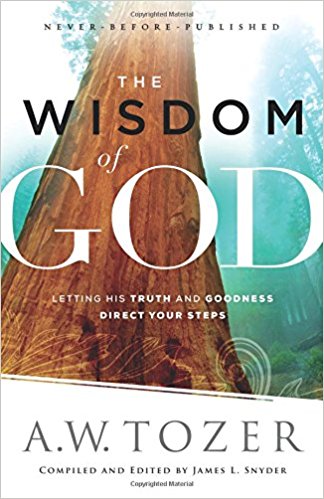
10 Prayers From A.W. Tozer In “The Wisdom Of God”

A.W. Tozer’s book The Wisdom Of God is a call to see Wisdom as a Person, not as a quality. As such, Tozer opens each chapter with a short prayer that we would bolster our relationship with Wisdom. Here are a few phrases from those prayers. 

“Let me not succumb to the limitations of my own reasoning and knowledge but leap beyond that and stepped into the reality of Thy Holy presence. Amen.” 

“Pour into my soul that which will enable me to see Thee as Thou wouldst have me to see Thee.” 

“O Wisdom, the incarnate Christ, fill my heart with desires that please Thee and show to the world around me Thy amazing grace.” 

“O God, Thou Eternal Wisdom, may I embrace that which You have created me for, and may out of my life flow the thanks and praise You so desire. Let me live my life by the wisdom of Thy Son, the Lord Jesus Christ.” 

“May Thy wisdom flow into me and out to the world around me, creating in me a vessel for Thy glory.” 

“O Holy Spirit, I praise Thee through the divine wisdom that Thou hast poured into my life, enabling me to understand who I am and who Thou art and how we come together.” 

“Let me not stay my heart till I have discovered Thee in all Thy fullness.” 

“Manifest Thy grace and wisdom in my life today as a witness to those around me.” 

“O Lord God, Thy wisdom has been poured into my heart, creating such a longing for Thee that nothing in this world can satisfy.” 

“Heavenly Father, open my eyes to recognize Thy hand in my life. … May I be aware of my surroundings in light of what Thou art doing.” 

You can check out my full book review of The Wisdom Of God by clicking here. And be sure to read some of the quotes I shared from this book by clicking here.

Is It Really The 11th Hour?

When we’re down to the last minutes before a crucial deadline, we often refer to it as “the eleventh hour.” 

Have you been there? You’re sweating it out, wondering if God is going to come through for you. Or perhaps thinking about what you might need to handle yourself in order to meet the deadline. And then God comes through for us, and we let out a deep sigh of relief and gratitude. 

But why a sigh? Were we worried that God wouldn’t come through? Did we think God’s supply was limited? And what made us think that it was “the eleventh hour” anyhow? 

What we often think is the eleventh hour is really God’s first hour! God is never late. He’s never scrambling to come up with what we need. We might be the ones “scrambling,” but God never is. He always has the perfect resources at the perfect moment. 

We should know this because the Bible tells us: God who did not spare His own Son, but gave Him up for us all—how will He not also, along with Him, graciously give us all things? (Romans 8:32) 

Jesus tells a story about an eleventh-hour situation in Matthew’s Gospel. Men were waiting around to work for the day when a landowner came along to hire them. He hired some guys first thing in the morning and agreed to pay them a full day’s pay. He hired some other workers at 9:00 AM and promised to pay them fairly, and then he hired even more workers at noon and at 3:00 PM, also promising to pay them what was fair. Finally, he hired some workers at 5:00 PM—literally at the eleventh hour—without any mention of pay. 

At the end of the day, every single worker was paid a full day’s wage. Every single one of them. Jerry Bridges notes why this is significant: 

“Each worker, regardless of how long he had worked, received a day’s wages. He received not what he had earned on an hourly basis, but what he needed to sustain his family for a day. … Those eleventh-hour workers were hired because they needed to receive a day’s wages. They had been standing all day waiting for someone to hire them so they could earn money to support their families. They needed to work more than the landowner needed their work. He hired them, not because of his need, but because of their need.” (emphasis added)

You see, God knows what you NEED and He generously supplies that NEED right on time.

Jesus taught us to pray, “Give us this day our daily bread.” The problem comes when we start looking down the road wondering what’s going to happen tomorrow, and the next day, and the next day (see Matthew 6:11, 31-34). 

God’s favor toward us is out of all proportion to our work or sacrifice. He gives exactly what we need, exactly when we need it. 

If you’re feeling anxious—like the clock is ticking down to the eleventh hour—perhaps you should recall how God has provided for you in the past. Then discipline your thoughts from running ahead to tomorrow as you pray, “Give me this day what I need.” 

Here’s a prayer I’m praying—

“God, I remember the wonderful deeds You have done for me. They are constantly in my thoughts. I cannot stop thinking about Your mighty works in the past. Therefore, I ask you today for my daily bread. Let my heart be on guard against scrambling as though I were in an eleventh-hour situation. You are my all-loving, all-gracious Father. You know what I have need of even before I ask. May my attitude be one of assured contentment in your abundant, right-on-time supply. May you be glorified as others see this confidence in my attitude.”

7 Quotes From “The Wisdom Of God”

A.W. Tozer never pulls his punches! The Wisdom Of God is no different as he calls the corporate church and individual Christians back to the biblical understanding of God’s wisdom. Check out my full book review by clicking here. 

“What would wisdom and spiritual understanding, for example, make out of man? Would the man filled with wisdom and spiritual understanding write cheap poetry? I would certainly hope not. What then does he do? Walk around in a brown robe and pull loose from the world, hiding in a cloister or an ivory tower? Absolutely not.

“What is the purpose then of this baptism of the ancient wisdom of God into the heart of a man? The old wisdom man said it was to make a man a friend of God. Paul said, ‘That ye might walk worthy of the Lord unto all pleasing, being fruitful in every good work, and increasing in the knowledge of God; strengthened with all might, according to His glorious power, unto all patience and longsuffering with joyfulness’ (Colossians 1:10-11). This is the practical meaning of this infusion of divine wisdom into the man walking with God.” 

“The purpose of God in Redemption is not just to save us from hell. The purpose of God in redemption is to save us unto heaven. To be totally saved, He has to save us from something in order to save us unto something. We are saved from sin, which is the negative side. We are saved unto holiness, which is the positive side. We are saved from hell, but we are saved unto heaven. We are saved from the devil, but we are saved unto Christ.” 

“When we deal with our sin, repent, and the Lord has taken our sin away, we are as wise as the angels and as discrete and as knowing as the seraphs before the throne, for we have an afflatus of that wisdom.” 

“In our day, we have degraded Christianity to be a kind of soft vaccine against hell and sin. We gather people, stick them with a religious needle, and say, ‘If you just accept Jesus you will not go to hell, you will go to heaven when you die. Keep living as well as you can, and when you die you’ll go to heaven.’ Many are preaching what I refer to as a kind of lifeboat salvation, and even the songs today reflected that idea.

“Certainly, this is an inadequate concept of Christianity. The purpose of God in redeeming man was not to save them from hell only, but to save them to worship, and to allow them to be born into that eternal wisdom that was with the Father, which is synonymous with that eternal life that was with the Father and was revealed unto men.” 

“You can promote religion without divine wisdom and power. You can promote your denomination. You can promote and build up your church numerically and financially, but in these ways, you cannot promote true Christianity.” 

“The evangelical church waivers today because it has burst out in two directions: One, in the direction of entertainment and pleasure for the like-minded ones. The other, in the direction of scholarship for the serious-minded. This is the new evangelicalism of today. An effort to do by scholarship what can only be done by wisdom and power. It is a glass eye trying to see.” 

“What I am praying for is that God Almighty would come upon this generation of Christians and make them dissatisfied with the cold, humanistic, intellectual evangelicalism of our time, and make us so thirsty for an afflatus of divine wisdom and power that they press through and receive that baptism.” 

Do People Know That You Know That God Is Good?

Listen to the podcast of this post by clicking on the player below, and you can also subscribe on AppleSpotify, or Audible.

If you’ve been reading or watching my series on God’s favor the last few weeks, I hope you truly know this: God is for you! 

But the key question for Christians comes down to this—Do others know that you know that God is for you? 

You see, God is for you because God is joyful and happy, and He wants you to not only know this but to radiate this joy and happiness to those around you. 

Here’s how it works:

(1) Joy is an inside job. The dictionary defines joy as “a feeling of great delight caused by something exceptionally good or satisfying.” When we know by our personal experience with Him how good God is, joy is birthed in our hearts as we see Him as All-Good and All-Satisfying. 

(2) Joy is regardless of my external circumstances. Some people try to pursue happiness apart from joy. Trying to get happy without having the foundation of joy is like having a flower that has been picked from the plant. Happiness may be pretty for a short while, but it is already fading because it is completely dependent on the environment around it. True happiness isn’t dependent on external circumstances because it is rooted in something far greater. 

(3) Knowing God’s favor fuels our joy. There is a Hebrew word for know which means “knowledge through intimate, personal experience.” Psalm 100 describes happy people and their joyful praise. Their joy comes from this: They know that their Lord is God and that He is good. This joy comes from seeing and savoring God’s favor.  

(4) Our internal joy should bubble up into external happiness. All throughout the Bible, we read how those who are filled with joy as they get to know this exceptionally good, all-satisfying God cannot help but burst out in songs of happy praise (see Psalm 28:7 and Luke 10:21).

(5) Our external happiness becomes our testimony. In Psalm 126 we read that God’s people who were full of God’s joy burst out into happy praise. When they did the people around them recognized that God had done great things for them. 

Check this out—

“I don’t think it’s a stretch to say that to be a Christian and to be unhappy is a sin. An unhappy Christian gives God no praise, robs Him of glory, and paints God in a bad light. A happy Christian knows the Lord is his strength, his comfort, his supply. The happy Christian lifts God high and invites others to know this All-Good, All-Happy God too!” —Craig T. Owens 

So let me ask you again: If you call yourself a Christian, do people know that you know that God is for you? Are you making God look All-Good and All-Satisfying by your deeply fueled joy and your face-brightening happiness? 

What a testimony it is when God’s people are happy in Him! 

►► Would you please prayerfully consider supporting this ministry? ◀︎◀︎

If you have missed any of my other posts about God’s favor, you may check them out by clicking here.

Thursdays With Oswald—Jeremiah 2-3

Oswald ChambersThis is a weekly series with things I’m reading and pondering from Oswald Chambers. You can read the original seed thought here, or type “Thursdays With Oswald” in the search box to read more entries.
Jeremiah 2-3

[These are notes from Oswald Chambers’ lecture on Jeremiah 2-3.]

     God is the “adornment” of His people; but God says, “My people have forgotten Me days without number”; the dead set of their life has been away from God (Jeremiah 2:32). Forgetting as an infirmity of mere consciousness is one thing; but forgetting by steadfastly refusing to recognize is another thing. These people had deliberately turned out of God’s way. They were wantoning after some other god than the God Who was holy (2:33). …  

     The thing that shocks us most is not the thing that shocked Jesus most. Social immorality shocks us till we don’t know where we are; but what struck the heart of Jesus Christ with horror was immorality against God, pride against Himself (see Luke 16:15). …  

     The innocence arising from evil is always like this—“I’ve done nothing.” It is the innocence we are all born with; sooner or later it takes its stand with evil and only knows good by contrast; whereas the innocence arising from the presence of the Spirit of God takes its stand with good and knows evil only by contrast. If we hand our hearts over to God we need never know in experience what Jesus Christ says of the human heart is true (see Mark 7:20-23). 

From Notes On Jeremiah

This is a tough concept that takes some quiet introspection in the presence of the Holy Spirit. Christians should ask themselves: Do I know the difference between good and evil because I’m doing evil and the opposite of what I’m doing is good, or because I’m doing good and the opposite of what I’m doing is evil? 

Originally, Eve knew evil only as the opposite of how she was living. But when satan tempted her to take the forbidden fruit, Eve now knew evil as something she was doing. Jesus said evil is what would naturally come out of our heart, unless “we hand our hearts over to God” and allow His Spirit to supernaturally bring out of us the Christlike fruit He produces. Is this happening in your life?

