Many of our prayers could be much bolder and much more specific than they are. Why is that? Because how we view God is going to determine what we pray and what we expect after we pray.
When we pray, we approach an All-Loving Father, and we approach an All-Powerful God. I have found that typically people get warmed by the idea of Father and get scared by the idea of God. They say things like: “What if my prayers don’t hallow God’s name? What if He’s mad at me? What if I pray an improper prayer?”
God wants us to come to Him in prayer, so He makes Himself very accessible! The Father is both Father and God; the Son is both Friend and King; the Spirit is both Comforter and Convictor. We get ALL of this in One God.
Charles Spurgeon had this word of encouragement: “If You are my Father, then You love me. If I am Your child, then You will regard me, and poor though my language is, You will not despise it.” Jesus came to earth fully God and fully man, making Him our perfect intermediary (see Job 9:32-35; 1 Timothy 2:5; Hebrews 7:25). And the Holy Spirit helps interpret our groaning prayers (Romans 8:26-27).
Have you ever noticed that neither the prophets of the Old Testament, nor Jesus in the Gospels, nor the apostles in the New Testament ever prayed, “God, if this is Your will please do such-and-such”? They simply prayed. Or more accurately, they prayed so boldly and specifically it almost sounded like a command: “Stand up” or “Be clean” or “Go, your prayer has been answered.”
When you and I are praying to an All-Loving and All-Powerful Father, with Jesus interceding for us, and the Spirit helping us, we too can pray these bold and highly specific prayers.
After all, if you don’t pray specifically and expectantly, how will you know when your prayer is answered?
I find John Piper’s acrostic very helpful in praying these bold and expectant prayers. He calls it APTAT:
Two final thoughts—
I hope you can join me this Sunday as we continue to work on our plans to pray.
…if someone desires to be a church leader, he desires an honorable position (1 Timothy 3:1).
Desires—Paul uses two different Greek words for this one English word. The first word is orego. In the (+) sense it means to stretch out in order to grasp something. In the (-) sense it means to give one’s self up to the love of money.
The second word is epithymeo. In the (+) sense it means to long for a good thing (see Matthew 13:17; Luke 22:15). In the (-) sense it means to covet what is forbidden (see Matthew 5:28; James 4:2).
So (+) or (-) leadership comes down to desire. If I want a leadership position for what I can get, that is a (-) desire. Should you then seek great things for yourself? Do not seek them… (Jeremiah 45:5).
But if I desire a leadership position for what I can give, that is a (+) desire. Not so with you. Instead, whoever wants to become great among you must be your servant, and whoever wants to be first must be slave of all. For even the Son of Man did not come to be served, but to serve, and to give His life as a ransom for many (Mark 10:43-45).
With these differing desires in mind, the list of qualifications for church leaders in verses 2-7 and 8-13 should be viewed through the (+)/(-) desire lenses:
A godly leader desires to glorify God and serve others, so a godly leader willingly submits to the Holy Spirit to address any area of (-) desire that may derail the God-honoring (+) desires. Just as Jesus is the Ultimate Servant-leader, I too must “have the same mind as Christ Jesus” (Philippians 2:5).
This is part 43 in my series on godly leadership. You can check out all of my posts in this series by clicking here.
Jesus was once asked, “What is the greatest commandment?” He responded by saying, “The Lord our God, the Lord is One,” and then saying we should love God with all our heart, soul, mind, and strength (which fulfills the first four of the Ten Commandments), and then love our neighbor as ourselves (which fulfills the next six of the Commandments).
To live this way, we need to pray this way too! That’s why Jesus taught us a model prayer—which we typically call “The Lord’s Prayer”—in which the first three petitions are for God’s glory (hallowed be Your name; Your kingdom come; Your will be done), and the next three petitions are for man’s help (daily bread, forgiveness, victory over temptation).
Jesus says we can pray to our Heavenly Father, but we still need to remember that He is also the God of the Hallowed Name. The Greek word for hallowed is made up of two other Greek words:
He is both unapproachable and approachable. He is both awful and lovable. He is both Supreme power and Supreme love. He is both Hallowed and Father. He is unique. Since He is unique, we must approach Him uniquely in holy prayer. But we must always approach first and foremost to reverence His holy Name. As Matthew Henry said, “Let Him have the praise of His perfections, and then let us have the benefit of them.”
Think of His glory in every request you make of Him. Father, may Your holy, righteous name be hallowed and exalted and made famous as You…
Let’s not pray prayers that rob God of His glory. Prayers like:
Let’s be known as people who pray confidently humble prayers. Let’s come to a Father Who is All-Love and to a God Who is All-Powerful—a God Whose power is perfectly balanced by His love, and Whose love is perfectly balanced by His power. May our prayers HALLOW His name!
Join me this Sunday as we continue to learn more about prayer.
John Piper has given us an extremely helpful book whether we ourselves are battling the darkness of depression, or someone close to us is. Please check out my full book review of When The Darkness Will Not Lift by clicking here.
“This is the rock where we stand when the dark clouds gather and the floods lick at our feet: justification is by grace alone (not mixed with our merit), through faith alone (not mixed with our works) on the basis of Christ alone (not mingling His righteousness with ours), to the glory of God alone (not ours).”
“Where should you start? Start at the easiest place for those in darkness. Start with despair. Despair of finding any answer in yourself. I pray that you will cease from all efforts to look inside yourself for the rescue you need. I pray that you will do what only desperate people can do, namely, cast yourself on Christ.”
“You cannot isolate the spiritual from the physical for we are body, mind and spirit. The greatest and the best Christians when they are physically weak are more prone to an attack of spiritual depression then at any other time and there are great illustrations of this in the Scriptures.”
“It will be of great advantage to the struggling Christian to remember that seasons of darkness are normal in the Christian life.”
“One of the reasons God loved David so much was that he cried so much. … It is a beautiful thing when a broken man genuinely cries out to God.”
“Faith is sustained by looking at Christ, crucified and risen, not by turning from Christ to analyze your faith. … Paradoxically, if we would experience the joy of faith, we must not focus much on it. We must focus on the greatness of our Savior.”
“It follows from this that we should all fortify ourselves against the dark hours of depression by cultivating a deep distrust of the certainties of despair. Despair is relentless in the certainties of its pessimism. But we have seen again and again, from our own experience and others, that absolute statements of hopelessness that we make in the dark are notoriously unreliable. Our dark certainties are not sureties. While we have the light, let us cultivate distrust of the certainties of despair.”
“Instead of only saying, ‘Just do your duty,’ we must say…that joy is part of your duty. The Bible says, ‘Rejoice always’ (1 Thessalonians 5:16). And in regard to the duty of giving, it says, ‘God loves a cheerful giver’ (2 Corinthians 9:7). In regard to the duty of service, it says, ‘Serve the Lord with gladness’ (Psalm 100:2). In regard to the duty of mercy, it says do it ‘with cheerfulness’ (Romans 12:8). In regard to the duty of afflictions, it says, ‘Count it all joy’ (James 1:2). We simply water down the divine command when we call someone to half their duty.”
“In dealing with our sin we can make two mistakes. One is to make light of it. The other is to be overwhelmed by it.”
“If we want the joy of seeing and savoring God in Christ, we must not make peace with our sins. We must make war.”
“Sometimes the darkness of our souls is owing in some part to the fact that we have drifted into patterns of life that are not blatantly sinful but are constricted and uncaring. … Unconsciously we have become very self-absorbed and oblivious and uncaring toward the pain and suffering in the world that is far worse than our own.”
“Paradoxically, depressed persons may say that they must care for themselves and cannot take on the problems of the world, when in fact part of the truth may be that their depression is feeding on the ingrown quality of their lives. … Joy in Christ thrives on being shared. That is the essence of Christian joy: it overflows or dies.”
For me He left His home on high;I am a foreigner and stranger among you… (Genesis 23:4).
Abraham and Peter remind us that God-fearing people are foreigners; they are not citizens of Earth. Christians are respectful of the people, laws, and customs of the land in which they sojourn, but they know that this land is not their home.
Abraham wanted his son to have a wife who was of the same mindset—not attached to the place of sojourning but looking forward to Heaven. Abraham knew how an earthly–focused wife (like Lot’s wife) could distract her husband, so he sent his servant on a mission to find a heavenly-minded, godly woman for his son Isaac.
This servant was a godly leader in his own right. He was loyal and loving to Abraham’s family. Abraham gave him two simple boundaries: don’t take a wife from Canaan, and don’t take Isaac back to Mesopotamia (the land from which God had called Abraham).
Notice how this godly leader undertook his mission:
When God calls us to live in a certain way, it is fitting that He will answer our prayers that align with that way of living. This is exactly what Jesus meant when He told us to “ask for anything in My name.”
This is part 42 in my series on godly leadership. You can check out all of my posts in this series by clicking here.
This is a weekly series with things I’m reading and pondering from Charles Spurgeon. You can read the original seed thought here, or type “Thursdays With Spurgeon” in the search box to read more entries.
“Got To” To “Get To”
What a glorious covenant the second covenant is! Well might it be called “a better covenant, which was established on better promises” (Hebrews 8:6). …
It is better, for it is founded upon a better principle. The old covenant was founded on the principle of merit. It was “Serve God and you will be rewarded for it. If you walk perfectly in the fear of the Lord, God will walk well toward you and all the blessings of Mount Gerizim will come upon you and you will be exceedingly blessed in this world and the world that is to come.” But that covenant fell to the ground, because, although it was just that man should be rewarded for his good works, or punished for his evil ones, yet man being sure to sin and since the fall infallibly tending toward iniquity, the covenant was not suitable for his happiness, nor could it promote his eternal welfare.
But the new covenant is not founded on works at all. It is a covenant of pure unmingled grace. You may read it from its first word to its last, and there is not a solitary syllable as to anything to be done by us. The whole covenant is a covenant, not so much between man and his Maker, as between Jehovah and man’s representative, the Lord Jesus Christ. The human side of the covenant has been already fulfilled by Jesus, and there remains nothing now but for the covenant of giving, not the covenant of requirements.
From God In The Covenant
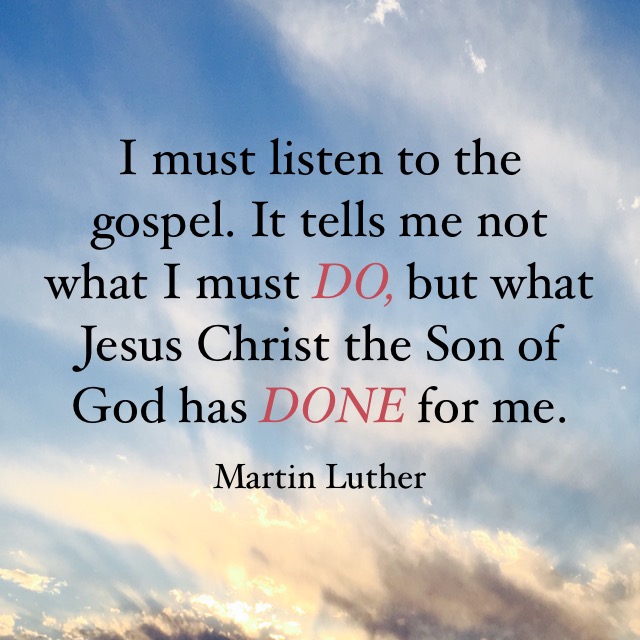
The old covenant was—you’ve got to do this. The new covenant is—you get to do this!
The old covenant made requirements. The new covenant invites joyful participation.
The old covenant needed men to do rituals of sacrifice. The new covenant was done once for all when Jesus said, “It is finished!”
Under the new covenant, we are free to worship God and enjoy His blessings without having to complete a checklist of religious duties. Have you traded GOT TO for GET TO?