Listen to the podcast of this post by clicking on the player below, and you can also subscribe on Apple, Spotify, or Audible.
Imagine if 700 years before you were born there was a prophecy given about you (Matthew 3:3). Or if on the day of your birth your father said, “And you, my child, will be called a prophet of the Most High; you will go on before the Lord to prepare the way for Him” (Luke 1:76).
This was John the Baptist.
With these kinds of announcements and the stamp of approval from God Himself, it’s really quite astounding how humble John remained:
“After me comes One Who is more powerful than I, Whose sandals I am not worthy to carry” (Matthew 3:11).
“[Jesus] must increase, but I must decrease” (John 3:30).
The confidence that he was God’s man for the hour gave John boldness to speak truth to religious leaders, wealthy people, and Roman soldiers (Matthew 3:7-12; Luke 3:7-20). Yet his humility was almost his undoing.
John preached boldly, fulfilling the prophecies that were made about him. But when Jesus came to him to be baptized, John’s humility caused him to defer initially. Then Jesus reminded him that His baptism was necessary “to fulfill all righteousness. Then John consented” (Matthew 3:13-15).
Whether I am lacking confidence to speak or lead boldly, or lacking humility to let someone else take the lead, I need to return to the Word of God—just as John did. Both his confidence and his humility were balanced by words spoken over him by God. So it must be for you and me too.
Confidence without humility or humility without confidence can trip me up and cause me to miss out on all that God needs me to do. So my daily prayer must be: Holy Spirit, may I be sensitive to every correction and adjustment You need to make in me. Illuminate the Scriptures that I need to apply to my life that will keep me in a healthy, balanced place.
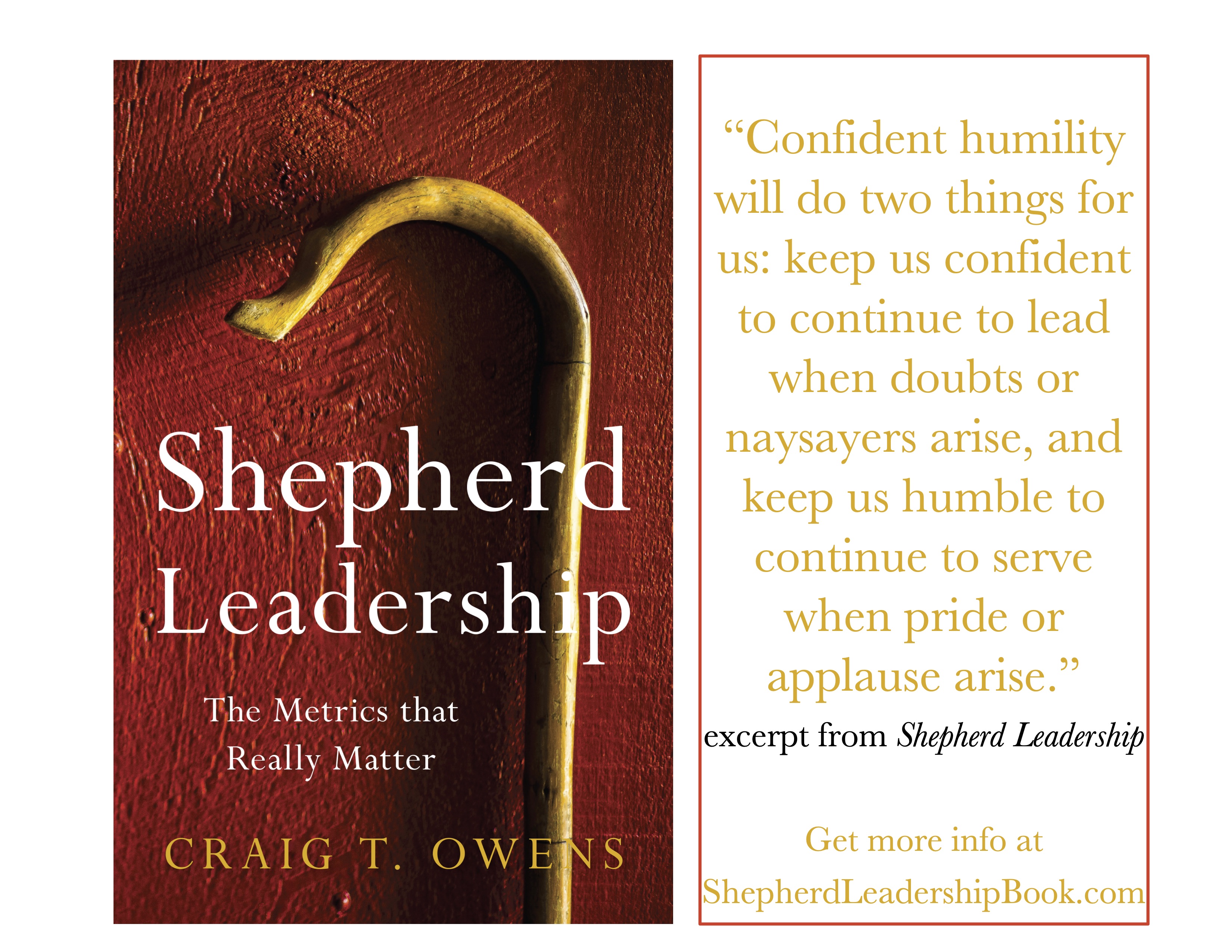
I wrote about this tension between confidence and humility in my book Shepherd Leadership. This was also a topic of conversation in two interviews I did, which you can find here and here. Healthy leaders need the proper balance of confidence and humility to keep their leadership in a place that God can use powerfully.
Listen to the podcast of this post by clicking on the player below, and you can also subscribe on Apple, Spotify, or Audible.
We said last week that nobody likes to be around a complainer, although many complainers would say they’re not complaining but just sharing facts. In their mind, they have a legitimate right to let everyone know how they’ve been short-changed, gotten a bad deal, or experienced something that no one else has gone through.
Have you ever heard your kids say, “I’m starving”? And perhaps you think, “Do you really know what starving is?” Or what about people waving their very expensive phones around as they complain, “Isn’t there any WiFi here?!”
This isn’t a glass half-full or half-empty thing. This is really closing your eyes to the fact that many people don’t even have a glass, or if they do have a glass, they don’t have access to the water that they need.
I was delivering some Christmas toys to a family and I discovered they had lost everything they owned. When I came to their house their furniture was mismatched, their food and clothes were donated, and their kids only had a couple of simple toys to play with. And yet this family was happy to be together!
That sort of puts things in perspective, doesn’t it?
We have to choose grumbling or gratefulness, but as E.M. Bounds noted, “Gratitude and murmuring never abide in the same heart at the same time.” So if you are complaining about what you don’t have, you cannot be grateful for what you do have.
There is a fascinating story told in all four Gospels of a woman named Mary. She was an uninvited guest at a house where Jesus and His disciples had been invited to dinner. Jesus was not there because someone was grateful to have Him in his home, but because Simon the Pharisee and his cronies were trying to find a reason to accuse Jesus of wrongdoing.
Simon was so focused on his “gotcha” moment that he completely overlooked his host duties. He didn’t wash Jesus’ feet, nor greet Him with a kiss, nor anoint Him with perfume, as the custom of the day demanded. But Mary, standing behind Jesus at the dinner table, washed Jesus’ feet with her tears, kissed His feet, and anointed Him with an entire bottle of costly perfume! She did all of this out of gratitude for what she had received from Jesus.
First, I would like you to consider what Mary didn’t have:
a seat at the table—even though the dinner was in her hometown of Bethany, her brother Lazarus was invited to the meal, and her sister Martha was serving the meal
a good reputation—twice Simon the Pharisee said, “Does Jesus even know what kind of woman she is? Does He know she is a sinner?”
the acceptance or approval of others—even the disciples thought her gesture of anointing Jesus with so much perfume was a wasted extravagance
Next, let’s look at what Simon did have:
an elevated position as a Pharisee
considerable wealth—he had servants and a home large enough for a big dinner party
healing from leprosy—the Gospels refer to him as “Simon the leper” which tells us that he had been healed of his leprosy
Now, let’s consider what the disciples did have:
an enviable position as disciples of Jesus
a dinner invitation to Simon’s house
access to the financial resources that people gave to Christ’s ministry
and let us never overlook the fact that they had access to Jesus Himself like no one else had
Finally, let’s look at what Mary did have:
forgiveness—Luke says this about her, “A woman who HAD lived a sinful life”
Gratitude is truly a great attitude. Grateful people stand out because they don’t grumble about what they don’t have, but they are focused on what they do have.
Mary knew that she didn’t have the outward marks of success or favor or approval, but she did have the assurance that she had been forgiven. For that, she was more than willing to give everything she had to Jesus in thankful worship!
And as a result, look what Mary now has:
the kind words of Jesus—He assured her that she was forgiven (Luke 7:47)
Jesus as her defender—He told His disciples, “Leave her alone” (John 12:7)
an eternal testimony—Jesus said that wherever the Gospel was preached, people would tell Mary’s story (Matthew 26:13)
I think a good way to sum up the distinguishing way grateful people live is like this: They don’t grumble about what they don’t have, but they are extremely grateful for what they do have.
When you find grumbling slipping out of your mouth, remind yourself of just how much you have been given. Even if you think to yourself, “I don’t have much,” you can be assured that you have Jesus, and He is more than enough! And with that assurance, let your gratitude be lifted up in extravagant, fragrant praise to God.
This is a weekly series with things I’m reading and pondering from Charles Spurgeon. You can read the original seed thought here, or type “Thursdays With Spurgeon” in the search box to read more entries.
Listen to the podcast of this post by clicking on the player below, and you can also subscribe on Apple, Spotify, or Audible.
Heart’s Desire
Do not fret because of evildoers, nor be envious of the workers of iniquity.For they shall soon be cut down like the grass, and wither as the green herb. Trust in the Lord, and do good; dwell in the land, and feed on His faithfulness.Delight yourself also in the Lord, and He shall give you the desires of your heart. (Psalm 37:1-4)
There is no room for fretting if we remember that God is ours; there is every incentive for sacred enjoyment of the most elevated and ecstatic kind. Every name, attribute, word, or deed of Jehovah should be delightful to us, and in meditating on it our souls should be as glad as the epicurean who feeds delicately with a profound relish for his dainties.
A pleasant duty is here rewarded with another pleasure. People who delight in God desire or ask for nothing but will please God; hence it is safe to give them carte blanche.
When we only have eyes for our God, when our heart craves for only what our Savior can provide, when we have ears that tune out all but what the Holy Spirit whispers to us, then we are living in a place where our hearts are continually delighted with what God provides.
We have to trust the One who gave us His unshakable promises—Be delighted with the Lord. Then He will give you all your heart’s desires (v. 4 TLB). Be delighted with Him and He will—not “may” or “hopefully He will” but He will—give you ALL your heart’s desires! That’s because your desires align with His.
There is an ultimate reward in Heaven but there are incredibly satisfying rewards along the journey to Heaven as well. Take time every day to meditate on the boundless love that God has toward you, and let your heart be transformed so that you only crave the very best that your Heavenly Father has for you!
Listen to the podcast of this post by clicking on the player below, and you can also subscribe on Apple, Spotify, or Audible.
Our cravings are implanted by God and are fulfilled solely in our relationship with Him. Sometimes the journey seems long. If you have been in the car with kids, you know they are infamous for asking, “Are we there yet?” just a couple of minutes into the trip. We adults aren’t much better. Perhaps we have a little more patience but if we’re honest we may find ourselves asking, “How long is this going to take? It seems like it’s soooo long!”
We’ve discussed that a maturing attitude shift for us is exchanging “have to” for “get to.” This is when we begin to understand that something good—something far better than what we have now—is coming. This is the starting point to help us to wait well, to not get frustrated and bail out.
Jesus did this: “For the joy set before Him He endured the Cross” (Hebrews 12:2). He could see what was coming so He wouldn’t accept any lesser substitutes. But that same verse also calls us to be “looking away from all that will distract to Jesus” (Hebrews 12:2 AMP).
This attitude exchange helps us in three ways:
Maturing self-control
Understanding the rewards of delayed gratification
Having a joyful expectation of both what’s coming and what’s happening now
Self-control, delayed gratification, and joyful expectation are also the key components of a satisfying relationship. These then allow me to make another important exchange: “don’t” for “won’t.”
For example, in my relationship with my wife Betsy, no one has to tell me, “Don’t speak to her unkindly.” I won’t speak to her unkindly because that would damage our relationship. No one has to tell me, “Don’t flirt with other women.” I won’t do that because I know that would jeopardize our relationship, perhaps causing me to look elsewhere to satisfy my craving for a meaningful relationship.
In the book called Song of Solomon, the word “lovely” is used frequently between lovers who only have eyes for each other. Paul uses this keyword when he talks about us only having our eyes, and heart, and mind on Jesus—“Whatever is true, whatever is noble, whatever is right, whatever is pure, whatever is lovely, whatever is admirable—if anything is excellent or praiseworthy—think about such things” (Philippians 4:8).
David, who is described as a man after God’s own heart, wrote several psalms expressing his longing to be in God’s presence both now and for all eternity. Especially in Psalm 16 and Psalm 37, David shows us the don’t-for-won’t exchange (Psalm 16:1-11; 37:1-4).
Sometimes we will experience some lovely things here on earth, but those are nothing compared to the eternal rewards awaiting us. C.S. Lewis wrote, “Our Father refreshes us on the journey with some pleasant inns, but will not encourage us to mistake them for home.”
Even if we experience unpleasant things here, the apostle Paul reminds us, “But what of that? For I consider that the sufferings of this present time—this present life—are not worth being compared with the glory that is about to be revealed to us and in us and for us and conferred on us!”(Romans 8:18 AMP).
The marshmallow test is a famous experiment. Kids were given the choice to eat one marshmallow immediately or be rewarded with a second marshmallow if they waited. Researchers found that those who practiced self-control, delayed gratification, and joyful expectation faired much better later in life.
So I would encourage you to keep your marshmallow somewhere you will see it often. It will harden, but it will not mold or spoil. Every time you look at it, let it remind you that what’s coming is so much more than anything you could ever find here! Let this reminder help you exchange don’t for won’t as the Holy Spirit helps you keep your eyes only on Jesus.
This is the most-viewed reel I have ever shared on Instagram! The Bible isn’t a bunch of “once upon time” stories but they are actual events at actual moments in history. Check out how Jesus verifies the historicity of the Bible.
“All obedient believers are near akin to Jesus Christ. They wear His name, bear His image, have His nature, are of His family. He loves them, converses freely with them as His relations. He bids them welcome to His table, takes care of them, provides for them, sees that they want nothing that is fit for them: when He died He left them rich legacies, now He is in heaven He keeps up a correspondence with them, and will have them all with Him at last, and will in nothing fail to ‘do the kinsman’s part’ (Ruth 3:13), nor will ever be ashamed of His poor relations, but will confess them before men, before the angels, and before His Father.” —Matthew Henry
Even skeptics of the claims of the Bible cannot help including biblical themes in their books, movies, plays, and TV shows. I discussed that in this apologetic video—
We also said that although we would all like to have the job that was wonderful, even the crummy jobs deserve our best attitude and our best effort.
This is very much the same for our relationships. We would all love to only have relationships in our lives that are energizing, fulfilling, and win-win. But the reality is that many of our relationships may be the exact opposite of this.
Jesus said our love for others would show the world that we are His disciples. Oh yeah, and the love we show is supposed to be a “10” on the Jesus Love Scale (John 13:34-35). Why? Because that’s how Jesus loved us:
Now it is an extraordinary thing for one to give his life even for an upright man, though perhaps for a noble and lovable and generous benefactor someone might even dare to die. But God shows and clearly proves His own love for us by the fact that while we were still sinners, Christ (the Messiah, the Anointed One) died for us. (Romans 5:7-8 AMP)
Remember we said that God is Love? But love needs to have both a lover and beloved—someone reaching out and someone receiving. God is Father, Son, and Holy Spirit so God is Relational. The Father loving the Son and Spirit, the Son loving the Spirit and the Father, the Spirit loving the Father and the Son. All loving and promoting the Other.
God is also Happy in this Relationship.
Because we are created in God’s image, we have a God-implanted craving to love and to be loved, to have meaningful companionships (Genesis 1:26; 2:18).
Remember that Jesus was all-in for us so that we could have this love relationship with God.This same passage calls us to have the same attitude as Jesus had. But we can also back up just a couple of more verses to find out what fuels the relationships that satisfy our craving for companionship and please God (Philippians 2:1-11). Those characteristics include:
being like-minded in striving to find agreement with others
having the same love as Jesus demonstrated
being one in spirit—this unique Greek word reminds us we all have immortal souls. As C.S. Lewis reminded us, “It is a serious thing to live in a society of possible gods and goddesses, to remember that the dullest and most uninteresting person you talk to may one day be a creature which, if you saw it now, you would be strongly tempted to worship, or else a horror and a corruption such as you now meet, if at all, only in a nightmare. All day long we are, in some degree, helping each other to one of these destinations.”
being one in purpose
giving up selfish ambitions as we trade “me” for “we”
not indulging in vain conceit, but thinking more highly of others
being humble
always striving to find the win-win
When Alexander Dumas wrote The Three Musketeers his Musketeers have been given a famous line: “All for one and one for all, united we stand divided we fall.” This is actually quite biblical because the Bible only has saints in the plural form, never in the singular. And the apostle Paul reminds us, “And if one member suffers, all the parts share the suffering; if one member is honored, all the members share in the enjoyment of it” (1 Corinthians 12:26 AMP).
God is pleased when our attitude about our fellow saints is all for one and one for all—when all the saints love and nurture the individual saint, and when each individual saint loves and supports all the other saints.
We were created for this. We crave this. God is pleased when we live and love like this. And this is the only way we will experience the joy of God’s favor on our relationships.
In reading Matthew 12:38-40 I notice something important about how Jesus answered a request. Be careful of quarreling with those skeptical of Christianity. When it gets to point that they aren’t looking for evidence to believe but another point to argue, do what Jesus did: point them to the empty tomb!
Some skeptics of the Bible want to make the argument that the Gospels were written at a much later date, thus they aren’t as accurate. Cold-case detective J. Warner Wallace addresses that topic in this video.
This is a weekly series with things I’m reading and pondering from Charles Spurgeon. You can read the original seed thought here, or type “Thursdays With Spurgeon” in the search box to read more entries.
Listen to the podcast of this post by clicking on the player below, and you can also subscribe on Apple, Spotify, or Audible.
Understanding Repentance
Repentance is an old-fashioned word, not much used by modern revivalists.
“Oh!” said a minister to me one day, “it only means a change of mind.” This was thought to be a profound observation. “Only a change of mind”; but what a change! A change of mind with regard to everything!
Instead of saying, “It is only a change of mind,” it seems to me more truthful to say it is a great and deep change—even a change of the mind itself. But whatever the literal Greek word may mean, repentance is no trifle. You will not find a better definition of it than the one given in the children’s hymn:
Repentance is to leave
The sins we loved before
And show that we in earnest grieve,
By doing so no more.
From The Soul Winner
The Greek word Spurgeon references that is rendered as repentance is metanoia. Many have translated this as a “new mind.” But a more literal translation is “with new understanding.” When my carnal mind has been replaced by a spiritual mind, I now see everything differently—I understand everything differently.
The Amplified Bible elaborates it like this: Bring forth fruit that is consistent with repentance—let your lives prove your change of heart (Matthew 3:11).
More than just an about-face away from my old sinful habits, repentance is a more profound understanding of just how grievous my sinful lifestyle was to God. It repulses me to even consider indulging in those sins again because now that I understand how joy-filled my relationship with Jesus is when I walk in righteousness, I never want to even dabble in that slime again!
Listen to the podcast of this post by clicking on the player below, and you can also subscribe on Apple, Spotify, or Audible.
A couple of weeks ago I asked a question about a fictitious job. Which job would you rather have: a job that’s (a) boring, not utilizing your skills, where you’re treated as a cog in the wheel, or (b) energizing, calling out your best talents, a place where you are making a difference?
As a follow up I asked, “Which of those jobs are you more likely to be happy to go to? Which job is going to inspire you to give your best work ethic?”
We all want that ideal job, but the reality is that in this fallen world there are no perfect jobs, so it’s very likely that we’re going to have the challenging jobs. Even when we have that kind of job, Christians are called to work with excellence and to find joy in that work (Colossians 3:23).
Work originated with God. At the conclusion of every day of Creation, God looked at His magnificent handiwork and pronounced it good. When God placed Adam and Eve in the Garden of Eden, He gave them instructions to work, and even after their sin, He repeated the call to work (Genesis 2:15, 3:17-19).
Whether we are called to be gardeners or evangelists, plumbers or salespeople, teachers or doctors, we are to work well. William Tyndale wrote, “There is no work better than to please God; to pour water, to wash dishes, to be a cobbler, or an apostle, all are one; to wash dishes and to preach are all one, as touching the deed, to please God.”
Let me give you two examples of good workers.
The first is Joseph whom we meet in the first book of the Bible. Out of their jealousy of their father’s preferential treatment of Joseph, his brothers sold him into slavery. Joseph ended up in Egypt working for a man named Potiphar. I don’t think anyone would have blamed Joseph for grumbling about his condition and giving the least effort possible, but instead, Joseph so excelled in his work that Potiphar promoted him over all his household.
After being framed for a crime he didn’t commit, Joseph found himself in prison. Once again, this innocent man could have sulked and complained and shirked his work responsibility. But once again, Joseph did such excellent work that the warden promoted him to a trustee position over all the other prisoners.
Eventually, Joseph was promoted to second in command in all of Egypt, where he continued to do excellent and innovative work. Joseph’s good attitude and impeccable work ethic allowed God to place him in a position where he could save his people from starvation (see Genesis 39-50).
What about the example of Jesus? He was fully God, yet He gave up His divine prerogatives to work as a carpenter and to eventually perform the most important work of all: the willing sacrifice for the sins of all humankind. Paul describes the servanthood and willing attitude of Jesus in Philippians 2, adding an important “therefore” when he tells us that the excellent work of Jesus allowed God to place Him in a position where He could save His people from eternal separation from God (Philippians 2:6-11).
But Paul also has an important word for us in the verse preceding this passage: “Let this same attitude and purpose and humble mind be in you which was in Christ Jesus” (v. 5 AMP).
I may not be able to choose my job, but I can always choose to have a God-glorifying attitude about my job. When I choose this attitude and live it out with an excellent work ethic, God is pleased.
So allow me to give you four attitude-checking questions about your own work ethic:
Do I feel like I have to go to work? I should so crave God’s glory and God’s rewards that I have a get to attitude about my work.
Am I living for T.G.I.F.? We shouldn’t be focused on just getting things done, but we should make the most of every day of work that we have been given. We should be living out T.G.I.T.—Thank God It’s Today (Psalm 90:12, 17)!
Let me repeat an important principle: I may not be able to choose my job, but I can always choose to have a God-glorifying attitude about my job. When you have this kind of attitude, you will experience the joy of a fulfilled craving that God has put in all of us—the desire to do meaningful and God-honoring work. This is the attitude and work ethic God delights to reward.
Listen to the podcast of this post by clicking on the player below, and you can also subscribe on Apple, Spotify, or Audible.
In my book Shepherd Leadership, I take five chapters to unpack the lessons we can learn from the health of Jesus. Yes, Jesus was mentally, physically, spiritually, and relationally healthy.
On the 200churches podcast with Jeff Keady we talked about a chapter in my book called “The Pinnacle of a Shepherd’s Health.” In that chapter I wrote—
The phrase Dr. Luke uses about Christ’s growth is, “Jesus grew in favor with men” [Luke 2:52]. People liked having Jesus around. The word Luke uses for favor is from the same root word that is also translated “grace.” Jesus was a graceful Man. Or we could say that He was a Man so full of grace that when He was jostled, only grace spilled out of Him.
What does it mean when someone is graceful? It means they are pleasant to be around. It means you feel safe around them, knowing they will never belittle you or put you down. It means that their focus is on your agenda, not their own agenda. It means they are a “there you are!” person, not a “here I am!” person. The bottom line: grace-full people are full of grace for others.
Let’s return to our perfect example in Jesus. He was treated rudely and spoken to condescendingly, even by people who should have been His allies. Then there were those on a constant mission to try to trip Him up or get Him to say or do something that would have undermined His credibility. Yet Jesus never spoke inappropriately nor acted childishly. Jesus never had to say, “My bad, I misspoke there,” or “Sorry, I shouldn’t have done that.”
We can make all of our plans to behave in loving ways toward the sheep under our care, but what happens when the sheep ignore us, bite us, or leave us? As boxer Mike Tyson noted, “Everyone has a plan until they get punched in the mouth.” Surely the best indication of our overall healthiness and servant-like attitude is not so much our actions but our reactions.
If your reactions are less than what you would like them to be, I believe you will find a lot of excellent content in my book that can help you.
If you want to catch up on some of the other clips I’ve already shared from this interview, you can find them here, and I’ll be sharing more clips from this 200churches interview soon, so please stay tuned. Shepherd Leadership: The Metrics That Really Matter is available in print or ebook, and in audiobook through either Audible or Apple.



 Imagine if 700 years before you were born there was a prophecy given about you (Matthew 3:3). Or if on the day of your birth your father said, “And you, my child, will be called a prophet of the Most High; you will go on before the Lord to prepare the way for Him” (Luke 1:76).