Poetry Saturday―There Is A Fountain Filled With Blood

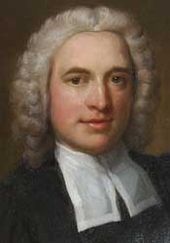
William CowperThere is a fountain filled with blood drawn from Emmanuel’s veins;
And sinners plunged beneath that flood lose all their guilty stains.
Lose all their guilty stains, lose all their guilty stains;
And sinners plunged beneath that flood lose all their guilty stains.

The dying thief rejoiced to see that fountain in his day;
And there have I, though vile as he, washed all my sins away.
Washed all my sins away, washed all my sins away;
And there have I, though vile as he, washed all my sins away.

Dear dying Lamb, Thy precious blood shall never lose its power
Till all the ransomed church of God be saved, to sin no more.
Be saved, to sin no more, be saved, to sin no more;
Till all the ransomed church of God be saved, to sin no more.

E’er since, by faith, I saw the stream Thy flowing wounds supply,
Redeeming love has been my theme, and shall be till I die.
And shall be till I die, and shall be till I die;
Redeeming love has been my theme, and shall be till I die.

Then in a nobler, sweeter song, I’ll sing Thy power to save,
When this poor lisping, stammering tongue lies silent in the grave.
Lies silent in the grave, lies silent in the grave;
When this poor lisping, stammering tongue lies silent in the grave.

Lord, I believe Thou hast prepared, unworthy though I be,
For me a blood bought free reward, a golden harp for me!
’Tis strung and tuned for endless years, and formed by power divine,
To sound in God the Father’s ears no other name but Thine. —William Cowper

William Shakespeare On Prayer

William ShakespeareSome great lines from William Shakespeare on prayer―

“We do pray for mercy, and that same prayer doth teach us all to render the deeds of mercy.” —William Shakespeare

“Now I am passed all comforts here, but prayers.” —William Shakespeare

“My words fly up, my thoughts remain below; Words without thoughts never to heaven go.” —William Shakespeare

“Sweet are the uses of adversity; which, like the toad, ugly and venomous, wears a precious jewel in his head; and this our life, exempt from public haunt, finds tongues in trees, books in the running brooks, sermons in stones, and good in everything.” —William Shakespeare

“I commend my soul into the hands of God my Creator, believing through the merits of Jesus Christ, my Savior, to be made a partaker of life everlasting.” —William Shakespeare’s opening line in his last will and testament

An Insightful Dozen From Andrew Murray

Andrew MurrayI love the insight of this godly man, and I hope you enjoy these quotes too…

“God, as Creator, formed man to be a vessel in which He could show forth His power and goodness. Man was not to have in himself a fountain of life or strength or happiness. The ever-living and only living One was intended each moment to be the communicator to man of all that he needed.” 

“The blessing of God’s Word is only to be known and enjoyed by obeying it: ‘If you love Me, you will obey what I command’ (John 14:15). Keeping His Word is the only proof of a genuine saving knowledge of God, of not being self-deceived in our faith, of God’s love being experientially known and not merely imagined.”

“The person who reads his Bible with longing and determination to learn and to obey every commandment of God is on the right path to receiving all the blessing the Word is meant to bring.”

“The New Testament standard of Christian commitment is barely realized in the church today. Its whole tone is intensely supernatural. Christian commitment and devotion involves a life totally identified with the life of Christ. It must be a life in the continual presence and under the guidance of the Holy Spirit.”

“Many pray for the Spirit that they may make use of Him and His power for their work. This is an entirely wrong concept. It is He who must use you.”

“Unless we are willing to pay the price, to sacrifice time and attention and seemingly legitimate or necessary tasks for the sake of the spiritual gifts, we need not look for much power from above in our work. God’s call to much prayer need not be a burden or cause for continual self-condemnation. He intends it to be a joyful task. He can make it an inspiration. Through it He can give us strength for all our work and bring blessing to others by His power that works in us.”

“Let our lack of prayer convict us of the coolness in our Christian life that lies at the root of it. God will use the discovery to bring us not only the power to pray that we long for but also the joy of a new and healthy life of which prayer is the spontaneous expression.”

“Our prayers must not be vague appeals to His mercy or indefinite cries for blessing, but the distinct expression of a specific need. It is not that Jesus’ loving heart does not understand our cry or is not ready to hear, but He desires that we be specific for our own good. Prayer that is specific teaches us to better know our own needs.”

“Do you see what holiness is and how it is to be found? It is not something formed in you. It is not something put on you from without. Holiness is the presence of God resting on you. Holiness comes as you consciously abide in that presence, doing all as a sacrifice to Him.”

“The connection between the prayer life and the Spirit life is close and indissoluble. … Learn from our Lord Jesus how impossible it is to walk with God, obtain God’s blessing or leading, or do His work joyously and fruitfully apart from close, unbroken fellowship with the One who is our living fountain of spiritual life and power.”

“His blood is the eternal and undeniable proof that God the Father and Christ will do for you all that is needed, and that they will not forsake you until they have accomplished their work in you from beginning to end.”

“Live your daily life in full consciousness of being righteous in God’s sight, an object of delight and pleasure in Christ. Connect every view you have of Christ in His other graces with this first one: Christ Jesus—our righteousness from God. This will keep you in perfect peace.”

No Plan B

The Old Rugged CrossIn my family, what starts off as Plan A at the beginning of the day is highly likely to end up as Plan K-13 by the end of the day! We just try to be flexible and roll with the changes.

But we must be careful about giving the characteristic of “flexibility” to God—He doesn’t need to be flexible and modify His plans. He has no Plan B; everything is His Plan A.

Jesus is described as being the sacrificial Lamb from before the dawn of Creation (1 Peter 1:18-20). And in Heaven Jesus is still known as the Lamb that was slain (Revelation 13:8 and 5:5-6). Jesus coming to earth to die on an old rugged Cross was always God’s Plan A. The whole time Jesus Christ was on earth, He knew what was happening.

Here are 5 things Jesus knew. He knew…

  1. …when His time had come, and that all things were about to be fulfilled through His crucifixion—John 13:1, 3
  2. …the exact sequence of events leading up to His death on Calvary—Matthew 20:17-19
  3. …the immutability of the Scriptures—Matthew 26:53-56
  4. …the infallibility of the Scriptures—Luke 24:25-27
  5. …that God would be glorified in fulfilling His Plan A—John 12:27-28

With this in mind, here are 5 things we should know. We should know…

  1. …that all my days were written down before the dawn of Creation—Psalm 139:16
  2. …God loves me more than I can fathom—Psalm 139:17
  3. …my life was always intended to be a part of God’s Plan A—Ephesians 2:10
  4. …no weapon formed against God’s Plan A for me will succeed—Isaiah 54:17
  5. …that God will be glorified in fulfilling His Plan A in my life—Romans 8:28

The old rugged Cross reminds us that God’s Plan A was always for Christ’s death to make it possible for our lives to make sense!

As Andrew Murray wrote: “God fully relied on His Son to see to it that His honor was respected. And in Jesus we too may bravely enter this covenant without fear that we will not be able to fulfill it. We can rely upon Jesus to see to it that He will bring everything to completion. Jesus has not only discharged our old debt but also undertaken the responsibility for whatever else may be required.”

I’ll be continuing our series on The Old Rugged Cross this Sunday, and I hope you can join me.

Links & Quotes

link quote

“When the body is about to be led into a sinful action by some fear or craving, we are to take the sword of the Spirit and kill that fear and that craving. In my experience, that means mainly severing the root of sin’s promise by the power of a superior promise. … Having promises at hand that suit the temptation of the hour is one key to successful warfare against sin…. Be constantly adding to your arsenal of promises. But never lose sight of the chosen few that God has blessed in your life. Do both. Be ever-ready with the old. And every morning look for a new one to take with you through the day.” —John Piper

“At the heart of the Hebrew concept of marriage is the notion of covenant—a legally binding agreement with spiritual and emotional ramification (Proverbs 2:17). God serves as a witness to the marriage covenant, blessing its faithfulness but hating its betrayal (Malachi 2:14-16). The Lord’s intimate involvement renders this legal commitment a spiritual union, ‘so they are no longer two, but one’ (Matthew 19:6). The purpose of marriage as articulated in the Bible is to find true companionship (Genesis 2:18; Proverbs 18: 22), produce godly offspring (Malachi 2:15; 1 Corinthians 7:14) and fulfill God’s calling upon an individual’s life (Genesis 1:28). … Marriage binds husband and wife together into an entity greater than either partner as an individual, and it does so in order to assure continuity of the family lineage.” —Archeological Study Bible

“To educate a man in mind and not in morals is to educate a menace to society.” —Theodore Roosevelt

Eric Metaxas, in his commentary A Murderous Mother, tells how the environmentalists have gotten off track, and how Christians are really the only one who can help us.

“In our esteem, the joys of earth are little better than husks for swine compared with Jesus the Heavenly Manna. I would rather have one mouthful of Christ’s love, and a sip of His fellowship, than a whole world full of carnal delights. What is the chaff to the wheat? What is the sparkling paste to the true diamond? What is a dream to the glorious reality?” —Charles Spurgeon

I really like this post—Is There A Spiritual Side To Sex?

Abortion, Inc. documents the $500 million Planned Parenthood gets in your tax dollars to keep killing innocent children.

Links & Quotes

link quote

“That is the religion of ninety-nine English people out of every hundred who know nothing of divine grace—we are to be as good as we can; we are to go to church or to chapel, and do all that we can, and then Jesus Christ died for us, and we shall be saved. Whereas the gospel is, that He did not do anything at all for people who think they can rely on themselves, but gave Himself for lost and ruined ones. He did not come into the world to save self-righteous people; on their own showing, they do not want to be saved.” —Charles Spurgeon

Twitter stands up to ISIS. About time!

bu-030415-1Interesting research results from The Barna Group in What Millennials Want When They Visit Church.

“The engagement of God’s power never takes the place of the engagement of our will! The power of God in sanctification never makes us passive! The power of God engages itself beneath or behind and within our will, not in place of our will. … God will never appear with power in your will in any other form than a good resolve that you make and keep.” —John Piper

“Jesus is Amen as to His righteousness. That sacred robe shall remain most fair and glorious when nature shall decay. He is Amen in every single title which He bears; your Husband, never seeking a divorce; your Head, the neck never being dislocated; your Friend, sticking closer than a brother; your Shepherd, with you in death’s dark vale; your Help and your Deliverer; your Castle and your High Tower; the Horn of your Strength, your confidence, your joy, your all in all, and Amen in all.” —Charles Spurgeon

Read this in my Archeological Study Bible and thought this rang true for our generation still today: “This generation was not guilty of the gross idolatry of its forefathers. Rather, these Israelites had embraced a kind of dead orthodoxy, in which they tried to get by with the minimum that their faith required.”

The Old Rugged Cross

The Old Rugged CrossThe Apostle Paul traveled the known world preaching and teaching. Luke preserves some of his sermons for us in the Book of Acts, and Paul’s letters reveal the depth of and breadth of his Spirit-inspired thoughts. But of all the doctrines which this eminent apostle taught, there was one truth that stood out as the foundation for all others—

And when I came to you, brethren, I did not come with superiority of speech or of wisdom, proclaiming to you the testimony of God. For I determined to know nothing among you except Jesus Christ, and Him crucified (1 Corinthians 2:1-2).

The work that Jesus Christ did on an old rugged Cross is absolutely the most central message of all others. Without the Cross, no other doctrine makes sense.

Sadly, we spend far too little time looking at the Cross.

Join me this Sunday as we take a long look at the Cross and the Lamb of God Who was sacrificed on it. Our series is simply called The Old Rugged Cross.

Charles Spurgeon On Humility

C.H. Spurgeon“How careful should we be when we do anything for God, and God is pleased to accept of our doings, that we never congratulate ourselves. The minister of Christ should unrobe himself of every rag of praise. ‘You preached well,’ said a friend to John Bunyan one morning. ‘You are too late,’ said honest John, ‘the devil told me that before I left the pulpit.’ The devil often tells God’s servants a great many things which they should be sorry to hear. Why, you can hardly be useful in a Sunday School but he will say to you ‘How well you have done it!’ You can scarcely resist a temptation, or set a good example, but he will be whispering to you ‘What an excellent person you must be!’ It is, perhaps, one of the hardest struggles of the Christian life to learn this sentence—‘Not unto us, O Lord, not unto us, but unto Thy name give glory.’ Now God is so jealous on this point that, while He will forgive His own servants a thousand things, this is an offense for which He is sure to chasten us. Let a believer once say, ‘I am,’ and God will soon make him say ‘I am not.’ Let a Christian begin to boast, ‘I can do all things,’ without adding ‘through Christ which strengtheneth me,’ and before long he will have to groan, ‘I can do nothing,’ and bemoan himself. Many sins of true Christians, I do not doubt, have been the result of their glorifying themselves. Many a man has been permitted by God to stain a noble character and to ruin an admirable reputation, because the character and the reputation had come to be the man’s own, instead of being laid, as all our crowns must be laid, at the feet of Christ.” —Charles Spurgeon

What God Is Building

Relativity by M.C. EscherI love the drawings of M.C. Escher. But some of his sketches are clearly optical illusions we all know couldn’t work in the real world. We don’t have to be architects or engineers or builders to know that for a building to be functional it has to have (1) a solid foundation, (2) it must be built with quality materials, and (3) it must be constructed by someone who knows what he/she is doing.

The Apostle Paul tells us that (1) Jesus Christ is the cornerstone of the sure foundation, (2) you and I—God’s saints—are the quality building materials that are being used, and (3) the Holy Spirit knows exactly what He is doing as He joins us together.

A cornerstone is the first stone set in the construction, the reference point for all other stone, which determines the position of the entire structure. Christ Jesus Himself is the cornerstone of His Church (Ephesians 2:20b). Orientated to that cornerstone we have the foundation of the apostles and prophets (2:20a).

This foundation is the Word of God (2 Peter 1:19-2:3 and 2 Timothy 3:14-4:5). We dare not try to replace, nullify, update, or change His Word. Not would this cause the foundation to crumble, but there are dire consequences for the one who tries to do so (Revelation 22:18-19).

Our foundationOn this foundation, God is constructing three things, each one growing in its level of intimacy with Him and with the surrounding saints:

  • God’s household (Ephesians 2:19)—this Greek word means a family home.
  • the whole building (Ephesians 2:21a)—this is a specific part of the family home used for prayer and fellowship.
  • a holy temple (Ephesians 2:21b)—this is the same word used for the Holy Place and Holy of Holies in the tabernacle.

God’s Presence dwells in us individually, but collectively we make a more powerful statement (1 Corinthians 3:16). There is a far greater testimony to the world when individuals willingly and actively allow themselves to be built together; when Christians give up their personal agendas to say, “I want to be a part of something bigger than me—I want to be a part of we.”

We must study God’s Word to make sure we are building on the same foundation. We must allow our lives to be quality building materials. We must allow the Holy Spirit to build us together through prayer and fellowship! This becomes the fulfillment of the prayer Jesus Himself prayed for us (John 17:20-23).

This was the last message (for this time) in our series on the Book of Ephesians. I hope to be able to continue this study next year.

9 More Quotes From “The Blood Of The Cross”

The Blood Of The CrossThere were way too many quotes from The Blood Of The Cross by Horatius Bonar that I wanted to share, so here is the second installment. You can read the first set of quotes by clicking here, and you can read my review of this must-read book by clicking here.

“It is not my looking to the blood in conjunction with my looking to my own act of seeing that brings this peace. It is my simple and direct looking to the blood. It is in looking that I am blessed; not in thinking about my looking. To look to the blood is to be cleansed; to look away from the blood, or too self, or to the world, or to sin, is to arrest the cleansing process and to neutralize the healing power. The more I see of the matchless value of that blood, and understand the substitution of life for life, which that blood proclaims, and to which it is ever pointing, the more will my peace be like a river.”

“The Lamb has been slain, the Lamb of God, as it is written, ‘It pleased the Lord to bruise Him’ (Isaiah 53:10). His blood has been shed, and sprinkled, and accepted; and that shed blood is for the remission of sin, and for reconciling us to God. That blood is intended to set us in the place of the innocent; to bring us nigh to God just as if we had never separated; to be our recommendation to God, so that coming with it as our plea, we may expect to be treated by God as HE is treated Whose blood we thus recognize and rest on.”

“To come with anything else than the blood as our introduction is most certainly to secure or for ourselves rejection; but to come with it alone is to ensure that blessed welcome which the blood has never yet failed to obtain for the vilest sinner that ever went to God with it as his only plea.”

“That blood is valuable enough to answer for yours, and God is willing to accept the exchange. Nay, it was He Who first proposed it; it is He Who is pressing this exchange upon your notice and entreating you to receive it, so that there maybe nothing left for you to pay.”

“It loses none of its efficacy by time or repetition. It is the same in this age as when it was shed at first. It is the same today as when first we applied to it for healing and for cleansing. Nothing can rob it of its potency. It has cleansed millions; it can cleanse millions more; it has washed out stains, in number past calculation, in dye most thoroughly crimson. Yet it is unpolluted. It has taken on no stain. It is still as able to pacify the conscience and to release the soul from guilt.”

“Realizing these things, the saint moves on his joyful course. The blood is ALL to him. It is his peace; it is his medicine; it is his daily comforter. And resting in it he rejoices in hope hope of the glory to be revealed.”

“Thou hast gone near enough to the gates of hell; yet go not in. Turn back. It is not yet too late. Even thou mayest be saved. The gate of light stands as widely open as the gate of darkness. The way of life, the narrow way, is as free to thee as is the way of death. There is still forgiveness. And the glad tidings of it are as glad as ever. No sin of thine has altered that gladness or made the tidings a forbidden joy to thee. We can tell you as truly as ever that ‘these things are written that thou mightest believe that Jesus is the Christ, and that believing thou mayest have life through His name’ (John 20:31).”

“That nonconductor is unbelief. It interposes between the soul and all heavenly blessing, all divine intercourse. It may seem a thing too slight to effect so great result; yet it does so inevitably. It shuts off the communication with the source of all glad tidings. It isolates man, and forbids the approach of blessing. That conductor is faith. In itself it is nothing, but in its connection everything. It restores in a moment the broken communication; and this, not from any virtue in itself, but simply as the conducting link between the soul and the fountain of all blessing above.”

“In Jesus there is salvation—salvation without a price—salvation for the most totally and thoroughly lost that this fallen earth contains. Go and receive it.”