Thursdays With Spurgeon—The Plan Of The Cross

This is a weekly series with things I’m reading and pondering from Charles Spurgeon. You can read the original seed thought here, or type “Thursdays With Spurgeon” in the search box to read more entries.

The Plan Of The Cross

What we have received is not the spirit of the world, but the Spirit who is from God, so that we may understand what God has freely given us. (1 Corinthians 2:12) 

     The course of our fallen race has been a succession of failures. Whenever there has been an apparent rise, it has been followed by a real fall. Into ever-increasing darkness the human mind seems resolved to plunge itself in its struggles after a false light. When men have been fools, they have danced in a delirium of sin. When they have been sober, they have given themselves up to a phantom wisdom of their own that has revealed their folly more than ever. It is a sad story, the story of mankind! Read it in the light of God’s Word and it will bring tears from your very heart.

     The only hope for man was that God should interpose. And He has interposed, as though He began a new creation or worked a resurrection out of the kingdom of death. God has come into human history and here the bright lights begin. … See yonder avalanche rushing down the steep mountainside? Such is humanity left to itself. Lo, God in Christ Jesus throws Himself in the way. He so interposes as to be crushed beneath the descending rocks. But beloved, He rises from the dreadful burial. He stops the avalanche in its terrible path. He hurls back the tremendous mass and changes the whole aspect of history. … 

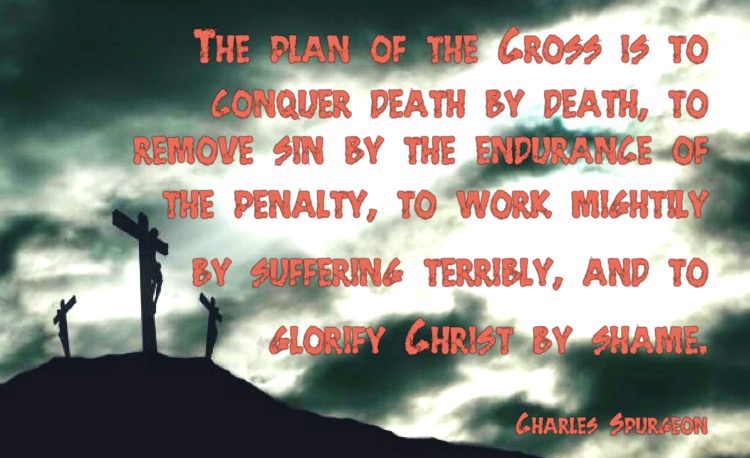
     The plan of the Cross is to conquer death by death, to remove sin by the endurance of the penalty, to work mightily by suffering terribly, and to glorify Christ by shame.

From Grace For Grace

This sermon reminds me of the poignant words from Isaac Watts—

When I survey the wondrous Cross 
On which the Prince of Glory died, 
My richest gain I count but loss, 
And pour contempt on all my pride. 
Forbid it, Lord, that I should boast, 
Save in the death of Christ my God! 
All the vain things that charm me most, 
I sacrifice them to His blood.
 

All of man’s attempts to control his universe, or determine his fate, or even make himself acceptable to God have been an abysmal failure. So God Himself stepped in, but He came in a way that no one could have imagined and no one could claim as their idea. The prophet Isaiah said it this way, “The Lord looked and was displeased that there was no justice. He saw that there was no one, He was appalled that there was no one to intervene; so His own arm achieved salvation for Him, and His own righteousness sustained Him” (Isaiah 59:15-16). 

It is by grace alone, through faith alone, in Christ alone that we have hope of our salvation. And for that we give all glory to God alone. Sola Deo gloria!


Fear’s Invitation

Have you ever had a really good scare? Maybe in the dark or when you were young? Then in the light or as you got older you thought, “Why was I afraid of that?” Our relief came from the fact that we think we know more. But here’s the problem: there is a difference between a healthy fear and an unhealthy fear, so not every fear is something we should try to alleviate.

Sometimes we treat too lightly the things that are really quite powerful. Consider the arrival of Jesus in Bethlehem. There are more angels sent by God surrounding this one event than anywhere else in all the Bible. Yet all four angelic appearances have the same message: “Do not be afraid.” 

Why would people fear what we now celebrate as such a joyous event? I think it’s because God Himself—the All-Holy Creator of the Universe—is coming near to sinful man (see John 1:9; 1 Timothy 6:15-16). 

God is holy, and His holiness is unapproachable by sin. At the exact same moment, God is love, and His love desires for us to approach Him. We cannot make this happen on our own, which leads to more fear. 

Thankfully for us, God Himself has provided the way for sinful man to approach His awesome, unapproachable holiness!  

In the Greek language of the New Testament phobeō is the main word for “fear.” This word can be defined as either fleeing from a terrible thing or clinging in obedience to an awesomely reverent thing. Jesus said the same things when He told us, “I tell you, my friends, do not be afraid of those who kill the body and after that can do no more. But I will show you whom you should fear: Fear Him who, after your body has been killed, has authority to throw you into hell. Yes, I tell you, fear Him” (Luke 12:4-5). 

In the Advent story, the first appearance of “Do not be afraid” is when an angel appears to Zechariah. Why would Zechariah be so afraid at the approach of God? I think there may have been three reasons: 

  • Herod was king—making the society Zechariah lived in politicized and irreligious 
  • Zechariah was without a priestly heir to carry on his family name 
  • his wife Elizabeth may have sinned—at least that’s what people would have whispered about her barrenness 

All of this added up to Zechariah feeling like God was displeased with them and that He was only coming close to bring fiery judgment. 

The angel told Zechariah not to fear because “your prayer has been heard.” In other words, “I am inviting you to trust in what God HAS already done versus trusting in what you might or might not be able to do on your own.” Phobeō was an invitation to choose reverential obedience (holy fear) of the eternal over the terror of the temporal. 

Sadly, Zechariah initially clung to the negative phobeō. Yet after Elizabeth did conceive and John was born, this was transformed into holy, reverential fear, as heard in the Spirit-inspired song he sang. Notice in Luke 1:67-75 Zechariah’s emphasis on all that God has done: He has come, He has redeemed, He has raised, He said, He has kept His covenant, He has rescued, He has enabled.  

Have you put yourself in the category of “unworthy of God’s favor”? Has fear crippled you—like it had done with Zechariah—from continuing to pray, believe, and try? 

Fear is an invitation to evaluate in who or in what I have placed my trust.

I invite you to accept the invitation to take your eyes off the temporary and put them on the Eternal One. “…The time is coming quickly, and what I show you will come true. It may seem slow in coming, but wait for it; it will certainly take place, and it will not be delayed. (Habakkuk 2:3 GNT) 

Check out the other messages in this Do Not Be Afraid series by clicking here. 

Thursdays With Spurgeon—Honey In My Mouth

This is a weekly series with things I’m reading and pondering from Charles Spurgeon. You can read the original seed thought here, or type “Thursdays With Spurgeon” in the search box to read more entries.

Honey In My Mouth

He will glorify Me, for He will take of what is Mine and declare it to you. All things that the Father has are Mine. Therefore I said that He will take of Mine and declare it to you. (John 16:14-15) 

     So we actually receive, through Jesus Christ, by the Spirit, what is in the Father!  

     Ralph Erskine, in the preface to a sermon upon the fifteenth verse, has a notable piece. He speaks of grace as honey for the cheering of the saints, for the sweetening of their mouths and hearts. But he says that in the Father, ‘The honey is in the flower….’ In the Son, ‘the honey is in the comb…. But then we have honey in the mouth. That is the Spirit taking all things and making application of them, by showing them to us and making us to eat and drink with Christ and share of these things….

From Honey In My Mouth

My grandfather had honeybees on his farm and I was fascinated by them. So much so that in my ecology class in college, I wrote my final research paper on the fascinating inner workings of the honeybee hive. My grandfather would often plant various crops so that the nectar from those flowers would give a distinct flavor to the honey. 

The nectar of a flower has everything in it to make honey except for one thing: a honeybee’s care. The nectar has to be transported back to the hive where it then undergoes the process of being transformed into honey—precise temperatures, storage, and evaporation processes are perfectly overseen by the bees until edible honey emerges. 

Ralph Erskine’s analogy of this nectar-to-honey process is very apropos to the things of God. Our Heavenly Father said that His thoughts are higher than our thoughts: they are inaccessible by our finite human minds (Isaiah 55:8-9). Jesus came as the revelation of all of the things of the Father, declaring to us all that God has for us. Jesus added, “I still have many things to say to you, but you cannot bear them now” (John 16:12), which is why the Holy Spirit illuminates the inspired Word of God.

Do you see the whole Trinity active in this process? The Father creates, the Son reveals, and the Spirit makes accessible (or, if you will, the Spirit makes edible). 

The Holy Spirit not only makes the things of God edible to us, but He gives us new tastebuds. No longer will the things of the world satisfy our tastes, no longer will we find any satisfaction in them, no longer will those earthly things nourish us. What the Father has created, and the Son has revealed, the Spirit will make real—and delicious!—to us.


Thursdays With Spurgeon—Poetic Groans

This is a weekly series with things I’m reading and pondering from Charles Spurgeon. You can read the original seed thought here, or type “Thursdays With Spurgeon” in the search box to read more entries.

Our Prayer Helper 

Likewise the Spirit also helps in our weaknesses. For we do not know what we should pray for as we ought, but the Spirit Himself makes intercession for us with groanings which cannot be uttered. (Romans 8:26) 

     A man’s heart is moved when he groans. A groan is a matter about which there is no hypocrisy. A groan comes not from the lips, but from the heart. A groan, then, is a part of prayer that we owe to the Holy Spirit, and the same is true of all the prayer that wells up from the deep fountains of our inner life. [see also Jeremiah 4:19; Isaiah 38:14; Psalm 77:4, 38:8-9] … 

     That which is thrown up from the depths of the soul, when it is stirred with a terrible tempest, is more precious than pearl or coral, for it is the intercession of the Holy Spirit! … 

     Beloved, what a different view of prayer God has from that which men think to be the correct one! You may have seen very beautiful prayers in print and you may have heard very charming compositions from the pulpit, but I trust you have not fallen in love with them. Judge these things rightly. I pray you never think well of fine prayers, for before the thrice-holy God it ill becomes a sinful supplicant to play the orator! … The tail feathers of pride should be pulled out of our prayers, for they need only the wing feathers of faith. The peacock feathers of poetical expression are out of place before the throne of God. … God looks at the heart. To Him fine language is as sounding brass or a tinkling cymbal, while a groan has music in it! 

From The Holy Spirit’s Intercession

God is not looking for well-polished prayers; He’s looking for real prayers. Let’s be honest: Not even the most educated person in the world has a vocabulary sufficient enough to accurately communicate with The Almighty God! 

Our Heavenly Father wants us to come to Him in simple, childlike anticipation. Notice I didn’t say childish anticipation—there is a huge difference. What Paul is telling us in Romans 8 is that the Holy Spirit can make the most eloquent, childlike, sincere prayer out of our deepest longings in our hearts. 

Jesus reminded us, “Your Father knows the things you have need of before you ask Him” (Matthew 6:8). Our Father wants to answer our prayers, and He has given us His Holy Spirit to help us pray in a way that He can answer. 

Don’t try to spruce up your vocabulary before you come to God in prayer. Just come to God in prayer, trusting that the Holy Spirit will make a beautiful prayer even out of your childlike groanings! The Holy Spirit turns our groans into prayerful poetry in our Heavenly Father’s ears!

Our Most Effective Shield And (S)word

…with Your mouth You have promised and with Your hand You have fulfilled it… (2 Chronicles 6:15). 

I rest solely on what God says—He says it and He fulfills it. 

I can live on “every Word” He speaks (Deuteronomy 8:3).

“Every Word” of God is flawless and is a protection for me (Proverbs 30:5).

None of God’s Word ever fail (Isaiah 55:11).

God gives us His Word to speak (Jeremiah 26:12; John 12:49; Luke 21:15).

We defeat our enemies by God’s Word in our mouth (Matthew 4:4, 7, 10; Revelation 12:11).

Every Word of God gives life because of the Holy Spirit’s anointing on it (John 6:63).

Every Word of God is a sword (Hebrews 4:12; Revelation 1:16; 2:12, 16; 19:15). Or as my friend Sasha reminds me God’s Word is our S(word)! 

There isn’t a more effective shield against enemies, there isn’t a more deadly weapon against temptation, there isn’t a more sure foundation in storms than the Word spoken and fulfilled by God! 

[check out all of the above passages for yourself by clicking here] 

Leadership Cycle

But a good leader plans to do good, and those good things make him a good leader. (Isaiah 32:8 NCV) 

A recognized good leader → Plans good things → Does good things → which makes that leader more recognizable, and on and on it goes. 

A good leader has to make good plans and has to followthrough on those good plans in a good way. The leader may have started off with just the title of “leader” but the good followthrough on good plans will help that leader be recognized by others as a good leader. 

That recognition of a leader by his/her teammates makes it that much easier the next time to make the good plans and then followthrough on them. 

This is a virtuous cycle that pays dividends for everyone involved!

Check out another virtuous leadership cycle I shared here. This is a part of my ongoing godly leadership series of blog posts.

The Role Of Prophecy

Micah may be classified as a minor prophet, but the prophecies in his book are fulfilled in a major way in as little as 20 years and as far out as 2700+ years! 

Here’s a question for us to consider: What exactly is the role of prophecy in the life of a Christian? 

Micah introduces himself in the opening verse. He was ministering in the country while Isaiah was in the city of Jerusalem at the same time. Micah’s ministry spans three kings of Judah in the south, and he overlaps the defeat of Israel in the north.  

Check out some of Micah’s most notable prophecies: 

  1. Judgment is coming to Samaria/Israel (1:6-7). This was fulfilled about 20 years later when the Assyrians defeated Samaria and took the Israelites into exile. 
  2. Judgment is coming on southern Judah (1:9-16). This was fulfilled about 30 years later when Sennacherib attacked Philistia and southern Judah, coming “even to the gate of Jerusalem” (v. 12). At the gate of Jerusalem was the miraculous deliverance God gave during Hezekiah’s reign (see 2 Kings 18-19; Isaiah 37). 
  3. Judgment is coming on Jerusalem (3:12). Micah even prophesied the Babylonians would defeat them (4:10). This is noteworthy because Assyria was the dominant world power at this time; it would be another 100 years before Babylon would even begin to rise to power. This prophecy was fulfilled about 160 years later, and this prophecy actually saved Jeremiah’s life around that same time (Jeremiah 26:7-19). 
  4. The Messiah will be born in Bethlehem (5:2). This prophecy was fulfilled about 700 years later when Jesus was born (Matthew 2:5-6). 
  5. How people will respond to the Messiah’s Advent (7:4-6). This prophecy was partially fulfilled 700 years later in a direct quotation from Jesus (Matthew 10:34-36). 
  6. The coming of the final Kingdom of God (4:1-3). This prophecy will be fulfilled at Christ’s second Advent. 

[you can read all of these prophecies yourself by clicking here

So what is the role of prophecy? 

First of all, fulfilled prophecy reminds us that God is sovereignly in control of everything (Isaiah 46:10). But right on the heels of that, fulfilled prophecy reminds us that there is still more prophecy left to be fulfilled (2 Peter 1:20-2:3). 

The Bible tells me that when I sin, God’s first response is not anger toward me but broken-hearted grief. In a similar fashion, the prophecies of coming judgment on sinners are intended to show us the incredible mercy of God in the forgiveness of sin that He made available (Micah 7:18-20). 

Prophecy is never, never to be used as a club to beat people into submission to God. When Micah prophesied the destruction of Israel and Judah, he wept (Micah 1:8). 

So did Jesus (Matthew 23:37). 

And so should we! 

We live in an age today—as Micah experienced and as the apostle Peter said would be coming—where people won’t want to hear the news that unforgiven sin brings God’s judgment. Our response to this should be brokenhearted grief, tears, and a steadfast commitment to speak the truth in love that Jesus has provided the only means to be rescued from that judgment. 

If you’ve missed any of the other posts in this series on the major lessons from the minor prophets, you can access the full list by clicking here.
Assyrian Kings Involved With Israel

A helpful Bible study tool—

Assyrian Kings Involved With Israel

  • Shalmaneser III (858-824 BC)—2 Kings 17:3-4
  • Adad-Nirari III (810-782 BC)—took tribute from Israel; king during Jonah’s visit (Jonah 3) 
  • Tiglath-Pileser III (745-727 BC)—deported most of the northern part of Israel 
  • Shalmaneser V (727-722 BC)—besieged Samaria (2 Kings 18:9) 
  • Sargon II (721-705 BC)—deported the rest of Israel (Isaiah 20) 
  • Sennacherib (704-681 BC)—invaded Judah (Isaiah 36) 
  • Esar-Haddon (681-669 BC)—very powerful king 
  • Ashurbanipal (668-626 BC)—most powerful and brutal Assyrian king 

Two weak kings followed (626-607 BC), and Assyria fell in 605 BC. 

Source: Halley’s Study Bible 

You may also want to check out my chart of the kings and prophets of the divided kingdom of Judah and Israel.

Knowing God’s Will

My dear friends Josh and Judy are moving. They feel like God has been calling them to Nebraska, and I affirm that God is directing them into this new chapter for their lives. I will miss them dearly, but I know God has indeed called them. 

During times like this many people will often ask, “How do I know that God is directing me?” 

In the Bible we see God speaking to people in several ways: 

  • An audible voice 
  • Through His prophets 
  • Sending an angel 
  • In a dream or vision 
  • One time God’s finger wrote a message on a wall
  • One time God spoke through a donkey 

But most often God speaks through the inner voice of the Holy Spirit.

The Holy Spirit is a Person. He is described as having a mind, a will, and emotions. Although He doesn’t have a physical body, He is still a Person. Just like any person you could get to know, you can get to know the Holy Spirit more and more personally, becoming increasingly more acquainted with His voice. 

All of us are unique individuals. God has never, ever duplicated a person. Your combination of genes, talents, personality, and personal experiences make you a one-of-a-kind in all of human history. That means that God speaks uniquely to each of us. 

Even though the exact manner God will speak to us will be unique, there are some clear principles that we can know from the Bible. 

1. Humbly listen for God’s voice.

Solomon wrote, “Trust in the Lord with all your heart and lean not on your own understanding; in all your ways acknowledge Him, and He will make your paths straight” (Proverbs 3:5-6). Let me unpack three key phrases:

  • lean not on your own understanding really means humbly exchanging an “I know best” posture for a “God, You know best” posture. 
  • acknowledge Him is the Hebrew word yada. This word means knowledge that comes from personal experience. This is where you act on something you think the Holy Spirit is saying to you and then evaluate it. It’s how you get to know the Person of the Holy Spirit better and better. 
  • He will make straight your paths might be better stated, “He will make your paths agreeable to His will.” In other words, you begin to feel in-sync with the Holy Spirit. The opposite of this would be grieving the Holy Spirit, where you feel out-of-step with God. 

2. Consult with godly friends. 

In Acts 16, the apostle Paul and his companions are attempting to go into new territories to share the good news about Jesus but Luke records twice that the Holy Spirit wouldn’t allow them. Perhaps they felt out-of-sync with the Spirit when they attempted to make their plans. Ultimately, God did open a door for them to move forward and Luke writes, “Concluding that God had called us.” Notice that word “us.” Paul shared his heart with his godly friends and they affirmed God’s voice, much as I affirmed the call on Josh and Judy’s lives in their move. 

3. Don’t be overly concerned about making a mistake. 

In Romans 8, Paul reminds us that God is working all things together for your good and for His glory. “All things” means even your mistakes—like not noticing that the Spirit was prompting you to move, or perhaps temporarily heading down a wrong path. The Holy Spirit can help you look back and see how these experiences have prepared you for your present moment. Even those missteps can be used for God’s glory. But most importantly, those missteps have never diminished God’s love for you! 

Your journey will be unique from everyone else’s journey, but these three principles are applicable to everyone who wants to walk in the paths God has set for them. 

He Who Laughs Last

Traced back to a play in the early 1600s, it still rings true: “He who laughs last, laughs best. 

The distraught father named Jairus hurriedly left his home. He was looking for this Man named Jesus. People said Jesus could perform miracles, and Jairus needed one. 

He found Jesus and quickly explained that his 12-year-old daughter was dying. They had tried everything they knew to do, but she kept inching closer and closer to death’s door. Jesus readily agreed to go with Jairus to his home. 

Along the way, Jesus was interrupted by another woman in desperate need, and He stopped to heal her. As Jairus was (im)patiently waiting for Jesus to continue on the journey, one of his servants ran up to Jairus with the sad news, “Your daughter is dead.” 

Jesus looked at this heartbroken father and simply said, “Don’t be afraid. Just believe, and your daughter will be well.” 

Jairus took Jesus at His word and continued walking with Jesus to his home. 

While Jairus was gone, family members and friends had shown up to mourn the death of this sweet girl. They were wailing loudly, but the clear voice of Jesus could be heard even over their woeful cries: “Stop crying. She is not dead, only asleep.” 

There was a pause, and then there was a totally unexpected and out-of-place response: laughter. 

Not joy-filled laughter, but mocking, derisive laughter at the utter foolishness of the words of Jesus. 

“What do you mean, ‘She isn’t dead’” they yelled. “We’ve been in her room. We’ve seen the cold, lifeless body! She is absolutely, undeniably dead!” And they continued to laugh at the sheer ridiculousness of what Jesus had pronounced. Many of the laughs probably turned to jeers as they began to mock His foolish, insensitive statement. The historian Luke wrote, “They knew the girl was dead.” 

Jesus took the grieving yet believing parents into the girl’s room, He took her lifeless hand in His hand, and simply said, “Little girl, get up.” 

And she did. Fully alive! 

Let me ask you something: Who was laughing now?! 

I’m sure the uncontainable joy of these parents burst out into laughter. And I think Jesus shared in the joyful laughter as well. 

“He who laughs last, laughs best.” 

Friend, what do you “know” right now? What’s gone wrong that cannot be fixed? What terminal diagnosis have the doctors given? What is approaching death’s door? What has already died? 

Listen again to the words of Jesus: “Don’t be afraid. Just believe.” 

Jesus gets the final word. Jesus gets the final laugh. Jesus will make all things new! 

The Sovereign Lord will wipe away the tears from all faces; He will remove His people’s disgrace from all the earth. (Isaiah 25:8) 

He will wipe every tear from their eyes. There will be no more death or mourning or crying or pain, for the old order of things has passed away. He who was seated on the throne said, “I am making everything new!” (Revelation 21:4-5) 

Don’t be afraid. Just believe. 

Jesus has secured the last—and best—laugh for both you and Himself! A laughter that will reverberate through all of eternity!