Listen to the podcast of this post by clicking on the player below, and you can also subscribe on Apple, Spotify, or Audible.
In the day when I cried out, You answered me, and made me bold with strength in my soul. (Psalm 138:3 NKJV)
Prayer requires stick-to-it-iveness, which means it takes strength to pray.
Therefore, being physically or emotionally drained makes it challenging to be alert and attentive in prayer. When we’re tired, our thoughts often drift; it’s hard to stay focused.
Sometimes one of the most helpful things you can do for your spiritual growth is to get a good night’s sleep (or take a nap).
Jesus did this (Matthew 14:22-23). He was very aware of His physical and emotional levels. When He was tired, He took a nap; when He was drained from ministry, He got alone with His Heavenly Father for refreshing (Mark 1:35, Luke 5:16).
Jesus told His disciples to pray so they wouldn’t give in to temptation (Luke 22:40, 45-46). Prayer does strengthen us against the enemy’s attack, but physical and emotional stamina helps us too.
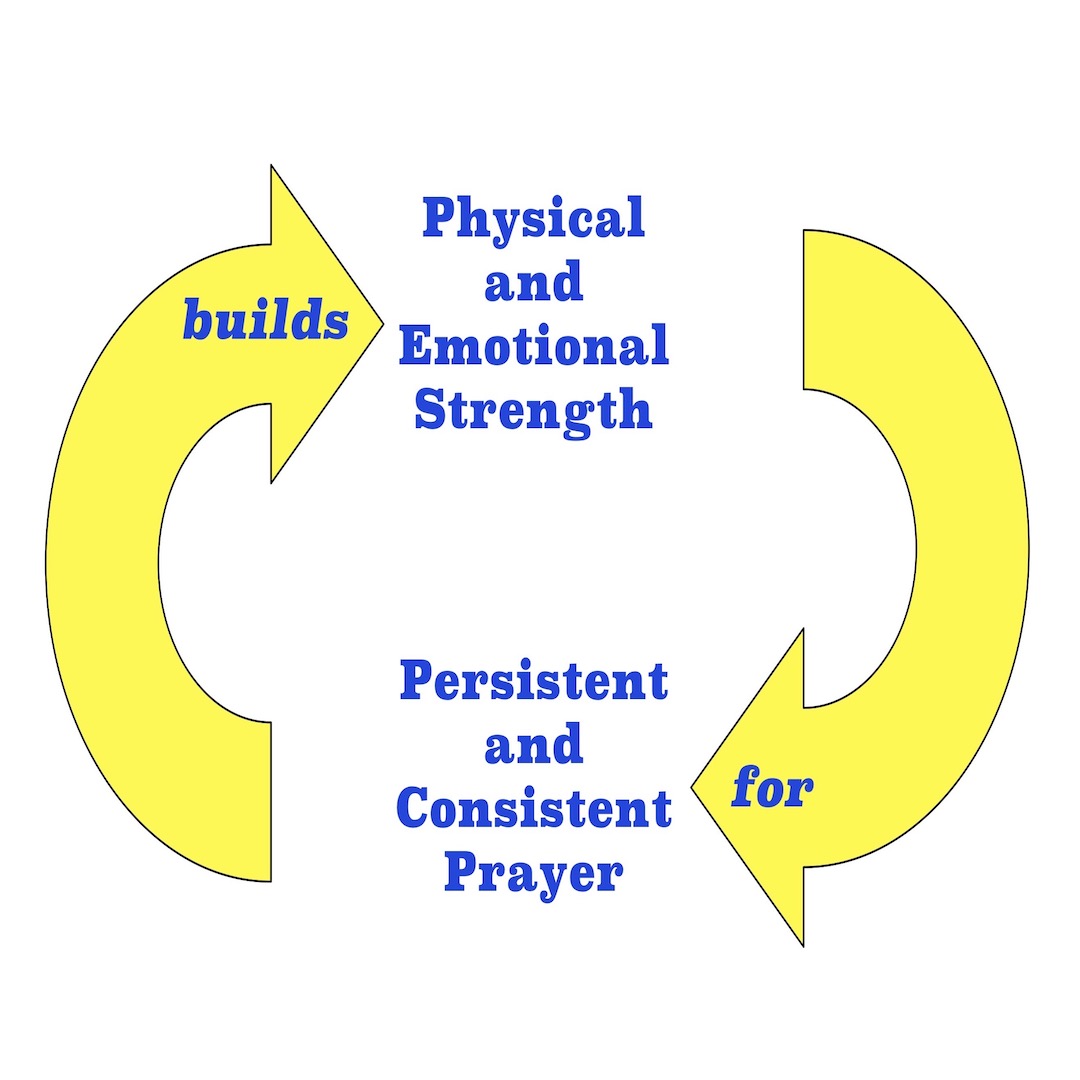
Notice the full cycle—we need physical and emotional strength to pray persistently and consistently, and prayer enhances our physical and emotional reserves to help us pray. So do all three:
When all three components of your being—spirit, body, soul—are alert and healthy, you will find your prayer life fully engaged. If one area becomes depleted, listen to the always-practical counsel of the Holy Spirit. Pray, rest, talk to a friend or a counselor so you can return to the optimal position of strength.
Yes, it takes strength to pray, but in prayer your strength is renewed.
Listen to the podcast of this post by clicking on the player below, and you can also subscribe on Apple, Spotify, or Audible.
You probably know the story of Daniel in the lion’s den, but I want to highlight a couple of really important things, so let me share this story with you from the Amplified Bible.
First of, remember how Daniel distinguished himself above all of the other governmental leaders: “Then this Daniel was distinguished above the presidents and the satraps because an excellent spirit was in him, and the king thought to set him over the whole realm” (Daniel 6:3).
Daniel’s rivals knew that they could never discredit him because of a lack of integrity or his shoddy work ethic. So they concocted a plan that played on King Darius’ pride. They got Darius to sign a law into effect that said no one could pray to anyone except Darius for the next month. Daniel, however, continued to pray to Jehovah three times a day, every single day.
Then they said before the king, “That Daniel, who is one of the exiles from Judah, does not regard or pay any attention to you, O king, or to the decree that you have signed, but makes his petition three times a day.” Then the king, when he heard these words, was much distressed over what he had done and set his mind on Daniel to deliver him; and he labored until the sun went down to rescue him. (Daniel 6:13-14)
Unable to find any loopholes in the law he had signed, Darius had to subject Daniel to the punishment for breaking this law—
Then the king commanded, and Daniel was brought and cast into the den of lions. The king said to Daniel, “May your God, Whom you are serving continually, deliver you!” Then the king went to his palace and passed the night fasting, neither were instruments of music or dancing girls brought before him; and his sleep fled from him. Then the king arose very early in the morning and went in haste to the den of lions. And when he came to the den and to Daniel, he cried out in a voice of anguish.
The king said to Daniel, “O Daniel, servant of the living God, is your God, Whom you serve continually, able to deliver you from the lions?”
Then Daniel said to the king, “O king, live forever! My God has sent His angel and has shut the lions’ mouths so that they have not hurt me, because I was found innocent and blameless before Him; and also before you, O king, as you very well know I have done no harm or wrong.”(Daniel 6:16, 18-22)
Daniel’s lifestyle—not his religion—first got the attention of King Darius, which led to Daniel’s promotion in the kingdom. But over time, Darius began to realize that Daniel’s faith in God is what fashioned Daniel’s lifestyle.
Notice that the Bible doesn’t say Daniel was praying in the lion’s den, but it does say that Darius was fasting while Daniel was in the lion’s den.
Daniel’s lifestyle of prayer prompted Darius to pray!
It is quite likely that Daniel was regularly praying for all the kings of Babylon and Persia because of what God had said through Jeremiah: And seek (inquire for, require, and request) the peace and welfare of the city to which I have caused you to be carried away captive; and pray to the Lord for it, for in the welfare of the city in which you live you will have welfare (Jeremiah 29:7 AMPC).
Darius’ response upon seeing Daniel’s deliverance shows a complete transformation in his attitude: He is now fully persuaded that the God who Daniel serves is the one true God.
Then King Darius wrote to all peoples, nations, and languages in his realm that dwelt in all the earth: “May peace be multiplied to you! I make a decree that in all my royal dominion men must tremble and fear before the God of Daniel, for He is the living God, enduring and steadfast forever, and His kingdom shall not be destroyed and His dominion shall be even to the end of the world. He is a Savior and Deliverer, and He works signs and wonders in the heavens and on the earth—He Who has delivered Daniel from the power of the lions.” (Daniel 6:25-27)
So Daniel didn’t need prayer, but Darius did. Daniel already knew that God would take him through, but Darius had to be convinced. It was the all-night prayer that saved the king.
Perhaps our God-centered, Christ-exalting, prayer-saturated lives may be just the catalyst that leads to the salvation of one of the most unlikely world leaders. So worship God, live with integrity, keep praying for those leaders, and wait in expectation for what God is going to do. Even if God takes you into a dark lion’s den, trust His plan that He is working out to glorify His name “to the end of the world”!
Just remember: Your prayer life may cause an unlikely leader to begin to pray too.
Christian saints have the joyful privilege of being able to step up for fellow saints. It’s hard work at times, but if we remember who those saints really are, it’s never heavy work!
“A people that values its privileges above its principles soon loses both.” —Dwight D. Eisenhower
“[Jesus] draws us to Himself daily, to seek His beauty in Scripture, dwell before the beauty of His glorious face, bask in the beauty of His heavenly throne room, and become, increasingly, His beauty in and to the world. No matter how long we’ve known Him or how careful and earnest our study of Him has been, His fresh beauty remains fresher still.” —T.M. Moore
“Christianity is always out of fashion because it is always sane; and all fashions are mild insanities.” —G.K. Chesterton
Replace the “sandwich method” of feedback with this: (1) Tell the person why you are giving them feedback, (2) Give them the feedback, and (3) End with a belief statement.
Listen to the podcast of this post by clicking on the player below, and you can also subscribe on Apple, Spotify, or Audible.
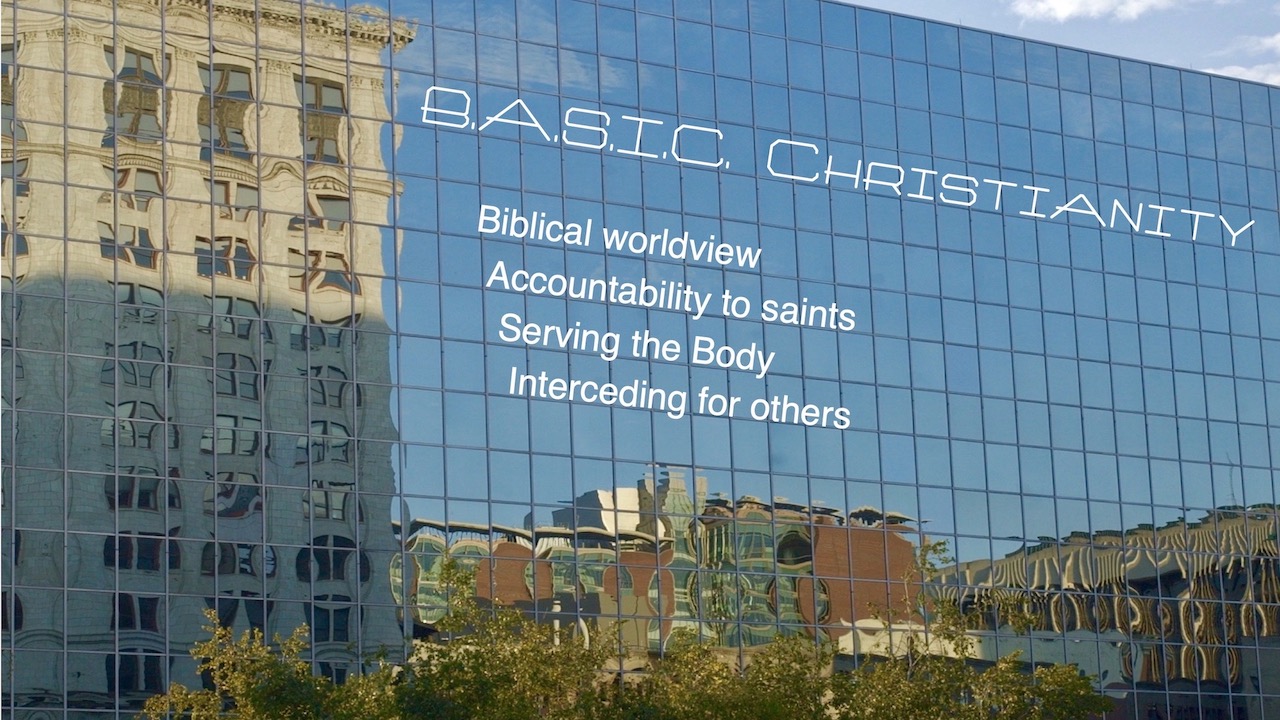
Sanctification (“saint-ification”) is an ongoing process that usually involves the help of other saints. We learn this by having a biblical worldview (that’s the “B”), being accountable with saints (“A”), and serving the Body of Christ (“S”). These are the things that bring out increased fruitfulness in our lives, make us more joy-full people, and enhance our testimony to others.
What a blessing it is to be involved in all of these saint-ification things alongside other brothers and sisters. Isn’t nice to know that you’re not all alone on your journey?
Two brothers walked up the hill to the park every afternoon to play baseball. One day a neighbor who lived near the bottom of the hill saw the younger brother pulling his older brother up the hill in a wagon. He observed this for a couple of days before he finally asked what was going on.
The younger brother said, “My big brother broke his leg so I pull him in the wagon so he can watch us play baseball and can be our coach.”
“He must be heavy,” the neighbor replied.
“He’s not heavy,” the little boy said, “he’s my brother!”
In the first brothers that the Bible shows us, we see the origin of the phrase “brother’s keeper.” Cain was jealous of the way God was blessing his younger brother, and so he murdered Able. God came to Cain and asked him, “Where is your brother Able?”
Cain responded with another question, “Am I my brother’s keeper?” (Genesis 4:9).
The word brother is someone connected to me by blood or some other common bond. Cain used the same word for brother but then asked if He was supposed to be his brother’s keeper—his guard, helping to keep him in bounds, celebrating his victories.
The clear teaching of Scripture is that the answer to Cain’s question is an emphatic “Yes!”
That definition of brother’s keeper sounds a lot like the definition of an intercessor. In the Hebrew, that word mean to go to God on someone else’s behalf (Genesis 25:21; 2 Samuel 24:25). The Greek of the New Testament sounds more intense (hyperentygchano): to meet a person of the purpose of conversation in behalf of someone else.
Remember that the Hebrew word for brother was pretty narrow? The Christians in the New Testament took the word for relative-by-blood (adelphos) and made it a synonym for fellow saint, regardless of where they are from (Acts 9:17; 2 Corinthians 13:11).
John used Cain’s misunderstanding of brother’s keeper to show us the spiritual responsibility we have to our adelphos (1 John 3:12, 15-16).
When we intercede for our adelphos—our fellow saints—we are participating in the same work as both the Spirit and Jesus (Romans 8:26-27, 34;Hebrews 7:25; 1 John 5:16).
A couple of weeks ago we looked at Philemon’s service to the Body of Christ. Look at how Paul’s intercession may have released Philemon to do this (Philemon 7, 16, 20).
As Paul said to Philemon, I say to you—
I appeal to you on the basis of love: Be your brother’s keeper!
Guard your adelphos, keep them in bounds, and celebrate both their righteousness and God’s blessing on their lives.
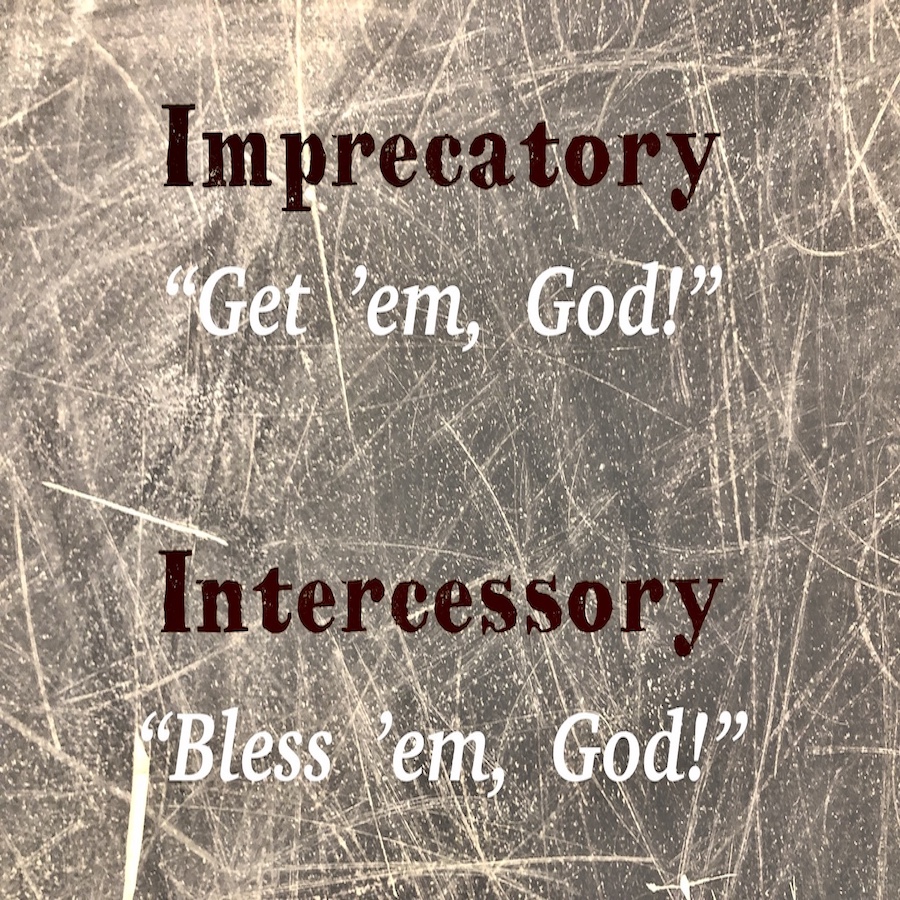
Since both of these prayers are in the Bible, both of them have their place in our healing from the bites we have received from others, but the intercessory prayers are the ones we need to strive to pray.
Listen to the podcast of this post by clicking on the player below, and you can also subscribe on Apple, Spotify, or Audible.
The dictionary defines a rhetorical question this way: A question asked solely to produce an effect or to make an assertion of affirmation or denial. In other words, the question is asked with the assumption that the answer is obvious.
The apostle Paul does this five times in five consecutive verses at the end of Romans 8 (see verses 31-35). These questions are Paul’s way of getting us to reaffirm our rock-solid assurance of just how amazing it is that God holds us so securely.
Even though these are rhetorical questions, I want to add the extra assurance by giving you the answer to each question.
(1) Who can stand against me? No one!
Because Almighty God is for me.
(2) Who can cause God’s blessings to be withheld from me? No one!
Because God didn’t withhold His Son Jesus, He won’t withhold any other lesser blessing either.
Because Jesus intercedes for me and imputes His righteousness to me.
(5) Who can separate me from God’s love? No one!
Not a single thing, person, or circumstance can diminish any part of God’s love for me.
Don’t ever buy into the devil’s lies—not even for a second—that somehow you have put yourself in a place where God’s love for you is questionable. Whenever you hear these lies, return again and again to these five powerful rhetorical questions to reassure your heart, mind, and soul of just how securely you are held in God’s grip of grace.
You and I will learn lessons in the hard times that we could learn no other way. Then God will use those lessons so we can help minister to others in their hard times. Check out my sermon about interceding for other saints.
ICR’s Dr. Randy Guliuzza says, “Convergent evolution is the fabricated conjecture evolutionists invoke to explain very similar characteristics between creatures that could not have been inherited from a common ancestor and that evolutionists will never accept as having been produced by an intelligently designed internal programming that is specified for common purposes.” This particular article is about bats which have always had the ability to fly. Not one fossil record shows any flightless bats because God created them as flying mammals.
In the early 1900s, Albert Norris was a missionary in India, observing firsthand the spiritual and physical hardships the people faced there. In an article in the Pentecostal Evangel, Norris wrote, “A Christianity that coldly sits down, and goes on its routine of formal work, and allows its fellowmen to starve, or to be obliged to go through all the hard sufferings and exposure connected with famine, without effort to help them, might as well quit its preaching.”
In answering a question about using AI to write a sermon, John Piper answers with an emphatic “no.” I agree! One of the reasons Piper shares: “One of the qualifications for being an elder-pastor-preacher in the Bible is the gift or the ability to teach, didaktikos (1 Timothy 3:2). That means you must have the ability, the gift, to read a passage of Scripture, understand the reality it deals with, feel the emotions it is meant to elicit, be able to explain it to others clearly, illustrate and apply it for their edification. That’s a gift you must have. It’s your number-one job. If you don’t have it, you should not be a pastor.”
“You don’t try to forget the mistake, but you don’t dwell on it. Don’t let it have any of your energy, or any of your time, or any of your space.” —Johnny Cash
Listen to the podcast of this post by clicking on the player below, and you can also subscribe on Apple, Spotify, or Audible.
We tend to be pretty self-centered creatures, filtering everything through our lens. This becomes especially true when we are going though a difficult time.
When I walked through a dark valley, I battled both physical and spiritual forces. People attacked me, but so did my own thoughts. “Why me?” and “I didn’t do anything to deserve this!” led to prayers like, “God, why didn’t You protect me from this? Why won’t you get me out of this?”
Do you hear a common theme? I didn’t while I was in the midst of the battle, but perhaps you hear it—“Why me? I didn’t do anything to deserve this! God, why didn’t You protect me from this? Why won’t You get me out of this?”
In his book Winning With People, John Maxwell shared ‘The Big Picture Principle’: “The entire population of the world, with one minor exception, is composed of others.”
On the other side of my dark valley I learned something about my time in the dark valley—I had grown:
I could help others diagnose depression
I could empathize with others
I could share helpful strategies to those who were struggling
I could intercede for them in prayer
My definition for intercede is to pray for people in a meaningful way because they are too beat up to pray for themselves.
In order to pray for them, I have to know what and how to pray. I can’t know what and how to pray unless I have firsthand experience. So perhaps my dark valley wasn’t for me, but for someone else (see Romans 8:28; 2 Corinthians 1:3-11).
I have talked and blogged so many times about the phrases “one another” and “each other” throughout Scripture. That means that Christian faith is best seen when we are with each other, supporting one another.
Jesus taught us to pray, “Our Father” (Matthew 6:9). The “our” signifies we are praying…
…with Jesus—John 14:13-14
…with other saints—Matthew 18:18-20
Even more than praying with us, Jesus intercedes for us (Hebrews 4:15-16). And Jesus gives us the Holy Spirit (John 14:26) who also intercedes for us and with us (Romans 8:26-27).
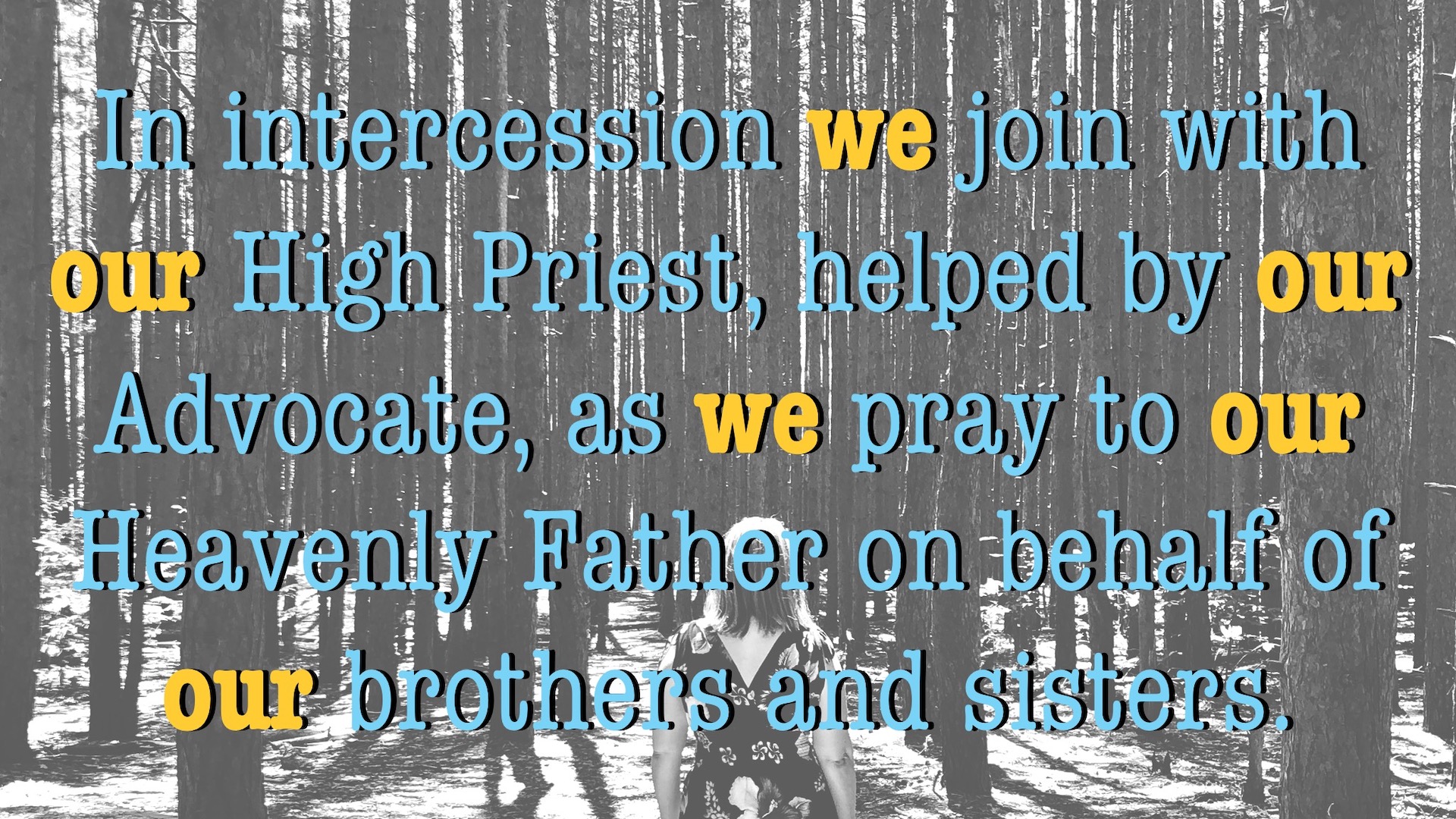
We join with our High Priest, helped by our Advocate, as we pray to our Heavenly Father on behalf of our brothers and sisters.
Listen to the interceding and expectation of a joyful answer that David writes in Psalm 20, and also notice how the saints are together—
May the LORD answer you when you are in distress; may the name of the God of Jacob protect you.May He send you help from the sanctuary and grant you support from Zion.May He remember all your sacrifices and accept your burnt offerings.May He give you the desire of your heart and make all your plans succeed.May we shout for joy over your victory and lift up our banners in the name of our God. May the LORD grant all your requests.Now this I know: The LORD gives victory to His anointed. He answers him from His heavenly sanctuary with the victorious power of His right hand.Some trust in chariots and some in horses, but we trust in the name of the LORD our God.They are brought to their knees and fall, but we rise up and stand firm.LORD, give victory to the king! Answer us when we call!
My cousin Dick Brogden wrote, “Jesus never intended us to suffer alone. We may not physically be able to cross oceans or deserts and sit in lonely cells with colleagues—but we are intended to traverse that distance spiritually and to bear the burdens of our brothers in prayer. Followers of Jesus under duress are empowered to bear unimaginable suffering when they know that they do not agonize alone.”
In your prayer time, I encourage you to ask the Spirit to show you lessons you have learned in your dark valleys, and then begin to intercede for your fellow brothers and sisters with the help you have already received.
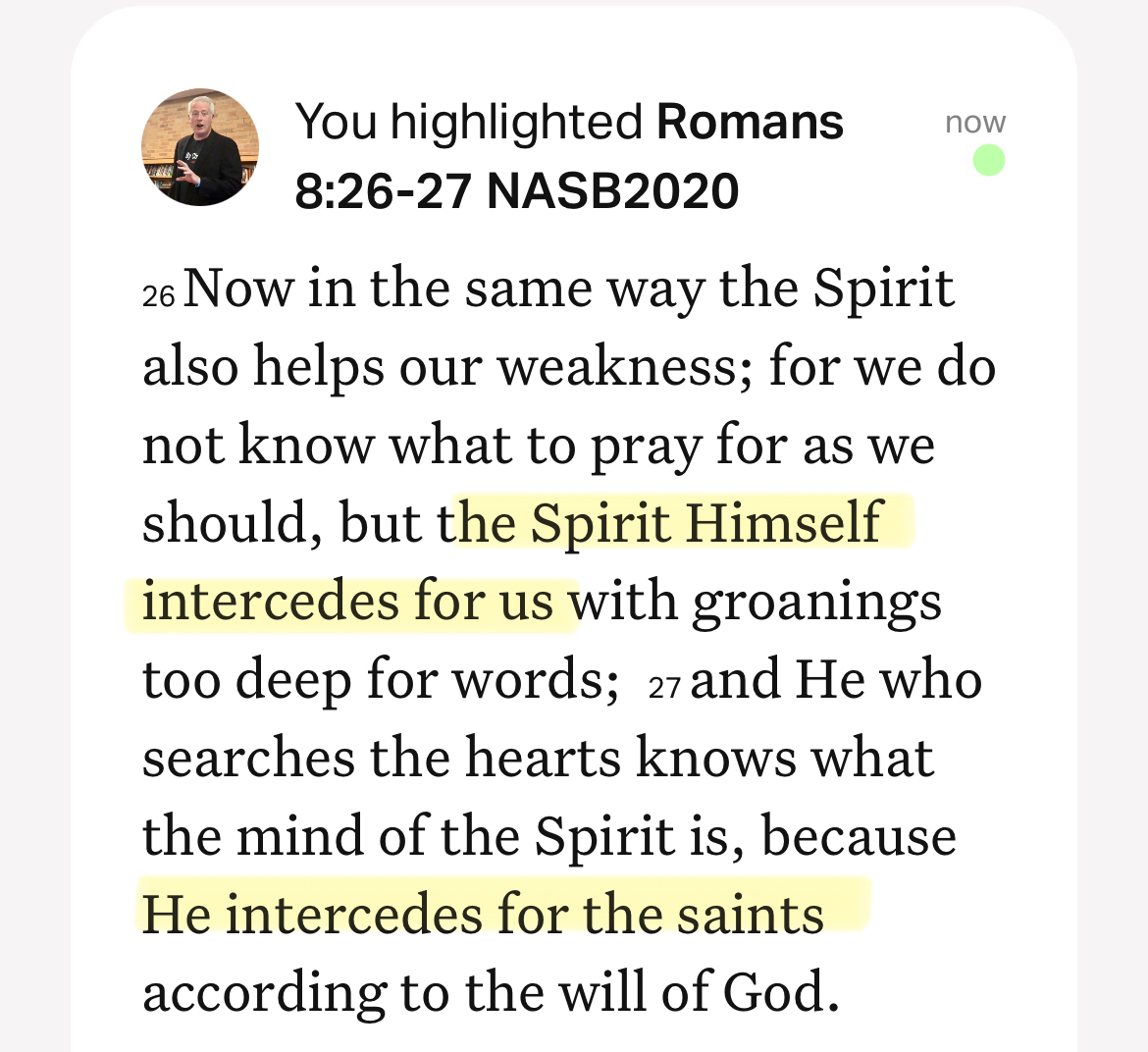
Now in the same way the Spirit also helps our weakness; for we do not know what to pray for as we should, but the Spirit Himself intercedes for us with groanings too deep for words; and He who searches the hearts knows what the mind of the Spirit is, because He intercedes for the saints according to the will of God. (Romans 8:26-27)
The Father, Son, and Holy Spirit all want us to live in the fullness and freedom of the Kingdom of God. The Father longs to give us the kingdom, and Jesus and the Holy Spirit intercede for us!
Do not be afraid, little flock, because your Father has chosen to give you the kingdom. (Luke 12:32)
Therefore [Jesus] is also able to save forever those who come to God through Him, since He always lives to make intercession for them. (Hebrews 7:25)
Listen to the podcast of this post by clicking on the player below, and you can also subscribe on Apple, Spotify, or Audible.
Here’s how God describes a wicked nation:
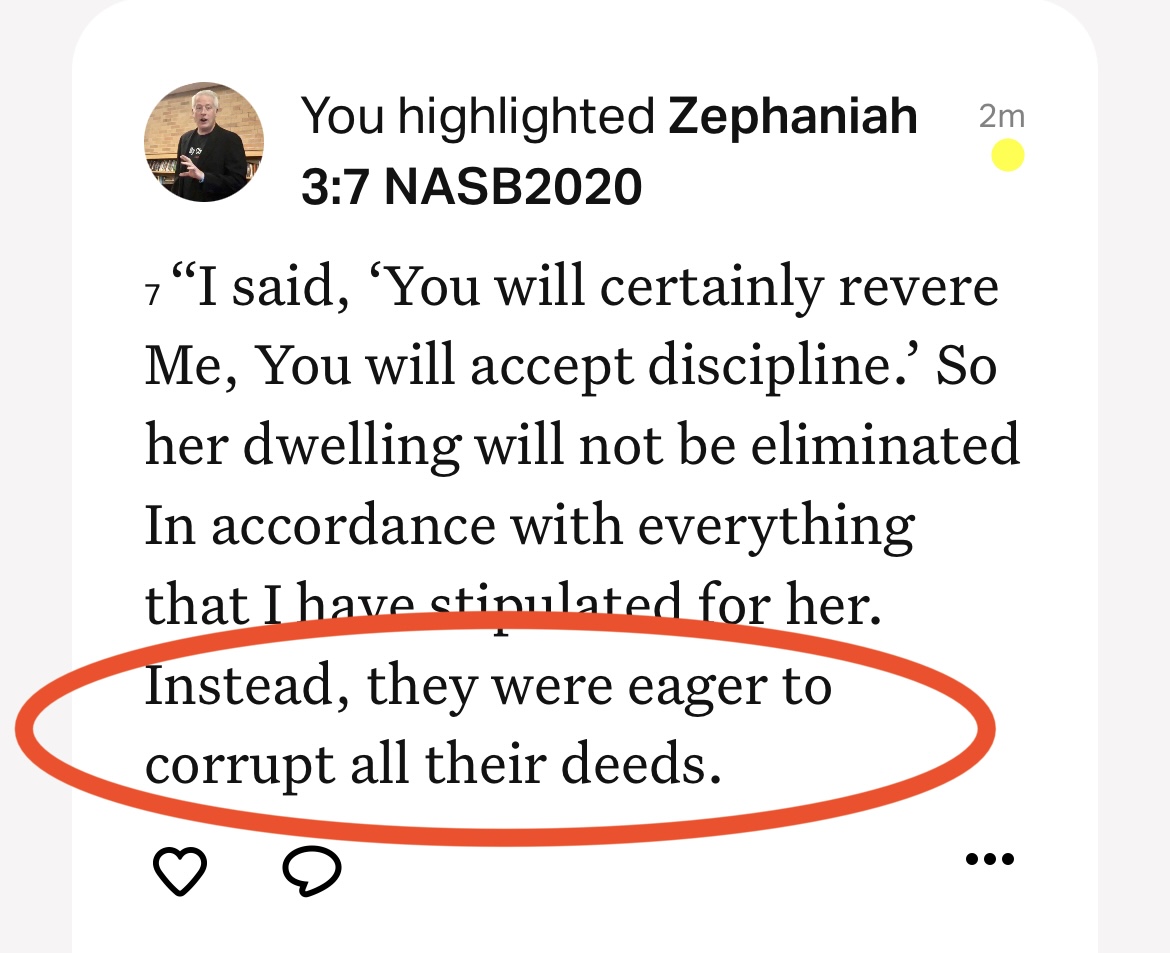
Woe to her who is rebellious and defiled, the oppressive city! She obeyed no voice, she accepted no discipline. She did not trust in the Lord, she did not approach her God. Her leaders within her are roaring lions, her judges are wolves at evening; they have no bones to gnaw in the morning. Her prophets are insolent, treacherous men; her priests have profaned the sanctuary. They have done violence to the Law. (Zephaniah 3:1-4)
These are people who were once so passionate for God and are hurtling toward His judgment on their sinful lifestyle—
thumbing their noses at their own civil laws
calling their own justice system into question
governed by leaders who are focused on flexing their power for themselves
afflicted by judges ruling by the desires of those who give them “bones to gnaw”
subject to preachers who twist and distort Scripture to suit their own desires
These things can come from nothing but pride that says, “We know best. We don’t need some out-of-date, behind-the-times god telling us what to do!”
These prideful people are hellbent on pursuing their sinful lifestyle—rejecting God’s warning of impending and certain judgment—because they have fooled themselves into believing there is no God!
Our history books are filled with stories of other proud nations that thought this same way, but God both announced and carried out His righteous judgment on them. And still, we foolishly believe we are better than them, that we can avoid the inscrutable eyes of God.
God is looking for one righteous man or woman who will hold to His righteous standard, and who will stand in the gap to intercede for rebellious, hellbent people (Ezekiel 22:30).



 In the day when I cried out, You answered me, and made me bold with strength in my soul. (Psalm 138:3 NKJV)
 Notice the full cycle—we need physical and emotional strength to pray persistently and consistently, and prayer enhances our physical and emotional reserves to help us pray. So do all three:





 Craig T. Owens