Faith Fueled By The Promise

Listen to the podcast of this post by clicking on the player below, and you can also subscribe on AppleSpotify, or Audible. 

Last week we looked at the amazing genealogy in Matthew 1 that connects Jesus to King David! 

After this genealogy, we read that an angel says to Joseph, “Joseph son of David, do not be afraid to take Mary home as your wife, because what is conceived in her is from the Holy Spirit” (Matthew 1:20). And then notice this commentary from Matthew—

All this took place to fulfill what the Lord had said through the prophet: “The virgin will conceive and give birth to a Son, and they will call Him Immanuel” (which means “God with us”). (Matthew 1:22-23)

Matthew says, “all this took place to fulfill what the Lord had said.” All what? Everything that came before that statement: the genealogy with all its exceptional items, the 70-year exile of the Jewish people, the Immaculate Conception, the fulfillment of a 700-year-old prophecy. 

I find this absolutely astounding! And so, apparently, did Joseph!  

But remember that Jesus is not only “the son of David” but He is also called a “son of Abraham.” This means that Jesus came to be more than just the King of the Jews. 

We have a cliché that says something like, “Don’t miss the forest for the trees.” By this, we mean that sometimes in the moment we only see one large tree or obstacle in front of us and we miss seeing the majesty of the whole forest. Or maybe we only see the obstacle and not the path that would take us where we need to go. 

We are living between the Advents now so you would think that we have a good “forest” perspective, but even we sometimes get bogged down in the moment, wondering what God is doing. The story of Abraham should help us to see the whole forest of God’s plan a little better. 

In Genesis 12:1-3 we read God’s promise to Abraham that all people on earth would be blessed by his obedience to God’s call. Listen to the opening words of Stephen’s sermon as he looked back on this—

The God of glory appeared to our father Abraham while he was still in Mesopotamia, before he lived in Harran. “Leave your country and your people,” God said, “and go to the land I will show you.” So he left the land of the Chaldeans and settled in Harran. After the death of his father, God sent him to this land where you are now living. (Acts 7:2-4) 

Stephen reminds us that God spoke to Abraham while he was still living in Mesopotamia. Abraham must have shared this promise with his father because in Genesis 11:31 we read that Terah takes Abraham, Sarah, and Lot with him to make this journey, but they only traveled as far as Harran. 

Why did they stop here? We’re not sure. Perhaps Terah was still grieving the death of his youngest son who had died before they left. Maybe Terah was concerned about his middle son Nahor who chose not to travel with them. Or maybe Terah was paralyzed by the magnitude of the journey still ahead of them. Whatever the reason, Terah allowed a “tree” to obscure his view of the whole “forest” of God’s plan. 

Stephen then says that Abraham continued the journey to Canaan “after the death of his father.” But if we do the math, it appears that Terah was still biologically alive when Abraham left (see Genesis 11:26, 32; 16:3, 16). 

Abraham had to trust God more than he respected his father, even to the point of considering his father as dead. 

Later on, God gave Abraham a similar test with his own son. Abraham passed this test and God repeated His promise about blessing all people through Abraham (see Genesis 22:1-18). 

In Romans 4, Paul explains that Abraham’s faith in God’s promise was rewarded, and that through our faith in Jesus we are connected to this same promise. 

Just as there was an “all this took place to fulfill what the Lord had said” about Jesus—including the faith-filled obedience of Abraham and David—God has an “all this” for your life too. 

God saw you before you were born. He had a plan for your life. He gave you gifts and talents to be used for His glory. There is not a single part—not a single experience—of your life that is accidental (Psalm 139:16; Ephesians 2:10; Romans 8:28). 

Just as He used all this for Jesus, He is using all this for your life too. Will you trust Him? 

Through David, God fulfilled the promise that Jesus would be King of the Jews. Through Abraham, God fulfilled the promise that Jesus would be King of all nations. Through Jesus, God fulfilled the promise that Jesus would be our Righteousness. 

Abraham died without seeing the promise fulfilled. But we have seen the promise fulfilled, and that should fuel our faith to trust God to fulfill the promise He has for each of us. I pray that this assurance will be renewed in your heart as you celebrate Advent this year. 

If you’ve missed any of the messages in our series called Long Live the King of Kings, you can check them all out here. 

►► Would you please prayerfully consider supporting this ministry? My Patreon supporters get behind-the-scenes access to exclusive materials. Like this video where I talk about the logic in Psalm 119. ◀︎◀︎

The Promise Of The King

Listen to the podcast of this post by clicking on the player below, and you can also subscribe on AppleSpotify, or Audible.

My podcast partner Greg and I just recorded an episode of our leadership podcast about Christmas traditions. I think there more traditions associated with this time of year than with any other event on our calendars. Traditions keep us connected to our roots, but they also help us feel like we can be in control of things. 

There has been a tradition in countries with monarchies that whenever a king died, the people would say something like, “The king is dead. Long live the king!” They would say this because the next king ascended to the throne immediately after his predecessor died. Except when a nation had been defeated, the traditional cry of, “The king is dead” was unanswered by, “Long live the king!” 

It appears at this moment that a new tradition has to be started—one where we take leadership over our own fates. 

The apostle Peter noted that people awaiting the Second Coming of Jesus would question if that event was ever going to happen. And the prophet Malachi closed the Old Testament with people saying much the same thing: “There doesn’t seem to be any advantage to following God’s laws, so maybe we should just do things our own way” (2 Peter 3:3-4; Malachi 3:13-15).

But then we turn the page to the dawn of the New Testament, and Matthew writes his Gospel about the First Advent of Jesus. He wants to show us that although the line of earthly kings in Israel may have been broken, the promised King of kings had now come to earth. 

I’m intrigued by the exceptions Matthew lists in his opening genealogy to illustrate this truth. First, as you might expect, the phrase “the father of” appears 39 times. This tells us a biological fact of life. These men didn’t know if they had fathered a son or a daughter, what their child’s contribution to the world might be, or even if their child would live faithfully to God. 

Matthew opens his genealogy by saying “the son of” twice. First, Matthew lists Jesus as the son of David—the king to whom God gave a very special promise of an eternal King coming from David’s family line. Then Matthew traces the genealogy back further to say “the son of Abraham”—the one through whom God said He would bless all nations (2 Samuel 7:11-16; Genesis 12:1-3). 

And what about the exceptional women Matthew records in this male-dominated genealogy? We have Tamar, Judah’s daughter-in-law, who tricked him into fathering a child by her; Rahab, a Canaanite prostitute who put her faith in God; Ruth, a Moabitess who left her homeland because she trusted God; Bathsheba, an adulteress who became David’s wife; and then Mary, the mother of Jesus, who was called “highly favored” of God (Luke 1:28). 

The phrase “son of” appears one more time when the angel calls Joseph by this title (Matthew 1:20). Jospeh is also called “the husband of Mary” (Matthew 1:16). 

Whereas Abraham and David were rewarded for their faithfulness to God and were told of future blessings, Joseph’s act was different. Joseph had a choice. He was told that the Child in Mary’s womb would be the Messiah. Now Jospeh had to decide: Would he choose to believe this? Would he choose to bear the shame and reproach to accept his role as father? 

We have the a similar choice today: Will we choose to believe that God has announced His plan and that He is fulfilling His plan? 

Here’s the simple truth. It appears as two statements, but it is really the same thought—

The Advent of Jesus has come. The Advent of Jesus will come. 

The First Advent of Jesus should build our anticipation for the Second Advent. His First Advent should be proof that God keeps His promise. 

Jesus told us that believing God’s promise would bring us into God’s family. Jesus said, “For My Father’s will is that everyone who looks to the Son and believes in Him shall have eternal life, and I will raise them up at the last day” (John 6:40). 

The apostle Paul also assures us, “So in Christ Jesus you are all children of God through faith” (Galatians 3:26). 

Let’s not blindly follow the traditions of previous generations, but let us chose for ourselves to believe in God’s promised Messiah, to trust that He alone can give us eternal life, and then let us live in both celebration of His First Advent and expectation of His Second Advent. 

If you’ve missed any of the messages in our Christmas series called Long Live The King Of Kings, you can find them all by clicking here. 

►► Would you please prayerfully consider supporting this ministry? My Patreon supporters get behind-the-scenes access to exclusive materials. ◀︎◀︎

Gratitude Is A Medicine

Listen to the podcast of this post by clicking on the player below, and you can also subscribe on AppleSpotify, or Audible. 

Gratitude is our shield against the negativity, and gratitude is also our sword against the ambushers. But using these pieces of our armor is exhausting, which means we also need a way to recover from the attacks of negativity. 

Jesus began His public ministry with a sermon that prompted Luke to record that “everyone spoke well of Him.” But in less than 60 seconds, after Jesus outlined how His ministry would unfold, Jesus is being criticized to the point where those same praising people are now ready to throw Jesus off a cliff (Luke 4:18-29)! 

Elbert Hubbard wrote, “If you have something others don’t, know something others don’t, or do something others aren’t doing, then, rest assured, you will be criticized. … To avoid criticism say nothing, do nothing, and be nothing.” 

Even though Hubbard is probably right, Christians don’t have the option to “say nothing, do nothing, be nothing,” because Jesus has called us to go into all the world, preach the Good News, and be salt and light. That means we will be victims of criticism. We can use our shield and sword of gratitude, but we are also going to need some medicine to help us recover too.

“Sticks and stones may break my bones but words will never hurt me” is a lie. Words do hurt. 

Jesus told us these stinging words would be thrown at us like sticks and stones in Luke 6:22. When we are criticized, we have to be careful not to get embittered. How does that happen? We are naturally self-protective, so criticized people become critical and cynical unless they can be healed and have joy restored. If we hold on to our hurts, bitterness can fester in our hearts (Hebrews 12:14-15). 

Look at David in Psalm 69. He acknowledged the attacks from his enemies and how it made him feel, but then he applies the healing medicine of gratitude—

But as for me, afflicted and in pain—may Your salvation, God, protect me. I will praise God’s name in song and glorify Him with thanksgiving. (Psalm 69:29-30) 

Our healing is in our thanking! 

Medical research has shown that gratitude improves physical health—it reduces stress and resets the heart’s healthy rhythm. This is just as true spiritually: gratitude is our medicine. 

You may be thinking, “How can I bless critical people? How can I be grateful when I’m surrounded by such hostility?”  

David also wrote Psalm 23 for us. This is the psalm that begins, “The Lord is my Shepherd, I shall not be in want.” But notice especially the words of verse 5: “You prepare a table before me in the presence of my enemies. You anoint my head with oil; my cup overflows.” 

It is precisely in the presence of enemies that God invites us to abide with Him and to receive His medicine of anointing. But I also see that our Good Shepherd doesn’t just give us adequate blessings, but overflowing blessings—enough for me and more to share with those around me. 

In the New Testament Greek, one word for “bless” is eulogeo which literally means “good words.” Jesus, Paul, and Peter all tell us that when we are victims of the sticks and stones of negative words, we are to respond by saying good words both to God and to those who are hurling evil words at us (Matthew 5:43-44; 1 Corinthians 4:12; 1 Peter 3:9). 

Peter shows us exactly how Jesus did this when He was hanging on the Cross and enduring the sneers, mocking words, and insults from those surrounding Him (1 Peter 2:21-23; Luke 23:35-39). Instead of throwing evil words back at them, Jesus blessed them by saying, “Father, forgive them for they do not know what they are doing” (Luke 23:34). 

Learn a lesson from our Lord
Often silence cuts like a sword
When we stand upon the Rock
We needn’t bother when fools mock

Bantering with fools just won’t do
Unless you want to be foolish too
To the wisest words they won’t listen
But joy in airing their own opinion

Our Lord knew just what to do
When mockers hurled words untrue
He entrusted things to the King
Who perfectly records everything

Help us follow the example You gave
To not engage with those who rave
May not our hasty words undo

Because we have been forgiven, we can forgive. Because we have been blessed with overflowing blessings, we can bless. Our healing is in our thanking! 

If you’ve missed any of the messages in this series on power of gratitude, you can check them all out by clicking here. 

►► Would you please prayerfully consider supporting this ministry? My Patreon supporters get behind-the-scenes access to exclusive materials. ◀︎◀︎

Gratitude Is A Shield

Listen to the podcast of this post by clicking on the player below, and you can also subscribe on AppleSpotify, or Audible. 

Gratitude is a great attitude. It sets you apart from the crowd of complainers, and it causes people to ask, “What do you know that we don’t know?”      

Wouldn’t you just love to silence the complainers in your life? Maybe you can relate to this poem by Shel Silverstein called Complainin’ Jack

This morning my old jack-in-the-box
Popped out—and wouldn’t get back-in-the-box.
He cried, “Hey, there’s a tack-in-the-box,
And it’s cutting me through and through.
“There also is a crack-in-the-box,
And I never find a snack-in-the-box,
And sometimes I hear a quack-in-the-box,
‘Cause a duck lives in here too.”
Complain, complain is all he did—
I finally had to close the lid.

Since, as Christians, we can’t really “close the lid” on the complaining people around us, maybe there’s something else we can do. I can think of three possibilities. 

  1. We could entirely avoid complaining people. But to do this wouldn’t allow us to live our lives as the salt and light Jesus called us to (Matthew 5:13-16). After all, in order for salt to season or light to drive away darkness, the salt and light have to be in close proximity to those they are helping. 
  1. We could simply ignore the negativity. Be around it, but do nothing about it. But both Paul and Jesus call us to engage with people in a way that points them to the Good News of the Gospel (Philippians 2:14-16; Matthew 28:19). 
  1. If we cannot avoid complainers nor remain apathetic about them, we must find a way to engage them but protect our hearts in the process. 

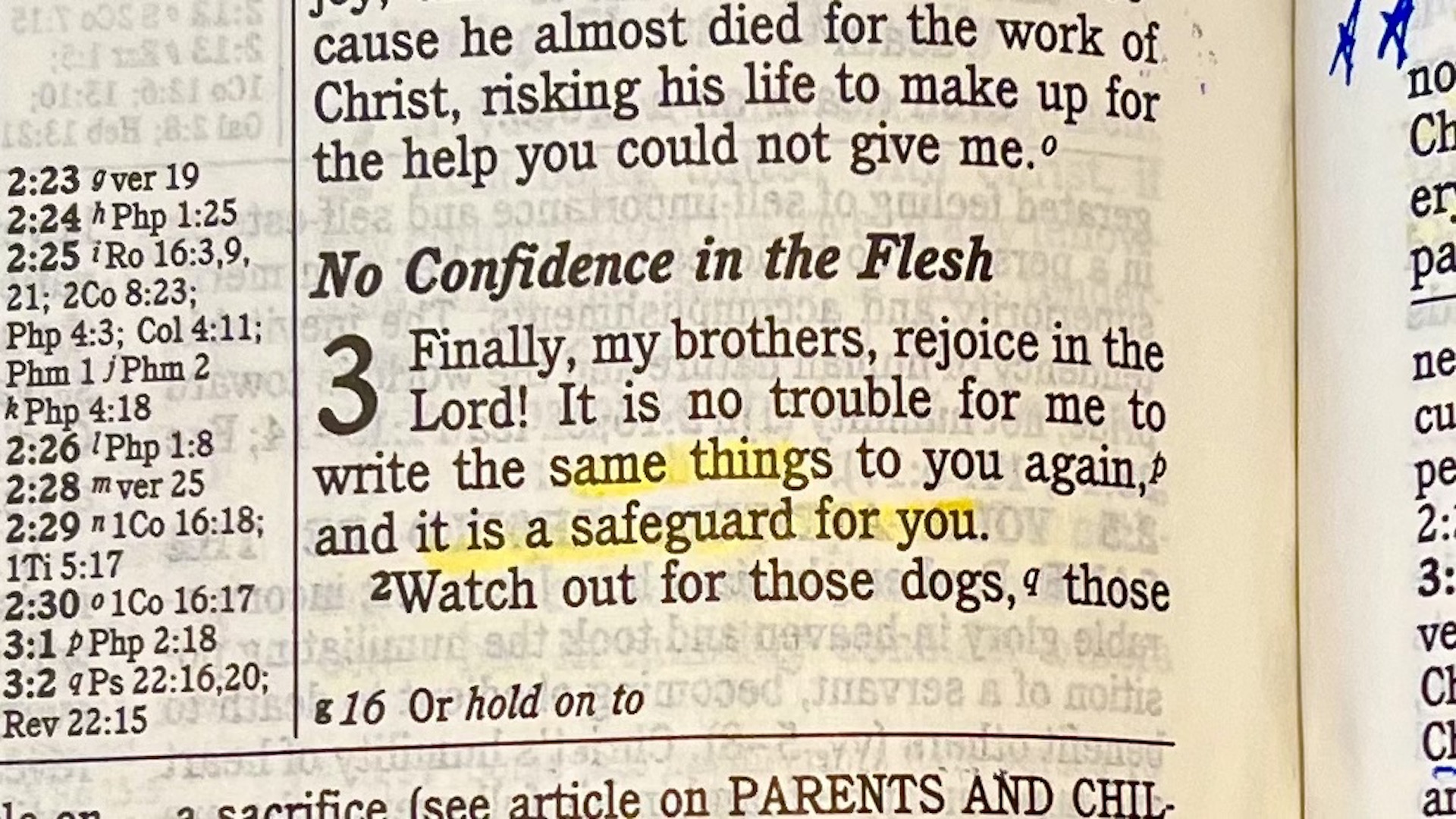
We learn from the apostle Paul’s letter to Philippi that gratitude is our shield against anything that would seek to steal our joy! “Further, my brothers and sisters, rejoice in the Lord! It is no trouble for me to write the same things to you again, and it is a safeguard for you” (Philippians 3:1). 

In the Greek, the root word for “safeguard” means “fail.” But when we add the prefix it becomes cannot fail! So rejoicing makes us secure, firm, reliable.

Quite simply that means that gratitude is our attitude protector because gratitude is our shield against anything that would seek to steal our joy!

Jesus used the same word for rejoicing even when we are facing insults, exclusion, and persecution—

Blessed are you when people hate you, when they exclude you and insult you and reject your name as evil, because of the Son of Man. Rejoice in that day and leap for joy, because great is your reward in heaven. For that is how their ancestors treated the prophets. (Luke 6:22-23) 

Both Jesus in this passage and Paul in Philippians 3:1 remind us that our rejoicing is IN the Lord. We are not expected to rejoice in our circumstances, but in who God is for us. Matthew Henry noted, “The more we rejoice in Christ the more willing we shall be to do and to suffer for Him, and the less danger we shall be in of being drawn away from Him.” 

I also like both the proactive and reactive use of rejoicing that John Henry Jowett identifies when he says, “Gratitude is a vaccine, an antitoxin, and an antiseptic.” Rejoicing is never supposed to be a one-and-done action, but it is an ongoing lifestyle. As Paul wrote to the Christians in Philippi just a few verses later, “Rejoice in the Lord always. I will say it again: Rejoice!” (Philippians 4:4). 

Gratitude is a shield—a vaccine, an antitoxin, and an antiseptic—but it doesn’t protect us unless we use it!

In order to use this shield whenever it’s needed, we have to be constantly reminded to be grateful. This is where we can leverage the power of our brain’s reticular activating system. I shared a short video about how to do this on The Podcast last week—check it out here. 

Gratitude is a great attitude, and grateful people are a winsome testimony of God’s love and provision to those “complainin’ Jacks” we all encounter. Try it and see what a difference it will make with those you are around this week. 

To check out all of the sermons in this series, please click here. 

►► Would you please prayerfully consider supporting this ministry? My Patreon supporters get behind-the-scenes access to exclusive materials, like this exclusive video in which I take my supporters behind the scenes of my thought process in designing my confrontation flowchart. ◀︎◀︎

The Goals Of Confrontation

Listen to the podcast of this post by clicking on the player below, and you can also subscribe on AppleSpotify, or Audible. 

Say the word “confrontation” and many people cringe. “I try to avoid confrontations with others,” people will quickly say. 

The origin of the word comes from a derivative of the word for “forehead.” The original intent of confrontation was simply putting the facts in front of someone’s face so that they could acknowledge them. 

The problem for most of us (myself included) is two-fold: 

  1. I don’t like to be confronted with things I may be doing incorrectly or incompletely. 
  2. I don’t like making others defensive when I confront them with the things they may be doing incorrectly or incompletely.

As a result, we usually don’t confront others and they usually don’t confront us. Sadly, this can keep us from maturing in areas where we may be able to soar if we could only make some minor changes. 

Christians should be especially open to confrontation from a brother or sister. After all, Solomon told us, “Wounds from a friend can be trusted, but an enemy only multiplies kisses” (Proverbs 27:6). And Jesus warned us, “Woe to you when all men speak well of you, for so did their fathers to the false prophets” (Luke 6:26 NKJV). 

The best confrontation is self-confrontation in the presence of the Holy Spirit. After we have submitted to that loving spotlight, then we can proceed with our loving confrontation with our brothers and sisters. 

Remember this: 

The goals of Christian confrontation are restoration and maturity. 

We want to see wandering saints return to God’s path, and we want those saints who are immature to blossom into Christ-like maturity that brings glory to God. 

I have prepared a flowchart that can help you with a biblical framework for the work of confrontation. Please work through this flowchart slowly and prayerfully. Don’t rush any step, but make sure you can answer an honest “yes” to each question. When you get to the last step, keep in mind these three Ms:

  1. Maturity—self-confrontation and confrontation of others should always be moving us toward maturity. 
  2. Mutual accountability—agree to stay involved in this process, with each of you remaining accountable to each other. 
  3. Mercymercifully restore the one who has strayed so that the entire Christian body of believers can be strengthened.

Here are some resources to help you:

►► Would you please prayerfully consider supporting this ministry? My Patreon supporters get behind-the-scenes access to exclusive materials. ◀︎◀︎

Moving Toward Maturity

Listen to the podcast of this post by clicking on the player below, and you can also subscribe on AppleSpotify, or Audible. 

Our sixth spiritual discipline—confession—is at the pinnacle of our growth as maturing saints. That’s because many of the other disciplines will culminate in one saint confessing to another saint. Confession not only keeps us strong as individuals, but it keeps the whole Christian community in a strong, healthy place. 

The story has been told about two monks who had woven plenty of baskets to sell in town on market day. On the way to town they devised a strategy where one monk would sell at one end of the market and the other at the opposite end. At the end of the day they would meet at a designated place to go back to the monastery. One monk sold all of his baskets and returned to the meeting place. He waited, and waited, and waited. It wasn’t until the next morning that the second monk appeared. 

“I cannot return to the monastery with you,” he told his waiting friend. “I have committed a terrible sin. I was tempted, and I gave into the temptation and committed fornication last night. I have broken my vows to my brothers and to God, so you will have to go back without me.” 

The first monk listened to his friend and then answered, “Come, my friend. We will go back to the monastery and repent together.” 

He was really saying to his friend, “I can identify, because under the same circumstances I might have done the same thing. Perhaps if I had stayed at your side I could have held you accountable, so I bear mutual responsibility for your stumble.” 

The early church is described in terms of togetherness. James, the early leader of the church in Jerusalem, was a part of this togetherness and used it as an important conclusion to his book of instructions to the saints—

Is anyone among you in trouble? Let them pray. Is anyone happy? Let them sing songs of praise. Is anyone among you sick? Let them call the elders of the church to pray over them and anoint them with oil in the name of the Lord. And the prayer offered in faith will make the sick person well; the Lord will raise them up. If they have sinned, they will be forgiven. Therefore confess your sins to each other and pray for each other so that you may be healed. … My brothers and sisters, if one of you should wander from the truth and someone should bring that person back, remember this: Whoever turns a sinner from the error of their way will save them from death and cover over a multitude of sins. (James 5:13-16, 19-20) 

James wants the saints to be together in prayer, together in worship, together in confession, and together in rescuing their fellow brothers and sisters. The word he uses for “confession” means an out-loud profession or agreement. When he says, “confess your sins” he uses a word that means a deviation from a standard, or a falling short of God’s word. 

James sees this ongoing confession as a preventative to “a multitude of sins.” In this instance, the word he uses is an outright violation of God’s laws. In other words, the small deviations can add up to something deadly. 

Paul uses a similar idea when he writes, “Let us purify ourselves” (2 Corinthians 7:1). The implication again is that we are confessing both individually and corporately. I can be a huge blessing to my brothers and sisters by going first in confession (Matthew 7:1-5). 

Confession also helps others know they are not alone (1 Corinthians 10:12-13). 

As an individual saint I mature by continually closing the gap between realizing a shortcoming in my life and confessing that shortcoming to God and to another saint. Then as saints together we can love, encourage, help, and hold each other accountable. I have said before that I think confession may be the most under-used resource for Christians to gain power in prayer and victory over falling into temptation! 

In each of our previous five spiritual disciplines I’ve shared a “so that” statement to help us keep perspective of why we need to employ those disciplines. For confession, here’s our focal point: I confess to other saints so that we can be mutually accountable in our growth toward purity and maturity. 

Confession is good for us individually and corporately, so let’s continue to use this to strengthen everyone. 

If you’ve missed the messages covering the other spiritual disciplines, you can find all of them by clicking here. 

►► Would you please prayerfully consider supporting this ministry? My Patreon supporters get behind-the-scenes access to exclusive materials, like this recent video where I explain how God reveals previously-unknown truths to us. ◀︎◀︎

Appointment Vs. Opportunity

Listen to the podcast of this post by clicking on the player below, and you can also subscribe on AppleSpotify, or Audible. 

If we’re not careful, we can get so focused on our own appointments that we will miss out on the amazing opportunities God sends our way to show His love to others.

Check out this episode of The Podcast.

Resources mentioned in this video:

►► Would you please prayerfully consider supporting this ministry? My Patreon supporters get behind-the-scenes access to exclusive materials, like this recent video where I explain how God reveals previously-unknown truths to us. ◀︎◀︎

Loving Fighters

Listen to the podcast of this post by clicking on the player below, and you can also subscribe on AppleSpotify, or Audible. 

I’ve always loved this stanza from a William Cowper poem:

Restraining prayer, we cease to fight
Prayer makes the Christian’s armor bright
And satan trembles when he sees
The weakest saint upon his knees.

Prayer is indispensable in spiritual warfare! Prayer is where we fight best for those we love. 

Have you ever heard the question, “Are you a lover or a fighter?” I don’t believe this is an either-or answer, both both-and. I’m a fighter because I’m a lover. I love Jesus and I am loved by Jesus.  This fuels my passion to fight for His glory to be seen. This drives me to fight against the powers that keep others from knowing this love for themselves. 

T.M. Moore wrote, “If we want God to bring revival and save the world from its many and increasing troubles, we must give ourselves to extraordinary efforts in prayer before we enter the conflict.” Prayer isn’t preparation for the fight; prayer is the fight that has been lovingly empowered. This is why our fifth spiritual discipline of prayer is so vital. 

As we have seen with giving and fasting, Jesus also has some don’ts and dos for us about praying (Matthew 6:5-8):

  • don’t pray publicly for earthly recognition or human applause (v. 5) 
  • do pray privately (v. 6) 
  • don’t pray robotically—And when you pray, do not heap up phrases—multiply words, repeating the same ones over and over—as the Gentiles do, for they think they will be heard for their much speaking (v. 7 AMP) 
  • do pray intimately (v. 8) 

Jesus practiced what He preached about praying in secret: Jesus was praying in private (Luke 9:18). He must have prayed so differently than anyone else the disciples had ever heard because they asked Him, “Lord, teach us to pray” (Luke 11:1). 

Remember that prayer is the battle—things are happening while I’m praying. 

There is a way I speak to my wife in private that I don’t typically say in public. If I didn’t speak intimately to her in private, others would notice a difference in public. When I do have intimate, private, regular conversations with her, it also shows publicly. 

So too with prayer. The New Testament doesn’t record very many of the prayers of Jesus for us. In fact, many of things we might think of as prayers sound more like commands from Jesus—“Lazarus, come forth,” “Little girl, get up,” “Be clean,” and similar phrases. We see the public display of power because Jesus had been empowered in private by His Father. 

Private prayer is noticed publicly in the lives of the followers of Jesus too (see Acts 4:13; 6:15). 

I don’t pray privately so that I can show off publicly. I pray in intimate privacy so that I can publicly show off Jesus! 

All of our spiritual disciplines are for us individually so that we have something to give corporately. For instance—

As we are built up in private prayer, there is a greater unity in corporate prayer, and Jesus is lifted up for the world to see. We love Jesus and we love others, so we fight for the glory of God and the strengthening of our brothers and sisters. We are loving fighters! 

So let me encourage you to make private, intimate conversation with Jesus a priority in your life. 

If you’ve missed any of the previous spiritual disciplines we’ve covered in this series, you can check them all out here. 

►► Would you please prayerfully consider supporting this ministry? My Patreon supporters get behind-the-scenes access to exclusive materials, like this recent video where I explain how God reveals previously-unknown truths to us. ◀︎◀︎

Fasting Unlocks Feasting

Listen to the podcast of this post by clicking on the player below, and you can also subscribe on AppleSpotify, or Audible. 

I find it interesting how many spiritual disciplines have both a physical and spiritual impact on our lives. Bible study, solitude, and giving all have benefits in both the physical and spiritual realms. This is even more apparent in spiritual discipline #4—fasting. 

As we saw with giving last week, fasting is another one of the spiritual activities that Jesus has a cautionary word for us (Matthew 6:16-18). As with giving and praying, Jesus notes that there are only two categories: true fast-ers and hypocrites. Of course, hypocrite means someone simply playing a role—it’s not who they really are. 

In Matthew 9:14-17, Jesus is asked about fasting and He uses some unusual analogies about fabrics and wineskins to teach us two don’ts about fasting:

  1. Don’t fast if you’re not ready for it. Jesus notes that “the unshrunken cloth” will do damage to both the new and old pieces of fabric. This goes back to the get-to vs. have-to attitude we should have about spiritual discipline.
  2. Don’t try to add a new religious practice to a religion-hardened heart. Jesus addresses this using the analogy of new wine ruining old wineskins. 

These fasting thoughts aren’t a teaching that is exclusive to the New Testament, but through the prophet Isaiah, God addressed it in the exact same way (Isaiah 58:5-9). In this passage we can learn the dos about fasting:

  1. Do fast when my heart’s motivation is a hunger for more of God. 
  2. Do fast as the Holy Spirit directs you, not in a formulaic, lifeless ritual. 

I’m not a big fan of diets that are no-no diets because telling people what they cannot eat isn’t a good motivator. But telling people what they can eat brings joy and freedom. 

The insidious nature of junk food is not so much the fat, sugar, and other unhealthy ingredients, but the fact that junk food is really empty calories. Your body needs a certain amount of fuel to operate. Junk food contains calories but lacks nutrients. You eat junk food, your body sends a signal to your brain that you’re no longer hungry, and then you never eat the nutrient-rich food. This is why your Mom may have told you something like, “Broccoli first, then dessert.” 

The Hebrew word for “fast” literally means to cover the mouth, but I think fasting is more than that. Just as we said money was one aspect of giving, so food is one aspect of fasting. The idea behind fasting is to be able to identify the “empty calories” of some of our lifestyle choices so that we can feast on the rich “nutrients” that God has for us. 

Just as junk food with its empty calories keeps us from nutrient-rich food, hours of video games or TV binge watching keeps us from mind-enriching learning, endless social media scrolling keeps us from developing real relationships with real people, and obsessive news gathering keeps us from focusing on God’s promises.

Periodically fasting from these things will allow us to spot the junk food we’ve been consuming. Our so that statement for this spiritual discipline says: I fast so that I can identify the junk food that is keeping me from feasting on Jesus. 

Can I give you a brief assignment for this spiritual discipline? After making sure your heart attitude about fasting is God-honoring, add regular fasting to your life so that you can use that time to feast on Jesus. 

If you’ve missed any of the other messages in this series on six empowering spiritual disciplines, you can check them out by clicking here. 

►► Would you please prayerfully consider supporting this ministry? My Patreon supporters get behind-the-scenes access to exclusive materials. ◀︎◀︎

The Joy Of Giving

Listen to the podcast of this post by clicking on the player below, and you can also subscribe on AppleSpotify, or Audible. 

In our series on six important spiritual disciplines, our key phrase is “so that”—

  • I get stronger so that we can get stronger. 
  • For discipline #1: I study my Bible so that I have something to apply to my life. 
  • For discipline #2: I take time for solitude so that I can respond in a God-glorifying way in stressful situations. 

Our third spiritual discipline makes people nervous: Giving. So perhaps if I give you the “so that” up front that will help you stick with me. Here it is: I practice the spiritual discipline of giving so that I can encourage others and experience God’s greater blessings. 

Jesus has a caution about giving: Don’t give to get earthly recognition (Matthew 6:1-4). He states this with two don’ts and one do:

  • do not announce your giving 
  • do not calculate or reckon your reward for giving
  • do expect God’s reward for your giving

The stark contrast is seen between Joseph Barnabas and Ananias and Sapphira in Acts 4:34-5:4. Barnabas gave everything he had received from the sale of a piece of property without expecting anything in return. Ananias and Sapphira pretended to give everything they had received from the sale of a piece of property fully expecting some sort of recognition. The results are just as stark and clear: Barnabas was honored by both the church and God, while Ananias and Sapphira were severely punished by God. 

When Jesus tells us in Matthew 6 that our giving should be in “secret,” He clearly doesn’t mean that no one knows that we have given. Clearly, in our examples in Acts, people knew that Barnabas had given money to the church. 

In two of his public letters, Paul gave public thanks to the church at Philippi for their financial gifts to him, and he called out the church at Corinth for their failure to give as they had promised they were going to (Philippians 4:10; 2 Corinthians 8:11). 

Paul noted that the Philippians gave because they knew there was a need, and Paul praised them for this and told them that they would see God’s reward for their generosity (Philippians 4:10-20). We can see our “so that” idea here: Paul was encouraged, he said that the Philippians would have all their needs met, and God was glorified. 

Paul used this example of the Philippians as an encouragement to the Corinthians (see 2 Corinthians 8:1-12, 9:5-8). Paul encouraged them to make sure they had a “get to” attitude about giving, not a “have to” obligation. He noted that God blesses the cheerful, get-to giver. 

Notice how similar the blessings of God sound to these two churches: 

And God is able to bless you abundantly, so that in all things at all times, having all that you need, you will abound in every good work. (2 Corinthians 9:8) 

And my God will meet all your needs according to the riches of His glory in Christ Jesus. (Philippians 4:19) 

When the Bible talks about giving, it is never restricted to money, although that is part of it. The Bible talks about giving in three categories. We could call these The three Ts

  1. Treasure—our tithes and offerings.
  2. Time—giving our service to those in need. 
  3. Talent—using the abilities God has given each believer to build up the Kingdom of God.  

How much of our treasure, time, and talent should we give? We should never look for the bare minimum, but we should be lavish givers. C.S. Lewis said it this way in his book Mere Christianity:

“I do not believe one can settle how much we ought to give. I am afraid the only safe rule is to give more than we can spare. In other words, if our expenditure on comforts, luxuries, amusements, etc., is up to the standard common among those with the same income as our own, we are probably giving away too little. If our charities do not at all pinch or hamper us, I should say they are too small. There ought to be things we should like to do and cannot do because our charities expenditure excludes them.”

For myself, I am trying to think of spiritual discipline #3 as this prayerful declaration: 

I will allow the Holy Spirit to show me how much of my time, talent, and treasure I am privileged to invest in the Kingdom of God. I will gladly do this so that God will meet all my needs here, He will reward me in Heaven, and other saints will be encouraged by my giving. 

I hope you will join me in making this your declaration as well. 

If you have missed any of the messages in our series called Saints Together, you can find the full list of messages by clicking here. 

►► Would you please prayerfully consider supporting this ministry? My Patreon supporters get behind-the-scenes access to exclusive materials, like a map and an app I just shared to help with your personal Bible study time. ◀︎◀︎