10 More Quotes From “The Christian In Complete Armour”

William Gurnall penned wise words for Christian warriors nearly 400 years ago, but their timelessness is still evident today. Check out a few more quotes from The Christian In Complete Armour. 

“When we consider satan’s many years of experience in studying natural knowledge, we will not accept his predictions as prophecies but see him as a learned naturalist with a short and dark text of natural causes. … Neither satan nor any other creature is able to foretell events which do not arise from natural causes nor follow moral and political probabilities. Prophecies in Scripture are locked up in the cabinet of the divine will to prove their heavenly extraction. They must come from God, Who can tell us what only He knows.”

“Look closely at the label to see whether the armor you wear is the workmanship of God or not. There are many imitations on the market nowadays. It is satan’s game, if he cannot keep the sinner satisfied in his naked, lustful state, to coax him into some flimsy thing or other that by itself will neither do him good nor satan harm. Perhaps it is church attendance, or good works, or some self-imposed penance by which he intends to impress both God and man. … Thus thousands perish who supposed they were armed against satan, death, and judgment—when all along they were miserable and naked. … God’s armor can never be made to fit over the suit [a self-satisfied man] has fashion for himself.”

“Knowledge is to faith as sunshine is to the farmer. Without it, faith cannot see to do her work. Nor can the work, once finished, be adequately inspected in the dim light of half-truths. If you do not ground yourself in the truth of the Gospel, satan will play upon your ignorance to thwart your spiritual growth.”

“You give satan a dangerous advantage if you see his wrath and fury bent in general against the saints, and not against you specifically: satan hates me; satan accuses me; satan temps me. Conversely, you lose much comfort when you fail to see the promises and providences of God as available for your own specific needs: God loves me; God takes care of me.”

“Until the love of a sin is quenched in the heart, the fire will never die out. How is this accomplished? Jerome says one love extinguishes another—that is, the love of Christ must quench the love of sin.”

“If you are a Christian, what is there to fear? You have no life to lose if you have already given yourself to Christ. And while God has not promised immunity from suffering, He has undertaken to bear your losses and pay you a hundredfold, though your reward may not come until another world.”

“A thief has no legal right to the wallet he takes from his victim simply because he puts it in his pocket and claims it is his own. Nor is the wrong thus committed ever made right by the passing of time. Years may go by before he is discovered; he will be as guilty on the day of his arrest as on the day he perpetrated the crime. Now a thief on the throne is no different from one in the alley. satan has indeed kept his stolen title a long time, but he is no less a criminal than on the day he first took Adam’s heart from God.”

“I grieve to see the soul fallen so far beneath its divine origin! The body, which was intended to be its servant, has instead become its master, and rules with a merciless hand.”

“When you cause anyone to sin, you take the devil’s office out of his hands. Let him do it himself if he can, but never allow him to use you as his hireling. Tempting someone else to sin is worse than sinning yourself. Those who tempt others plant their own wickedness in fertile fields and raise up new seed to the devil.”

“One reason we are so easily persuaded to sin is because we do not understand satan’s purpose. … Shall I tell you? Do you think your pleasure or profit is his goal? Not likely! His aspirations are all for himself. He has a personal grudge against God, and he brings you, by sinning, to join his quarrel. What he fails to mention is that you jeopardize your very soul to defend his pride and lust. But he is hardly worried about your welfare. He loses no more sleep over your certain damnation than a demented general does over the men he sends on a suicide mission. Knowing this, why would you ever join satan in his fight against God?”

You can read my full review of William Gurnall’s book by clicking here. I have shared other quotes from The Christian In Complete Armour here, here, and here.
Joyless Christianity??

“Many—would I overstate the case if I said the majority?—of those who confess their faith in Christ and enter into association with the community of believers have little joy in their hearts, no peace in their minds, and from all external appearances are no better morally than the ordinary educated citizen who takes no interest whatever in religion and, of course, makes no profession of Christianity. Why is this? I believe it is the result of an inadequate concept of Christianity and an imperfect understanding of the revolutionary character of Christian discipleship.

“True faith brings a spiritual and moral transformation and an inward witness that cannot be mistaken. These come when we stop believing in belief and start believing in the Lord Jesus Christ indeed. …

“One of the first changes will be a shift of interest from earth to heaven, from men to God, from time to eternity, from earthly gain to Christ and His eternal kingdom.” —A.W. Tozer, in Man—The Dwelling Place Of God

3 Apologetics For Your Christian Hope

There was a story circulating that a physicist once claimed that the bumblebee was defying the laws of physics and aerodynamics in its flight. Apparently, he calculated that the ratio of the bumblebee’s wing size in comparison to his body size just didn’t make the math work.

But entomologists and physicists quickly jumped in to say, “Hey, look, the bumblebee is flying, so clearly it works!” And then they went to work to try to explain it. They figured out that the bumblebee flaps its wings more back-and-forth than up-and-down, creating tiny hurricanes the propel them through the air. But then that created a whole new set of problems, like how does the bumblebee control a hurricane so precisely as it turns, stops, dives, and climbs. So then they had to create a new explanation, which they named dynamic stall.

All the while, the bumblebee is flapping its too-small wings 230 times per second(!), and going about its daily activities without being able to explain tiny hurricanes, the laws of physics or aerodynamics, or even knowing what dynamic stall is. It simply flies!

The ultimate argument for anything is doing something that critics say is impossible.

Peter tells Christians to be prepared to answer anyone for the reason for the hope that they have (1 Peter 3:15-16). The Greek word for “give an answer” is apologia, from which we get our word apologetic. Here are three apologetics for Christians to use for the hope that they have.

It really comes down to this: My hope is based on the resurrection from the dead of Jesus Christ, which I believe because of the Bible AND because of the change in my life.

  1. The Bible’s authenticity

“No other work in all literature has been so carefully and accurately copied as the Old Testament. The particular discipline and art of the Jewish scribes came out of a class of Jewish scholars between the fifth and third centuries BC. They were called the Sopherim, from a Hebrew word meaning ‘scribes.’ The sopherim, who initiated a stringent standard of meticulous discipline, were subsequently eclipsed by the Talmudic scribes, who guarded, interpreted, and commented on the sacred texts from AD 100 to AD 500. In turn, the Talmudic scribes were followed by the better-known and even more meticulous Masoretic scribes (AD 500-900).” —Josh McDowell, God-Breathed

“No other ancient text is substantiated by such a wealth of ancient textual witnesses as is the New Testament. Roughly 5,500 separate manuscripts are available, variously containing anything from the entire New Testament corpus to a slight fragment of a single verse. … This textual support is far superior to that available for any other ancient documents, such as the classical texts from Greek and Roman writers (e.g., Plato, Aristotle, and Cicero). Only partial manuscripts have survived for many works of antiquity, and it is not unusual to find that the only complete manuscript for some ancient writing is a copy dating from 1,000 years after its composition.” —Archaeological Study Bible, “The New Testaments Texts” (page 1859)

“The biblical Dead Sea Scrolls are up to 1,250 years older than the traditional Hebrew Bible, the Masoretic text. We have been using a one-thousand-year-old manuscript to make our Bibles. We’ve now got scrolls going back to 250 BC. … Our conclusion is simply this—the scrolls confirm the accuracy of the biblical text by 99 percent.” —Dr. Peter Flint

I have shared other apologetic evidence for the authenticity of Scripture here and here.

  1. Christ’s resurrection 

In 1 Corinthians 15:1-8 Paul lists all of the eyewitnesses to Christ’s resurrection, giving critics ample opportunity to challenge these witnesses in person. If these witnesses would have been perpetrating a hoax, skeptics of their day would have been able to uncover the inconsistencies in their story. If the account of Christ’s resurrection was made-up, it’s doubtful the early Christian martyrs would have “stuck to their story” as they were being tortured, but none recanted.

Josh McDowell notes, “By AD 100, the apostles had died, but the Christian Church was still in its infancy, with fewer than twenty-five thousand proclaimed followers of Christ. But within the next two hundred years, the fledgling church experienced explosive multiplication of growth, to include as many as twenty million people. This means the church of Jesus Christ quadrupled every generation for five consecutive generations!

  1. My personal experience

“I am a changed person. I am not who I was before I met Jesus” and “My life tends to go better when I live by biblical principles” are both excellent apologetics!

Let others argue that God doesn’t exist, or that you shouldn’t have hope, and then you—like the bumblebee—just keep flying with Jesus! (see 2 Timothy 3:14)

If you’ve missed any messages in this series, you may find the complete list by clicking here.

11 Quotes From “If”

As I said in my book review of Amy Carmichael’s book If, this is definitely not a book for everyone. Amy herself said, “It is clear, I think, that such a booklet as this is not meant for everyone, but only for those who are called to be undershepherds.” So the quotes I’m sharing today are just a few of her “If…” statements that especially resonated with me in my role as an under-shepherd pastor.

“If I enjoy a joke at the expense of another; if I can in any way slight another in conversation, or even in thought, then I know nothing of Calvary love.”

“If I can write an unkind letter, speak an unkind word, think an unkind thought without grief and shame, then I know nothing of Calvary love.”

“If I can rebuke without a pang, then I know nothing of Calvary love.”

“If my attitude be one of fear, not faith, about one who has disappointed me; if I say, ‘Just what I expected,’ if a fall occurs, then I know nothing of Calvary love.”

“If I cast up a confessed, repented, and forsaken sin against another, and allow my remembrance of that sin to color my thinking and feed my suspicions, then I know nothing of Calvary love.”

“If I put my own happiness before the well-being of the work entrusted to me; if, though I have this ministry and have received much mercy, I faint, then I know nothing of Calvary love.”

“If I am soft to myself and slide comfortably into the vice of self-pity and self-sympathy; if I do not by the grace of God practice fortitude, then I know nothing of Calvary love.”

“If I do not give a friend ‘the benefit of the doubt,’ but put the worst construction instead of the best on what is said or done, then I know nothing of Calvary love.”

“If I say, ‘Yes, I forgive, but I cannot forget,’ as though the God who twice a day washes all the sands on the shores of all the world, could not wash such memories from my mind, then I know nothing of Calvary love.”

“If the praise of man elates me and his blame depresses me; if I cannot rest under misunderstanding without defending myself; if I love to be loved more than to love, to be served more than to serve, then I know nothing of Calvary love.”

“Let us listen to simple words; our Lord speaks simply: ‘Trust Me, My child,’ He says. ‘Trust Me with a humbler heart and a fuller abandoned to My will than ever thou didst before. Trust Me to pour My love through thee, as minute succeeds minute. And if thou shouldst be conscious of anything hindering that flow, do not hurt My love by going away from Me in discouragement, for nothing can hurt so much as that. Draw all the closer to Me.’”

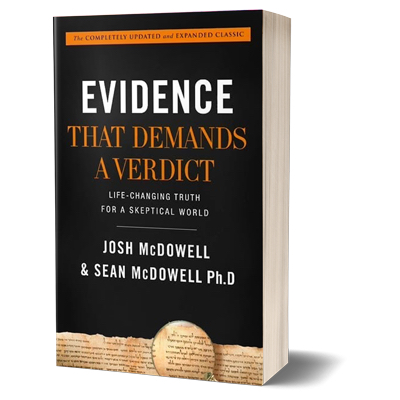
Evidence That Demands A Verdict (book review)

The Apostle Peter wrote a letter to Christians in which he called them “aliens and strangers” because of their belief in a personal Creator and Lord. In this letter, he tells Christians to “always be prepared to give an answer” to those skeptics who want to know about their faith in God. In Evidence That Demands A Verdict, Josh and Sean McDowell have given Christians a key component to help them be prepared to give sound answers.

This book is massive (at just under 900 pages)! But it is an encyclopedia of evidence that will prepare Christians to respond to any argument that an atheist or skeptic may bring up. To be honest with you, the Table of Contents is usually one of the first places I study in books I’m reading, but I usually end up skimming through it pretty quickly. But in Evidence, I was pleasantly surprised at the layout. Not only will you find a listing of the chapters, but a brief description of the contents. At the opposite end of the book, the Subject Index is also quite extensive. I know these are not things usually bragged on in a book review, but for a book this size—and for the numerous times you undoubtedly will be returning to prepare to answer a skeptic—these two reference points are extremely handy!

The first edition of Evidence (written by just Josh) came out nearly 20 years ago. If anything, the evidence for the beliefs that Christians hold has been further validated through research, archeological discoveries, and the like. So it was time for this classic book to be updated. The additional apologetic insights from Sean in this edition is a very nice addition.

Whether you read Evidence when it was first released or not, every Christian that wants to answer Peter’s directive for preparedness needs to get this new edition.

I am Thomas Nelson book reviewer.

C.S. Lewis Asks, Is There Such A Thing As “Christian Obstinacy”?

“There are times when we can do all that a fellow creature needs if only he will trust us. In getting a dog out of a trap, in extracting a thorn from a child’s finger, in teaching a boy to swim or rescuing one who can’t, in getting a frightened beginner over a nasty place on a mountain, the one fatal obstacle may be their distrust. We are asking them to trust us in the teeth of their senses, their imagination, and their intelligence. We ask them to believe that what is painful will relieve their pain and that what looks dangerous is their only safety. We ask them to accept apparent impossibilities: that moving the paw farther back into the trap is the way to get it out—that hurting the finger very much more will stop the finger hurting—that water which is obviously permeable will resist and support the body—that holding onto the only support within reach is not the way to avoid sinking—that to go higher and onto a more exposed ledge is the way not to fall. …

“But if we succeed, we do so because they have maintained their faith in us against apparently contrary evidence. …

“Now to accept the Christian propositions is ipso facto to believe that we are to God, always, as that dog or child or bather or mountain climber was to us, only very much more so. …

“There is, you see, no real parallel between Christian obstinacy in faith and the obstinacy of a bad scientist trying to preserve a hypothesis although the evidence has turned against it. Unbelievers very pardonably get the impression that an adherence to our faith is like that, because they meet Christianity, if at all, mainly in apologetic works. And there, of course, the existence and beneficence of God must appear as a speculative question like any other. Indeed, it is a speculative question as long as it is a question at all. But once it has been answered in the affirmative, you get quite a new situation. To believe that God—at least this God—exists is to believe that you as a person now stand in the presence of God as a Person. What would, a moment before, have been variations in opinion, now become variations in your personal attitude to a Person. You are no longer faced with an argument which demands your assent, but with a Person who demands your confidence.” —C.S. Lewis, in The World’s Last Night

13 More Quotes From “How Great Is Our God”

Scholars, tradesmen, politicians, theologians, pastors, and martyrs—all have spoken or written about the greatness of God over the past two millennia. In How Great Is Our God we are treated to a sampling of these writings. Check out my full book review by clicking here, and then enjoy this second set of quotes.

“Some of us, no doubt, have to live outwardly solitary lives. We all live alone after fellowship and communion. We die alone, and in the depths of our souls we all live alone. So let us be thankful that the Master knows the bitterness of solitude, and has Himself walked that path. Jesus Christ’s union with the Father was deep, close, constant; altogether transcending any experience of ours. But still He sets before us the path of comfort for every lonely heart: ‘I am not alone, for the Father is with Me.’ If earth be dark, let us look to Heaven. If the world holds no friend, let us turn to Him who never leaves us. If dear ones are torn from our grasp, let us grasp God.” —Alexander Maclaren

“The blessedness of individuals must not be determined by the value of their known wealth, but according to the voice of their conscience within them.” —Ambrose

“If God gave you not only earth but heaven, that you should rule over sun, moon, and stars, and have the rule over the highest of the sons of men, it would not be enough to satisfy you, unless you had God Himself.” —Jeremiah Burroughs

“Father in Heaven! What is a man without You! What is all that he knows, vast accumulation though it may be, but a chipped fragment if he does not know You!” —Soren Kierkegaard

“Great are You, O Lord, and greatly to be praised; great is Your power, and Your wisdom is infinite. You awaken us to delight in Your praise; for You made us for Yourself, and our heart is restless, until it rests in You. They that seek the Lord shall praise Him: for they that seek shall find Him, and they that find shall praise Him. I will seek You, Lord, by calling on You; and will call on You, believing in You; for to us You have been preached.” —Augustine

“In the Old Testament, there are twenty times as many references to the second coming of Christ, as to His first coming. … The Cross must ever precede the Crown. He came with the Cross, fulfilling Isaiah 53; and now He is coming with the Crown, the Messiah and King.” —Aimee Semple McPherson

“The Word is the one Shepherd of things rational which may have an appearance of discord to those who have not ears to hear, but are truly at perfect concord. … For all the Scripture is the one perfect and harmonized instrument of God, which from different sounds gives forth one saving voice to those willing to learn, which stops and restrains every working of an evil spirit.” —Origen

“So desperate is the need that we have no time to engage in vain babblings. While we are discussing the exact location of the church of Galatia, men are perishing under the curse of the law; while we are setting the date of Jesus’ birth, the world is doing without its Christmas message.” —J. Gresham Machen

“If the Christian plan is true, then all others are false. If others are true, then there was no need of the sacrifice on the Cross.” —Albert Barnes

“I want through the day to walk with God; God has taken charge of me, He is going with me Himself; I am going to do His will all day in His strength; I am ready for all that may come.” —Andrew Murray

“When the time for the Advent of the Antichrist approaches, people’s minds will grow cloudy from carnal passions, and dishonor and lawlessness will grow stronger. Then the world will become unrecognizable. People’s appearances will change, and it will be impossible to distinguish men from women due to their shamelessness in dress and style of hair. 

There will be no respect for parents and elders, love will disappear, and Christian pastors, bishops, and priests will become vain men. At that time the morals and traditions of Christians and the Church will change. People will abandon modesty, and dissipation will reign. Falsehood and greed will attain great proportions; and lust, adultery, homosexuality, secret deeds, and murder will rule in society. 

At that future time, the churches of God will be deprived of God-fearing and pious pastors, and woe to the Christians remaining at that time; they will completely lose their faith because they will lack the opportunity of seeing the light of knowledge from anyone at all.” —Nilus the Elder (d. 430 AD) 

“It is the Bible itself that drives us out beyond ourselves and invites us, without regard to our worthiness or unworthiness, to reach for the last highest answer. … We need only dare to follow this drive, this spirit, this river, to grow out beyond ourselves toward the highest answer. This daring is faith; and we read the Bible rightly when we read it in faith. The Bible unfolds to us as we are met, guided, drawn on, and made to grow by the grace of God.” —Karl Barth

“Who is regulating affairs on this earth today—God or the devil? That God reigns supreme in Heaven, is generally conceded; that He does so over this world, is almost universally denied—if not directly, then indirectly. More and more are men relegating God to the background. … Therefore we need not be surprised that men exclude Him from the realm of human affairs. … In light of this [Isaiah 55:8-9], it is only to be expected that much of the Bible conflicts with the sentiments of the carnal mind, which is at enmity against God.” —Arthur Pink

You can check out the first set of quotes I shared from How Great Is Our God by clicking here. Stay tuned: more quotes coming soon!

Jesus Our Healer

“It’s clear from the Gospels that Jesus was a healer. We don’t know the exact number of people He healed, but it was certainly in the thousands, as on many occasions the Gospel writers tell us He healed ‘multitudes.’ We don’t know all the afflictions people suffered from, but they included leprosy, a deformed hand, swollen limbs, hemorrhaging, blindness, deafness, lameness, paralysis, seizures, a severed ear, and even death.

“It’s tempting to believe that all these people were healed by their faith, but we don’t know that for sure. We do know, however, that they were all healed by Jesus.

“I’m not just playing with words here.

“There are about forty different descriptions of healings in the four Gospels (some are described in more than one place), but faith is said to play an explicit part in only a little more than one-third of them. And in most of those healings, the faith of another person, not the afflicted, is stated. Faith is not even mentioned in the majority of Jesus’ recorded healings. Only twice did Jesus remark about someone (the centurion in Matthew 8:10 and the Gentile mother in Matthew 15:28) having great faith before He healed that person’s loved one.

“The common factor in all Jesus’ recorded healing miracles was Jesus Himself—not the faith of the sick people or their loved ones.” —Lynn Eib, in Peace In The Face Of Cancer

8 Quotes From “Paths To Power” by A.W. Tozer

As I said in my book review, A.W. Tozer’s words frequently make me say both “Ouch!” and “Amen!” Maybe you’ll feel the same thing in these few quotes.

“Left to herself the Church must have perished as a thousand abortive sects had done before her, and have left nothing for a future generation to remember. That the Church did not so perish was due entirely to the miraculous element within her. That element was supplied by the Holy Spirit who came at Pentecost to empower her for her task. For the Church was not an organization merely, not a movement, but a walking incarnation of spiritual energy. …

“In short, the Church began in power, moved in power, and moved just as long as she had power. When she no longer had power she dug in for safety and sought to conserve her gains. But her blessings were like manna: when they tried to keep it overnight it bred worms and stank. So we have had monasticism, scholasticism, institutionalism; and they have all been indicative of the same thing: absence of spiritual power.” 

“The weakness in our message today is our overemphasis on faith with a corresponding underemphasis on obedience. This has been carried so far that ‘believe’ has been made to double for ‘obey’ in the minds of millions of religious persons.”

“In every denomination, missionary society, local church, or individual Christian this law operates. God works as long as His people live daringly; He ceases when they no longer need His aid.” 

“To any casual observer of the religious scene today, two things will at once be evident: one, that there is very little sense of sin among the unsaved, and two, that the average professed Christian lives a life so worldly and careless that it is difficult to distinguish him from the unconverted man.”

“It is always dangerous to isolate a truth and then press it to its limit without regard to other truth.”

“It may be stated as an axiom of the Christian system that whatever makes sin permissible is a foe of God and an enemy of the souls of men.”

“Some time after Pentecost a group of believers met to pray for strength and power to meet the emergency then facing them, and to enlist the help of God on their behalf. ‘And when they had prayed, the place was shaken where they were assembled together; and they were all filled with the Holy Ghost, and they spake the Word of God with boldness’ (Acts 4:31). Some of these were of the original number filled at Pentecost. It is hardly conceivable that God acted contrary to His own will in filling them again after Pentecost. Still other outpourings are recorded in Acts 8, 10 and 19. All these occurred some years after the original act.

“In brief, the teaching of the New Testament is that the outpouring at Pentecost was the historic beginning of an era which was to be characterized by a continuous outpouring of the Holy Spirit.”

“This anti-emotionalism, though it is sponsored by some good people and travels in pretty orthodox company, is nevertheless an unwarranted inference, not a scriptural doctrine, and is in violent opposition to psychology and common sense. Where in the Bible are feeling and faith said to be at odds? The fact is that faith engenders feeling as certainly as life engenders motion. We can have feeling without faith, it is true, we can never have faith without feeling. Faith as a cold, unemotional light is wholly unknown in the Scriptures.”

How Our Faith Is Perfected

“God’s promises and His provision do not lift us from the world of common sense and everyday trials, for it is through these very things that our faith is perfected.” —Lettie Cowman, in Streams In The Desert