Thursdays With Oswald—Isaiah 30

Oswald ChambersThis is a weekly series with things I’m reading and pondering from Oswald Chambers. You can read the original seed thought here, or type “Thursdays With Oswald” in the search box to read more entries.

Isaiah 30 

[These are the notes on Oswald Chambers’ lecture on Isaiah 30.] 

     The test of true religion is the knowledge of the character of God. As long as you think of God in the quietness of a religious meeting you will never know God—what kind of God have you got when you are in touch with the wrong, bad, evil things? God’s Book reveals that it is right in the midst of the very opposite of God that His blessings occur. The very things which seem to be making for destruction become the revealers of God. It is an easy business to preach peace when you are in health and have everything you want, but the Bible preaches peace when things are in a howling tumult of passion and sin and iniquity; it is in the midst of anguish and terror that we realize Who God is and the marvel of what He can do. …  

     God makes His people sing where in the eyes of the world it seems ironical to sing—in a besieged city where things are going to ruin, in the suburbs of hell, in the valley of the shadow of death. When you see lives in the midst of turmoil and anguish full of amazing brightness and uncrushable elasticity of faith in God, if you do not know God you will say, “However can they go through it? how is it that they remain undiscouraged and undismayed?” The explanation is the presence of God made real in His promises.” 

From Notes On Isaiah 

When you go through a “howling tumult” there are some things to remember:

  1. God is with you
  2. God is in control 
  3. God will help you sing through the storm
  4. Others are watching you
  5. God can be glorified in your undismayed faith in His presence through the tumult 

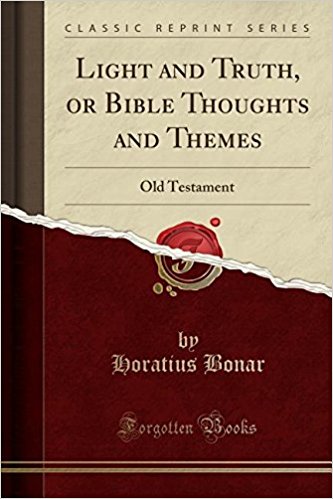
5 Quotes From “Light And Truth—The Old Testament”

I like to think of Horatius Bonar as a tour guide as I read through the Bible, pointing out themes and insights I might have otherwise missed. Check out my full review of Light and Truth—Old Testament by clicking here. 

The elders [1 Chronicles 21:16]. They acknowledge the stroke and the sin: ‘It is the Lord.’ They clothe themselves in sackcloth, they fall upon their faces. So far as we know, they had not shared David’s sin, yet they at once place themselves by his side in confession and humiliation. David had sinned (v. 8), Israel had sinned (2 Samuel 24:1). They identify themselves with both. It is thus that we should take up a ruler’s sin, or a brother’s sin, or a nation’s sin; not blazoning it abroad in private gossip, or in the newspapers, but taking it on ourselves, and carrying it to God.” 

“We do great injustice to the Old Testament saints and to their privileges, and no less so to the God who made them what they were, when we conceive of them as possessing an imperfect justification, or an imperfect and uncertain knowledge of their justification. Paul’s declaration was explicit on this point: ‘I know Whom I have believed’; and yet it was not a jot more explicit than that of Job: ‘I know that my Redeemer lives.’ When Paul said, ‘It is God that justifies, who is he that condemns?’ he was only speaking what Job had spoken in ages before: ‘I know that I shall be justified. Who is he that will plead with me?’” [Job 13:18-19]

“Everything in God’s character, has by the Cross of Christ been turned into a reason for trusting Him. The more man knows of Him the more he trusts. Trust is the natural and inseparable response of the soul to the divine revelation of the character of God. It is not what man sees in himself, of his good deeds or good feelings, of his graces, or his repentance, or his regeneration, or his faith; but what he sees in God, that calls out confidence.” 

“It is with no distant, unheeding God that we have to do; but with that God who fixes the bounds of our habitation, who counts our hairs, who feeds the ravens, notes a sparrow’s death, clothes the lilies of the field. He is nearer to us than the nearest earthly object or being; more closely in contact with us than we are with one another.” 

“We disjoined God from creation, and so see nothing in it of divine life and power. … The separation of God from His works is one of the awful features of human unbelief. How much more of Him should we know, were we to interpret His works aright. … These skies of His are not bent over us in beauty without a meaning. These seas of His do not roll for nothing. These flowers of His are not fragrant and fair for nothing. They do not say to us, ‘God is your enemy, He hates you’; but ‘God is your friend, He pities you, yearns over you, wishes to make you happy.’ How full a gospel does creation to preach to us, according to its kind and measure!”

Everyone’s A Critic

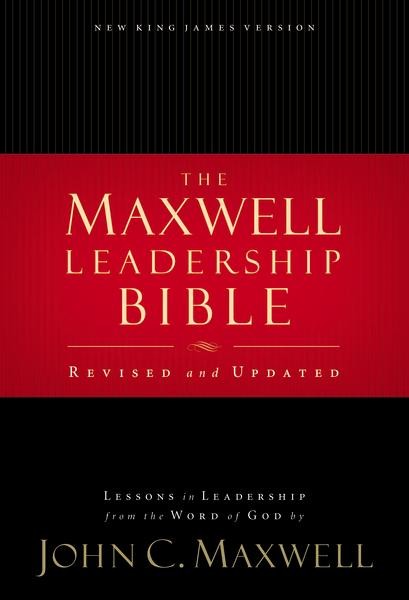
These are wise words from John Maxwell in The Maxwell Leadership Bible

Then Miriam and Aaron spoke against Moses because of the Ethiopian woman whom he had married; for he had married an Ethiopian woman. (Numbers 12:1)

Leaders can bank on two truths. First, they will be criticized. Second, criticism always changes the leader. Unhappy people tend to attack the point person.

Moses’ only family criticized him. Notice what God and Moses teach us on how to handle criticism (Numbers 12):

  1. Maintain your humility. (v. 3)
  2. Face the criticism squarely. (v. 4)
  3. Be specific about the issue. (vv. 5-8)
  4. Lay out consequences. (vv. 9, 10)
  5. Pray for the criticizers. (vv. 12, 13)
  6. Restore them when appropriate. (v. 14)

Beyond that, consider the ways leaders should handle criticism:

  1. Understand the difference between constructive and destructive criticism.
  2. Look beyond the criticism to see the critic.
  3. Guard your own attitude toward the critic.
  4. Keep yourself spiritually in shape. Associate with people of faith.
  5. Wait for time to prove the critic wrong.
  6. Concentrate on your mission; change your mistakes.

You might also want to check out—

Thursdays With Oswald—Isaiah 6

Oswald ChambersThis is a weekly series with things I’m reading and pondering from Oswald Chambers. You can read the original seed thought here, or type “Thursdays With Oswald” in the search box to read more entries.

Isaiah 6

[These are the notes on Oswald Chambers’ lecture on Isaiah 6.]

     My vision of God depends upon the state of my character. Character determines revelation. … Until I am born again and enter the Kingdom of God I see only along the line of my prejudices. …  

     The purpose of the vision is to enable me to see “the arm of the Lord” behind all circumstances (see Isaiah 53:1). God never gives a man the power to say “I see” until his character proves itself worthy of its purification. What hinders the purging of our perception is that we will build our faith on our experiences instead of on the God who gave us the experiences. My experience is the evidence of my faith, never the ground of it, and is meant to reveal to me a God who is bigger than any experience. …  

     The symbol of the live coal ‘from off the altar’ represents the twofold nature of the substitution of Christ, not only Christ for me, but Christ in me. … 

     God only gives us visions of Himself for one purpose, that we may work them out into character. … After God has given us a time of face-to-face contact with Himself and then puts us into tumults, the temptation is to sit down and say “Where is the blessedness I had when I first knew the Lord?” The Spirit of God holds us steady until we learn to know God, and the details of our lives are established before Him, then nothing on the outside can move us.

From Notes On Isaiah

There are specific reasons God will give us a clearer revelation of Himself—

  1. to purify godly character in us
  2. to help us deal with our own sin
  3. to see God at work in everyday affairs
  4. to keep us energized through trying times
  5. to make us more aware of what Jesus has done for us and in us
  6. to be His messenger among needy people

God doesn’t give visions or revelations just to thrill us or give us an experience. God is perfectly purposeful in everything He does. His visions are for His glory.

How Should Christians Handle Objections?

It’s no secret that when a Christian says, “This is what I believe,” or “This is what the Bible says,” or even something as simple as, “I believe in God,” that there will be people who disagree. Sometimes their disagreement may even become an outright attack.

How are Christians to respond?

Here are five ways I’ve found to be effective and Christ-honoring—

1. Don’t argue. Arguments tend to create an “I don’t want to lose” feeling in the other person, which makes them unable to truly hear what you’re saying. Solomon wrote, “Do not answer a fool according to his folly, or you will be like him yourself” (Proverbs 26:4).

2. Ask questions. Jesus was a master at this. Look through the Gospels and you will see Jesus asking questions to clarify others’ positions. Questions stimulate further conversation, while statements tend to shut down the conversation. Questions develop a relationship, while definitive statements make you seem superior to the other person.

3. Don’t argue. Yes, this is good enough to repeat! Paul’s advice to Timothy was, “Do not waste time arguing over godless ideas and old wives’ tales” (1 Timothy 4:7).

4. Pray for mercy. Remember that if you are really speaking truths from the Bible, the person arguing against those truths is arguing with God, not with you.

5. Pray for light. Paul said that the “god of this age” has blinded people (see 2 Corinthians 4:2-4), so we should pray that the Holy Spirit would grant them light to see the truth.

“Oh, the unmitigated curse of controversy! Oh, the detestable passions that corrections and contradictions kindle up to fury in the proud heart of man! Eschew controversy, my brethren, as you would eschew the entrance to hell itself. Let them have it their way; let them talk; let them write; let them correct to you; let them traduce you; let them judge and condemn you; let them slay you. Rather let the truth of God suffer itself, than that love suffer. You have not enough of the divine nature in you to be a controversialist.” —Dr. Alexander Whyte

Let’s be passionate for people, not passionate to win an argument!

I go into more detail in this video…

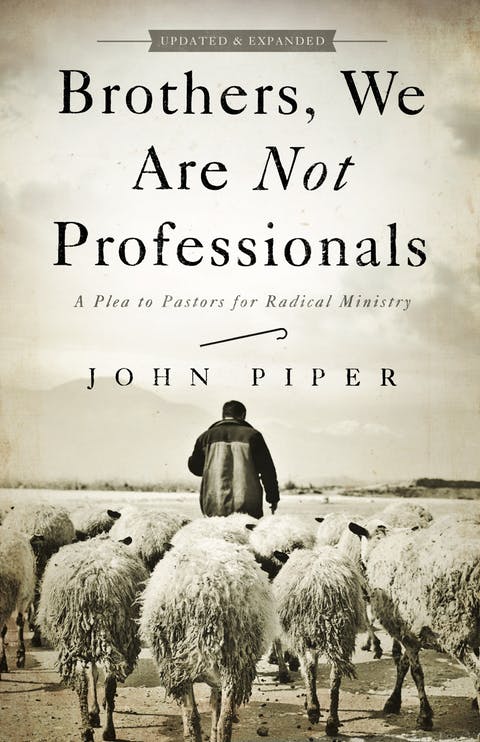
11 Quotes From “Brothers, We Are Not Professionals”

John Piper has written a book that I think every pastor should read: Brothers, We Are Not Professionals. You can read my review of this book here. Below are just a few quotes that caught my attention.

“We pastors are being killed by the professionalizing of the pastoral ministry. The mentality of the professional is not the mentality of the prophet. … The professionalization of the ministry is a constant threat to the offense of the gospel.”

“I defined spiritual leadership as ‘knowing where God wants people to be and taking the initiative to get them there by God’s means in reliance on God’s power.’ …  So the goal of spiritual leadership is to muster people to join God in living for God’s glory.”

“The Son of Man has not come seeking employees. He has come to employ Himself for our good.”

“In this fallen world, the tide is always going out. That is, the affections of our people have for God Himself (as distinct from His gifts) are continually prone to shrink. Our job is to tilt the world, by the power of the Spirit and the Word, so that the tide rolls in again.”

“A pastor who feels competent in himself to produce eternal fruit knows neither God nor himself.”

“Salvation is a gift of God (Ephesians 2:8). Love is a gift of God (1 Thessalonians 3:12). Faith is a gift of God (1 Timothy 1:14). Wisdom is a gift of God (Ephesians 1:17). Joy is a gift of God (Romans 15:13). Yet as pastors we must labor to ‘save some’ (1 Corinthians 9:22). We must stir up the people to love (Hebrews 10:24). We must advance their faith (Philippians 1:25). We must impart wisdom (1 Corinthians 2:7). We must work for their joy (2 Corinthians 1:24). We are called to labor for that which is God’s alone to give. The essence of the Christian ministry is that its success is not within our reach.”

“Are not our people really yearning to be around a man who has been around God? Is it not the lingering aroma of prayer that gives a sense of eternity to all our work?”

“Few things frighten me more than the beginnings of barrenness that come from frenzied activity with little spiritual food and meditation.”

“The domestication of God is a curse on preaching in our day. We need to recover reality and the language of majesty and holiness and awe and glory.”

“He knows that the only way he can deliver God’s message to God’s people is by being rooted in it and by saturating his sermon with God’s own revelation in the Bible. The Bible-oriented preacher wants the congregation to know that his words, if they have any abiding worth, are in accord with God’s words. He wants this to be obvious to them. That is part of his humility and his authority. Therefore, he constantly tries to show the people that his ideas are coming from the Bible. He is hesitant to go too far toward points that are not demonstrable from the Bible.”

“Our salvation and the salvation of those who hear us week after week depend in large measure on our faithful attention to personal holiness and sound teaching” [see 1 Timothy 4:16]. … Oh, how earnest we should be in attending to ourselves and the soundness and helpfulness of our teaching!”

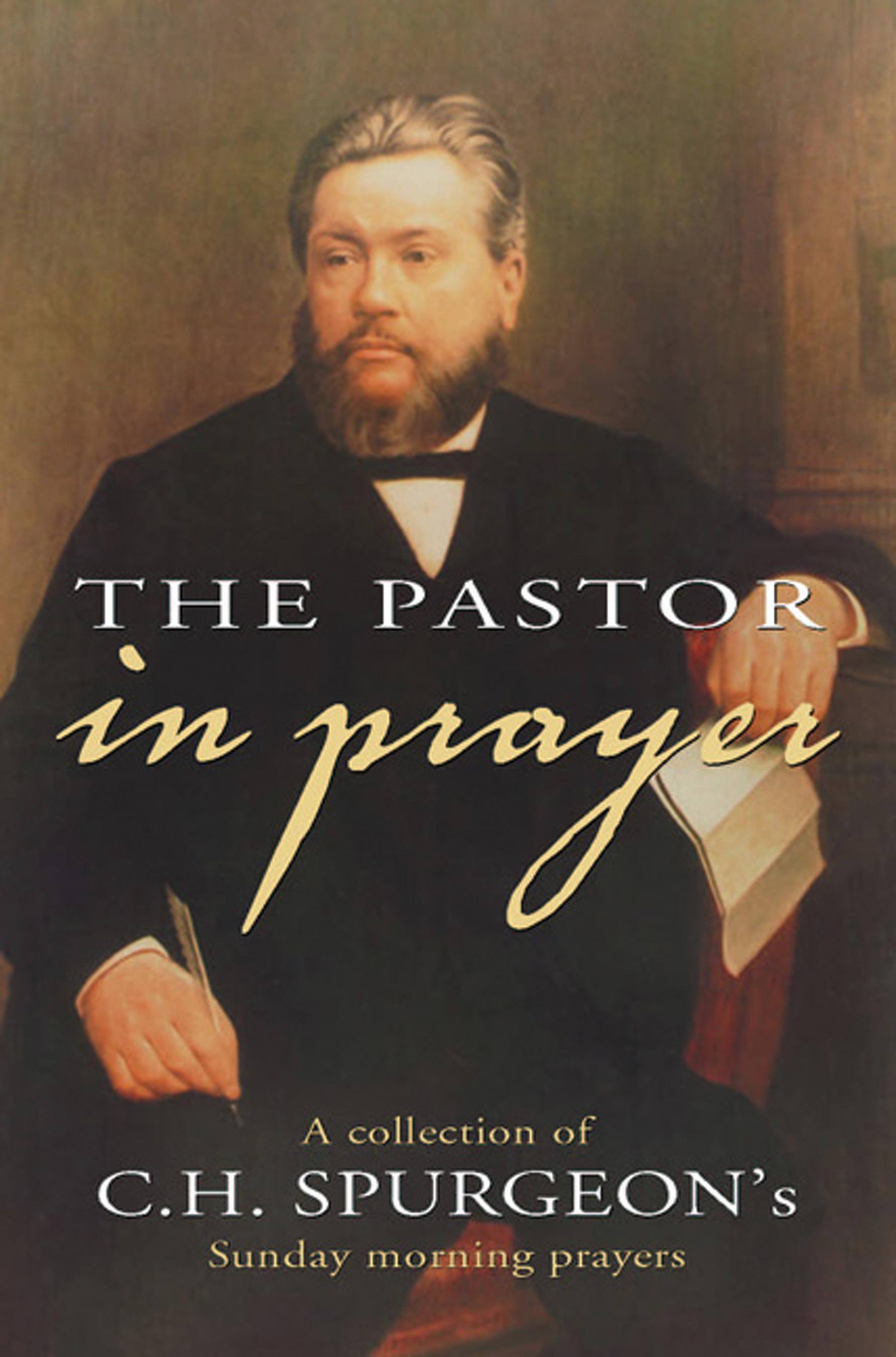
7 Quotes From “The Pastor In Prayer”

In The Pastor In Prayer we discover that Charles Spurgeon is not only the prince of preachers, but the prince of pray-ers as well. Check out my review of this fabulous book by clicking here.

“Thy grace must give us even to know our need of grace. We are not willing to confess our own sinfulness until Thou dost show it to us. Though it stares us in the face our pride denies it, and our own inability is unperceived by us. We steal Thy power and call it our own till Thou dost compel us to say that we have no strength in ourselves.”

“Thy grace has almost out-graced itself, Thy love has reached its height love to rebels; so to love that even Thy Son could not be spared. O God, we are afflicted in our hearts to think we do not love Thee more after such love as this.”

“O God, we beseech Thee bring men away from all their false trusts to rest in the great sacrifice of Thy dear Son.”

“Oh that we might live so near to the great Shepherd as to be familiar with His voice, to know its tones, that so a stranger we may not follow, for we know not the voice of strangers.”

“Thou art good when Thou givest, and Thou art good when Thou takest away. Thou art good when the night gathers heavy about us. Thou art good when the sun shineth and gladdeneth our pathway. Thou art always good and doest good, and blessed be the name of the Lord from the rising of the sun unto the going down thereof, and through the night watches let His praise be still celebrated.”

“And truly since we have received so many mercies at Thy hand, we do feel that Thou wilt never forsake us in any darkness which may be in our path in the future. Thou hast done too much for us to desert us now. We have cost Thee so much—Oh wondrous price that Thou hast paid for us—and Thou hast spent so much of wise thought, and gracious act upon us, that we are persuaded Thou wilt go through with the work which Thy wisdom has undertaken. But give us faith to believe this when the stormy times come, let us not doubt.”

“Lord, while we work for Thee, always keep us sitting at the feet of Jesus. Let our faith never wander away from the simplicity of its confidence in Him. Let our motive never be anything but His glory; may our hearts be taken up with His love, and our thoughts perpetually engaged about His person.”

Love Is Really Love

Love is really love—when we are loving the unlovable.

Forgiveness is really forgiveness—when we are forgiving the unforgivable.

Repentance is really repentance—when we let our wrong loves be broken by the rightness of God’s unbreakable love.

Faith is really faith—when we believe God for the unbelievable.” —Ann Voskamp, in The Broken Way

The Christmas Candle (book review)

Max Lucado is a storyteller par excellent! His craft is on full display in the engaging short story The Christmas Candle.

Lucado takes us back to Victorian-era England, to the small village of Cotswolds. Nothing much seems to happen in this little village, except for a visit from an angel every 25 years to one specific family. The Haddington family have been candle-makers for as far back as anyone can remember. Every quarter-century, just before Christmas, an angel appears in the Haddington’s shop and points out one special candle. When this unique candle is given away by the Haddingtons to an individual, they can pray for a miracle and expect that God will answer that prayer.

Lucado’s story centers on a time when the angel should be appearing soon. But Mr. and Mrs. Haddington are older now, and worried that they don’t have an heir to which the candle-making trade can be passed on, the townspeople are in more desperate need than ever before, and the village’s new pastor is highly skeptical about the so-called “miracle qualities” of an ordinary looking candle. And all the while, the time of the angel’s appearing is getting closer and closer.

The message Lucado is able to drive home through this story is truly a God-given gift that will encourage your faith. Whether you read this book at Christmas time or not, you will be uplifted in your faith in God’s power to do the miraculous!

Thursdays With Oswald—The Power Is In The Solitude

Oswald ChambersThis is a weekly series with things I’m reading and pondering from Oswald Chambers. You can read the original seed thought here, or type “Thursdays With Oswald” in the search box to read more entries.

The Power Is In The Solitude

     If we want to know the universal sovereignty of Christ, we must get into solitude with Him. It is not sufficient for someone else to tell us about Him; we must perceive with our own eyes Who He is, we must know Him for ourselves. … 

     We must get to the place of real solitude with Christ. He is our mountain-height and our sea-calm; He is the recreating power; He is the universal Sovereign. He tells us to consider the lilies; we say—“No, we must consider life.” We mistake the mechanism of life for life itself, and that idea has become incorporated into Christian work. In the active work we do for God we do not really believe that Jesus Christ is sovereign Lord; if we did, we should fuss less and build more faith in Him. We cannot do the Savior’s work by fuss, but only by knowing Him as the supreme sovereign Lord. … 

     Our Lord’s word “go” simply means “live,” and Acts 1:8 describes the “going.” Jesus did not say to the disciples—“Go into Jerusalem, go into Judea, go into Samaria, go into the uttermost part of the earth”; but—“You shall be My witnesses” in all these places: He undertakes to establish the goings. So many people are obsessed with this idea—“What are you going to do?” I hope none of us are going to do anything: I hope we are going to be what He wants us to be. … 

     The key to the missionary is the absolute Sovereignty of the Lord Jesus Christ. We must get into real solitude with Him, feed our soul on His Word, and He will engineer our circumstances.

From So Send I You 

Jesus gave a command to all His followers—including all of us today—All authority in heaven and on earth has been given to Me. Therefore go (Matthew 28:18-19). Jesus is saying to us, “Preach and teach out of a living experience of Myself.” In this respect, we are all missionaries.

Oswald Chambers reminds us missionaries that the only way we will be effective in our goings is by spending adequate time in solitude and worship with Our Lord. If we don’t, then we are trying to do ministry on our own, trying to engineer our own circumstances. But the missionary who is spending time with Jesus finds that He directs all our goings and engineers all our circumstances.

The power to testify about Jesus comes from our time of solitude with Jesus.