Praying Against Spiritual Strongholds

“This week we pray that God will demolish the Antichrist’s strongholds

“We are surrounded by systems and strongholds that oppose Christ the Lord and King. There are social, political, economic, and legal structures and schemes that try to disparage God.

“We are not for or against a particular political system. We are Bible-believers, Christ-worshippers; and we come from all walks of life and backgrounds. We seek the glory of God and His alone. We align ourselves with His Word.

“We should not harbor enmity or hatred toward anyone. Even if they oppose us, deride our faith, doubt our God, and insult our Savior and King, they are not our enemies. The real enemy is satan who manipulates them. Our war is against satan and his strongholds.

“Such people are poor humans who need love and compassion from us, and mercy and forgiveness from God. We do not depend on human methods or material weapons, because this is spiritual warfare against satanic powers. Rather, our method is prayer, and that is all.

“Our prayer—O Lord our God, may You be praised for ever and ever! Why do the nations rage? Why do the peoples plot in vain? The kings of the earth set themselves, and the rulers take counsel together, against You and against Your Anointed One (Psalm 2:1-2).

“Help us arm ourselves with the weapons You gave us in Your Word: the belt of truth, the breastplate of righteousness, the readiness of the gospel of peace, the shield of faith, the helmet of salvation, and the sword of the Spirit (Ephesians 6:14-17).

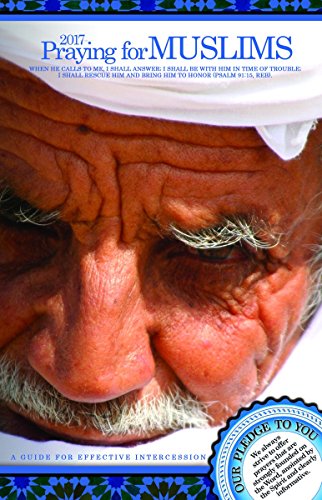
He who sits in the heavens laughs; the Lord derides them … at the name of Jesus every knee will bow, in heaven and on earth and under the earth, and every tongue confess that Jesus Christ is Lord, to the glory of God the Father (Psalm 2:4; Philippians 2:10-11). I pray in the mighty name of Jesus. Amen.” —a prayer from Praying For Muslims

If (book review)

Amy Carmichael was a committed follower of Jesus Christ! She served as a missionary in India, where she operated an orphanage, for 55 years. During all that time, she never took a furlough, but remained at her post, faithfully loving Indian children with God’s love. She wrote a number of books, but perhaps the most hard-hitting is a little book simply called If.

This isn’t a book for everyone. In fact, Amy herself wrote, “It is clear, I think, that such a booklet as this is not meant for everyone, but only for those who are called to be undershepherds.” By ‘undershepherds,’ Amy is referring to those who feel God has called them into full-time vocational ministry.

(A little side-note. I feel the Bible is clear that all followers of Christ are to be involved in ministry [see Ephesians 4:11-16], but God has appointed some to positions where their ministry is also their vocation. These ‘undershepherds’ [see 1 Peter 5:2-3] will have to give account to God for the handling of their vocational ministry [Hebrews 13:17]. It is to these folks that Amy writes.)

Amy set the bar high for herself. She expected to be continually growing in her level of commitment to Christ, and she expected that her outward life would continually show greater devotion to her Savior. If comes out of Amy’s personal introspection in the Holy Spirit’s presence on how she was progressing in her faith-walk with God.

If is written as a series of challenges that all follow the same format: “If I don’t measure up to God’s standard in this area … then I know nothing of Calvary love.” I realize this sounds challenging. In fact, this book smacked me right between the eyes! This is why If is only for a small segment of people.

What Does The Bible Say About Church Leaders?

God’s plan has always been for His leaders to organize and oversee His ministry.

The important thing for us to distinguish is “His.” It’s not a man or woman saying, “I will be a leader,” or even a God-appointed leader saying, “I am going to build up my ministry.”

The New Testament gives us a fourfold purpose for the Body of Christ:

  1. Mobilizing for evangelism
  2. Organizing for more meaningful ministry
  3. Making disciple-makers
  4. Caring for one another

We see God’s leaders involved in all of these aspects—

Mobilizing for evangelism—Peter pointed out the need for an apostle to be appointed to replace Judas, thus returning their ranks to the 12 apostles just as Jesus had originally said (Acts 1:15-22).

Organizing for more meaningful ministry—Everywhere Paul founded a church, he also appointed leaders to oversee and shepherd that church.

Making disciple-makers—Paul tells us that God appointed five offices of leaders in the church who had the specific task of preparing church members to do the ministry of building maturity in the church (Ephesians 4:11-16).

Caring for one another—The First Church set the pace for providing care for all who were in need, including organizing leaders to oversee specific care ministries (Acts 6:1-5).

What about a church congregation’s responsibility to their leaders? I see five areas:

  1. Hold them accountable to the Word (Acts 17:11). The Bible has to be THE standard to which leaders are held.
  2. Give them your confidence and submission after they have shown accountability to their biblical mandate (Hebrews 13:17).
  3. Pray for them (Ephesians 6:19).
  4. Pay them (1 Timothy 5:17).
  5. Be very careful about accusing them (1 Timothy 5:19).

A church and its leaders following this biblical pattern is a church that can effectively fulfill the Great Commission which Jesus gave us.

The Mystery & Meaning Of Marriage

John Piper’s insight of both the Old Testament and New Testament meaning of marriage is profound!

Here are the links to the Scriptures he references:

Piper’s conclusions:

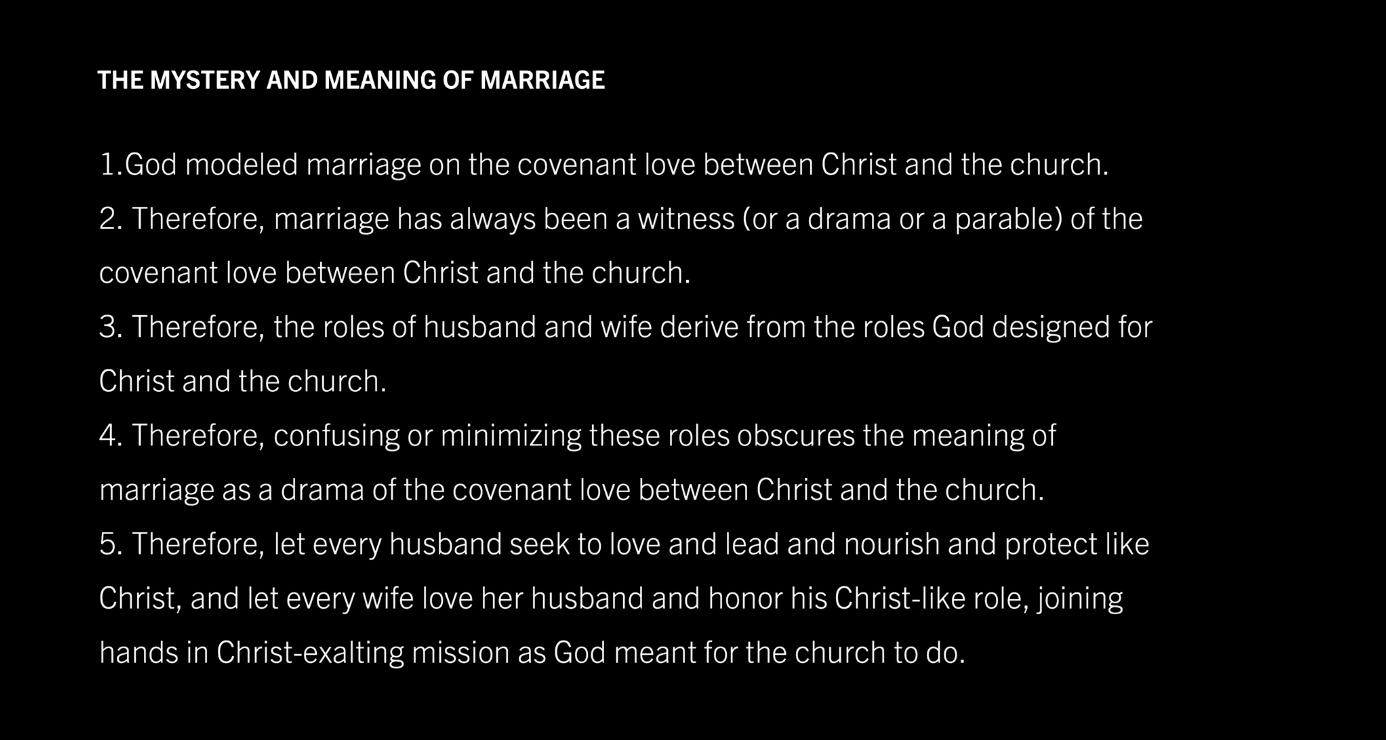
  1. God modeled marriage on the covenant love between Christ and the church.
  2. Therefore, marriage has always been a witness (or a drama or a parable) of covenant love between Christ and the church.
  3. Therefore, the roles of husband and wife derive from the roles God designed for Christ and the church.
  4. Therefore, confusing or minimizing these roles obscures the meaning of marriage as a drama of the covenant love between Christ and the church.
  5. Therefore, let every husband seek to love and lead and nourish and protect like Christ, and let every wife love her husband and honor his Christ-like role, joining hands in Christ-exalting mission as God meant for the church to do.

What Is The Church Supposed To Be Doing?

Listen to the podcast of this post by clicking on the player below, and you can also subscribe on AppleSpotify, or Audible.

Before ascending back to Heaven, Jesus commissioned His followers. He gave them a mission that Christians often refer to as The Great Commission.

Jesus said, “All authority in heaven and on earth has been given to Me. Therefore go and make disciples of all nations, baptizing them in the name of the Father and of the Son and of the Holy Spirit, and teaching them to obey everything I have commanded you. And surely I am with you always to the very end of the age.”

There are several pictures in the New Testament of how the Church could live out this Great Commission, but one of the pictures that I find the most helpful is that of a Body.

The human body is an amazing creation! Just to accomplish the simple task of picking up something between our thumb and forefinger is a miracle in itself. The structure of bones and ligaments and tendons, the interaction of nerves in the fingers coordinating with the optical nerve, not to mention the enzymes and blood vessels that are all doing their part.

Yet if any part is not functioning properly, that simple action becomes more difficult. Maybe it even becomes impossible.

The Church is the same way. Every part of the Church Body has to be functioning in healthy order for the whole Body to be effective.

Here are four aspects of a healthy Church Body that the Apostle Paul lists in Ephesians 4:

  1. Caring for one another
  2. Mobilizing for evangelism
  3. Making disciple-makers
  4. Helping organize for more meaningful ministry

If every part of the Body is doing its part, we’re Living out the Great Commission.

If some parts are missing or unhealthy, we’re Wallowing in the Great Omission.

It’s not about your church (small “c”) or my church. It’s about all Christian disciples being a part of one Church—one Body—going into all the world and making disciples of all peoples. That’s what the Church is supposed to be doing!

►► Would you please prayerfully consider supporting this ministry? My Patreon supporters get behind-the-scenes access to exclusive materials. ◀︎◀︎

Are There Ghosts?

As a part of our annual Q Series, this was a question that was turned in: Are there ghosts?

Check out the video below…

The Scriptures I reference in this answer:

For other Q&As from this series, check out discussions about the Bible here, and questions about the mark of the beast here, and a question about a Christian losing his/her salvation here.

You Are A Masterpiece!

“‘For we are His workmanship, created in Christ Jesus for good works, which God prepared beforehand so that we would walk in them’ (Ephesians 2:10). The Greek word for workmanship is poiema, from which we get the English word poem. It can also mean masterpiece. …

“The book of Genesis tells us that God created each of us in His image. You and I are created to be so much more than normal. Being normal is safe. And easy. It doesn’t require much work or effort or change on our part. But it always leads to mediocrity. When you strive to be just like everyone else, you never have a chance to be special. When you start to embrace and even celebrate how different God made you, you can begin to do extraordinary things. You can begin to see yourself through His eyes. You can begin to live in the uniqueness with which you were created.” —Tim Tebow, in Know Who You Are, Live Like It Matters (emphasis mine)

11 More Quotes From “Cherish”

Gary Thomas calls on husbands to not just love their wives, but to cherish them. It’s an admirable goal for all married men! Please check out my review of Cherish by clicking here. Below are a few more quotes I especially liked.

“Never forget: You married a spouse with natural weaknesses. You married a spouse with a history of hurt. We can be agents of healing redemption and acceptance in our marriage, or we can do further harm, perhaps unintentionally.”

“Of course, there’s no promise that if you persevere, you’ll get just what you’re hoping for. But the one certainty is that if you give up, you definitely won’t get it.”

“Every conversation—every one!—takes you closer to or farther away from a cherishing marriage. The Bible declares this truth: ‘The tongue has the power of life and death’ (Proverbs 18:21).”

“If we want our spouses to feel cherished, we may have to work at a few things we’re not so good at by nature.”

“Pam Farrel writes in several of her books that a wife often feels most loved when her husband is simply more curious about her. … It’s not enough to simply listen. We have to take the next step, engage, and go even further to say, ‘I want more. Tell me more.’ We have to maintain our curiosity. … Husbands, cherishing often isn’t about what your wife is saying; it’s about who is saying it.”

“Silence is often unintentionally malicious, so try to verbalize every positive thing you can think of.”

“A joyful person walking in grace and hope can cherish much more than one who is tangled up in the guilt that Christ died to remove. Our guilt serves no one. In Christ, our self-condemnation offends God; it doesn’t please Him. To walk in condemnation is to call God a liar and Christ’s work insufficient. One of the worst sins you can commit as a Christian is to define yourself by your sin. In the same way, one of the worst sins you can commit against your spouse is to always define them by their sin. Biblical marriage is about defining each other as Christ defines us—saved.”

“Your spouse has a unique history, so cherish your spouse by treating them according to their reality: They are living a life that has never been lived before. They have a personality that has never existed before. They have a unique blend of strengths and weaknesses, temptations and gifts, as well as a once-in-the-universe calling. Your role is to help them complete their one-of-a-kind story.”

“Never, ever, get to the point that you expect your spouse to never stumble. Otherwise, you won’t cherish them; you’ll resent them.”

“Stop comparing your spiritual maturity with your spouse’s; instead, start comparing your spiritual maturity with Ephesians 4:1–3. If you do that, you will change the climate of your marriage.”

“When someone pledges to be your spouse, that commitment alone should earn him or her the benefit of the doubt. Even when things may not look the best, seek understanding before you even think about censure. Cherishing our spouses doesn’t mean living in Fantasyland, but it does mean giving our spouses the benefit of the doubt instead of jumping immediately to accusation.”

To read the first set of quotes I shared from Cherish, click here.

Thursdays With Oswald—Teach Them While They’re Young

Oswald ChambersThis is a weekly series with things I’m reading and pondering from Oswald Chambers. You can read the original seed thought here, or type “Thursdays With Oswald” in the search box to read more entries.

Teach Them While They’re Young

      We need a personal knowledge of God through all our life. The time to discover Him for ourselves is in life’s earliest morning—“that from a child thou hast known the holy Scriptures, which are able to make thee wise unto salvation,” wrote Paul to Timothy (2 Timothy 3:15). “And ye fathers, provoke not your children to wrath: but nurture them in the chastening and admonition of the Lord” (Ephesians 6:4).

     We are so built that in childhood we can more easily come to a knowledge of God in simplicity than in later years. And in those formative years the personal life can be shaped and fitted to God’s standard more surely than later on.

From Shade Of His Hand

At the end of Ecclesiastes, Solomon wrote, “Remember your Creator in the days of your youth, before the days of trouble come” (Ecclesiastes 12:1).

Oswald Chambers notes that parents lay a much stronger foundation for their children’s future spiritual attainment by talking often of the love of God while those children are still young.

Parents—start early, keep at it often, and don’t ever quit telling your children about God’s love. 

These commandments that I give you today are to be on your hearts. Impress them on your children. Talk about them when you sit at home and when you walk along the road, when you lie down and when you get up. Tie them as symbols on your hands and bind them on your foreheads. Write them on the doorframes of your houses and on your gates. (Deuteronomy 6:6-9)

Train up a child in the way he should go: and when he is old, he will not depart from it. (Proverbs 22:6)

[Mom and Dad, be sure to check out Andrew Murray’s exceptional book Raising Your Child To Love God. You can read some quotes from Murray’s book here, and some of his prayers for children here.]

The Christian In Complete Armour (book review)

the-christian-in-complete-armourWhen I saw both John Newton and Charles Spurgeon put William Gurnall on their “must read” lists (I’ll share their quotes in a moment), I thought, “I have to get this book!” Although The Christian In Complete Armour was written by Gurnall over 360 years ago, the words ring just as true for Christians today.

In summary, The Christian In Complete Armour is an intensive look at the spiritual warfare preparations that the Apostle Paul lists in Ephesians 6:10-18. Gurnall opens his book with these sobering challenges to Christians:

“All may have a desire to be successful soldiers, but few have the courage and determination to grapple with the difficulties that accost them on the way to victory.”

“The fearful are those who march for Hell (Revelation 21:8); the valiant are those who take Heaven by force (Matthew 11:12). Cowards never won Heaven. Do not claim that you are begotten of God and have His royal blood running in your veins unless you can prove your lineage by this heroic spirit: to dare to be holy in spite of man and devils.” (emphasis mine in both quotes)

So piece by piece, step by step, William Gurnall explains the value of each of the Christian’s armaments. He tells us what we can expect when we employ them as God intended, and what we should fear if we fail to make use of each and every piece of equipment God has made available for His soldiers.

John Newton said, “If I might read only one book besides the Bible, I would choose The Christian In Complete Armour.”

And Charles Spurgeon noted, “Gurnall’s work is peerless and priceless; every line is full of wisdom; every sentence is suggestive…the best thought-breeder in all our library.”

Although a very old text, James S. Bell, Jr. has done a marvelous work in preserving Gurnall’s message, but presenting it to us in modern-day English. This is an excellent work for every Christian soldier to have on their shelf.

I am a Moody Press book reviewer.