4 Terrible Ways & 4 Great Ways To Study Your Bible

Isaac Newton Bible study.001There are two Greek words in the New Testament that have to do with trying to figure things out. One of them leads to less knowledge, and one opens the way for greater learning. Not surprisingly, Jesus never used the first way, but He confronts people who try to.

The first Greek word is defined as learning through self-calculation. In other words, I try to get at the right answer by either teaching myself, or by talking with people who don’t know any more than I do. This way leaves me in the dark.

For example, notice the phrase “discussed among themselves” in Matthew 16:7 and Mark 11:31. These are people who wanted to try to get answers without going to someone who could teach them. So that leads to four terrible ways to study your Bible—

  1. Approach your Bible with a know-it-all attitude.
  2. Try to figure out what the Bible is saying all on your own.
  3. Try to be your own Bible teacher.
  4. Grade your own tests as to your answers being right or wrong.

These are not only terrible ways to learn, but they are the exact opposite of what God desires. God says things like, “Come, let us reason together” (Isaiah 1:18), and “Call to Me and I will tell you things you do not know” (Jeremiah 33:3).

There is another Greek word which means to learn by having a conversation with someone more knowledgable than myself. So that means four great ways to study your Bible are—

  1. Ask the Holy Spirit to illuminate Scripture to you (John 16:13).
  2. Study the Bible in a daily systematic way (Acts 19:9).
  3. Don’t take anyone else’s word for what the Word says (Acts 17:11).
  4. If you’re confused, ask God to make it clear to you (Jeremiah 33:3).

Luke records an important story for us that took place on the day Jesus was raised from the dead. Two men were walking along “discussing these things with each other,” but not consulting the Scriptures. The result: they were sad and confused. Jesus join them on their journey (although they didn’t recognize Him at first), and took them to the Scriptures that showed them the answers for which they were yearning. They even said, “When He talked to us from the Scriptures, that’s when our hearts burned within us!” (see Luke 24:13-32).

You can try to figure life out on your own, and you will probably end up stymied like the religious leaders in Mark 11, or downcast like the disciples in Luke 24. Or you can ask the Holy Spirit to show you truths from the Scriptures, and have your eyes opened, like the two disciples after Jesus met with them. I think the choice is obvious!

Join me next week as we continue our series How To Study Your Bible.

8 Quotes From “Light & Truth—Acts and the Larger Epistles”

Light & Truth [Acts]Horatius Bonar had great insight into the application of Scriptures. Check out my review of this commentary from Dr. Bonar by clicking here. Below are a few quotes that caught my attention. The reference in brackets after the quote is the biblical passage on which Bonar is commenting.

“Our Bible is of God; yet it is also of man. It is both divine and human. It comes to us from God’s Spirit; it comes also from man’s spirit. It is written in the language of the earth, yet its words are the words of him ‘Who speaketh it from heaven.’ Natural, yet supernatural; simple, yet profound; undogmatical, yet authoritative; very like a common book, yet very unlike also; dealing often with seeming incredibilities and contradictions, yet never assuming any need for apology, or explanation, or retraction; a book for humanity at large, yet minutely special in its fitnesses for every case of every soul; throughout its pages, from first to last, one unchanging estimate of sin as an infinite evil, get always bringing out God’s gracious mind toward the sinner, even in his condemnation of the guilt; such is the great Book with which man has to do, which man has to study, out of which man has to gather wisdom for eternity.” [Acts 1:1

“One of the great characteristics of the whole interval between Christ’s first and second coming is the world’s rage, secret and open, against the Father and the Son. … It is very useless anger. It accomplishes nothing. It is like an angry child striking a huge rock with its fist. It is the mere display of impotent hatred, or the temporary gratification of their dislike of God, and their rejection of His purpose regarding His Son. … It calls light darkness, and darkness light; good evil, and evil good; but the light and the darkness, the good and evil, still remain as they were. All the enlightenment of the age, all the appliances of modern progress, are impotent against God and His Christ, against His truth, and His church, and His Word.” [Acts 4:25]

“This is one of the many repetitions of the Pentecostal scene which occurred in early days. Most unscriptural is the statement of some that the giving of the Spirit at Pentecost was a thing done once for all, not to be repeated, and that we are not to pray for or expect such things again. The whole of the ‘Acts of the Apostles’ is a direct refutation of this piece of human fancy. Wherever the apostles went there was a repetition of Pentecost, whether at Jerusalem, or Samaria, or Antioch, or Corinth. Every conversion is the repetition of Pentecost; it is doing the same thing for an individual soul as was done for three thousand then, by a similar process, and by the same power—the power of the Holy Spirit. The Holy Ghost is the heritage of the church. The Old Testament saints possessed Him; and still more the New. This is our heritage, the heritage of every believing man.” [Acts 11:15

“Beware of seeking anything less than the baptism of the Holy Ghost. Our whole life is to be a reception of the Spirit. He is to be continually coming down on us, and filling us. Let us open our mouth wide that He may fill it. Let us beware of anything that would present itself as a substitute for the living Spirit. Many such things may we expect in these last days from satan as an angel of light.” [Acts 11:15]

“We are tempted in our day to be ashamed of the gospel. It is thought to be bare, unintellectual, almost childish by many. Hence, they would overlay it with argument and eloquence, to make it more respectable and more attractive. Every such attempt to add to it is being ashamed of it.” [Romans 1:16

“We must have a righteousness, else we cannot stand before God; we cannot have merely a religion.” [Romans 4:6-8]

“The prodigal did not work for the ‘best robe,’ but got it all ready-made from his father’s hands; Joseph did not work for his coat of many colors, but received it as the gift of his father’s love; Adam did not work for the skins with which the Lord God clothed him: so it is with the sinner in his approach to God, and in God’s approaches to him. ‘Righteousness without works’ is given him; nay, put upon him as a raiment, a divine raiment, to fit him for drawing near to God.” [Romans 4:6-8

“When the night is darkest, and the stars are hidden, and the clouds are black, then we think most of the clear fair day, and long for its dawn. When the storm is roughest, with the waves and wind roaring around the laboring vessel, then we are troubled, and look eagerly out for the glad and sunny calm. When winter binds the earth in its chain of frost, and wraps it in snow and ice, then we begin to ask for spring, with its flowers, and songs, and verdure. So with the saint, as represented by the apostle here. This is night, and storm, and winter to him; he is ever thinking of the day, and the calm, and the spring.” [Romans 8:19-23]

More quotes are here.

Light & Truth—Acts And the Larger Epistles (book review)

Light & Truth [Acts]Horatius Bonar has given us a fantastic companion for our Bible reading time. This is my second review of his Light And Truth series (the first review on the Gospels may be read here). This installment covers the biblical books of Acts, Romans, and 1 & 2 Corinthians.

Bonar grew up in a pastoral home, with plenty of other pastors and evangelists in his family tree. You might say that he was weaned on Scripture and its application to our lives. This Bible-based heritage comes through in all he writes. By no means, though, does Bonar simply ride the coattails of his esteemed family, but he is quite brilliant in his own Holy Spirit-inspired insights.

Bonar’s commentaries are not a verse-by-verse exposition of the Scripture. Instead, he may just take one or two verses and “go deep” with them. A short passage may be taken apart word by word, and many rich applications are thus brought forth.

As I am reading through the New Testament, I am finding Horatius Bonar to be a helpful “tour guide” on my journey.

Asyougo

Listen to the podcast of this post by clicking on the player below, and you can also subscribe on AppleSpotify, or Audible.

A little habit started for me as a kid. I’d put things on the bottom steps of the stairway, so I’d be sure to see them and grab them as I went upstairs to my bedroom. After a while, everyone in our family had his or her own “step.” I called these asyougos: as you go upstairs, please take these with you. The principle was pretty simple, as I would naturally see these things going about my regular route.

Jesus had a similar idea for His followers: Go into all the world and preach the Good News to all creation (Mark 16:15). The verb tense and definition of the word go literally means that Jesus said, “Asyougo into all the world, preach the Good News.

In fact, this is exactly how Jesus lived His life. As He went about His normal life, His life intersected with people who needed Good News (check out Mark 10:17, 46; Luke 8:4, 42; 17:11; and John 9:1 as examples).

Peter summed up all of Christ’s life like this: God anointed Jesus of Nazareth with the Holy Spirit and power, and how He went around doing good and healing all who were under the power of the devil, because God was with Him (Acts 10:38).

Jesus lived an asyougo lifestyle, He called us to do the same, and He empowered us to live our asyougo lifestyle with the same power He had (Matthew 28:18-19; Acts 1:8).

Here’s the big idea—We don’t need to go anywhere special to find people who need Good News…

  • asyougo to school, you will attend class with them
  • asyougo to work, you will work alongside them
  • asyougo to the grocery store, you will interact with them
  • asyougo to do yard work, you will talk over the backyard fence with them
  • asyougo out to eat, you will sit next to them

People who need the life-changing, disease-healing, sin-forgiving power of Jesus are all around you. ASYOUGO share the Good News of Jesus Christ with them!

►► Would you please prayerfully consider supporting this ministry? My Patreon supporters get behind-the-scenes access to exclusive materials. ◀︎◀︎

4 Thoughts To Help Prayer Become A Daily Habit

ImportunityI have shared several strategies about prayer throughout this series (you can read them here, here, here, and here). One danger in putting these steps into practice in our life is what I would call one-and-done. We do it once and think we’ve done all we need to do.

Scientists tell us at a minimum it takes 21 days in a row to make a habit. Jesus went even farther than that in talking about prayer in Matthew 7:7. When we look at the three aspects of the verbs ask, seek, and knock in this verse, it would be better stated like this—

You need to keep on asking, and keep on seeking, and keep on knocking. This is not good advice or a helpful suggestion, but it is vital for your spiritual life. So after you have asked, sought, and knocked, then do it again, and again, and AGAIN.

Matthew Henry said it this way: “Here is a precept in three words to the same purport, Ask, Seek, Knock; that is, in one word, ‘Pray; pray often; pray with sincerity and seriousness; pray, and pray again; make conscience of prayer, and be constant in it; make a business of prayer, and be earnest in it.’”

In the English language the dictionary has a word for this: importunity. This means being urgent and persistent, sometimes annoyingly so!

I believe importunity requires these four characteristics:

  1. Trust. Remember Jesus taught us to begin our prayer with, “Our Father.” We have to come to Him again and again and again trusting that He loves us, that He alone is the Source of our help, and that He wants to help us. We also have to trust that our Father wants to give us the very best (Matthew 6:8, 7:7-11).
  2. Perseverance. I love the story of the persistent widow in Luke 18:1-5. This determined lady kept coming back again and again. Henry Ward Beecher said, “The difference between perseverance and obstinacy is, that one often comes from a strong will, and the other from a strong won’t.”
  3. Creativity. One of my favorite New Testament stories is about a mother who is not only as persistent as the widow in Luke 18, but she is creative in her prayer as well (Mark 7:24-30). This lady bantered with Jesus in a way that I believe caused Christ to throw back His head and laugh! This is not bargaining with God, as Oswald Chambers wrote, “Repetition in intercessory importunity is not bargaining, but the joyous insistence of prayer.”
  4. Action. Paul was looking for an open door to preach the Gospel, but he didn’t sit still while he waited for God to say “yes” (Acts 16:6-10).

Keep these in mind as you make importunity a key part of your prayer life. And check out the full video of my message on importunity in prayer.

Week Of Prayer—Monday

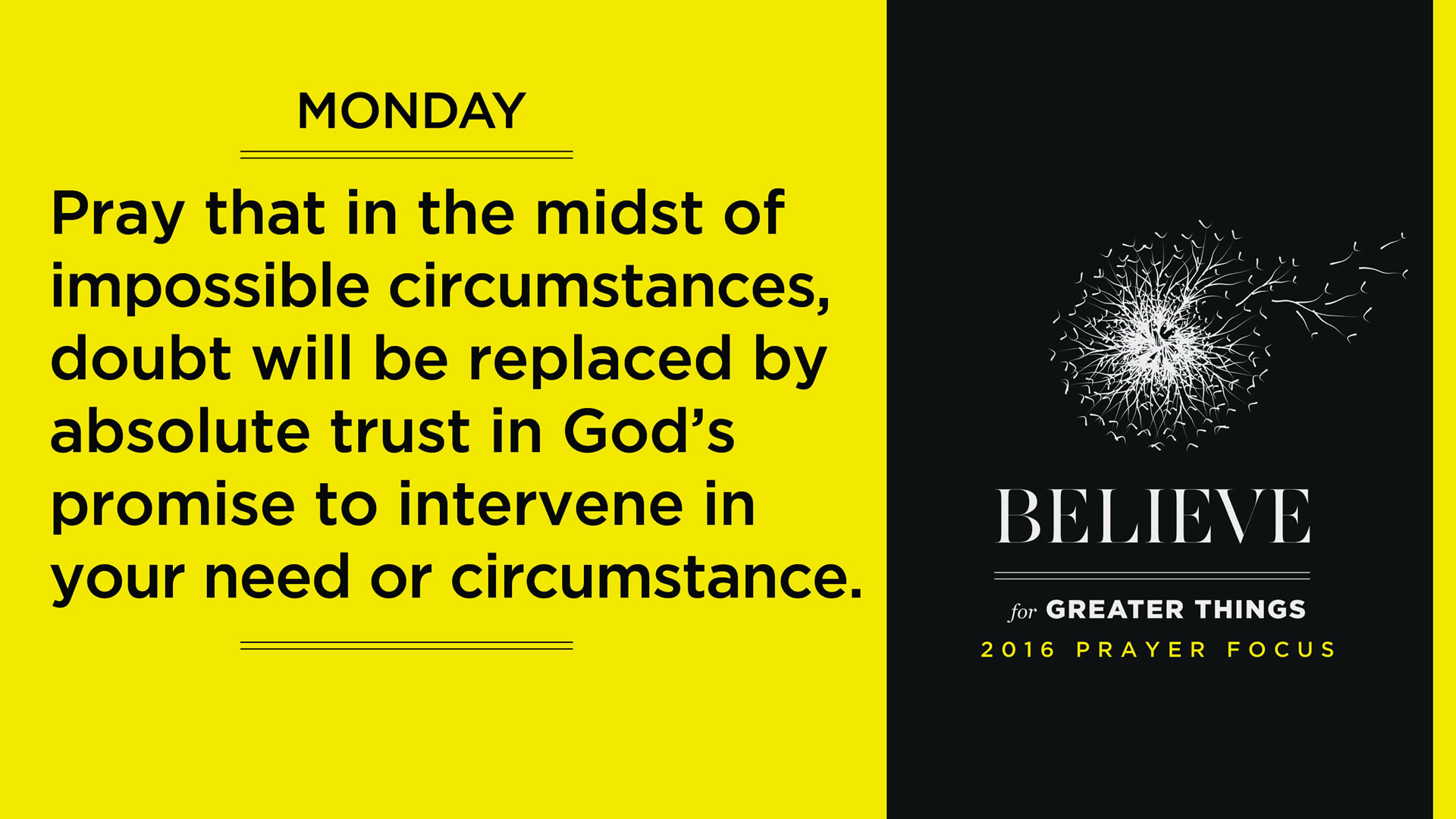
WOP_2016_Slide_MonOur week of prayer continues today with this prayer focus—

Pray that in the midst of impossible circumstances, doubt will be replaced by absolute trust in God’s promise to intervene in your need or circumstance.

When I pray, I love to pray God’s Word. Perhaps on Monday you could pray something like this:

Jesus, You said if I have faith as small as a mustard seed, I can say to this mountain—this “impossible thing” in my life—“Move from here to there,” and it will move. Nothing will be impossible [Matthew 17:20]. It was impossible for death to hold You, Jesus, so I know that no word from You will ever fail [Acts 2:24; Luke 1:37]

I have some seemingly “impossible” situations in my life. There is a relationship that seems beyond repair … there is a doctor’s diagnosis that seems terminal … there is a financial debt that seems like a bottomless pit … there is a situation that seems hopeless. But things that seem like they’re terminal, impossible and hopeless to man are perfect opportunities for You to do what only You can do. I put my absolute trust in You. I believe that You are going to do what others say is impossible, so that all will see Your unequaled greatness. In Jesus’ mighty name I pray, Amen.

6 Facts About Angels

Angels from the realms of gloryAngels play a fairly visible role in the First Advent story. As a result, we can begin to piece together some facts about angels from the biblical accounts. In my series on The Carols Of Christmas, I was looking at Angels From The Realms Of Glory, and there is information about the angels in this carol that is well-support from the Scripture.

  1.  Angels were created before the Earth was created, and they celebrated as God created our universe (Job 38:4-7). The Christmas carol says, “ye who sang Creation’s story now proclaim Messiah’s birth,” which we see in Luke 2:8-14.
  2. Angels are messengers sent from God, and they carry a message from God to turn people toward God (Daniel 10:12; Matthew 1:20-23; Luke 1:11-20, 26-38). In the Christmas carol they remind us to leave our contemplations and “seek the great Desire of nations.”
  3. Angels are not to be worshiped, because they are created beings. Lucifer’s desire to be worshipped is what led to his rebellion against God and expulsion from Heaven (Isaiah 14:13-14). And he still tries to appear today as an angel of light (2 Corinthians 11:14).
  4. Angels long to look into the Gospel that humans can know by personal experience (1 Peter 1:12).
  5. Angels know that Christ’s First Advent is a reminder of His Second Advent (Acts 1:10-11; see also 1 Thessalonians 4:13-18).
  6. We have been given an angelic responsibility to tell others about Christ’s First and Second Advents (notice that the messengers in the churches are called angels in Revelation 2:1, 8, 12, 18; 3:1, 7, 14; 22:16). The carol reminds us that it’s “all creation” (that includes us!) that joins the angels in praising God.

One of the biggest lessons we need to learn from this Christmas carol, and the corresponding verses about angels, is that we aren’t just celebrating the First Advent. We are anticipating and looking forward to the Second Advent as well! 

Next Sunday we will be continuing our look at the rich messages in the familiar Christmas carols. Please join me!

In the video below, we had some slight technical difficulties. But it clears up about the 5-minute mark, so hang in there!

If you have missed any of the messages in our series The Carols Of Christmas, you can find the full list by clicking here.

Is “Christian” Just A Label?

Josh SchramOur youth pastor, Josh Schram, shared a message yesterday which really convicted me. Here are my notes just as I took them Sunday morning.

Some stereotypes of Christians aren’t very flattering. If we ask someone to think of a farmer or a plumber, we probably all get the same sorts of images in our minds. But when we say “Christian,” there are a lot of images that come to mind. And many of them aren’t very flattering.

The word Christian only appears three times in New Testament (in the NIV)—Acts 11:26; Acts 26:28; 1 Peter 4:16.

The followers of Jesus preferred to call themselves disciples (see Acts 26:11). That signals a lifestyle, not just a label.

Does my lifestyle reflect the fact that I’m a follower of Jesus, or am I just happy with the title “Christian”? Am I trying to justify not doing the discipleship work that Jesus commanded me to do, namely loving God and loving others (Luke 10:25-37)? Notice especially this verse: But he wanted to justify himself, so he asked Jesus, “And who is my neighbor?” (Luke 10:29).

Why don’t Christians want to put their love into action? They say they’re busy, or don’t have enough resources, or don’t want to get involved, or they think helping may be a trap. But the priest and Levite who didn’t stop to help may have saved the injured man’s life! How much so the Christian of today!

Does my faith in Jesus change the way I live, or is “Christian” just a title I’m happy to live with?

As kids, when we play “follower the leader” we follow all the actions of the leader. But Christians seem to change the rules: “I just need to believe what He says, but I don’t have to do what He says.”

To truly be called a “Christian”—a disciple of Jesus—my LOVE should be in action, just like Jesus (Luke 10:27-28; c.f. Acts 10:38).

If you’re ready to be challenged, check out Josh’s message for yourself—

6 Ways To Make Sure Everything You Do Is Sacred

It's all sacredAround 1300 AD, the Church began propagating a myth. It showed up in two words that were created around that time: clergy and laity.

Simply stated, clergy is from a root word that means “the learned men … the ones enlighten for ministry.” And laity is anyone not in that inner circle.

Insecure leaders did this to maintain control. They continued to read the Scriptures in Latin, which few could read, so they made sure that the clergy alone had a Bible, and they alone became the expounders of how the Bible told us to live.

In the clergy-laity divide, they also created a sacred-secular divide.

When Paul addresses the Colossians he does so with anything but a clergy-laity divide in mind. He calls them the holy and faithful brothers in Christ (Colossians 1:2). The KJV translates holy as saints, for that’s how Paul indeed sees them. And he sees them as his very own faith-filled brothers.

Paul also has anything but a sacred-secular divide in mind as he instructs then—whatever you do, whether in word or deed.

He makes it clear that everything we do as faith-filled, holy saints is to be sacred and God-honoring.

How do we do whatever we do in a sacred, God-honoring way? We ask these six questions:

[1] Can it be done with a clear conscience? (Acts 23:1; 24:16)

  • “It is not WHAT a man does that determines whether his work is sacred or secular, it is WHY he does it.” —A.W. Tozer

[2] Will it promote the Gospel? (Philippians 1:27)

[3] Is it a good deed? (Acts 10:38; James 3:13)

[4] Does it point people to God? (1 Peter 2:12; 1 Corinthians 10:31)

[5] Can I do it in the name of Jesus? (Colossians 3:17do it ALL in the name of Jesus)

[6] Does it cause others to be thank-full? (Colossians 3:17giving THANKS to God the Father).

Live according to your high calling, for all you do is sacred!

(To check out more thoughts on Colossians 3:15-17, click here and here.)

Links & Quotes

link quote

“With such prayer [‘Praying in the Holy Sprit’ (Jude 20)] it is an absolute certainty that I must succeed with God in prayer. If my prayer were my own prayer, I might not be so sure of it, but if the prayer which I utter be God’s own prayer written on my soul, God is always one with Himself, and what He writes on the heart is only written there because it is written in His purposes.” —Charles Spurgeon

“In the passage where the New Testament says that every one must work [Acts 20:34-35], it gives as a reason ‘in order that he may have something to give to those in need.’ Charity—giving to the poor—is an essential part of Christian morality.” —C.S. Lewis

“Security comes as we put God’s precepts into practice. We’re only as strong as our obedience.” —Max Lucado

Dan Reiland shares 6 things God says to church leaders.

“Mountain lions detect vulnerabilities in their prey and attack the weakest—the young, the sick, the injured. Studies have confirmed this instinctive cruelty. It’s how the mountain lion lives, following the scent of suffering and feasting on whatever he finds. The enemy of your hope and happiness hunts with that same instinct, with a cold-hearted and ruthless hunger for the weak or hurting. satan prowls like a roaring lion.” Read how to overcome the prowlings of the devil.

For anyone struggling with pornography, here is a great source of help: MyPilgrimage.com. Watch the introductory video, and then subscribe!

Here is some good advice for students who are addicted to pornography—