Links & Quotes

I shared several videos this week while I was on vacation. If you missed any, you can check them out on my YouTube channel.

A good definition of apologetics is found in Acts 17:2-3. We need to share (1) reasons from Scripture, (2)   logical explanations, and (3) verifiable evidence. I have written quite a bit on my blog on the topic of apologetics, including several book reviews of apologetics books that you may want to check out.

The Babylon Bee cracks me up! I love this one: “It has been scientifically proven that it’s impossible to know what women want (and we all know you can’t question science). In fact, there is usually a vast discrepancy between what men think women want and what women actually want. You don’t have to despair, because The Babylon Bee is here to provide an invaluable translation to help give men an idea of what a woman really wants.”

“The life we speak over others they will pass on. While it is true that hurting people hurt others, it is just as true that healed people heal others, blessed people bless others, loved people love others, and ‘mercied’ people mercy others—if, that is, they have any sense of gratefulness.” —Dick Brogden, in Proverbs: Amplified and Applied

“The Kingdom of God will be present within us to the extent that we maintain a clean and good conscience. The conscience is the valuing center of the soul. It holds the priorities which serve to clarify and direct both the mind and the heart for Kingdom presence. As thoughts or affections stir in the soul, the conscience reads the Law of God, which is written on the heart and settled in the mind (Romans 2:14-15), and engages the will to act in line with the vision of Christ and the counsel of His Word.” —T.M. Moore

“Value those people who tell you the truth, not just those people who tell you what you want to hear.” —Pat Summitt

Nabataean king Aretas IV is only mentioned once in the Bible, but once again archeology has bolstered the historicity of the biblical reports. Check out this archeological biography of Aretas IV here, and read more about the historicity of the Bible here.

Some people claim those with a biblical worldview and lifestyle are “extremists.” I think this chart (I cannot find the author to give credit on this one) explains it well.

“Life without love isn’t worth anything. Justice without love makes you hard. Intelligence without love makes you cruel. Kindness without love makes you a hypocrite. And faith without love makes you a fanatic.” —Mother Teresa


Worth The Effort

Listen to the podcast of this post by clicking on the player below, and you can also subscribe on AppleSpotify, or Audible. 

The Bible is not only the inspired Word of God but it is rooted in history too. Every prayer was prayed by a real person in distress, and every song of praise was lifted up by someone who personally experienced God’s deliverance. 

The reason why this is so important is that it makes God’s Word relatable and applicable to us. If the Bible merely contained moral stories set in some make-believe world, we may have a hard time seeing how to apply the principles to our daily lives. But, thankfully, this isn’t the case. We can read the real-life experiences of real historical people and then we can allow the Holy Spirit to help us apply this inspired Word to our lives. 

There is a collection of 15 songs in the Book of Psalms called “The Songs of Ascent.” Even these songs have an important historical background. 

The books of Kings and Chronicles tell the sad history of Israel and Judah sliding farther and farther away from God until finally, God must punish them. He punishes Judah by bringing King Nebuchadnezzar against them, who destroyed the temple at Jerusalem and carried the people into exile in Babylon. But even as they are being taken away, God speaks a prophetic word through Jeremiah that in 70 years He will raise up another leader, Cyrus king of the Persians, who will allow the exiles to return home. You can read all of these historical accounts in 2 Chronicles 36:15-23; Jeremiah 29:10-14; and Isaiah 44:28-45:6. 

Second Chronicles ends with this proclamation from King Cyrus: “The Lord, the God of heaven, has given me all the kingdoms of the earth and He has appointed me to build a temple for Him at Jerusalem in Judah. Anyone of His people among you—may the Lord his God be with him, and let him go up” (2 Chronicles 26:23). 

The phrase “let him go up” is both literal (since Jerusalem is 2500 feet above sea level) and spiritual. Listen to these words from King Solomon, “The way of life winds upward for the wise, that he may turn away from hell below” (Proverbs 15:24 NKJV). 

The Songs of Ascent were a rallying cry—an encouragement to all pilgrims to keep climbing up. 

In Hebrew literature, the main point is usually found in the middle of the poem or story, unlike our Western literature which puts the payoff at the end. In the first Song of Ascent, the middle is verse 4. But the second half of Psalm 120 seems out of place for people ascending up to Jerusalem to worship God. Verse 5 begins with the words, “Woe to me.” 

The psalmist is expressing his pain in living among the people of Meshech and Kedar. The people of Meshech were vicious people who traded human lives for money and who conducted themselves as terrorists (Ezekiel 27:13; 32:26). Their name literally means “drawing away.” The people of Kedar were nomadic sons of Ishmael. Being nomadic means they were never at rest. Their name literally means “dark place.” Very noteworthy is that there is no mention of God in verses 5-7.  

The middle verse of this song (v. 4) turns the people of Meshech and Kedar over to God. It is a reminder that we are not the ones to dispense justice. If God knew how to overthrow the powerful kingdoms of Judah, Babylon, and the Medes, if He knew to call Cyrus by name at just the right moment, He also knows how to deal with these sinners. 

This Song of Ascent shows the stark contrast between keeping our eyes on the dark culture around us versus keeping our eyes on the God who is never weighed down by the darkness. As we go higher up, we focus more on God; as His saints focus on Him, His light shines on them; as His light shines on them, they point sinners living in dark valleys to the God of light and love. 

Staying down is easy. Getting up requires intentional effort. Going up requires us to overcome the pull of sin and the frustration of watching for judgment to fall on sinners. 

Continually going up glorifies God, has eternal rewards for saints, and creates a compelling testimony for sinners.

Going up is a lot of effort, but the rewards are so worth it! As the apostle Paul reminded his friends in Rome, “I consider that our present sufferings are not worth comparing with the glory that will be revealed in us” (Romans 8:18). Let’s keep climbing up and let’s keep lifting our eyes to the only One who has the eternal light. 

If you’ve missed any of the messages in our look at the Songs of Ascent, you can find them all here. 

►► Would you please prayerfully consider supporting this ministry? My Patreon supporters get behind-the-scenes access to exclusive materials. ◀︎◀︎

Links & Quotes

Some of our best lessons are learned in difficult places, so let’s not be too quick to rush in and soften the blow for someone who has taken a tumble. Check out the full conversation I had with my podcast partner Greg. And be sure to check out all of my videos on my YouTube channel.

“A champion is one who gets up when he can’t.” —Jack Dempsey

Once again, archeological finds in Israel confirm the historicity of the biblical accounts of the kings of Judah and Israel. John Stonestreet shares some of the most recent finds. Jewish archeologist Nelson Gluek states, “It may be stated categorically that no archaeological discovery has ever controverted a biblical reference.”

“The reward for work well done is the opportunity to do more.” —Jonas Salk

Scott Hubbard writes, “Stepping into leadership means stepping into mistakes, regrets, and many small but stinging failures. And surviving in leadership, I am learning, means stepping upward on those mistakes—owning them, learning from them, and having the stability in Christ to keep leading after them.” Read more about how leaders can fail well.

J. Warner Wallace addresses the claim that all religions are true or are essentially the same.

“The Scriptures represent the Holy Spirit, not only as moving, and occasionally influencing, the saints, but as dwelling in them as His temple, His proper abode, and everlasting dwelling-place. And He is represented as being there so united to the faculties of the soul, that He becomes there a principle or spring of a new nature and life.” —Jonathan Edwards

Links & Quotes

Your relentless pursuit of personal improvement becomes a better resume than anything you could ever put on paper! Check out the full conversation Greg and I had about personal development on The Craig And Greg Show leadership podcast. And be sure to check out all of my videos on my YouTube channel.

T.M. Moore has a regular series of posts for pastors. This week he shared this, “In his training manual for pastors, Gregory the Great wrote, ‘There are some who investigate spiritual precepts with cunning care, but what they penetrate with their understanding they trample on in their lives: all at once they are teaching the things which not by practice but by study they have learnt; and what in words they preach by their manners they impugn. Whence it comes to pass that when the shepherd walks through steep places, the flock follows to the precipice’ (The Book of Pastoral Rule).” If you are a pastor, I encourage you to check out the Pastor To Pastor posts on The Fellowship Of Ailbe.

On May 22, A.D. 337, Emperor Constantine died. John Stonestreet wrote, “Many Christians think that Constantine was perhaps the worst thing to happen to the Church. They believe he made Christianity the imperial religion, thus leading the Church to compromise with pagan culture, marrying it to state power, and derailing the spread of the Gospel. The Church, they argue, was better off as a persecuted minority.” Please check out this post co-written by Dr. Glenn Sunshine that gives some better historical perspective than perhaps what you have heard previously.

The other day, a friend of mine was scammed through her Facebook page. Scams are everywhere, so you need to stay aware of the ways to protect yourself. This is a helpful overview from Capital One of various types of scams.

“A problem is a chance for you to do your best.” —Duke Ellington

Jellyfish fossils point to a global Flood, like the one reported in the Bible. Because jellyfish are 95 percent water, they have to be buried quickly in order to be saved as a fossil. 

J. Warner Wallace describes how Jesus arrived at the perfect moment in history. Once again giving more evidence to the historicity of the biblical accounts.

One of the most powerful missions sermons I have heard was preached by Dick Brogden:

An important warning from Axis—What it is: The Surgeon General has issued a warning on the dangers of social media for teenagers. Why the alarm bell is reaching a fever pitch: People have been wary of social media’s impact on developing brains for two decades—so why are highly-visible tone setters, like the Surgeon General and the American Psychological Association, issuing big, sweeping statements now? Part of it could be because we are getting more quality data on how social media shapes a young person’s brain. One newer study that’s been getting some buzz suggests that individuals who received their first smartphone at a later age have better mental health as young adults. Several big bills that aim to protect minors online will be voted on this year as tech giants face increased scrutiny over their safeguards (or lack thereof), for younger users. Kids growing up even a decade from now may encounter a completely different digital landscape when it’s their turn to learn about online literacy.

Links & Quotes

I have a series of nearly 70 posts on the topic of godly leadership. Here is the latest installment about going all in. Be sure to check out all of my videos on my YouTube channel.

T.M. Moore writes persuasively to Christians to encourage them to build for the future. He wrote, “For most Christians today, the Kingdom which Daniel saw, Jesus proclaimed and brought near, and the Spirit inaugurated on that first Christian Pentecost—that Kingdom is little more than a theological idea, or a distant hope. It is not a daily reality to be sought, seized, shared, and strengthened in every nook and cranny of our Personal Mission Fields. Christians today are trapped in their past or mired in their present, and they have little or no sense of what it means to build for the future so that righteousness, peace, and joy in the Spirit increase wherever they live, move, and have their being.”

Whether you know it as the Mesha Inscription, the Mesha Stele, or the Moabite Stone, this 1868 discovery is another piece of archeological evidence lending proof to the historicity of the Bible.

And another piece of research from both paleontologists and entomologists points to the Flood described in the Bible as historically viable. Researchers discovered fossilized giant ants in Canada where evolutionists claim they shouldn’t be. The Institute for Creation Research commented, “There is no need to postulate ants trekking across the Arctic to explain the distribution. Nor is there a need to inject short ‘hyperthermal’ episodes to allow passage from one continent to another. The global Flood explains what we observe the best. The warmer pre-Flood conditions and likely higher oxygen levels explain the large size of the ants. And their fossil distribution is best explained by their transport off the highest pre-Flood hills as the waters were receding.”

“If we were to look at Jesus’s death merely as a result of a betrayer’s deceit and the Sanhedrin’s envy and Pilate’s spinelessness and the soldiers’ nails and spear, it might seem very involuntary. And the benefit of salvation that comes to us who believe might be viewed as God’s way of making a virtue out of a necessity. But once you read Luke 9:51, all such thoughts vanish. Jesus was not accidentally entangled in a web of injustice. The saving benefits of His death for sinners were not an afterthought. God planned it all out of infinite love to sinners like us, and He appointed a time.” —John Piper, Love To The Uttermost reading plan on YouVersion

When “The End” Is Just The Beginning

Listen to the podcast of this post by clicking on the player below, and you can also subscribe on AppleSpotify, or Audible. 

We’ve all heard people make some audacious claims. But the real power is in being able to back up those claims. Without any proof, it’s all talk! As things were coming to a conclusion for Christ’s ministry—at least in the world’s eyes—there were some bold claims being made. Some were made by Jesus Himself, some by His rivals, and some by His supporters. 

The first bold claim we’re going to consider was made by the high priest: a man named Joseph Caiaphas. 

The Sanhedrin was the highest court in the land and was made up of 70 + 1 men. This comes from Numbers 11:16-17 (seventy leaders) plus Moses. After Moses, another person was always appointed to serve as the leader, which was usually the high priest. 

By the time of Jesus, this ruling body had become more political than religious. Very frequently, leadership would change because of the whims of the Romans or their puppet leaders (someone like a King Herod). The high priest in Christ’s early years was a man named Annas, who served from AD 6-15. During all of the public ministry of Jesus, the high priesthood had transferred to Caiaphas (AD 18-36), who was Annas’ son-in-law. Yet both of them still shared considerable influence (see Luke 3:2; John 18:13, 24; Acts 4:6). 

Caiaphas and his family were Sadducees. They didn’t hold to any beliefs of the supernatural—no angels or demons, no resurrection, no afterlife. Partly because of these unscriptural beliefs, the Jewish Qumran, who safeguarded the careful copying of the Scriptures, called Caiaphas “the wicked priest.”

Annas, Caiaphas, and their family member were the ruling party that wanted to stay in power. So their activities were always a balancing act: Trying to keep the Jewish community happy on one hand, while not offending the Romans or other political leaders on the other hand. 

It’s with this backdrop that we read the story of Lazarus’ resurrection in John 11. Jesus knew this miracle would validate His ministry, and sure enough, after the resurrection of Lazarus, more and more people put their faith in Jesus. So much so that the religious leaders wanted to kill both Jesus and Lazarus (11:53; 12:9-11). 

Ironically, these same religious leaders had previously asked Jesus for a sign to prove He was who He made the bold claim to be. To this demand, Jesus said that He would give them “the sign of Jonah” who was considered dead in the belly of the fish before he was “resurrected” to complete his mission (Matthew 12:38-40, 16:1-4). 

Since the religious leaders viewed everything through a political lens, they thought Jesus was also going to instigate a political or military uprising. The following that Jesus would gather would challenge the Sanhedrin’s hold on power, so Caiaphas proposed a political solution disguised as a prophecy (John 11:49-53). 

Caiaphas meant it like this: “We’re trying to keep the balance between the Jewish people and the powerful Romans. If we kill one Man (Jesus) in time, we may be a little out of favor with the Jews but we will save our position with the Romans. Later on, we’ll make things right with the common people.” 

Even to this day, people are trying to balance, juggle, control, appease, and bargain their way to get or keep the life they want to live. They will use religious dressing to do political things, thinking they will “make it right” later on. 

Caiaphas made this bold claim: “If Jesus dies, our position will be saved for us and our children.” But he had no power to back up his bold claim, so it was just talk. 

But Jesus made this bold claim: “I will die so that your souls can be saved for eternity.” He, on the other hand, had the power to back up His bold claim (John 10:17-18). 

God’s plan always prevails! 

Caiaphas’ plan sounded like it would be the end of Jesus and His mission, but “the end” was really just another step in fulfilling what God had already planned! 

Let me say it again: God’s plan always prevails. The bold claims of powerful evil people may make it seem like the end is near, but don’t fret because their “end” is only fulfilling God’s plan! 

If you’ve missed any of the messages in this series of Bold Claims, you can check them all out by clicking here. 

►► Would you please prayerfully consider supporting this ministry? My Patreon supporters get behind-the-scenes access to exclusive materials. ◀︎◀︎

Links & Quotes

Every Monday I share a 1-minute thought to get your week started. It’s my weekly Monday Motivation series of videos. Check out this week’s video that I posted the day after Christmas, and please subscribe on YouTube.

T.M. Moore wrote one of the endorsements for my book Shepherd Leadership. In an interview I then did on his Fellowship of Ailbe podcast, I shared my dismay over unbiblical ideas and practices that have crept into the church. Both T.M. and I share a passion to see our church leadership return to our secure biblical foundation. 

In a recent blog post, T.M wrote, “From the days of the apostles onward, a tendency has existed among church leaders to drift from the plain teaching of the Word of God into forms of Christian life and ministry that derive from sources other than Scripture. Or that stretch the meaning of Scripture to fit the shape of certain cultural forms.” Please check out T.M.’s post “Do not go beyond.”

In a fascinating post from Rabbi Benjamin Blech, I read these thoughts about the power of a name: “The Hebrew word for soul is neshamah. Central to that word, the middle two letters, shin and mem, make the word shem, Hebrew for ‘name.’ Your name is the key to your soul. … When the Torah says, ‘God created,’ it doesn’t suggest that He worked with what He fashioned by labor, but merely that He spoke—and the very words describing the object came into being. God said, ‘Let there be light and there was light.’ The Almighty merely gave it a name, and the very letters defined its atomic structure.” Check out the full post here.

And once again archeologists discover evidence that corroborates the biblical accounts. In this case, more evidence is found from King Hezekiah. As I have said numerous times, the historicity of the Bible is amply verified.

“Success” doesn’t always mean bigger numbers. King David got into trouble with God when he wanted to measure his success by how many fighting men he had under his command. Consistently throughout the Bible God’s measure of success is our trust in Him. This thought was a key part of the sub-title of my book Shepherd Leadership: The Metrics That Really Matter.

Cold-case detective J. Warner Wallace tackles an important topic: Does objective truth exist, and how can it be defined? This is a quite lengthy post but it is well worth your time.

“Pain nourishes courage. You can’t be brave if you’ve only had wonderful things happen to you.” —Mary Tyler Moore

Book Reviews From 2022

Listen to the podcast of this post by clicking on the player below, and you can also subscribe on AppleSpotify, or Audible.

I love reading, and I love sharing my love of good books with others! Here is a list of the books I read and reviewed in 2022. Click on a title to be taken to that review.

Autobiography of Calvin Coolidge

Cary Grant

Contending For Our All

Father Sergius

Hank Greenberg: The Story Of My Life

Living In A Gray World

Out Of The Depths

Roots Of Endurance

Simple Truths Of Leadership

Spurgeon And The Psalms

Susanna Wesley

The Holy War

The Legacy Of Sovereign Joy

The Poetry Of Prayer

The Self-Aware Leader

Who Says Elephants Can’t Dance?

Who’s Pushing Your Buttons?

Here are my book reviews for 2011.

Here are my book reviews for 2012.

Here are my book reviews for 2013.

Here are my book reviews for 2014.

Here are my book reviews for 2015.

Here are my book reviews for 2016.

Here are my book reviews for 2017.

Here are my book reviews for 2018.

       Here are my book reviews for 2019.

Here are my book reviews for 2020.

Here are my book reviews for 2021.

►► Would you please prayerfully consider supporting this ministry? My Patreon supporters get behind-the-scenes access to exclusive materials. ◀︎◀︎

Crucifixion Events

Listen to the podcast of this post by clicking on the player below, and you can also subscribe on AppleSpotify, or Audible. 

The death of Jesus may be the most attested execution in all of history. It’s certainly the most meaningful execution, as the death of Jesus brought a fulfillment to prophecy that was made in the immediate aftermath of humanity’s first sin. 

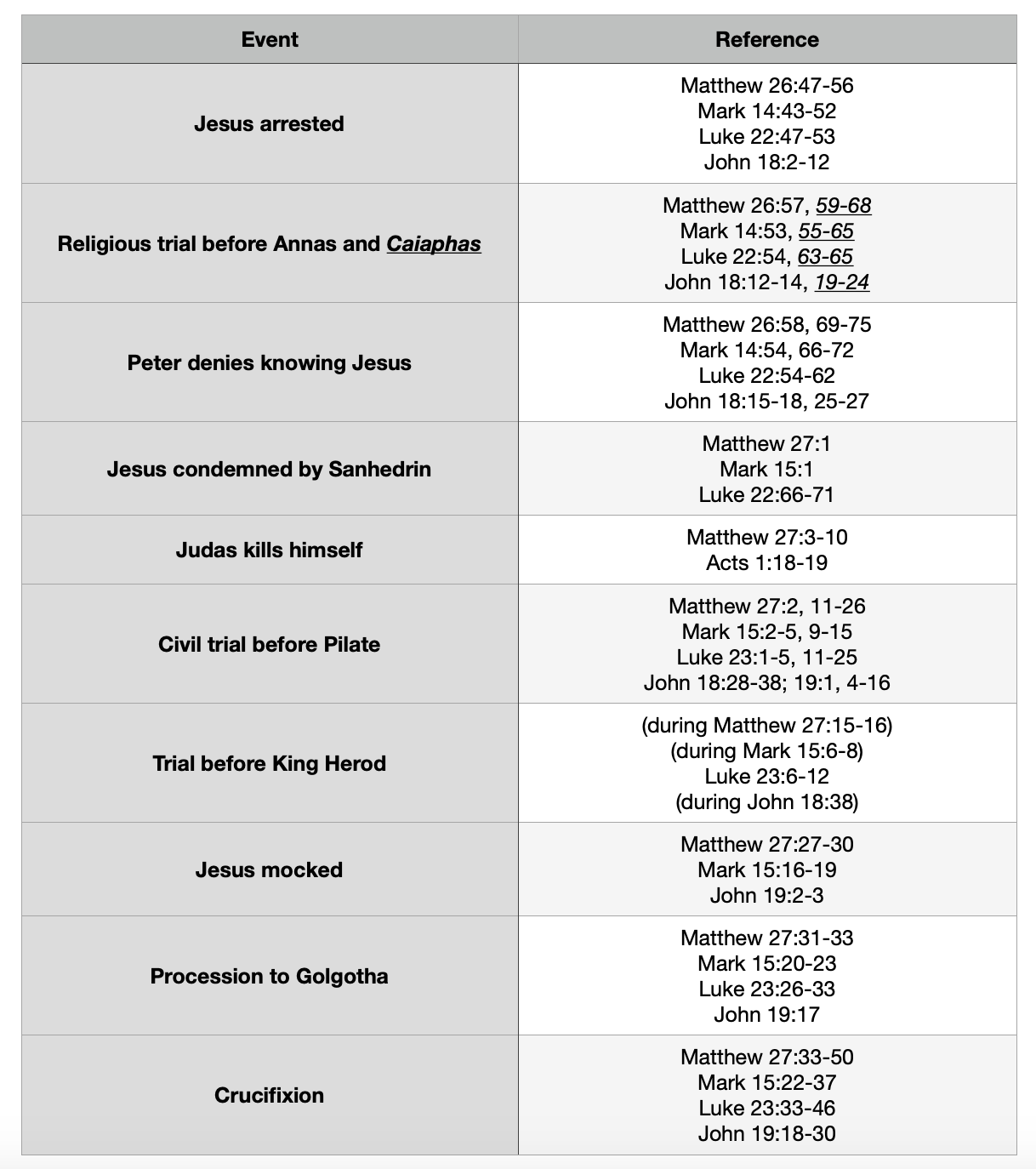
I have frequently written about the historicity of the Bible. The crucifixion of Jesus is not a “once upon a time” or “in the make-believe land of Israel” story, but an actual event, which involved actual people, at an actual moment in history. Even the way the four Gospel writers record the crucifixion of Jesus attests to the historicity of this event.

Check out this chart of the events that show how Matthew, Mark, Luke, and John record this historical moment. 

When did this moment in history occur? Consider this scholarly insight from The Archeological Study Bible

“In what year was Jesus born, and when was He crucified? These are long-standing historical questions. The seemingly obvious answer to the first—that He was born in A.D. 1 (there is no year 0)—is incorrect, however, since the calculations on which our modern calendar is based were faulty. …

“The chronology of Jesus’ life, though clear in outline, cannot be fixed with absolute precision. Matthew and Luke both inform us that Jesus was born before the death of Herod (4 B.C.), though it would appear that His birth occurred toward the final years of Herod’s reign, suggesting an approximate date of 6-4 B.C. The next chronological marker comes from Luke 3:1, where we learn that John the Baptist’s ministry began during the fifteenth year of the reign of the emperor Tiberius. Since A.D. 14 is the generally accepted date for Tiberius’ accession to the throne, John’s ministry would have commenced between August A.D. 28 and December of 29. Jesus began His own ministry shortly after John had embarked on his, at some point in A.D. 28 or 29, making Jesus about 32 or 33 years old at the time. This fits well with Luke’s statement that Jesus was ‘about 30 years old’ (Luke 3:23).

“The duration of Jesus’ public ministry was approximately three years. While the exact chronology of this period is difficult to ascertain, the final phase of His ministry allows for closer scrutiny. It is clear that Jesus was crucified under Pontius Pilate, who governed Judea from A.D. 26-36. …

“Taking Friday, Nisan 14, as the day of the crucifixion, astronomical data informs us that the only years from A.D. 29-36 that could have seen Nisan 14 on a Friday are A.D. 30, 33 and 36. A.D. 36 is easily dismissed as too late, while A.D. 30 seems too early (although some who begin Jesus’ ministry in A.D. 28 and shorten His public ministry find it acceptable). This leaves A.D. 33 as the most likely date for the year of Jesus’ death and resurrection.” 

As you celebrate the victory over sin and death that Jesus won by His sacrificial death on the Cross, rejoice also that this is an actual historical event that bought your freedom from your sin. It is indeed miraculous, but it is also historic. Let’s never lose sight of either of those facets. 

►► Would you please prayerfully consider supporting this ministry? My Patreon supporters get behind-the-scenes access to exclusive materials. ◀︎◀︎

Book Reviews From 2021

Listen to the podcast of this post by clicking on the player below, and you can also subscribe on AppleSpotify, or Audible.

I love reading, and I love sharing my love of good books with others! Here is a list of the books I read and reviewed in 2021. Click on a title to be taken to that review.

24

AC/DC

Churchill’s Ministry Of Ungentlemanly Warfare

Faithlife Illustrated Study Bible

George Whitefield

Hal Moore On Leadership

His Last Bow

Holy Sexuality And The Gospel

How Christianity Changed The World

How I Got This Way

How To Bring Men To Christ

Jesus On Trial

John Adams

Miracles Out Of Somewhere

My Lucky Life

Out Of The Silent Planet

Perelandra

Pilgrim’s Progress

Prayer

Prophet With A Pen

QB

Reading The Bible With The Founding Fathers

Secrets Of Dynamic Communication

Seeing Beauty And Saying Beautifully

Shepherd Leadership

Star Struck

Talking To GOATs

That Hideous Strength

The Art Of Writing And The Gift Of Writers

The Hidden Smile Of God

The Hiding Place

Thompson Chain-Reference Bible

To The Work!

Voice Of A Prophet

Washington’s Immortals

Word-For-Word Bible Comic: Jonah

Here are my book reviews for 2011.

Here are my book reviews for 2012.

Here are my book reviews for 2013.

Here are my book reviews for 2014.

Here are my book reviews for 2015.

Here are my book reviews for 2016.

Here are my book reviews for 2017.

Here are my book reviews for 2018.

       Here are my book reviews for 2019.

Here are my book reviews for 2020.

►► Would you please prayerfully consider supporting this ministry? ◀︎◀︎