The Sovereign King

Listen to the podcast of this post by clicking on the player below, and you can also subscribe on AppleSpotify, or Audible. 

What people were saying about Jesus right from His birth—before He preached a sermon, performed a miracle, or stepped on the toes of religious or political leaders—was revealing the truth. 

As the Gospel of Matthew’s account of Christ’s birth begins, Persian Magi came from Babylon, having been keepers of the Truth handed down to them for over 500 years from Belteshazzar the Chief of Magician. This was the Babylonian name given to the Hebrew exile Daniel. 

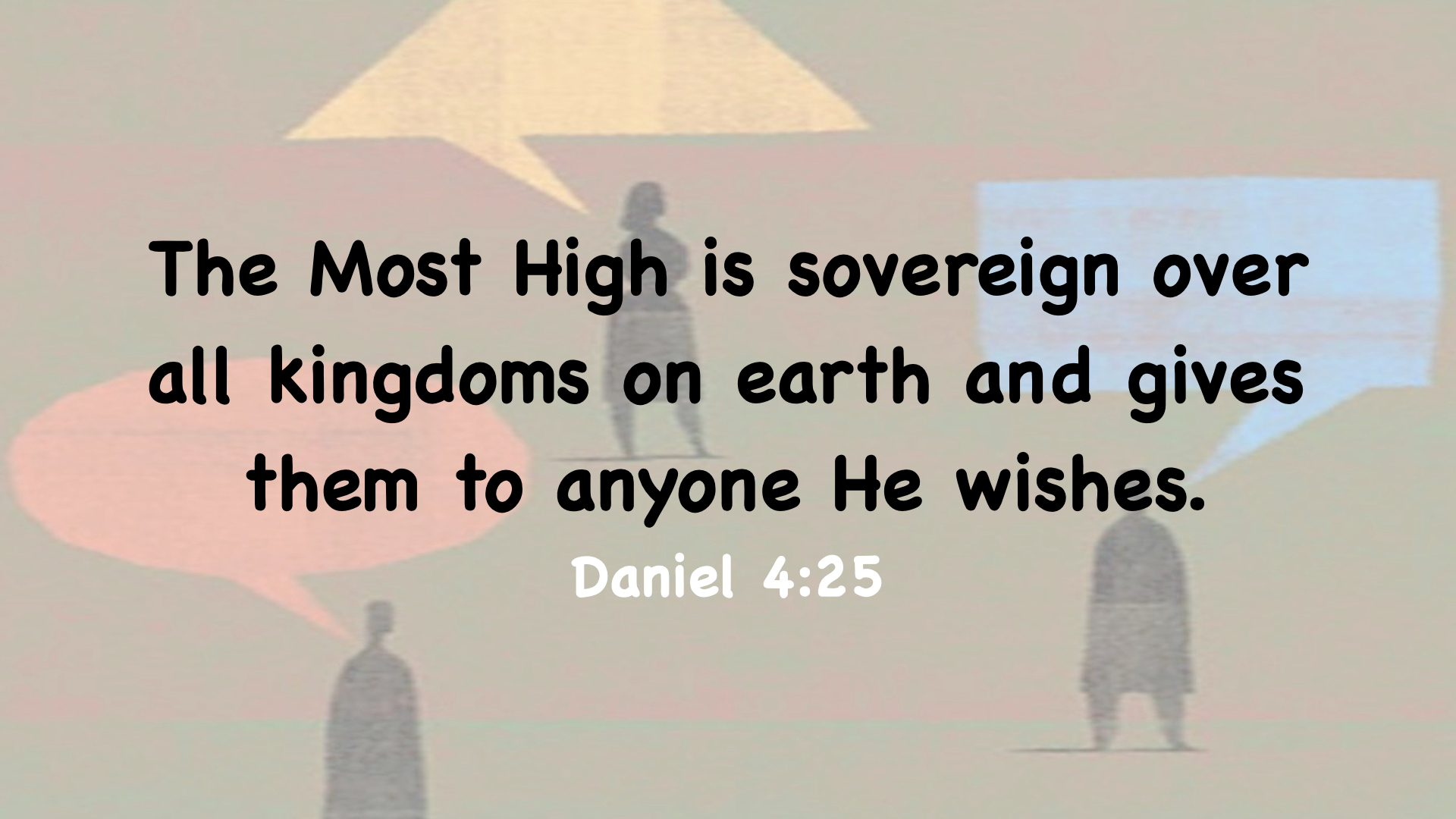
Daniel served under multiple kings, even as the regimes changed from Babylonian, to Median, to Persian. He never waiver in his adherence to the Truth that God had spoken. He fearlessly told these world leaders, “The Most High is sovereign over all kingdoms on earth and gives them to anyone He wishes” (Daniel 4:25). 

Most leaders forget this the moment they obtain power. Such is the case of the man the Magi met: King Herod the Great. Listen to how William Barclay describes this monarch: 

“Herod the Great was always despised by the pure-blooded Jews because he was half an Edomite; and we can see the importance that even Herod attached to these genealogies from the fact that he had the official registers destroyed, so that no one could prove a purer pedigree than his own. … 

“He had made himself useful to the Romans in the wars and civil wars of Palestine, and they trusted him. He had been appointed governor in 47 B.C.; in 40 B.C. he had received the title of king. … 

“But Herod had one terrible flaw in his character. He was almost insanely suspicious. He had always been suspicious, and the older he became the more suspicious he grew, until, in his old age, he was, as someone said, ‘a murderous old man.’ … He murdered his wife Mariamne and her mother Alexandra. His eldest son, Antipater, and two other sons, Alexander and Aristobulus, were all assassinated by him. Augustus, the Roman Emperor, had said, bitterly, that it was safer to be Herod’s pig than Herod’s son. … 

“When he was seventy he knew that he must die. … He gave orders that a collection of the most distinguished citizens of Jerusalem should be arrested on trumped-up charges and imprisoned. And he ordered that the moment he died, they should all be killed. He said grimly that he was well aware that no one would mourn for his death, and that he was determined that some tears should be shed when he died.” 

Lord Acton famously said, “Power tends to corrupt and absolute power corrupts absolutely. …  Despotic power is always accompanied by corruption of morality.” This is so obvious in Herod! So we can understand why the city of Jerusalem was disturbed when the Magi arrived! Whether Herod knew the prophecy of the coming Messiah or not, it’s inescapably true that his days and his legacy were numbered (see Isaiah 9:2-7). 

When King Herod heard the announcement from the Magi, his reaction was violent. Perhaps Herod lashed out so ferociously because these words of Truth from the Magi reminded him his end was near, his power was not absolute, he had to answer to The Most High who is sovereign over all. 

We are no better. Oswald Chambers defines sin as “my claim to my right to myself.” We want absolute sovereignty over ourselves, but Jesus will allow no rival to His throne! He is either King over all or else He is not King at all. 

Beware of your own reaction when the Holy Spirit convicts you of a rival to Christ’s throne in your heart. If you lash out like Herod, dismiss it, or try to justify it, that is proof that you needed to hear that word of Truth. Don’t delay: Repent and allow Christ to have His rightful throne.

Jesus came as a Baby and a Savior at his First Advent. He opened the way for us to enter the presence of The Most High God, but it will cost us something to enter. Oswald Chambers tells us: 

“Redemption is easy to experience because it cost God everything, and if I am going to be regenerated it is going to cost me something. I have to give up my right to myself. I have deliberately to accept into myself something that will fight for all it is worth, something that will war against the desires of the flesh, and that will ask me to go into identification with the death of Jesus Christ, and these things produce a struggle in me.” 

Christ’s Second Advent will be as the conquering King and righteous Judge of all humanity. We have precious little time to tell others the good news. People may react violently like Herod did, but that is simply proof that they needed to hear that Truth. 

If you’ve missed any of the messages in our series People Will Talk, you can find the complete list by clicking here. 

►► Would you please prayerfully consider supporting this ministry? ◀︎◀︎
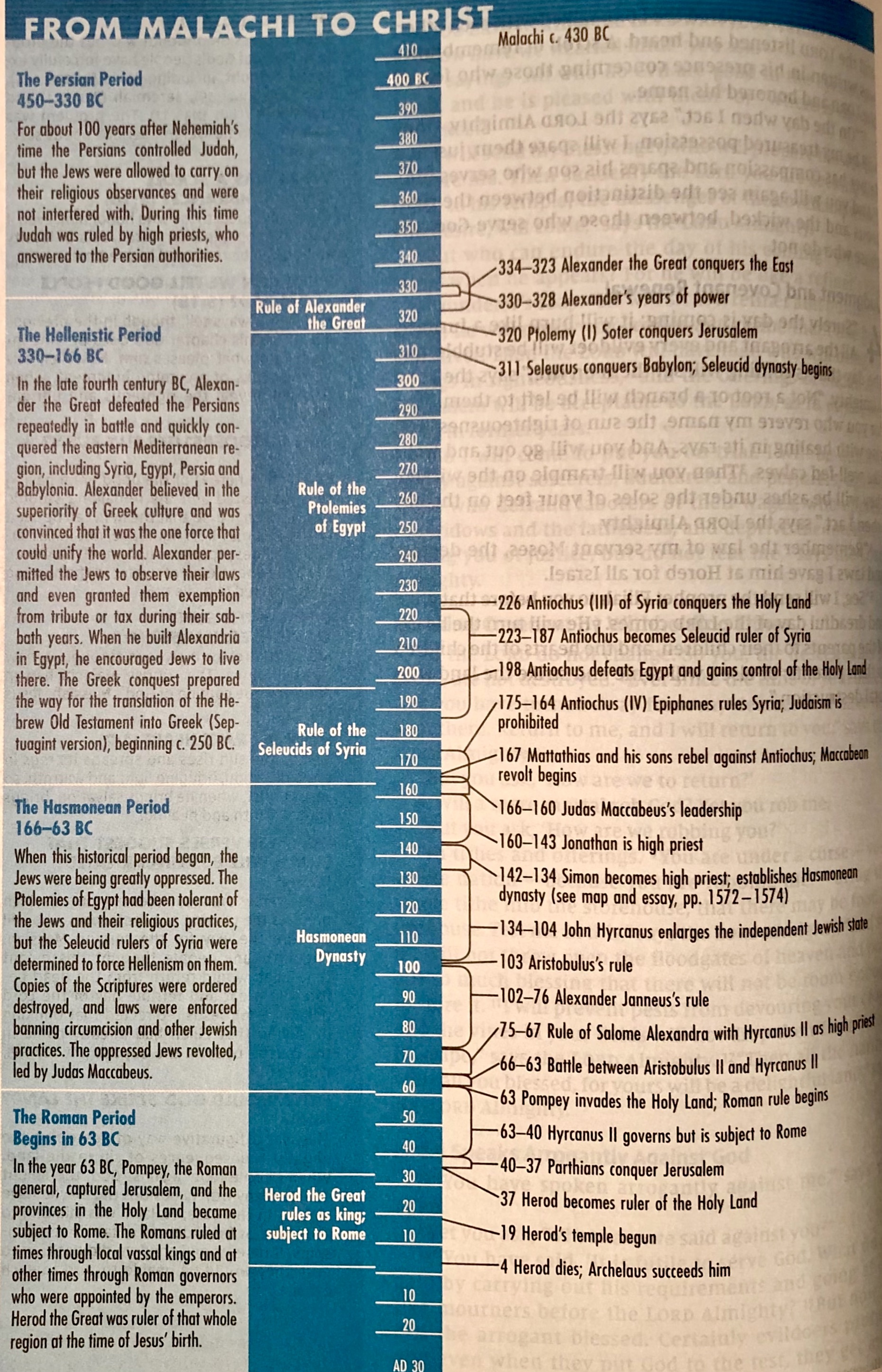
From Malachi To Jesus

I just finished a series looking at the minor prophets. After Malachi, there is about 400 years of silence as far as what is recorded in the Bible for us. That doesn’t mean nothing is happening on the pages of history. In actuality, there is so much happening on the world scene.

This chart is in both the Quest Study Bible and The Life In The Spirit Study Bible. Always remember: All of history is His story! 

The History Of Zechariah

Zechariah and Haggai are both very specific in the dating of their prophetic activity. We can also cross-reference their dates with the historical books of Ezra and Nehemiah, and with numerous other extra-biblical sources. 

There is an important reminder for us in this: The historicity of the biblical accounts. 

In the chart I share there are references to other timelines:

  • the timeline for Haggai is here
  • the timeline for Ezra is here
  • and the story of Zechariah’s murder is found here

Always remember that God is sovereignly in control of world events—all of history is His Story! 

To check out other resources from the historical and prophetic minor prophets, check out the list I have posted here.

Major Lessons From Minor Prophets (concluded)

Sometimes the naming of things gives us an inaccurate picture of the thing being named. For instance, many people think the “old” in Old Testament means outdated or perhaps updated by the “new” in the New Testament. When in fact, both Testaments are needed to give us the full picture of God’s love and glory. 

A similar thing happens with the headings “major prophets” and “minor prophets.” It makes it sound like the major prophets have something major to say to us, while we could take or leave the minor messages of the minor prophets. 

In reality, they were given these headings simply because of the volume of writing—the five major prophets consist of 182 chapters, whereas the 12 minor prophets only have 67 chapters. The volume of their writing may be minor, but their content carries major messages of meteoric power! 

Join me this Sunday as we rejoin this highly informative series.

If you have missed any of the messages in this current session, check them out here:

10 Quotes From “Reading The Bible With The Founding Fathers”

Listen to the podcast of this post by clicking on the player below, and you can also subscribe on AppleSpotify, or Audible. 

For any students of American history or of the role the Bible has played in affecting world affairs, Reading The Bible With The Founding Fathers is an eye-opening book. You can check out my full book review by clicking here. Unless otherwise noted, quotes are from author Daniel Dreisbach. 

“Following an extensive survey of American political literature from 1760 to 1805, political scientist Donald S. Lutz reported that the Bible was referenced more frequently than any European writer or even any European school of thought, such as the Enlightenment or Whig intellectual traditions. Indeed, the Bible accounted for about one-third of all citations in his sample. According to Lutz, ‘Deuteronomy is the most frequently cited book, followed by Montesquieu’s The Spirit of the Laws.’ … Saint Paul is cited about as frequently as Montesquieu and [William] Blackstone, the two most-cited secular authors, and Deuteronomy is cited almost twice as often as all of [John] Locke’s writings put together.”

“The founders often quoted the Bible without the use of quotation marks or citations, which were not necessary for a biblically literate society but the absence of which fail to alert a biblically illiterate modern audience to the Bible’s invocation.” 

“Increasing unfamiliarity with the Bible makes it harder and harder for Americans to understand their origins and their mores, or to put words to their experiences. … Lacking knowledge of the Bible, Americans are likely to be literally inarticulate, unable to relate themselves to American life and culture as a whole.” —Wilson Carey McWilliams

“Knowledge of the Bible and its place in the American experience, in short, helps Americans better understand themselves and their history.” 

“In regard to this Great Book [the Bible], I have but to say, it is the best gift God has given to man. All the good the Saviour gave to the world was communicated through this book. But for it we could not know right from wrong. All things most desirable for man’s welfare, here and hereafter, are to be found portrayed in it.” —Abraham Lincoln 

“[T]he Bible has had a literary influence not because it has been considered as literature, but because it has been considered as the report of the Word of God.” —T.S. Eliot 

“[William] Tyndale, who was the first to translate the Bible into English from the original Hebrew and Greek, can be rightly called the father of the King James Bible. Approximately ‘eighty percent of his Old Testament and ninety percent of his New Testament’ were adopted by the King James translators. …  

“There is much truth in the remark that ‘without Tyndale, no Shakespeare.’ It is also true that ‘without Tyndale, no King James Bible.’ ‘Without the King James Bible,’ Alister McGrath observed, ‘there would have been no Paradise Lost, no Pilgrim’s Progress, no Handel’s Messiah, no Negro spirituals, and no Gettysburg Address. … Without this Bible, the culture of the English-speaking world would have been immeasurably impoverished.’” 

“The size of the vocabulary found in the King James Bible is not extensive. [William] Shakespeare, it is estimated, used between fifteen and twenty thousand different words. Milton’s verse draws on a lexicon of about thirteen thousand words. The Old Testament, in the Hebrew and Aramaic, has approximately fifty-six hundred words. The New Testament, in the Greek, has around forty-eight hundred words. In the entire King James Bible, by contrast, there are only about six thousand different words, according to one accounting.” 

“The opinion that human reason, left without the constant control of divine laws and commands, will preserve a just administration, secure freedom and other rights, restrain men from violations of laws and constitutions, and give duration to a popular government, is as chimerical as the most extravagant ideas that enter the head of a maniac. … Where will you find any code of laws, among civilized men, in which the commands and prohibitions are not founded on Christian principles? I need not specify the prohibition of murder, robbery, theft, [and] trespass. … Every wise code of laws must embrace the main principles of the religion of Christ.” —John Adams 

“Moral principles and precepts contained in the Scriptures ought to form the basis of all our civil constitutions and laws. These principles and precepts have truth, immutable truth, for their foundation; and they are adapted to the wants of men in every condition of life. They are the best principles and precepts, because they are exactly adapted to secure the practice of universal justice and kindness among men; and of course to prevent crimes, war and disorders in society. No human laws dictated by different principles from those in the gospel, can ever secure these objects. All the miseries and evils which men suffer from vice, crime, ambition, injustice, oppression, slavery and war, proceed from their despising or neglecting the precepts contained in the Bible. … For instruction then in social, religious and civil duties resort to the scriptures for the best precepts and most excellent examples of imitation.” —Noah Webster

First-Century Rulers In Palestine

I have frequently made the assertion that God is sovereign over all history, or as I like to say it… All History is His Story

When we are reading the Bible, it is important to keep in mind that these are not “once upon a time” stories, nor are they set “a long time ago in a galaxy far, far away,” but we are reading the accounts of actual people in actual moments of history.

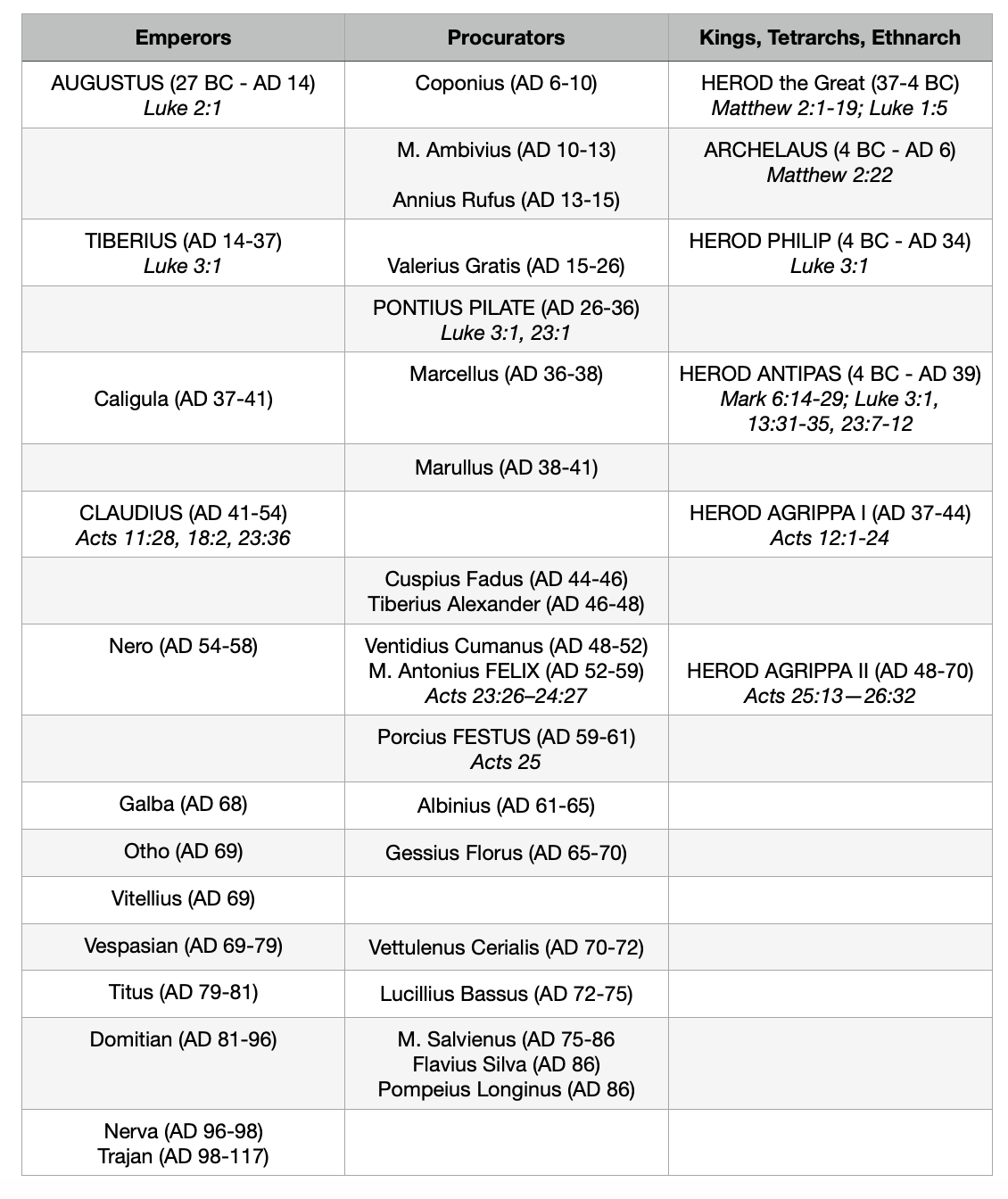
I hope this chart from The Archeological Study Bible helps you in your reading of the New Testament.

Any of the names listed above in ALL CAPS are people who appear on the pages of the New Testament.

You may also want to check out a previous post where I discuss the historicity of the Gospels, or this post and this post about the resurrection appearances of Jesus.

The Historicity Of The Gospels

Listen to the podcast of this post by clicking on the player below, and you can also subscribe on Apple or Spotify.

I’m intrigued by the way the four Gospel writers have recorded the dying declarations of Jesus:

  • Father, forgive them—only in Luke 
  • Today you will be with Me in paradise—only in Luke 
  • Dear women, behold your son—only in John 
  • My God, My God, why have You forsaken Me?—only in Matthew and Mark (and this is the only dying declaration they record) 
  • I thirst—only in John
  • It is finished—only in John
  • Father, into Your hands I commend My spirit—only in Luke 

This is an excellent apologetic for the legitimacy and authenticity of the historical record. 

You know that when your friends are at an important event, not everyone notices the same thing or even to the same extent as the others. 

Cold-case detective J. Warner Wallace has pointed out that when he’s conducting an investigation, he separates the eyewitnesses from each other exactly so they don’t get their stories to “match.” Detective Wallace is able to get the full story precisely because of the differences in each of the accounts. 

This is why the Gospel writers’ accounts ring true: they tell us the same historical event from their unique perspectives. It’s only by reading all of them that we get the full picture. If the death and resurrection of Jesus had been a conspiracy, these writers clearly would have collaborated to “get their story straight” ahead of time, and as a result, we would have four identical stories. 

The historicity of Jesus as told in the Bible is spot-on and completely trustworthy! 

►► Would you please prayerfully consider supporting this ministry? ◀︎◀︎

The Fear And The Comfort Of God’s Judgment

Near the end of the movie The Princess Bride, the grandson learns that Wesley, the hero of the story, has apparently died. He asks his grandfather, “Who kills Prince Humperdink,” the arch-villain in the story. 

His grandfather replies, “No one. He lives.” 

“You mean he wins!?” blurts out the exasperated boy, “Grandpa, why did you read me this story??” 

We love to see bad guys get what’s coming to them, don’t we? Some of the baddest bad guys—perhaps in all of history—are the kings of Assyria. When the Assyrians in Nineveh repented and God’s judgment didn’t fall on them, Jonah’s response was much like the grandson in The Princess Bride, “God, why did You send me here?!” 

Sennacherib was the king of Assyria who was threatening Judah. Nahum writes a short, scathing prophecy about the destruction that is headed Assyria’s way. This is fulfilled in a small part when God defeats Sennacherib’s army, which leads to Sennacherib then being assassinated by two of his sons.

For Judah, this is a short-lived victory because the two kings which follow Sennacherib turn out to be two of the evilest and ruthless kings of Assyria. Yet Nahum’s prophecy still stands: an ultimate destruction is coming. In 605 BC Assyria was defeated by the Babylonians, and the destruction was so complete that Nineveh’s very existence was questioned until archeological discoveries were made in the 19th century. 

Why is this prophecy given to us? What are we New Testament Christians supposed to do with this promise of judgment? 

Nahum’s name means comfort, so it seems like God’s justice should comfort us. But, interestingly, the root word of his name means to regret or to feel sorry

Why is this? Think about it: You cannot really know what peace is unless you have been through a period of turmoil. Likewise, you cannot truly understand the relief of being spared God’s judgment unless you fully understand the weight and totality of God’s judgment that should fall on you.  

Nahum reminds us that God will never let the guilty go unpunished, and yet in the very next breath he tells us that the Lord is a refuge for those who trust in Him.

God is Just. This is a cause for…

  • …BOTH fear of God’s anger AND rejoicing that He is good 
  • …BOTH humility for our sin AND confidence that He forgives our sin 
  • …BOTH regret that we fall short of God’s righteous standard AND relief that Christ’s blood makes us righteous in God’s sight 

It’s amazing to think that it was MY sin that nailed Jesus to the Cross, but it was HIS love that allowed that to happen so that I could be forgiven! 

God is not willing that any should be separated from Him, but we do have to choose to receive the forgiveness that Jesus purchased for us. 

Assyria’s utter destruction is less than a drop in the bucket compared to eternal separation from God. As C.S. Lewis commented about the end of time: 

“For this time it will be God without disguise; something so overwhelming that it will strike either irresistible love or irresistible horror into every creature. It will be too late then to choose your side. There is no use saying you choose to lie down when it has become impossible to stand up. That will not be the time for choosing: it will be the time when we discover which side we really have chosen, whether we realized it before or not. Now, today, this moment, is our chance to choose the right side. God is holding back to give us that chance. It will not last forever. We must take it or leave it.” 

Today (and every day) is the day for heart-searching, acutely feeling the regret of our sin, and then knowing that our forgiven sins are forgotten sins! 

If you have missed any of the messages in this series on the major lessons from the minor prophets, you can find the full list by clicking here.

The Lingering Effects Of Poor Leadership

Surely these things happened to Judah according to the Lord’s command… (2 Kings 24:3). 

I am intrigued by the succession of the last kings of Judah just before Jerusalem falls in 586 BC. The leadership authority has been completely undermined by the downward spiral of sin in the previous leaders. As a result, the kings of Judah are now just an “empty suit,” with someone else exerting the real influence.

King Josiah was the last God-fearing king Judah had. After Josiah died, “the people of the land” made Jehoahaz king of Judah. He only reigned three months. 

After Jehoahaz died, “Pharaoh Neco made Eliakim son of Josiah king” after Egypt subdued Judah. Pharaoh changed his name to Jehoiakim, took all of Judah’s treasures, and imposed a tribute on Judah, forcing Jehoiakim to tax all the citizens. 

Later on, Jehoiakim became a vassal king of Nebuchadnezzar. After Jehoiakim died, his son Jehoiachin only reigned as king for three months before he was deposed by Nebuchadnezzar. 

Nebuchadnezzar then “made Mattaniah” king. He also imposed tribute and changed the king’s name to Zedekiah. 

King Zedekiah rebelled and was executed, after which Nebuchadnezzar “appointed Gedaliah as governor.” Gedaliah was assassinated shortly thereafter, completing the collapse of Judah and sending the people into exile in Babylon for the next 70 years. 

[Check out all of the biblical references for these sad events by clicking here]

Oh, what misery for the people of Judah for this last 20-year span under these final kings! The consequences of the leaders’ continual rebellion against God brought such uncertainty and heartache for the citizens. 

A mark of a godless leader is the wake of misery that follows him for generations afterward. 

Lord God, help me to see that my actions today have consequences for tomorrow. I want to leave an empowering, God-honoring legacy for the next generations, but this can only happen as I remain obedient to You! 

This is part 51 in my series on godly leadership. You can check out all of my posts in this series by clicking here

The Role Of Prophecy

Micah may be classified as a minor prophet, but the prophecies in his book are fulfilled in a major way in as little as 20 years and as far out as 2700+ years! 

Here’s a question for us to consider: What exactly is the role of prophecy in the life of a Christian? 

Micah introduces himself in the opening verse. He was ministering in the country while Isaiah was in the city of Jerusalem at the same time. Micah’s ministry spans three kings of Judah in the south, and he overlaps the defeat of Israel in the north.  

Check out some of Micah’s most notable prophecies: 

  1. Judgment is coming to Samaria/Israel (1:6-7). This was fulfilled about 20 years later when the Assyrians defeated Samaria and took the Israelites into exile. 
  2. Judgment is coming on southern Judah (1:9-16). This was fulfilled about 30 years later when Sennacherib attacked Philistia and southern Judah, coming “even to the gate of Jerusalem” (v. 12). At the gate of Jerusalem was the miraculous deliverance God gave during Hezekiah’s reign (see 2 Kings 18-19; Isaiah 37). 
  3. Judgment is coming on Jerusalem (3:12). Micah even prophesied the Babylonians would defeat them (4:10). This is noteworthy because Assyria was the dominant world power at this time; it would be another 100 years before Babylon would even begin to rise to power. This prophecy was fulfilled about 160 years later, and this prophecy actually saved Jeremiah’s life around that same time (Jeremiah 26:7-19). 
  4. The Messiah will be born in Bethlehem (5:2). This prophecy was fulfilled about 700 years later when Jesus was born (Matthew 2:5-6). 
  5. How people will respond to the Messiah’s Advent (7:4-6). This prophecy was partially fulfilled 700 years later in a direct quotation from Jesus (Matthew 10:34-36). 
  6. The coming of the final Kingdom of God (4:1-3). This prophecy will be fulfilled at Christ’s second Advent. 

[you can read all of these prophecies yourself by clicking here

So what is the role of prophecy? 

First of all, fulfilled prophecy reminds us that God is sovereignly in control of everything (Isaiah 46:10). But right on the heels of that, fulfilled prophecy reminds us that there is still more prophecy left to be fulfilled (2 Peter 1:20-2:3). 

The Bible tells me that when I sin, God’s first response is not anger toward me but broken-hearted grief. In a similar fashion, the prophecies of coming judgment on sinners are intended to show us the incredible mercy of God in the forgiveness of sin that He made available (Micah 7:18-20). 

Prophecy is never, never to be used as a club to beat people into submission to God. When Micah prophesied the destruction of Israel and Judah, he wept (Micah 1:8). 

So did Jesus (Matthew 23:37). 

And so should we! 

We live in an age today—as Micah experienced and as the apostle Peter said would be coming—where people won’t want to hear the news that unforgiven sin brings God’s judgment. Our response to this should be brokenhearted grief, tears, and a steadfast commitment to speak the truth in love that Jesus has provided the only means to be rescued from that judgment. 

If you’ve missed any of the other posts in this series on the major lessons from the minor prophets, you can access the full list by clicking here.