Whether you call it grit or stick-to-it-iveness, those who don’t give up easily are the ones who will become leaders by their example. Check out the conversation we had on The Craig and Greg Show.
I was thrilled to be asked to write an article for Influence Magazine about the biting sheep that every pastor has experienced. I am praying that this article will help pastors recover and thrive in their shepherding ministry.
“Knowing our lowliness and Christ’s worthiness, we neither grovel nor saunter into the presence of God. And we do not go home flippant or weeping. In Christ, we will receive what we ask or what we should have asked.” —David Mathis
In 1 Thessalonians 5:19, the apostle Paul warns us not to quench the Holy Spirit. T.M. Moore asks, “How do we quench the Spirit?” and then gives Christians seven warning signs to avoid this quenching. Check out his post Joy In His Spirit.
I really enjoy these archeological biographies of biblical people and places. The Bible Archeology Report writes, “The Neo-Babylonian king, Amēl-Marduk (biblical Evil-Merodach) is only mentioned twice in Scripture (in 2 Kings 25:27–30 and the parallel passage, Jeremiah 52:31–34), both times in connection with the restoration of Jehoiachin, king of Judah.” In a separate post, John Stonestreet shares an archeological discovery in a Roman cemetery in Frankfurt of an amulet that shows that “the Gospel spread farther and faster than historians thought.”
Listen to the podcast of this post by clicking on the player below, and you can also subscribe on Apple, Spotify, or Audible.
I want to give you some thoughts to take your Bible studies even deeper. Here are three strategies to make your Bible study time stickier—sticking in your heart and your mind.
Listen to the podcast of this post by clicking on the player below, and you can also subscribe on Apple, Spotify, or Audible.
Much like Jude who had a message he wanted to deliver to the saints, but was compelled by the Holy Spirit to address something concerning him (Jude 3-4), I, too, was excited to deliver the next message in our series on discovering your gifts and then living in your gift zone. But I am deeply concerned about the words and actions of Christian saints during these past election cycles.
I recently heard John Stonestreet say, “Currently, politics is carrying far more cultural weight than it is able to bear.” I agree: Christians are putting far too much emphasis on political candidates than the Bible would suggest.
I frequently quote something from Charles Colson that always makes people smile. He said, “Salvation will never arrive in Air Force One.” The flip side is true as well: Neither will the Apocalypse arrive on Air Force One.
We have to remember that the Most High is sovereign over all the nations of the earth, and He gives them to whom He choose (Daniel 4:25, 32). When we think that our candidate or our party is the only way our nation can be saved, aren’t we elevating the political process above God’s plan?
I hope this doesn’t come as a shock to anyone, but there are no perfect candidates, perfect political parties, nor perfect party platforms. We can study our Bibles, pray, study the candidates’ lifestyle and policies, but ultimately we will have to cast a ballot for an imperfect candidate.
God doesn’t have an “R” or “D” next to His name. He has not endorsed a political candidate. You may be sitting next to someone right now that is going to vote for the opposite political party that you will be voting for. And the way we interact with those people—whether they are fellow Christians or not—is deeply concerning to me.
Moses saw a couple of fellow Israelites fighting each other, and he asked them, “Why are you hitting your fellow Hebrew” (Exodus 2:13). The Hebrew word rea means a friend who is also a fellow citizen. These Hebrews were citizens of Zion, but they were living in Egypt, and they definitely weren’t treating each other in a way that would be a testimony to the Egyptians.
When Stephen retold this portion of the story in his sermon, he phrased it this way, “Men, you are brothers” (Acts 7:25-26). Stephen used the Greek word adelphos which literally means “from the same womb.” But the Christians used this word to mean brothers and sister in Christ—people with whom we will spend eternity.
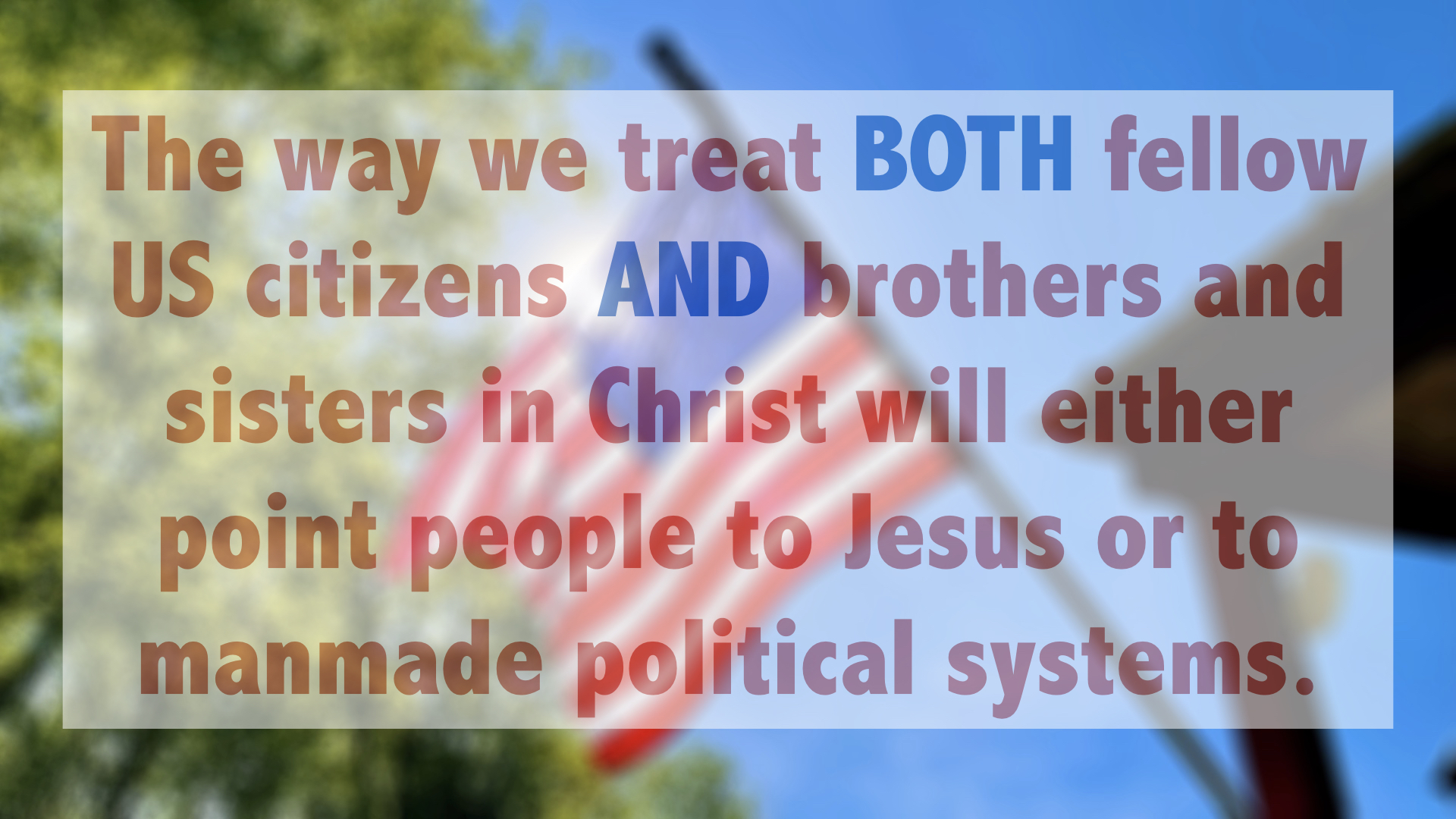
Let us always remember that others who are participating in the American political process are BOTH fellow US citizens AND brothers and sisters in Christ.
In J.R.R. Tolkien’s Return of the King, when Gandalf sees fellow citizens and friends at each other’s throats, he exclaims, “Work of the enemy! Such deeds he loves: friend at war with friend, loyalty divided, and confusion of hearts.” Indeed, the enemy of our souls would love to see the chaos of a nation at war with itself; especially to see Christians at odds with each other.
Paul said, “Therefore, as we have opportunity, let us do good to all people,especially to those who belong to the family of believers” (Galatians 6:10). On the flip side, Jesus said that when we think or speak poorly of a fellow human, we are in danger of judgment (Matthew 5:22).
Listen to Paul’s appeal to his friends at Philippi—
Therefore if you have any encouragement from being united with Christ, if any comfort from His love, if any common sharing in the Spirit, if any tenderness and compassion, then make my joy complete by being like-minded, having the same love, being one in spirit and of one mind.
I plead with Euodia and I plead with Syntyche to be of the same mind in the Lord. Yes, and I ask you, my true companion, help these women since they have contended at my side in the cause of the gospel, along with Clement and the rest of my co-workers, whose names are in the book of life. (Philippians 2:1-2, 4:2-3)
The politicians we have are always downstream from culture, which means we have allowed those sorts of politicians to be in place.
John Stonestreet used a phrase I hadn’t heard before, but I think it’s appropriate: “Christian political engagement should hit its fever pitch notduring elections. The only way to relieve the political pressures of our day is to build up the pre-political aspects of our life together, especially the family and the Church. When we care well for our children, our neighbors, and our communities, the state doesn’t have to.”How true this is!
I wrote something this summer based on Isaiah 3:4-5. In essence, I wrote that God gives nations the “leaders” they deserve. They are leaders in that they occupy an office, but they don’t lead people nor care for the citizens—they don’t have wisdom to lead nor do they care about anyone but themselves. This is the inevitable result for a nation that turns its back on God! So if we think our political and civic leaders are self-focused, unskilled, and childish, we should look in the mirror. It’s not “them,” it’s us. We have to change—turning wholeheartedly to God—and only then God can change our leadership.
We need to be praying for our governmental leaders, not vilifying them. We need to be speaking well of our fellow US citizens. We need to be especially treating our fellow brothers and sisters in Christ well.
Our hope is not in the results of an election. Our hope is in Jesus. The way we treat BOTH fellow US citizens AND brothers and sisters in Christ will either point people to Jesus or to manmade political systems.
I pray we can do better at pointing people to Jesus! I pray I can do better!
Godly men honor their wives by having eyes only for them. Fellas, if you find your eyes wandering you need to tell yourself, “That’s not mine!” and then quickly put your eyes back where they belong. Check out my full message to men on Father’s Day.
I have lots of new content every week, which you can check out on my YouTube channel.
From a recent article at The Institute for Creation Research: “Astronomers using the James Webb Space Telescope have recently confirmed that two galaxies are extremely distant, with one becoming the new record holder as the most distant galaxy from Earth. … By uniformitarian reckoning, this galaxy existed just 290 million years after the supposed Big Bang, yet it looks too mature for its age. … This new record-breaker is just the latest example of the ‘distant mature galaxy problem’ that has long plagued the Big Bang model.” These galaxies are all the masterpiece of one Creator! Here is another resource from a biblical perspective that outlines what the “in the beginning” moment (Genesis 1:1) may have looked like.
“Give me the preacher who opens the folds of my heart; who accuses me, convicts me, and condemns me before God; who loves my soul too well to suffer me to go on in sin, unreproved, through fear of giving me offence; who draws the line with accuracy, between the delusions of fancy, and the impressions of grace; who pursues me from one hiding place to another, until I am driven from every refuge of lies; who gives me no rest until he sees me, with unfeigned penitence, trembling at the feet of Jesus; and then, and not till then, soothes my anguish, wipes away my tears, and comforts me with the cordials of grace.” —Samuel Pearce
Matthew Emadi writes, “The New Testament quotes Psalm 110 more than any other Old Testament passage. The apostles and the early church loved Psalm 110 for its majestic depiction of the Lord Jesus Christ and His reign over all nations.” Here’s how to read Psalm 110 in light of the words and works of Jesus.
J. Warner Wallace, at a Q&A session, answers questions about why some Bible translators have marked a couple of passages as unreliable, and why some books that claim to be authentic accounts aren’t included in the canon of Scripture.
“So the writer [of the Book of Hebrews] urges his readers, as part of being faithful to Him Who called them, to consider Jesus, to strive for the glory of Jesus, and to fix their minds on Jesus as the key to knowing daily strength for faithfulness (Hebrews 12:1-2). What does this entail? … The writer of Hebrews admits that he learned to look to Jesus by paying attention to those who had known Him, listening carefully to their words, and laying hold on them with faith (Hebrews 2:1-4). As he heard the apostles and studied the Scriptures of the Old Testament, the picture of Jesus presented there began to become increasingly clear. … The lesson is plain: Jesus is being revealed in the Scriptures of the Old and New Testament. Wherever we read or study in the Scripture, Jesus is present, making Himself known. We can see Jesus throughout the Bible, and consider Him as He is presented to us, in all His majesty, beauty, and power. Our responsibility is to read the Bible in such a way as to recognize what God is revealing about His Apostle and our High Priest, Jesus Christ.” —T.M. Moore
Listen to the podcast of this post by clicking on the player below, and you can also subscribe on Apple, Spotify, or Audible.
Let’s review the historical background for the Psalms of Ascent. The Jewish people made four pilgrimages to Jerusalem each year, which sit about 2500 fee above sea level, so this was a physical climb. But this also has a spiritual lesson for us today: We are to continue progressing in our walk with God—upward and onward!
The songs of ascent that these pilgrims sang give us life-changing lessons that we can still apply today.
I’m sure there were some pilgrims who thought, “We have to go to Jerusalem.” Just as there are some people today who may something like, “I have to tithe.” But when you have experienced the blessing that comes from obedience, your “have to” turns to “get to” really quickly!
There is a longing in Psalm 128 for God’s blessing. In fact, we see it in nearly every verse: blessed (v. 1), blessing and prosperity (v. 2), blessed (v. 4), bless and prosperity (v. 5), and peace (v. 6).
We have to remember that our obedience doesn’t earn God’s blessing, but rather our obedience keeps us in the place where we can receive God’s ever-flowing blessings. When I have experienced the blessing that followed even my “have to” attitude, I now joyfully “get to” obey because I know that keeps me in a blessed place.
But even knowing that these blessings are flowing for us, sometimes we still get weary. Sometimes it seems as if we are being faithful but we aren’t seeing the results that perhaps we saw before.
Think about these pilgrims ascending 2500 feet year after year after year. It was challenging enough during the golden days of King David and King Solomon, but can you imagine the feelings of futility during the dark days? Perhaps during the exile when the temple was in ruins, or after the exile when the temple didn’t look as it did before and there were overlords ruling Israel? And then it was unquestionably true that the older a pilgrim got, the harder the climb became for them.
But the struggle keeps us reliant on God. Like Solomon said, “The way of life winds upward for the wise, that he may turn away from hell below” (Proverbs 15:24). The longer I walk, the more I get to rely on God’s help, and the sweeter He becomes to me!
I love the line in the hymn Great is Thy Faithfulness, “Strength for today and bright hope for tomorrow—blessings all mine with ten thousand beside.” Because of God’s blessings that I’ve already experienced, I can trust Him for more, even in the struggle of the climb.
Look at some of these promises that come out in other biblical translations.
Blessedare those who fear God (NIV) = “How joyful are those who fear the Lord” (NLT)
Blessing and prosperity will be yours (NIV) = “You will enjoy the fruit of your labor” (NLT) and “You will eat what you worked so hard to grow” (NET)
The middle of this psalm is in verses 3-4. Remember above when I said nearly every verse contains a word of blessing? I didn’t list verse 3, but there is language in this verse that makes it pregnant with blessing—Your wife will be like a fruitful vine within your house; your sons will be like olive shoots around your table.
You may ask, “How is this a blessing?”
The phrase “under their own vine and under their own fig tree” appears throughout the Old Testament. It described a blessed, prosperous, happy, and peaceful home. It was a home at peace within because there was also peace without.
This described the golden era of King Solomon—During Solomon’s lifetime Judah and Israel, from Dan to Beersheba, lived in safety, everyone under their own vine and under their own fig tree (1 Kings 4:25).
After the northern kingdom of Israel fell and the southern kingdom of Judah was surrounded by the Assyrian forces of King Sennacherib, the king’s field commander tried to entice them the people with similar words—
Do not listen to Hezekiah. This is what the king of Assyria says: “Make peace with me and come out to me. Then each of you will eat fruit from your own vine and fig tree and drink water from your own cistern until I come and take you to a land like your own—a land of grain and new wine, a land of bread and vineyards, a land of olive trees and honey. Choose life and not death! Do not listen to Hezekiah, for he is misleading you when he says, ‘The LORD will deliver us.’” (2 Kings 18:31-32)
Notice that he said the land would be “a land like your own.” He was trying to get them to compromise, to no longer listen to God’s voice, to no longer climb up into God’s presence. Much like satan tempted Adam and Eve to eat the forbidden fruit with the promise, “You will be like God.”
But these blessings in Psalm 128 don’t come from fearful “have to” obedience to man, but from reverencing God above all else. So the longing of verses 1-4 become the prayer of verses 5-6 (notice the word may used three times in these verse).
The focus of our longing—where we need to keep our eyes—is on God’s heavenly throne: Zion, Jerusalem, Israel (vv. 5-6; Micah 4:1-5).
In an earlier story, Caleb may have gotten tired while he waited for God to fulfill His promise to him, but he always trusted God as he walked on (see Joshua 14:9-12).
What promises of God are you still praying for?
What are you longing to see accomplished?
What has God already done that you can look back on?
The Hill, though high, I covet to ascend, The Difficulty will not me offend; For I perceive the Way to life lies here. Come, pluck up Heart, let’s neither faint nor fear;
Better, though difficult, the Right Way to go,
Than wrong, though easy, where the End is Woe. (John Bunyan)
Don’t give in.
Don’t give up.
Keep climbing.
Like Caleb say, “It may have been 85 years of walking and climbing, but I’ll keep climbing. GOD, GIVE ME THIS HILL!”
If you would like to check out the other songs of ascent that we’ve already studied, please click here.
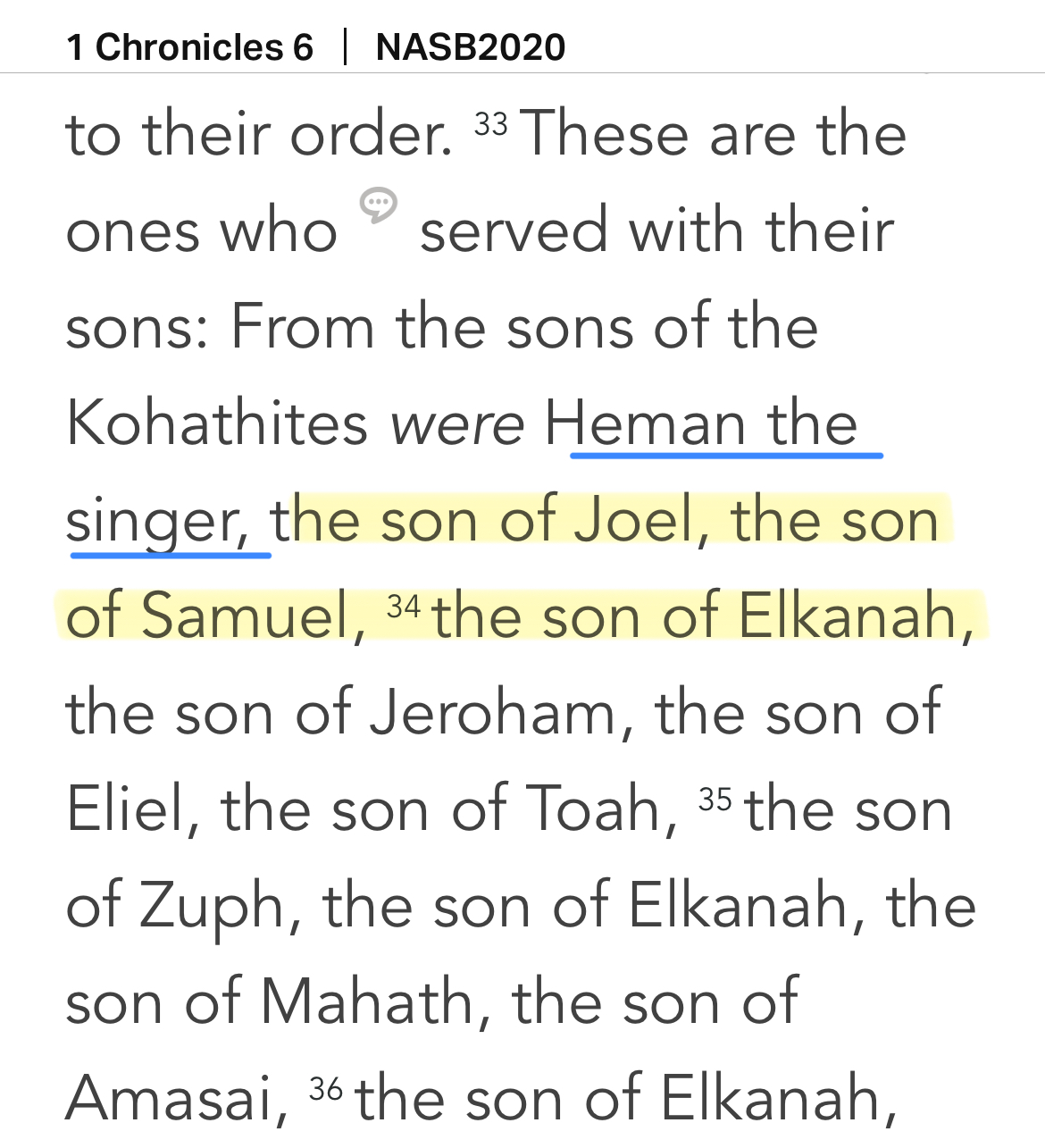
The psalmist Heman is the grandson of Samuel. “These are the ones who served with their sons: From the sons of the Kohathites wereHeman the singer, the son of Joel, the son of Samuel, the son of Elkanah, the son of Jeroham, the son of Eliel, the son of Toah” (1 Chronicles 6:33-34; 1 Samuel 1:1, 20).
Samuel came from the line of Levites (specifically the Kohathites), which is the same family to which Moses, Aaron, and Miriam belonged. While the tabernacle of the Lord was mobile in the wilderness, the Kohathites were responsible for carrying the furnishings of the tabernacle (Numbers 4:4-20).
When the permanent temple was constructed in Jerusalem, the responsibility of the Kohathites changed. They now oversaw the worship in the temple, and Heman is listed as the chief worship leader, with others to his right and left. “Heman’s brother Asaph stood at his right hand, Asaph the son of Berechiah, the son of Shimea. … On the left hand were their kinsmen the sons of Merari: Ethan the son of Kishi, the son of Abdi, the son of Malluch” (1 Chronicles 6:39, 44).
And then we see Heman’s family line continuing in the roles of worship leaders after him: ”All these were the sons of Heman the king’s seer to exalt him according to the words of God, for God gave fourteen sons and three daughters to Heman. All of these were under the direction of their father to sing in the house of the Lord, with cymbals, harps, and lyres, for the service of the house of God. Asaph, Jeduthun, and Heman were under the direction of the king. Their number who were trained in singing to the Lord, with their relatives, all who were skillful, was 288“ (1 Chronicles 25:5-7).
The Book of Psalms contains just one psalm that Heman composed (Psalm 88).
In the fourth year of King Hezekiah, which was the seventh year of Hoshea son of Elah, king of Israel, Shalmaneser king of Assyria came up against Samaria and besieged it (2 Kings 18:9). The Bible Archeology Report puts together wonderful biographies of biblical characters based on archeological discoveries that corroborate the account in Scripture. Here is the biography of Assyrian King Shalmaneser V.
Meteorologist Dr. Roy Spencer writes, “Atmospheric CO2 levels will start to fall even with modest reductions in anthropogenic CO2 emissions. Why is that? The reason is due to something called the CO2 ‘sink rate.’ It has been observed that the more CO2 there is in the atmosphere, the more quickly nature removes the excess.” Imagine that! It’s almost as if the Creator of the Universe knew exactly what He was doing.
J. Warner Wallace makes the case that the origin of the universe points to a Creator—but he does so without using Scripture.
“You will not be able to extemporize good thinking unless you have been in the habit of thinking and feeding your mind with abundant and nourishing food.” —Charles Spurgeon
God’s blessings are not primarily for me, but they are through me for His glory. This is a short clip from an exclusive video I shared with my Patreon supporters. Become a supporter today! I have lots of new content every week, which you can check out on my YouTube channel.
“What to do with a mistake: recognize it, admit it, learn from it, forget it.” —Dean Smith
Until the mid-1800s, the historicity of King Sargon II (mentioned by Isaiah) was in doubt. Not only has archeology again affirmed the historical statements made in Scripture, but “the way Isaiah spelled Sargon’s name is an indicator that the prophet lived at the time of Sargon II, and that the book was not penned hundreds of years later.” Check out this archeological biography of Sargon II.
And then there is this archeological report about the destruction of Sodom and Gomorrah. Fascinating!
How sweet and gracious even in common speech,
Is that fine sense which men call Courtesy!
Wholesome as air and genial as the light,
Welcome in every clime as breath of flowers—
It transmutes aliens into trusting friends,
And gives its owner passport round the globe. —James T. Fields
“A person always doing his or her best becomes a natural leader, just by example.” —Joe DiMaggio
Not using the spiritual gift God has given you is selfish. He gave you these gifts on purpose so that His kingdom could be made more visible and desirable.
He turned to God and the people put away their idols <or>
He turned from God and the people turned to their idols
It’s true: As goes the leader, so go the people.
In my life, I’ve experienced that the good things that I do over-the-top are only moderately emulated by those around me. But the unhealthy things that I even slightly indulge in are adopted quickly by everyone else.
Godly leaders must be so aware of how their example impacts everyone around them, and they must fight to maintain biblical standards. When we miss the mark, we must be quick to admit our shortcoming, repent, and get back on track.
In Hosea 4:9, God warns that the people will follow the ungodly example of their leaders, which is why God’s punishment is often more severe for those leaders.
On the positive side, in Leviticus 9, Moses and Aaron demonstrate the leadership example of spending time in God’s presence and fully obeying everything God had revealed to them there. Then verse 23 it says that after they came out of His presence, God’s glory appeared to all the people. The positive example of the leaders led to huge blessings for all the people!
A mark of a godly leader is one who increasingly aware of the power of his example.
Leaders, let’s be first to go first in…
…being in God’s presence
…obeying God’s commands
…repenting when we fall short
…asking forgiveness of those who have seen our poor example
…asking God to bless His people because of our good example
This is part 77 in my series on godly leadership. You can check out all of my posts in this series by clicking here.



 Whether you call it grit or stick-to-it-iveness, those who don’t give up easily are the ones who will become leaders by their example. Check out the conversation we had on The Craig and Greg Show.




 Craig T. Owens