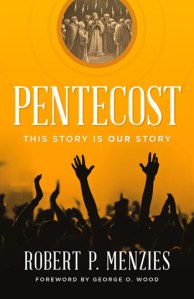
14 Quotes From “Pentecost”

Pentecost

I thoroughly enjoyed reading Pentecost by Robert P. Menzies, and learned quite a bit. You can read my full book review by clicking here. Here are a few quotes that stood out to me.

“It’s because Pentecostals fuse the biblical and contemporary horizons that we link baptism in the Holy Spirit with speaking in tongues, since that’s what Acts 2 does. It’s why we associate Spirit-baptism with empowerment for mission rather than with spiritual regeneration. And it’s why we expect God to perform ‘signs and wonders’ and to manifest spiritual gifts in worship services. All these things happened in the first Pentecostal community, and their story is our story.” 

“At its heart, the Pentecostal movement is not Spirit-centered but Christ-centered. The work of the Spirit, as Pentecostals understand it, centers on exalting and bearing witness to the Lordship of Christ.”

“Pentecostals are ‘people of the Book.’ Although Pentecostals certainly encourage spiritual experience, they do so with a constant eye to Scripture.”

“So, the stories of Acts are our stories, and we read them with expectation and eagerness: stories of the Holy Spirit’s power, enabling ordinary disciples to do extraordinary things for God. … The hermeneutic of the typical Pentecostal believer is straightforward and simple: the stories in Acts are my stories—stories that were written to serve as models for shaping my life and experience.”

“In Luke’s view, every member of the church is called (Luke 24:45–49; Acts 1:4–8/Isaiah 49:6) and empowered (Acts 2:17–21; cf. 4:31) to be a prophet. Far from being unique and unrepeatable, Luke emphasizes that the prophetic enabling experienced by the disciples at Pentecost is available to all of God’s people. … Through his two-volume work, Luke declares that the church, by virtue of its reception of the Pentecostal gift, is nothing less than a community of prophets. It matters not whether we are young or old, male or female, rich or poor, black or white; the Spirit of Pentecost comes to enable every member of the church, each one of us, to fulfill our prophetic call to be a light to the nations.” 

“Not long ago a Chinese house church leader commented, ‘When Western Christians read the book of Acts, they see in it inspiring stories; when Chinese believers read the book of Acts, we see in it our lives.’”

“Luke’s theology of the Spirit is different from that of Paul. Unlike Paul, who frequently speaks of the soteriological dimension of the Spirit’s work, Luke consistently portrays the Spirit as a charismatic or, more precisely, a prophetic gift, the source of power for service.” 

“Luke crafts his narrative so that the parallels between Jesus’ experience of the Spirit (Luke 3–4) and that of the disciples on the day of Pentecost (Acts 1–2) cannot be missed. Both accounts: 1. Are placed at the outset of Luke’s Gospel on the one hand, and the book of Acts on the other; 2. Associate the reception of the Spirit with prayer; 3. Record visible and audible manifestations; 4. Offer explanations of the event in the form of a sermon that alludes to the fulfillment of Old Testament prophecy.”

“Luke’s understanding of baptism in the Holy Spirit, I have argued, is different from that of Paul. It is missiological rather than soteriological in nature. … The tendency in Protestant churches has been to read Luke in the light of Paul. Paul addresses pastoral concerns in the church; Luke writes a missionary manifesto.” 

“Bold witness for Jesus is recognized as our primary calling and the central purpose of our experience of the Spirit’s power. Missions is woven into the fabric of our DNA.”

“I do not wish to minimize in any way the significance of the great doctrinal truths of Paul’s writings. I merely point out that since Paul was, for the most part, addressing specific needs in various churches, his writings tend to feature the inner life of the Christian community. His writings, with some significant exceptions, do not focus on the mission of the church to the world. … It is probably fair to say that while Paul features the ‘interior’ work of the Spirit (e.g., the fruit of the Spirit, Gal. 5:22–23); Luke features His ‘expressive’ work (Acts 1:8). Thus, by appropriating in a unique way the significant contributions of Luke-Acts, Pentecostals have developed a piety with a uniquely outward or missiological thrust.”

“The clarity of the Pentecostal message flows from the simple, straightforward manner in which we read the Bible. As I have noted, Pentecostals love the stories of the Bible. We identify with the stories that fill the pages of the Gospels and Acts, and the lessons gleaned from these stories are easily grasped and applied in our lives. For Pentecostals, the New Testament presents models that are to be emulated and guidelines that are to be followed. It should be noted that our approach to doing theology is not dependent on mastering a particular set of writings, say, the works of Luther; or coming to terms with a highly complex theological system. Pentecostals also do not worry much about cultural distance or theological diversity within the canon. We do not lose sleep over how we should understand the miracle stories of the Bible or how we might resolve apparent contradictions in the Bible. Our commitment to the Bible as the Word of God enables us to face these questions with a sense of confidence.”

“We must remember that whatever we do, God is measuring the work we do for Him in a qualitative, not quantitative way. … Only the work which is done by the power of the Holy Spirit can be acceptable in the Kingdom of God.” —David Yonggi Cho

“Some will still remain skeptical. They will ask: Is not this approach to church life, with its emphasis on ecstatic experience, emotional response, and spiritual power, filled with inherent dangers? Might it not encourage us to feature emotionally manipulative methods and to focus on superficial matters? Yes, undoubtedly, there are dangers. However, there is more danger in an approach that fails to make room for the full range of human experience, including the emotions, in our encounter with God.”

A Caution About Success

CautionAfter King David had been firmly established as the king of Israel, he wanted to show the world how devoted he was to God, and undertook to bring the ark of the covenant to Jerusalem.

This move came after “David knew that the Lord had established him as king” and “that his kingdom had been highly exalted for the sake of God’s people” (2 Samuel 5:12; 1 Chronicles 14:2). David also asked the people about bringing the ark to Jerusalem and “it seemed right to all the people” (1 Chronicles 13:4).

Hooray! It sure sounds like David is using his new position as king to do something wonderful for his people. But…

Even with David’s knowledge that God had established him, David proceeded in a way that was displeasing to God, by attempting to move the ark in a way that God never sanctioned (2 Samuel 6:3; 1 Chronicles 13:7).

When things are going well and there seems to be a lot of positive momentum, we cannot abandon the things that brought God’s success in the first place! 

David had a habit of inquiring of God (2 Samuel 5:19, 23; 1 Chronicles 14:10, 14) which had led to his God-given success (1 Chronicles 14:17). But in the excitement of moving the ark, and the applause of the people David said, “We did not inquire of Him” (15:13) nor did they undertake the task “in accordance with the Word of the Lord” (15:15).

CAUTION!!! We can never be too careful about inquiring of God nor consulting His Word. A danger of success is that we abandon those things which God blesses and simply ride the positive momentum of the moment. No matter how popular or obvious a thing may seem, don’t forget to pray about it and consult God’s Word about it!

Thursdays With Oswald—Heavenly Minded & Earthly Good

This is a weekly series with things I’m reading and pondering from Oswald Chambers. You can read the original seed thought here, or type “Thursdays With Oswald” in the search box to read more entries.

Oswald Chambers

Heavenly Minded & Earthly Good 

     Entire sanctification puts a man’s breast and back as either should be, places his feet on earth and his head in Heaven, and gives him the royal insignia of the saints. 

From Christian Disciplines

Have you ever heard it said of someone, “He’s so heavenly minded that he’s no earthly good”? They are saying that man has ideas which sound spiritual but aren’t very practical.

Isn’t it also true that someone could be “so earthly minded that he’s no heavenly good”? Yes, sadly, many people fall into this category!

Oswald Chambers is saying that those people who allow the Holy Spirit’s total sanctification process in their lives are both heavenly minded and earthly good. Or, as Chambers says in If Ye Will Ask, “Jesus Christ does not make monks and nuns, He makes men and women fit for the world as it is (see John 17:15).”

Christians should be the most practical people on earth, because their feet remain on earth while their mind and hearts remain in Heaven, hearing and applying God’s timeless and practical truths. True Christians should sound and live differently.

Sword Drills

© kpmoorse.deviantart.com

© kpmoorse.deviantart.com

When I was a kid in Sunday School, we used to have “sword drills.” Anyone remember those? We would hold our Bibles up in the air until the teacher gave us a reference to look up. The first one to find it, and stand up and read it, won that drill. For that, we received a sticker to put inside the front cover of our Bibles. I loved sword drills, and it showed: the front cover of my Bible was filled with stickers!

Oh, that we were as quick to pull out the Sword God has given us today! I wish we were as quick to flip open our Bibles as we seem to be to turn to something else. We call friends, consult a pastor or a counselor, pray about it, talk about, plan how to overcome it; but we are slow on pulling out our Swords. 

  • The writer of Hebrews tells us that the Word of God is sharper than a sword (Hebrews 4:12).
  • Paul told Timothy that the Bible was the premier place for teaching, rebuking, correcting and training (2 Timothy 3:16).
  • He told the Corinthians that God’s Word is what helps us capture wrong thoughts (2 Corinthians 10:5).
  • In Revelation we see satan defeated by the blood of the Lamb and the use of the Word (Revelation 12:11).
  • Jesus Himself demonstrated the power to defeat satan’s temptations when He used the Word to ward off every attack (Luke 4:1-13).
  • And Paul said the Sword is the weapon we should arm ourselves with every single day (Ephesians 6:17).

I love the story John Knox (1514-1572) told about defeating satan’s temptations by the Sword of the Word—

“All my life I have been tested and assaulted of satan. But my present test has assailed me most fearfully. He has set to devour me, and make an end of me. Before, he often would place all my sins before my eyes. He tried to ensnare me with the allurements of this world. But the Spirit broke those attacks. Now he has attacked me another way. This cunning devil has labored to persuade me that I have earned heaven by my faithfulness to my ministry! … Blessed be God who has enabled me to beat down and quench this fiery dart by passages from the Scripture. By the grace of God, I am what I am, not I, but the grace of God in me. Through Jesus Christ I have gained the victory.” (emphasis added)

What do you think? Is it time to brush up on our Sword-handling skills? Get some Sword drills in today, and see how God’s Word will help you!

Prayer’s Empowerment

Prayer is not about insurance, but assurance. Prayer is not about figuring things out, but about getting God’s mind on a subject.

But how does the faith to believe for that assurance, and the faith to capture God’s discernment come to us? It comes through the Third Person of the Trinity: the Holy Spirit. The Holy Spirit empowers us; He’s the central part of our prayer life.

Check out what Jesus said about the Holy Spirit’s role in your prayer life (see John 14:15-27).

EmpowermentAssurancethe Counselor [will] be with you forever (v. 16). The Holy Spirit doesn’t come and go, but He abides constantly. Jesus said I will not leave you as orphans (v. 18), but you will be loved by My Father (vv. 21-23). The Holy Spirit plays a vital role in bringing you into this intimate relationship (Romans 8:15).

Discernment—Jesus said a key component of your prayer life was if you remain in Me and My words remain in you (John 15:7). The Holy Spirit helps teach you what the Word says, and He will remind you of everything I have said to you (John 14:26). The more you can be reminded of God’s Word, the more you can pray and live with God’s discernment.

PeaceMy peace I give you … do not be afraid (v. 27). One of the names given to the Holy Spirit is Comforter. The Amplified Bible defines this title as, “Counselor, Helper, Intercessor, Advocate, Strengthener, and Standby.”

Boldness—when you have greater assurance of God’s Word, deeper discernment into the mind of the Lord, and a more tranquil peace because of prayer, you can pray and live boldly! Want to see boldness in action? Check out how the followers of Jesus lived and prayed after they were baptized in the Holy Spirit (Acts 1:8; 2:14; 4:8; 4:31).

Make no mistake about it:

How we pray is how we will live! 

Our prayers and our lives will be more assured, more discerning, more peace-producing and more bold when we let the Holy Spirit empower every aspect!

We will be continuing our series on prayer—If You Will Asknext Sunday. I would love to have you join us!

19 Quotes From “If Ye Shall Ask”

If Ye Shall AskA challenging and educational look at prayer from the unique perspective of Oswald Chambers is If Ye Shall Ask. You can read my book review of this book and another book on prayer Chambers wrote by clicking here. These are some of the quotes that I especially liked from this book.

“Prayer is not an interruption to personal ambition, and no man who is busy has time to pray. What will suffer is the life of God in him, which is nourished not by food but by prayer.”

“The purpose of prayer is to reveal the Presence of God, equally present at all times and in every condition.”

“Our Lord in His teaching regarding prayer never once referred to unanswered prayer; He said God always answers prayer.” 

“As long as we are self-sufficient and complacent, we don’t need to ask God for anything, we don’t want Him; it is only when we know we are powerless that we are prepared to listen to Jesus Christ and to do what He says.”

“If prayer is not easy, we are wrong; if prayer is an effort, we are out of it.” 

“If once we accept the Lord Jesus Christ and the dominion of His Lordship, then nothing happens by chance, because we know that God is ordering and engineering circumstances.”

“A thing is worth just what it costs. Prayer is not what it cost us, but what it cost God to enable us to pray. It cost God so much that a little child can pray. It cost God Almighty so much that anyone can pray.” 

“It is not a prayer that is strenuous, but the overcoming of our own laziness.”

“We must be in continual practice so that when we find ourselves in a tight place we are perfectly fit to meet the emergency.” 

“There is no such thing as a holiday for the beating of your heart. If there is, the grave comes next. And there is no such thing as a moral or spiritual holiday. If we attempt to take a holiday, the next time we want to pray it is a struggle because the enemy has gained a victory all around, darkness has come down and spiritual wickedness in high places has enfolded us. If we have to fight, it is because we have disobeyed; we ought to be more than conquerors.”

“God’s silences are His answers.”

“Can it be said of us that Jesus so loved us that He stayed where He was because He knew we had a capacity to stand a bigger revelation?”

“Some prayers are followed by silence because they are wrong, others because they are bigger than we can understand.” 

“Jesus Christ does not make monks and nuns, He makes men and women fit for the world as it is (see John 17:15).”

“God does not expect us to work for Him, but to work with Him.” 

“God will not leave us alone until we are one with Him, because Jesus has prayed that we may be.”

“A Christian’s duty is not to himself or to others, but to Christ. We think of prayer as a preparation for work, or a calm after having done work, whereas prayer is the essential work. It is the supreme activity of everything that is noblest in our personality.”

“As long as we get from God everything we ask for, we never get to know Him, we look upon Him as a blessing-machine, that has nothing to do with God’s character or with our characters. … Then why pray? To get to know the Father.”

“All other fields have the glorious but risky snare of publicity; prayer has not.”

Yahweh Vs. Polytheism

I have been reading through the Bible chronologically for awhile now using The Archeology Study Bible, and I am really enjoying the new insights into Scripture that I am gaining.

A couple of weeks ago I saw this chart (on page 408) contrasting the monotheistic characteristics of the one true God (Yahweh) with the polytheistic characteristics which the nations surrounding Israel adhered to. It’s quite a fascinating contrast!

Theological difference between Israel and others

(Click the image to see a larger view, or download a PDF version here → Theological difference between Israel and others. Or better yet, purchase a copy of this amazing study Bible for your own use.)

The monotheistic worldview presented in the Bible is the only worldview which makes the most sense of the universe in which we live. Therefore, the Bible is the filter through which I process all of the other books I read.

Book Reviews From 2013

BookshelfHere are the books I read and reviewed in 2013. Click a title to read the review…

10 People Every Christian Should Know

A Harmony Of The Gospels

Alive To Wonder

All In

Alone

Altar Ego

Andrew Murray Daily Reader

Dear Abba

Decision Points

Did The Resurrection Happen … Really?

Draw The Circle

Fight

Firsthand

Francis

God’s Favorite Place On Earth

God’s Workmanship

Habitudes

He Shall Glorify Me

I Never Thought I’d See The Day

If Thou Wilt Be Perfect

If Ye Shall Ask

It Is Finished

Jesus Is _____.

Jesus: A Theography

Knocking At God’s Door

Love To The Uttermost

One Year Book Of Personal Prayer

Outliers

Plastic Donuts

Pouring Holy Water On Strange Fire

Promotion

Raising Your Child To Love God

Seven Men

Smith Wigglesworth On Healing

Sometimes You Win, Sometimes You Learn

Stopping Words That Hurt

The 13th Resolution

The Baptism With The Holy Spirit

The Bare Facts

The Five Levels Of Leadership

The Highest Good

The Hobbit

The Man Who Knew Too Much

The Purpose Of Christmas

The Ragamuffin Gospel

The Reagan Diaries

The Secrets Of Intercessory Prayer

Things We Couldn’t Say

Understanding Sexting

Unfinished

Unstoppable

Visioneering

Who Do You Think You Are?

You Don’t Need A Title To Be A Leader

For my book reviews of 2011 click here, and for 2012’s list click here.

It’s Good When God Says, “No, Never, Certainly Not!”

No!My friend, God is fully aware of the situation you are facing. He knows what is happening in your life. Here’s the good news—the great news: you are not going down, but you are going through!

“What does God want from you in your difficult time? He wants you to believe His Word—His promises! He wants you to fully trust that He is with you in your struggle. It does not matter if all hell is coming at you, His presence will never be taken from you, even in the midst of your fears and tears. No dart of the devil—no powerful attack against you—will destroy you. Your Father already has a plan of deliverance in place. God is waiting for you to cling to Him in blind trust. He wants you to be able to face all your ferocious temptations, and say, ‘I may not understand this but I know my Lord will not forsake me. I am trusting Him to see me through!’ … God is saying, ‘You’re not going down. I am with you through all of this! If you will just seek My face and trust Me, I will bring you through—because I am always with you!’” —David Wilkerson

In Hebrews 13:5 God says, “I will never leave you, nor forsake you.”

But in English this isn’t quite strong enough. In this short phrase the Greek language uses five negatives. Let me try to state God’s words as they are literally written—

I will never, certainly not, by no means ever loosen My grip on you, and I will never, certainly not, by no means ever leave you behind, nor leave you helpless, nor leave you abandoned. 

Commenting on this verse, Charles Spurgeon wrote—

“This priceless Scripture does not promise us exemption from trouble, but it does secure us against desertion. We may be called to traverse strange ways, but we shall always have our Lord’s company, assistance, and provision. … Come, my heart; if God says He will never leave you nor forsake you, be much in prayer for grace that you may never leave the Lord, nor even for a moment forsake His ways.”

Oh my, what a word of hope! God has not abandoned you, friend. In fact, the Bible makes it clear that He is close to the brokenhearted and the beat-up. He will never, certainly not, by no means ever leave you, so don’t leave Him but cling even more tightly to His unshakable promise!

Thursdays With Oswald—Solitude

This is a weekly series with things I’m reading and pondering from Oswald Chambers. You can read the original seed thought here, or type “Thursdays With Oswald” in the search box to read more entries.

Oswald Chambers

Solitude 

     Solitude with God repairs the damage done by the fret and noise and clamor of the world. … The disaster of shallowness ultimately follows the spiritual life that takes not the shining way upon the Mount of God. Power from on high has the Highest as its source, and the solitudes of the Highest must never be departed from, else that power will cease. 

From Christian Disciplines 

We live in a go, go faster, then go some more world. Everything is urgency and immediacy. It is vital for Christians to find times of solitude to tune out the clamor and tune in to God’s Voice.

The prophet Elijah was one who learned that God was not in the noise, but in the still, small Voice (see 1 Kings 19:1-13). Are we quieting ourselves enough to hear His Voice? If we don’t, we run the risk of spiritual burnout, just as Elijah experienced. Find Make some time for solitude this week.