The Joy Of Giving

Listen to the podcast of this post by clicking on the player below, and you can also subscribe on AppleSpotify, or Audible. 

In our series on six important spiritual disciplines, our key phrase is “so that”—

  • I get stronger so that we can get stronger. 
  • For discipline #1: I study my Bible so that I have something to apply to my life. 
  • For discipline #2: I take time for solitude so that I can respond in a God-glorifying way in stressful situations. 

Our third spiritual discipline makes people nervous: Giving. So perhaps if I give you the “so that” up front that will help you stick with me. Here it is: I practice the spiritual discipline of giving so that I can encourage others and experience God’s greater blessings. 

Jesus has a caution about giving: Don’t give to get earthly recognition (Matthew 6:1-4). He states this with two don’ts and one do:

  • do not announce your giving 
  • do not calculate or reckon your reward for giving
  • do expect God’s reward for your giving

The stark contrast is seen between Joseph Barnabas and Ananias and Sapphira in Acts 4:34-5:4. Barnabas gave everything he had received from the sale of a piece of property without expecting anything in return. Ananias and Sapphira pretended to give everything they had received from the sale of a piece of property fully expecting some sort of recognition. The results are just as stark and clear: Barnabas was honored by both the church and God, while Ananias and Sapphira were severely punished by God. 

When Jesus tells us in Matthew 6 that our giving should be in “secret,” He clearly doesn’t mean that no one knows that we have given. Clearly, in our examples in Acts, people knew that Barnabas had given money to the church. 

In two of his public letters, Paul gave public thanks to the church at Philippi for their financial gifts to him, and he called out the church at Corinth for their failure to give as they had promised they were going to (Philippians 4:10; 2 Corinthians 8:11). 

Paul noted that the Philippians gave because they knew there was a need, and Paul praised them for this and told them that they would see God’s reward for their generosity (Philippians 4:10-20). We can see our “so that” idea here: Paul was encouraged, he said that the Philippians would have all their needs met, and God was glorified. 

Paul used this example of the Philippians as an encouragement to the Corinthians (see 2 Corinthians 8:1-12, 9:5-8). Paul encouraged them to make sure they had a “get to” attitude about giving, not a “have to” obligation. He noted that God blesses the cheerful, get-to giver. 

Notice how similar the blessings of God sound to these two churches: 

And God is able to bless you abundantly, so that in all things at all times, having all that you need, you will abound in every good work. (2 Corinthians 9:8) 

And my God will meet all your needs according to the riches of His glory in Christ Jesus. (Philippians 4:19) 

When the Bible talks about giving, it is never restricted to money, although that is part of it. The Bible talks about giving in three categories. We could call these The three Ts

  1. Treasure—our tithes and offerings.
  2. Time—giving our service to those in need. 
  3. Talent—using the abilities God has given each believer to build up the Kingdom of God.  

How much of our treasure, time, and talent should we give? We should never look for the bare minimum, but we should be lavish givers. C.S. Lewis said it this way in his book Mere Christianity:

“I do not believe one can settle how much we ought to give. I am afraid the only safe rule is to give more than we can spare. In other words, if our expenditure on comforts, luxuries, amusements, etc., is up to the standard common among those with the same income as our own, we are probably giving away too little. If our charities do not at all pinch or hamper us, I should say they are too small. There ought to be things we should like to do and cannot do because our charities expenditure excludes them.”

For myself, I am trying to think of spiritual discipline #3 as this prayerful declaration: 

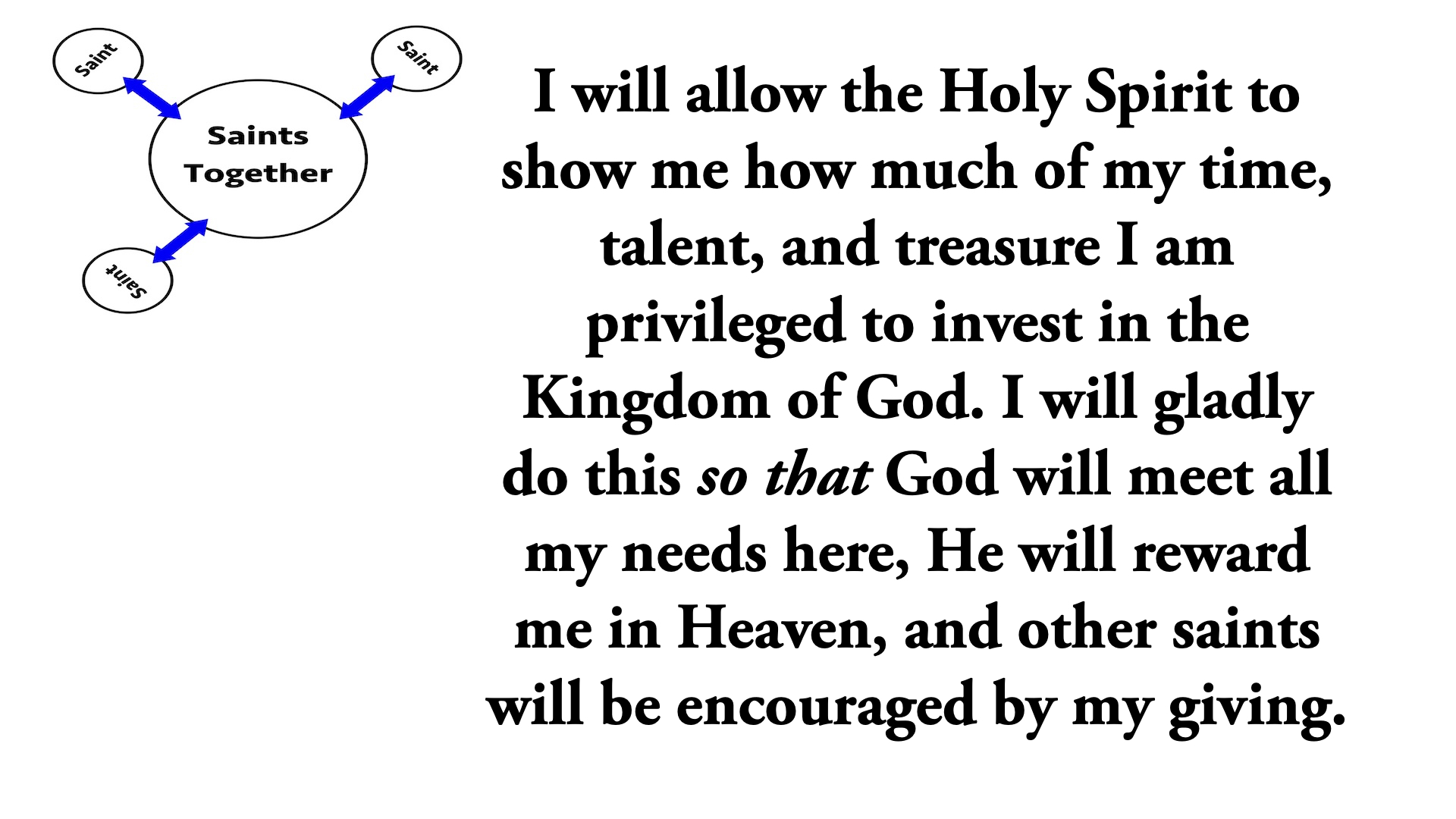
I will allow the Holy Spirit to show me how much of my time, talent, and treasure I am privileged to invest in the Kingdom of God. I will gladly do this so that God will meet all my needs here, He will reward me in Heaven, and other saints will be encouraged by my giving. 

I hope you will join me in making this your declaration as well. 

If you have missed any of the messages in our series called Saints Together, you can find the full list of messages by clicking here. 

►► Would you please prayerfully consider supporting this ministry? My Patreon supporters get behind-the-scenes access to exclusive materials, like a map and an app I just shared to help with your personal Bible study time. ◀︎◀︎

Avoiding The Bad Days

Listen to the podcast of this post by clicking on the player below, and you can also subscribe on AppleSpotify, or Audible. 

Would you like to avoid having a bad day? I have the solution for you!

Check out this episode of The Podcast.

Resources mentioned in this video:

►► Would you please prayerfully consider supporting this ministry? My Patreon supporters get behind-the-scenes access to exclusive materials. ◀︎◀︎
Be Careful Of Your Ego

Listen to the podcast of this post by clicking on the player below, and you can also subscribe on AppleSpotify, or Audible. 

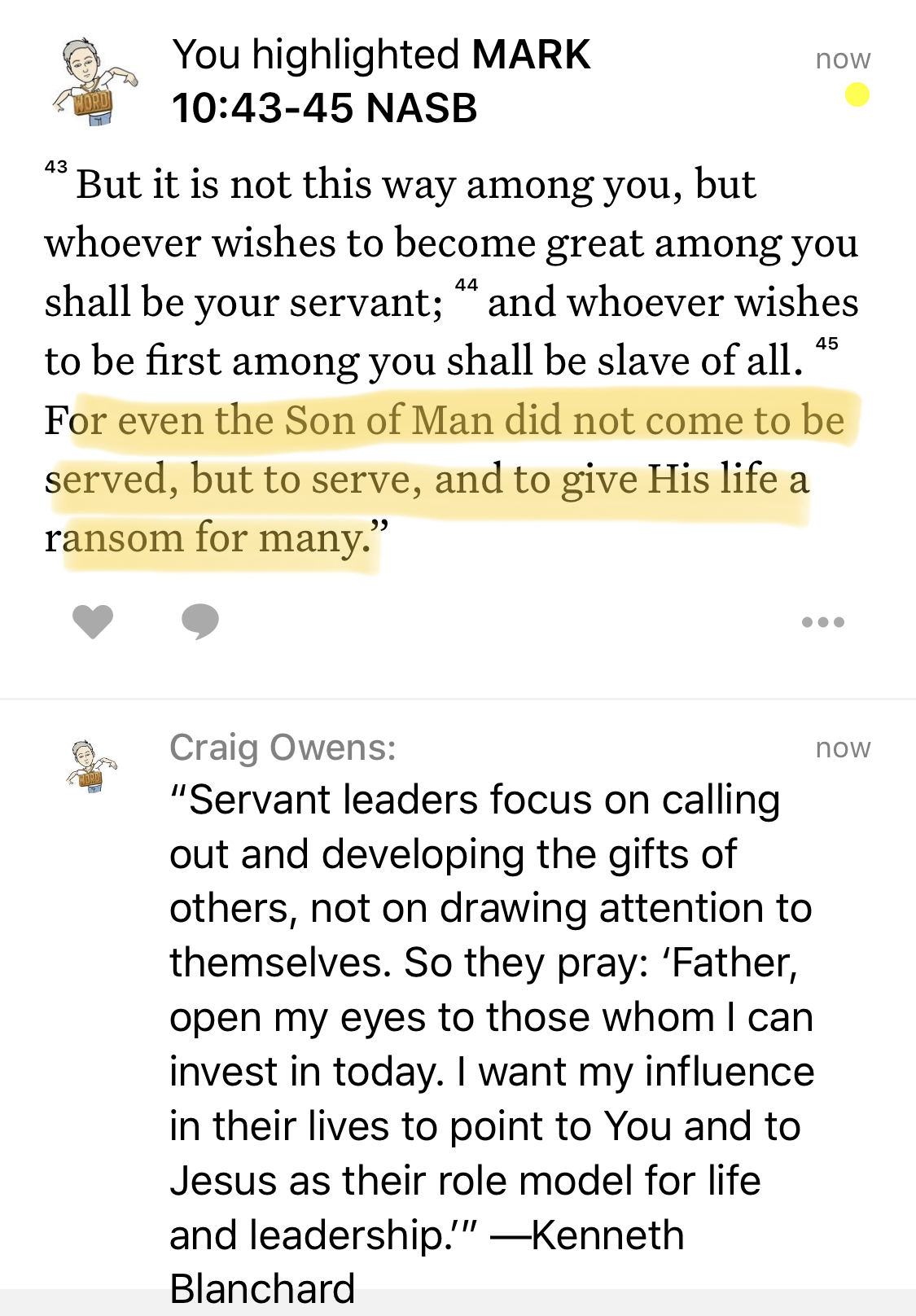
The Scriptures I reference in this video—Mark 12:38-40; James 3:1; Mark 10:45

Some other blog posts and videos that can help you go deeper on this topic:

►► Would you please prayerfully consider supporting this ministry? My Patreon supporters get behind-the-scenes access to exclusive materials. ◀︎◀︎

Sacred Cultural Cows

Listen to the podcast of this post by clicking on the player below, and you can also subscribe on AppleSpotify, or Audible. 

Every organization has a culture and has some sacred cows. 

I define culture as the unwritten rules that everyone who’s been around for a while knows, but seldom thinks to share with any newcomers. Those newcomers usually don’t know they have broken one of those unwritten rules until they actually break one of those rules! 

Sacred cows are the untouchable things in every organization. Those things that have always been in place and can never be changed or removed. 

But what if you’re the new leader coming into an organization? How do you navigate the new culture? How do you keep from messing with those sacred cows? Greg and I discussed this on a recent episode of our leadership podcast. 

Check out the full episode this clip came from by clicking here. 

►► Would you please prayerfully consider supporting this ministry? My Patreon supporters get behind-the-scenes access to exclusive materials. ◀︎◀︎
The Attitude That Defeats Defeatism

Listen to the podcast of this post by clicking on the player below, and you can also subscribe on AppleSpotify, or Audible. 

Some additional resources for you to go deeper on this topic:

►► Would you please prayerfully consider supporting this ministry? My Patreon supporters get behind-the-scenes access to exclusive materials. ◀︎◀︎

The Craig And Greg Show: Keep Your Emotions Regulated

Listen to the audio-only version of this podcast by clicking on the player below, or scroll down to watch the video.

As a leader, you will have to deal with very emotional situations from time to time. While you may not always have control over when these situations arise, you do have the ability to control your reaction to them. In this episode of The Craig and Greg Show, we discuss emotional regulation and how keeping your emotions managed can be a powerful tool for leaders.

  • [0:34] Well-regulated emotions are powerful.
  • [0:55] How do we keep emotions in check?
  • [2:52] Greg thinks of emotional regulation as a throttle.
  • [3:31] What are the messes created by unregulated emotion?
  • [5:59] The triggers of emotional response.
  • [8:35] We can’t control situations, but we can control our responses.
  • [9:06] The four categories of regulation.
  • [10:52] What should you look for to help you be more self-aware?
  • [13:25] Don’t give up how you feel.
  • [14:12] Self-awareness doesn’t come from a book, it takes practice and reflection.
  • [16:10] Slow down!
  • [16:40] Dis-regulated emotions hurt your ability to influence.
  • [18:34] I talk about servant leadership from my book Shepherd Leadership.
  • [19:05] How to improve your emotional regulation skills.
  • [22:48] I discuss the difference between responding and reacting.
  • [24:02] Greg says people are sensitive and the damage done can be lasting.
  • [25:27] Greg shares an insightful quote from Viktor Frankl.
  • [26:45] We would love to coach you if you need help with emotional regulation.

Check out this episode and subscribe on YouTube so you can watch all of the upcoming episodes. You can also listen to our podcast on Spotify and Apple.

The Craig And Greg Show: Lead Up

Listen to the audio-only version of this podcast by clicking on the player below, or scroll down to watch the video.

When we think about leadership, we often envision the people in organizationally designated leadership roles “leading down” to the people on their team. In this episode of The Craig And Greg Show, we flip the script, discussing how you can “lead up” to those above you and help your team achieve greater levels of success. 

  • [0:30] This is part 1 of a new series of periodic episodes of how to lead at all levels of your organization. 
  • [1:07] What is the real definition of a leader?
  • [1:55] You need different skills to lead up based on how receptive your leader is.
  • [3:31] Do you have the right tools to lead up, or do you need to fill your toolbox first?
  • [5:30] What happens when the leadership above you changes?
  • [6:35] There are two really important words when leading up: stewardship and accountability.
  • [7:59] “I told you so” doesn’t help you lead up, nor does withholding information from your up-leader.
  • [11:55] What are the best ways to talk to your up-leader?
  • [14:35] Everyone in the organization already knows when you have the good ideas, so you don’t have to announce it.
  • [15:05] How do you balance being proactive with being too aggressive?
  • [16:05] What lessons can you learn from working with your difficult up-leader?
  • [17:42] You shouldn’t try to “fix” your up-leader, but help your up-leader.
  • [19:34] I share how I kept my attitude in check with my difficult up-leader.
  • [22:00] Coaches can help you do what you’re already doing better than you’re currently doing it

Check out this episode and subscribe on YouTube so you can watch all of the upcoming episodes. You can also listen to our podcast on Spotify and Apple.

Year-End Review (2022 Edition)

Listen to the podcast of this post by clicking on the player below, and you can also subscribe on AppleSpotify, or Audible.

The apostle Peter said he wrote two letters to the church “as reminders to stimulate you to wholesome thinking” (2 Peter 3:1). And Paul reminded his young friend Timothy to “keep reminding [your congregation] of these things” (2 Timothy 2:14). 

In the spirit of those great apostles, I have made it a practice to take time at the end of each year to look back on all that we have learned in the previous year, and then to look forward to where God may be leading Calvary Assembly of God in this upcoming year.

Clicking on each series title will take you to a list of all of the sermons in that series. 

Awesome—Jesus told us that we could pray in His name and expect amazing things (see John 14:13-14, 15:16, 16:23-24). This does not mean that simply adding the phrase “in Jesus’ name, Amen” to the end of a prayer unlocks a secret code. Rather, it means that the more we understand just how awesome our Savior is, and that He is the Key to God’s storeroom, the more we will being to align our prayers with the will of God. Jesus desires for His Father’s glory to be seen on earth through the answers to our prayers. The writer of Hebrews opens his letter by reminding us that Jesus is “the radiance of God’s glory and the exact representation of His being, sustaining all things by His powerful word” (Hebrews 1:3).

Is That In The Bible? (part 1 and part 2)—A meme that makes me chuckle every time I see it is a “quote” attributed to Abraham Lincoln in which he says, “The problem with quotes found on the internet is that they are often not true.” (Not to spoil the joke for you, but unless Lincoln knew how to time travel to the future, I don’t think he knew about the modern internet! 😂). I love this meme because it captures something that so many people fall into: a quick acceptance of a statement without verifying its source or thinking through the implications of the statement’s truthfulness. I think you may be surprised to discover just how many phrases we call biblical aren’t, and how many phrases there are that we never realized are actually in the Bible.

Christmas Unwrapped At Easter—Remember as a kid when you would unwrap a gift and discover it wasn’t something you really wanted, but then your parents explained that it was something you needed? The birth of Jesus in Bethlehem was a little like that—it wasn’t exactly what people were hoping for, but it was exactly what they needed. The real meaning of that Christmas gift wasn’t realized until after Jesus was crucified and resurrected back to life.

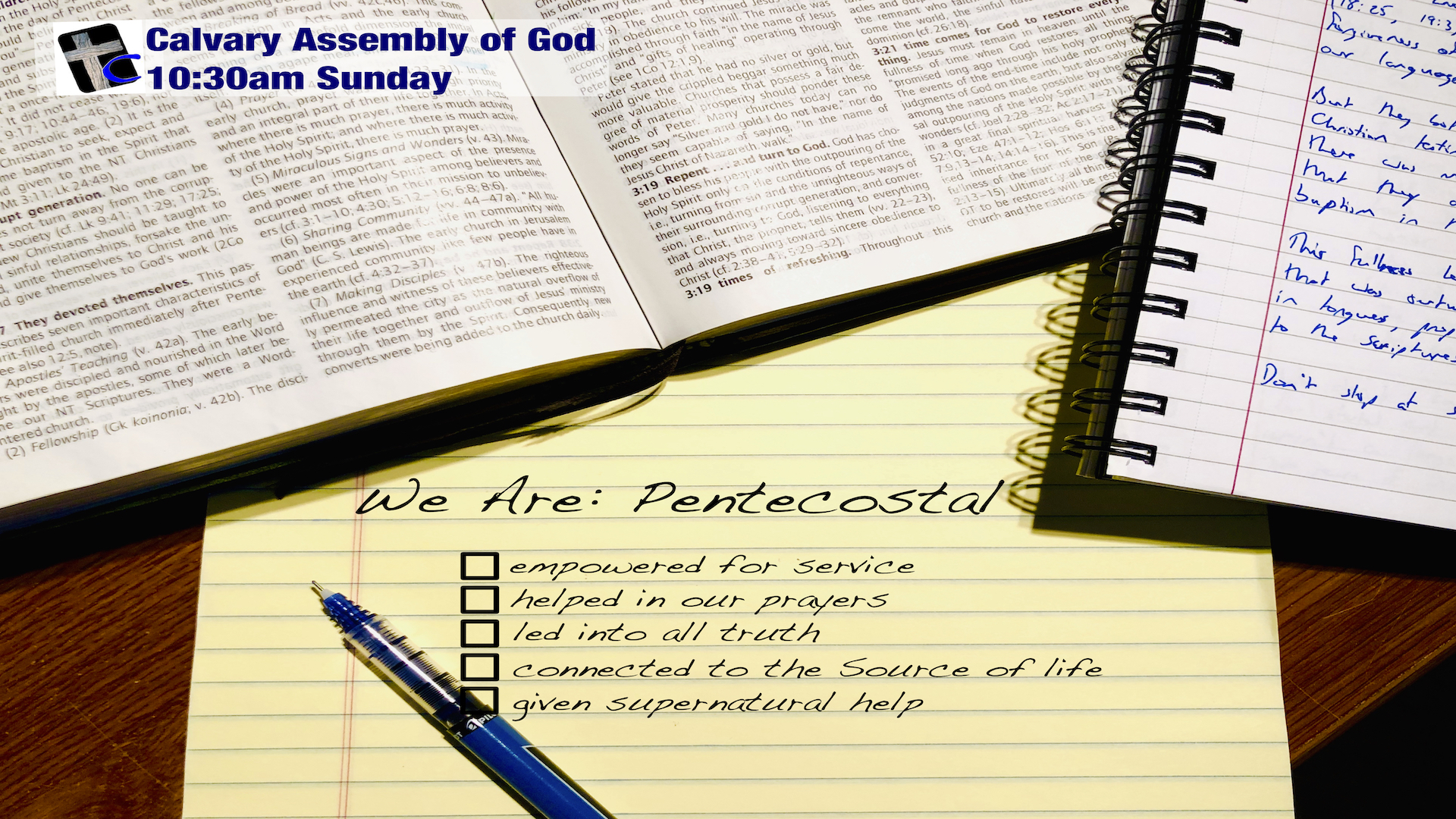
We Are: Pentecostal—Pentecost for over 1500 years was a celebration in Jerusalem that brought in Jews from all over the world. But on the Day of Pentecost that came just ten days after Jesus ascended back into heaven, the meaning of Pentecost was forever changed! Followers of Jesus—now empowered by an infilling of the Holy Spirit—began to take the good news of Jesus all over the world. These Spirit-filled Christians preached the Gospel and won converts to Christ even among hostile crowds, performed miracles and wonders, stood up to pagan priests and persecuting governmental leaders, and established a whole new way of living as Christ-followers. We, too, can be Pentecostal followers of Jesus Christ today. 

Selah—The word Selah appears nearly 70 times in the Bible, almost exclusively in the Psalms. Although it is primarily a musical term, it applies beautifully to our summer series. It means a pause. Throughout the Psalms, Selah appears at the end of a verse, at the end of the psalm, or sometimes even mid-sentence. But each one of them is perfectly placed by the Spirit-inspired authors to get us to take a breath and deeply contemplate what we just read or sang. 

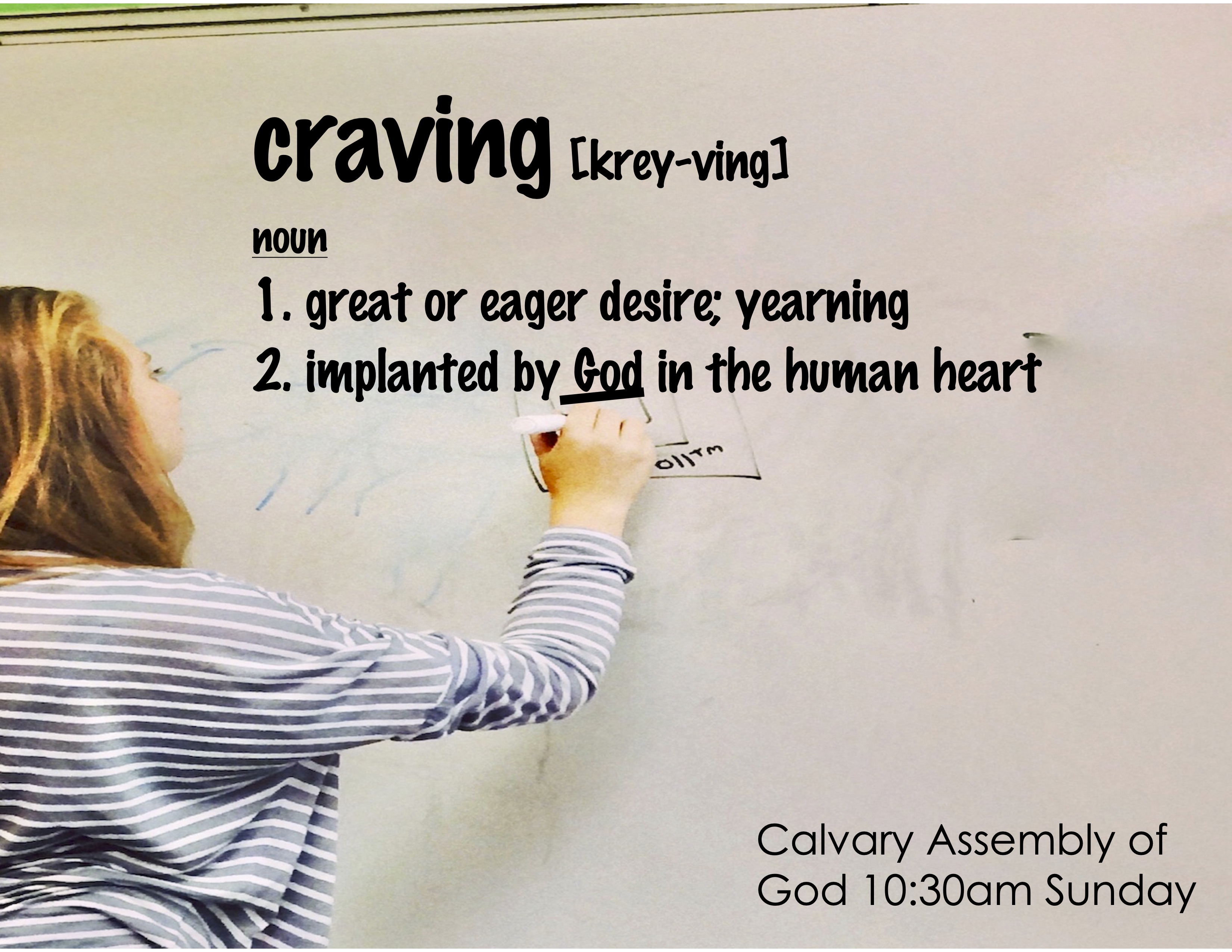
Craving—Doesn’t it seem like far too many Christians think of their relationship with Jesus as bland? After all, we’ve been told that any cravings we have should be quickly downplayed so that they don’t carry “good Christians” away. But what we discover in the Bible is that God made us to be craving creatures—He wants us to long deeply and find ultimate satisfaction for those longings. In short, God created us to long after the things that only He can fulfill. As we dive into this new series, I think you will find it quite eye-opening and heart-lifting. 

The Great Attitude Of Gratitude—There’s something about gratitude that distinguishes people. Think about it: would you rather hang around with grumblers or grateful people? The gratitude of Paul and Silas certainly made them stand out from the crowd when they were in Philippi. Wrongly accused, beaten, and thrown in prison, but instead of bellyaching, they were praising God. Later on, when Paul wrote his letter to the Christians in Philippi, the theme of gratefulness permeates his letter. The distinguishing mark is actually in the title: The GReat ATTITUDE spells out GRATITUDE!

Bethlehem Is Proof—The prophet Micah foretells that the Messiah will arrive in dark times. Enemies will surround Israel, and Israel’s ruler will receive a nasty punch to the jaw. Demonic strongholds, witchcraft, and idolatry will appear to be gaining the upper hand. And then Micah turns his attention to a small village just south of Jerusalem—a village so small that it is often overlooked—a village from which no one would expect Israel’s Deliverer. And yet, Micah writes, “But you, Bethlehem Ephrathah, though you are small among the clans of Judah, out of you will come for Me One who will be Ruler over Israel, Whose origins are from of old, from ancient times” (Micah 5:2). Jesus the Deliverer was born in the little town of Bethlehem, and His birth there 700 years after Micah foretold it is our proof that God always gets the last word, the decisive word, and the best word!

We will be returning to a couple of these series in 2023, and we’ll be launching some brand-new ones as well. If you don’t have a home church in the northern Kent County area, I would love to have you join us! 

►► Would you please prayerfully consider supporting this ministry? My Patreon supporters get behind-the-scenes access to exclusive materials. ◀︎◀︎

Grateful For What You Have

Listen to the podcast of this post by clicking on the player below, and you can also subscribe on AppleSpotify, or Audible. 

We said last week that nobody likes to be around a complainer, although many complainers would say they’re not complaining but just sharing facts. In their mind, they have a legitimate right to let everyone know how they’ve been short-changed, gotten a bad deal, or experienced something that no one else has gone through.    

Have you ever heard your kids say, “I’m starving”? And perhaps you think, “Do you really know what starving is?” Or what about people waving their very expensive phones around as they complain, “Isn’t there any WiFi here?!” 

This isn’t a glass half-full or half-empty thing. This is really closing your eyes to the fact that many people don’t even have a glass, or if they do have a glass, they don’t have access to the water that they need. 

I was delivering some Christmas toys to a family and I discovered they had lost everything they owned. When I came to their house their furniture was mismatched, their food and clothes were donated, and their kids only had a couple of simple toys to play with. And yet this family was happy to be together! 

That sort of puts things in perspective, doesn’t it? 

We have to choose grumbling or gratefulness, but as E.M. Bounds noted, “Gratitude and murmuring never abide in the same heart at the same time.” So if you are complaining about what you don’t have, you cannot be grateful for what you do have. 

There is a fascinating story told in all four Gospels of a woman named Mary. She was an uninvited guest at a house where Jesus and His disciples had been invited to dinner. Jesus was not there because someone was grateful to have Him in his home, but because Simon the Pharisee and his cronies were trying to find a reason to accuse Jesus of wrongdoing. 

Simon was so focused on his “gotcha” moment that he completely overlooked his host duties. He didn’t wash Jesus’ feet, nor greet Him with a kiss, nor anoint Him with perfume, as the custom of the day demanded. But Mary, standing behind Jesus at the dinner table, washed Jesus’ feet with her tears, kissed His feet, and anointed Him with an entire bottle of costly perfume! She did all of this out of gratitude for what she had received from Jesus. 

First, I would like you to consider what Mary didn’t have:

  • a seat at the table—even though the dinner was in her hometown of Bethany, her brother Lazarus was invited to the meal, and her sister Martha was serving the meal 
  • a good reputation—twice Simon the Pharisee said, “Does Jesus even know what kind of woman she is? Does He know she is a sinner?” 
  • the acceptance or approval of others—even the disciples thought her gesture of anointing Jesus with so much perfume was a wasted extravagance 

Next, let’s look at what Simon did have:

  • an elevated position as a Pharisee 
  • considerable wealth—he had servants and a home large enough for a big dinner party 
  • healing from leprosy—the Gospels refer to him as “Simon the leper” which tells us that he had been healed of his leprosy 

Now, let’s consider what the disciples did have:

  • an enviable position as disciples of Jesus
  • a dinner invitation to Simon’s house
  • access to the financial resources that people gave to Christ’s ministry
  • and let us never overlook the fact that they had access to Jesus Himself like no one else had

Finally, let’s look at what Mary did have:

  • forgiveness—Luke says this about her, “A woman who HAD lived a sinful life” 

Gratitude is truly a great attitude. Grateful people stand out because they don’t grumble about what they don’t have, but they are focused on what they do have.  

Mary knew that she didn’t have the outward marks of success or favor or approval, but she did have the assurance that she had been forgiven. For that, she was more than willing to give everything she had to Jesus in thankful worship! 

And as a result, look what Mary now has:

  • the kind words of Jesus—He assured her that she was forgiven (Luke 7:47)
  • Jesus as her defender—He told His disciples, “Leave her alone” (John 12:7)
  • an eternal testimony—Jesus said that wherever the Gospel was preached, people would tell Mary’s story (Matthew 26:13) 

I think a good way to sum up the distinguishing way grateful people live is like this: They don’t grumble about what they don’t have, but they are extremely grateful for what they do have. 

When you find grumbling slipping out of your mouth, remind yourself of just how much you have been given. Even if you think to yourself, “I don’t have much,” you can be assured that you have Jesus, and He is more than enough! And with that assurance, let your gratitude be lifted up in extravagant, fragrant praise to God. 

If you’ve missed any of the messages in our series The Great Attitude of Gratitude, you can find the full list by clicking here. 

►► Would you please prayerfully consider supporting this ministry? My Patreon supporters get behind-the-scenes access to exclusive materials. ◀︎◀︎

Can God Get My Attention?

Listen to the podcast of this post by clicking on the player below, and you can also subscribe on AppleSpotify, or Audible. 

God needed the Ninevites to hear the message of impending judgment, and He needed Jonah to deliver that message and call the Ninevites to repentance. In four short chapters, the phrases about God providing what was needed appear six times! 

Because His messenger was running away and prejudiced against the Ninevites, God had to provide the means to get Jonah’s attention and provide a way to get him back on mission. So God provided

  • …a great wind on the sea (1:4) 
  • …a huge fish to swallow Jonah (1:17) 
  • …the command to the fish of where and when to deposit Jonah (2:10) 
  • …a green plant, a worm, and a scorching east wind to awaken Jonah to his prejudice (4:6-8)

The storm God provided caused the sailors to turn to God. The fish God provided caused Jonah to turn to God. And the sermon God provided Jonah to preach caused the Ninevites to turn to God.

What about the worm and the wind? Did those cause Jonah to turn his attention back to God? The Bible doesn’t tell us because I believe we each have to complete that story ourselves. When God provides trials, discomforts, and even disasters, they are intended to get our attention. 

Let’s keep this in mind the next time things aren’t going the way we had planned. Instead of complaining—or even praying for God to remove us from those difficulties—let’s instead ask ourselves:

  • Have I been disobedient to something God has directed me to do? 
  • Have I allowed myself to get off-track? 
  • Is my attitude about my God-directed assignment God-honoring? 
  • Is there something God is trying to bring to my attention? 

God provides everything needed to keep us on mission for Him. Let’s not try to get out of these difficulties, but let’s ask Him what we need to get out of these difficulties. 

►► Would you please prayerfully consider supporting this ministry? My Patreon supporters get behind-the-scenes access to exclusive materials. ◀︎◀︎