When The World Fears Christians

Listen to the podcast of this post by clicking on the player below, and you can also subscribe on AppleSpotify, or Audible. 

Here’s an interesting interaction between King Saul and David—

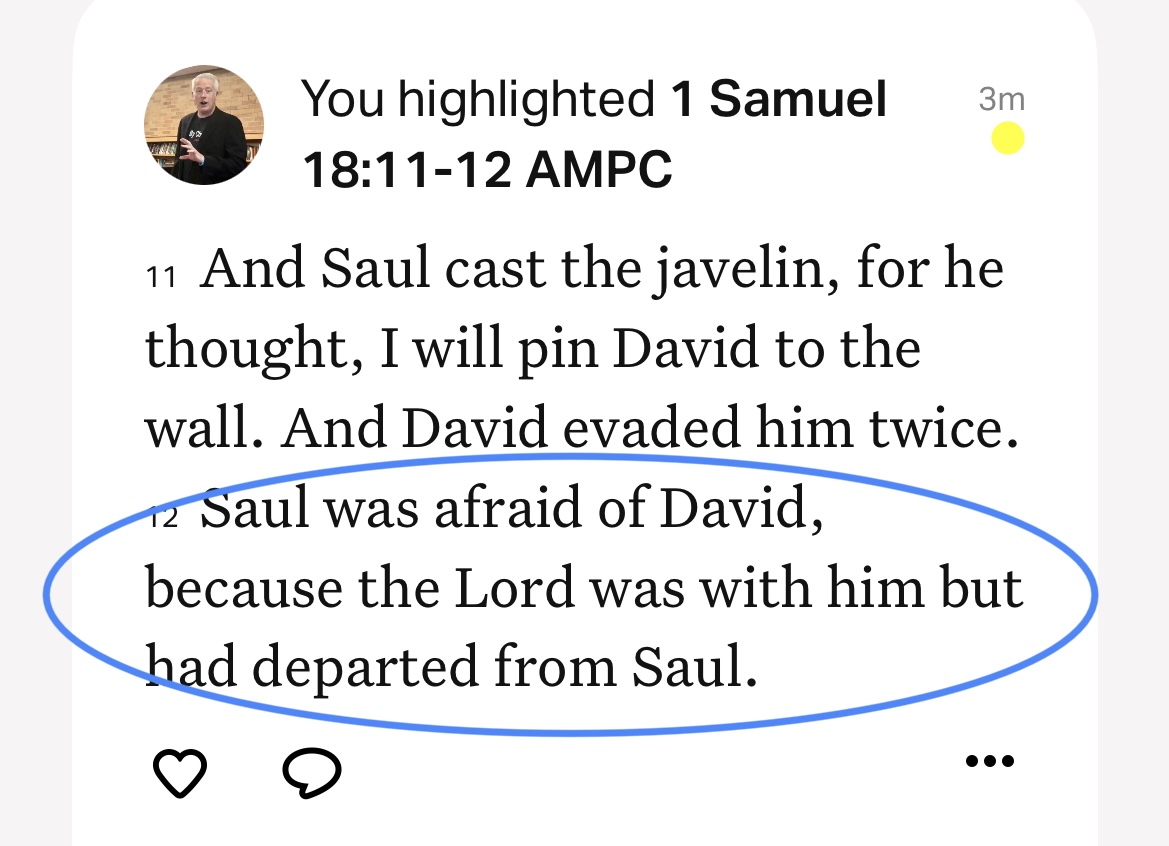
And Saul jealously eyed David from that day forward. … And Saul cast the javelin, for he thought, I will pin David to the wall. And David evaded him twice. Saul was afraid of David, because the Lord was with him but had departed from Saul. (1 Samuel 18:9, 11-12 AMPC)

This exchange in this well-known story got me wondering. I was thinking how Saul had the position of authority over David and he had a javelin in his hand, but the Bible still says that Saul “was afraid of David.” Why would that be? I think even the most atheistic of people intuitively know there is something other-worldly about those in whom the Spirit of God abides, which makes worldly people lash out at them in fear. 

But those who fear God—as David did—don’t fear mortals. Jesus said, “Don’t be afraid of those who want to kill your body; they cannot touch your soul. Fear only God, Who can destroy both soul and body in hell” (Matthew 10:28 NLT). This reverent fearlessness is what galls those who fear the unknown, so they try to silence confident God-followers. 

In these attacks, Jesus tells us not to respond naturally, but supernaturally. “But to you who are willing to listen, I say, love your enemies! Do good to those who hate you. Bless those who curse you. Pray for those who hurt you” (Luke 6:27-28 NLT). 

Peter picked up those words from Jesus and instructed Christians: “Be careful to live properly among your unbelieving neighbors. Then even if they accuse you of doing wrong, they will see your honorable behavior, and they will give honor to God when He judges the world. … For God called you to do good, even if it means suffering, just as Christ suffered for you. He is your example, and you must follow in His steps.” (1 Peter 2:12, 21 NLT). 

Although Saul feared the presence of God in David, he also had to acknowledge the success that came to David because of God’s abiding presence in him, and also, by extension, the success that came to Saul’s kingdom. On the one hand, Saul wanted David dead; on the other hand, he wanted David close by—

So Saul removed David from him and made him his commander over a thousand; and [David] went out and came in before the people. David acted wisely in all his ways and succeeded, and the Lord was with him. When Saul saw how capable and successful David was, he stood in awe of him. (1 Samuel 18:13-15 AMPC) 

When Christians are supernaturally empowered by God, they never have to respond in natural fight-or-flight from those who lash out at them. Let your faithfulness to God be your testimony that points others to Him. 

►► Would you please prayerfully consider supporting this ministry? My Patreon supporters get behind-the-scenes access to exclusive materials. ◀︎◀︎
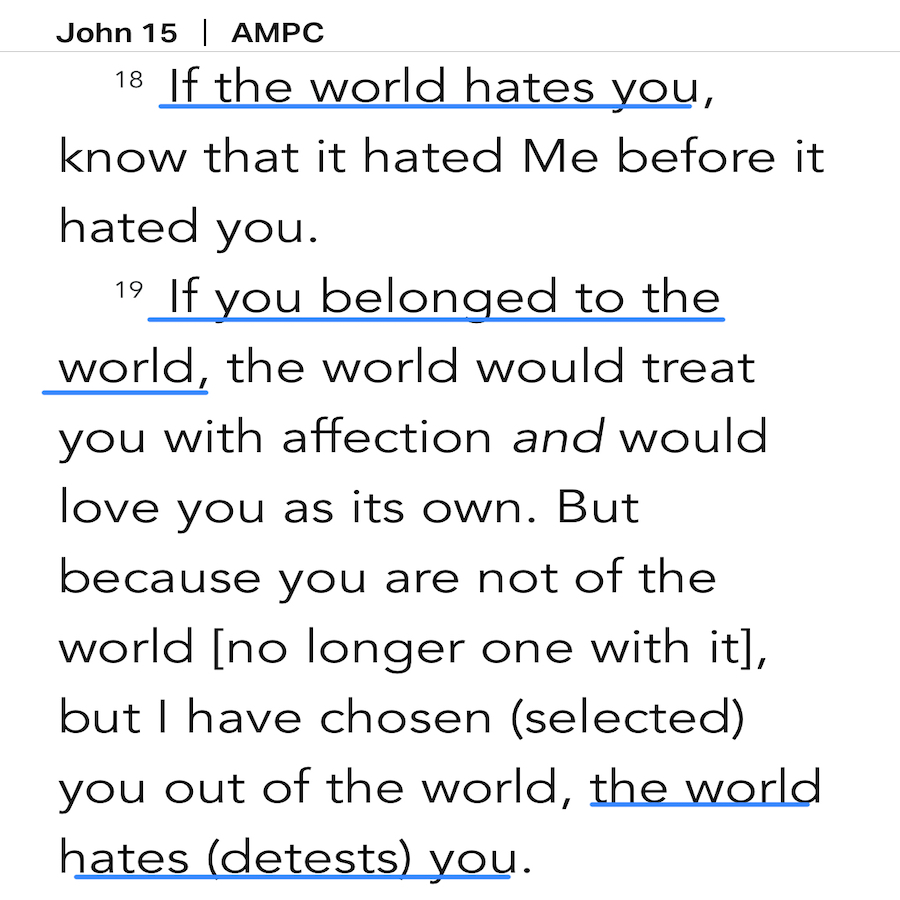
Jesus said, “If the world hates you, know that it hated Me before it hated you. If you belonged to the world, the world would treat you with affection and would love you as its own. But because you are not of the world [no longer one with it], but I have chosen (selected) you out of the world, the world hates (detests) you.” (John 15:18-19)

Links & Quotes

We are to love the sinner but hate the sin. This is hard to do, especially when the sin they are doing is directed at us and making us angry! Jesus gave us a great example in these times of high anger: withdraw. Check out my full message “A Christlike Response to Skeptics.” I have lots of new content every week, which you can check out on my YouTube channel.

“In many pagan religions the purpose of worship is to placate the gods—to keep them happy and to stay on their good side, lest they mess with, you know, the harvest or procreation or whatever. Worship is thus a work pagans do to earn or keep the favor of their deity. Christians don’t worship to placate God or earn His favor. We don’t worship to make God happy or bring Him pleasure. God is all-satisfied, all-happy, and all-pleased in Himself alone. We add nothing to Him when we come together to worship. At the same time, as we worship, God adds Himself to us. He deigns to commune with us, inhabits our praises, and brings us into His presence and joy in ways that transform all we are, think, feel, value, say, and do. … In worship, rightly conceived and conducted, our minds and imaginations expand beyond their everyday thoughts and dreams, stretched and molded to fill up with the glory of the heavenly throne room, to be conformed to the mind of Christ, and to see the world as He does (1 Corinthians 2:16).” —T.M. Moore

J. Warner Wallace shares two reasons why we can still consider the Bible relevant today.

My grandpa had honey bees on his farm, and I’ve been intrigued by them ever since that time. In fact, honey bees were subject of my semester-long research project in my ecology class. So I’m always fascinated to read more discoveries about these amazing insects!

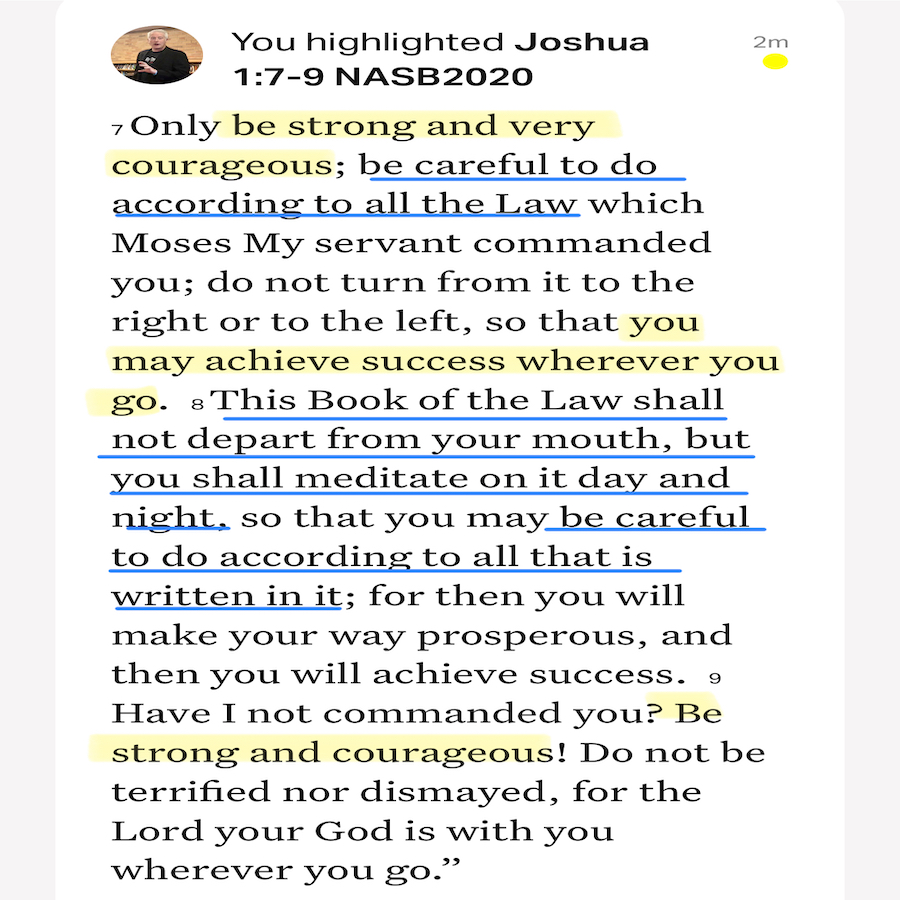
The level of a leader’s strength and courage is directly tied to the leader’s meditation upon God’s word. God’s wisdom transforms a leader’s heart and sharpens his thoughts. This is what gives the leader the necessary courage to lead people in a God-honoring way. I have a whole series of posts on godly leadership where I expand more on these thoughts. 

A Christlike Response To Skeptics

Listen to the podcast of this post by clicking on the player below, and you can also subscribe on AppleSpotify, or Audible. 

God is precise in His promise making and promise keeping. He doesn’t just fulfill promises in a vague way or in “the spirit of the law,” but He attends to the jots and tittles of every single detail.  

Last week we saw the example of Jesus going into a dark place to bring the light of hope. It’s the same for us: God uses circumstances to direct our steps into dark places because people need to see the light. 

But people living in darkness sometimes don’t like the light. 

When we feel like our message of hope is being ignored or rejected (or we’re even being persecuted for sharing the truth) we have a natural emotional response that begins to bubble up. That emotion is anger. How do I know this? Because Jesus experienced this too. 

We can do two things with our anger: 

  1. We can blast skeptics with righteous judgment <or> 
  2. We can follow the example of Jesus  

In The Pilgrim’s Progress, Faithful told how a man came and beat him because he had broken the law. Even when Faithful begged for mercy the man said, “I don’t know how to show mercy to anyone.” This man was Moses the Lawgiver. Faithful explained what finally gave him relief: “He would have finished me off, but then One came by, and told Him to stop. I did not know Him at first, but as He went by, I saw the holes in His hands and in His side and I concluded that He was Jesus.” 

Moses had every right to be angry, and he expressed it a way that tried to finish off Faithful. 

Jesus also got angry, but let’s see what He did with it. 

(Check out all of the Scriptures I list below by clicking here.)

In Matthew 12:9-10 we see the motive of the skeptics: catch Jesus doing something wrong. This opposition came from the religionists—they weren’t interested in the truth, they were interested in proving themselves right and righteous. 

As they are asking their entrapping question, Luke tells us that “Jesus knew what they were thinking” (Luke 6:8). And Mark tells us that Jesus then asked a question of His own (Mark 3:4-5). These religionists refused to answer His question, and their stubborn hearts made Jesus deeply angry! 

So Jesus answered His own question, concluding that the Sabbath was the day that god intended for healing and helping. To prove this point, Jesus then healed the shriveled hand of the man who stood before Him (Matthew 12:11-14). In response to this, the Pharisees plotted with the Herodians on how to kill Jesus (Mark 3:6). 

Matthew then writes, “Aware of this, Jesus withdrew from that place (Matthew 12:15). He didn’t withdraw in fear, but in complete awareness of His Father’s plan. Part of that plan was not for Jesus to win argument, but for Him to win souls. 

Perhaps in His anger in the moment, Jesus would have spoken words that were too harsh. There is a time to speak, but it’s usually not in the heat of the moment. In fact, Laurence J. Peter rightly said, “Speak when you are angry, and you will make the best speech you’ll ever regret.” 

So in fulfillment of another prophetic word given in Isaiah 42, Jesus withdrew to continue His teaching and healing ministry (Matthew 12:17-21). 

What does this mean for us today? I think we can see five important responses in these prophetic words: 

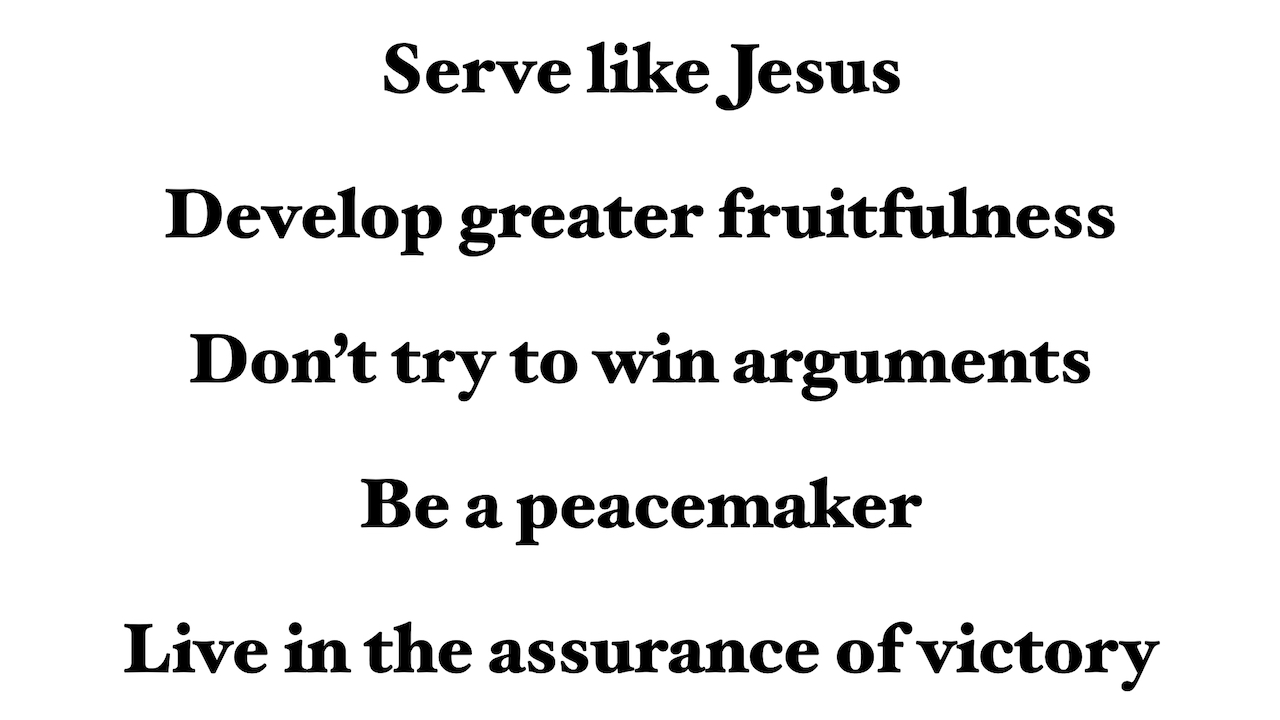
  1. I am to serve others as Jesus did—even those who want to silence me.  
  2. I can let the Holy Spirit use this opposition to bring greater fruitfulness out of my life (Galatians 5:19-26).  
  3. I don’t need to win an argument with skeptics. 
  4. I can be a peacemaker that points people to the Prince of Peace (1 Peter 2:8-12). 
  5. I should live in the assurance of ultimate victory, just as Jesus did (1 Peter 2:23).  

God gets the final word, the decisive word, and the best word, so I don’t have to try to win arguments with skeptics. Like Jesus, I can love and serve in a way that leaves them an unmistakable testimony. 

To check out the other messages in this series called Jots and Tittles: Why it matters that God is in the smallest of details, please click here. 

►► Would you please prayerfully consider supporting this ministry? My Patreon supporters get behind-the-scenes access to exclusive materials. ◀︎◀︎

Unshakable You (book review)

Mental health issues grab a lot of headlines, and they should! I believe mental health is at the foundation of all of the other aspects of our lives, so we should be paying attention to this core issue. John Opalewski helps us do this through his book Unshakable You. 

The subtitle of this book—5 Choices of Emotionally Healthy People—gives you the outline of the entire book. John skillfully shares the importance of these five choices through a combination of recounting his own story, applicable biblical principles, and pertinent scientific discoveries. John concludes each chapter with an “I choose” statement. 

  1. I choose to love myself as Jesus commanded. 
  2. I choose to manage my anger instead of it managing me. 
  3. I choose to protect myself from abusive people. 
  4. I choose to refuel emotionally. 
  5. I choose to stay alert.

This is a short book, but you should spend a lot of time reading it, processing the “I choose” statements, discussing the concepts, and finally in implementing the principles John presents. I would strongly recommend reading this book with a friend who can help you in the implementation of each of the “I choose” statements. 

P.S. I addressed many of the same points John did in my year-long series of messages A Christian’s Mental Health.

Flatten The Rollercoaster

Listen to the podcast of this post by clicking on the player below, and you can also subscribe on AppleSpotify, or Audible. 

I’m not a fan of rollercoasters, but I know a lot of people who really like them. Some even travel all over the world to experience unique rollercoasters. The anticipation as the cars climb slowly up the big hill, knowing that there’s no stopping this thing now! Then the rush of emotions, a deep breath and a laugh at the end (usually laughing at our friends’ responses while on the ride), and then we just walk away. The moment of anticipation leading up to the big drop was usually longer and more intense than the ride itself. 

Not only do people travel all over to find rollercoasters, some people seem to have their emotions perpetually on rollercoasters. 

One of the telltale signs of someone with an immature mental health is the way every situation gets blown out of proportion before anything even happens. Then as an event unfolds, their exaggerations continue: the molehills are mountains, every valley is the valley of the shadow of death, the night is a nightmare, the “crisis” is lasting forever, no one has ever gone through what they’re going through, and the list goes on. 

To break out of this habit requires us developing emotional capacity. John Maxwell describes it like this: “Emotional capacity is the ability to handle adversity, failure, criticism, change, and pressure in a positive way.” Just as athletes have to develop lung capacity or muscle capacity, developing emotional capacity takes time, patience, and diligence. 

Increased emotional capacity is not escaping from our problems or even learning coping skill. Escapism never allows us to confront the things that are keeping our emotional capacity immature. On the other hand, maturing emotional capacity is learning to pause to get perspective so that we can avoid turning every mountain into a molehill, and every challenge into a do-or-die battle.  

Mentally healthy people don’t try to escape, but they learn how to de-escalate by getting a new perspective. Or to use the language of our first mental health strategy, they get off their old, well-worn paths. 

Let me illustrate this by looking at two emotions which seem to be the most rollercoaster-ish. 

(1) The first rollercoaster emotion is anger 

Out-of-proportion anger can either burn everyone around us when we explode, or it can eat away inside us if we hold it in. Neither of these are healthy emotional responses. Jesus got angry at the religious crowd that was keeping people away from God’s kingdom, but He didn’t ride the rollercoaster that led to a sinful expression of His anger. 

God asked Jonah a very helpful question: Have you any right to be angry? (Jonah 4:4). When we feel the Holy Spirit asking us this question, our defiant first response is almost always, “Yes! I didn’t do anything wrong! It was all him!” Solomon would counsel us to cross-examine that thought (Proverbs 18:17). 

Sometimes God will bring someone else across our path to help us pause to get perspective—to flatten the rollercoaster. For instance, God used Abigail to help David (see the story in 1 Samuel 25). However the Holy Spirit cross-examines us, we need to learn to truly listen. James told us: 

My dear brothers and sisters, take note of this: Everyone should be quick to listen, slow to speak and slow to become angry, because human anger does not produce the righteousness that God desires. (James 1:19-20)

(2) The second rollercoaster emotion is fear 

Fear usually causes us to fight or flight. Those are the natural responses, but the supernatural response is to pause to evaluate. I love the reminder that F.E.A.R. means false evidence appearing real. 

As with anger, our first pause to get perspective on this potential rollercoaster that can plunge us into a deep, dark valley should be to cross-examine the false evidence of fear. 

When the group of ladies came to the tomb of Jesus on the Sunday following His crucifixion, they were already battered and bruised in their emotions. Finding an empty tomb brought even more fear in their hearts. But there is a keyword in this account that will help us: 

In their fright the women bowed down with their faces to the ground, but the men [angels] said to them, “Why do you look for the living among the dead? He is not here; He has risen! Remember how He told you, while He was still with you in Galilee: ‘The Son of Man must be delivered over to the hands of sinners, be crucified and on the third day be raised again.’” Then they remembered His words. (Luke 24:5-8)

The Holy Spirit can help us remember the truth in God’s Word to counteract the fear-inducing false evidence (2 Timothy 1:7; John 14:26), but we must pause to listen to this evidence before this rollercoaster emotion picks up speed. 

The bottom line: Don’t try to escape your strong emotions. Pause. Cross-examine the evidence with the help of God’s Word, the Holy Spirit, and a friend to get a healthy perspective. This can help you flatten the rollercoaster before your emotions run away with you. 

If you’ve missed any of the other mental health strategies we’ve already covered in this series, you can find the full list by clicking here. 

►► Would you please prayerfully consider supporting this ministry? My Patreon supporters get behind-the-scenes access to exclusive materials. ◀︎◀︎

Quieting The Angry Rhetoric

Listen to the podcast of this post by clicking on the player below, and you can also subscribe on AppleSpotify, or Audible. 

When the culture becomes increasingly angry and loud, how are Christians to respond? 

Check out this episode of The Podcast. 

Resources I mentioned in this podcast:

►► Would you please prayerfully consider supporting this ministry? My Patreon supporters get behind-the-scenes access to exclusive materials. ◀︎◀︎

Links & Quotes

If your mental health is struggling remember GIGO: garbage in, garbage out. We need to look at all our inputs: physical, emotional, and spiritual. Check out this full message by clicking hereAnd be sure to check out all of my videos on my YouTube channel.

In a post entitled The Quest For Immortality, John Stonestreet reminds us that we are more than just the physical bodies we have. He wrote, “Attempts to achieve immortality have continued (and continued to fail) right up to our own time. Medieval European alchemists believed they could produce ‘the philosopher’s stone,’ which would perfect the imperfect, turning lead into gold and making mortal life immortal. Enlightenment thinkers of the late 18th century rejected the mysticism of alchemy but continued to speculate about the means to attain physical immortality. Mary Shelley’s Frankensteinwas written as a cautionary tale about scientific hubris, in response to the more modern attempts of medicine and biology to preserve, extend, and improve life.” Check out this full post.

“You have to train your mind as much as your body.” —Venus Williams

“Peace is the normal condition and set of the soul of those who know the Kingdom’s presence in their lives. And only Jesus can give us the peace that overcomes the fears and troubles of the world, so that His Kingdom citizens may ‘be of good cheer’ [John 16:33] in all they do, come what may.”

“Hatred and anger are the greatest poison to the happiness of a good mind.” —Adam Smith

“Hard work beats talent when talent doesn’t work hard.” —Anonymous

I really love the He Gets Us presentation of Jesus. Check them out! I used the example Jesus showed us of proper self-care in my book Shepherd Leadership.

Links & Quotes

Shalom—the peace that comes from God—could be defined simply as “nothing missing.” But couldn’t it also be defined as “no one missing”? It sure could! What peace there is when no one is missing from Heaven! Check out more of this message hereAnd be sure to check out all of my videos on my YouTube channel.

“A good man is a God-fixated man, ever-receiving, ever-overflowing.” —Dick Brogden, in Proverbs: Amplified and Applied

“Despite the moon’s apparently simple shape, uniformitarian scientists have long had great difficulty explaining how it could form by natural processes apart from a supernatural Creator. One Harvard astrophysicist once quipped that the best explanation for the moon’s existence was observational error—the moon doesn’t really exist!” This is a very interesting post from the Institute for Creation Research.

“Do we not miss very much of the sweetness and efficacy of prayer by a want of careful meditation before it, and hopeful expectation after it? … We too often rush into the presence of God without forethought or humility. We are like people who present themselves before a king without a petition, and what wonder is it that we often miss the end of prayer? We should be careful to keep the stream of meditation always running, for this is the water to drive the mill of prayer. … Prayer without fervency is like hunting with a dead dog, and prayer without preparation is hawking with a blind falcon. Prayer is the work of the Holy Spirit, but He works by means. God made man, but He used the dust of the earth as a material. The Holy Ghost is the Author of prayer, but He employs the thoughts of a fervent soul as the gold with which to fashion the vessel. Let our prayers and praises be not the flashes of a hot and hasty brain but the steady burning of a well-kindled fire.” —Charles Spurgeon, in Spurgeon and the Psalms

What a powerful word to pastors from T.M. Moore’s post First Things First. “Pastors sometimes complain that their people don’t seem very hungry or thirsty for the things of the Lord. Sated on the junk food of getting-and-spending, generously ladled over with pop culture, God’s people have little appetite for Christ or His Word. But what about us? Does our hunger and thirst for Christ make them long for the same? Do they see in us that earnest desire to be with the Lord that tells them they’re missing something of great importance? Loving Christ and delighting to be with Him is infectious. If the people we serve see it in us, they’ll want it for themselves, more than anything this world might offer.”

We don’t read about Jesus getting angry that often, but what usually got Him upset was when people in need were being kept from the God who could meet their needs. Sadly, it was usually man-made rules and practices that kept people away. I don’t want to make Jesus angry, so I need to evaluate anything in my life that may be standing in the way of connecting needy people with a need-satisfying God. 

“So in our broader culture, people no longer sin; they make mistakes. What about our Christian environment? In our case, sin is not denied. Instead it is often redefined to refer to the more flagrant sins of society. We tend to ignore our own sins of pride, selfishness, gossip, and the like. So, effectively, no one sins anymore. The reason is that we have lost sight of the biblical meaning of sin.  Typically, if we are not actually murderers, felons, or adulterers, we tend to think of our common sins as no more serious than a parking violation. We are so used to living with pride, selfishness, envy, gossip, and a whole host of other ‘respectable sins’ that we don’t even think of them as sin. But the fact is that, as serial sinners, we are all as guilty before God as that murderer. You and I sin every day in thought, word, deed, and motive. And whether those sins appear great or small in our own sight, in reality every sin we commit is an act of rebellion against God, a rejection and attempted negation of His sovereignty and rulership over us.” —Jerry Bridges

Links & Quotes

“But friendship is precious; not only in the shade, but in the sunshine of life.” —Thomas Jefferson

“People are just about as happy as they make up their minds to be.” —Abraham Lincoln

“Humility is the foundation of all the other virtues hence, in the soul in which this virtue does not exist there cannot be any other virtue.” —Augustine

When you praise God, despite your surroundings, you magnify Him. And when you magnify God, you invite others to magnify Him with you!

“Manhood first and then gentleness.” —Ralph Waldo Emerson

I have blogged quite a bit about the historicity of the Bible. The Bible Archeology Report has a very informative post of the top 10 historical references to Jesus outside the Bible. These sources are from the first or second century AD, and specifically mention Jesus of Nazareth, not just Christians.

Dan Reiland wrote, “Church leadership always carries with it seasons of success and setbacks, momentum and grind, joy and discouragement. Yet, we all do better through those seasons when we have learned the rhythms of resilience—the lifelines we need.” Check out the 6 sustaining lifelines for leaders that he shared.

The Institute for Creation Research reported, “Two separate studies claim massive tsunamis and earthquakes from an asteroid impact profoundly affected the rock record. … [Yet] these global phenomena are better explained by the global Flood described in Genesis.”

“Anger makes dull men witty, but it keeps them poor.” —Francis Bacon

Hating Well

Listen to the podcast of this post by clicking on the player below, and you can also subscribe on AppleSpotify, or Audible. 

I hate… (Psalm 119:163). 

In my experience, many Christians struggle with the word “hate,” as though it shouldn’t have any part in their vocabulary. And yet here is that word right in the middle of Psalm 119, this longest chapter in the Bible which extols the value of the Bible in all 176 verses. 

I remember watching “Sesame Street” when they would sing the song, “One of these things is not like the other.” Let’s play that same game from this Sin/Shin section of Psalm 119:

  • I stand in awe of Your Word 
  • I rejoice in Your promise 
  • I love Your law 
  • I praise You, God, for Your righteous laws 
  • I follow Your commands 
  • I obey Your statues 
  • I love Your statutes 
  • I obey Your precepts 
  • I hate falsehood 

Doesn’t that last one seem out of place? In fact, it’s not just “hate,” but one translation says, “hate and abhor,” and another says, “hate and detest”! 

But I want you to notice first of all that it is not a person that the psalmist hates, but falsehood, deception, fraud, lying. The root word in Hebrew is someone who is purposefully dealing falsely as a means of tricking or cheating. 

This is what we could correctly say is righteous anger.

The psalmist’s love for the glory of God is great, which means he also reveres this Book of Truth—the Bible—that leads people to basking in God’s glory. To be apathetic about lies that are deliberately attempting to cheat people out of an intimate relationship with God is the exact opposite of love.

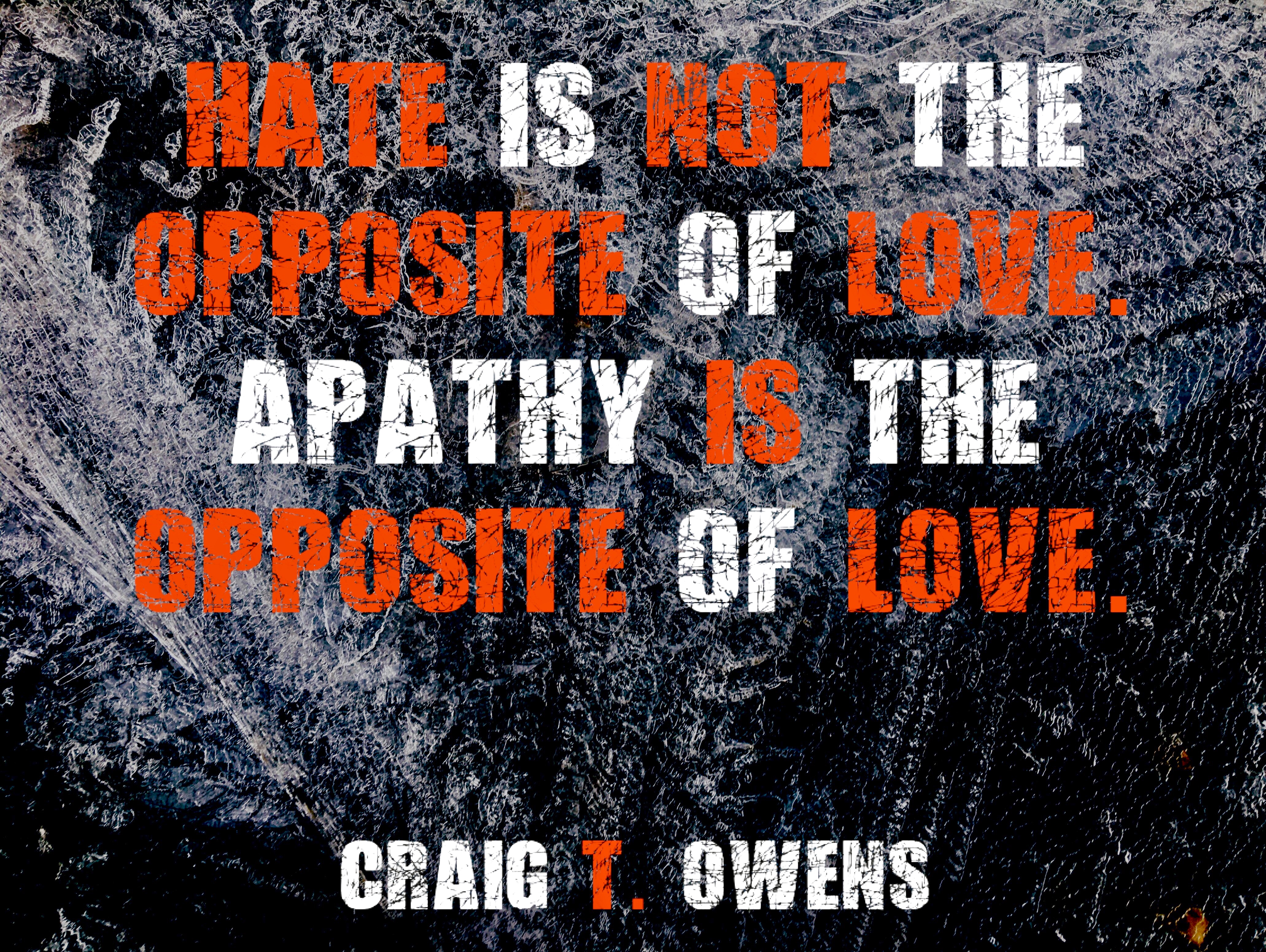
Hate is not the opposite of love; apathy is the opposite of love.

Hate of those things which keep people from God is the completion of the love for God and the respect for the Book that brings people to Him.

To love fully, I must also hate well. Not people, but actions that keep people away from experiencing and knowing God’s love. May all of us learn from the Holy Spirit how to awaken from any apathy we may have, and to correctly express our righteous anger. 

►► Would you please prayerfully consider supporting this ministry? ◀︎◀︎