It Takes All Of Us

Listen to the podcast of this post by clicking on the player below, and you can also subscribe on AppleSpotify, or Audible. 

In my book Shepherd Leadership I talk about some strong, godly men who gave into temptation at a moment of weakness—David who behaved so poorly toward Bathsheba and Uriah, Elijah who got depressed and suicidal, and Peter who denied knowing Jesus. 

One common factor for all of these guys is that their moment of giving in came when they were alone. They were isolated from others who may have been able to help them overcome the temptations that tripped them up. 

The principle is clear: Christians are stronger when they are with other Christians.  

Have you ever heard of the law of the weakest link? 

If I have a chain with links that can handle 400, 300, 250, 175, and 500 pounds, how much weight can the chain hold? You don’t really need a calculator for this one because the answer is the capacity of the weakest link: 175 pounds. This is why it’s to my advantage to not only strengthen myself, but to help others grow their strength as well. 

In Galatians 6:2-5, the apostle Paul talks about the strength we need for ourselves and our fellow Christian brothers and sisters. First, he says that each of us should test our own actions. I can only know my breaking point if I’m tested, and the Holy Spirit knows how to do this perfectly. After this testing, Paul says then I can take pride in myself without saying, “Well, at least I’m better than him!” 

Quite simply, Paul tells each of us that we must be able to carry our own loads. Why? Because only a strong Christian can help someone else with their load. We each have to get stronger individually so that we have strength for others! 

This is just like what we’ve been learning in our look at the Songs of Ascent: the goal is for all of the pilgrims to get to Zion together!

In this series, we are going to learn about six spiritual disciplines. Much like a physical workout, the Holy Spirit will start with us where we are. Not everyone will be at the same level nor will everyone progress at the same rate. But all of us will need these four things.

(1) Discipline. This is saying no to the easy thing or the thing that brings only fleeting happiness so that I can say yes to the things that bring eternal joy. 

(2) Stick-to-it-iveness. I have to be committed to this process for a lifetime. 

(3) Grace for yourself. There are going to be moments of struggles, plateaus, and even stumbles. Those are all a part of the journey, so we must extend grace to ourselves to learn, repent, and move forward. 

(4) Patience for others. As I just mentioned, we are all on our own journey and we all progress at different rates. Let’s be patient with each other. 

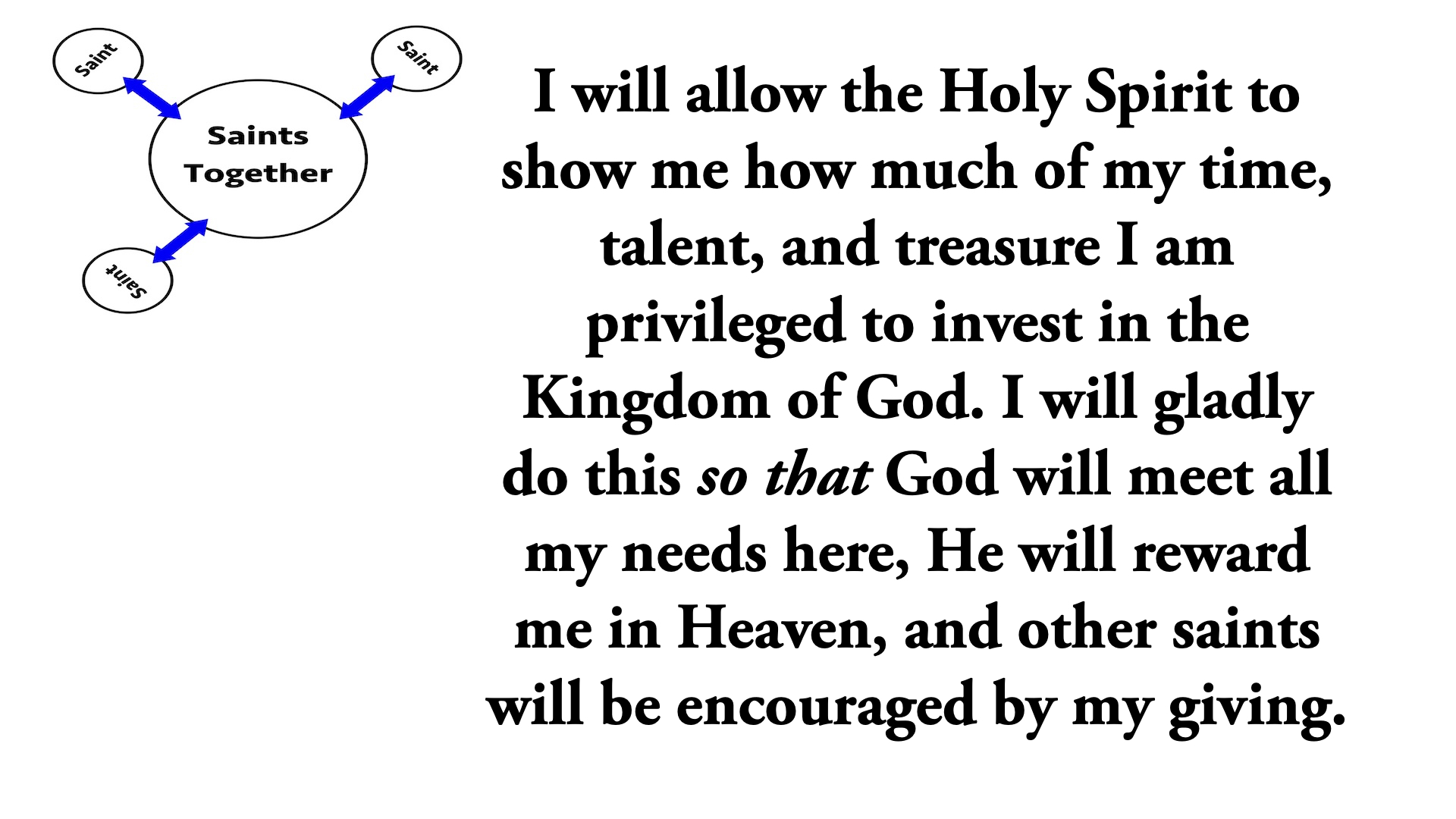
All of these spiritual disciplines are to strengthen us individually so that we have something to share with other saints (2 Corinthians 1:3-6). 

These spiritual disciplines shouldn’t become legalistic. Don’t make the way you do it the way everyone has to do it. After all, a 175-pound link will be different than a 250-pound link. 

What I am calling spiritual disciplines, C.S. Lewis called religious practices. In a letter to a friend, he wrote about the safety and beauty that result from these pursuits—

“I think about the practices what a wise old priest said to me about a ‘rule of life’ in general—‘It is not a stair but a bannister’…i.e. it is, not the thing you ascend by but it is a protective against falling off and a help-up. I think thus we ascend. The stair is God’s grace. One’s climb from step to step is obedience. Many different kinds of bannisters exist, all legitimate. It is possible to get up without any bannisters, if need be: but no one would willingly build a staircase without them because it would be less safe, more laborious, and a little lacking in beauty.” (C.S. Lewis)

The New Testament always has the words “saints” in the plural, so these disciplines will help us grow from strong individual saints to a healthy and effective collection of saints. 

Each of us needs all of us, and all of us need each of us! It does, indeed, take all of us.  

If you would like to follow along as we learn about these six spiritual disciplines, you can find all of the messages by clicking here. 

►► Would you please prayerfully consider supporting this ministry? My Patreon supporters get behind-the-scenes access to exclusive materials. ◀︎◀︎
Eternally Confident

Listen to the podcast of this post by clicking on the player below, and you can also subscribe on AppleSpotify, or Audible. 

When we hear the word “if” we hear something that is uncertain: “If only I get that job” or “If I have enough money at the end of the month” or “If we get there in enough time.” 

The dictionary tells us “if” has an element of uncertainty. Like when King George III said of George Washington’s decision to step down as the president, “If he does that, he will be the greatest man in the world.” 

Sometimes we think of “if” as a condition to receive some sort of award or recognition. Like Rudyard Kipling’s famous poem If

If you can keep your head when all about you are losing theirs and blaming it on you … [then] Yours is the Earth and everything that’s in it, and—which is more—you’ll be a Man, my son! 

We need to be careful of those paradigms when we come to the next song of ascent in Psalm 124, since the word “if” appears twice in the opening two verses. 

David is not saying, “Weren’t we lucky that God was there for us” or “I wonder if He will be for us again in the future.” I like how the New Living Translation renders this verse: “What if the Lord had not been on our side?” In other words, He was on our side, therefore look what we avoided! 

Far from being a statement of uncertainty, this is a statement of total assurance: It’s saying, “I’m confident of what would have happened if God wasn’t there, and I’m assured of what will happen in the future.” This is why in the next verses David calls on us to praise God in the present tense. 

Every one of these songs of ascent can be sung as stand-alone songs, but the Jewish sages believed that these 15 songs are like the 15 steps that go up to the center of the courtyard. No one climbs the steps from their basement, stops after three or four steps, and says, “I was lucky that the first steps held me! Now I’m wondering if the next step is going to fail me or not.” No, the fact that we have already climbed some steps gives us assurance of the stability of the next step. 

Look at a quick review of the previous steps: 

  • in Psalm 120 pilgrims climb away from the pull of the dark valleys 
  • in Psalm 121 we read the phrase, “I lift my eyes up to the One who is watching over me”  
  • in Psalm 122 we climb the steps knowing that we aren’t climbing to a throne of judgment but a throne of shalom because of the peace Jesus purchased for us
  • in Psalm 123 we are called to only have eyes for our Savior who has lavished His grace on us, and who continues to lavish His grace on us
  • now in Psalm 124 we continue to climb up in growing assurance 

The devil loves to use “if” as a weapon to keep us from this confidence. Perhaps the doubt comes like this, “This song was written by David. If I’m not King David—or even a part of the Jewish nation—can I be assured that God is on my side?” 

Yes, you can! Remember that God’s grace is unearned, undeserved, and unending. And it’s for anyone and everyone who puts their faith in Jesus (Romans 4:23-24; 1 Corinthians 1:30; Romans 8:31-32). 

Or perhaps the devil’s doubt comes like this, “If I sin, will God no longer be on my side?” 

No, neither our efforts nor our shortcomings increase nor decrease God’s love for us. He loved us before we even knew we needed Him, and our sin cannot diminish His love one iota (Romans 5:20-21; 2 Corinthians 5:21; Ephesians 2:4-5). 

When the devil confronted Jesus, he used that little weapon “if” with all three of his temptations. Jesus dismantled those temptations to doubt God by quoting Scripture. So too with Joshua. As he contemplated leading the Israelites into the Promised Land, he may have felt a bit insecure. God told Joshua to continue to meditate on His Word and as a result, Joshua would be strong and courageous. 

David’s closing words in Psalm 124:8 is the Source of our doubt-destroying confidence: “Our help is in the name of the Lord, the Maker of heaven and earth!” 

Whenever the devil plagues you with doubts, keep your eyes on your Maker, keep His Word in your mouth, and then feel His confidence grow in your heart. 

If you’ve missed any of the messages in our Ascending series, you can find all of them here. 

►► Would you please prayerfully consider supporting this ministry? My Patreon supporters get behind-the-scenes access to exclusive materials. ◀︎◀︎
Talk Back To Your Thoughts

Listen to the podcast of this post by clicking on the player below, and you can also subscribe on AppleSpotify, or Audible. 

Do you talk to yourself? 

Of course you do. We all talk to ourselves: it’s called “thinking.” 

But do you talk out loud when you talk to yourself? 

An unhealthy habit for most of us is that our thoughts are only a one-way monologue. That is, we are listening to our thoughts but we are not talking back to them. As a result, everything negative we’ve heard from our enemies is bouncing around in our heads. The more we hear it, the more likely we are to believe it. 

In Psalm 42, we hear from a psalmist who is longing to experience God’s presence but at the same time there’s a nagging thought implanted by skeptics: “Where is your God?” The psalmist reminisces how it used to be, which means there is a nagging doubt in his mind that it may never be like that again. 

But finally, the psalmist does the mentally healthy thing: he talks back to his thoughts. He asks himself a question and then he gives a new response—a response that is hope-filled instead of doubt-plagued. 

Why are you downcast, O my soul? Why so disturbed within me? Put your hope in God, for I will yet praise Him, my Savior and my God. My soul is downcast within me; therefore I will remember You. (Psalm 42:5-6) 

When the nagging thought of “Where is your God?” comes up again just a couple of verses later, he doesn’t linger or brood over this doubt-inducing thought but immediately talks back to that negative voice with hope-filled words (vv. 10-11). 

The devil has a singular agenda: to separate you from God. He does this through lies and doubts. Jesus told us the devil’s native language is lies: “He was a murderer from the beginning, not holding to the truth, for there is no truth in him. When he lies, he speaks his native language, for he is a liar and the father of lies” (John 8:44). 

The Bible tells us that the devil can also put thoughts and desires in our hearts, but they are all lies (see John 13:2; Acts 5:3). 

We cannot let these lies go unchallenged, so here’s our battle strategy: 

For the weapons of our warfare are not physical weapons of flesh and blood, but they are mighty before God for the overthrow and destruction of strongholds, inasmuch as we refute arguments and theories and reasonings and every proud and lofty thing that sets itself up against the true knowledge of God; and we lead every thought and purpose away captive into the obedience of Christ—the Messiah, the Anointed One. (2 Corinthians 10:4-5 AMP) 

There are five questions we need to use to talk to ourselves about the thoughts we hear: 

  1. Is this thought unbiblical? (2 Timothy 3:16-17)
  2. Does this thought rob God of the glory due His name (Psalm 29:1-11)? 
  3. Does this thought stifle my love for God or others (Mark 12:28-31)? 
  4. If I linger on this thought, does it rob me of peace (Isaiah 26:3-4)? 
  5. Does this thought make me apathetic toward sin (Genesis 4:7)? 

(Check out all of the above verses by clicking here.)

If we answer “yes” to any of these questions, we must capture that thought and put it to death, which requires the sword of the Spirit, which is the Word of God (Ephesians 6:17). Because of what Jesus has done for us on the Cross, every promise in God’s Word is “yes and amen” in Jesus, and therefore is an invincible weapon against lying thoughts (2 Corinthians 1:20). 

Here’s how we use those promises: 

For the accuser of our brothers and sisters, who accuses them before our God day and night, has been hurled down. They triumphed over him by the blood of the Lamb AND by the word of their testimony. (Revelation 12:10-11)

Listen to your thoughts, but don’t listen too long before you start to challenge them with these five questions. Then demolish those lies—triumph over them by the blood of the Lamb and your spoken testimony. Speak the truth out loud for all to hear. 

This is part 4 in our series on a Christian’s mental health. If you’ve missed any of the other messages I’ve shared, you can find them all by clicking here. 

►► Would you please prayerfully consider supporting this ministry? My Patreon supporters get behind-the-scenes access to exclusive materials. ◀︎◀︎
Difficult Doesn’t Mean You’re Out Of God’s Will

Listen to the podcast of this post by clicking on the player below, and you can also subscribe on AppleSpotify, or Audible. 

After speaking with some ministry interns, we wrapped up our time with a Q&A session. I had lots of very thoughtful questions, but this one seemed to really resonate with everyone. I was asked:

“When you’re contemplating resigning from a ministry position, how do you know that God called you to this position in the first place and it wasn’t just me calling myself here?” 

I know when the going gets tough it’s natural to think that it is time to move on. Before you submit that letter of resignation, there are a couple of things to consider first. Check out this short video…

Resources:

►► Would you please prayerfully consider supporting this ministry? My Patreon supporters get behind-the-scenes access to exclusive materials. ◀︎◀︎

Mighty Deliverer

Listen to the podcast of this post by clicking on the player below, and you can also subscribe on AppleSpotify, or Audible. 

The world can marshal its weapons of war. They may gain a temporary victory. They may build strongholds, and cast spells, and appear to be the unquestioned ruler. But God always gets the final word, the decisive word, and the best word! 

Don’t despair in the middle of the Story! All of History is His Story. No matter how dark it seems, we are assured of God’s victorious outcome! 

Bethlehem is our proof:

  • 700 years before it happened, Bethlehem is named as the birthplace of Jesus (Micah 5:2; Luke 2:1-7) 
  • 700 years before Jesus was born in Bethlehem, His titles were given and then fulfilled in the way that Jesus lived (see for example Isaiah 9:6 and Hebrews 13:20) 

Sometimes God has to let the darkness fall so heavy so that it seems hopeless. In fact, in human power alone it is hopeless and impossible. So God foretells His victory—

“Listen to this, you descendants of Jacob, you who are called by the name of Israel and come from the line of Judah, you who take oaths in the name of the Lord and invoke the God of Israel—but not in truth or righteousness—you who call yourselves citizens of the holy city and claim to rely on the God of Israel—the Lord Almighty is His name: I foretold the former things long ago, My mouth announced them and I made them known; then suddenly I acted, and they came to pass. … Therefore I told you these things long ago; before they happened I announced them to you so that you could not say, ‘My images brought them about; my wooden image and metal god ordained them.’” (Isaiah 48:1-5) 

We have seen how Micah prophesied our Messiah coming as the Great Shepherd and as the Prince of Peace, but He also comes as our Mighty Deliverer (Micah 5:1-6). He comes at an incredibly dark time that is described like this: “He will rescue us from the Assyrians when they pour over the borders to invade our land” (Micah 5:6 NLT). 

Darkness may appear to have a stranglehold even now in our time. One of the verses in the New Testament that pretty accurately sums up a Christ-less culture says, “The god of this world has blinded the unbelievers’ minds that they should not discern the truth, preventing them from seeing the illuminating light of the Gospel of the glory of Christ” (2 Corinthians 4:4 AMP) . 

But this is only temporary darkness. When the mob came to arrest Jesus, He said, “This is your hour—when darkness reigns” (Luke 22:53). Darkness only gets an hour, but the Light of God shines for all of eternity! 

One of my favorite Advent texts is found in Hebrews 2:14-15:

Since the children have flesh and blood, [Jesus] too shared in their humanity so that by His death He might destroy him who holds the power of death—that is, the devil—and free those who all their lives were held in slavery by their fear of death. 

Our Mighty Deliverer came to destroy satan’s power and free those held hopelessly in darkness. The word “destroy” is a powerful, all-encompassing word. Imagine a tyrannical ruler who sent one of his strongest police officers with an arrest warrant, who then grabbed onto you and subdued you with his vice-like grip. 

Only someone stronger than that officer can release you from that grip. That’s what Jesus did when He destroyed satan’s ironclad grip on your soul. Paul asks mockingly, “Where, O death, is your victory? Where, O death, is your sting? The sting of death is sin, and the power of sin is the law. But thanks be to God! He gives us the victory through our Lord Jesus Christ!” (1 Corinthians 15:55-57)

Now you may be free of the grip of that officer, but the arrest warrant still remains—you are still subject to the penalty. But that word “destroy” also means that the charges against you have been set aside so that there is no penalty outstanding against you. The apostle Paul again addressed this when he wrote, “For we know that our old self was crucified with [Jesus] so that the body ruled by sin might be done away with, that we should no longer be slaves to sin. … Who will bring any charge against those whom God has chosen? It is God who justifies” (Romans 6:6, 8:33). 

You are now set completely and irrevocably free! “But it has now been revealed through the appearing of our Savior, Christ Jesus, who has destroyed death and has brought life and immortality to light through the gospel” (2 Timothy 1:10). 

The Messiah—our Mighty Deliverer—destroys darkness and delivers those who believe in Him! 

No matter how hopeless it may seem, the Mighty Deliverer always prevails! Jesus has destroyed every enemy that has opposed God’s people! Jesus our Champion shines a light so brightly that nothing in satan’s arsenal can ever diminish it. 

The Light shines in the darkness, and the darkness can never extinguish it (John 1:5 NLT). 

So allow me to repeat: Don’t despair in the middle of the Story! All of History is His Story. No matter how dark it seems, Bethlehem is our proof that Jesus has destroyed our enemy and removed from him all grounds for charging us with sin. Bethlehem is our proof that we can live assured of God’s victorious outcome! 

What a great Christmas gift that truly is! 

If you’ve missed any of the messages in this Advent series, you can find a list of all of those messages by clicking here. 

►► Would you please prayerfully consider supporting this ministry? My Patreon supporters get behind-the-scenes access to exclusive materials. ◀︎◀︎

5 Quotes From “The Poetry Of Prayer”

In The Poetry Of Prayer, T.M. Moore not only introduces us to the imaginative poetry of George Herbert, but he also shows us what Herbert was trying to portray: There’s an undiscovered world in our prayer time! You can check out my full book review by clicking here. 

“The imagination is a wonderful if much-neglected resource. It is that place in the soul where mind, heart, and conscience, most fruitfully overlap to enhance, enrich, and enlarge each other. 

“When our imaginations are functioning as God intends, they can open the windows of refreshment into our souls, so that we think bigger and more clearly and excitedly; we feel with more urgency and delight; and we establish new priorities and values. 

“Poetry stretches the imagination by inviting it on to familiar ground and then changing the nature of that ground, right under our feet. Images, metaphors, rhyme, rhythm, and in an agreeable form can lead us, through our imaginations, into seeing familiar things in new and exciting ways.” 

“Prayer fixes the focus of our minds on unchanging spiritual realities. Prayer engages our imaginations—what Paul calls ‘the eyes of your understanding’—with visions of unseen glories and wonders. …

“At the same time, as we gaze in prayer upon the beauty of Christ, and commune with Him in His glory, we find that our hearts are enlarged in love for the Lord. The sheer beauty, majesty, and immensity of God can suck the breath out of us and fill us with the Spirit of the Lord at the same time. Lesser things lose their thrall as we drink in the vision of Christ and pour out heartfelt words of worship, adoration, and praise. These, in turn, exercise our heart in love for the Lord, just as our physical muscles are exercised during a workout.” 

“We feed our souls in prayer when, having entered His presence, we fill our minds with the vision of His glory, our hearts with the joy and pleasure of His presence, and our wills with iron resolve to serve this glorious God at every moment.” 

“Even now, as the Apostle Paul indicates [2 Corinthians 4:6], we who feast at the banquet table of prayer can glimpse the glory of God in the face of Jesus Christ and know daily revival and renewal in His grace.” 

“Prayer brings us from earth to heaven, and then brings heaven to earth in our transformed souls and renewed commitments for the day ahead.”

My Patreon supporters have been given all the rest of the quotes I pulled from this book. If you would like to have access to all of the content I regularly share with my Patreon team, please click here. 

Contented To Intercede

Listen to the podcast of this post by clicking on the player below, and you can also subscribe on AppleSpotify, or Audible. 

There is a sportswear company called ActiveFaith. I have a warmup shirt I wear sometimes in preparing for my workout. The front of the shirt says, “I can do all things,” and on the back it says, “through Christ.” I think that phrase is supposed to help me muscle through when I want to back off in my workouts. Perhaps reminding myself, “I can do all things through Christ” will help me persevere. 

As we continue our series asking, “Is that in the Bible?” we have come to statement #8—I can do everything through Christ. Is that in the Bible? Yes, but.…  

Yes, this verse is in the Bible in Philippians 4:13, but we need to as what exactly is the “everything” Paul is referencing. 

Remember that context is king, so we need to look at this whole letter to the church at Philippi, and especially the verses surrounding this statement. Let’s consider verses 10-19. 

In verse 10, Paul says he is glad that the Philippian Christians have had an opportunity to meet his material and financial needs again. This church was famous for its generosity (see 2 Corinthians 8:1-4), and when they heard Paul was in prison, they wanted to help. 

Prison was actually house arrest for Paul. He wasn’t allowed to leave the house, but he was responsible for all of his living expenses. Quite simply put: no money, no food. Epaphroditus brought the necessary funds from Philippi to Rome. He so invested himself in this mission to help Paul that he nearly died in the process (Philippians 2:25-30). 

Paul expresses his gratitude for the way these friends supplied for his needs, and he tells them twice that he has learned contentment during this ordeal. He says that he knows what it is to have plenty, and he knows what it is to have nothing. 

Did you catch that: Paul says that contentment is a learned attitude. It is learned through appetites satisfied and appetites thwarted, it is learned by looking back to recall God’s past mercies and then reassuring an anxious mind—that may become a discontented mind—that God is still God and that His future grace has not diminished one iota (see Philippians 4:4-7).  

Bottom line: Contentment is learned by being assured (or reassured) that I can get through this season of life by my unwavering faith in Christ’s ability to supply my needs. So Paul concludes, “I can do everything through Him who gives me strength.” 

I like the way the Amplified Bible translates this verse: I have strength for all things in Christ Who empowers me—I am ready for anything and equal to anything through Him Who infuses inner strength into me; I am self-sufficient in Christ’s sufficiency. 

Contentment is keeping my eyes on Jesus regardless of the circumstances. Contentment brings an assurance to my heart to keep trusting God regardless of my circumstances. And contentment then helps me pray for others. 

How does contentment help us pray—or intercede—for others? 

Before I answer that, let me have you consider another “Is that in the Bible” statement. Statement #9—My God will meet all my needs according to His glorious riches in Christ Jesus. Is that in the Bible? No! 

Paul is not praying for himself, but for his friends. Listen carefully to the pronouns in this verse: And my God will meet all YOUR needs according to the riches of His glory in Christ Jesus (Philippians 4:19). 

So back to my earlier question: How does contentment help us intercede for others?

It’s hard for me to pray for others to be blessed and have their needs supplied when my heart is discontented, isn’t it? When I have learned contentment—especially when I learned it by having all my needs supplied in a time of want—then I know how to both empathize with my friends who are in need and how to intercede for them. 

To the church at Corinth Paul said, “Praise be to the God and Father of our Lord Jesus Christ, the Father of compassion and the God of all comfort, who comforts us in all our troubles, SO THAT we can comfort those in any trouble with the comfort we ourselves receive from God” (2 Corinthians 1:3-4). 

The Holy Spirit teaches me contentment through these difficult circumstances SO THAT I am strong, and SO THAT I can pray for that strength for others in their difficult circumstances. My contentment helps me empathize and intercede for my brothers and sisters. 

To check out other “Is that in the Bible” phrases we have explored, please click here to check out the full list. 

►► Would you please prayerfully consider supporting this ministry? My Patreon supporters get behind-the-scenes access to exclusive materials. ◀︎◀︎

Expecting Miracles

Listen to the podcast of this post by clicking on the player below, and you can also subscribe on AppleSpotify, or Audible. 

Last week we saw the in-ness of the Holy Spirit guiding us, teaching us, and empowering us to overcome evil. For what purpose? Why does the Holy Spirit lead us this way? Because the Spirit desires to draw everyone into this in-ness. His work in and through our lives is always unmistakable and irrefutable. 

A good word to describe the unmistakable and irrefutable work of the Spirit is: Miracles. 

Miraculous signs characterized the earthly ministry of Jesus, and they also should to the hallmark of Spirit-baptized Christians today who are sharing the Gospel with others (Acts 10:38; 2:43; Mark 16:20). 

Some may ask, “Why don’t we see as many miracles today?” And some skeptics even point to a decrease in miracles as proof of their cessationist paradigm. But consider this: Has God’s power been diminished? Have all needs been met? Are there no more sickness or unsolvable problems of human suffering? Is everyone free of the power of the devil? 

No, of course not! 

So that would mean if there is any diminishment in miracles, the diminishment would seem to be in us! Particularly I think it is that we no longer expect miracles to happen.

Not only should we expect miracles, but we should also expect to be the vessel through which the Holy Spirit demonstrates the miracle. 

Here are 8 miracles that we should be expecting:

  1. Minds opened that were blinded to the Gospel message—2 Corinthians 4:4-6 
  2. Thoughts transformed—Romans 12:2-3; Philippians 2:5 
  3. Invincible words spoken by us to others—Acts 6:10 
  4. Love tangibly expressed through our spiritual gifts—John 13:34-35; 1 Corinthians 12:1, 31—13:3 
  5. Gifts of the Spirit used constructively in the church to both evangelize the sinner and edify the saint—1 Corinthians 14
  6. Compassionate actions constantly initiated to address areas of human suffering—Philemon 4-7, 17
  7. Powerful prayers prayed and answered—Acts 3:6, 4:31, 13:2-3 
  8. Miracles consistently seen as authenticating the Gospel message—Acts 10:38, 19:11-12 

(Check out all of the above scripture verses by clicking here.) 

Don’t limit the Supernatural power of the Holy Spirit in you to only natural expressions. Constantly expect miracles! 

If you’ve missed any of the messages in our series We Are: Pentecostal, you can find them all by clicking here.

►► Would you please prayerfully consider supporting this ministry? My Patreon supporters get behind-the-scenes access to exclusive materials. ◀︎◀︎

Anointed To Minister

Listen to the podcast of this post by clicking on the player below, and you can also subscribe on AppleSpotify, or Audible. 

Last week I shared this key thought: The Holy Spirit’s empowerment ignites and then alines our light-bearing to a disaster-prone world. 

Despite what some people try to say, this empowerment from the Holy Spirit isn’t just for a select few. Jesus not only prayed for all of His followers to know this, but Peter also brought this out in his Pentecost Day sermon (John 17:20-23; Acts 2:21, 38-39). 

So why are some people not baptized in the Holy Spirit? I think there are numerable reasons, but allow me to share four broad headings: 

  1. They have impenetrable hearts to the Holy Spirit’s wooing (Acts 7:51)
  2. They are ignorant of the fact that this baptism is available to them (Acts 19:1-2) 
  3. They have impure motives regarding the baptism in the Holy Spirit (Acts 8:9-19) 
  4. They are too impatient (Luke 11:9-13)  

(Check out all of the above passages by clicking here.)

The bottom line: God wants to baptize you in His Spirit, Jesus wants you to be anointed with the same power He used, and the Spirit wants to bring out greater Jesus-exalting fruitfulness from your life. 

Two years ago in this series, I said that when it comes to the Holy Spirit’s involvement in a Christian’s life: In > On. 

In the Old Testament, Samson had the Spirit of God ON him, but he never allowed the Holy Spirit to come IN him and make important changes. Three times we read that “the Spirit of the Lord came upon him” (Judges 14:6, 19; 15:14), but after every one of these times we see Samson reverting to his childish, selfish, pouting ways again. 

By contrast, consider the life of Jesus. After He was baptized by John we read that Jesus was “full of the Holy Spirit” and “led by the Spirit.” That word for “full” means complete or lacking nothing. Jesus yielded to the Holy Spirit and allowed Him to lead and direct, as well as supply everything that was needed for ministry. Just a few verses later we read that “Jesus returned to Galilee, in the power of the Spirit.” And in His first recorded sermon, Jesus read from the prophet Isaiah about the Holy Spirit anointing Him for ministry (Luke 4:1, 14, 18). 

That word for “anointed” is chiro, from which we get the word Christ. That is the same root word in us as CHRISTians. 

We see this in Peter, Stephen, Barnabas, and Paul (Acts 4:8; 6:3, 5; 7:55; 11:24; 13:9). And then Paul writes that this anointing is for all Christians—“Now it is God who makes both us and you stand firm in Christ. He anointed us [that’s the word chiro again], set His seal of ownership on us, and put His Spirit in our hearts as a deposit, guaranteeing what is to come” (2 Corinthians 1:21-22). 

The anointing that characterized the life of Jesus in Acts 10:38—“How God anointed Jesus of Nazareth with the Holy Spirit and power, and how He went around doing good and healing all who were under the power of the devil, because God was with Him”—is the same anointing for ministry for all CHRISTians today! 

So…

Don’t dabble—dive in! 

Don’t settle for on—allow the Holy Spirit fully in! 

When we are yielded and baptized in the Holy Spirit, we have the anointing to shine brightly for Jesus in our generation. 

If you’ve missed any of the messages in our series We Are: Pentecostal, you can check them all out by clicking here. 

►► Would you please prayerfully consider supporting this ministry? My Patreon supporters get behind-the-scenes access to exclusive materials. ◀︎◀︎

It’s What Shepherds Do

Listen to the podcast of this post by clicking on the player below, and you can also subscribe on AppleSpotify, or Audible. 

T.M. Moore shares my heartbeat for pastors to align their minds, hearts, and wills to leading as shepherds. T.M. graciously wrote one of the endorsements for my book Shepherd Leadership: The Metrics That Really Matter by saying, 

“The combination of Craig’s Biblical understanding, practical insights, and consistent personal practice make this a book every pastor should read. Unless our goals and practices in ministry line up with those Jesus taught and exemplified, we cannot expect Him to bless us with world-uprighting power.”

In a recent blog post, T.M. shared these poignant words—

     “Many pastors today seek to model themselves and their ministries along the lines of whichever pastor and whatever church seem to be the most ‘popular’ or ‘successful’ in attracting people. The result is, increasingly, worship services are starting to look alike, and pastors are starting to preach alike. And those who aren’t are wondering what they might do to become more like everybody else.

     “We ought not model ourselves on our contemporaries, be they ever so ‘successful.’ Such comparing and adjusting, Paul suggested, is not wise (2 Corinthians 10:12). Jesus is our great model for ministry, and we should look to Him to wash, shape, enliven, empower, and employ every aspect of our lives and ministries for His glory.

     “In his sermon, ‘Christ the Example of Ministers,’ Jonathan Edwards offered a concise summary of the reason people submit themselves for ordination to ministry: ‘The work and business of ministers is as it were that of servants, to wash and cleanse the souls of men: for this is done by the preaching of the Word, which is their main business, Ephesians 5:26. “That He might sanctify and cleanse it with the washing of water by the Word.” … It is the duty of ministers of the gospel, in the work of their ministry, to follow the example of their great Lord and Master.’ 

     “Elsewhere Paul talked about spending and being spent for the souls of God’s people (2 Corinthians 12:15). The challenge that faces us who have accepted the call to ministry is to follow the example of Paul (1 Corinthians 11:1) and strive to see Jesus, become like Jesus, work and serve like Jesus, lay down our lives like Jesus, and trust in Jesus to make our labors fruitful for His glory.” 

I wholeheartedly agree! 

Pastors, let’s get back to the shepherding model the Scriptures show us. This is truly the heartbeat of my book. You can get more information on Shepherd Leadership by clicking here. 

If you feel my book would benefit you (or your pastor) I would be happy to send you the ebook version free of charge. Just email me to let me know. 

►► Would you please prayerfully consider supporting this ministry? My Patreon supporters get behind-the-scenes access to exclusive materials. ◀︎◀︎