This is a weekly series with things I’m reading and pondering from Oswald Chambers. You can read the original seed thought here, or type “Thursdays With Oswald” in the search box to read more entries.
A New Look At Some Old Bible Studies
It is important to notice the difference between the Wisdom of the Hebrews and the Wisdom of the Greeks. The Wisdom of the Hebrews is based on an accepted belief in God; that is, it does not try to find out whether or not God exists, all its beliefs are based on God, and in the actual world of things as they are, all its mental energy is bent on practical living. The Wisdom of the Greeks, which is the wisdom of our day, is speculative; that is, it is concerned with the origin of things, with the riddle of the universe, etc., consequently the best of our wits is not given it to practical living.
The value of the Book of Job is not in what it teaches, but that it expresses suffering, and the inscrutability of suffering. In the Book of Psalms, Wisdom is applied to things as they are and to prayer. The Book of Proverbs applies Wisdom to the practical relationships of life, and Ecclesiastes applies Wisdom to the enjoyment of things as they actually are; there is no phase of life missed out, and it is shown that enjoyment is only possible by being related to God.
The record of the whirl of things as they are is marvelously stated in these books of Wisdom: Job—how to suffer; Psalms—how to pray; Proverbs—how to act; Ecclesiastes—how to enjoy; Song of Solomon—how to love. …
Solomon sums up the whole thing as follows: If you try to find enjoyment in this order of things, you will end in vexation and disaster. If you try to find enjoyment in knowledge, you only increase your capacity for sorrow and agony and distress. The only way you can find relief and the right interpretation of things as they are it is by basing your faith in God, and by remembering that man’s chief end is to glorify God and enjoy Him forever. Jesus Christ is the One Who can transmute everything we come across.
From Shade Of His Hand
Sometimes the “wisdom” books of the Bible can be difficult to understand in our modern day, Western culture. But perhaps you may be able to read them differently with these insights that Oswald Chambers shares.
Why not try giving a new look at some old Bible studies, and then comment below on how it worked for you.
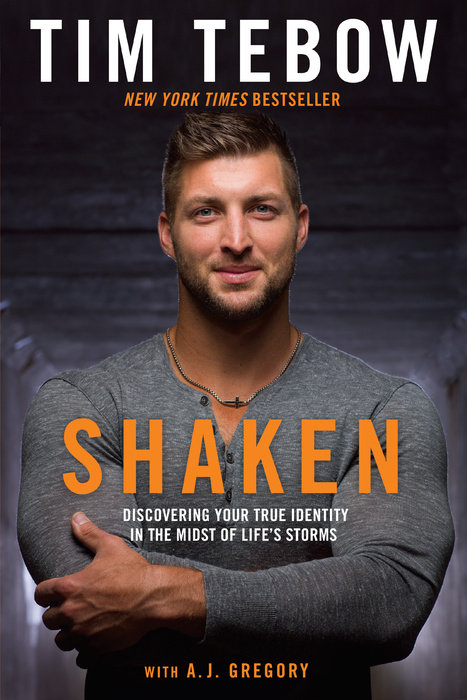
Tim Tebow explores what happens when your nice, neat world is shaken by the unexpected. It’s a phenomenally encouraging book! Check out my book review by clicking here. Then enjoy these quotes from Shaken.
“Sure, God loves the world, but He also loves each one of us individually. With billions of people on the planet, I know it can be hard to comprehend His love for us personally. God is infinite and focuses all of His love on you and me. He can’t spread Himself too thin. He cannot exhaust Himself. He cannot overextend Himself. And so every single person on the planet is the object of His love.”
“God can do a lot with what we think is a little. He can take something that can be described as ‘insignificant’ or ‘not enough’ or ‘small’ or ‘meaningless’ and use it to perform a miracle.”
“There will always be people in your life who will underestimate your potential, saying that you’ll never reach your dream or make that goal, or try to hold you back in some way. … Here’s the good news. What God knows about us is more important than what others think.”
“Being normal is safe. And easy. It doesn’t require much work or effort or change on our part. But it always leads to mediocrity. When we strive to be just like everyone else, we never have a chance to be special. When you start to embrace and even celebrate how special and different God made you, you can begin to do extraordinary things. You can begin to see yourself through His eyes. You can begin to live in the uniqueness with which you were created. You can be motivated and inspired to go against the grain. What does that mean? When everyone around you is picking on someone, stand up for that person. When everyone around you is using foul language, say kind things. When you see injustice and everyone else turns a blind eye, try to make it right.”
“Don’t get beat down by the stares, whispers, or obnoxious opinions of others who points out how different you are, look, or act. They don’t know God’s plan for your life. They don’t know how God can use what they may view as a weakness. If you focus on how much you hate those scars or those burns, you might missed the opportunity to encourage or inspire someone else who is going through a similar journey. … When you begin to accept how God purposely created you, you can begin to appreciate your uniqueness and allow Him to use those gifts.”
“While self-confidence is important and we should believe we can achieve great things, there must be a balance. We must be proud of our accomplishments without letting them define us.”
“When is the last time you did something different? Something beyond your comfort zone? Something that wasn’t familiar but could do a world of good in the life of another? When you stay put in your comfort zone, you don’t grow. You don’t stretch. You’re not challenged. You stay the same.”
“The stand you take may not be the biggest deal to the entire world, but it can be a big deal for one person. … A stand doesn’t always mean doing something radical. Sometimes God will use something you’ve always done in a way that’s bigger than you can imagine. Sometimes He’ll use something He puts on your heart, or maybe He’ll use your convictions, your search for the truth, your desire to do the right thing for a greater purpose.”
“We don’t have to feel led into full-time ministry before we can help the homeless or share a message of hope to someone who may need it. The only qualification necessary is willingness. I know not everyone has the opportunity to visit hospitals or prisons or make wishes come true. But there is always something you can do, even when you’re in a busy season in life. Give someone a hug. Send a text with an inspiring quote. Mail someone a heartfelt card. Donate blood. Tell someone how much you appreciate him or her. If we open our eyes, each day presents us with opportunities to do something kind or nice for someone else.”
“Don’t limit what God can do based on how you limit yourself. Be you, and let God be God.”
I continue to be so impressed with the way Tim Tebow always finds a way to let his light shine for Jesus in everything he does. Many people find it easy to give God praise when things are going well, but it might not be as easy to praise Him in the down times. This is exactly what Tim Tebow explores in his latest book Shaken.
Football fans have seen the on-field celebrations after a big victory, the joyous locker rooms, and the upbeat press conferences. But seldom do we see much from the team that loses the big game. Even less often do we get a glimpse behind the scenes of the heartache for athletes in the day-to-day grind of their sport.
Tim Tebow has won the Heisman Trophy, the NCAA football national championship, and one of the most exciting NFL playoff games in history. Tim has also been traded, benched and cut by other NFL teams. During these times, Tim has learned to rely on his bedrock faith. And in Shaken we get to hear the lessons he’s learned, and to discover the truth behind an important Bible verse (from which the name of the book comes): I keep my eyes always on the Lord. With Him at my right hand, I will not be shaken (Psalm 16:8).
Shaken isn’t all about Tim. He is refreshingly transparent to share with us about his struggles and the lessons he’s learned, but he also shares with us the overcoming stories of some other amazing people—folks who wouldn’t normally be in the spotlight. And in so doing, Tim shows us that each and every one of us has immeasurable value to God, that tragedies don’t have to shake our world, but that we can use even the difficult times to lean into God and to do great things for Him.
My level of respect for Tim Tebow, and the way he uses his notoriety for God’s glory, has risen again after reading this book. For anyone who is looking for a way to make sense of the hard things in life, Shaken will be an eye-opening, heart-changing book.
I am a Waterbrook book reviewer.
(By the way, Tim’s first book—Through My Eyes—is also an excellent read!)
As for me, I call to God, and the Lord saves me. Evening, morning and noon I cry out in distress, and He hears my voice. (Psalm 55:16-17, emphasis added)
T.M. Moore has an interesting suggestion based on these verses:
“Establishing set times for prayer—hours for prayer—in your daily schedule can be a first step toward praying always and without losing heart. Observing these hours of prayer doesn’t mean you need to pray for an hour each time; usually 10 or 15 minutes, sometimes more, will suffice to keep us focused on the Lord throughout the day and in continuous communication with Him.”
Here’s how I have tried to put this into action in my life. I have three alarms set in my iPhone as prayer reminders:
Why don’t you try something like this, and see if it helps you learn to pray without ceasing. Feel free to share some things that have worked for you in the comments below so all of us can benefit from what you are learning.
When I worked in the business field, I was invited to be a teacher for a program called GROW (Grand Rapids Opportunities for Women), where I taught a class on marketing. Then later on, I served as a reviewer as the students turned in their marketing plans.
One of the main points I tried to drive home to my students is a basic Marketing 101 principle which says—you can’t be all things to all people. You have to pick a niche market and then try to dominate that market. There are two general ideas here: (1) Make your product or service pricey and therefore exclusive to a select group, or (2) Make your product or service affordable and accessible for the mass market.
The Incarnation of Jesus totally violates this Marketing 101 principle. (Which goes to show you that God knows more than all the world’s so-called “experts”!)
First, there was a marketing message to shepherds (see Luke 2:8-11). This would have been the “mass market” as shepherds represented the every-day, working-class man. The first two verses of The First Noël carol addresses these “certain poor shepherds in fields where they lay.”
But then there is this appearance of a very exclusive group of Magi (see Matthew 2:1-2, 11). These men were highly educated and had gained great influence and affluence. Verse 3 of The First Noël references these “wise men…from country far” who could present such lavish gifts to Jesus.
God did exactly what I told my GROW students they shouldn’t do if they wanted to be successful!
The Incarnation of Jesus is one of those rarest of rare things that actually can be all things to all people! Why? Because ALL people need what the Incarnation of Jesus brings. That’s why the final verse of The First Noël calls for ALL of us to join in singing our praise to God because of the salvation Jesus had purchased for ALL mankind.
Here’s the reason—
“The coming of Jesus was a search-and-save mission. ‘The Son of Man came to seek and save the lost.’ So Advent is a season for thinking about the mission of God to seek and to save lost people from the wrath to come. … ‘As the Father has sent Me, even so I am sending you’ (John 20:21). It’s the story of how the vertical Advent of God in the mission of Jesus bends out and becomes the horizontal Advent of Jesus in the mission of the church. In us.” —John Piper
You have been rescued, now go be a rescuer. Take this Noël message to ALL … young/old, rich/poor, Black/white, educated/illiterate, healthy/sick, friend/enemy…. the message in the First Noël and every Noël is for everyone!
If you’ve missed any of the messages in our series The Carols Of Christmas, you can find the full list here.
In John Maxwell’s book Think On These Things, he encourages us to think about our world the way Jesus thinks about the world. This must lead to us loving and serving others!
“The way to the top is not ‘stepping on others,’ but ‘stooping to help others.’”
“How many lives are wasted and destroyed because the world’s attitudes and actions toward needy people say ‘I couldn’t care less’? How beautiful this world would be if this unchristian philosophy was replaced with Christian attitudes until people would begin saying, ‘I couldn’t care more.’ If I am to say to my world, ‘I couldn’t care more,’ I must open my eyes and look for hurting people.”
“Jesus was concerned that others would see the hurts of humanity and respond with care. Too many times we, like the disciples, see only the problems of people. We feel the frustration of their failures and the weight of their weaknesses. We remember only the reliance upon our strength and forget our obligation to freely give what we have received.”
“My helping hand to a needy world is empty unless love is the motive. Material handouts are a poor substitute for love and understanding. People do not need more trinkets, they need more tenderness.”
“The next time you want to help someone who is in difficulty, stop and think. Why not change your approach? Instead of ‘telling it like it is’ why not ‘tell it like it could be.’ Before you begin to question my motives, let me state that I am not asking you to be dishonest. I did not say, ‘Tell it like it could never be.’ I said, ‘Tell it like it could be!’ … When you ‘tell it like it could be’ you help others to see things more clearly. There is no better way to change a problem than to help someone see a solution. Many times people with problems become slaves to their situation because they can see nothing but problems.”
If you would like to read my review of Think On These Things, please click here. And you can read some other quotes I shared from this book by clicking here.
This is a weekly series with things I’m reading and pondering from Oswald Chambers. You can read the original seed thought here, or type “Thursdays With Oswald” in the search box to read more entries.
Christ’s Incarnation Means Our Freedom
Other religions deal with sins; the Bible alone deals with sin. The first thing Jesus Christ faced in man was this heredity of sin, and it is because we have ignored it in our presentation of the Gospel that the message of the Gospel has lost its sting, its blasting power; we have driveled it into insurance tickets for heaven, and made it deal only with the wastrel element of mankind. …
The revelation is not that Jesus Christ was punished for our sins, but that He was made to be sin. “Him who knew no sin” was made to be sin, that by His identification with it and removal of it, we might become what He was. … Jesus Christ went straight through identification with sin that every man and woman on earth might be freed from sin by His atonement. He went through the depths of damnation and came out more than conqueror; consequently everyone of us who is willing to be identified with Him is freed from the disposition of sin, freed from the connection with the body of sin, and can come out more than a conqueror too because of what Jesus Christ has done. …
The Holy Spirit will take my spirit, soul and body and bring them back into communion with God, and lead me into identification with the death of Jesus Christ, until I know experimentally that my old disposition, my right to myself, is crucified with Him, and my human nature is now free to obey the commands of God.
From The Shadow Of An Agony
As we approach the time of year we celebrate the Incarnation of Jesus, it’s amazing to think that He didn’t come just to identify with our sin, but to be made sin! Without Jesus Christ’s death on a Cross in our place, there is no hope for us.
As we celebrate the First Advent, it’s a good idea to keep in the front our our minds what Christ’s Incarnation means for us. It means we can be freed from sin—free to obey God, and free to look forward to Christ’s Second Advent, where He will take away His saints to be with Him forever!
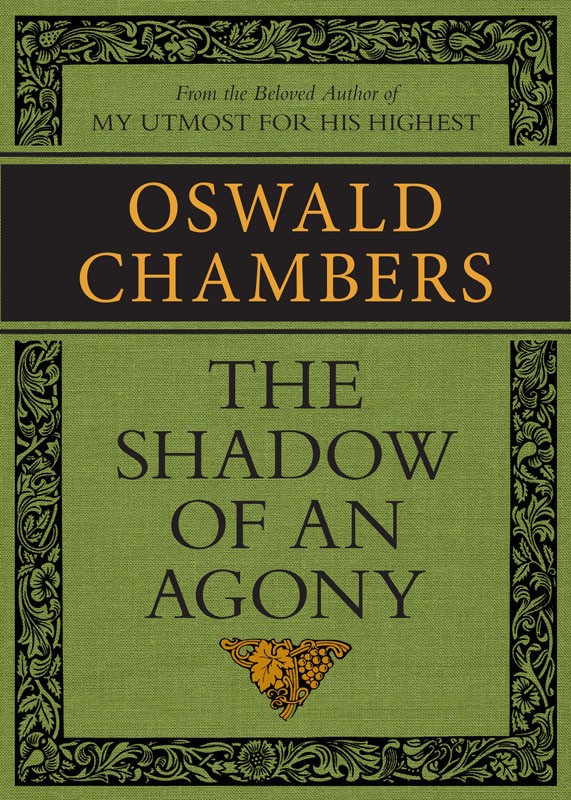
In The Shadow Of An Agony, Oswald Chambers explores how we should process the hard events of our lives which seem to totally rock our neat and orderly world. Check out my book review by clicking here, and then enjoy a few quotes from this book.
“If Jesus Christ were only a martyr, His Cross would be of no significance; but if the Cross of Jesus Christ is the expression of the secret heart of God, the lever by which God lifts back the human race to what it was designed to be, then there is a new attitude to things.”
“The agony of a man’s affliction is often necessary to put him into the right mood to face the fundamental things of life. The Psalmist says, ‘Before I was afflicted I went astray: but now I have kept Thy Word.’ The Bible is full of the fact that there has to be an approach to the holy ground. If I am not willing to be lifted up, it is no use talking about the higher heights. … No man can do wrong in his heart and see right afterwards. If I am going to approach the holy ground, I must get into the right frame of mind—the excellency of a broken heart.”
“Jesus Christ did not come to give us pretty ideas of God, or sympathy with ourselves; He came from a holy God to enable men, by the sheer power of His Redemption, to become holy.”
“No man is the same after an agony; he is either better or worse, and the agony of a man’s experience is nearly always the first thing that opens his mind to understand the need of Redemption worked out by Jesus Christ.”
“The attitude of the Bible to the human race is not a common-sense one. The Christian aspect deals with the a specimen of a human race which is a magnificent ruin of what it was designed to be. Supposing the view of the Bible to be right, to whom it is it ‘up to’ to right the wrong? The Creator. Has He done it? He has, and He has done it absolutely single-handed. The tremendous revelation of Christianity is not the Fatherhood of God, but the Babyhood of God—God became the weakest thing in His own creation, and in flesh and blood He levered it back to where it was intended to be. No one helped Him; it was done absolutely by God manifest in human flesh. God has undertaken not only to repair the damage, but in Jesus Christ the human race is put in a better condition than when it was originally designed.”
“We have been taken up with creeds and doctrines, and when a man is hit we do not know what to give him; we have no Jesus Christ, we have only theology. For one man who can introduce another to Jesus Christ by the way he lives and by the atmosphere of his life, there are a thousand who can only talk jargon about Him.”
“The New Testament view of a saint is a more rugged type. You and I are a mixture of dust and Deity, and God takes that sordid human stuff and turns it into a saint by Regeneration. A saint does not mean a man who has not enough sin to be bad, but a man who has received from Jesus Christ a new heredity that turns him into another man.”
“Our guide as to what emotions we are going to allow is this—What will be the logical outcome of this emotion? If it has to do with sin and satan, then grip it on the threshold of your mind and allow it no more way. You have no business to harbor an emotion the outcome of which you can see to be bad; if it is an emotion to be generous, then be generous, or the emotion will react and make you a selfish brute.”
“When I receive the Spirit of God, I am lifted not out of reason, but into touch with the infinite Reason of God.”
“Any fool will give up wrongdoing and the devil, if he knows how to do it; but it takes a man in love with Jesus Christ to give up the best he has for Him.”
“Churchianity is an organization; Christianity is an organism. Organization is an enormous benefit until it is mistaken for the life.”
“The stupendous difference between the religion of Jesus Christ and every other religion under heaven is that His religion is one which brings help to the bottom of hell, not a religion that can deal only with what is fine and pure.”
Every Thursday I share a section of the current Oswald Chambers book I am reading, in a series called “Thursdays With Oswald.” If you would like to be notified when these posts go live, just enter your email address in the box on the right, and then click “Sign me up!”