what is the difference between unity and conformity, and how do leaders promote the right thing [7:20]
we need to help independent people choose to be interdependent [8:27]
we unpack a quote Greg shares about trading doing what we want to do for doing what we ought to do [8:54]
we don’t want to be told what to do unless we understand why we need to do it—helping a team grasp this is how leaders get buy-in [10:23]
Greg shares a quote from Francis of Assisi about living out what we are talking about [12:00]
Check out this episode and subscribe on YouTube so you can watch all of the upcoming episodes. You can also listen to our podcast on Spotify and Apple.
Listen to the podcast of this post by clicking on the player below, and you can also subscribe on Apple, Spotify, or Audible.
I call on the Lord in my distress, and He answers me (Psalm 120:1).
What power and love is packed into this short verse! “I call…He answers.” There’s nothing else I need to do—just called to my God. There is no delay or deliberation on His part—He answers me.
“Distress” comes from the root word that can mean a tight spot, or it can mean a hard pebble. The distress we face may be a full frontal assault or it may be a nagging, almost indefinable, annoyance. Since Psalm 120 is a Psalm of Ascent, whatever the distress is, the psalmist feels like it is keeping him from going up into God’s presence. He lists three known distresses:
Deceit—people around him were lying or distorting the truth.
Separation—he wants to ascend into God’s presence but feels held back by those among whom he lives.
Turmoil—he’s looking for peace, but everyone around him wants to stir up trouble and controversy.
What about those annoying, hard-to-identify distresses? In the next Psalm of Ascent the call is for us to trust God and to not worry. But in this psalm, there’s no calling to God for help because no specific threats have been identified. Still we learn that our Heavenly Father, who does not slumber, perpetually watches over us. Our Father knows our needs before we can even perceive them, and He is fully prepared to handle them.
So we are promised:
I can sleep securely
I can travel safely
I can work each day confidently
I can pass through the night unharmed
I can move around without having to look around
The LORD will watch over my coming and going both today and forevermore!
Father, may any distresses I experience today send me ascending into Your presence. Whether I know what the threats are or not, I know that You are watching over me and will answer me whenever I call to You. I thank You for this confidence that I have both today and forevermore!
Listen to the podcast of this post by clicking on the player below, and you can also subscribe on Apple, Spotify, or Audible.
One of the things I enjoy about my Apple Watch is the connection I have with others who also use an Apple Watch. For instance, I get notified when my wife has finished a workout, and one of the pre-set replies I could choose is, “I’ve got questions!” That’s a funny way of me saying, “How did you complete that workout?!”
In Psalm 75 and Psalm 76, Asaph tells us how God will deal with the wicked. But then Psalm 77 begins with Asaph using words like, “My soul refused to be comforted, my spirit is overwhelmed,” and then he launches into the tough questions like: “How long is this going to last? Has God forgotten me? Have I fallen out of favor with God? Has His mercy dried up? Can God keep what He has promised? Is God angry with me?” When I read all this, I feel like saying, “Asaph, I’ve got questions!”
Yet, these complaints of Asaph ring true to real life. Like when a friend called me last week and started our conversation by asking, “Why can’t things just go easy for me?”
Here’s the simple answer: The Story isn’t over yet. We are in a battle, and the enemy of our soul is still trying to take us out, or at least shut us up.
In Psalm 77, Asaph tells his story to Jeduthun (a Levite worship leader whose name means praising) in four chapters, with a Selah for each of the breaks between the chapters.
Chapter 1—Distress (vv. 1-3)
The word distress means confronted by an adversary. Ever been there? Every follower of God has been, so Asaph invites us to Selah: pause to contemplate things like (a) Is this distress causing me to reevaluate the foundation on which I stand? (b) What is it God is shaking in my life? When God shakes things up, it is to cause us to remember and muse about the ONLY sure foundation that can withstand any storm (see Matthew 7:24-27).
Chapter 2—Questioning (vv. 4-9)
Notice the words Asaph uses: thought, remembered, mused, inquired. He is asking those tough questions, but he is asking them in a way that he can carefully consider the answers. That means he is really taking a Selah pause with each question. I think he has come to this conclusion: “Aren’t all these really just rhetorical questions? And isn’t the answer to all of them a resounding ‘NO!’?” If you aren’t sure the answer to all of these questions is no, please read Romans 8:31-39.
Chapter 3—Recalling (vv. 10-15)
Notice the continuation of the words: thought, remember, meditate, consider. He also asks another question in v. 13 which he then answers in the next two verses. His call to Selah here is another pause to reflect: “Has God lost His power? Has He changed His mind?” And once again the answer is a loud and clear, “NO!” (see Isaiah 59:1; Hebrews 13:8)
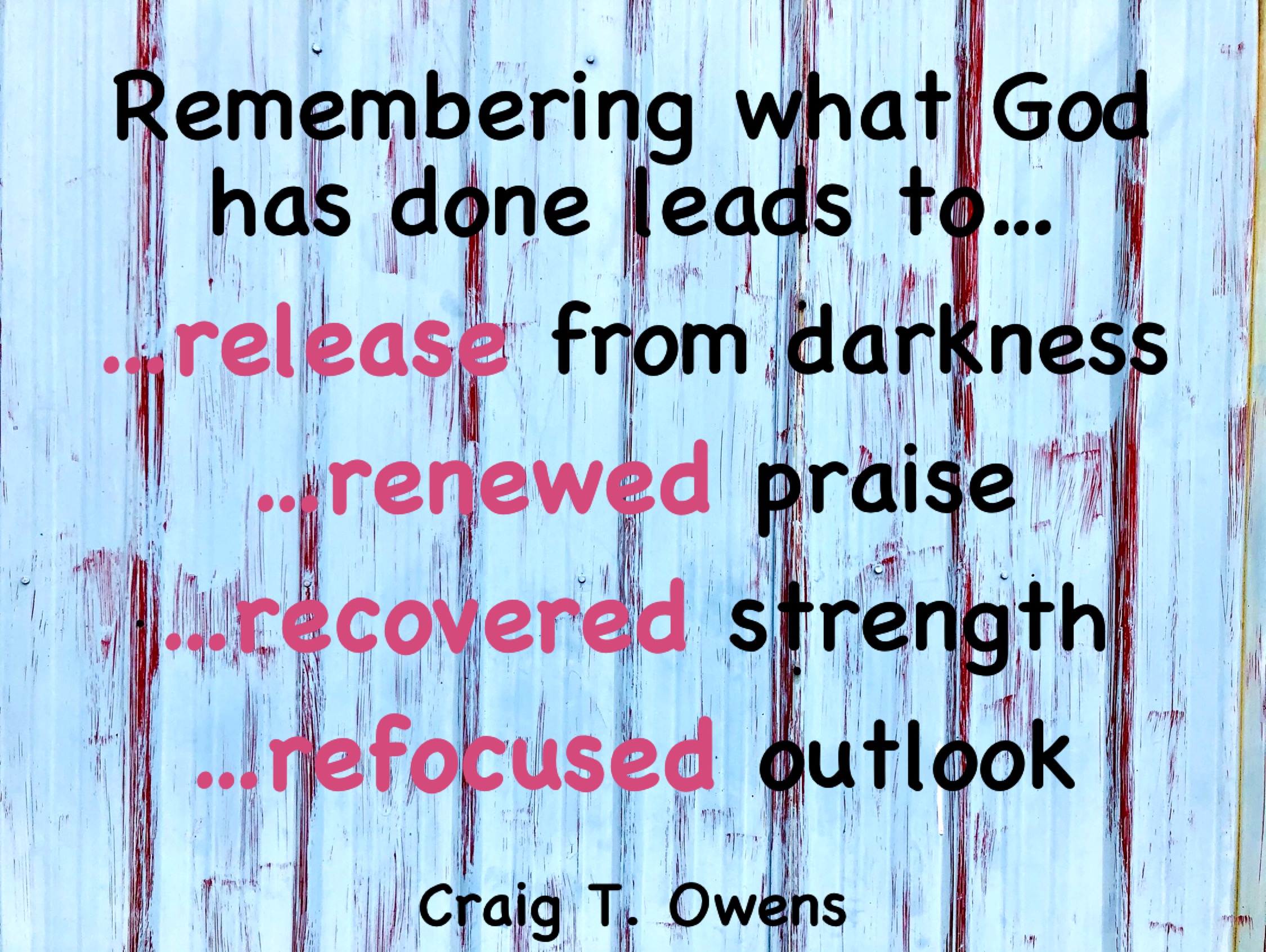
One of the important takeaways from this stanza of Psalm 77 is this: Looking back in gratitude at what God has done allows me to look forward in hope to what He is still going to do. My remembering what God has done in the past leads to:
Release from the darkness
Renewed praise
Recovered strength
Refocused outlook
Chapter 4—Hope (vv. 16-20)
Asaph says, “Look what God did! And since He is the same today as He was yesterday, guess what He’s still able to do!” We know this because the Bible says, “For no matter how many promises God has made, they are ‘Yes’ in Christ. And so through Him the ‘Amen’ is spoken by us to the glory of God” (2 Corinthians 1:20).
Remember I said earlier that God isn’t done telling His story yet? God isn’t done yet, He knows His Story, and His Story is still being told. But He’s also already told us how His story will end (see Revelation 21:4-6). And the end of His story is really just the beginning of the Real Story!
C.S. Lewis said it this way in the closing words of The Last Battle:
“And for us this is the end of all the stories, and we can most truly say that they all lived happily ever after. But for them it was only the beginning of the real story. All their life in this world and all their adventures in Narnia had only been the cover and the title page; now at last they were beginning Chapter 1 of the Great Story, which no one on earth has read; which goes on forever; in which every chapter is better than the one before.”
When you find yourself saying, “I’ve got questions: How long is this going to last,” Selah to remember that the Story isn’t over yet. The Storyteller knows how it ends, and He promises us: But what of that? For I consider that the sufferings of this present time—this present life—are not worth being compared with the glory that is about to be revealed to us and in us and for us and conferred on us! (Romans 8:18 AMP)
This is a weekly series with things I’m reading and pondering from Charles Spurgeon. You can read the original seed thought here, or type “Thursdays With Spurgeon” in the search box to read more entries.
Listen to the podcast of this post by clicking on the player below, and you can also subscribe on iTunes or Spotify.
We Are All Laborers
I planted, Apollos watered, but God gave the increase. So then neither he who plants is anything, nor he who waters, but God who gives the increase. Now he who plants and he who waters are one, and each one will receive his own reward according to his own labor. For we are God’s fellow workers; you are God’s field, you are God’s building. (1 Corinthians 3:6-9)
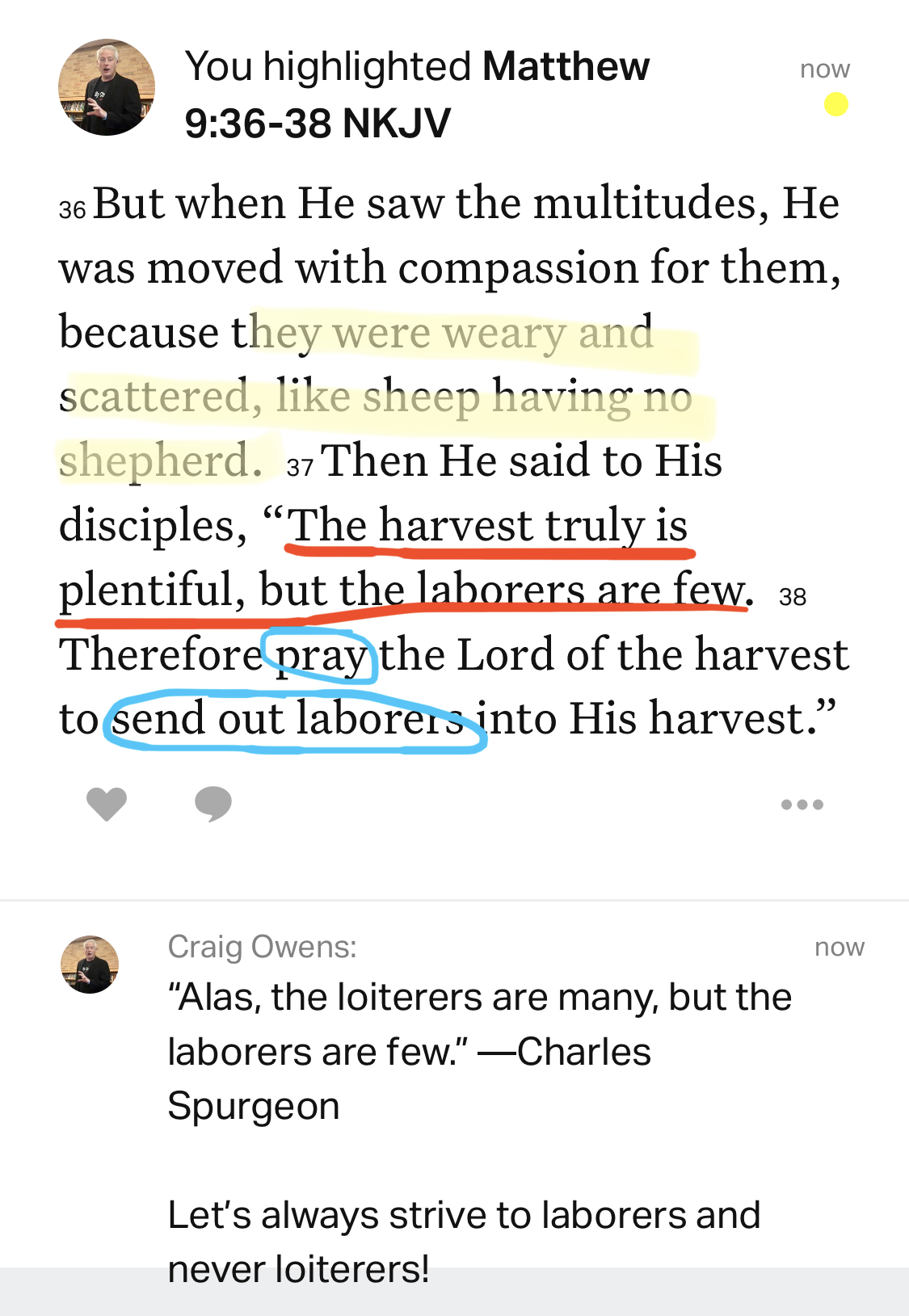
Remember that the ablest ministers, the most powerful evangelists, the most profound teachers are, after all, nothing but laborers together with God. Let your mind be set upon the Master and not upon the servants! Do not say, ‘We are for this man because he plants,’ or ‘We are for the other because he waters,’ or ‘We are a third party for nobody at all.’ But let us join in ascribing all honor and praise to God, Who works all our works in us, since every good gift and every perfect gift is from above and comes down from the Father of lights, to Whom be glory world without end! …
The church is God’s farm.… In the margin of the Revised Version, we read, ‘You are God’s tilled ground….’
We begin by considering that the church is God’s farm. The Lord has made the church of His sovereign choice to be His own by purchase, having paid an immense price for it. ‘For the Lord’s portion is His people; Jacob is the lot of His inheritance’ (Deuteronomy 32:9). Because the Lord’s portion was under mortgage, therefore the only begotten Son laid down His life as the purchase price and redeemed His people to be the Lord’s portion forever and ever. Henceforth it is said to all believers, ‘You are not your own. For you were bought at a price’ (1 Corinthians 6:19-20). Every acre of God’s farm cost the Savior bloody sweat, yes, the blood of His heart! He loved us and gave Himself for us; that is the price He paid! …
The Master’s commission is not ‘sit still and see the Spirit of God convert the nations,’ but ‘Go into all the world and preach the gospel to every creature’ (Mark 16:15).
Alas, the loiterers are many, but the laborers are few.
From Farm Laborers
It’s sad how much time Christians spend on non-essential things. We church shop to find the pastor or the music that suits our tastes; we claim ownership over ministries and only allow others to work under us, but never alongside us; or we attend church and give our tithes and offerings and expect the pastor to do all of the ministry.
All of this is not only unbiblical but none of this is focused on eternity. And as C.S. Lewis said, “All that is not eternal is eternally useless.”
Jesus paid too high a price for us to keep the good news to ourselves, or claim that our ministry is superior to someone else’s, or to simply loiter and watch others do the work. All Christians are laborers in God’s field. God made an invaluable investment in the work Jesus did on the Cross, so He wants to see a return on His investment that will last for all eternity.
It’s time for us to stop squabbling, stop protecting our turf, and stop loitering. We must get to the work because the time is short and the Master is looking for eternal results.
Listen to the podcast of this post by clicking on the player below, and you can also subscribe on Apple, Spotify, or Audible.
Oh, how I love Your law! … Therefore I hate every wrong path (Psalm 119:97, 104).
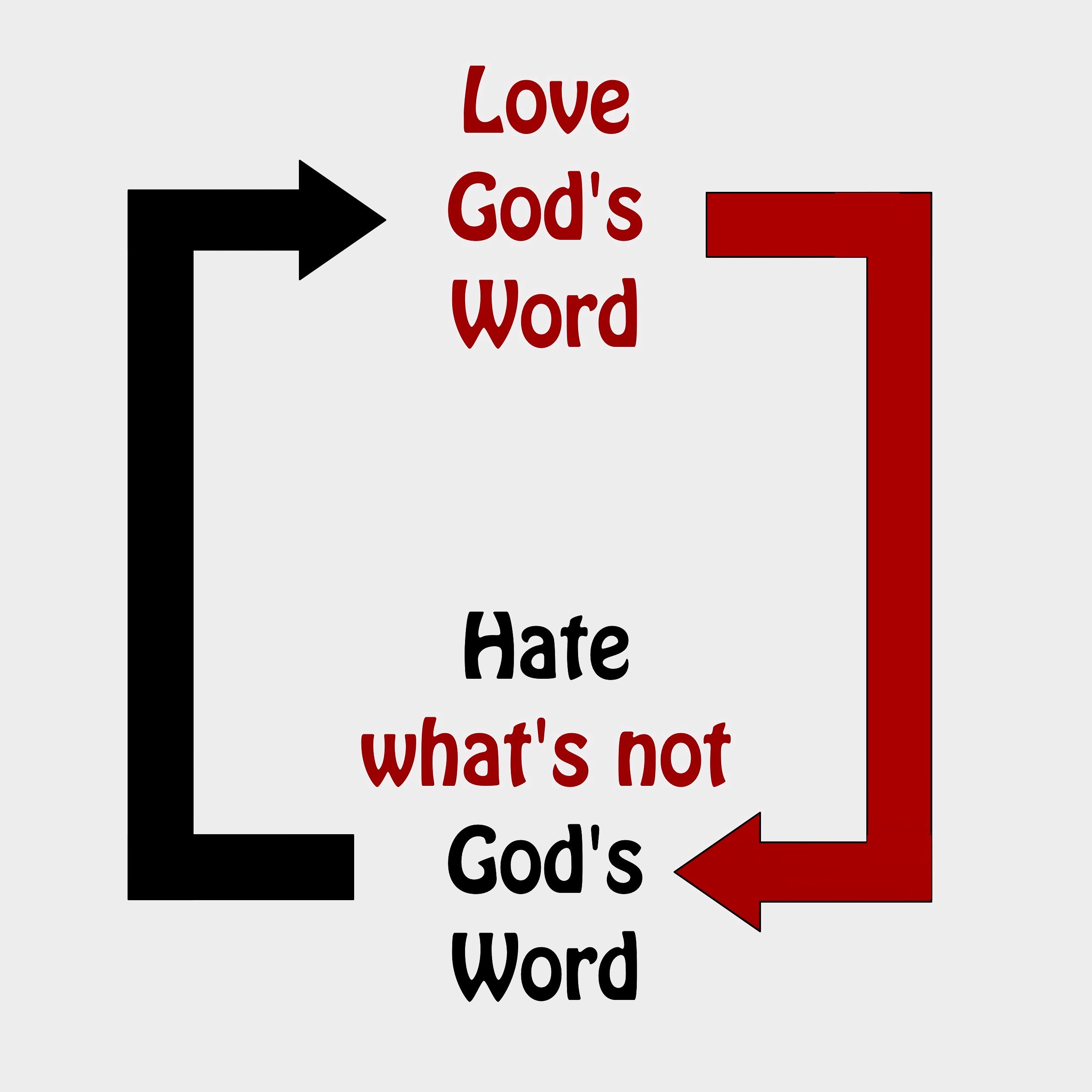
These bookend verses of the section called Mem form the conclusion of a logical argument, and in between are each step of the progression. Notice the word “for” (in vv. 98, 99, 100, and 102) and the words “so that” in v. 101.
This progression forms a circle from love to hate, and back to love again. Check this out—
I love Your law so I meditate on it all day.
Meditating on Your law makes me wiser than my enemies and my teachers.
This wisdom helps me obey Your laws.
Obedience keeps me on the right path.
I stay on the right path because You Yourself teach me while I’m on that path.
Because You are my Teacher, Your laws are sweet to me.
Because Your laws are sweet, I hate anything contrary to Your laws.
Hating everything that is not found in Your law helps me love Your law even more.
[Back to the top] Since I love Your law, I keep on meditating on it all day.
The Bible uses two phrases that we don’t typically use today: “the horn of the wicked” and “the horn of the righteous.”
A horn in Hebrew literature is a symbol of strength. The wicked blow their own horn—trumpeting how they are self-made people. Obviously, this God-ignoring arrogance isn’t something God can bless!
What about “the horn of the righteous”? Is there a way to blow our horn so that God is glorified? In a word: Yes!
Check out this short 2-minute video to hear how I describe the right and wrong ways to honor your uniqueness by blowing a righteous, God-honoring horn…
Listen to the podcast of this post by clicking on the player below, and you can also subscribe on Apple, Spotify, or Audible.
Who doesn’t love Regis Philbin? Even if a morning talk show wasn’t your thing, the personality and professionalism that Regis demonstrated for over 50 years put him in a category all by himself. How did he get this way? He tells us in his entertaining memoir How I Got This Way.
I purchased the audiobook for this one because I love hearing Regis speaking so passionately about those things that fire him up. Although he was mostly subdued in his recording, there were moments that his Irish was up!
This book is presented in a very interesting format, with each chapter being named after a person who had a huge impact on fashioning Regis into the television icon that he became. Some names are readily recognizable, while others would be names known to only a handful of people. Since Regis would stick with this person through all of the years that he knew them, as the book progresses you will begin to see these strands intersecting with other people and forming a comprehensive picture.
This was a delightful book! If you want a behind-the-scenes look at the television industry almost from its very beginning stages, this memoir will more than fit that bill.
Listen to the podcast of this post by clicking on the player below, and you can also subscribe on Apple, Spotify, or Audible.
I had just finished playing three games of full-court basketball and it was time to leave for work. A young kid challenged me to stay for another game by making some comment about my old(er) age, which give me a fresh motivation to play another game. I told him I would play one more game on one condition: he had to guard me. I scored all 15 of our team’s points. One of my teammates said to that kid after the game, “You shouldn’t have made Craig angry.”
I know the Israelites had strayed from God, but the Assyrians made no pretense whatsoever to honor Yahweh, so why was God allowing them to get away with this? Doesn’t it seem sometimes like God is waiting too long to deal with these wicked insulters?
Many scholars feel that Psalm 76 was written after Sennacherib’s defeat. And make no mistake about this: it was a decisive defeat—God struck down 185,000 Assyrian soldiers while they slept! Asaph’s song of victory contains two Selah pauses, both of them intended for us to consider the greatness of Yahweh:
one Selah is after verse 3—pause and remember that God is Sovereign and Resplendent in glorious victory
the second Selah is after verse 9—pause and reflect that God’s wrath defeats His enemies and brings forth praise from His people
Jesus said, “No one can serve two masters. Either you will hate the one and love the other, or you will be devoted to the one and despise the other. You cannot serve both God and money.” The Pharisees, who loved money, heard all this and were sneering at Jesus. (Luke 16:13-14)
Jesus said, “Father, forgive them, for they do not know what they are doing.” And they divided up His clothes by casting lots. The people stood watching, and the rulers even sneered at Him. They said, “He saved others; let Him save Himself if He is God’s Messiah, the Chosen One.” (Luke 23:34-35)
These are the only two times in the New Testament that this Greek word for “sneer” is used. It means to deride, scoff, or mock. But in the Septuagint (the Greek translation of the Old Testament) the same word that Luke used for sneer is used when God Himself says to Sennacherib, “The Virgin Daughter Zion despises you and mocks you” (see 2 Kings 19:20-28).
Sennacherib thought he was insulting God’s people, but God said, “You are really insulting Me!” Yikes—you shouldn’t make God angry!
Psalm 76 gives us the same reminder that we read in Revelation 12:10-11—“Now have come the salvation and the power and the kingdom of our God, and the authority of His Messiah. For the accuser of our brothers and sisters, who accuses them before our God day and night, has been hurled down. They triumphed over him by the blood of the Lamb and by the word of their testimony; they did not love their lives so much as to shrink from death.”
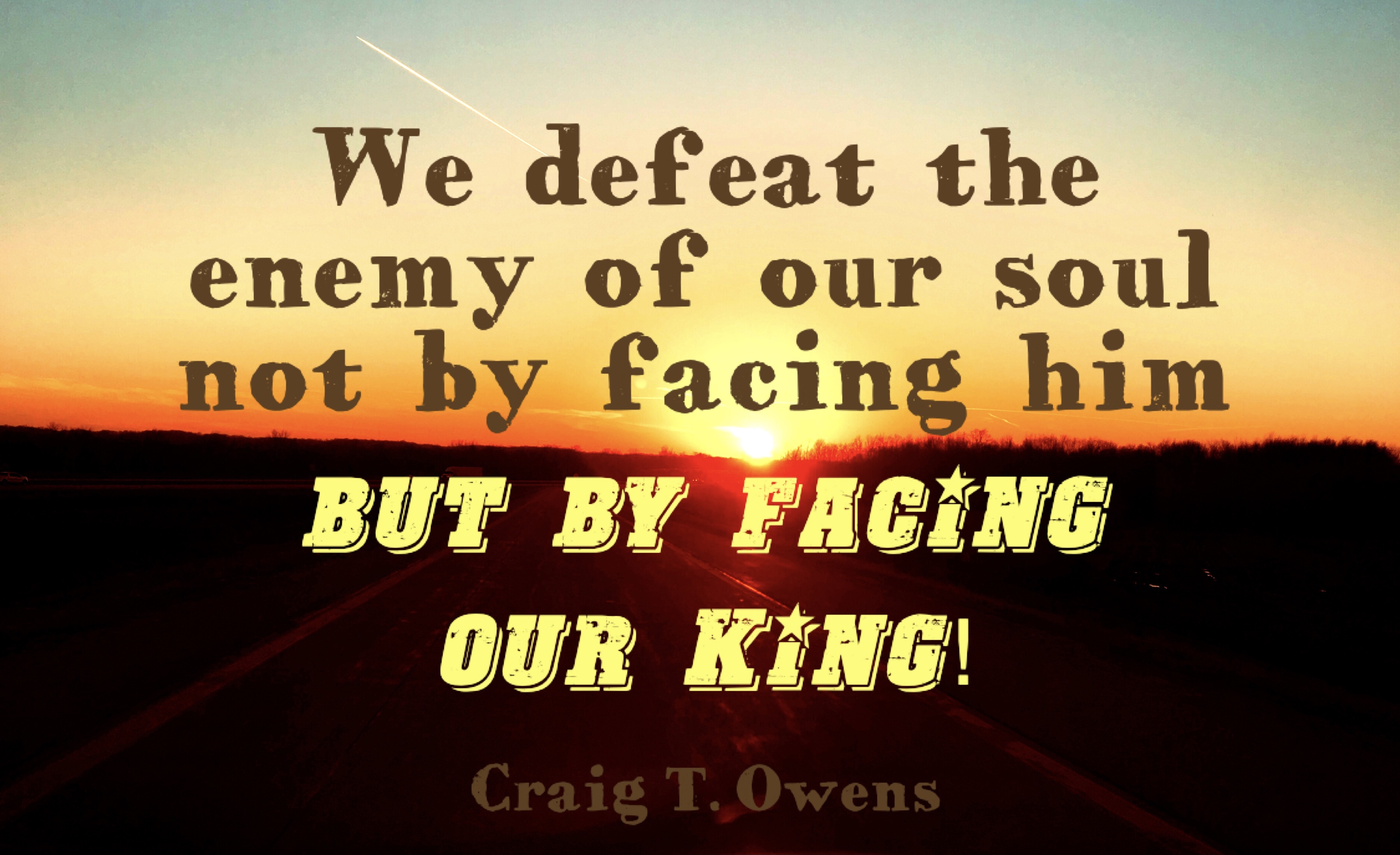
We defeat the enemy of our soul not by facing him but by facing our King!
When we are confronted by the ungodly insults from snarling, scoffing, wicked people, we must Selah to remind ourselves that Yahweh is—
Alpha
Known and Renown
Invincible
Majestic
Awesome
Holy
The Final Judge
Irrefutable
Glorious
Omniscient
Omnipotent
Unrivaled
Undefeated
King of kings
Lord of lords
Sovereign Ruler
Omega
THE Decisive Word
Let me say it again: We defeat the enemy of our soul not by facing him but by facing THIS King of kings!



 how does freedom differ from liberty [0:47]









 Craig T. Owens