What God Will You Choose?

What God:godMy friend Chuck and I have a sort of shorthand when we talk. We’ve been through so many experiences together, that now just a single word can bring to our minds the fullness of that time, with all of its tears and laughter. Someone listening to one of our conversations might not get the full impact, but we sure do!

It’s the same way when we read one of the Apostle Paul’s letters. He is writing to a church or an individual with whom he had a rich, personal experience. So when he alludes to something, those friends who went through that experience with him recall all of the fullness. When reading the letter to the church at Ephesus, you can experience some of that fullness by reading about Paul’s experience in that city in Acts 19.

In Acts 19 you will meet the followers of Jesus who were already there and see them get baptized in the Holy Spirit … watch Paul teach for three months in the synagogue before the Jewish troublemakers run him out … see Paul lecture for the next three years in the Hall of Tyrannus, so that everyone in that province heard the Word of God … see how God authenticated Paul’s ministry with miracles … experience those who tried to counterfeit what Paul was doing … see many in that city turn from their witchcraft and idol worship … and finally experience the tumult of a near-riot started by the merchants who were losing their income on sales of mythological trinkets because so many were turning to Christ.

With this backdrop, you can then understand why Paul uses such specific language in the opening greeting of his letter to Ephesus (see Ephesians 1:1-3). By doing so he is contrasting the followers of Jesus with the followers of Artemis—

  • Christians for whom God has a specific plan (“by the will of God” [1:1a]; see also 1:4 and 2:10) versus Artemis’ followers who felt like they had no choice (Acts 19:26).
  • Christians who are called saints (set apart for God’s special use) and faithful (trusting Jesus implicitly [1:1b]) versus those followers of Artemis who are self-serving (Acts 19:24, 25).
  • Christians who experience God’s grace and peace (1:2) versus those followers of Artemis who did not even know why they were there (Acts 19:32).

But the most specific language is in Ephesians 1:3—Praise be to THE God and Father of our Lord Jesus Christ (emphasis added)….

  • Not “a” god, but “THE” God.
  • Not a god that needs to be appeased, but THE loving Father.
  • Not a god that may or may not be able to respond, but OUR Lord Jesus Christ Who overcame death, hell and the grave so that our sins can be forgiven!

The question Paul invites the Ephesians to consider is the same question we must consider:

What God / god will you choose?

We will be continuing our study on the book of Ephesians next Sunday, and I would love to have you join us!

Links & Quotes

link quote

These are links to articles and quotes I found interesting this weekend.

Victory! FCC Pulls The Plug On Its Unconstitutional Plans

John Maxwell talks about delegation: Overloaded & Underempowered

“Before I became a Christian I do not think I fully realized that one’s life, after conversion, would inevitably consist in doing most of the same things one had been doing before, one hopes, in a new spirit, but still the same things.” —C.S. Lewis

“The only people with whom you should try to get even are those who have helped you.” —John E. Southard

“I’m a fool for Christ. Whose fool are you?” —John Wimber

“Holiness is not freedom from temptation, but power to overcome temptation.” —G. Morgan Campbell

Are environmentalists going too far? The War On Humans

[VIDEO] The more I hear Sen. Ted Cruz, the more I like him. “I don′t work for the party bosses.”

Eric Metaxas on a baby′s innate sense of morality: Babies & The Not-So-Blank Slate

“Forget others’ faults by remembering your own.” —John Bunyan

Poetry Saturday—A Psalm Of Life

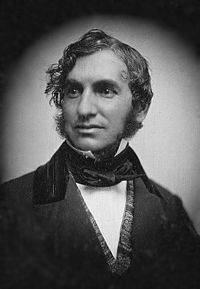
LongfellowTell me not, in mournful numbers,
   Life is but an empty dream!
For the soul is dead that slumbers,
   And things are not what they seem.

Life is real! Life is earnest!
   And the grave is not its goal;
Dust thou art, to dust returnest,
   Was not spoken of the soul.

Not enjoyment, and not sorrow,
   Is our destined end or way;
But to act, that each to-morrow
   Find us farther than to-day.

Art is long, and Time is fleeting,
   And our hearts, though stout and brave,
Still, like muffled drums, are beating
   Funeral marches to the grave.

In the world’s broad field of battle,
   In the bivouac of Life,
Be not like dumb, driven cattle!
   Be a hero in the strife!

Trust no Future, howe’er pleasant!
   Let the dead Past bury its dead!
Act,— act in the living Present!
   Heart within, and God o’erhead!

Lives of great men all remind us
   We can make our lives sublime,
And, departing, leave behind us
   Footprints on the sands of time;

Footprints, that perhaps another,
   Sailing o’er life’s solemn main,
A forlorn and shipwrecked brother,
   Seeing, shall take heart again.

Let us, then, be up and doing,
   With a heart for any fate;
Still achieving, still pursuing,
   Learn to labor and to wait. —Henry Wadsworth Longfellow

The Work Of A Preacher

Rev. John Venn was a key member in the Clapham Sect, a group of devout Christian reformers in England, alongside William Wilberforce. These wise words should be well attended to by all pastors—

John Venn“Were the work of a preacher indeed confined to the delivery of a moral discourse, this would not be an arduous task. But a Minister of the Gospel has much more to do. He will endeavor, under Divine Grace, to bring every individual in his congregation to live no longer to himself, but unto Him who died for us. But here the passions, prejudices, and perhaps the temporal interests of men combine to oppose his success. It is not easy to obtain any influence over the mind of another; but to obtain such an influence as to direct it contrary to the natural current of its desires and passions, is a work of the highest difficulty. Yet such is the work of a Minister…. 

“We have to convey unpleasant tidings; to persuade to what is disagreeable; to effect not only a reformation in the conduct of men, and a regulation of their passions, but, what is of still higher difficulty, a change in their good opinion of themselves.  Nay, further we have not merely to ‘wrestle against flesh and blood but against principalities and powers, against the rulers of the darkness of this world, against spiritual wickedness in high places.’ ‘Who is sufficient for these things?’ For this office the Christian Minister may in himself ‘have no resources above those of any of his congregation,’ their weaknesses are his weaknesses, he must therefore undertake his work in weakness, fear and much trembling, but knowing that it may yet be effectual, for it is in weakness that Christ’s strength is always made perfect.” —John Venn (1759-1813)

Amen!

Links & Quotes

link quote

These are links to articles and quotes I found interesting today.

“The patience of hope does not turn men and women into monks and nuns, it gives men and women the right use of this world from another world′s standpoint.” —Oswald Chambers

The proper place of science in our culture: Science And Its Limits

Astronomers, cosmologists and physicists are always trying to explain the “missing” parts of their evolutionary theories: Missing Galaxy Mass Found

Very good! The Non-Physical Sides Of Sex

“You may think it out of place for me to say so, but in our churches today we are leaning too heavily upon human talents and educated abilities. We forget that the illumination of the Holy Spirit of God is a necessity, not only in our ministerial preparation, but in the administrative and leadership functions of our churches.” —A.W. Tozer

“It is not the man who has too little, but the man who craves more, who is poor.” —Seneca

“Selfish religion loves Christ for His benefits, but not for Himself.” —David Brainerd

“Few marriages can make it if both partners are hiding out from God. Show me a marriage without one partner that is close to Jesus, and I’ll show you a marriage with little chance of survival. At least one of the partners must be in daily consultation with the Lord. It is best when both husband and wife are talking to Him, but if one partner is running from God, it is all the more important that the other be able to run to a secret closet of prayer for help and direction. A praying wife can often save her marriage, as can a praying husband. Love alone is not enough to keep a marriage strong—only God’s power can do that. That power is at work right now, healing and keeping marriages. Where Jesus rules, the marriage can make it.” —David Wilkerson

Thursdays With Oswald—Sixth Sense

This is a weekly series with things I’m reading and pondering from Oswald Chambers. You can read the original seed thought here, or type “Thursdays With Oswald” in the search box to read more entries.

Oswald Chambers

Sixth Sense 

     The life of faith is the life of a soul who has given over every other life but the life of faith. Faith is not an action of the mind, nor of the heart, nor of the will, nor of the sentiment, it is the centering of the entire man in God. 

     … The faith of the saints is, as it were, a God-given sixth sense which takes hold on the spiritual facts that are revealed in the Bible. 

From Christian Disciplines 

When we look at the “hall of fame” of faith in Hebrews 11, we see the repeated phrase by faith. These amazing lives were lives not by a belief in a principle, but by belief in a Person. Faith-filled people haven’t worked themselves up into faith, but have centered themselves in the rock-solid assurance that the God of the Bible is their God.

When Christians live this way, we don’t always have “logical” rationale for why we feel a certain way, but we do have, as Chambers put it, a sixth sense. The Holy Spirit in us bears witness with our mind, and heart, and will, and sentiment that we are following God’s way.

Links & Quotes

link quote

These are links to articles and quotes I found interesting today.

“It is not hard for the Lord to turn night into day. He that sends the clouds can as easily clear the skies. Let us be of good cheer. It is better on before. Let us sing hallelujah by anticipation.” —Charles Spurgeon

“A holy life is not an aesthetic, or gloomy, or solitary life, but a life regulated by divine truth and faithful in Christian duty.” —Tyron Edwards

“The greatest miracle that God can do today is to take an unholy man out of an unholy world, and make that man holy and put him back into that unholy world and keep him holy in it.” —Leonard Ravenhill

“If you see church as being just your local fellowship, then you still have not found the true Church. The God-blessed, righteous Church starts where you live.” —David Wilkerson

“As long as Christians split hairs, Christians will split churches.” —Max Lucado

Uh oh! Minimum Wage Hike Would Eliminate 500,000 Jobs

From Tim Elmore: Four Timeless Ideas To Make Your Point

“The Christian church is the body of Christ, Jesus Himself being the Headship of that body. Every true Christian, no matter where he or she lives, is a part of that body, and the Holy Spirit is to the church what our own souls are to our physical bodies.” —A.W. Tozer

Listen, O My Soul

Listen O my soulDavid wraps up the 35th Psalm with a thought that is familiar to him—

My tongue will speak of Your righteousness and of Your praises all day long. (Psalm 35:28)

Praise is good for the soul! But in the midst of enemies gloating over David, hating him without reason, devising false accusations against him, and making plans to do him in (see verses 19-21), where could David get the strength to sing about God’s goodness?

As I said, it’s the last verse where David declares his unending praise. This verse is the result of seeing God move. But much earlier in this psalm David says, “Say to my soul, ‘I am your salvation’” (v. 3).

Before David could speak it, he had to hear it! He had to quiet himself in the midst of all the assaults on him to hear God say, “I AM your salvation!”

Not “my ears,” but “my soul”: the very center of my being, my mind, my emotions. I need the I AM to reassure the soul He created that He is still there. Unless I hear that assurance at the core of my being, I can only go through the motions. True worship comes from a real, personal encounter with the I AM.

O, listen my soul! Hear your Savior speak the assurance of His salvation. Only then can I open my lips in endless praises all day long.

Links & Quotes

link quote

These are links to articles and quotes I found interesting today.

“The continued neglect of the Holy Spirit by evangelical Christians is too evident to deny and impossible to justify. … There can be no doubt that there is a huge disparity between the place given to the Spirit in the Holy Scriptures and the place He occupies in popular evangelical Christianity. In the Scriptures the Holy Spirit is necessary. There He works powerfully, creatively; here He is little more than a poetic yearning or at most a benign influence. There He moves in majesty, with all the attributes of the Godhead; here He is a mood, a tender feeling of good will.” —A.W. Tozer

“Talk to me about the truth of religion and I’ll listen gladly. Talk to me about the duty of religion and I’ll listen submissively. But don’t come talking to me about the consolations of religion or I shall suspect that you don’t understand.” —C.S. Lewis

URGENT: United Nations Documents Human Rights Abuses In North Korea, equating the abuses here to those atrocities committed in Nazi Germany.

“Today, the United States is one of only four countries in the world—in the company of China, North Korea, and Canada—in which late-term abortions are allowed for any reason after a child is able to survive outside the womb.” —Heritage Foundation report. [FREE E-BOOK] How To Speak Up For Life

[VIDEO] U2 on The Tonight Show with Jimmy Fallon

Who Knew? 9 Amazing Uses For Aspirin

[INFOGRAPHIC] You need more sleep

Miracles (book review)

MiraclesReading C.S. Lewis elaborate on theology is no easy task. But for those willing to work through his profound thoughts, a treasure trove of new insights into Scripture await. Miracles: How God Intervenes In Nature And Human Affairs is no exception to this.

“Miracle” is directly mentioned so 30 times in Scripture, but the Bible never explicitly defines miracle. Lewis gives this definition: “I use the word Miracle to mean an interference with Nature by supernatural power.” He then proceeds to explain what philosophers such as Socrates, Plato and Aristotle meant by “nature” and “super-nature” and how those understandings have been dismissed, adapted or corrupted throughout history.

Lewis moves through several chapters without admitting miracles are probable (or even possible) and without ascribing any possible miracles to God. When he finally reveals that there is a God, he states, “From the admission that God exists and is the author of Nature, it by no means follows that miracles must, or even can, occur.” He then moves to the Scripture to show how God could—and indeed, does—work miraculously.

Even after all of Lewis’ brilliant arguments, I appreciate one of his final admissions in this book: “If you find that [these ideas] so distract you, think of them no more. I most fully allow that it is of more importance for you or me today to refrain from one sneer or to extend one charitable thought to an enemy than to know all that angels and archangels know about the mysteries of the New Creation.”

Even for those who accept his arguments, Lewis offers this counsel: “My work ends here. If, after reading it, you now turn to study the historical evidence for yourself, begin with the New Testament and not with the books about it.” Ultimately I recommend this book for this one reason—Miracles creates a hunger to study God’s Word more.