Listen to the podcast of this post by clicking on the player below, and you can also subscribe on Apple, Spotify, or Audible.
Have you ever wondered why the Roman soldiers treated Jesus so cruelly? After all, these are professional soldiers so why are they acting in such an unsoldierly way (see Mark 15:16-20)?
Perhaps they thought that Jesus was just another criminal that was in cahoots with Barabbas—a murderer and insurrectionist. But where would they get that idea? It must have come from the lies and slander that the Sanhedrin were spewing.
Perhaps the soldiers had a low value of all human life. Where would this come from? First from their leadership: particularly the way history tells us that Pontius Pilate treated the Jews. But we can go a little broader because we also know from history the disregard the Romans had for the weak, the young, the sick, and the aged.
The bottom line is this: Anytime there is a departure in even the slightest degree from the Great Commandment—love God, love yourself, and love your neighbor—the resulting society is dark and ugly, with people mistreating others in the most inhumane of ways.
We stand as a check against the decay in societal values. Our high view of God’s power and love, our proper understanding of each person’s worth in God’s sight, and the way we express genuine love for others—especially the weak and marginalized—is a preservative to the moral decay.
It’s so easy to get caught up with the loud voices around us. Pontius Pilate did, the Roman soldiers did, the Sanhedrin did, and the crowds that listened to these leaders did too.
If you are concerned about the moral decay you see in your neighborhood, the movies and music that are released, or the behavior of our elected officials, we must adhere all the more closely to the Great Commandment: Love God with all your being, maintain a healthy self-image in light of God’s love for you, and then love your neighbor—allof your neighbors—in the same way God loves you.
I shared several videos this week while I was on vacation. If you missed any, you can check them out on my YouTube channel.
A good definition of apologetics is found in Acts 17:2-3. We need to share (1) reasons from Scripture, (2) logical explanations, and (3) verifiable evidence. I have written quite a bit on my blog on the topic of apologetics, including several book reviews of apologetics books that you may want to check out.
“The life we speak over others they will pass on. While it is true that hurting people hurt others, it is just as true that healed people heal others, blessed people bless others, loved people love others, and ‘mercied’ people mercy others—if, that is, they have any sense of gratefulness.” —Dick Brogden, in Proverbs: Amplified and Applied
“The Kingdom of God will be present within us to the extent that we maintain a clean and good conscience. The conscience is the valuing center of the soul. It holds the priorities which serve to clarify and direct both the mind and the heart for Kingdom presence. As thoughts or affections stir in the soul, the conscience reads the Law of God, which is written on the heart and settled in the mind (Romans 2:14-15), and engages the will to act in line with the vision of Christ and the counsel of His Word.” —T.M. Moore
“Value those people who tell you the truth, not just those people who tell you what you want to hear.” —Pat Summitt
Some people claim those with a biblical worldview and lifestyle are “extremists.” I think this chart (I cannot find the author to give credit on this one) explains it well.
“Life without love isn’t worth anything. Justice without love makes you hard. Intelligence without love makes you cruel. Kindness without love makes you a hypocrite. And faith without love makes you a fanatic.” —Mother Teresa
Listen to the podcast of this post by clicking on the player below, and you can also subscribe on Apple, Spotify, or Audible.
The Bible is not only the inspired Word of God but it is rooted in history too. Every prayer was prayed by a real person in distress, and every song of praise was lifted up by someone who personally experienced God’s deliverance.
The reason why this is so important is that it makes God’s Word relatable and applicable to us. If the Bible merely contained moral stories set in some make-believe world, we may have a hard time seeing how to apply the principles to our daily lives. But, thankfully, this isn’t the case. We can read the real-life experiences of real historical people and then we can allow the Holy Spirit to help us apply this inspired Word to our lives.
There is a collection of 15 songs in the Book of Psalms called “The Songs of Ascent.” Even these songs have an important historical background.
Second Chronicles ends with this proclamation from King Cyrus: “The Lord, the God of heaven, has given me all the kingdoms of the earth and He has appointed me to build a temple for Him at Jerusalem in Judah. Anyone of His people among you—may the Lord his God be with him, and let him go up” (2 Chronicles 26:23).
The phrase “let him go up” is both literal (since Jerusalem is 2500 feet above sea level) and spiritual. Listen to these words from King Solomon, “The way of life winds upward for the wise, that he may turn away from hell below” (Proverbs 15:24 NKJV).
The Songs of Ascent were a rallying cry—an encouragement to all pilgrims to keep climbing up.
In Hebrew literature, the main point is usually found in the middle of the poem or story, unlike our Western literature which puts the payoff at the end. In the first Song of Ascent, the middle is verse 4. But the second half of Psalm 120 seems out of place for people ascending up to Jerusalem to worship God. Verse 5 begins with the words, “Woe to me.”
The psalmist is expressing his pain in living among the people of Meshech and Kedar. The people of Meshech were vicious people who traded human lives for money and who conducted themselves as terrorists (Ezekiel 27:13; 32:26). Their name literally means “drawing away.” The people of Kedar were nomadic sons of Ishmael. Being nomadic means they were never at rest. Their name literally means “dark place.” Very noteworthy is that there is no mention of God in verses 5-7.
The middle verse of this song (v. 4) turns the people of Meshech and Kedar over to God. It is a reminder that we are not the ones to dispense justice. If God knew how to overthrow the powerful kingdoms of Judah, Babylon, and the Medes, if He knew to call Cyrus by name at just the right moment, He also knows how to deal with these sinners.
This Song of Ascent shows the stark contrast between keeping our eyes on the dark culture around us versus keeping our eyes on the God who is never weighed down by the darkness. As we go higher up, we focus more on God; as His saints focus on Him, His light shines on them; as His light shines on them, they point sinners living in dark valleys to the God of light and love.
Staying down is easy. Getting up requires intentional effort. Going up requires us to overcome the pull of sin and the frustration of watching for judgment to fall on sinners.
Continually going up glorifies God, has eternal rewards for saints, and creates a compelling testimony for sinners.
Going up is a lot of effort, but the rewards are so worth it! As the apostle Paul reminded his friends in Rome, “I consider that our present sufferings are not worth comparing with the glory that will be revealed in us” (Romans 8:18). Let’s keep climbing up and let’s keep lifting our eyes to the only One who has the eternal light.
Some of our best lessons are learned in difficult places, so let’s not be too quick to rush in and soften the blow for someone who has taken a tumble.Check out the full conversation I had with my podcast partner Greg. And be sure to check out all of my videos on my YouTube channel.
“A champion is one who gets up when he can’t.” —Jack Dempsey
Once again, archeological finds in Israel confirm the historicity of the biblical accounts of the kings of Judah and Israel. John Stonestreet shares some of the most recent finds. Jewish archeologist Nelson Gluek states, “It may be stated categorically that no archaeological discovery has ever controverted a biblical reference.”
“The reward for work well done is the opportunity to do more.” —Jonas Salk
Scott Hubbard writes, “Stepping into leadership means stepping into mistakes, regrets, and many small but stinging failures. And surviving in leadership, I am learning, means stepping upward on those mistakes—owning them, learning from them, and having the stability in Christ to keep leading after them.” Read more about how leaders can fail well.
J. Warner Wallace addresses the claim that all religions are true or are essentially the same.
“The Scriptures represent the Holy Spirit, not only as moving, and occasionally influencing, the saints, but as dwelling in them as His temple, His proper abode, and everlasting dwelling-place. And He is represented as being there so united to the faculties of the soul, that He becomes there a principle or spring of a new nature and life.” —Jonathan Edwards
Quite frequently God’s measurement of success is nothing like our measurements. “More” doesn’t always mean success. Check out this example which I unpack in my book Shepherd Leadership.And be sure to check out all of my videos on my YouTube channel.
Living in the Great Lakes state my whole life, I have always been fascinated by the huge bodies of water which surround us—they are almost like mini-oceans. As a result, there have been nearly 600 shipwrecks on our lakes. Check out the history of these wrecks here.
In spite of what some skeptics claim, Christianity is not anti-science. In fact, J. Warner Wallace lays out the evidence that shows that Christ-followers have fueled the major scientific advancements of history.
“Always be a first-rate version of yourself, instead of a second-rate version of somebody else.” —Judy Garland
Isaac Newton said, “Atheism is so senseless. When I look at the solar system, I see the earth at the right distance from the sun to receive the proper amounts of heat and light. This did not happen by chance. … This most beautiful system of the sun, planets, and comets, could only proceed from the counsel and dominion of an intelligent and powerful Being.” Check out the amazing symmetries in our solar system that Copernicus, Kepler, and Newton all identified.
“The truth is the kindest thing we can give folks in the end.” —Harriet Beecher Stowe
T.M. Moore has a regular series of posts for pastors. This week he shared this, “In his training manual for pastors, Gregory the Great wrote, ‘There are some who investigate spiritual precepts with cunning care, but what they penetrate with their understanding they trample on in their lives: all at once they are teaching the things which not by practice but by study they have learnt; and what in words they preach by their manners they impugn. Whence it comes to pass that when the shepherd walks through steep places, the flock follows to the precipice’ (The Book of Pastoral Rule).” If you are a pastor, I encourage you to check out the Pastor To Pastor posts on The Fellowship Of Ailbe.
On May 22, A.D. 337, Emperor Constantine died. John Stonestreet wrote, “Many Christians think that Constantine was perhaps the worst thing to happen to the Church. They believe he made Christianity the imperial religion, thus leading the Church to compromise with pagan culture, marrying it to state power, and derailing the spread of the Gospel. The Church, they argue, was better off as a persecuted minority.” Please check out this post co-written by Dr. Glenn Sunshine that gives some better historical perspective than perhaps what you have heard previously.
One of the most powerful missions sermons I have heard was preached by Dick Brogden:
An important warning from Axis—What it is: The Surgeon General has issued a warning on the dangers of social media for teenagers. Why the alarm bell is reaching a fever pitch: People have been wary of social media’s impact on developing brains for two decades—so why are highly-visible tone setters, like the Surgeon General and the American Psychological Association, issuing big, sweeping statements now? Part of it could be because we are getting more quality data on how social media shapes a young person’s brain. One newer study that’s been getting some buzz suggests that individuals who received their first smartphone at a later age have better mental health as young adults. Several big bills that aim to protect minors online will be voted on this year as tech giants face increased scrutiny over their safeguards (or lack thereof), for younger users. Kids growing up even a decade from now may encounter a completely different digital landscape when it’s their turn to learn about online literacy.
Listen to the podcast of this post by clicking on the player below, and you can also subscribe on Apple, Spotify, or Audible.
On Resurrection Sunday, Christians celebrate an event that is the foundational truth for all of the Bible and for the Christian faith which springs from the Scriptures: The resurrection of Jesus.
If Jesus wasn’t resurrected, this is a terrible, cruel lie we are perpetuating. If Jesus was resurrected, we have been given the key to eternal life. No one has ever made the bold claims that Jesus made about His own death and resurrection and then backed them up!
On the Sunday morning after Jesus was crucified, some women arrived at His tomb to finish preparing His body for burial, but Luke records something fascinating: “They did not find the body of the Lord Jesus” (Luke 24:1-8).
Think about this in a modern-day setting. If you were at the bedside of your loved one when they took their last breath, if you heard the doctor pronounce them dead, if you were at the funeral and saw their body in a casket, and if you saw that casket closed, sealed, and lowered into the ground, you would have every reason to find a body if that casket were re-opened.
These women were on Golgotha when Jesus died, they saw the Roman soldiers verify His death, they witnessed Joseph and Nicodemus wrap His body in linen strips, and they saw His body placed in a sealed tomb.
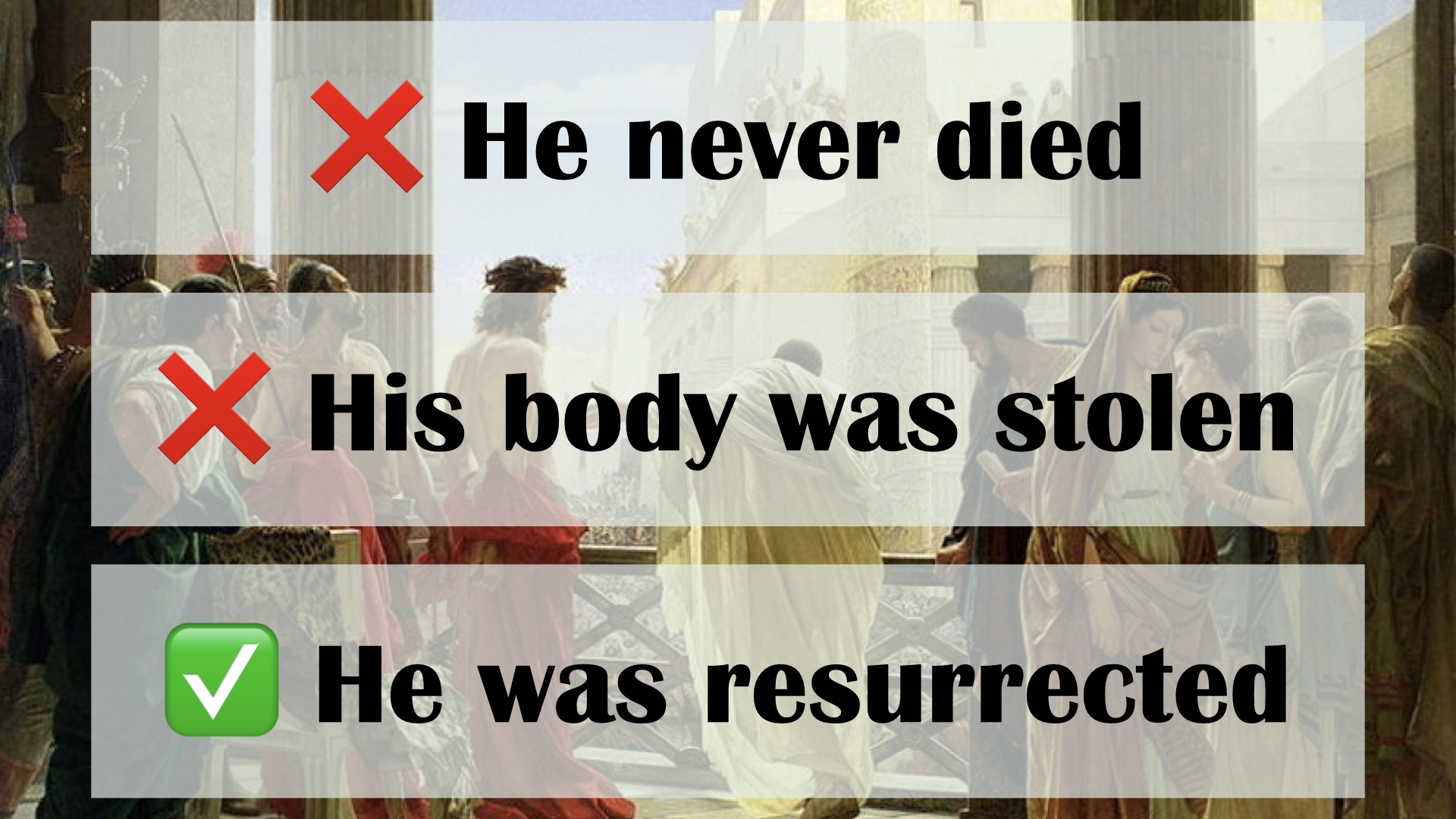
Then when there is no body where the dead body of Jesus is expected, there are only three possibilities:
(1) He never died
Medical experts have concluded that the horrific torture that Jesus endured prior to even being crucified resulted in significant blood loss, and would have put His body in shock. Then the strain on His weakened body during crucifixion would have resulted in His body experiencing either pleural effusion or cardiac effusion, which is attested to by the flow of “blood and water” from Jesus’ dead body when His side was pierced by a Roman spear (John 19:34).
The dead body of Jesus was thoroughly examined by both the Romans who conducted the crucifixion and His friends who prepared His body for burial (Mark 15:43-45; John 19:38-40). And two contemporary historians—Tacitus and Josephus—who were unfriendly to the cause of Christianity both attested to Christ’s death by crucifixion.
(2) His body was stolen
The Sanhedrin was so insistent on Jesus being crucified, they wouldn’t have left the “conspiracy” option open. So they convinced Governor Pontius Pilate to allow them to both seal the tomb and place a group of soldiers outside the tomb to guard it (Matthew 27:62-66). It is highly unlikely that the disciples who fled before the temple guard and who were now locked in a room because they were quaking with fear would somehow gain the courage to undertake a mission to steal Jesus’ body. Nor is it likely that they could have escaped the notice of the highly-trained Roman soldiers guarding the tomb.
(3) He was resurrected
The angels at the empty tomb reminded the women that Jesus had foretold both the manner of His death and the assurance of His resurrection. Jesus described His death in detail multiple times, including such key details as His death would be in Jerusalem, the religious leaders would pronounce a death sentence but the Romans would crucify Him, and that He would be resurrected three days later (Matthew 20:18-19; Luke 18:31-33). In addition, Paul tells us that there were hundreds of eyewitnesses to the resurrected Jesus (1 Corinthians 15:3-8).
Jesus said, “The reason my Father loves Me is that I lay down My life—only to take it up again. No one takes it from Me, but I lay it down of My own accord. I have authority to lay it down and authority to take it up again. This command I received from My Father” (John 10:17-18).
If Jesus foretold this and fulfilled this, we can also trust His other promises. Assurances such as:
He is preparing an eternal home for us and He will come back to take His followers there
That He alone holds the keys to Death and Hades
And that only those who have been cleansed from their sins will be able to enter Heaven
The bold claim that Jesus would be resurrected back to life is adequately backed up by the events on Resurrection Sunday! So now we can say that believing the bold claim of Christ’s resurrection gives us hope for the future and reason to tell others about Him!
I have a series of nearly 70 posts on the topic of godly leadership. Here is the latest installment about going all in. Be sure to check out all of my videos on my YouTube channel.
T.M. Moore writes persuasively to Christians to encourage them to build for the future. He wrote, “For most Christians today, the Kingdom which Daniel saw, Jesus proclaimed and brought near, and the Spirit inaugurated on that first Christian Pentecost—that Kingdom is little more than a theological idea, or a distant hope. It is not a daily reality to be sought, seized, shared, and strengthened in every nook and cranny of our Personal Mission Fields. Christians today are trapped in their past or mired in their present, and they have little or no sense of what it means to build for the future so that righteousness, peace, and joy in the Spirit increase wherever they live, move, and have their being.”
And another piece of research from both paleontologists and entomologists points to the Flood described in the Bible as historically viable. Researchers discovered fossilized giant ants in Canada where evolutionists claim they shouldn’t be. The Institute for Creation Research commented, “There is no need to postulate ants trekking across the Arctic to explain the distribution. Nor is there a need to inject short ‘hyperthermal’ episodes to allow passage from one continent to another. The global Flood explains what we observe the best. The warmer pre-Flood conditions and likely higher oxygen levels explain the large size of the ants. And their fossil distribution is best explained by their transport off the highest pre-Flood hills as the waters were receding.”
“If we were to look at Jesus’s death merely as a result of a betrayer’s deceit and the Sanhedrin’s envy and Pilate’s spinelessness and the soldiers’ nails and spear, it might seem very involuntary. And the benefit of salvation that comes to us who believe might be viewed as God’s way of making a virtue out of a necessity. But once you read Luke 9:51, all such thoughts vanish. Jesus was not accidentally entangled in a web of injustice. The saving benefits of His death for sinners were not an afterthought. God planned it all out of infinite love to sinners like us, and He appointed a time.” —John Piper, Love To The Uttermost reading plan on YouVersion
Listen to the podcast of this post by clicking on the player below, and you can also subscribe on Apple, Spotify, or Audible.
Our country has a policy of separation of church and state, and that appears to be a good thing. When the head of the government starts telling the church how to worship, or when the head of the church starts telling the government how to run its affairs, strife typically results.
There have been some notable examples of wise kings who were God-fearing rulers, and some examples of religious leaders who had the wisdom to make just laws. But history has most often shown us that when a king imposes on the church a mode of worship or a pastor imposes on the king religious ways of governing, clashes result. Some of them have been bloody civil wars and some have spread into international conflicts.
That being said, wouldn’t it be better for everyone if there was a way that one person could hold both of those offices simultaneously? If only there was some way to bring those different offices together. Very few people could ever accomplish this because it would require a perfect person with both absolute wisdom and complete God-honoring selflessness, someone so confident in both their wisdom and their relationship with God that they would never be swayed unfairly one way or the other.
Last week we saw the first bold claim from Jesus: “I am the I AM.” With this title and authority, Jesus claimed to be the Head of the Church. This is a title Paul uses several times in his letter to the church at Ephesus (Ephesians 1:22, 5:23). Paul goes on to remind us that our aim as the Church body is to grow into maturity under the Headship of Jesus (Ephesians 4:15).
Consider two other notable rulers during this same time period. As the high priest, Caiaphas would have laid claim to the title of “head of the church.” As the Roman governor, Pilate would have laid claim to the title of “head of the government in Judea.” Yet both of them clearly demonstrated that they had “become the symbol of those who make religious decisions based on political expediency rather than truth and justice,”as Dr. Donald Stamps noted.
Paul goes father than calling Jesus simply the Head of the Church—
And He [Jesus] is the head of the body, the church; He is the beginning and the firstborn from among the dead, so that in everything He might have the supremacy. (Colossians 1:18)
Not just Headship over the Church, but Headship over “everything.”
After the bold claim of Jesus that He was the I AM, the Sanhedrin wanted to have Him put to death, so they took Jesus to Pontius Pilate (Luke 22:71—23:2; Matthew 27:1-2; John 18:28-37).
Pilate “knew it was out of self-interest that they had handed Jesus over to him” (Matthew 27:18), but he still asked Jesus, “Are You the king of the Jews?” Just as Caiaphas was trying to save his position of power by keeping a delicate balance between the Jews and the Romans, Pilate was also trying to save his skin. Pilate was trying to appease both the Sanhedrin and Tiberius Caesar.
Jesus answers Pilate’s question in a way Pilate never expected. Twice Jesus says “My kingdom,” noting that His kingdom is other-worldly. His kingdom comes from outside this world and therefore supersedes any government of this world. Pilate clearly has never heard anything like this, so after hearing this statement he announces, “You are a king, then!”
Just as Jesus had answered the Sanhedrin with, “You are right in saying I am the Messiah,” now He answers Pilate, “You are right in saying I am a king.”
Combining those two bold claims—“I am God” and “I am a King”—Jesus is the only One who can perfectly hold both offices without any conflict. This is what the prophecy in Isaiah 9:1-7 foretold, and this is the fulfillment that John shows us at the end of time (Revelation 17:14, 19:11-16).
What does this mean for us? How are we now supposed to live knowing Jesus as our God and as our King? We should live confidently before our King and humbled before our God. We don’t fear earthly kings, but neither do we fight them. We don’t have to try to convince earthly kings to rule a certain way because they are God’s servants to accomplish God’s plan. We don’t have to get caught up in the politics of the day because this day will come to an end.
We are subjects of a kingdom not of this world, so the kings of this world don’t get to decide our final destiny!
(If you would like to explore this topic further, check out my series of messages from 1 Peter called Aliens and Strangers.)
Every Monday I share a 1-minute thought to get your week started. It’s my weekly Monday Motivation series of videos. Check out this week’s video that I posted the day after Christmas, and please subscribe on YouTube.
T.M. Moore wrote one of the endorsements for my book Shepherd Leadership. In an interview I then did on his Fellowship of Ailbe podcast, I shared my dismay over unbiblical ideas and practices that have crept into the church. Both T.M. and I share a passion to see our church leadership return to our secure biblical foundation.
In a recent blog post, T.M wrote, “From the days of the apostles onward, a tendency has existed among church leaders to drift from the plain teaching of the Word of God into forms of Christian life and ministry that derive from sources other than Scripture. Or that stretch the meaning of Scripture to fit the shape of certain cultural forms.” Please check out T.M.’s post “Do not go beyond.”
In a fascinating post from Rabbi Benjamin Blech, I read these thoughts about the power of a name: “The Hebrew word for soul is neshamah. Central to that word, the middle two letters, shin and mem, make the word shem, Hebrew for ‘name.’ Your name is the key to your soul. … When the Torah says, ‘God created,’ it doesn’t suggest that He worked with what He fashioned by labor, but merely that He spoke—and the very words describing the object came into being. God said, ‘Let there be light and there was light.’ The Almighty merely gave it a name, and the very letters defined its atomic structure.” Check out the full post here.
“Success” doesn’t always mean bigger numbers. King David got into trouble with God when he wanted to measure his success by how many fighting men he had under his command. Consistently throughout the Bible God’s measure of success is our trust in Him. This thought was a key part of the sub-title of my book Shepherd Leadership: The Metrics That Really Matter.



 Have you ever wondered why the Roman soldiers treated Jesus so cruelly? After all, these are professional soldiers so why are they acting in such an unsoldierly way (see Mark 15:16-20)?





 Craig T. Owens