Our Perfect King

Listen to the podcast of this post by clicking on the player below, and you can also subscribe on AppleSpotify, or Audible. 

Our country has a policy of separation of church and state, and that appears to be a good thing. When the head of the government starts telling the church how to worship, or when the head of the church starts telling the government how to run its affairs, strife typically results. 

There have been some notable examples of wise kings who were God-fearing rulers, and some examples of religious leaders who had the wisdom to make just laws. But history has most often shown us that when a king imposes on the church a mode of worship or a pastor imposes on the king religious ways of governing, clashes result. Some of them have been bloody civil wars and some have spread into international conflicts. 

That being said, wouldn’t it be better for everyone if there was a way that one person could hold both of those offices simultaneously? If only there was some way to bring those different offices together. Very few people could ever accomplish this because it would require a perfect person with both absolute wisdom and complete God-honoring selflessness, someone so confident in both their wisdom and their relationship with God that they would never be swayed unfairly one way or the other. 

Last week we saw the first bold claim from Jesus: “I am the I AM.” With this title and authority, Jesus claimed to be the Head of the Church. This is a title Paul uses several times in his letter to the church at Ephesus (Ephesians 1:22, 5:23). Paul goes on to remind us that our aim as the Church body is to grow into maturity under the Headship of Jesus (Ephesians 4:15). 

Consider two other notable rulers during this same time period. As the high priest, Caiaphas would have laid claim to the title of “head of the church.” As the Roman governor, Pilate would have laid claim to the title of “head of the government in Judea.” Yet both of them clearly demonstrated that they had “become the symbol of those who make religious decisions based on political expediency rather than truth and justice,” as Dr. Donald Stamps noted. 

Paul goes father than calling Jesus simply the Head of the Church—

And He [Jesus] is the head of the body, the church; He is the beginning and the firstborn from among the dead, so that in everything He might have the supremacy. (Colossians 1:18) 

Not just Headship over the Church, but Headship over “everything.” 

After the bold claim of Jesus that He was the I AM, the Sanhedrin wanted to have Him put to death, so they took Jesus to Pontius Pilate (Luke 22:71—23:2; Matthew 27:1-2; John 18:28-37). 

Pilate “knew it was out of self-interest that they had handed Jesus over to him” (Matthew 27:18), but he still asked Jesus, “Are You the king of the Jews?” Just as Caiaphas was trying to save his position of power by keeping a delicate balance between the Jews and the Romans, Pilate was also trying to save his skin. Pilate was trying to appease both the Sanhedrin and Tiberius Caesar. 

Jesus answers Pilate’s question in a way Pilate never expected. Twice Jesus says “My kingdom,” noting that His kingdom is other-worldly. His kingdom comes from outside this world and therefore supersedes any government of this world. Pilate clearly has never heard anything like this, so after hearing this statement he announces, “You are a king, then!” 

Just as Jesus had answered the Sanhedrin with, “You are right in saying I am the Messiah,” now He answers Pilate, “You are right in saying I am a king.” 

Combining those two bold claims—“I am God” and “I am a King”—Jesus is the only One who can perfectly hold both offices without any conflict. This is what the prophecy in Isaiah 9:1-7 foretold, and this is the fulfillment that John shows us at the end of time (Revelation 17:14, 19:11-16). 

What does this mean for us? How are we now supposed to live knowing Jesus as our God and as our King? We should live confidently before our King and humbled before our God. We don’t fear earthly kings, but neither do we fight them. We don’t have to try to convince earthly kings to rule a certain way because they are God’s servants to accomplish God’s plan. We don’t have to get caught up in the politics of the day because this day will come to an end. 

We are subjects of a kingdom not of this world, so the kings of this world don’t get to decide our final destiny!

(If you would like to explore this topic further, check out my series of messages from 1 Peter called Aliens and Strangers.)

If you’ve missed any of the messages in our series called Bold Claims, you can find the full list of messages by clicking here. 

►► Would you please prayerfully consider supporting this ministry? My Patreon supporters get behind-the-scenes access to exclusive materials. ◀︎◀︎

Links & Quotes

Every Monday I share a 1-minute thought to get your week started. It’s my weekly Monday Motivation series of videos. Check out this week’s video that I posted the day after Christmas, and please subscribe on YouTube.

T.M. Moore wrote one of the endorsements for my book Shepherd Leadership. In an interview I then did on his Fellowship of Ailbe podcast, I shared my dismay over unbiblical ideas and practices that have crept into the church. Both T.M. and I share a passion to see our church leadership return to our secure biblical foundation. 

In a recent blog post, T.M wrote, “From the days of the apostles onward, a tendency has existed among church leaders to drift from the plain teaching of the Word of God into forms of Christian life and ministry that derive from sources other than Scripture. Or that stretch the meaning of Scripture to fit the shape of certain cultural forms.” Please check out T.M.’s post “Do not go beyond.”

In a fascinating post from Rabbi Benjamin Blech, I read these thoughts about the power of a name: “The Hebrew word for soul is neshamah. Central to that word, the middle two letters, shin and mem, make the word shem, Hebrew for ‘name.’ Your name is the key to your soul. … When the Torah says, ‘God created,’ it doesn’t suggest that He worked with what He fashioned by labor, but merely that He spoke—and the very words describing the object came into being. God said, ‘Let there be light and there was light.’ The Almighty merely gave it a name, and the very letters defined its atomic structure.” Check out the full post here.

And once again archeologists discover evidence that corroborates the biblical accounts. In this case, more evidence is found from King Hezekiah. As I have said numerous times, the historicity of the Bible is amply verified.

“Success” doesn’t always mean bigger numbers. King David got into trouble with God when he wanted to measure his success by how many fighting men he had under his command. Consistently throughout the Bible God’s measure of success is our trust in Him. This thought was a key part of the sub-title of my book Shepherd Leadership: The Metrics That Really Matter.

Cold-case detective J. Warner Wallace tackles an important topic: Does objective truth exist, and how can it be defined? This is a quite lengthy post but it is well worth your time.

“Pain nourishes courage. You can’t be brave if you’ve only had wonderful things happen to you.” —Mary Tyler Moore

Verifiable Facts About The Birth Of Jesus

Listen to the podcast of this post by clicking on the player below, and you can also subscribe on AppleSpotify, or Audible. 

Check out the resources I mention in this video:

►► Would you please prayerfully consider supporting this ministry? My Patreon supporters get behind-the-scenes access to exclusive materials. ◀︎◀︎

Links & Quotes

Premier athletes know the value of flexibility for keeping them in the game. I think we would be wise to practice flexibility in our relationships too—this is definitely a game-changing move! Check out my weekly Monday Motivation videos on my YouTube channel

“The bravest are surely those who have the clearest vision of what is before them, glory and danger like, and yet notwithstanding, go out to meet it.” —Thucydides

This week we remember Columbus Day. You probably remember the rhyme: In 1492, Columbus sailed the ocean blue. Many people have thought Columbus set out to prove the world was round, but the History Channel has a mini-biography that debunks this claim.

One of my YouVersion friends (Nikki) commented a great reminder: “God can do way more with my surrender than with my striving.”

Thomas Zimmerman was an influential leader in the early days of the Assembly of God fellowship’s history. “Over a 50-year period, Thomas F. Zimmerman (1912-1991) served the Assemblies of God as pastor, district official, department leader, assistant general superintendent, and general superintendent. His leadership greatly increased the influence of the Pentecostal movement in the evangelical world, as well as in the broader American religious landscape.”

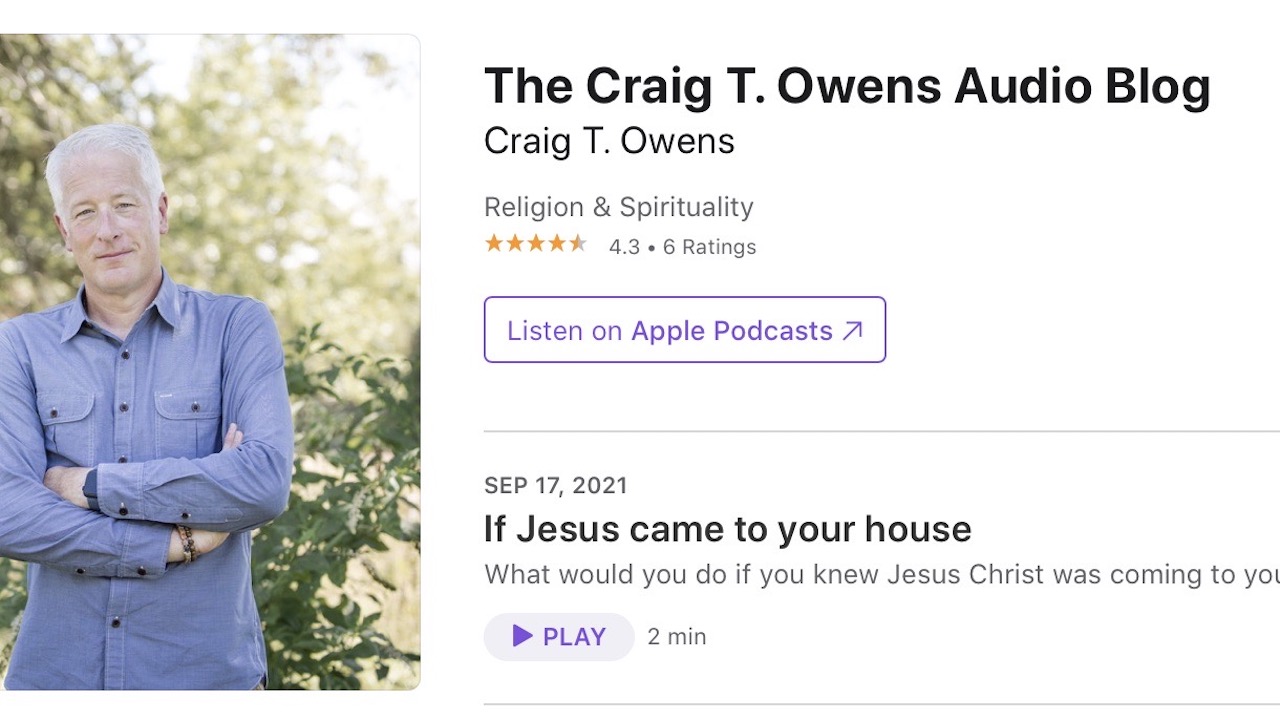
I post quality content nearly every day. If you don’t have time to read all that I share, please let me read it for you. The Craig T. Owens Audio Blog is just like this blog, except you get to hear me read my blog posts. Check it out my podcast on Spotify, Apple, and even Audible.

“The word ‘hell’ is used in the New Testament fourteen times, twelve times by Jesus Himself. It is not a myth created by dismal and angry preachers. It is a solemn warning from the Son of God who died to deliver sinners from its curse. We ignore it at great risk.” —John Piper

Christian apologist and cold-case detective J. Warner Wallace wrote, “the battleground on the abortion issue is beginning to shift, and this shift is going to cause us to rethink our approach to the debate.” Pro-life advocates need to check out Wallace’s post Justifying Homicide: The Future Battleground In The Abortion Debate.

Responsibility isn’t supposed to be fatal! Exceptional leaders accept and promote appropriate responsibility, while weak leaders play the blame game. But accepting responsibility doesn’t mean “falling on your sword”! You can check out the rest of this conversation I had with my podcast partner Greg Heeres on The Craig And Greg Show leadership podcast.

10 Quotes From “The Roots Of Endurance”

John Piper’s intertwining of the biographies of John Newton, Charles Simeon, and William Wilberforce in The Roots Of Endurance was masterfully done! Especially because, unlink the previous books in Pastor John’s “The swans are not silent series,” all three of these men knew each other and interacted with each other. Check out my full book review by clicking here. 

“Simeon with us—his heart glowing with love of Christ. How full he is of love, and of desire to promote the spiritual benefit of others. Oh! that I might copy him as he Christ.” —William Wilberforce, writing in his journal about Charles Simeon 

“It is hoped and believed that the Lord has raised you up for the good of His church and for the good of the nation.” —John Newton, in a letter to William Wilberforce 

“Unless God has raised you up for this very thing, you will be worn out by the opposition of man and devils. But if God be for you, who can be against you.” —John Wesley, at 87 years of age, in a letter to William Wilberforce 

“Frustration is normal, disappointment is normal, sickness is normal. Conflict, persecution, danger, stress—they are all normal. The mind-set that moves away from these will move away from reality and away from Christ. —John Piper 

The remaining six quotes are exclusive content for my Patreon supporters. In addition to book quotes, there are videos and behind-the-scenes views that only these supporters have access to. I would love it if you would prayerfully consider supporting my ministry for just $5 per month.

The End Of Our Struggle

Listen to the podcast of this post by clicking on the player below, and you can also subscribe on AppleSpotify, or Audible. 

Christmas time finds me sampling a whole lot of delicious treats, and I’m not complaining at all! But I’m a pretty simple guy, so one of my favorite treats is just plain old peanut butter. I love it! Sometimes I stick my spoon right in the jar and eat a big spoonful. 

But then there’s the age-old problem: How do you get peanut butter off the roof of your mouth? You can use your tongue or try blowing on it. Or you can use your finger! 

But then there’s another problem: How do you get peanut butter off your finger? Blow it? Shake it? Or eat it! 

Hmm, now I seem to be back to the original problem: How do you get peanut butter off the roof of your mouth? 

Maybe you’ve tried to solve one problem, only to create another problem. And then when you solve that problem you find yourself right back where you started! Round and round it goes! 

The Israelites were facing much the same situation. They sinned, God punished them through King Nebuchadnezzar, they tried to rebel, they were taken into captivity, and then they were finally allowed to return to Jerusalem after 70 years. But they still weren’t in charge of their own fate. First it was the Babylonians calling the shots, then the Medians, then the Persians, and then the Romans. Luke begins the birth story of Jesus with the words “in the days of Caesar Augustus” (Luke 2:1). 

The Israelites were waiting for God to restore their Promised Land to them. Some people believed a miraculous champion was going to come on the scene (much like Samson of old), and some thought a new anointed king from King David’s line would appear and rally an army to himself. 

We can understand this because of one of the prophecies from Isaiah 9 that talks about a warrior and God’s zeal. 

That word “warrior” got people pumped up! As did the promise that “the zeal of the LORD Almighty will accomplish this”! For many, this was their proof that God wanted His people to rule this Promised Land for themselves 

We’ve been going through a series called People Will Talk, and these voices of a miraculous champion or a new king from David’s line were loud voices to be sure. But interestingly, the Bible doesn’t record much of what these loud voices were saying. 

Also among the people of this time there was another group that were called “the Quiet in the Land.” These were people who didn’t talk very much, but instead they clung to the promise spoken by God Himself of the Messiah. One of these quiet ones was a man named Simeon.

He was called “righteous and devout” and someone “waiting for the consolation of Israel.” Which meant he carefully attended to the prophecies of Scripture. The Amplified Bible says that Simeon “lived in prayerful expectancy [of] the Lord’s Christ. 

I left out an important part of that prophecy in Isaiah 9—something that I think the loud ones overlooked or downplayed too. In between those words about “warrior” and “God’s zeal” we read this: “For to us a Child is born, to us a Son is given. The government will be upon His shoulders. And He will be called Wonderful Counselor, Mighty God, Everlasting Father, Prince of Peace” (Isaiah 9:6). 

What does the “Prince of Peace” have to do with a warrior? Quite simply, when Jesus the Messiah came, the struggle was over. Jesus was the Warrior King who defeated the enemy of sin that kept us out of God’s presence. 

The loud Israelites believed God wanted His people to rule their Promised Land for themselves. But God wanted a people exclusively for Himself. ALL people—Jews and Gentiles alike—regardless of where or when they lived! 

Jesus is the way into God’s presence. He told us, “I am the way, the truth, and the life” (John 14:6). 

You can try to solve your own problems, but only Jesus can bring the ultimate salvation. In the Christmas carol Come, Thou Long-Expected Jesus, check out the lyrics of the second stanza:

Born Thy people to deliver, 
Born a child and yet a King, 
Born to reign in us for ever, 
Now Thy gracious kingdom bring. 
By Thine own eternal Spirit, 
Rule in all our hearts alone; 
By Thine all sufficient merit, 
Raise us to Thy glorious throne.

A relationship with Jesus means there is no more struggle of trying to solve our own problems, or figure out how things are supposed to work, or pushing down one problem only to have another one pop up. We come to the One and Only One who can raise us to His glorious throne forever and ever! 

Advent is a celebration of the end of our struggle because Jesus has made the way for us to have peace with God. 

And that means a very Merry Christmas indeed! 

If you’ve missed any of the messages in our Advent series People Will Talk, you can find links to all of them by clicking here. 

►► Would you please prayerfully consider supporting this ministry? ◀︎◀︎

The Sovereign King

Listen to the podcast of this post by clicking on the player below, and you can also subscribe on AppleSpotify, or Audible. 

What people were saying about Jesus right from His birth—before He preached a sermon, performed a miracle, or stepped on the toes of religious or political leaders—was revealing the truth. 

As the Gospel of Matthew’s account of Christ’s birth begins, Persian Magi came from Babylon, having been keepers of the Truth handed down to them for over 500 years from Belteshazzar the Chief of Magician. This was the Babylonian name given to the Hebrew exile Daniel. 

Daniel served under multiple kings, even as the regimes changed from Babylonian, to Median, to Persian. He never waiver in his adherence to the Truth that God had spoken. He fearlessly told these world leaders, “The Most High is sovereign over all kingdoms on earth and gives them to anyone He wishes” (Daniel 4:25). 

Most leaders forget this the moment they obtain power. Such is the case of the man the Magi met: King Herod the Great. Listen to how William Barclay describes this monarch: 

“Herod the Great was always despised by the pure-blooded Jews because he was half an Edomite; and we can see the importance that even Herod attached to these genealogies from the fact that he had the official registers destroyed, so that no one could prove a purer pedigree than his own. … 

“He had made himself useful to the Romans in the wars and civil wars of Palestine, and they trusted him. He had been appointed governor in 47 B.C.; in 40 B.C. he had received the title of king. … 

“But Herod had one terrible flaw in his character. He was almost insanely suspicious. He had always been suspicious, and the older he became the more suspicious he grew, until, in his old age, he was, as someone said, ‘a murderous old man.’ … He murdered his wife Mariamne and her mother Alexandra. His eldest son, Antipater, and two other sons, Alexander and Aristobulus, were all assassinated by him. Augustus, the Roman Emperor, had said, bitterly, that it was safer to be Herod’s pig than Herod’s son. … 

“When he was seventy he knew that he must die. … He gave orders that a collection of the most distinguished citizens of Jerusalem should be arrested on trumped-up charges and imprisoned. And he ordered that the moment he died, they should all be killed. He said grimly that he was well aware that no one would mourn for his death, and that he was determined that some tears should be shed when he died.” 

Lord Acton famously said, “Power tends to corrupt and absolute power corrupts absolutely. …  Despotic power is always accompanied by corruption of morality.” This is so obvious in Herod! So we can understand why the city of Jerusalem was disturbed when the Magi arrived! Whether Herod knew the prophecy of the coming Messiah or not, it’s inescapably true that his days and his legacy were numbered (see Isaiah 9:2-7). 

When King Herod heard the announcement from the Magi, his reaction was violent. Perhaps Herod lashed out so ferociously because these words of Truth from the Magi reminded him his end was near, his power was not absolute, he had to answer to The Most High who is sovereign over all. 

We are no better. Oswald Chambers defines sin as “my claim to my right to myself.” We want absolute sovereignty over ourselves, but Jesus will allow no rival to His throne! He is either King over all or else He is not King at all. 

Beware of your own reaction when the Holy Spirit convicts you of a rival to Christ’s throne in your heart. If you lash out like Herod, dismiss it, or try to justify it, that is proof that you needed to hear that word of Truth. Don’t delay: Repent and allow Christ to have His rightful throne.

Jesus came as a Baby and a Savior at his First Advent. He opened the way for us to enter the presence of The Most High God, but it will cost us something to enter. Oswald Chambers tells us: 

“Redemption is easy to experience because it cost God everything, and if I am going to be regenerated it is going to cost me something. I have to give up my right to myself. I have deliberately to accept into myself something that will fight for all it is worth, something that will war against the desires of the flesh, and that will ask me to go into identification with the death of Jesus Christ, and these things produce a struggle in me.” 

Christ’s Second Advent will be as the conquering King and righteous Judge of all humanity. We have precious little time to tell others the good news. People may react violently like Herod did, but that is simply proof that they needed to hear that Truth. 

If you’ve missed any of the messages in our series People Will Talk, you can find the complete list by clicking here. 

►► Would you please prayerfully consider supporting this ministry? ◀︎◀︎

From Malachi To Jesus

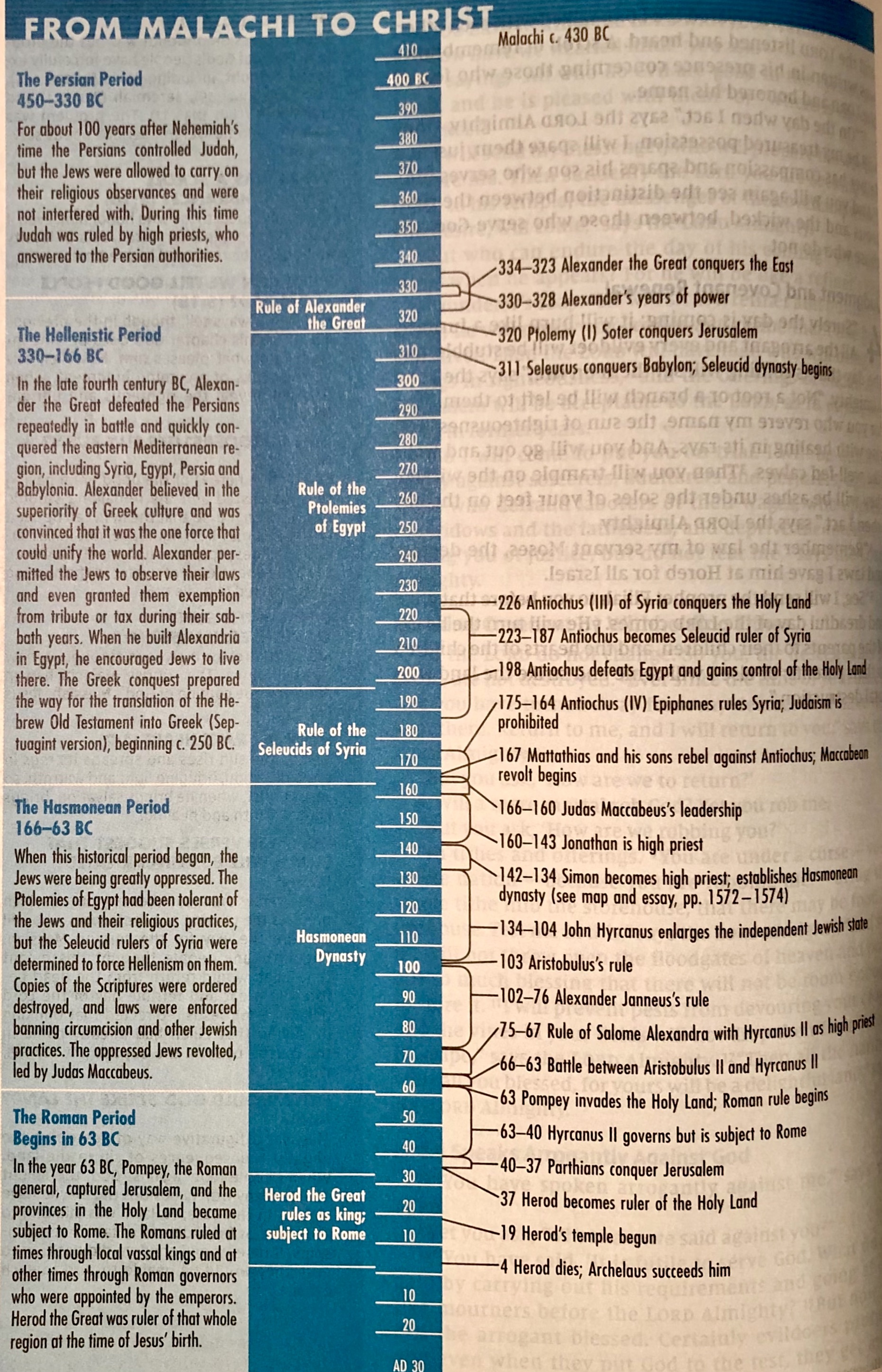
I just finished a series looking at the minor prophets. After Malachi, there is about 400 years of silence as far as what is recorded in the Bible for us. That doesn’t mean nothing is happening on the pages of history. In actuality, there is so much happening on the world scene.

This chart is in both the Quest Study Bible and The Life In The Spirit Study Bible. Always remember: All of history is His story! 

The History Of Zechariah

Zechariah and Haggai are both very specific in the dating of their prophetic activity. We can also cross-reference their dates with the historical books of Ezra and Nehemiah, and with numerous other extra-biblical sources. 

There is an important reminder for us in this: The historicity of the biblical accounts. 

In the chart I share there are references to other timelines:

  • the timeline for Haggai is here
  • the timeline for Ezra is here
  • and the story of Zechariah’s murder is found here

Always remember that God is sovereignly in control of world events—all of history is His Story! 

To check out other resources from the historical and prophetic minor prophets, check out the list I have posted here.

First-Century Rulers In Palestine

I have frequently made the assertion that God is sovereign over all history, or as I like to say it… All History is His Story

When we are reading the Bible, it is important to keep in mind that these are not “once upon a time” stories, nor are they set “a long time ago in a galaxy far, far away,” but we are reading the accounts of actual people in actual moments of history.

I hope this chart from The Archeological Study Bible helps you in your reading of the New Testament.

Any of the names listed above in ALL CAPS are people who appear on the pages of the New Testament.

You may also want to check out a previous post where I discuss the historicity of the Gospels, or this post and this post about the resurrection appearances of Jesus.