Links & Quotes

Jesus showed us how to remain faithful as a shepherd even in the face of painful attacks. If you are a pastor—or if you love your pastor—please check out my books Shepherd Leadership and When Sheep Bite. 

I have a lot of new video content on my YouTube channel every week. Please check it out and subscribe so you don’t miss anything.

Every year I see the same unsubstantiated claims that the Christian celebration of Christmas is a hodgepodge of pagan and cultic myths cobble together and hijacked by Christians. Here are three myths refuted by archeological evidence.

Dr. Allen Tennison points out how Luke emphasizes the work of the Holy Spirit all throughout his Gospel, and then continues that theme as he moves into the Book of Acts.

“One of the first gospel blessings is that of complete justification. A sinner, though guilty in himself, no sooner believes in Jesus than all his sins are pardoned. The righteousness of Christ becomes his righteousness, and he is accepted in the Beloved.” —Charles Spurgeon 

“For the apostle Paul, as, indeed, for all the apostles and early Christians, the Church is the Body of Christ, the continuing incarnation of the reigning and conquering King of Glory. The Church, according to the apostles, is the centerpiece of Christ’s historical agenda (Matthew 16:18). Whatever Christ intends to do on earth prior to His imminent return, the focal point of that work will be in and through His Church. … We do not have the mind of Christ if we are not thinking the same way about His Body, the Church. We need the Church, and if we do not think this is so, then we do not have the mind of Christ. We need the Church. But we need it according to the purpose with the guidance and blessing of the Lord Jesus Christ.” —T.M. Moore 

What an amazing story of faithfulness! The faithfulness of God is seen in the loving actions of an unnamed Sunday School teacher and in a lifelong missionary.

Cold-case detective J. Warner Wallace contrasts blind belief and unreasonable belief with what he calls forensic faith. His conclusion: “A forensic faith gives you confidence in uncertainty, strength in adversity, and the ability to engage intellectually with both believers and skeptics. It transforms faith from mere hope into informed trust, and that makes all the difference in how you live out your beliefs in a world that’s constantly questioning them.”

“Depression is one of satan’s most dynamic weapons to divert you from God’s purpose for your life. If he can scatter a little dejection here and there in your thoughts—and even in your prayers—he can convince you to remove your breastplate of righteousness because it is too cumbersome and will go against your material and temporal interest. Do not give in that easily!” —William Gurnall, The Christian In Complete Armor 

Links & Quotes

The armor of God is not for us to fight in but to shield us while we pray. Prayer is the weapon!

I have a lot of new video content on my YouTube channel every week. Please check it out and subscribe so you don’t miss anything.

“Psychologists, since the beginning of the discipline, have argued about the essence of what it means to be human. Some, like [Sigmund] Freud, insist that we are motivated by physical pleasure, while others, like Victor Frankl or Abraham Maslow, believe that some higher purpose…. Human beings, made in the image and likeness of God, only realize their full potential and pleasure as they participate in the very being of God and know and experience the pleasure He takes in Himself and His glory.” —T.M. Moore 

“If you are persevering in faith today, you owe it to the blood of Jesus. The Holy Spirit, who is working in you to preserve your faith, is honoring the purchase of Jesus. God the Spirit works in us what God the Son obtained for us. The Father planned it. Jesus bought it. The Spirit applies it—all of them infallibly.” —John Piper

“The Hebrew word Davar (דבר, pronounced ‘daw-var’) reveals something profound about God’s Word—it’s not merely information, but transformation. … Throughout Scripture, God’s Word consistently proves both living and active. It has the power to create worlds (Genesis 1), transform lives (Psalm 119:105), and accomplish God’s purposes (Isaiah 55:11).” —Dave Adamson 

More fascinating archeology that supports the Bible’s historicity. This is a look at the library of letters found at Tell el-Amarna in Egypt. “The most obvious connection between the Amarna Letters and biblical history is that some of the letters appear to be describing, in real-time, the attacks of the Israelites during the period of the conquest. Remember, the initial conquest battles took a period of some 5–6 years, but the attempts by various tribes to conquer their allotted territories lasted into the period of the Judges. The letters from the rulers of some of the very cities named in the biblical conquest calling for help from the attacking ʿapîru/ḫa-bi-ru, provide a poignant backdrop to this period of biblical history.”

“Because I am your constant Companion, there should be a lightness to your step that is observable to others. Do not be weighed down with problems and unresolved issues, for I am your burden-bearer.” —Jesus in Sarah Young’s Jesus Calling, based on Psalm 31:19–20; John 16:33

Links & Quotes

Controlling leaders shut down creativity among their teammates, which leads to higher turnover. If your team isn’t sharing their good ideas with you or if they are leaving you, that may be an indicator that you are too controlling. Check out the full conversation on The Craig and Greg Show

I have a lot of new video content on my YouTube channel every week. Please check it out and subscribe so you don’t miss anything.

“As a fact, men only become greedily and gloriously material about something spiritualistic. … Take away the supernatural, and what remains is the unnatural.” —G.K. Chesterton 

Astronomical technology like the James Webb Space Telescope (JWST) are providing breathtaking images. They are also creating problems for the scientific theories of the origins of our universe. University of California Santa Barbara physicist Caitlin Casey, said, “It makes sense—the Big Bang happens and things take time to gravitationally collapse and form, and for stars to turn on. There’s a timescale associated with that…. And the big surprise is that with JWST, we see roughly 10 times more galaxies than expected at these incredible distances.” There is a more straightforward answer found in Genesis 1:1, “In the beginning, God created the heavens and the earth.”

“Knowing where God wants people to be and taking the initiative to use God’s gifts and God’s methods to get them there, in reliance on God’s power through Christ, with God’s appointed people following.” —John Piper, giving his definition of godly leadership 

The Bible records the names of five Persian kings. One of them called “Darius the Persian” in Nehemiah 12:22 requires some historical cross-referencing to identify. The Bible Archeology Report presents another one of their fascinating archeological biographies on this Persian king. 

“The greatness of a leader is in his humility before God, not in his eloquence before men.” —Anonymous

The most viewed and downloaded resource on my blog is my chart of the kings of the united kingdom of Israel and the divided kingdoms of Israel and Judah. I was thrilled to discover this week that Jacob Edson at Biblegateway has taken my chart even deeper!

T.M. Moore has vital counsel for pastors, “Jesus must increase in us, and we must decrease. But that doesn’t just happen by carrying out whatever our ‘spiritual work’ requires of us week-in and week-out. Our ‘natural gifts’ cannot replace spiritual ones, and ‘mental powers’ are no match for the mind of Christ. It is a shepherd’s ‘duty’ to attend to the care and nurture of his soul, for unless we are diligent in this, we will not be able to lead the Lord’s sheep into a greater experience of our great salvation or a fuller realization of His Kingdom.”

A Lost Culture Of Reverence

Listen to the podcast of this post by clicking on the player below, and you can also subscribe on AppleSpotify, or Audible. 

There are several psalms that are regal in their focus—talking about the King’s coronation, or the King ruling on His throne, or the ultimate victory of the King that is coming in the future. Although these royal psalms are extolling God as King, many of these psalms use King David as an object lesson. The idea is seeing how a man after God’s heart (1 Samuel 13:14) became the standard by which all other kings were measured: 

  • Asa did what was right in the eyes of the Lord, as his father David had done (1 Kings 15:11) 
  • Amaziah did what was right in the eyes of the Lord, but not as his father David had done (2 Kings 14:3) 
  • Unlike his father, Ahaz did not do what was right in the sight of the Lord, as his father David had done (2 Chronicles 28:1) 

(Check out all of the Scriptures in this post by clicking here.)

The people followed their king in both righteousness and evil. They were fiercely loyal to their monarch. We don’t really get that loyalty today. “We’re Americans,” we cry, “We live in the land of the free and don’t ever bow our knee to a king!” 

That’s an appropriate response for those living in a democratic republic, but we would do well to learn to bow our knee to a true King. 

After the United States Constitution was adopt adopted, Elizabeth Willing Powel asked Benjamin Franklin, “Well, Doctor, what have we got, a republic or a monarchy?“ Franklin replied, “A republic, if you can keep it.” Franklin went on to say, “In these sentiments, Sir, I agree to this Constitution, with all its faults, if they are such; because I think a General Government necessary for us, and there is no form of government, but what may be a blessing to the people if well administered; and believe further, that this is likely to be well administered for a course of years, and can only end in despotism, as other forms have done before it, when the people shall become so corrupted as to need despotic government.” 

Because of our defiance as free people in our government, we have become lacking in our loyalty, which shows itself in a lack of proper reverence or respect. Just listen to how people talk so disrespectfully or even hatefully about those in “the other political party.” Benjamin Franklin also said, “Only a virtuous people are capable of freedom. As nations become corrupt and vicious, they have more need of masters.” 

Where are the days of the armor bearer who said to Prince Jonathan, “Do all you have in mind. I’m with you heart and soul,” even though Jonathan was proposing an impossible task? Or the loyalty of the men around David who heard him sigh about the water in Bethlehem, and they put their lives at risk to bring him a drink? This was even before he was on a throne, and yet they showed their loyalty to him. I fear that our lost culture of reverence for earthly leaders has eroded our reverence for the King of kings, and vice versa. 

The first royal psalm (Psalm 2) practically open the Psalter. This psalm calls us to consider the differences between earthly kings and the King of kings.  

Notice that earthly kings “conspire”—they angrily boast and rage. They plot (v. 1b) and scheme (AMPC). They take their stand together (v. 2). 

Against Whom? Against the LORD (Jehovah) and against His Anointed One (the Messiah)! 

Much like the fiercely independent people I described us as earlier, these earthly rulers want to call their own shots—they don’t want to take directions from anyone else because they think they know best (v. 3). But notice in v. 1 that the peoples have followed their leaders in their plot. 

God doesn’t rage at them, but He laughs, He scoffs, He rebukes, and the people are terrified when they realize that they cannot overcome Him. In v. 1 we see their plots are “in vain.” 

There is nothing men can do—no matter how powerful they may seem or how many of them “take their stand…together”—to thwart or even delay the plans of Jehovah. 

All of History is His Story. Notice the phrase that God speaks, “I have … I will” (in vv. 6-7; c.f. Daniel 4:25). 

In vv. 7-9 God speaks to His Son—the Messiah, the Anointed One, the King of kings. We hear this repeated in Acts 13:32-33 and in God’s own voice in Matthew 3:17. Then we see the fulfillment of this in passages like Philippians 2:9-11 and Revelation 11:17-18. 

This royal psalm ends with an important conclusion: Therefore (vv. 10-12): 

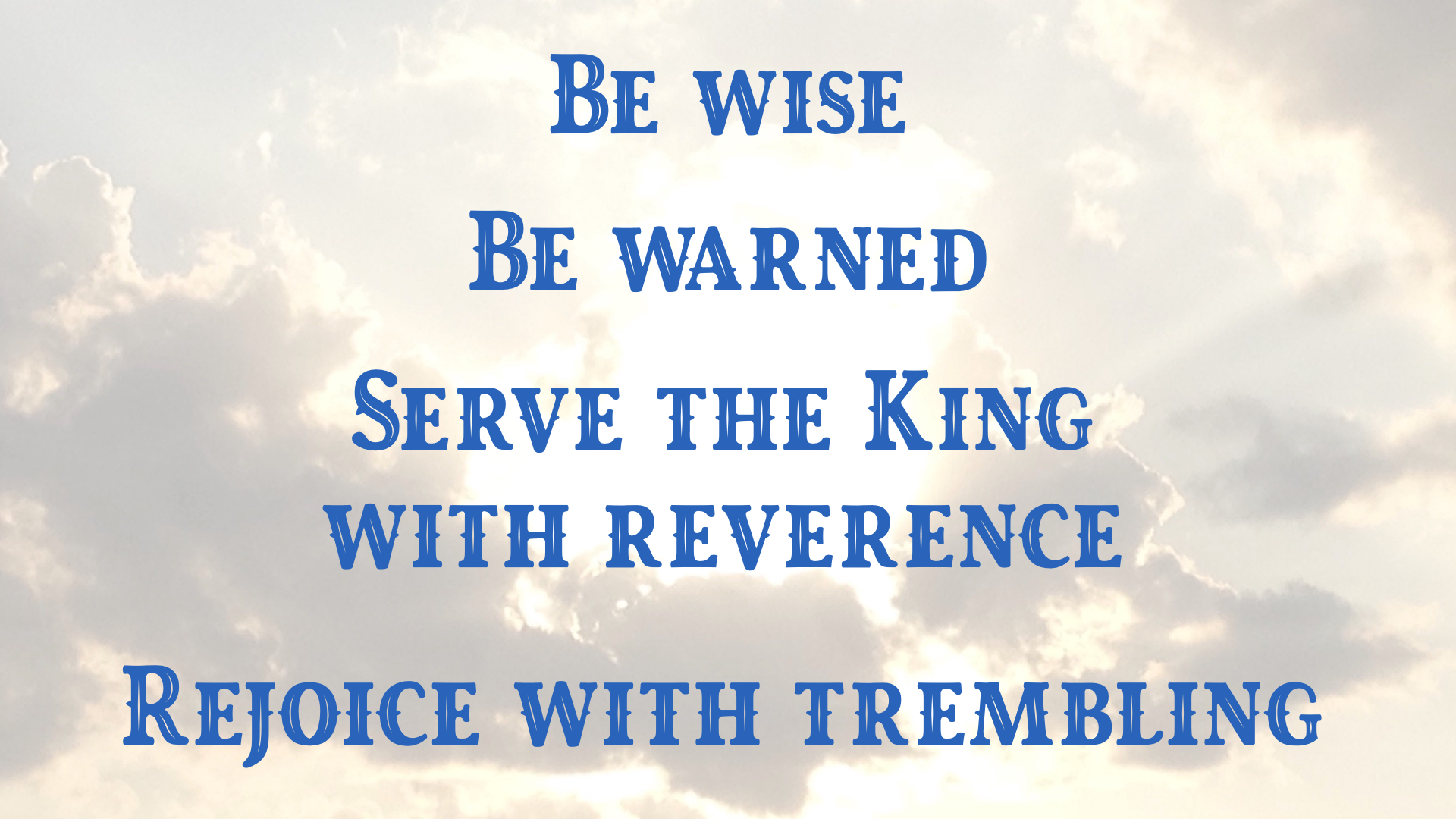
  • Be wise 
  • Be warned 
  • Serve the King with reverential fear 
  • Rejoice with trembling  
  • Kiss the Son with absolute loyalty and joyful reverence 

Check out another “therefore” in Philippians 2:12-16. This is a call for righteous, reverent living for those who have acknowledged Jesus as their King. It’s only those who live this way who will know the blessed refuge in Him that is unshakable for ever and ever! 

Follow along with our look at all of the royal psalms by clicking here. 

►► Would you please prayerfully consider supporting this ministry? My Patreon supporters get behind-the-scenes access to exclusive materials. ◀︎◀︎
My Most Popular Bible Study Resource

Listen to the podcast of this post by clicking on the player below, and you can also subscribe on AppleSpotify, or Audible. 

Back in 2014, I was reading through the history of the divided kingdoms of Judah and Israel. The historical accounts of these kingdoms in both the Books of Kings and Chronicles go back-and-forth from kings in the north to kings in the south. I was having trouble keeping them all straight, so I began designing a side-by-side chart to help me. 

I had no idea that this chart would be viewed and downloaded by other Bible students literally thousands and thousands of times each year. 

You can find all of the download information for this chart by clicking here. 

A few of my other popular downloads:

►► Would you please prayerfully consider supporting this ministry? My Patreon supporters get behind-the-scenes access to exclusive materials. ◀︎◀︎

Links & Quotes

Christian parents often experience both a weight and a wait as they pray for their children. Biblical waiting is always active, calling us to continue to pray for our kids—not matter how old they are!

I have a lot of new video content on my YouTube channel every week. Please check it out and subscribe so you don’t miss anything.

The Institute for Creation Research reported: “Perhaps one of the top evidences for creation are the subcellular and incredibly efficient molecular protein machines that clearly function by known engineering principles. They are hardly simple. Determining just a part of their function requires the best science has in twenty-first-century technology: ‘While belonging to the nanoscale, protein machines are so complex that tracing even a small fraction of their cycle requires weeks of calculations on supercomputers.’”

Dr. Thaddeus Williams said, “What do you think is the most repeated phrase in the entire Bible? It’s, ‘Thus says the Lord…’ which clocks in at over 400 occurrences. The God of the Bible is not the stone-cold silent god of the ancient Greeks. Nor is He the stone-cold silent god of the ancient Stoics or Epicureans, too busy enjoying the amenities of divine bliss to bother with humanity. No. The God who exists is a God who speaks.” What does this mean for us? Dr. Williams talks about what happens to people who make time to regularly hear what God has to say to them through His Word.

“Work is the outcome of effort; fruit, of life. A bad man may do good work, but a bad tree cannot bear good fruit.” —Hudson Taylor 

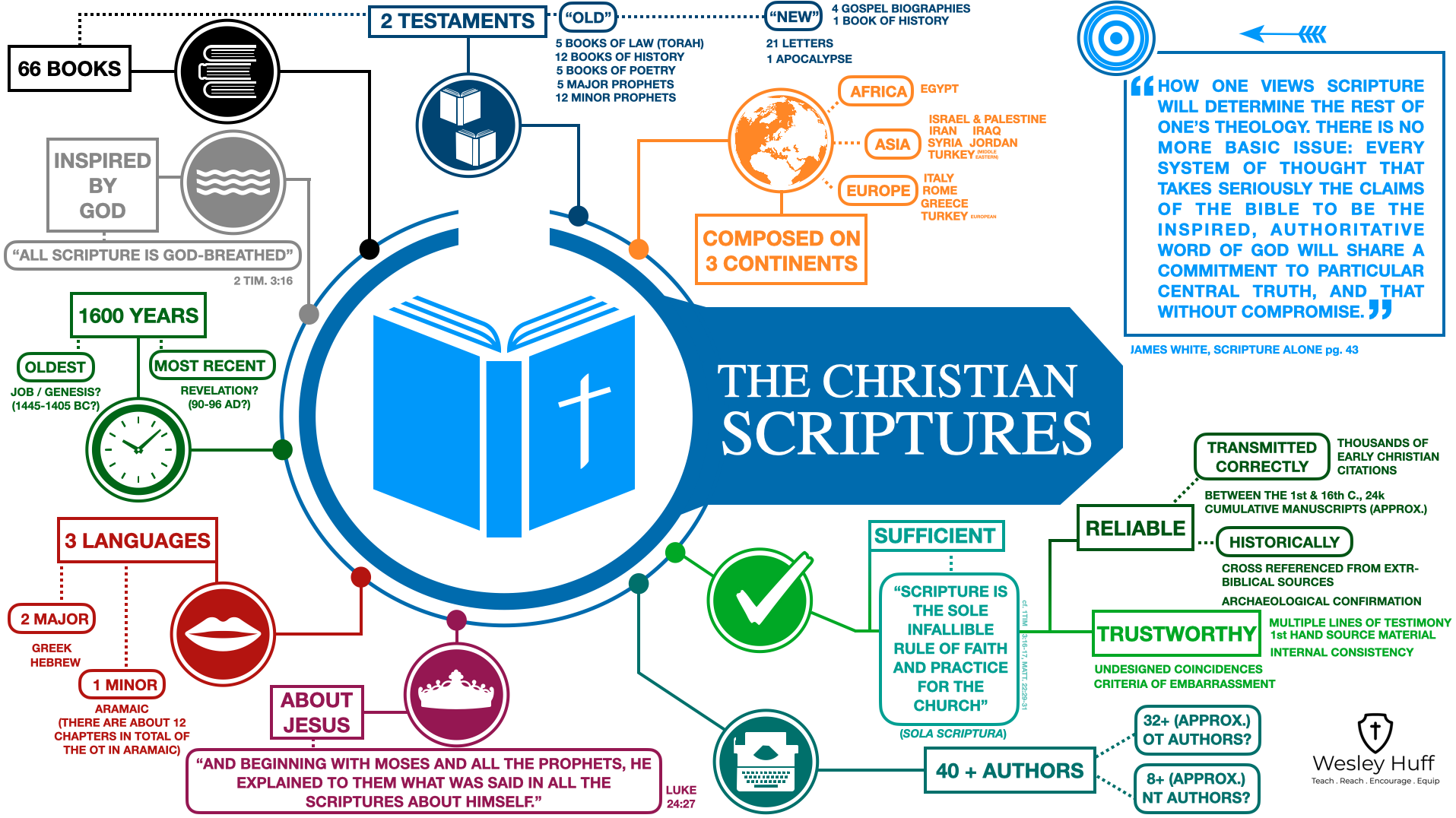
I love studying my Bible, and I also enjoy passing along things that encourage others to begin studying their own Bibles. This is a really cool infographic from Wesley Huff, giving a great overview of the Bible.

Dr. Steve Nichols has an interesting mini-biography of King Louis IX, whom some have called “the greatest king of the Middle Ages.”

J. Warner Wallace leads us all along “the fuse” that led up to the arrival of Jesus as the Messiah, the One to whom the Old Testament prophets predicted.

Links & Quotes

Whether you call it grit or stick-to-it-iveness, those who don’t give up easily are the ones who will become leaders by their example. Check out the conversation we had on The Craig and Greg Show.

I have a lot of new video content on my YouTube channel every week. Please check it out and subscribe so you don’t miss anything.

I was thrilled to be asked to write an article for Influence Magazine about the biting sheep that every pastor has experienced. I am praying that this article will help pastors recover and thrive in their shepherding ministry.

“Knowing our lowliness and Christ’s worthiness, we neither grovel nor saunter into the presence of God. And we do not go home flippant or weeping. In Christ, we will receive what we ask or what we should have asked.” —David Mathis

In 1 Thessalonians 5:19, the apostle Paul warns us not to quench the Holy Spirit. T.M. Moore asks, “How do we quench the Spirit?” and then gives Christians seven warning signs to avoid this quenching. Check out his post Joy In His Spirit.

I really enjoy these archeological biographies of biblical people and places. The Bible Archeology Report writes, “The Neo-Babylonian king, Amēl-Marduk (biblical Evil-Merodach) is only mentioned twice in Scripture (in 2 Kings 25:27–30 and the parallel passage, Jeremiah 52:31–34), both times in connection with the restoration of Jehoiachin, king of Judah.” In a separate post, John Stonestreet shares an archeological discovery in a Roman cemetery in Frankfurt of an amulet that shows that “the Gospel spread farther and faster than historians thought.”

Kenneth Blanchard shares his novel way of setting personal and business goals for the year in a post ‘Look forward to looking back at your goal success in 2025.’

Links & Quotes

This is amazing—Jesus wants to say, “Amen!” to your prayers!

I have a lot of new video content on my YouTube channel every week. Please check it out and subscribe so you don’t miss anything.

“If we try to display the excellence of God without joy in it, we will display a shell of hypocrisy and create scorn or legalism. But if we claim to enjoy His excellence and do not display it for others to see and admire, we deceive ourselves, because the mark of God-enthralled joy is to overflow and expand by extending itself into the hearts of others. … God calls us to pray and think and dream and plan and work not to be made much of, but to make much of Him in every part of our lives.” —John Piper

I have blogged quite a bit about the importance of getting enough quality sleep. A new study finds that the link between poor sleep and mental health problems could be related to deficits in brain regions that keep unwanted thoughts out of mind. Check out the full report.

“You may have to fight the battle more than once to win it.” —Margaret Thatcher 

Believe it or not, New Year’s Day hasn’t always been observed on January 1. Dr. Steve Nichols has the strange and sometimes comical history about this date.

“Heroes always have their scars. Some you can see, some you read about later on.” —George Foreman 

What Do We Do With Really Bad Leaders?

Listen to the podcast of this post by clicking on the player below, and you can also subscribe on AppleSpotify, or Audible. 

How are Christians supposed to respond to really, really bad guys, especially those in positions of leadership?  

Check out this episode of The Podcast. 

The Scriptures that I reference in this video are Acts 12:1-17; 1 Peter 2:17; Acts 4:24; 1 Timothy 2:1-2; Acts 26.

I have shared a couple of other posts about our interactions with leaders. Check out:

Get more information on When Sheep Bite here. 

Check out the family tree of King Herod the Great:

►► Would you please prayerfully consider supporting this ministry? My Patreon supporters get behind-the-scenes access to exclusive materials. ◀︎◀︎

Ungodly Leadership Is Unsure Leadership

Listen to the podcast of this post by clicking on the player below, and you can also subscribe on AppleSpotify, or Audible. 

After examining Jesus himself and then getting a report back from King Herod, Pontius Pilate announces to the crowd of religious leader, “I find no basis for a charge against Him. But…” (John 18:38-39). 

The “But” signals the language of an unsure leader.  

Pilate knew the truth. He knew the Roman law. He had soldiers around him to protect him from physical harm. No recrimination or rebuke would have come from Rome for letting Jesus go free. Yet Pilate wavered. 

He was unsure of his leadership position. “Did I earn this position or did I manipulate my way into it? What will others think of me if I make this decision? Is there a way that I can keep everybody happy?” 

Pilate gave himself an out: “…but it is your custom for me to release to you one prisoner at the time of the Passover. Would you like me to release Jesus?” 

Pilate was hoping to satisfy the fickle mob that was pressing in on him and pestering him to give in to their demands, even if it meant he would be perverting justice. Unsure leaders are always trying to find a way to navigate the current situation, just to get on to the next chapter of their leadership. 

History records that about three years later, Pilate took his own life in the face of being removed from his office. 

A godly leader who is sure of his calling can make tough calls while still preserving justice and maintaining truth. 

A mark of an ungodly leader is one who is both unsure of his leadership authority and unstable in his leadership activities. 

I talk more about a godly leader’s sure calling in my book Shepherd Leadership. And in this blog post, I give a three-word statement that can help godly leaders navigate through the toughest of decisions. 

This is part 79 in my series on godly leadership. You can check out all of my posts in this series by clicking here.

►► Would you please prayerfully consider supporting this ministry? My Patreon supporters get behind-the-scenes access to exclusive materials. ◀︎◀︎