Ordinances Of The Church

Listen to the podcast of this post by clicking on the player below, and you can also subscribe on AppleSpotify, or Audible. 

Many churches recognize a various numbers of ordinances within their worship services. The dictionary gives two definitions of the word ordinance that are helpful for us: (1) a rule to be followed, and (2) something believed to be ordained (or made holy). 

There are two ordinances that we celebrate: baptism in water and holy communion. 

Water Baptism

This wasn’t a practice invented by Christians, but teachers had been baptizing their students for years as an outward sign of followership. Not only did various members of the Israelite community come to John to be baptized, but even Jesus desired to be water baptized (Matthew 3:5-6, 13-17). 

Why would Jesus need to be baptized? Look at how Jesus replied to John, “It should be done, for we must carry out all that God requires” (Matthew 3:15 NLT), or in the NIV: “to fulfill all righteousness.” 

Jesus came to be our High Priest. One of the requirements for the priest was “he must bathe himself in water before he puts” on the ceremonial robes that were to be worn in the tabernacle (Leviticus 16:4). Jesus also came to be our perfect sacrifice, so He needed to be like us in every single way. If Jesus wasn’t water baptized, not “all righteousness” would have been fulfilled. 

Jesus was also baptized as an example for us. We, too, are priests in God’s Kingdom that need to be washed for our priestly service (1 Peter 2:9; 3:20-21). 

Our foundational truth statement on this is: “The ordinance of baptism by immersion is commanded by the Scriptures. All who repent and believe on Christ as Savior and Lord are to be baptized. Thus they declare to the world that they have died with Christ and that they also have been raised with Him to walk in newness of life.” 

Jesus gave us this rule to follow for new Christians: “baptizing them in the name of the Father and of the Son and of the Holy Spirit” (Matthew 28:19). This is also what Peter announced to the new believers on the Day of Pentecost: “Repent and be baptized, every one of you, in the name of Jesus Christ for the forgiveness of your sins” (Acts 2:38).  

Communion

Sometimes called The Last Supper or The Lord’s Supper, the Israelites had continued to celebrate the Passover (Exodus 12) with unleavened bread and wine—symbolizing the body and the blood of the sacrificial lamb which saved them from death. 

Our foundational truth statement on this is: “The Lord’s Supper, consisting of the elements—bread and the fruit of the vine—is the symbol expressing our sharing the divine nature of our Lord Jesus Christ, a memorial of his suffering and death, and a prophecy of His second coming, and is enjoined on all believers ‘till He come!’” 

Jesus, while celebrating Passover with His disciples, showed how Passover had been pointing to His First and Second Advents (Luke 22:13-20; 1 Corinthians 11:23-26). 

Both of these ordinances have reminders in them of our new life in Christ:

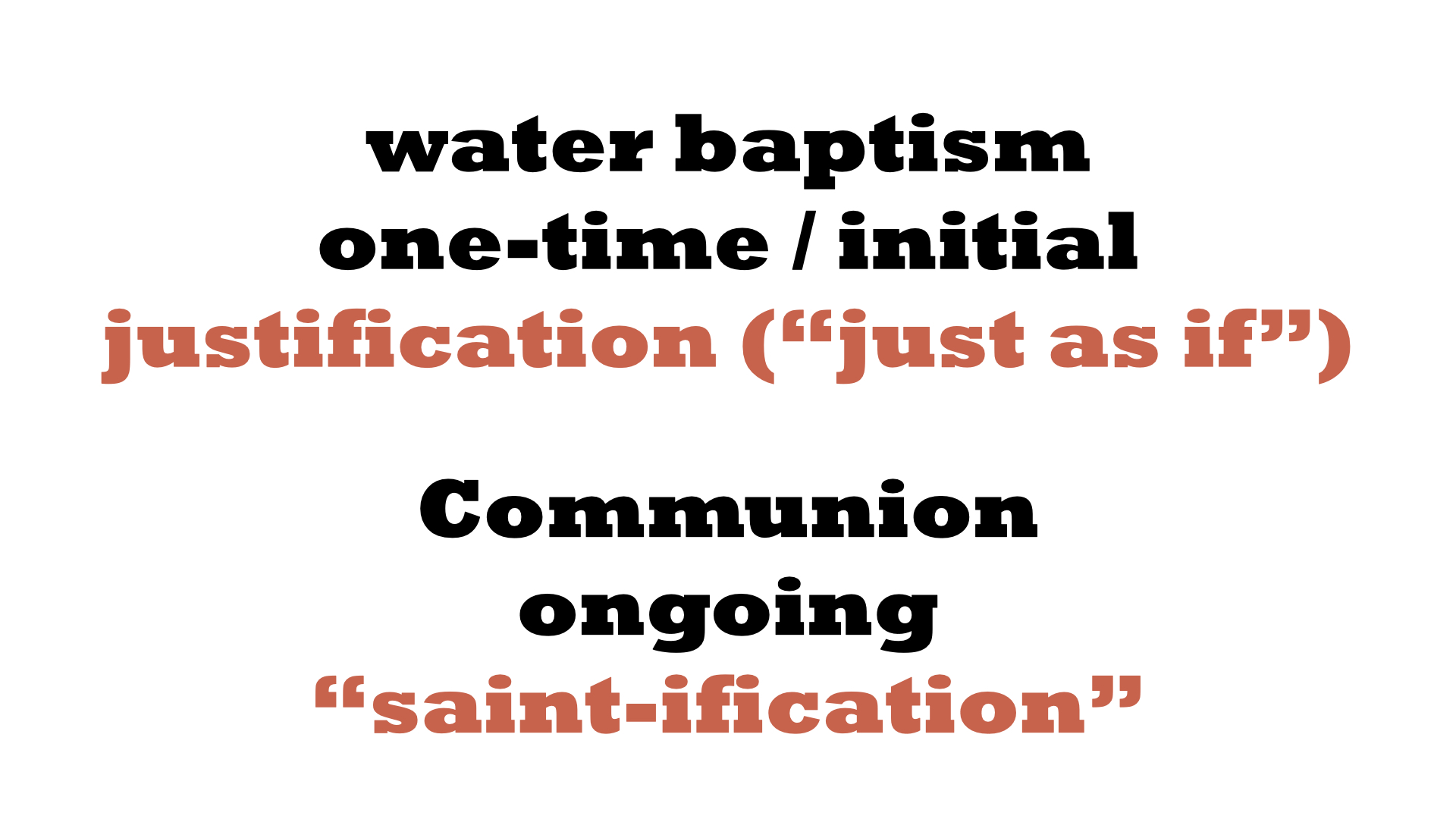
  1. Water baptism is a one-time event, just as our justification (“just as if I’d never sinned”) is a one-time event. This looks back to what Jesus did on the Cross. 
  2. Communion is an ongoing celebration “until He comes,” just as our sanctification (“saint-ification”) is an ongoing process. This looks ahead to what Jesus will complete when we are glorified in Heaven. 

If you’ve missed any of the other messages in our series exploring our foundational beliefs, you can find the complete list by clicking here.

►► Would you please prayerfully consider supporting this ministry? ◀︎◀︎
Still Being Fashioned

Listen to the podcast of this post by clicking on the player below, and you can also subscribe on AppleSpotify, or Audible. 

Psalm 119 is a fascinating chapter of Scripture. Not only is it the longest chapter in the Bible (at 176 verses) but it is divided into twenty-two 8-verse sections, corresponding with the 22 letters of the Hebrew alphabet. Each of the verses in the different sections all begin with the same Hebrew letter of that section. 

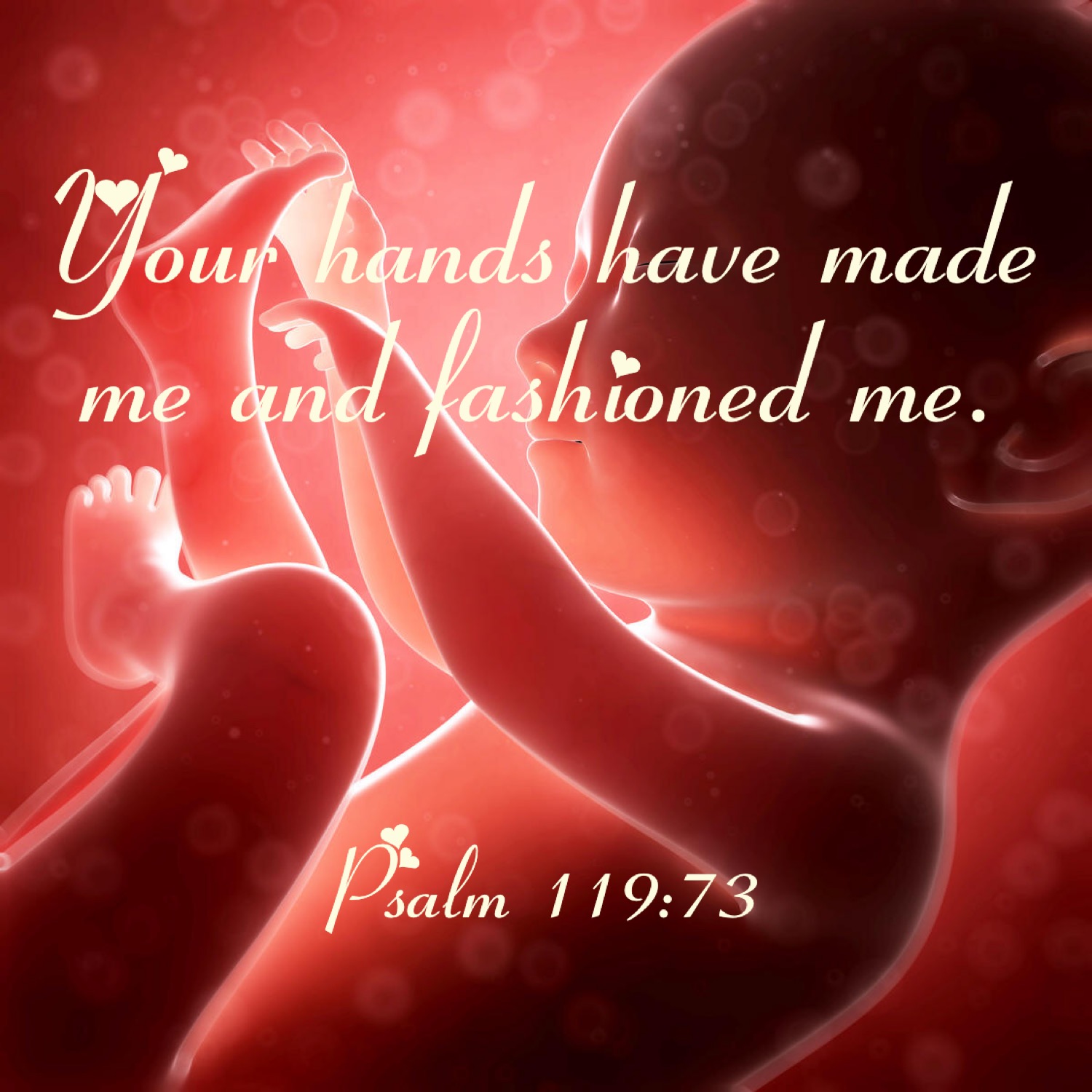
In the section called yodh, the psalmist wrote, “Your hands formed me and made me; give me understanding to learn Your commands” (v. 73). There is just one Hebrew word for “Your hands” and it also happens to be the name of this section of Psalm 119: Yodh. The psalmist sees God’s hands all over his life, and he welcomes God’s continued involvement in every aspect of his life. 

This yodh section is presented to us in alternating verses: the odd-numbered verses are a declaration, and the even-numbered verses are a corresponding prayer. It looks something like this…

Declaration: You made me

Prayer: May I be a hope-filled testimony to others by my reverence of You

Declaration: You continually discipline and fashion me

Prayer: May I continually find my comfort in Your unfailing love

Declaration: Your compassion is my life and my delight

Prayer: May You deal with those who afflict me while I remain focused on You

Declaration: You bring people into my life on purpose

Prayer: May I be a blameless witness of Your love

In light of this section I declare in prayer: “God, You created me on purpose and for a purpose. What You create, You complete; and what You complete, You complete perfectly. May I remain sensitive to Your Holy Spirit and malleable to Your touch, so that You are glorified through my obedient life.” 

►► Would you please prayerfully consider supporting this ministry? ◀︎◀︎
Nature Walk

Listen to the podcast of this post by clicking on the player below, and you can also subscribe on AppleSpotify, or Audible. 

How many are Your works, O Lord! In wisdom You made them all; the earth is full of Your creatures. There is the sea, vast and spacious, teeming with creatures beyond number—living things both large and small. (Psalm 104:24-25) 

This psalm makes me want to go on a nature walk! 

The psalmist is in awe of the Creator’s handiwork—from the majestic sun and moon, to the smallest of creatures, God created them and sustains them all. 

God set the earth on its foundations; it can never be moved.  … He makes springs pour water into the ravines; it flows between the mountains. They give water to all the beasts of the field; the wild donkeys quench their thirst. The birds of the air nest by the waters; they sing among the branches. He waters the mountains from His upper chambers; the earth is satisfied by the fruit of His work. He makes grass grow for the cattle, and plants for man to cultivate—bringing forth food from the earth. … The moon marks off the seasons, and the sun knows when to go down. … The lions roar for their prey and seek their food from God. … These all look to You to give them their food at the proper time. When You give it to them, they gather it up; when You open Your hand, they are satisfied with good things. 

Take a walk. See God’s beauty.

Listen to the wind, the birds, the lions.

Taste the food from the soil and the trees.

Feel the coolness of the water, the warmth of the sun, the invigoration of the breeze. 

Smell the flowers, the soil, the sea air.

And then as you take all of these in, remind yourself: “If God cares for the fields, if He sees the smallest sparrow, how much more does He care for me!” 

Jesus told us much the same thing—

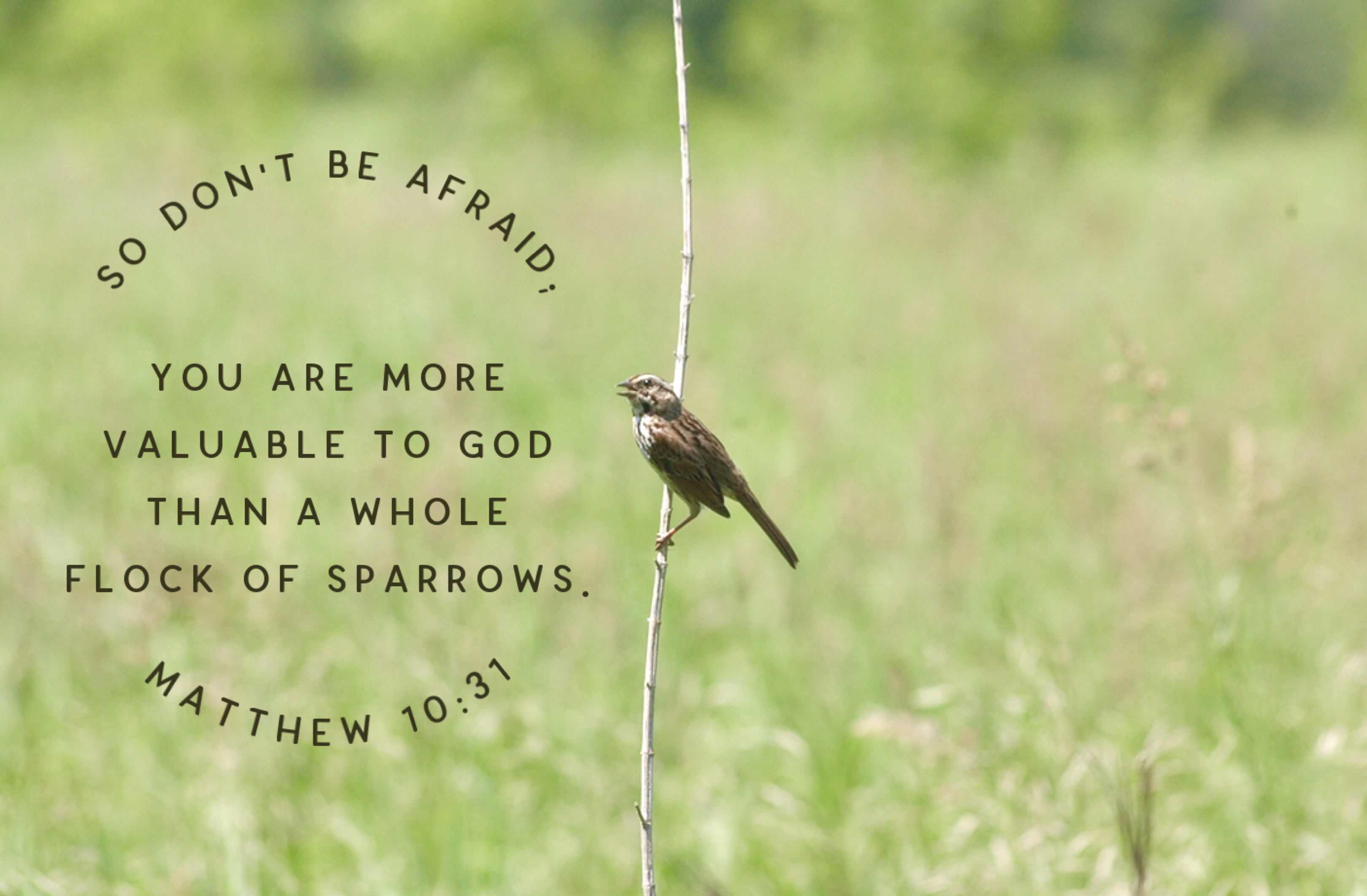
Look at the birds of the air; they do not sow or reap or store away in barns, and yet your Heavenly Father feeds them. Are you not much more valuable than they? … See how the lilies of the field grow. They do not labor or spin. Yet I tell you that not even Solomon in all his splendor was dressed like one of these. If that is how God clothes the grass of the field, which is here today and tomorrow is thrown into the fire, will He not much more clothe you? … Are not two sparrows sold for a penny? Yet not one of them will fall to the ground apart from the will of your Father. And even the very hairs of your head are all numbered. So don’t be afraid; you are worth more than many sparrows. … Your Father knows what you need before you ask Him. (Matthew 6:8, 26, 28-30; 10:29-31)  

My friend, the next time you need reassurance of God’s love for you, I invite you to take a nature walk and let the beauty of the Creator fill you with confidence of His love for you and His power to care for your every need! 

►► Would you please prayerfully consider supporting this ministry? ◀︎◀︎
Heart Rate Recovery

Listen to the podcast of this post by clicking on the player below, and you can also subscribe on AppleSpotify, or Audible. 

A few years ago Mark Schultz wrote a song about someone living a go-go-go, overly-busy life and he entitled the song “Running just to catch myself.” Ever been there? 

There’s a Hebrew word that shows up 70 times in the Bible (mostly in the Psalms) that, sadly, many English translations of the Bible have relegated to a footnote. That’s too bad because Selah is such a powerful word. Unless we want to live our lives “running just to catch myself,” we all need a take time to Selah. Look how some have translated this word:

  • “Stop there and consider a little” (Matthew Henry) 
  • “the sacred pause” (Charles Spurgeon) 
  • “pause and calmly think of that” (AMP) 

Whether it’s a planned exercise time or just something that frightens or excites us, our heart rate is designed by God to increase—this is how we prepare for fight-or-flight. Doctors say that one of the most vital statistics they now look at to gauge overall cardio health is heart rate recovery (HRR). Doctors want to see a significant increase in HRR after exercise, fright, or excitement. 

A few of the factors that boost HRR:

  • Regular, planned exercise 
  • Getting the proper amount of quality sleep 
  • Reducing stress 

Respond-and-recover is part of a health-building cycle. But if we’re “running just to catch myself” all the time, this time of recovery isn’t happening. Not only are we not recovering well, but we are not properly prepared for the next time our heart needs to start beating faster.   

This HRR is just as vital for us emotionally and spiritually as it is physically: We cannot always be stressed or always be “on.” We need a Selah—a time to stop and consider, a time to take a sacred pause to calmly think. 

This is what David teaches us in Psalm 68. Check out the “bookend verses” where he reminds us that when God arises His enemies are scattered, and that God is awesome and He gives power and strength to His people (vv. 1, 35). And look a the middle verse where David says that when God ascends in victory He gives gifts (v. 18). 

This tells me two things: (1) God is sovereignly in charge (not me or anyone else), and (2) In His love, God delights to use His sovereign power to bless His children. 

The question is not IF I’m going to be confronted by difficult things or difficult people, but HOW will I recover from these confrontations? 

May I suggest a 3-step process to increase your spiritual HRR? 

  1. Acknowledge your situation—don’t try to cover it up or justify it 
  2. Selah—pause to take a deep breath  
  3. During that breath, redirect your thoughts from the difficulty to your awesome God (see 2 Corinthians 10:5; Philippians 4:4-8)

Look at David’s example in this psalm:

Reflect Worship
God defeats enemies (vv. 1-2) Be glad, rejoice, sing (vv. 3-4)
God is a Father and Deliverer (vv. 5-7) Selah (v. 7)
God is sovereignly in control (vv. 8-18) Praise and Selah (v. 19)
God defeated Death (vv. 20-23) Join the procession of worshippers (vv. 24-27) 
God uses His strength to care for His people (vv. 28-31) Sing praises and Selah (vv. 32-35)

As you breathe deeply in this worship of recovery, think on this: “Your sigh can move the heart of Jehovah; your whisper can incline His ear to you; your prayer can stay His hand; your faith can move His arm.” —Charles Spurgeon 

Our Selah pause leads to proper perspective, which allows us to recover more quickly. That, in turn, helps us to be better prepared for the next time we’re confronted by difficulties. 

To check out the other lessons we’ve learned in our ongoing series called Selah, please check out the list I’ve compiled here.

►► Would you please prayerfully consider supporting this ministry? ◀︎◀︎

The Craig And Greg Show: Handling Personnel Conflicts

On this episode of “The Craig And Greg Show” we talk about: 

  • a previous episode where we discussed how leaders handle general problems [0:28]
  • the distinction between conflict management and conflict leadership [1:30] 
  • managers who try to make people get along vs. leaders who empower people to solve their own issues [2:44]
  • my 3 tips to prepare yourself before a meeting with your teammates [3:38]
  • how to look beyond the “triggers” to the root issue of a problem [5:04]
  • most people share the same values but conflict happens when they express that value differently [6:17]
  • leaders allow for the differences in style and personality [7:15]
  • how leaders can proactively prepare themselves and their team members to navigate personnel conflicts [8:00]
  • Greg relates conflict leadership to parenting terminology [10:15]
  • leaders need to stay among their team members [11:29]
  • what “peace” really is and where conflicts usually originate [12:50]
  • team members bring their past experiences with them [14:20]
  • Craig & Greg are ready to help coach you [16:30]

Check out this episode and subscribe on YouTube so you can watch all of the upcoming episodes. You can also listen to our podcast on Spotify and Apple.

Ruth + Boaz—The Father’s Day Version

Listen to the podcast of this post by clicking on the player below, and you can also subscribe on Apple or Spotify.

On Mother’s Day that we saw how Ruth’s obedience allowed her to realize God’s favor, part of that favor is being included in the genealogy of Jesus Christ. Of course, Ruth can’t give birth to her son Obed without there being a father, which makes Boaz’s part in this story just as important. 

[This whole story of Ruth + Boaz is just four short chapters, so I’d encourage you to take a couple of minutes to read it.] 

When we first meet Boaz, he is described as “a man of standing.” Some Bible translations say “a man of wealth,” which is an acceptable definition. In fact, the word can mean strength, wealth, valor, or prominence, but the root word means something brought forth out of travail and pain. That tells us that Boaz wasn’t born a man of standing, he became a man of standing by going through difficult times, not giving in to the downward slide of culture, and remaining true to God. 

Boaz had a steel-forged integrity! 

Believe me, it would have been easy for Boaz to compromise! This was a dark time of selfishness in Israel’s history. A time where just doing the bare minimum was acceptable because most of the Israelites were selfishly doing whatever would benefit them (Judges 21:25). 

The other description we read about Boaz is that he is a “kinsman-redeemer.” This same word is used in this verse: “Plead my cause and redeem me; revive me and give me life according to Your word” (Psalm 119:154). A redeemer is one who is close by to help, has the strength or resources to help, and is willing to help. Of course, the perfect example of a Kinsman-Redeemer is Jesus, who became our human kinsman so that He could rescue us (see Hebrews 2:14; Philippians 2:7-8). 

Boaz was given the opportunity to do this for Naomi and Ruth, and he seized the opportunity with gusto. Far from being a “bare minimum” man, Boaz always went the second mile to bless Ruth and Naomi:

  • he practiced the “hospitality clause” plus he protected Ruth and gave her more than was required 
  • he provided food for his workers plus he provided food for Ruth and Naomi 
  • he blessed his workers plus he blessed Ruth in the name of the Lord 

Ultimately, Boaz did indeed become the kinsman-redeemer for Naomi (by paying off all the debts of her deceased husband) and for Ruth (by marrying this non-Israelite woman and bringing her into the family line of Jesus). 

Boaz was King Solomon’s great-great-grandfather. When Solomon was completing the temple in Jerusalem, he erected two pillars at the entrance: one was named Boaz, and the other was Jakim (with means “God will establish”). Taken together these pillars proclaim the message: By His integrity and faithfulness, God establishes and makes firm. 

Boaz exhibited integrity at every opportunity, which is what forged his character and made him “a man of standing.” Boaz demonstrated that integrity is really faith in God plus faith-filled, second-mile, others-focused actions.

“Faith without works is just wishful dreaming.
Works without faith is just religious posturing.
Works with faith is God-glorifying!” —Craig T. Owens

Men of God, please remember this: 

  • Every Word of God that you read or hear is a test—will you obey Him or will you compromise? 
  • Every setback you go through is a test—will you learn and grow or will you sulk and shrink back? 
  • Every success you experience is a test—will you bless others or will you hoard your blessings? 
  • Every decision you make in a dark culture is a test—will you just have faith, just have bare-minimum works, or will you exhibit the steel-forged integrity that comes from putting your faith to work? 

God’s blessing on your life of integrity will show others a picture of Jesus. God’s blessing on your life of going the second mile will show others that it is God who establishes and makes firm. 

Don’t rob your family, don’t rob us, don’t rob future generations of the outpouring of God’s blessing because you are selfish or compromising. Stand strong, trust God, go the second mile, be the kinsman-redeemer for those in need, and then watch for God’s blessings! 

If you missed Ruth’s vital part in this story, please check that out by clicking here.

►► Would you please prayerfully consider supporting this ministry? ◀︎◀︎

Thursdays With Spurgeon—Context Is King

This is a weekly series with things I’m reading and pondering from Charles Spurgeon. You can read the original seed thought here, or type “Thursdays With Spurgeon” in the search box to read more entries.

Listen to the podcast of this post by clicking on the player below, and you can also subscribe on iTunes or Spotify.

Context Is King

And the glory that You gave Me I have given them, that they may be one just as We are One: I in them, and You in Me; that they may be made perfect in one, and that the world may know that You have sent Me, and have loved them as You have loved Me. (Jesus in John 17:22-23)

     Some words serve many uses and have many meanings. We are very apt to make mistakes if we give the same sense in all places to the same word. The word world throughout Scripture is used with a very remarkable variety of meaning, and one had need to have his wits about him and to read carefully in order to know what is the precise source of the term in each place where it occurs. …  

     I say again, the word world, therefore, has many shades of meaning ranging from that jet black meaning in which the world lies in the wicked one—‘Love not the world, neither the things that are in the world’ (1 John 2:15)—upward to the milder sense in John 1:10, ‘He was in the world, and the world was made through Him, and the world did not know Him.’ And yet higher to the bright meaning, ‘The kingdoms of this world have become the kingdoms of our Lord and of His Christ’ (Revelation 11:15). It is not in the worst sense that our text speaks of the world, but in the same manner as we find it used in such passages as these: ‘The Lamb of God who takes away the sin of the world!’ (John 1:29). ‘God was in Christ reconciling the world to Himself, not imputing their trespasses to them’ (2 Corinthians 5:19). And again in 1 John 2:2, ‘And He Himself is the propitiation for our sins, and not for ours only but also for the whole world.’ 

     It is certain that ‘God so loved the world that He gave His only begotten Son, that whoever believes in Him should not perish but have everlasting life’ (John 3:16), and we cannot suppose that the great Redeemer would refuse to pray for those whom He was given. I understand in this particular place by the word world the whole mass of mankind upon the face of the earth who are not as yet converted. … 

     For the sake of the world, He would have the church in a high state of holy beauty and strength. May His gracious prayer be answered in all of us by the working of the Holy Spirit! … Our wish is to bring multitudes to the Savior and to conquer province after province of this revolted world for King Jesus. ‘Let the whole earth be filled with His glory’ (Psalm 72:19) is a prayer that we cannot, we dare not, we would not fail to pray! 

From The Glory, Unity, And Triumph Of The Church

When we are studying our Bibles, we must remember that context is so vital. We have to read each inspired word in its proper context so that we know how to believe, think, live, and pray. I urge you to slow down in your Bible reading—aim for better and richer comprehension than to just try to read a lot in one sitting. Sometimes in my own personal Bible study time, I may spend several minutes just thinking about one phrase, and that may be the only part that I read on that particular morning. 

I would also counsel you to use some trustworthy Bible study tools. I have a list here of 8 must-have Bible study tools, and you can find some new ways to use these tools in this post about three types of Bible studies you may not have considered before. 

However you read your Bible, make sure you are reading each part in its proper context. Pray before you begin reading and ask the Holy Spirit—Who inspired the Scriptures—to illuminate them to your heart and mind. These thoughtful Bible studies will do more to grow your spiritual maturity than simply rushing through your reading time.

Maturing Reactions

Listen to the podcast of this post by clicking on the player below, and you can also subscribe on Apple or Spotify.

Jesus lived out the example of wholly healthy growth. The way Dr. Luke records it, the pinnacle of Christ’s health (and our health too) is seen in our relationships with other people.  

Why is relational maturity at the peak of the pinnacle? How else could you know whether you truly have mental, physical, and spiritual health unless it’s put to the test? And the ultimate test is how we react when we’re caught off guard. Our so-called Freudian slips can reveal an area of immaturity. C.S. Lewis reminds us that the suddenness of the provocation that caused the slip didn’t create our immature response, but it actually revealed what is really inside our hearts. Surely our unplanned reactions are a better indicator of our spiritual maturity than our planned actions! 

Jesus told us that our “slips” reveal what’s really inside (Matthew 15:19), but are these really unknown to us? If we’re really honest, how many times do we think unpleasant things without saying them or doing them? The Holy Spirit—the Spirit of Truth—knows so well what’s on the inside (Psalm 139:1-4). 

When we experience one of these slip ups, the devil loves to pounce! Paul calls it “sin seizing an opportunity” (Romans 7:7-11). But even as sin pounces, Paul assures us, “Therefore there is no condemnation for those who are in Christ Jesus” (Romans 8:1). 

What is the “therefore” there for? After the “therefore” the Holy Spirit as the Spirit of Adoption reminds us we are in Jesus and children of God, and the Holy Spirit as the Spirit of Intercession help us pray perfect, childlike prayers. So what comes before the “therefore” must be something that makes us feel unworthy, distant, and condemned. 

Paul explains that “we died to sin” (Romans 6:2). That word “died” means to be separated from one thing which brings about the destruction of the other thing. When we are separated from God by our sin we are dead, when are separated from our sin by God we are alive. At that moment of salvation, we stand before Almighty God justified—just as if I’d never sinned. That is irrevocable: God will never go back on that, we will never slip away from His grace. But that moment of salvation also begins a lifelong process of sanctification—or as I like to say it saint-ification. 

Remember that pyramid of growth Jesus demonstrated for us? Paul says, “I myself in my mind am a slave (Romans 7:25). The mind is where the Spirit of Truth begins His maturing, saint-ifying process in us. As our minds are transformed, then our bodies and our mouths can live out a Christlike lifestyle (see Romans 12:1-2). It’s this mind and body transformation that matures our spiritual health, which is then revealed in our relationships with others.  

Notice that it is after we have been through this transformation of mind, body, and spirit that Paul tells us the standard for God-honoring living. This is where we see even our unplanned reactions becoming more and more Christ-like (Romans 12:9-21). We cannot live out this Romans 12 mandate solely on our own willpower. We aren’t trying to become self-made people, but instead, we are allowing the Holy Spirit to make us transformed saints. Transformed saints that are known by their unplanned Christlike reactions. 

This is why I keep stressing for Christians to not stop at salvation, but to press on to be baptized in the Holy Spirit. 

If you’ve missed any of the messages in our series We Are: Pentecostal, you can access the full list by clicking here.

►► Would you please prayerfully consider supporting this ministry? ◀︎◀︎
Two Perfect Prayers

Friends, I recently shared a message in which I talked about how the Holy Spirit helps us in our prayer life, specifically how the Spirit reminds Christians that we have been adopted into God’s family. 

In this clip from that sermon, I talk about the only two times that we can pray perfect prayers, and I make reference to two passages of Scripture: John 14:26 and Romans 8:26-27. Take a listen… 

The Spirit of Truth reminds us of everything God has said to us in His Word, and He helps us turn those promises into prayers (see John 14:26). 

The Spirit of Intercession gives us a prayer language unknown to our logical mind, whereby we pray in a language in which we have no control over the words being spoken (see Romans 8:26-27; 1 Corinthians 12:4-10). 

Only when we pray God’s Words directly back to Him, or when we pray in tongues as the Holy Spirit enables us, are we praying a perfect, unselfish, God-glorifying prayer.

►► Would you please prayerfully consider supporting this ministry? ◀︎◀︎

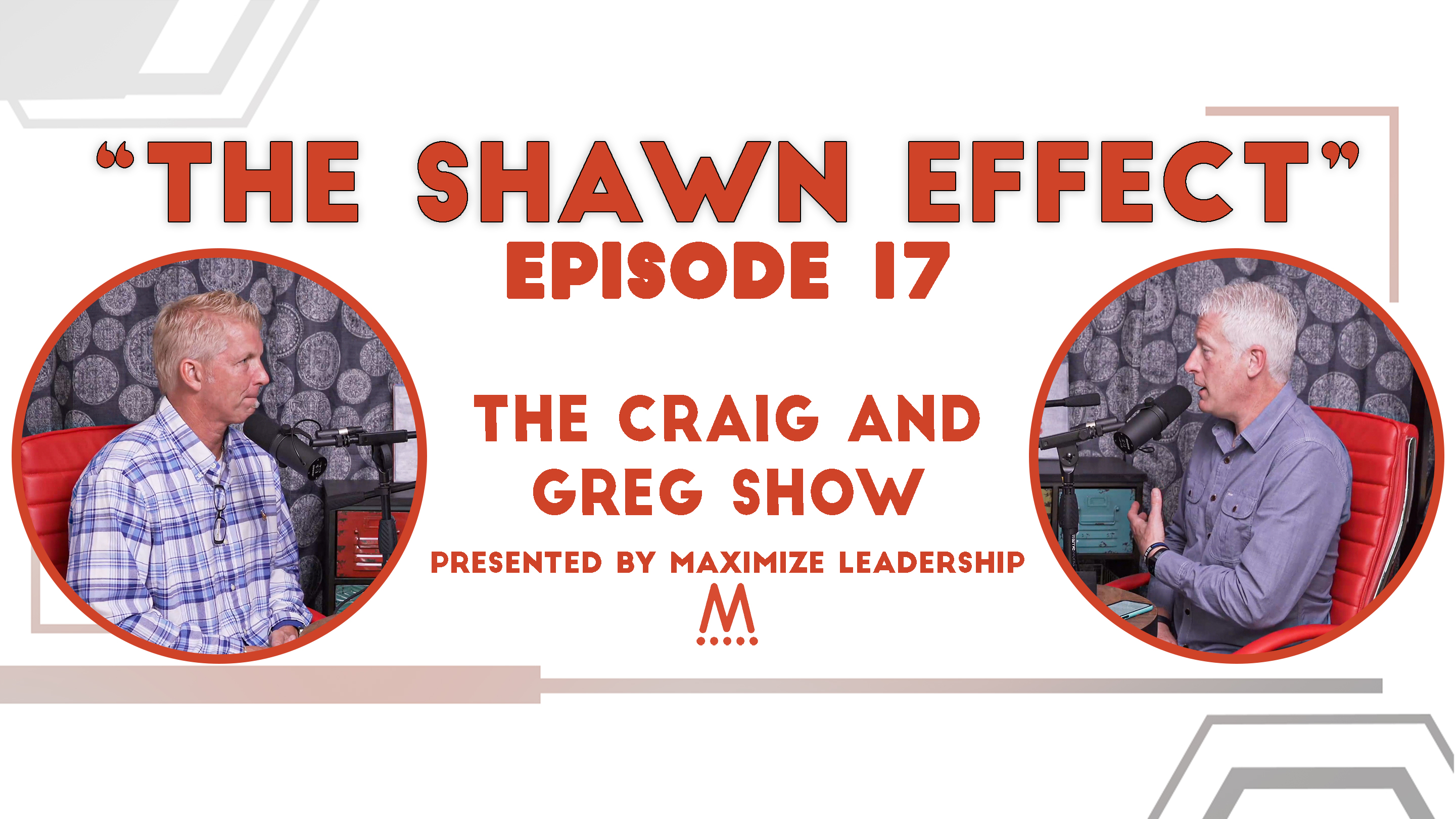
The Craig And Greg Show: Talking About “The Shawn Effect”

On this episode of “The Craig And Greg Show” we talk about: 

  • Greg’s booked called The Shawn Effect
  • what leaders look like [1:14] 
  • leaders make friends easily [2:53]
  • how you can get a free copy of The Shawn Effect [3:53]
  • Shawn’s parents set him up for success [5:15]
  • leaders get informed so they can interact with others and stay relevant [6:28]
  • Shawn demonstrated chivalry and trained young men to be gentlemen [7:53]
  • leaders don’t need a platform or a big following to be an influencer [8:40]
  • Shawn shows how leaders love [10:33]
  • leaders are encouragers [11:37]
  • leaders are readers and appliers [12:27]

Check out this episode and subscribe on YouTube so you can watch all of the upcoming episodes. You can also listen to our podcast on Spotify and Apple.