Listen to the podcast of this post by clicking on the player below, and you can also subscribe on Apple, Spotify, or Audible.
The word sounds as painful physically as it is emotionally. I am talking about the word “fester.”
Check out this episode of The Podcast.
I truly believe that When Sheep Bite will be a healing resource for shepherd leaders who are still feeling the pain of their latest sheep bite. Please pick up a copy today!
If you would like to check out the full conversation Greg and I had on our leadership podcast called The Craig and Greg Show, you can find that episode here.
Listen to the podcast of this post by clicking on the player below, and you can also subscribe on Apple, Spotify, or Audible.
On Mother’s Day, I mentioned that Proverbs 31 might be an intimidating description for Moms, but it doesn’t need to be that way. This chapter lists what is possible when a woman is fully committed to God, her husband, and her children.
Her faithfulness is her superpower which unleashes so many good things for those around her. Or as we said it: Her nobility helps her be a king maker.
I concluded by saying that men have an important role to play in order to honor the king-making power which the godly women in his life have unlocked. This is a man’s superpower! Together, God-fearing men and women can create a legacy of king makers. But separated or self-focused men and women can create a legacy of king breakers.
The Hebrew word for noble is used five times in Proverbs: three times for the godly superwoman (Proverbs 12:4, 31:10, 31:29), and twice for the godly superman (13:22, 31:3).
Remember that this word is also translated in different versions of the Bible as excellent, virtuous, and strong in character.
In Proverbs 31:3 the word vigor for men is attached to that same Hebrew word. In this context, the word can be defined as strength, efficiency, ability, or wealth.
On Mother’s Day, we said that Eve is the “help meet” (as the old King James Version says), which means that she is the key that unlocks Adam’s potential. The teaching throughout Proverbs says that men can squander this unlocked potential by…
…forgetting God’s laws—Proverbs 31:4-5
…not stewarding the unlocked leadership opportunities in our marriage, parenting, work, or community involvement (Proverbs 5:15-20; 2:1-5, 12-17; 22:29; 31:23).
In essence, we cancel the definition of vigor that we saw above, changing strength to weakness, efficiency to inefficiency, ability to inability, and wealth to poverty.
On Mother’s Day we looked at virtuous Ruth who used her godly superpower to unlock the potential for Boaz, the man who would become her husband. Let’s look at his example:
he was called a man of standing because his righteousness was well known in Bethlehem—Ruth 2:1
he was obedient to the smallest details of the law—Ruth 2:3; Leviticus 19:9-10
he honored his father by following his example—Matthew 1:5; Joshua 2:1-24, 6:23
he was an honored employer—Ruth 2:4
he was also (just like Ruth) called a man of noble character—Ruth 3:7-11, 14
A Dad’s superpower looks very similar to a Mom’s superpower. The godly woman unlocks the potential, and when the godly man carefully stewards that potential, he is also using his godly superpower (Luke 12:42-43, 48)!
Guys, when we use our God-given superpower, we honor Him and the godly women in our lives who have made this possible for us. We do this by…
…faithfully loving God with all our heart, soul, mind, and strength—Proverbs 31:4-5; Mark 12:28-31
…caring for our bride like Jesus cares for His bride—Ephesians 5:25
…honoring the legacy of our parents—Ephesians 6:2-3
…passing on a godly heritage to our children—Ruth 4:21-22
This is God’s design. And it is God’s delight when we live this way. So we must make the choice to either carry on the godly heritage that was handed down to us, or reverse the ungodly heritage that we may have inherited.
Godly men and women unlock and perpetuate their God-given superpower by giving their heart, soul, mind, and strength to God. And then God will continue to empower us as the spouses, parents, and leaders in our community that He desires for us to be!
There’s no secret formula to fruitfulness as a Christian. We just stay connected to Jesus and the fruit will grow. This clip is from this sermon.
I have lots of new content every week, which you can check out on my YouTube channel.
The “Ten Commandments” are not explicitly listed or reiterated in the New Testament. Does that mean they are obsolete? No, says David Mathis, it means they are fulfilled. “Jesus Himself says He did not come to destroy the Law and Prophets, but to do something even more striking: fulfill them (Matthew 5:17). That is, fulfill like prophecy. Not simply keep the Ten in place, or remain under them, or leave them untouched, but fulfill them—first in His own person, and then by His Spirit in His church. He came not to cast off Moses, but to fulfill Jeremiah, and in doing so, He accomplished what is even more radical: establishing Himself as the supreme authority, putting God’s law within His people (rather than on tablets), writing it on their hearts (rather than stone), and making all His people to know Him (Jeremiah 31:31–34).” Check out my post The 10 Commandments in the New Testament.
More archeological evidence supporting to the historicity of the Bible. You can check out the full article, but this paragraph is a good summation: “One of the surprising findings was that, according to the results of their tests, the Broad Wall in Jerusalem, also known as Hezekiah’s Wall, was likely built during the reign of Uzziah, who Scripture says built fortifications in Jerusalem (2 Chronicles 26:9). Another finding was that Jerusalem was much more heavily populated and urbanized in the 12th through 10th centuries BC than some scholars previously thought. This would align with the biblical description of Jerusalem, particularly during the days of David and Solomon.”
“There is much of beauty, goodness, and truth to be discovered in the city of man, as Augustine pointed out toward the end of his great treatise, City of God. But all the culture and best intentions of men turn to corruption apart from the power of God to redeem and renew them. We who live also in the heavenly city now possess the mind of Christ (1 Corinthians 2:16); we are able to see the ways that culture can be ‘taken captive’ from the clutches of sin and unbelief and made to serve the purposes of Christ in all things. Thus, for the honor and glory of God, we commit ourselves daily to using all our time, activities, relationships, roles, responsibilities, and culture to furthering His rule on earth as it is in heaven.” —T.M. Moore
“Have movies and most conventional paleontologists got it all wrong? T. rex and other theropod dinosaurs (the meat-eaters) are often portrayed as intelligent predators that can outmuscle and outsmart their opponents. But is that really supported by science?” A very interesting compilation of research can be found here. The conclusion is exactly right: “God designed dinosaur brains that were perfectly suited for their lifestyles and body size when He created dinosaurs on Day 6 of the creation week (Genesis 1:25).”
Listen to the audio-only version of this podcast by clicking on the player below, or scroll down to watch the video.
As you may have heard, I have written a new book! In this episode Greg and I sit down and chat about When Sheep Bite, and discuss how the valuable lessons it provides are critical for leaders of any organization.
[0:21] I have a confession to make…
[1:43] This book is for both business leaders and church leaders.
[3:07] Attacks usually lead to to fight-or-flight, but When Sheep Bite offers a new response.
[5:21] It’s healthy to validate our feelings when we’ve been hurt, but then good leaders go deeper.
[8:39] Empathy is health, but making excuses is not healthy.
[10:37] Watch out for the sneaky bite of flattery.
[11:26] Leaders who have been hurt have to guard against harboring that hurt.
[13:23] Leaders need to learn how to confront misbehavior correctly.
[14:46] In order for sheep to bite, and in order for the shepherd to lead, they have to be close to each other. How do both sheep and shepherds set boundaries?
[17:46] We can disagree but we cannot disrespect!
[19:49] Bitterness can rob a leader of vitality, so we have to find effective ways to heal.
[22:46] Fight-or-flight is natural, but we need to strive for the supernatural response of faithfulness to our calling.
[23:40] In many ways WSB points to what a good coach does. Contact Maximize Leadership about how our coaching huddles can help your leadership soar—get in touch with us!
Check out this episode and subscribe on YouTube so you can watch all of the upcoming episodes. You can also listen to our podcast on Spotify and Apple.
Listen to the podcast of this post by clicking on the player below, and you can also subscribe on Apple, Spotify, or Audible.
How exactly should we pray for those who have so badly mistreated us? There’s a natural response, and then there’s a supernatural response that Jesus calls us to.
In the New Testament, the Greek word for “bless” is eulogeo. The prefix eu- means “good” and the root logos is “word.” So, in the New Testament context in which we now live, to bless someone literally means to say good words both to them and about them. So when Jesus tells us, “Bless those who curse you and pray for those who mistreat you,” He is telling us to say good words to them, and to say good words about them in prayer to our Heavenly Father. …
Commenting on Psalm 109:4, my friend Kevin Berry said, “While they accuse me like satan, I will pray for them like Jesus.” This is the highest level of Christian maturity: To pray like Jesus did for those who insulted Him, slandered Him, and crucified Him, “Father, forgive them for they don’t understand what they are doing” (Luke 23:34).
I truly believe that When Sheep Bite will be a healing resource for shepherd leaders who are still feeling the pain of their latest sheep bite. Please pick up a copy today!
Listen to the podcast of this post by clicking on the player below, and you can also subscribe on Apple, Spotify, or Audible.
I’ve noticed how quick some people are to give up when things don’t get them the results they thought they should get, or the results don’t come as soon as they expected.
Anytime we try something new, there is always the potential for failure. Even later on, those who appear to be an expert at something rarely do it perfectly. But in either case, there are three things we need to do if we don’t get the results we expected: (1) reflect, (2) evaluate possible improvements, (3) re-engage.
Even before Jesus commissioned us to take His message of Good News to every street everywhere, He told us not to expect perfect results. In one of His best-known parables, Jesus talked about the farmer sowing seed (see Luke 8:5-8).
Jesus didn’t say, “All of your efforts at sharing the Gospel will be successful.” In fact, He said some efforts would totally fail (falling on the hard path), and some would have only temporary success (falling on the weedy and stony ground). But we keep on sowing the seed because some will fall on good soil and yield a harvest a hundred times more than was sown!
So, as John Wesley said, “Do all the good you can, by all the means you can, in all the ways you can, in all the places you can, at all the times you can, to all the people you can, as long as ever you can.”
The baptism of the Holy Spirit brings dynamic, life-changing power (Acts 1:8). The life that is changed first is our own. Everything about us begins to change.
When people heard Jesus speak, they said, “How did this Man get such learning without having been taught?” (John 7:15). The same Holy Spirit who empowered Jesus to speak is the same Holy Spirit who will empower our words.
When our words are Spirit-empowered words, people can feel it. When our words are matched by our lifestyle, people can’t ignore it (John 7:46; Acts 2:37, 4:13, 6:10)!
Just like salt that influences effortlessly, silently, and irreversibly, we never know what part the salt of our lives is playing in someone else’s life, even if it appears that nothing substantial is happening at all. But God said His word always accomplishes its purpose (Isaiah 55:10-11), which is why we keep on living and speaking as Spirit-empowered witnesses.
And we live expecting that something is happening—Let us not become weary in doing good, for at the proper time we will reap a harvest if we do not give up (Galatians 6:9).
How do we take this message of Jesus to every street?
Stay yielded to the influence of the Holy Spirit
Regularly and consistently read and apply God’s Word to your own life
Keep sowing in expectation
If your efforts appear to fail: reflect, evaluate, re-engage in expectation
We can be salt without being salty; we can be light without being annoying.
We have been empowered to take the Good News to every street, so let us not become weary in doing this.
Guys, you don’t have to “live down” to the poor male role models that Hollywood portrays, but you can create a beautiful culture in your marriage, your home, and your workplace. Check out the full sermon this clip came from.
I have lots of new content every week, which you can check out on my YouTube channel.
“Challenge yourself; it’s the only path which leads to growth.” —Morgan Freeman
Michael R. Emlet writes, “There are no easy answers here. In thinking about the juxtaposition of mental-health issues and church discipline, we want to be wary of two extremes. First, we don’t want to avoid corrective pastoral care out of fear that we will ‘add insult to injury’ for those struggling with mental affliction. Second, we don’t want to care for someone with mental illness exactly as we would care for someone without such a struggle. We want biblical truth and love to guide us.” This is a thoughtful post about how pastors should think about mental illness in church disciple. I shared a year-long series of messages on a Christian’s mental health, which you can find here.
Listen to the podcast of this post by clicking on the player below, and you can also subscribe on Apple, Spotify, or Audible.
I’m going to guess that I’m not alone in this: I don’t like when people criticize me.
Especially when I’m in a leadership position, trying my best to make good decision for the entire organization, and someone comes up to me to criticize my decision-making abilities or my skill at carrying out my decisions.
The easiest thing to do is simply dismiss their biting remarks. We can so easily say, “They have no idea what they’re talking about so I can ignore everything they’ve said to me.”
Criticism is one of the most common bites that sheep dispense to those who are trying to shepherd them.
But before we simply dismiss them, let me ask you to consider this:
Is it possible that God is using these critics to get your attention?
Is it possible that you have a flaw in a blind spot, and this critic is showing you something that you’ve been missing?
If you can answer, “Yes” to even one of those questions, then you can also say that your critic is a God-sent gift for you to improve your leadership capacity.
I discussed this recently on the Fellowship of Ailbe podcast.
The full quote from Dick Brogden’s book Proverbs: Amplified and Applied says: “Critics and skeptics are gifts to us, for in their aspersions they often bring to light a brokenness or a liability early on in its development in us. If we are secure enough to ferret out the truth through the condemnation of others, we remain healthy in the long term as our malady is exposed and dealt with before it becomes too serious.”
This means that criticism should lead us to a time of honest introspection.
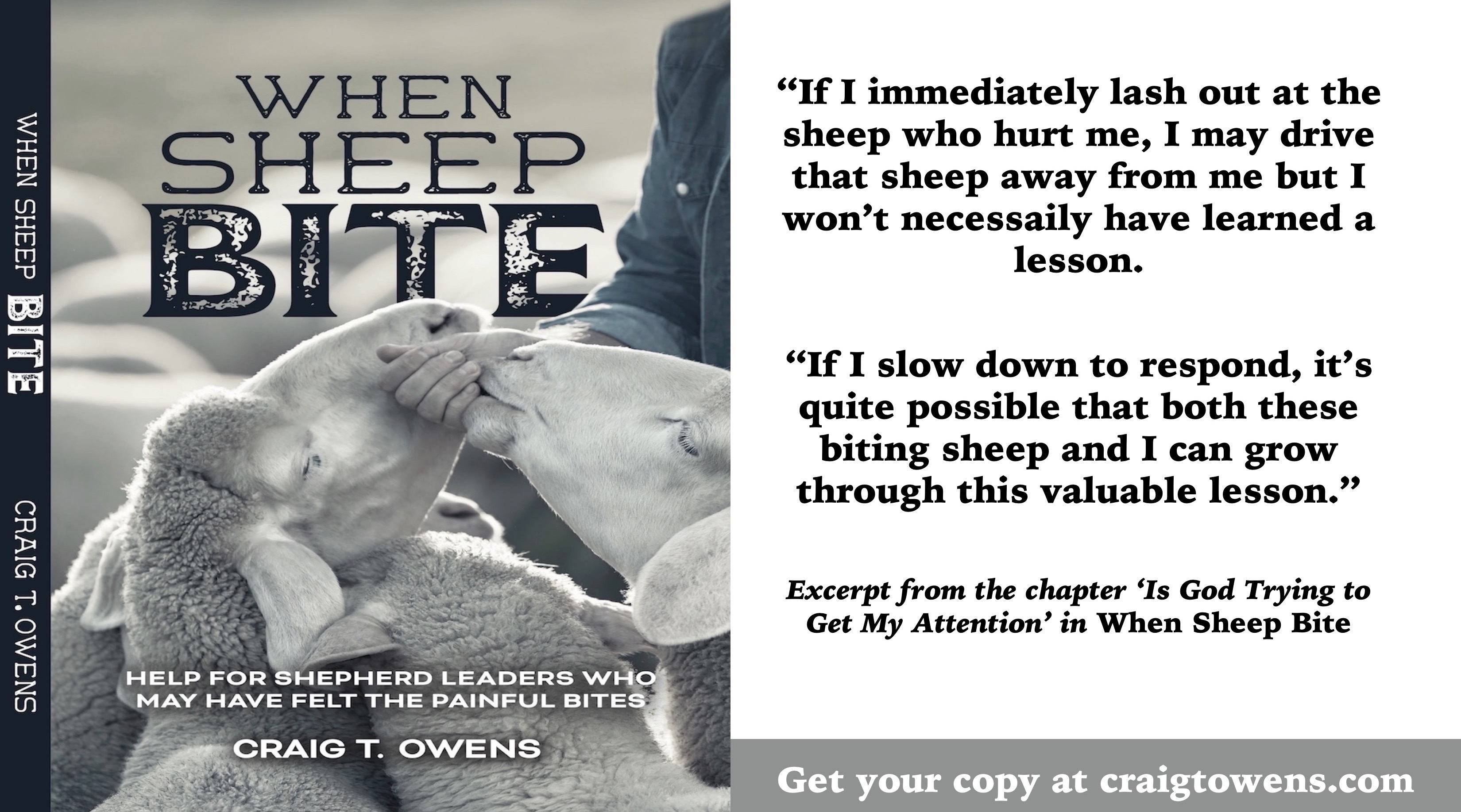
In the chapter “Is God Trying to Get My Attention?” in my book When Sheep Bite, I wrote—
Remember that we are naturally self-protective, so this time of introspection will need to be supernaturally empowered by the Holy Spirit if we are going to see the true prompter of the attack. A prayer I have prayed more times than I can count is, “Search me thoroughly, O God, and know my heart! Try me and know my thoughts! And see if there is any wicked or hurtful way in me, and lead me in the way everlasting” (Psalm 139:23-24 AMPC).
It is only this humble reflection that can turn an experience into a lesson. If I immediately lash out at the sheep who hurt me, I may drive that sheep away from me but I won’t necessarily have learned a lesson. The one who bit me may have left my pasture, but perhaps they will never join any other pasture but may wander in the wilderness for the rest of their life. If I slow down to respond, it’s quite possible that both these biting sheep and I can grow through this valuable lesson.
Let’e reframe the way we think about critics and their criticism. Before we simply dismiss it, let’s prayerfully consider if there is a lesson that God is trying to teach to us through this critic.
We don’t worship because we have a comfortable setting. We worship God because He is worthy to be worshiped! Our focus is not on these temporal things, but on His eternal, majestic glory!
Listen to the podcast of this post by clicking on the player below, and you can also subscribe on Apple, Spotify, or Audible.
Jesus sent us and the Holy Spirit empowers us to take the Good News to all nations—all the streets (Luke 24:47-49; Acts 1:8)—even the streets of Samaria where we will have more differences than similarities.
There is one street that has infiltrated and affected every other street more profoundly than any other: Hollywood Boulevard. The constant bombardment of messages through movies, television programs, music, literature, and the arts is almost immeasurable.
I think Christians rarely stop to ponder how much of the culture on Main Street is influenced by the content from Hollywood Boulevard. Probably because so few Christians are involved in the artistic or creative communities.
Here’s what we need to remember: All of this creativity is God-given. The opening words in the Bible say, “In the beginning God created…” (Genesis 1:1).
We specific examples of God-given creative skills in:
Bezalel—Exodus 31:1-5
Oholiab—Exodus 31:6, 35:34
craftsmen and craftswomen—Exodus 31:6; 35:10, 22, 25
In more modern times, we see notable creative people giving credit to God for their abilities.
William Shakespeare’s use of biblical themes—and even exact phrases—throughout his work is easy to spot. In the opening line of his last will and testament, he wrote, “I commend my soul into the hands of God my Creator, believing through the merits of Jesus Christ, my Savior, to be made a partaker of life everlasting.”
Johan Sebastian Bach, considered by many to be the greatest composer to ever live, placed “S.D.G.” on every one of his musical compositions, which stands for Sola Deo Gloria: only for the glory of God.
The apostle James tells us that every good and beautiful gift has come to us from God our Creator (James 1:17). And then this is my paraphrase of a similar thought the apostle Peter—
Each of you should use whatever gift you have received to serve others, as faithful stewards of God’s grace in its various forms. If anyone speaks [writes, paints, composes, sculpts], they should do so as one who speaks [writes, paints, composes, sculpts] the very words of God. (1 Peter 4:10-11)
So, here are four thoughts about how we can take the Good News of Jesus to Hollywood Boulevard.
Create a beautiful culture in your home, your Main Street, your workplace, your school. Ask the Holy Spirit to help you answer the question, “What can I do so that the love and beauty of Jesus will be felt here?”
Use your creative skills—write poems, compose music, paint a picture, sew clothing, bring innovation to your job.
Support beautiful authors, musicians, moviemakers, painters, etc. Hollywood produces what they think will make money, so if you are supporting creators of beautiful things, they will produce more of those things.
Leverage Hollywood’s culture to talk to others about heavenly culture. Point out biblical themes, challenge the rationale behind unbiblical lyrics, etc.
“Christians need to ask themselves a few key questions to help us respond to the society around us. First, what is good in our culture that we can promote, protect, and celebrate? Second, what’s missing in our culture that we can creatively contribute? Third, what’s evil in our culture that we can stop? And fourth, what’s broken in our culture that we can restore?” —John Stonestreet
Don’t complain—create something better.
Don’t compromise—promote what is beautiful and edifying.
The Holy Spirit can empower us to take the Good News of Jesus even to Hollywood Boulevard!
If you’ve missed any of the other messages in our series Takin’ Him to the Streets, you can find them all here.








 Craig T. Owens