Thursdays With Oswald—Second Mile Christianity

This is a weekly series with things I’m reading and pondering from Oswald Chambers. You can read the original seed thought here, or type “Thursdays With Oswald” in the search box to read more entries.

Second Mile Christianity

     To go the second mile means always do your duty, and a great deal more than your duty, in a spirit of loving devotion that does not even know you have done it. … The supreme difficulty is to go the second mile with God, because no one understands why you are being such a fool. The summing up of Our Lord’s teaching is that it is impossible to carry it out unless He has done a supernatural work in us. … 

     The interests of the Son of God and of the disciple are to be identical. How long it takes to manifest that identity depends on the private history of the disciple and his Lord. … 

     We do not need the grace of God to stand crises; human nature and pride will do it. We can buck up and face the music of a crisis magnificently, but it does require the supernatural grace of God to live twenty-four hours of the day as a saint, to go through drudgery as a saint, to go through poverty as a saint, to go through an ordinary, unobtrusive, ignored existence as a saint, unnoted and unnoticeable. The “show business,” which is so incorporated into our view of Christian work today, has caused us to drift far from Our Lord’s conception of discipleship. It is instilled in us to think that we have to do exceptional things for God; we have not. We have to be exceptional in ordinary things, to be holy in mean streets, among mean people, surrounded by sordid sinners. That is not learned in five minutes. 

From So Send I You

Jesus calls His disciples to go the second mile. Others won’t understand us, and few (if any) people will applaud us for doing so.

Like a novice runner, maybe we can’t go the whole second mile the first time out. Maybe not even the second or third time. But can we go a bit further the second time than we did the first? And a bit further the third time than we did the second? That’s what discipleship is all about: Letting Jesus help us go a bit further each time.

If you stick with it, soon you will be going the second mile and not even realize it. Other may not realize it either, but God always sees when we do, and He is pleased!
Proof Of Impossibilities

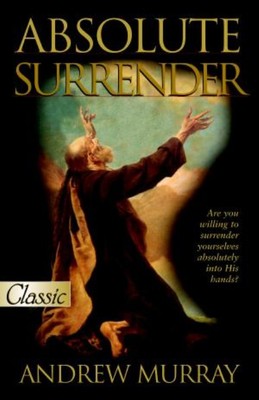
“Your religious life is every day to be a proof that God works impossibilities; your religious life is to be a series of impossibilities made possible and actual by God’s almighty power. That is what the Christian needs. He has an Almighty God that he worships, and he must learn to understand that he does not need a little of God’s power, but he needs—with reverence be it said—the whole of God’s omnipotence to keep him right, and to live like a Christian.” —Andrew Murray, in Absolute Surrender (emphasis mine)

10 Quotes From “Everything You Always Wanted To Know About God”

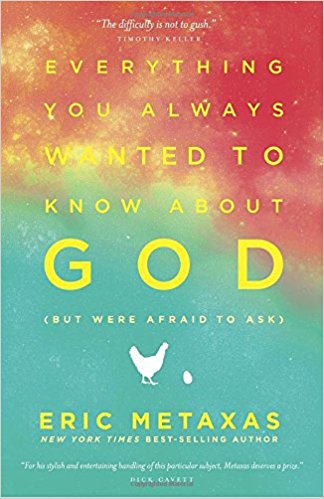
This book from Eric Metaxas is a great way to stimulate a conversation about spiritual questions, or a wonderful resource for you to read together with a friend who is on a spiritual journey of discovery. Check out my review of this book by clicking here, and then enjoy a few of the quotes I especially appreciated.

“We aren’t responsible for having answers to every question about God or the Bible posed to us, but we are responsible for how we answer, even if we don’t have a full answer.”

“Our culture is so obsessed with the physical and the material that we have lost the ability to think logically about anything outside that realm.”

“The bottom line is that those who follow God have to have genuine love and compassion for others, and if we recognize how profoundly messed up we ourselves are, we will have compassion for other people. So if people don’t have serious humility about their own state of affairs, they should probably keep their mouth shut. God doesn’t want His followers to add to the pain of the people He loves. He wants His children to treat others as people He desperately loves.”

“The idea of a moral structure that cuts God out of the picture is very attractive to humans because that puts us in control. But God wants us to understand that without a relationship with Him, moral behavior isn’t worth anything. Mere moral rectitude doesn’t fool God.”

“Religion in the negative sense of simply being a bunch of rules and rituals is pretty much the same as superstition. Without a relationship with God at its core, all religion devolves to superstition.”

“One of the most harmful things in human history is when people have confused fear-based superstition with faith in God.”

“Either Jesus was God and died on the Cross and then rose bodily from the dead, thereby destroying sin and death and making it possible for us to be with Him in paradise forever, or having faith in him is bogus. Period. Without the central events of Jesus’ crucifixion and resurrection, you simply don’t have Christianity. You can call it Christianity, but it’s not. All religions are not alike, so ultimately you have to choose.” 

“That’s always the case with sin. It never presents itself as sin. It’s always presented as a doorway to a higher consciousness, as a path to enlightenment meant, as the path to divinity—to becoming a god, or like God.”

“To try to earn God’s love is to miss the point entirely. He loves us already. We can’t be more loved by Him. So to try is like adding numbers to infinity. You can’t get higher than infinity, and His love for us is infinite.”

“Faith does not necessarily make us perfect, but perhaps it does have a way of making us more aware of our feelings.”

7 Quotes On Conquering Fear From “The Seven Laws Of Love”

The Seven Laws Of Love

In The Seven Laws Of Love, Dave Willis gives us some highly practical, biblically-based counsel for investing in all of our relationships. Normally when I share quotes from books, I share all of them at once, but for this book I felt like it would be good to share these quotes a bit more slowly, to give you time to read them and apply them.

The seven laws Dave identifies are:

  1. Love requires commitment (read the quotes here)
  2. Love selflessly sacrifices (read the quotes here)
  3. Love speaks truth (read the quotes here)
  4. Love conquers fear
  5. Love offers grace
  6. Love brings healing
  7. Love lives forever

From law #4, here are some quotes on how love conquers fear—

“Fear may be something natural, but love represents something supernatural. Love has the power to set a positive course for your life and chase away your fears in the process.”

“We do have the power to shape the future, but unless you actually own a time machine, worrying about the past is a complete waste of your time and energy. If you want to live a life of love and the freedom it brings, you’ve got to make peace with your past. We should learn from our past and build on our past but not ever dwell on our past. Just like the rearview mirror in your car, looking at the past gives us perspective; but if you’re staring at it all the time, you’re going to cause a wreck. We need to embrace the moment we are in. Don’t let regrets from yesterday or worries about tomorrow rob you of the peace and blessings God has for you today!”

“The truth is that your past has helped shape your character, but it has nothing to do with your identity. Your identity comes from God alone, and He loves you unconditionally.”

“Don’t get trapped trying to recreate the good old days when your best days are still to come.”

“There isn’t enough room in your heart for both fear and faith, so each day you must decide which one gets to stay.”

“Your character should always be stronger than your circumstances.”

“Your struggles always lead to strength.”

Check out my review of The Seven Laws Of Love by clicking here.

Watch for more quotes from the other laws of love explained in this book throughout this week.

10 Quotes From C.S. Lewis

C.S. Lewis(When is it ever not a good day to share C.S. Lewis quotes?!)

“There is either a warning or an encouragement here for every one of us. If you are a nice person—if virtue comes easily to you—beware! Much is expected from those to whom much is given. If you mistake for your own merits what are really God’s gifts to you through nature, and if you are contented with simply being nice, you are still a rebel: and all those gifts will only make your fall more terrible, your corruption more complicated, your bad example more disastrous. The devil was an archangel once; his natural gifts were as far above yours as yours are above those of a chimpanzee.” —C.S. Lewis 

“The monstrosity of sexual intercourse outside marriage is that those who indulge in it are trying to isolate one kind of union (the sexual) from all the other kinds of union which were intended to go along with it and make up the total union. …You must not isolate that pleasure and try to get it by itself, any more than you ought to try to get the pleasures of taste without swallowing and digesting, by chewing things and spitting them out again.” —C.S. Lewis

“On the contrary, those who are seriously attempting chastity are more conscious, and soon know a great deal more about their own sexuality than anyone else. They come to know their desires as Wellington knew Napoleon, or as Sherlock Holmes knew Moriarty; as a rat-catcher knows rats or a plumber knows about leaky pipes. Virtue—even attempted virtue—brings light; indulgence brings fog.” —C.S. Lewis

“For there are two things inside me, competing with the human self which I must try to become. They are the Animal self, and the Diabolical self. The Diabolical self is the worse of the two. That is why a cold, self-righteous prig who goes regularly to church may be far nearer to hell than a prostitute. But, of  course, it is better to be neither.” —C.S. Lewis

 “A great deal of our anxiety to make excuses comes from not really believing in it, from thinking that God will not take us to Himself again unless he is satisfied that some sort of case can be made out in our favor. But that would not be forgiveness at all. Real forgiveness means looking steadily at the sin, the sin that is left over without any excuse, after all allowances have been made, and seeing it in all its horror, dirt, meanness, and malice, and nevertheless being wholly reconciled to the man who has done it. That, and only that, is forgiveness, and that we can always have from God if we ask for it.” —C.S. Lewis 

“To be a Christian means to forgive the inexcusable, because God has forgiven the inexcusable in you.” —C.S. Lewis

“The human lives in time but our enemy destines them to eternity. He therefore, I believe, wants them to attend chiefly to two things, to eternity itself, and to that point of time which they call the Present. For the Present is the point at which time touches eternity. Of the present moment, and of it only, humans have an experience analogous to the experience which our Enemy has of reality as a whole; in it alone freedom and actuality are offered them. He would therefore have them continually concerned either with eternity (which means being concerned with Him) or with the Present—either meditating on their eternal union with, or separation from, Himself, or else obeying the present voice of conscience, bearing the present cross, receiving the present grace, giving thanks for the present pleasure.” —C.S. Lewis

“War creates no absolutely new situation; it simply aggravates the permanent human situation so that we can no longer ignore it.” —C.S. Lewis

“The rescue of drowning men is, then, a duty worth dying for, but not worth living for.” —C.S. Lewis

“Christianity does not simply replace our natural life and substitute a new one; it is rather a new organization which exploits, to its own supernatural ends, these natural materials.” —C.S. Lewis

Links & Quotes

link quote

“satan is real and may have a hand in our calamities, but not the final hand, and not the decisive hand. James makes clear that God had a good purpose in all Job’s afflictions: ‘You have heard of the steadfastness of Job, and you have seen the purpose of the Lord, how the Lord is compassionate and merciful’ [James 5:11]. So satan may have been involved, but the ultimate purpose was God’s, and it was ‘compassionate and merciful.’” —John Piper

“God’s will is determined by His wisdom which always perceives, and His goodness which always embraces, the intrinsically good.” —C.S. Lewis

“Let us never suppose that there is any lack of charity in speaking of hell. Let us rather maintain that it is the highest love to warn men plainly of danger, and to beseech them to ‘flee from the wrath to come.’ It was satan, the deceiver, murderer, and liar, who said to Eve in the beginning, ‘You shall not surely die.’ (Genesis 3:4.) To shrink from telling men, that except they believe they will ‘die in their sins,’ may please the devil, but surely it cannot please God.” —J.C. Ryle

“You aren’t the only person with your skill. But you are the only person with your version of your skill.” —Max Lucado

“There is nothing natural about the Christian life. It is all supernatural. It’s a life dependent upon miracles from the very beginning (including your conversion). And it simply can’t be lived without faith in the supernatural.” —David Wilkerson

It is time for science to detach itself from an atheistic worldview. Douglas Rushkoff states, “By starting with Godlessness as a foundational principle of scientific reasoning, we make ourselves unnecessarily resistant to the novelty of human consciousness, its potential continuity over time, and the possibility that it has a purpose.”

Detroit Tigers fans (like me!) will love this: an interactive map that shows where every Tiger has been born.

John Stonestreet asks, “Why is pop music so angry?” Check out his answer in Bad Blood.

[VIDEO] John Maxwell challenges us to find someone we can inspire this weekend—


Links & Quotes

link quote

“Don’t dare to be different, dare to be yourself—if that doesn’t make you different then something is wrong.” —Laura Baker

“Real joy is to be found in the presence of God, with Jesus Christ, secure and loved forever and ever (Psalm 16:11). Knowing the presence of God is the unique privilege of all who have made the Kingdom turn. God never changes in His love for us, and Jesus Christ holds us fast forever, regardless of the outward circumstances of our lives. The result of experiencing this is joy.” —T.M. Moore

“We can do nothing unless by a supernatural grace of God. It is God who gives the will. It is God who gives the power.” —John Calvin

“How singularly does God, in political events, prepare men’s minds for the particular phase which His church assumes! … I cannot go into the question now, but every Christian student of history knows that the circumstances of the outward world have ever been arranged by God so as to prepare the way for the advance of His great cause.” —Charles Spurgeon

“There is no such thing as genuine knowledge of God that does not show itself in obedience to His Word and will.” —Sinclair B. Ferguson

Eric Metaxas reminds us why Darwinism cannot explain religion. Check out Saber-tooth Psychology.

New emails continue to show the tragedy that Benghazi is. Hold our leaders accountable!

Tim Elmore explains how leading and following must go hand-in-hand.

[VIDEO] John Maxwell challenges us to enrich other people’s lives—

9 Quotes From “Purple Fish”

Purple FishI thoroughly enjoyed my time reading Purple Fish (you can read my book review by clicking here), and now I’m looking forward to sharing with others about this eye-opening book. To start with, here are a few quotes from the author of Purple Fish, Mark O. Wilson.

“We write off people too quickly as lost causes when we thought to consider them lost treasures instead.”

“In God’s grand redemption story, we humans are created for good, broken by sin, redeemed by grace, and sent to bless and heal.”

“The love of marriage, joys of childhood, and peace of home are all snippets of Eden, pointing to our original creation.” 

“Evangelism is simply how followers of Jesus interact with the world. It’s not a program or a project; it’s a life.”

“God loves us too much to waste our painful experiences. He salvages our shame and redeems our regrets. The place of great pain becomes the place of great gain. When Jesus steps in, His healing touch changes the entire outcome. Jesus mends us to send us—joining Him in the greatest adventure on earth. Salvation joy overflows. We can’t help but share this with others.” 

“We are more inclined to look up when things are looking down. … Painful experiences open the soul’s windows. … Christ stands as the solid rock for those overwhelmed by uncertainties.”

“Someone who crosses boundaries without permission is trespassing. Stepping into space where hospitality is not extended is rude and intrusive. When it comes to faith sharing, there are several layers of permission giving, and you should not trespass beyond the area you have been invited to enter. Knock gently and then follow the hints from the other person concerning how deep the conversation goes.”

“If you start with lost, then your job is to set them straight. That means you know something and they don’t. In other words, you assume you’re smart and they’re stupid. But when you start with hurting, your job is to bring healing. … When we begin with healing, we follow the Jesus path and find a strong connection. Distressed people will avoid you if they perceive you are trying to change or correct them. If, on the other hand, through kind words, gentle touch, and understanding, you bring healing and grace to their painful situations, they will seek you out.”

“Does our worldview leave room for the supernatural? Is God truly present and active in our lives? Can He really guide us by the Holy Spirit? If you only listen to your rational side, the answer is no, and you won’t see much in the supernatural department. You’ll accomplish good things, of course, but won’t experience anything marvelous. Those who believe in miracles are much more likely to experience them.”

Miracles And Nature

C.S. Lewis at his deskI recently re-read C.S. Lewis’ book Miracles (you can read my full book review by clicking here). As you may have noticed, after reading and reviewing books on this blog, I also like to share some quotes that caught my attention. Doing this with Lewis is difficult, because in order to get the context of a particular quote, I think I would have to cite almost a full page or more. So over the next few weeks I plan to share some quotes from Miracles that require not as much context, or I will provide a bit of background to set the stage.

Lewis talks at great length how Nature (and our natural laws) had to come out of something, which he calls Supernature. What we commonly refer to as a miracle is not a miracle in the sense of natural laws being broken, but in Nature accommodating Supernature. Thus, Lewis writes…

“This perhaps helps to make a little clearer what the laws of Nature really are. We are in the habit of talking as if they caused the events to happen; but they have never caused any event at all. … Thus in one sense the laws of Nature cover the whole field of space and time; in another, what they leave out is precisely the whole real universe—the incessant torrent of actual events which makes up true history. That must come from somewhere else. To think the laws can produce it is like thinking that you can create real money by simply doing sums. … It is therefore inaccurate to define a miracle as something that breaks the laws of Nature. It doesn’t. … The divine art of miracle is not an act of suspending the pattern to which events conform but of feeding new events into that pattern. It does not violate the laws proviso, ‘If A, then B’: it says, ‘But this time instead of A, A2,’ and Nature, speaking through all her laws, replies, ‘Then B2’ and naturalizes the immigrant, as she well knows how. She is an accomplished hostess. A miracle is emphatically not an event without cause or without results. Its cause is the activity of God: its results follow according to Natural law.”

For another quote from this book, see Miracle Or “Cheating”?

Miracles (book review)

MiraclesReading C.S. Lewis elaborate on theology is no easy task. But for those willing to work through his profound thoughts, a treasure trove of new insights into Scripture await. Miracles: How God Intervenes In Nature And Human Affairs is no exception to this.

“Miracle” is directly mentioned so 30 times in Scripture, but the Bible never explicitly defines miracle. Lewis gives this definition: “I use the word Miracle to mean an interference with Nature by supernatural power.” He then proceeds to explain what philosophers such as Socrates, Plato and Aristotle meant by “nature” and “super-nature” and how those understandings have been dismissed, adapted or corrupted throughout history.

Lewis moves through several chapters without admitting miracles are probable (or even possible) and without ascribing any possible miracles to God. When he finally reveals that there is a God, he states, “From the admission that God exists and is the author of Nature, it by no means follows that miracles must, or even can, occur.” He then moves to the Scripture to show how God could—and indeed, does—work miraculously.

Even after all of Lewis’ brilliant arguments, I appreciate one of his final admissions in this book: “If you find that [these ideas] so distract you, think of them no more. I most fully allow that it is of more importance for you or me today to refrain from one sneer or to extend one charitable thought to an enemy than to know all that angels and archangels know about the mysteries of the New Creation.”

Even for those who accept his arguments, Lewis offers this counsel: “My work ends here. If, after reading it, you now turn to study the historical evidence for yourself, begin with the New Testament and not with the books about it.” Ultimately I recommend this book for this one reason—Miracles creates a hunger to study God’s Word more.