There are more angels sent by God concerning one event than anywhere else in the Bible—the Advent of Jesus. Clearly, this is a big deal: The coming to earth of God Himself!
You would think this would be an occasion for great joy. But all four of the angelic appearances around the birth of Jesus have the same message: Do not be afraid.
Why are people so afraid? It’s because fear invites us to make a decision to trust God completely. People remain crippled by fear when they try to deal with fear by themselves. But when they learn to fear God instead, there is an almost inexpressible joy and freedom that explodes in our hearts!
Join us for this Advent series where we will explore why this “Do not fear” message is still relevant for us today. Please join us either in-person or on Facebook.
If you have missed any of the messages in this series, check them out here:
I have shared three lessons I learned going through dark times in my life (you can check them out here, here, and here), but we aren’t even close to exhausting all of the lessons that can be learned in the night. I want to teach you one principle that will allow for lifelong learning and application of these nighttime lessons.
The apostle Paul shared how he had matured during his times of struggle. He told the Corinthians he realized that God had delivered him in the past, was delivering him now, and would continue to deliver him in the future (see 2 Corinthians 1:3-11). The key is to hang in long enough to actually see how God brings about the deliverance and teaches the lessons.
Paul told the Corinthians, “No temptation has overtaken you except what is common to mankind. And God is faithful; He will not let you be tempted beyond what you can bear. But when you are tempted, He will also provide a way out so that you can ENDURE it”(1 Corinthians 10:13). And the writer of Hebrews said, “So do not throw away your confidence; it will be richly rewarded. You need toPERSEVERE so that when you have done the will of God, you will receive what He has promised” (Hebrews 10:35-36).
The Greek word translated “persevere” means keeping focused on the goal despite the struggles that it takes to get there. Jesus used this same Greek word at the conclusion of His parable of the sower: “The seed on good soil stands for those with a noble and good heart, who hear the Word, retain it, and by PERSEVERING produce a crop”; a crop that Jesus said was a hundred times more than what was sown (see Luke 8:5-15).
I love riding my bike on the White Pine Trail by my house. My long rides have a really fun stretch where I am flying downhill! But as fun as that part is, I’m not really building anything of lasting value. However, when I am coming back uphill and I want to quit because my legs are burning and I can hardly breathe, that becomes a valuable struggle. I cannot build endurance by any other way than to push myself just a little bit farther each time. When I want to quit, I pedal just a few more feet. Gradually, the uphill becomes less daunting.
A friend gave me a t-shirt I like to wear on my rides. When I put it on the blue-lettered message on the shirt says, “Do It!” but as I struggle uphill and the sweat begins to pour off my body, a new message emerges: “Don’t Quit!”
Remember that as you struggle and persevere, you are not only building your own endurance, but you are strengthening yourself to be able to help others. So we can be thankful IN the night because God is building our endurance for the next night, and our endurance for our friend’s next night.
I’m an up-and-at-em, carpe diem kinda guy. Nothing gets me down for very long—I’m resilient and self-motivated. So I used to have a hard time relating to people who weren’t wired the same way. That is until I went through a time in my life where getting up-and-at-em was one of the hardest things I had to do each day.
In the midst of this dark night, I would ask God, “Why is this happening to me? What did I do wrong?” But I heard the Holy Spirit gently but unmistakably remind me, “This isn’t about you!”
The dictionary says that empathy is nearly a transliterated word from the Greek word empatheia. It means to be in suffering, but the emphasis is more on imaginativeempathy. Something like, “If I was them and I was in that situation, I bet it might feel like this.”
In the New Testament, a different Greek word is translated sympathy, which is also a transliterated word from the Greek sympatheō. This word means to enter into another’s suffering, but the emphasis is on experientialempathy.In other words, I don’t have to imagine how you might feel, but I know how you feel because I’ve gone through the same thing myself.
Just as the Holy Spirit taught me this lesson, let me say the same thing to you: the dark night you are going through isn’t about you. It’s about learning empathy SO THAT you can help others persevere all the way to the end!
Think about the dark night Jesus went through just before His crucifixion. He might have asked His Father, “Why is this happening to Me? What did I do wrong?” But He knew why He was going through this night: it was to prepare Him to be the perfect empathetic High Priest for all of us (check out these verses in Hebrews).
When we invite Jesus to be our Lord and Savior, we become a part of His Body (1 Corinthians 12:13, 26).
Dr. Paul Brand was a renowned hand surgeon and missionary who worked with leprosy patients in India for years. He learned that leprosy doesn’t mangle a person’s foot or hand, but their lack of ability to feel pain does. He wrote, “A body only possesses unity to the degree that it possess pain…. We must develop a lower threshold of pain by listening, truly listening, to those who suffer. … The body protects poorly what it does not feel.”
Sometimes we have to go through the painful, dark nights so that we can learn to feel others’ pain so that we can learn empathy.
Through those nights we can learn to hear what others aren’t saying, and feel what others aren’t expressing. We don’t have to ask, “Can I help?” but rather, “I’m here to help because I know what you’re going through.”
You cannot truly empathize until you go through your own dark night. I can be thankful IN the night because God is growing my empathy so that I can help others!
A mark of a maturING saint is one who when he realizes he is in a trough begins to praise God in anticipation of the blessings which are coming! Even the most mature Christian you know hasn’t “arrived”; we are all a work-in-progress. Going through the dark nights is one way God helps mature our understanding of contentment.
You know the differences between a need and a want: a need is something vital, something I require to survive; a want is something that would be nice to have.
In good times I can convince myself that my wants are really the same as my needs. In the bright, sunny times a lot of wants mistakenly get called needs. But in the dark nights, this confusion is quickly clarified!
In Philippians 4, Paul explains what he has learned about needs as he went through some very challenging, dark times. When he says he knows what a need is, he isn’t exaggerating a bit (see 2 Corinthians 11:24-28). And yet the Amplified Bible has Paul saying, “Not that I am implying that I was in any personal want.”
That’s because Paul was learnING contentment. The verb tense here means I have learned, I am learning, and I will keep on learning. It was an ongoing process that helped him clarify needs from wants. The word Paul uses for content is unique in all the New Testament and it means independent of external circumstances, or as the Amplified Bible says, “satisfied to the point where I am not disturbed or disquieted in whatever state I am.”
Paul uses another unique word in verse 12 when he says “I have learned.” This is a different Greek word from the previous verse. This time it means disciplined by experience to know how to respond. In other words, Paul disciplined himself to reflect on the lessons he learned in the night. The cliche “Experience is the best teacher” isn’t necessarily true. Lots of people go through experiences and never learn a single thing. Instead, we should say, “Evaluatedexperience is the best teacher.” That’s exactly what Paul is saying here: “I have learned lessons in my time of meditation after going through a dark night.”
The English dictionary defines contentment in two important phrases:
Satisfied with what I have. In Psalm 16, David learned that he had everything he needed in God, and Jesus reminded us that “your Father knows what you NEED before you ask Him” (Matthew 6:8).
Satisfied with who I am. Paul knew that “God, who set me apart from my mother’s womb and called me by His grace, was pleased” (Galatians 1:15). God made Paul on purpose and for a purpose, and Paul was satisfied with who he was in Christ. God made you on purpose too!
Our relationship with Jesus is a maturING one. It’s only IN Christ that I can be satisfied with what I have, and satisfied with who I am. It’s only IN the night that my wants get separated from my needs, by learnING contentment.
I can be thankful in the night because I am learning contentment.
Notice Asaph’s words at the beginning of Psalm 77. Twice he says he “cried out” to God. This literally means that he called aloud, not caring who heard him. It wasn’t a whimper, but Asaph said he was “distressed.” As soon as he realized the distressed state he was in, notice the words of meditation in the next four verses:
remembered (2x)
mused (2x)
thought
inquired
Asaph also began to ask himself questions, all of which have the obvious answer “NO”:
Will the Lord reject me forever?NO!
Will He never show His favor again?NO!
Has His unfailing love vanished forever?NO!
Has His promise failed for all time?NO!
Has God forgotten to be merciful?NO!
Has He in anger withheld His compassion?NO!
Again, Asaph meditates (notice the words thought, remember, meditate, and consider once again in the next three verses). His conclusion leads him not to self-pity, but to praising God.
Asaph taught us that when we get our eyes off ourselves we can see what God is doing in us, around us, and through us.
One lesson I learned in a very dark night time of my life: Who my true friends are. When all my “fans” stopped cheering and started jeering, I ended up in a very dark place. But as soon as I realized the valley I was in and began to meditate on God’s presence even in this dark place, I began to see what was happening around me. One of the things I saw were two men who stood up for me against all the foes attacking me. They stepped in when all my “fans” stepped away.
Dark times can quickly lead us to self-pity UNLESS we will realize we are in a dark place and begin to meditate on all that God says in His Word about His faithfulness. Once we get our eyes off ourselves and onto Him, we will begin to see the lessons God is teaching and the amazing things He is accomplishing.
I can be thankful IN the night because the dark nights have shown me my true friends.
Some people mistakenly think that the maturity of a Christian is a steady climb, and anything short of that is not God-honoring. They feel the graph has to always be moving up and to the right. In reality—if we zoom in—we will see lots of peaks and troughs that are in the climb.
For instance, we read the worship leader of Psalm 42 saying, “By day the Lord directs His love, at night His song is with me—a prayer to the God of my life,” and we think, “Yeah, that’s what I expect from a saintly psalmist!”
But let’s get the context. In the opening verses, this same worship leader talks about his profound thirst, his tears, and the taunts of his enemies. Twice in this psalm, he laments, “Why are you so downcast, O my soul? Why so disturbed within me?”
Many people have gone through what has been called “the dark night of the soul.” I doubt anyone has ever given thanks because of those dark times, but they have learned to give thanks during those dark times.
Consider David’s beautiful words in Psalm 23. He points out that the Good Shepherd leads us into green pastures AND into dark valleys, beside quiet waters AND into the presence of enemies.
But notice this: the Shepherd of our soul provides what we need in both daytime AND nighttime. He pours out blessings in the presence of our enemies, and as my grandfather wrote in the margin of his Bible next to verse 4, “Where there is shadow there must be light.”
Consider the example of Paul who wrote to the Philippians, “Rejoice in the Lord always. I will say it again: Rejoice!” (4:4). He wrote this to the church that was birthed by Paul’s miraculous deliverance from prison, while Paul and Silas were doing just that: Praying and singing hymns to God!
In The Screwtape Letters, C.S. Lewis gives us insight into how the demons view the temptation of Christians. Uncle Screwtape wrote to his nephew, “It may surprise you to learn that in God’s efforts to get permanent possession of a soul, He relies on the troughs even more than on the peaks; some of His special favorites have gone through longer and deeper troughs than anyone else. … It is during such trough periods, much more than during the peak periods, that the human is growing into the sort of creature He wants it to be. Hence the prayers offered in the state of dryness are those which please Him best.”
A mark of a maturing saint is one who when he realizes he is in a trough begins to praise God in anticipation of the blessings which are coming!
Don’t feel like you need to praise God FOR your troughs, but you can and should praise Him BECAUSE of His presence even in your driest, darkest trough. God is doing something in this trough time that He could accomplish in no other way. As David said, our Good Shepherd leads us in both sunlit and dark paths “for His name’s sake”—He will be glorified and you will be rewarded!
The psalmist wrote, “Yet the Lord will command His loving-kindness in the daytime, and in the night His song shall be with me” (Psalm 42:8).
Notice that the psalmist was praising God IN the night, not praising Him FOR the night. Many people have gone through what has been called “the dark night of the soul.” I don’t think anyone has ever given thanks because of being in a dark time, but certainly they have given thanks afterward because of the lessons learned in that dark time.
Quite simply put, there are some things God wants to teach us that we can learn in no other way than to go through a dark night. So we can learn to be thankful even IN those nights.
How did Nahum respond to this word of judgment God spoke through him? His opening words say, “The burden against Nineveh. The book of the vision of Nahum the Elkoshite” (NKJV). The Hebrew word for “burden” is almost always associated with a word God has spoken. It’s a realization of God’s weighty glory; it’s never, ever something we should trivialize!
Prophets don’t just prophesy future events, they also announce in the present tense where people have departed from a lifestyle that robs God of His glory and how they can be forgiven of sins.
“The prophets foretell (speak to what will happen in the future) and forth-tell (speak to what we should be doing in the present), both in the light of God’s heart for His own glory among all peoples of the world.” —Dick Brogden
God never makes idle threats nor empty promises. Truly His Word is His bond. Through Nahum, God foretold that Assyria would be utterly destroyed, twice saying, “I am against you” (Nahum 2:13-3:7).
The world may rejoice at God’s justice on evil (3:19), but how does God feel about carrying out His judgment? Ezekiel records God saying, “Do I take any pleasure in the death of the wicked,” declares the Sovereign Lord. “Rather, am I not pleased when they turn from their ways and live?” (Ezekiel 18:23)
And Jesus declared, “For God so loved the world that He gave His one and only Son, that whoever believes in Him shall not perish but have eternal life. For God did not send His Son into the world to condemn the world, but to save the world through Him.” (John 3:16-17)
The Bible shows that when I sin, God’s first response is not anger toward me but broken-hearted grief. This is the message that must be both foretold and forth-told by Christians.
“But what can I do,” you might ask. “I’m just one person. I’m not a big-time evangelist.” That sounds a lot like Nahum. He was just a guy from Elkosh—no special family lineage, no large city to claim as his home.
Foretelling God’s judgment is a burden. Forth-telling God’s forgiveness is a joy. All Christians have been given the joyful burden of this both-and ministry!
“The question, therefore, which each of us has to answer to his own conscience is, ‘Has it been the end of my ministry, has it been the desire of my heart to save the lost and guide the saved? Is this my aim in every sermon I preach, in every visit I pay? Is it under the influence of this feeling that I continually live and walk and speak? Is it for this I pray and toil and fast and weep? Is it for this I spend and am spent, counting it, next to the salvation of my own soul, my chiefest joy to be the instrument of saving others? Is it for this that I exist?’”
“It is not opinions that man needs: it is truth. It is not theology: it is God. It is not religion: it is Christ. It is not literature and science; but the knowledge of the free love of God in the gift of His only-begotten Son.”
“Our power in drawing men to Christ springs chiefly from the fullness of our personal joy in Him, and the nearness of our personal communion with Him.”
“Why so many meetings with our fellow men, yet so few meetings with God?”
“Our life has not been a lying-in-wait for the voice of God. ‘Speak, Lord; for Thy servant heareth,’ has not been the attitude of our souls, the guiding principle of our lives. Nearness to God, fellowship with God, waiting upon God, resting in God, have been too little the characteristic either of our private or our ministerial walk. Hence our example has been so powerless, our labors so unsuccessful, our sermons so meager, our whole ministry so fruitless and feeble.”
“It is easier to speak or write about revival than to set about it. There is so much rubbish to be swept out, so many self-raised hindrances to be dealt with, so many old habits to be overcome, so much sloth and easy-mindedness to be contended with, so much of ministerial routine to be broken through, and so much crucifixion, both of self and of the world, to be undergone. As Christ said of the unclean spirit which the disciples could not cast out, so we may say of these: ‘This kind goeth not out but by prayer and fasting.’”
“These must be days of strenuous, ceaseless, persevering, and, if God bless us, successful toil. We shall labor till we are worn out and laid to rest.”
“It is unbelief that makes ministers handle eternal realities with such irreverence. It is unbelief that makes them ascend with so light a step ‘that awful place the pulpit,’ to deal with immortal beings about heaven and hell.”
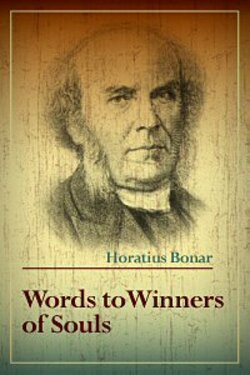
Horatius Bonar has given us a collection of sermons preached to pastors, which have been collated in a book under the title Words To Winners Of Souls.
Although these were words by a pastor to pastors, this shouldn’t be a book exclusively read by pastors. Anyone who wants to successfully share their Christian testimony with unsaved friends and loved ones can find much to digest in these sermons. That being said, this is still a must-read (and I don’t say that very often) for those in pastoral ministry.
Bonar was a no-pulled-punches preacher! He spoke candidly and forcefully, but he also spoke out of a love for the Body of Christ and its ministers. Early on in this book he says, “We take for granted that the object of the Christian ministry is to convert sinners and to edify the body of Christ. No faithful minister can possibly rest short of this. Applause, fame, popularity, honor, wealth—all these are vain. If souls are not won, if saints are not matured, our ministry itself is vain.” Wow: “our ministry itself is vain”—you cannot get more gut-level honest than that!
In this collection of messages, Bonar helps us diagnose what may be hindering our soul-winning practices, and he also proposes the remedy for those shortcomings. These words are honest and often hard to hear, but they are so needed for everyone who desires, as Jesus does, “that none should perish but all should come to repentance” (2 Peter 3:9).
Pastors, please read this book!
Parishioners, please get a copy of this book for your pastor and then offer to prayerfully read through it with him or her. I promise you: this book will pay eternal dividends.



 There are more angels sent by God concerning one event than anywhere else in the Bible—the Advent of Jesus. Clearly, this is a big deal: The coming to earth of God Himself!




 Craig T. Owens