Links & Quotes

If you want your heart to be able to perform better, you are going to have to stress it a bit—that’s called exercise. The same thing is true for the heart of leadership—we have to exercise our leadership so that it can rise to the challenge later.

I have a lot of new video content on my YouTube channel every week. Please check it out and subscribe so you don’t miss anything.

J. Warner Wallace wrote, “Everyone, whether they realize it or not, is engaged in worship. We all adore something, elevating it above the rest, sometimes so much that we overlook its flaws.” Check out this post about being careful about what we worship.

“Nothing teaches us about the preciousness of the Creator as much as when we learn the emptiness of everything else.” —Charles Spurgeon 

“We should avoid end-time hysteria and ‘not grow weary in doing good’ (2 Thessalonians 3:13). There will be good work to do (vocationally and socially and personally) right up to the Lord’s coming. Our normal earthly duties will not end until the Lord appears. The rule then, until he comes, is, ‘Whatever you do, work heartily, as for the Lord and not for men’ (Colossians 3:23).” —John Piper 

Greg Morse has a fascinating post connecting the fable of Chicken Little with the historical account of Noah and the imminent return of Jesus. “I hope an acorn falls afresh on our heads as we observe an Old Testament saint who was the Chicken Little of his day. A man who remained awake and faithful with his back against the end of the world: a man named Noah.”

Keep Your Lamp Burning

     In the Tent of Meeting [of God with His people], outside the veil which sets apart the Testimony, Aaron and his sons shall keep it burning from evening to morning before the Lord…. (Exodus 27:21) 

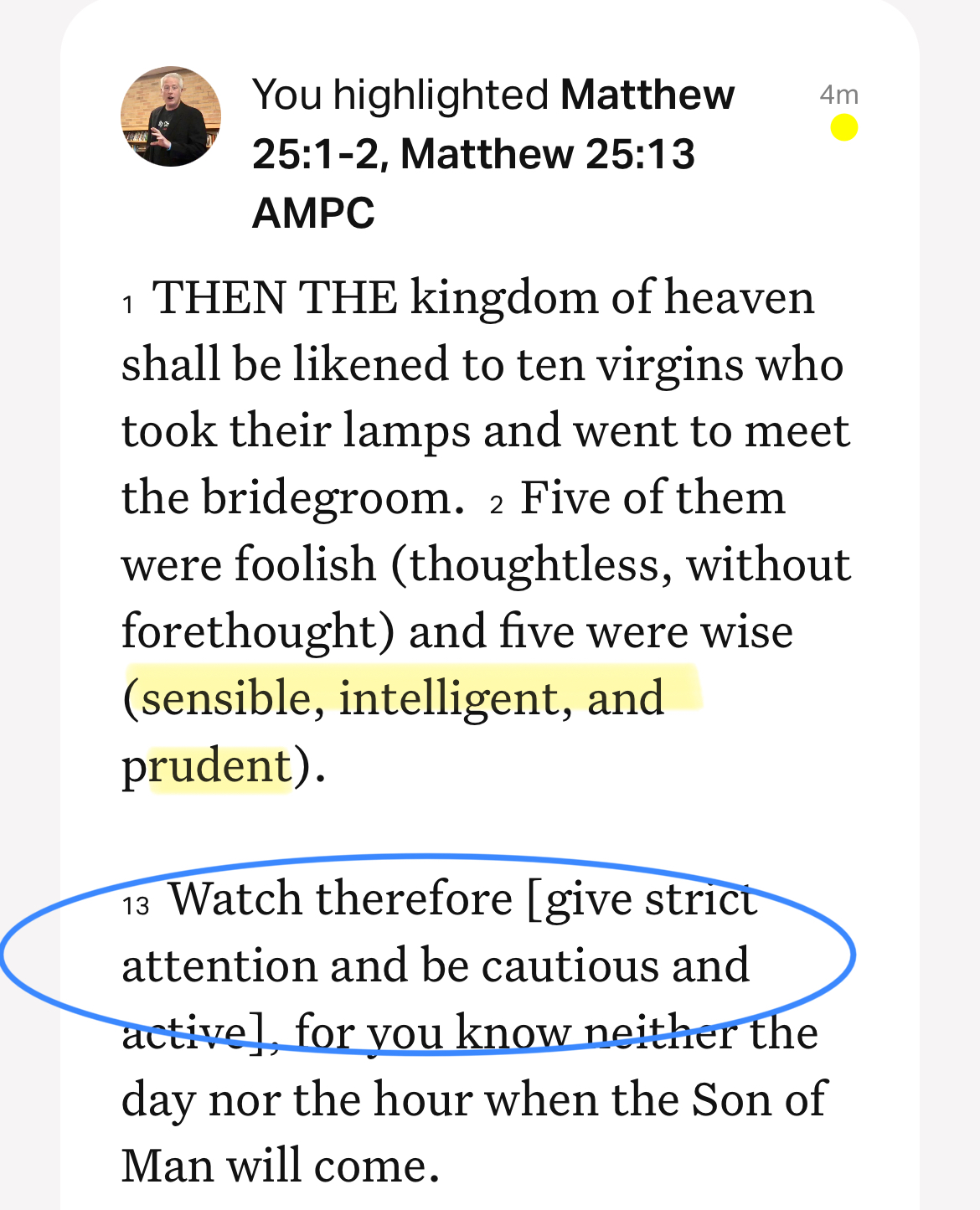
     Then the kingdom of heaven shall be likened to ten virgins who took their lamps and went to meet the bridegroom. Five of them were foolish (thoughtless, without forethought) and five were wise (sensible, intelligent, and prudent). … Watch therefore [give strict attention and be cautious and active], for you know neither the day nor the hour when the Son of Man will come. (Matthew 25:1-2, 13) 

Just as the lamps in the Tabernacle had to be continually supplied with oil so they never went out, we have to keep our lamps burning. We have the full supply of the Holy Spirit, but we have to make sure we don’t quench the Spirit. That means listening to His voice and responding in quick obedience. 

If we want to be shining brightly when Jesus returns, we must “give strict attention and be cautious and active” every single day. 

“The Days of Noah”

Listen to the podcast of this post by clicking on the player below, and you can also subscribe on AppleSpotify, or Audible.

Jesus said His Second Coming would occur at a time in history that was just like the behaviors during “the days of Noah” (Matthew 24:36-39; Luke 17:26-27). 

What exactly did those days look like? 

   The earth was depraved and putrid in God’s sight, and the land was filled with violence (desecration, infringement, outrage, assault, and lust for power). And God looked upon the world and saw how degenerate, debased, and vicious it was, for all humanity had corrupted their way upon the earth and lost their true direction. (Genesis 6:11-12 AMPC) 

Paul describes this same environment to his friend Timothy—

   For people will be lovers of self and [utterly] self-centered, lovers of money and aroused by an inordinate [greedy] desire for wealth, proud and arrogant and contemptuous boasters. They will be abusive (blasphemous, scoffing), disobedient to parents, ungrateful, unholy and profane. [They will be] without natural [human] affection (callous and inhuman), relentless (admitting of no truce or appeasement); [they will be] slanderers (false accusers, troublemakers), intemperate and loose in morals and conduct, uncontrolled and fierce, haters of good. [They will be] treacherous [betrayers], rash, [and] inflated with self-conceit. [They will be] lovers of sensual pleasures and vain amusements more than and rather than lovers of God. (2 Timothy 3:2-4 AMPC) 

It seems to me that we are now living in “the days of Noah” and “the last days.” For Christians, I think this means two things:

(1) Be diligent to keep yourself devoted to living for God. Noah stood out in stark contrast to everyone else because of his righteousness and blamelessness “in his evil generation” (Genesis 6:9). Peter wrote, 

   So, beloved, since you are expecting these things, be eager to be found by Him [at His coming] without spot or blemish and at peace [in serene confidence, free from fears and agitating passions and moral conflicts]. (2 Peter 3:14 AMPC) 

(2) Be active in telling people about the Second Coming of Jesus and that the only door to salvation from God’s judgment is Jesus Christ. Jude wrote this—

   Guard and keep yourselves in the love of God; expect and patiently wait for the mercy of our Lord Jesus Christ (the Messiah)–[which will bring you] unto life eternal. And refute [so as to] convict some who dispute with you, and on some have mercy who waver and doubt. [Strive to] save others, snatching [them] out of [the] fire; on others take pity [but] with fear, loathing even the garment spotted by the flesh and polluted by their sensuality. (Jude 1:21-23 AMPC) 

The time is short. Let’s stay righteous and let’s stay active in proclaiming the Good News that Jesus is coming as the All-Righteous Judge, but He has already paid for our forgiveness so that we can “stand in the presence of His glory, blameless and with great joy” (Jude 1:24).

►► Would you please prayerfully consider supporting this ministry? My Patreon supporters get behind-the-scenes access to exclusive materials. ◀︎◀︎
Christ’s Advents Bring Love

Listen to the podcast of this post by clicking on the player below, and you can also subscribe on AppleSpotify, or Audible

The lights of hope, peace, and joy burn brightly. They drive out the darkness in our own lives and in the lives of others with whom we come in contact. But you and I both know lots of people who are very positive people—always upbeat, seemingly peaceful and joyful. The real question is: What is the source of this light? Or more specifically, how do people know that you are hopeful, peaceful, and joyful because you know Jesus as your Savior and King?  

Jesus said there were two proofs that we are His followers:

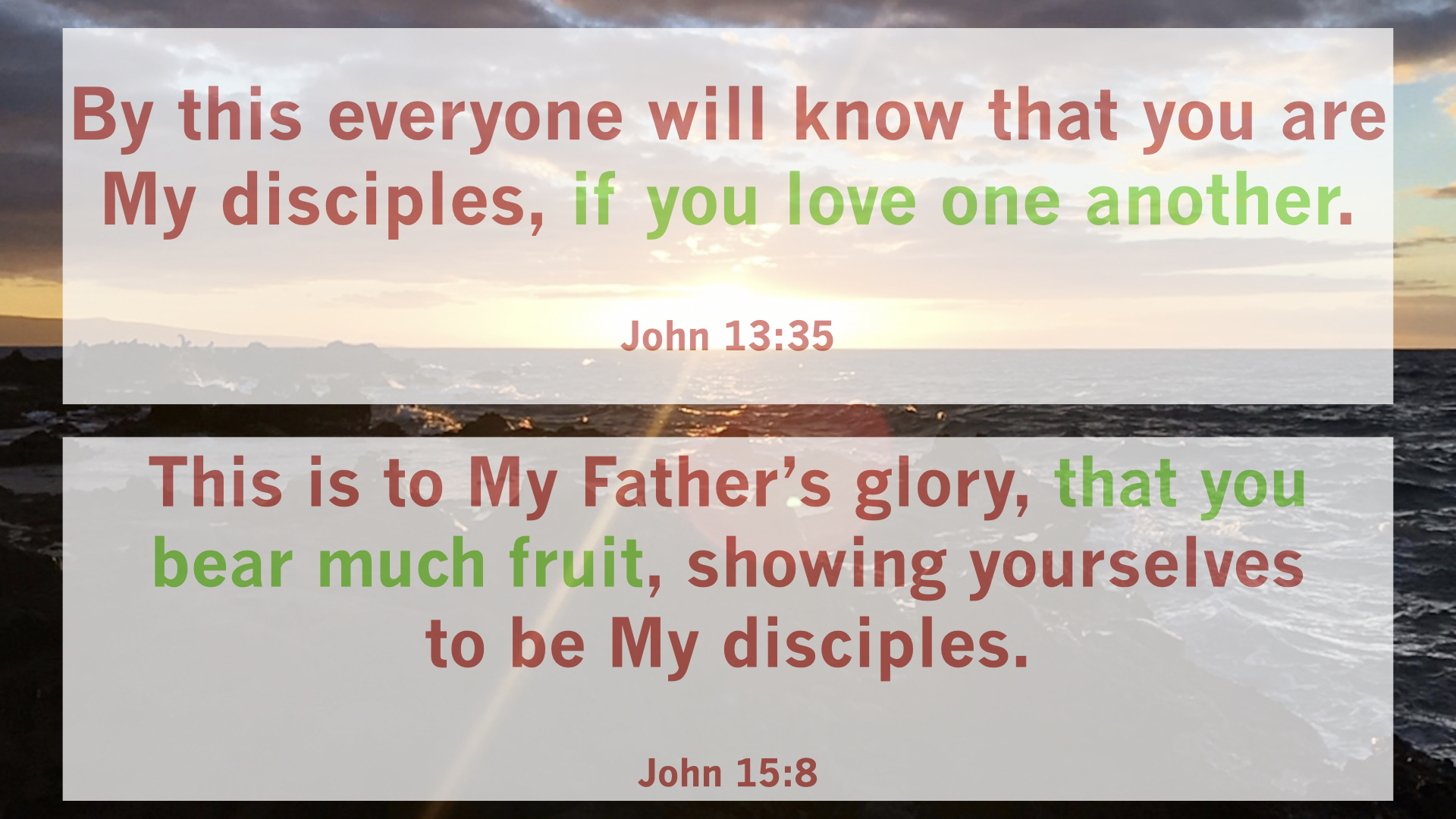
  1. That we love others (John 13:35) 
  2. That we are producing God-honoring fruit (John 15:8) 

God IS love—it’s His very nature. Just like an apple doesn’t have the capacity for apple-ness but is by its nature an apple, so God doesn’t have the capacity for love, or love more than others, but He is by His nature Love. 

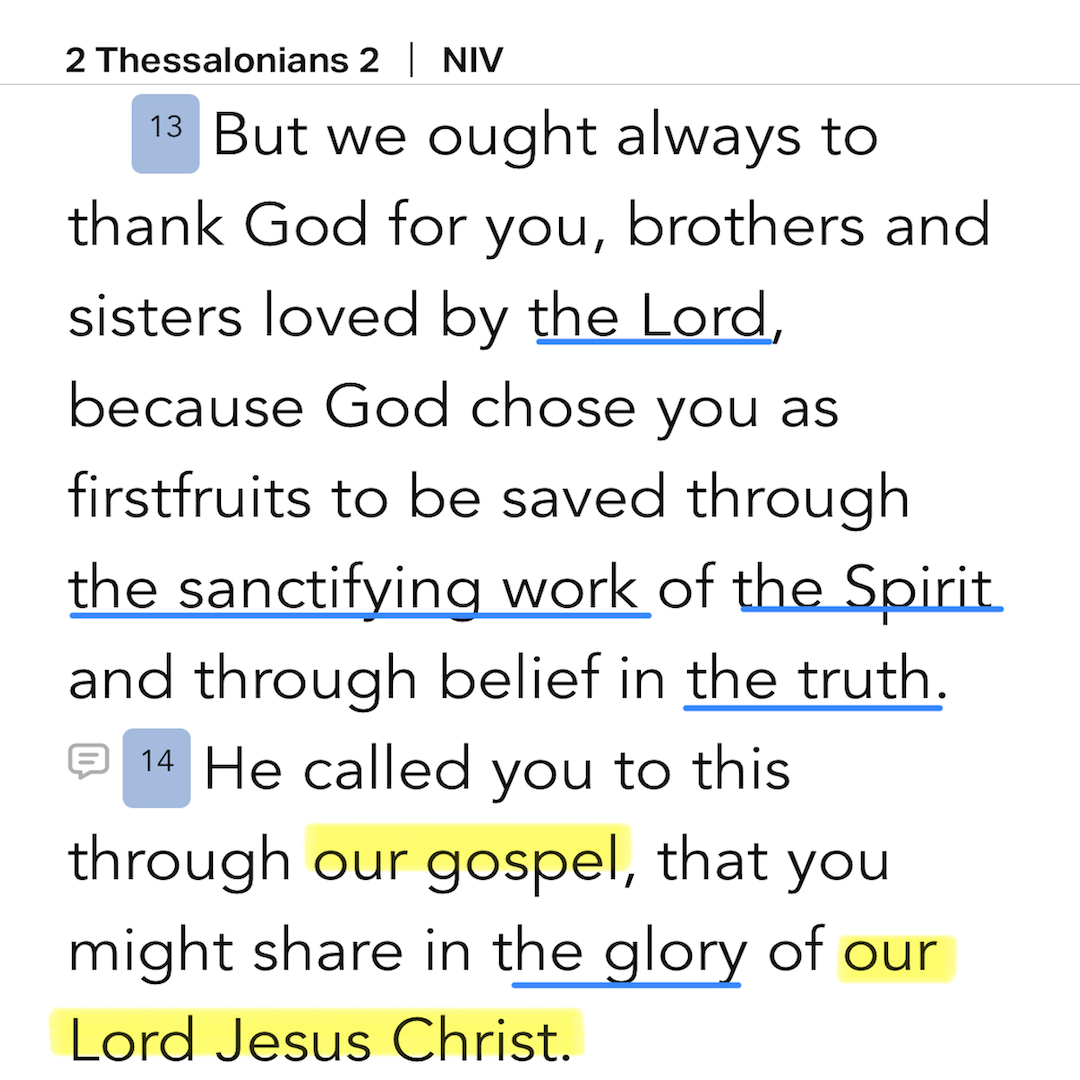
Any qualities of hope, peace, and joy in our lives have to originate from God’s love. We cannot manufacture these fruits, but they are a natural result of our being connected with Love Himself. 

Love is what brought Jesus to earth at His First Advent (John 3:16-17; Romans 5:5-8). And we can only love others and produce the fruit of hope, peace, and joy because Jesus went first and became our Source (1 John 4:19; John 15:1). 

Love brought Jesus to earth at His First Advent, and Love is what empowers us to be loving and fruitful between His Advents. 

  1. Love one another means that love serves (John 13:1-5, 15-17, 34-35) 
  2. Bear much fruit means that love grows (John 15:1-12) 

We can only serve and be lovingly fruitful as we stay connected to Love (2 Peter 1:2-7; 1 John 2:28). 

Love brought Jesus to earth at His First Advent, Love is what empowers us to be loving and fruitful between His Advents, and Love is what patiently waits for Christ’s Second Advent (2 Peter 3:3-4, 9). 

We continue to grow in our love and produce fruit by being connected to the Vine of Love (1 Corinthians 13:11-12; 1 John 3:1-2 ; Hebrews 10:23-24). 

We need to let our love be continually supplied by Love Himself so that our fruitfulness can shine as a bright testimony. Jesus said, He was the Light of the world, and then He called us to be the light to our part of the world where He has placed us (John 8:12; Matthew 5:14-16). 

Always remember that we celebrate the First Advent and look forward to the Second Advent by staying connected to Jesus, growing in our love for Him and for others, and allowing the fruit of hope, peace, and joy to shine brightly for God’s glory. 

If you’ve missed any of the other messages in our Advent series, you can find them all by clicking here

►► Would you please prayerfully consider supporting this ministry? My Patreon supporters get behind-the-scenes access to exclusive materials. ◀︎◀︎

Christ’s Advents Bring Hope

Listen to the podcast of this post by clicking on the player below, and you can also subscribe on AppleSpotify, or Audible. 

The word Advent means the appearing—something that bursts onto the scene. At this time of year we are actually thinking about TWO Advents. We look backward in gratitude to celebrate the first Advent of Jesus when He was born in a manger in Bethlehem. And then we look forward in joyful expectation to the second Advent of Jesus when He will return to earth again as King of kings. As we will in this time between the Advents, there are four qualities that we should exemplify—the first is hope. 

When the candle is lit, darkness disappears. 

Darkness is not the opposite of light, it is the absence of light. In the same way, despair or hopelessness is the absence of hope. 

Adam and Eve lived in perfection, but when they tried to do things their way—instead of obeying God’s way—their sin caused them despair. They tried to cover their nakedness, but with a hopeless covering of dying leaves. God came with a promise of full restoration, and illustrated it by covering them with the skin of a sacrificial animal (Genesis 3:7, 15, 21). 

(Check out all of the Scriptures in this post by clicking here.) 

Job knew the hopelessness of self-covering and finality of earthly life, and even David—the man after God’s own heart knew this too (Job 6:11-13, 17:13-16; 1 Chronicles 29:15). 

But Job and David both knew the hope they could have in their Redeemer (Job 19:25; Psalm 16). 

Hope in both the Old and the New Testaments means a patient waiting, anticipating with pleasure, having a confident expectation. It’s a light shining in the darkness that cannot be extinguished—it’s hope that despair cannot darken (Isaiah 9:1-2, 6-7). 

At His first Advent, Jesus appeared in our “clothing” so that He could become our sin and then clothe us in His righteousness (Hebrews 2:17; John 1:14; Romans 4:6-8; Hebrews 6:16-20). For this we look back in gratitude. 

But we don’t live today merely in gratitude for Christ’s first Advent, but we also live in confident hope of Christ’s second Advent (Acts 1:11; John 14:1-3; 2 Corinthians 5:1-8; Revelation 22:7, 12, 20).

He came into this world of sin,
Made flesh and blood His dearest kin;
He died, that He might take us in,
And keep us till He comes again. —Scott Hubbard


How do we live out this confident hope—

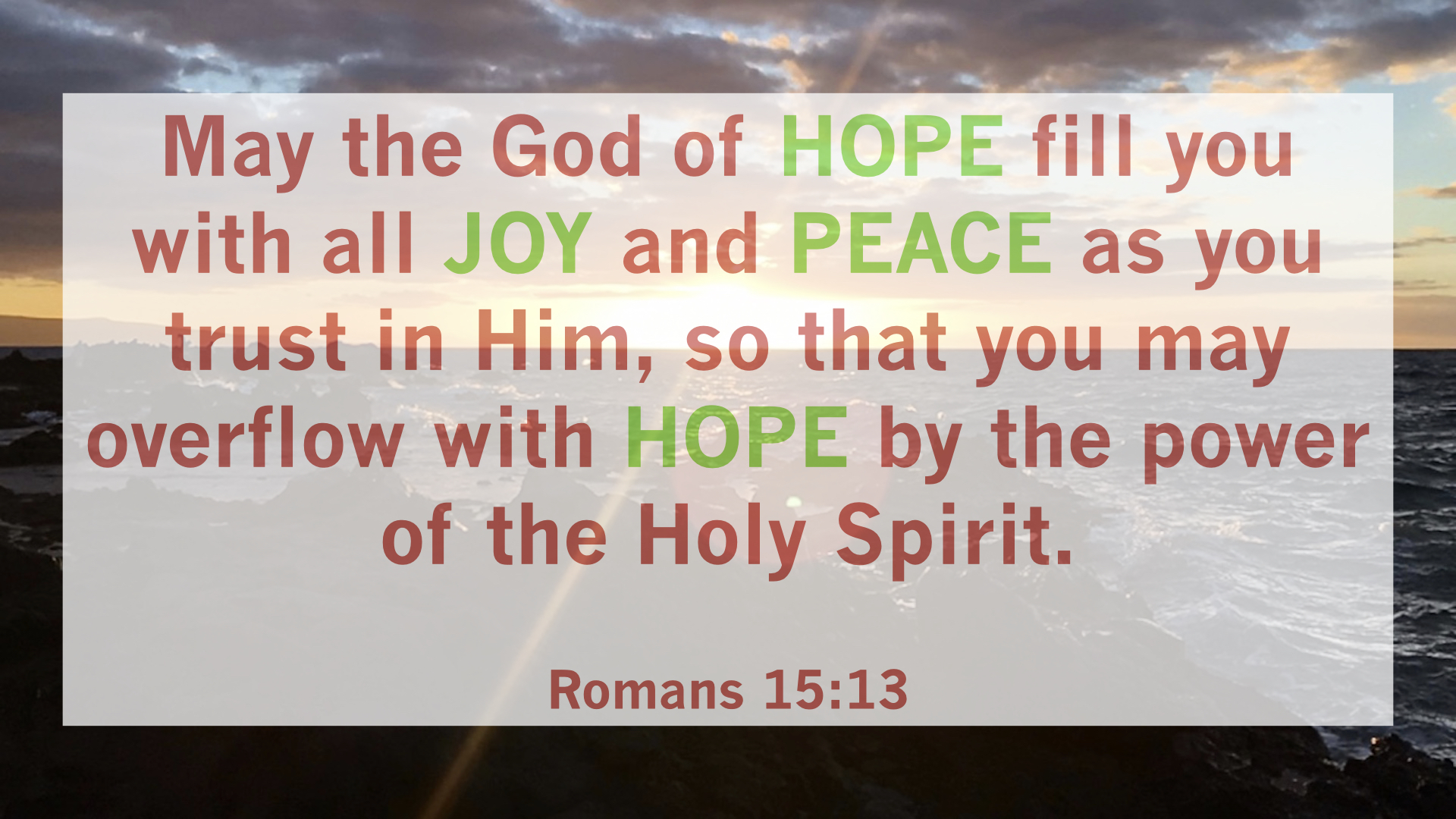
May the God of HOPE fill you with all JOY and PEACE as you trust in Him, so that you may overflow with HOPE by the power of the Holy Spirit. (Romans 15:13) 

Follow along with all four of the Advent attributes by clicking here. 

►► Would you please prayerfully consider supporting this ministry? My Patreon supporters get behind-the-scenes access to exclusive materials. ◀︎◀︎
Ready, Waiting, And Watching

Listen to the podcast of this post by clicking on the player below, and you can also subscribe on AppleSpotify, or Audible. 

Although Jesus spoke these words to His followers 2000 years ago, they are especially important to all of His followers who are awaiting His imminent return—

Be dressed ready for service and keep your lamps burning, like servants waiting for their master to return from a wedding banquet, so that when he comes and knocks they can immediately open the door for him. It will be good for those servants whose master finds them watching when he comes. Truly I tell you, he will dress himself to serve, will have them recline at the table and will come and wait on them. It will be good for those servants whose master finds them ready, even if he comes in the middle of the night or toward daybreak. But understand this: If the owner of the house had known at what hour the thief was coming, he would not have let his house be broken into. You also must be ready, because the Son of Man will come at an hour when you do not expect Him. (Luke 12:35-40) 

There are three words that stand out to me: ready, waiting, and watching. 

Ready is an adjective describing the Christian servant. Its etymology is from the noun meaning “fitness.” So the ready servant has all that he needs at hand. He is prepared for every opportunity, ready to serve and to receive whomever his Master sends him. 

Waiting is a verb that is in the present tense. That means it is something we always have to be doing. The prefix of this Greek word—like the adjective for “ready”—also means that everything that we need to serve is close by and ready to be used, and the root word is to give hospitality. So the waiting servant is waiting with a purpose: always ready to serve at a moment’s notice. 

Watching is also a present tense verb. This word means that we are giving undivided attention to the task that has been given us. 

Jesus was addressing His disciples, but these words are still for you and for me. At every moment we need to be fit to serve, with all that we need close at hand for every opportunity God sends our way.

I want to be occupied in my heavenly service until the very moment Jesus returns to earth or calls me Home. There are no off days. There is no time to waste on frivolous matters, but I need to be solely focused on only doing what matters for eternity. 

Will you join me in serving like this? We lead others to Jesus by serving those Jesus puts in our life. And as we do that, we serve our Master as well.

►► Would you please prayerfully consider supporting this ministry? My Patreon supporters get behind-the-scenes access to exclusive materials. ◀︎◀︎

Jesus In The Seven Feasts

Listen to the podcast of this post by clicking on the player below, and you can also subscribe on AppleSpotify, or Audible. 

Douglas Carmel from Rock Of Israel ministries shared an amazing overview of the seven Jewish feasts that are listed in the Book of Leviticus, and how Jesus is the fulfillment of all of these feasts. Doug was born into a Jewish family and became a Christian in his late teens, so he has firsthand knowledge of both the traditional celebrations and the Christian understanding of these feasts. 

One of the things I appreciated was Doug’s explanation that the feasts were merely a shadow of the reality—Jesus is the Reality! 

Please check out the message he shared at Calvary Assembly of God. I encourage you to visit his website to get more information on all of the ministries Rock Of Israel. 

Passover—celebrated on the 14th day of the first month 

  • Leviticus 23:4-5
  • Matthew 26:17-29; Mark 14:12-26; Luke 22:7-20
  • Jesus was crucified on the same day that the Passover lamb was being sacrificed 

Unleavened Bread—celebrated on the 15th day of the first month

  • Leviticus 23:6
  • 1 Corinthians 5:6-9

Firstfruits—celebrated on the 16th day of the first month (or the day after the Sabbath) 

  • Leviticus 23:9-14 
  • 1 Corinthians 15:12-26 

Seven Weeks—celebrated 50 days after Firstfruits 

  • Leviticus 23:15-21 
  • Also known as Pentecost 
  • Acts 2:1-41

Doug called our attention to the calendar on which these feasts appeared. Passover, Unleavened Bread, Firstfruits, and Seven Weeks all happen in the spring. All four of these feasts have already been fulfilled in the life, death, and resurrection of Jesus. 

There are no feasts in the summer months, as these are the months of field work (Leviticus 23:22). This is where we are now, which is why Jesus told us, “Ask the Lord of the harvest, therefore, to send out workers into His harvest field” (Matthew 9:38). This is the time for us to tell others about Jesus the Messiah! 

The final three feasts appear in the autumn—Trumpets, Atonement, and Tabernacles. These are feasts that are still to be fulfilled at Christ’s Second Advent. 

Trumpets—celebrated on the 1st day of the seventh month

  • Leviticus 23:23-25 
  • This is also known as Rosh Hashanah when the shofar is blown 
  • 1 Corinthians 15:51-53; 1 Thessalonians 4:15-18

Atonement—celebrated on the 10th day of the seventh month

  • Leviticus 23:26-32 
  • This is also known as Yom Kippur—the one day of the year the high priest goes into the Holy of Holies 
  • Romans 11:25-32; Matthew 23:39 

Tabernacles—celebrated on the 15th through the 21st days of the seventh month

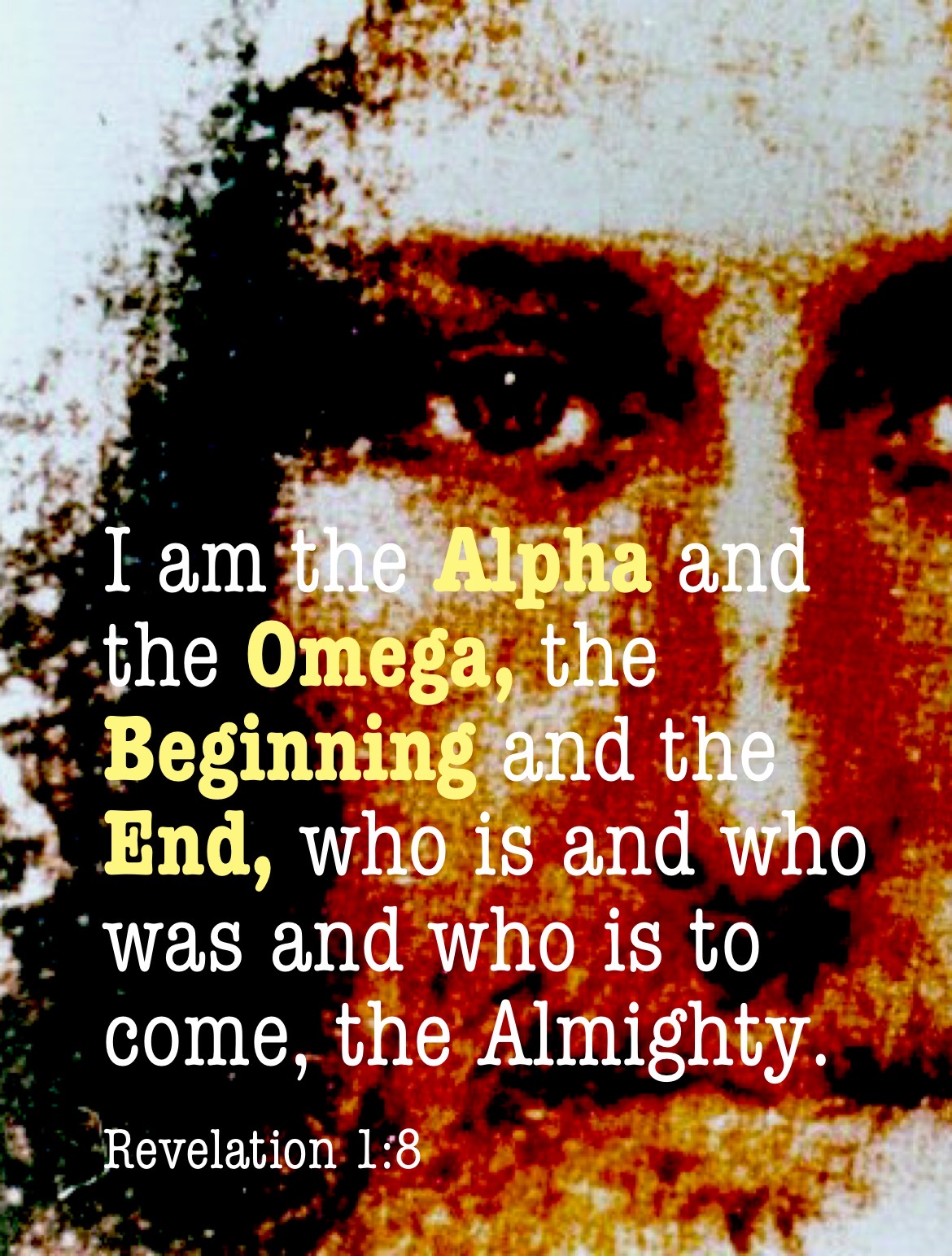
Jesus said of Himself, “I am the Alpha and the Omega, who is, and who was, and who is to come, the Almighty” (Revelation 1:8). Jesus is THE Reality and THE Fulfillment of all of these celebrations! 

(Check out all of the Scripture verses I listed above by clicking here.) 

►► Would you please prayerfully consider supporting this ministry? My Patreon supporters get behind-the-scenes access to exclusive materials. ◀︎◀︎
Links & Quotes

I’m really excited for this! On March 9, I will be a guest on The Church Lobby podcast with Karl Vatters! Check it out wherever you get your podcasts.

T. M. Moore has been presenting an outstanding series of posts in the series To Stop The Lie. In his most recent post, he wrote, “Winds of false doctrine blow across the sails of the Church continuously, bringing lies against the ship of truth to drive it off its Kingdom course. Wafting in from worldly thinking, these false doctrines downplay the Word of God, make the needs of people rather than the glory of God the focal point of religion, introduce alien practices to worship and church life, and becalm the Body of Christ into complacency. Such lies must be exposed, deconstructed, and stopped.” Check out the post from which this quote came by clicking here, and then you can follow the thread to read the other posts in this series.

“We are more fulfilled when we are involved in something bigger than ourselves.” —John Glenn

NASA has a really cool interactive map that allows you to track the flight of asteroids and comets as they orbit around the sun. You can go forward or backward in time, zoom in or out, and angle the solar system to see the flights and orbits from a different perspective.

John Stonestreet has a good history lesson for us of past revivals on American soil, and the transformation that came about as a result. If you are a pastor and would like to join other pastors once per week for prayer for revival, please check out this prayer group.

Doug Clay has a reassuring post about the blessed hope Christians should have concerning Christ’s Second Coming. He writes, “Will Jesus return in 2023? That question stirs hope in some and anxiety in others. … The Rapture should calm anxious Christians rather than causing anxiety. No matter how bad things get, we know that our Blessed Hope is imminent!”

Too many people in leadership positions think that leadership means that others do things for them. In actuality, godly leaders view their elevated position as an opportunity to serve more—to do more things for more people. I dive deeper into this in my book Shepherd Leadership: The Metrics That Really Matter.

Links & Quotes

God made you uniquely YOU on purpose. So you can ask Him to show you why He put you together as He did—with all of the gifts that make you YOU. Please subscribe to my YouTube channel.

In my Halley’s Study Bible, I read this commentary on Matthew 24-25—

“It is best not to be too dogmatic about the events surrounding [Christ’s] second coming. But if language is a vehicle of thought at all, it certainly takes a good deal of explaining and interpreting to make anything else out of Jesus’ words than that He Himself looked forward to His coming again as a definite historical event in which He will personally and literally appear to gather to Himself and to eternal glory those who have been redeemed by His blood.

“And it is best not to cloud the hope of His coming with too detailed a theory as to what is going to happen when He comes. Some people may be disappointed if Jesus does not follow the schedule they have mapped out for Him.”

“The future doesn’t belong to the fainthearted; it belongs to the brave.” —Ronald Reagan

“We are not called to punish the people for whom Jesus was already punished.” —Kevin Berry

Daniel B. Wallace, a New Testament professor at Dallas Theological Seminary, wrote, “If you could stack up all handwritten manuscripts of the New Testament—Greek, Syriac, Latin, Coptic, all languages—how tall would the stack be? … I have said in many lectures that it would be the equivalent of c. 4 & 1/2 Empire State Buildings stacked on top of each other. How did I come up with that number?” Check out his post to read how he calculated this astounding number. This is just another link in the chain of evidence for the historicity of the Bible.

I shared this commentary on YouVersion this week: We are made in God’s likeness. Ever since sin entered the world, man’s sinful nature is to flip this around—to make God in our likeness. Literally to say, “This is what I want God to be. I want Him to approve what I want.”

“Pure humor is the most difficult of all of comedy. Late night humor is funny because it is mean. It is relatively easy to be crude, cynical, and sarcastic. It comes naturally to our fallen natures to criticize, tease, mock, and scoff. It’s much harder to make people laugh by lifting others up.” —Dick Brogden, in his book Proverbs: Amplified and Applied, commenting on Proverbs 1:22

Our Blessed Hope

Listen to the podcast of this post by clicking on the player below, and you can also subscribe on AppleSpotify, or Audible. 

As we wrap up our series looking at our foundational belief statements, I want to combine the last four statements together, not only because they all cover the same theme of end-times events, but also because these statements should give every Christian hope! 

  • “Hope is the power of being cheerful in circumstances which we know to be desperate.” —G.K. Chesterton 
  • “One of the great enemies of hope is forgetting God’s promises.” —John Piper 
  • “Hope is not wishful thinking; it’s well-founded believing!” —Craig T. Owens 

Christians have a fantastic, unshakable, blessed hope on which we can stand not only secure but joyful! 

Foundational truth #13: “The resurrection of those who have fallen asleep in Christ and their translation together with those who are alive and remain unto the coming of the Lord is the imminent and blessed hope of the church.” 

This blessed hope in the future helps us live with joy today! Knowing that death has been defeated and Jesus will come back to take us home with Him should fuel us to say “no” to the temporary pleasures of sin, and live such godly lives that it turns others’ eyes to Jesus (Titus 2:11-14; 1 Corinthians 15:51-52; 1 Thessalonians 4:16-17). 

Foundational truth #14: “The second coming of Christ includes the rapture of the saints, which is our blessed hope, followed by the visible return of Christ with His saints to reign on earth for one thousand years.” 

Sometimes you will hear Christians talk about the “rapture” of the Church. Although this word itself isn’t in the Bible, the Greek word harpazo in 1 Thessalonians 4:17 means “catching up.” It also means “to eagerly claim for one’s self,” which reminds me that Jesus is thrilled to bring His Bride home to be with Him forever! After the Church has been caught up to Heaven, a period of tribulation will plague the earth, followed by Christ’s Second Coming and His millennial reign (Zechariah 14:4-5; Revelation 19:11-15; 20:1-10). 

Foundational truth #15: “There will be a final judgment in which the wicked dead will be raised and judged according to their works. Whosoever is not found written in the Book of Life, together with the devil and his angels, the beast and the false prophet, will be consigned to the everlasting punishment in the lake which burns with fire and brimstone, which is the second death.” 

Christians have no fear of the second (or final) death because our names are written in the Book of Life (Luke 12:4-6; Revelation 20:11-15). Not only is there judgment for the wicked, but there will be rewards for the righteous. 

Foundational truth #16: “In keeping with His promise we are looking forward to a new heaven and a new earth, where righteousness dwells” (2 Peter 3:13). Revelation 21-22 give us a small glimpse of our eternal home. 

In light of these truths, how should Christians live while still on earth? I think there are three ways we should live: 

  1. Live circumspectly
  2. Live on-mission
  3. Live unafraid

(see Ephesians 5:15; Matthew 28:18-20; Proverbs 24:11-12; Jude 1:20-25) 

With this blessed hope of the Second Coming of Jesus and our security in knowing we will remain with Him forever, let’s tell everyone we can how they too can know what it is to live with this hope in their heart. 

If you’ve missed any of the messages in our series exploring our foundational beliefs, you can access the full list by clicking here. 

►► Would you please prayerfully consider supporting this ministry? ◀︎◀︎