The Way Of Abundance (book review)

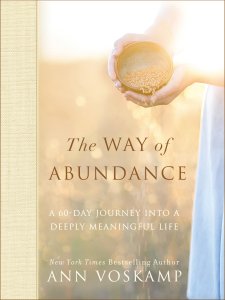
About a year ago I read and reviewed The Broken Way by Ann Voskamp. And now that I share a review of her newest book—The Way Of Abundance—you might be tempted to think that brokenness and abundance sound contradictory, but you would be wrong! 

In The Broken Way, Ann wrote, “Unless we die, unless we surrender, unless we sacrifice, we remain alone. Lonely. But if we die, if we surrender, if we sacrifice, that is when we experience the abundance, that is when we dance in communion. The life that yields the most—yields the most” (emphasis mine). 

Now in The Way Of Abundance, she shares this opening thought, “What would happen if the scars you carry are what God uses to carry Christ to a scarred and broken world? Weak is the real strong. Brokenness is the real abundance” (emphasis mine). 

Brokenness cannot stop meaningfulness. God wants to work through your brokenness to do something abundantly more than you can even imagine. And He can and will do it if only you will yield your pain to Him. 

The Way Of Abundance is given to us in 60 shorter devotional-style chapters. It’s a two-month journey into getting to see our pain, disillusionment, brokenness, and questions in a new light. It’s a journey to get us to change the focus from our brokenness to Christ’s abundance, and in so doing, discovering how Christ can enrich the world through our yieldedness. 

What I wrote a year ago is just as true for this book: “This is a book of healing. A book that will remind you that you are not alone in your pain, in your questions, in your searching for answers. This book is a gift to anyone who feels broken, cut up, cut off, or beaten down.” 

Read this book for yourself. Read this book for other broken people. Read this book with other broken people. And then watch the abundance of Christ’s life explode like you’ve never imagined! 

I am a Zondervan book reviewer. 

Poetry Saturday—In Christ

In Christ I feel the heart of God. 
Throbbing from heaven through earth: 
Life stirs again within the clod. 
Renewed in beauteous birth. 
The soul springs up, a flower of prayer, 
Breathing his breath out on the air. 

In Christ I touch the hand of God, 
From His pure height reached down, 
By blessed ways before untrod, 
To lift us to our crown;—
Victory that only perfect is 
Through loving sacrifice, like His. 

Holding His hand, my steadied feet 
May walk the air, the seas; 
On life and death His smile falls sweet,—
Lights up all mysteries: 
Stranger nor exile can I be 
In new worlds where He leadeth me. 

Not my Christ only: He is ours; 
Humanity’s close bond; 
Key to its vast unopened powers, 
Dream of our dreams beyond.—
What yet we shall be, none can tell; 
Now are we His, and all is well. —Lucy Larcom

Poetry Saturday—See How The Patient Jesus Stands

See how the patient Jesus stands,
Insulted in His lowest case!
Sinners have bound the Almighty hands,
And spit in their Creator’s face.

With thorns His temple gored and gashed
Send streams of blood from every part;
His back’s with knotted scourges lashed,
But sharper scourges tear His heart.

Nailed naked to the accursed wood
Exposed to earth and heaven above,
A spectacle of wounds and blood,
A prodigy of injured love!

Hark! how His doleful cries affright
Affected angels, while they view;
His friends forsook Him in the night,
And now His God forsakes Him too!

Behold that pale, that languid face,
That drooping head, those languid eyes!
Behold in sorrow and disgrace
Our conquering Hero hangs, and dies!

Ye that assume His sacred name,
Now tell me, what can all this mean?
What was it bruised God’s harmless Lamb,
What was it pierced His soul but sin?

Blush, Christian, blush: let shame abound:
If sin affects thee not with woe,
Whatever life is in thee found,
The life of Christ thou doest not know. —Joseph Hart

George Whitefield On Developing Godly Attributes

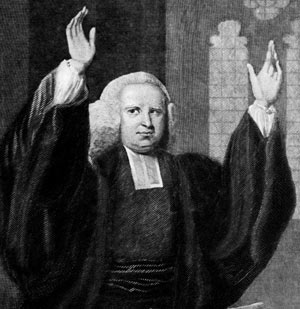
George Whitefield“The fruit of the Spirit (Galatians 5:22-23) do not automatically become evident in our lives. If we are not discerning enough to recognize their availability to us, to desire them, and then to nourish them in our thoughts, they will never become embedded in our nature or behavior. Every further step of spiritual growth in God’s grace must be preceded by acknowledging our lack of a godly attribute and then by exhibiting a prayerful determination to obtain it. …

“Today many people are attempting to use their mental capacity and logical thinking to obtain sanctification, yet this is nothing but a religious fabrication. They believe that if they just mentally put themselves on the altar and believe the altar provides the gift of sanctification, they can then logically conclude they are fully sanctified. Then they go happily on their way, expressing their flippant, theological babble about the ‘deep’ things of God.

“Yet the heartstrings of their old nature have not been broken, and their unyielding character, which they inherited from Adam, has not been ground to powder. Their soul has not throbbed with the lonely, gushing groans of Gethsemane. Having no scars from their death on Calvary, they will exhibit nothing of the soft, sweet, gentle, restful, victorious, overflowing, and triumphant life that flows like a spring morning from an empty tomb.” —George Whitefield

6 Quotes On Speaking Truth From “The Seven Laws Of Love”

The Seven Laws Of LoveIn The Seven Laws Of Love, Dave Willis gives us some highly practical, biblically-based counsel for investing in all of our relationships. Normally when I share quotes from books, I share all of them at once, but I felt like it would be good to share these quotes a bit more slowly, to give you time to read them and apply them.

The seven laws Dave identifies are:

  1. Love requires commitment (read the quotes here)
  2. Love selflessly sacrifices (read the quotes here)
  3. Love speaks truth
  4. Love conquers fear
  5. Love offers grace
  6. Love brings healing
  7. Love lives forever

From law #3, here are some quotes on truth speaking—

“The truth isn’t always comfortable, but it’s always necessary.”

“Honesty always paves the way to intimacy.”

“Selective honesty is the same as dishonesty.”

“The truth might be expensive at times, but it’s always worth it.”

“We all tend to craft a self-focused view of the world where we emerge as either a hero or a victim in every scene. We’re never the villains in the story. The truth is, though, that we’ve all been the bad guy more often then we’d like to admit. A life of love requires that we look in the mirror and give an honest and humble self-assessment.”

“What kind of legacy do you want for your own life? What stories do you want people telling about you a generation after your death? The decisions you are making right now are shaping future generations. Your legacy will be measured by your relationships, and your relationships will only be as strong as the trust your loved ones have in you.”

Check out my review of The Seven Laws Of Love by clicking here.

Watch for more quotes from the other laws of love explained in this book throughout the next few days.

4 Quotes On Selfless Sacrifice From “The Seven Laws Of Love”

The Seven Laws Of LoveIn The Seven Laws Of Love, Dave Willis gives us some highly practical, biblically-based counsel for investing in all of our relationships. Normally when I share quotes from books, I share all of them at once, but for this book I felt like it would be good to share these quotes a bit more slowly, to give you time to read them and apply them.

The seven laws Dave identifies are:

  1. Love requires commitment (read the quotes here)
  2. Love selflessly sacrifices
  3. Love speaks truth
  4. Love conquers fear
  5. Love offers grace
  6. Love brings healing
  7. Love lives forever

From law #2, here are some quotes on selfless sacrifice—

“That’s the beautiful irony of love. The only way we can truly keep it is to give it away.”

“First Lieutenant Alonzo Cushing was a twenty-two-year-old officer in the Union Army during the Civil War when he made the ultimate sacrifice. The young West Point graduate was in charge of six cannons and more than one hundred men during the Battle of Gettysburg. His small force found itself trapped in the middle of the battlefield during the Confederate Army’s infamous assault known as Pickett’s Charge. The full force of the rebels was closing in on Cushing and his men. The young officer had already been shot twice and was critically wounded. He had every right to retreat to safety, but he recognized the magnitude of the moment. Instead, he ordered the cannons moved to the front lines, and he limped forward to lead a counterattack. His courage and tenacity inspired the men around him, and they fought back valiantly before Cushing was shot again. The final shot proved to be fatal. The sacrifice of one young man turned the tide of a battle, which turned the tide of war, which ultimately held a nation together.”

“We don’t make our sacrifices for recognition; we make our sacrifices for love. When love moves you to sacrifice, you can rest assured that lives will be changed and eternity will be impacted.”

“Many people believe they have put their faith in Jesus, but they also believe they have to earn what He did for them on the Cross. Here’s the good news: when Jesus was hanging on that Cross, dying to save you, He did not use His dying words to say, ‘Earn this.’ Do you know what He said instead? He said, ‘It is finished!’ Did you catch that? It is finished. That means done, complete, sealed, finished! That’s God’s gift of grace. Jesus has done all the work already. You couldn’t possibly earn it even if you tried with everything you had, and God never expected you to.”

Check out my review of The Seven Laws Of Love by clicking here.

Watch for more quotes from the other laws of love explained in this book throughout the next few days.

Good Friday—It Is Finished

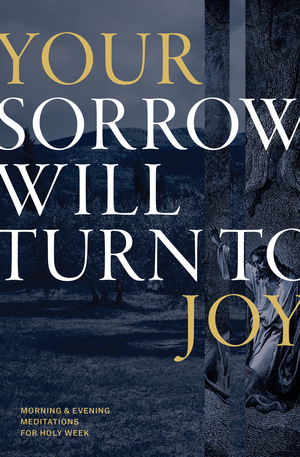
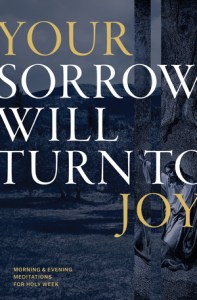
Your Sorrow Will Turn To JoyThis is from a chapter in Your Sorrow Will Turn To Joy, and is probably one of the best depictions of Good Friday I have read. Jon Bloom writes—

It is Friday, April 3, A.D. 33. It is the darkest day in human history, though most humans have no clue of this. In Rome, Tiberius attends to the demanding business of the empire. Throughout the inhabited world, babies are born, people eat and drink, marry and are given in marriage, barter in marketplaces, sail merchant ships, and fight battles. Children play, old women gossip, young men lust, and people die. 

But today, one death, one brutal, gruesome death, the worst and best of all human deaths, will leave upon the canvas of human history the darkest brushstroke. In Jerusalem, God the Son, the Creator of all that is (John 1:3), will be executed. 

The Garden 

The Jewish day dawns with night, and never has it been more fitting, since today the hour has come and the power of darkness (Luke 22:53). Jesus is in Gethsemane, where He has prayed with loud cries and tears, being heard by His Father (Heb. 5:7) whose will will be done. Jesus hears noises and looks up. Torches and hushed voices signal the arrest party’s arrival. 

Jesus wakes His sleepy friends who are jarred alert at the sight of their brother, Judas, betraying his Rabbi with a kiss. Soldiers and servants encircle Jesus. Peter, flushed with anger, pulls out his sword and lunges at those nearest Jesus. Malchus flinches, but not enough. Blinding pain and blood surge where his ear had been. Voices speak, but Malchus only hears the screaming wound, which he’s grabbed with both hands. He feels a hand touch his hands and the pain vanishes. Under his hands is an ear. Stunned, he looks at Jesus, already being led away. Disciples are scattering. Malchus looks down at his bloody hands. 

The Sanhedrin 

Jesus is led brusquely into the house of Annas, a former High Priest, who questions Him about His teaching. Jesus knows this informal interrogation is meant to catch Him disoriented and unguarded. He is neither, and gives this manipulative leader nothing. Rather, He refers Annas to his hearers and is struck with irony by a Jewish officer for showing disrespect. Frustrated, Annas sends Jesus on to his son-in-law Caiaphas, the current High Priest. 

At Caiaphas’s house the trial gets underway quickly. Morning will come fast. The Council needs a damning verdict by daybreak. The examination proceeds as bleary-eyed Sanhedrin members continue to file in. 

The trial has been assembled hastily and witnesses haven’t been screened well. Testimonies don’t line up. Council members look disconcerted. Jesus is silent as a lamb. Irritated and impatient, Caiaphas cuts to the quick: “I adjure You by the living God, tell us if you are the Christ, the Son of God” (Matt. 26:63). The hour has come. Charged in the name of His Father to answer, Jesus speaks the words that seal the doom for which He had come to endure (John 12:27): “You have said so. But I tell you, from now on you will see the Son of Man seated at the right hand of Power and coming on the clouds of heaven” (Matt. 26:64). 

In a moment of law-breaking (Lev. 21:10) politically religious theater, Caiaphas tears his robes in feigned outrage and thinly concealed relief over Jesus’s blasphemy. He declares the trial’s end with, “What further testimony do we need? We have heard it ourselves from His own lips” (Luke 22:71). 

As the sun breaks over Jerusalem’s eastern ridge, Judas swings from his own belt, Peter writhes in the grief of his failure, and Jesus’s face is streaked with dried blood and saliva from the pre-dawn sport of the temple police. The Council’s verdict: guilty of blasphemy. Their sentence: death. But it’s a sentence they cannot carry out. Rome refuses to delegate capital punishment. 

The Governor 

Pilate’s mood, already sour over the Sanhedrin’s sudden insistent intrusion so early in the morning, worsens as he grasps the situation. They want him to execute a Galilean “prophet.” His seasoned instincts tell him something isn’t right. He questions Jesus and then tells the Council, “I find no guilt in this Man” (Luke 23:4). 

A game of political chess ensues between Pilate and the Sanhedrin, neither realizing that they are pawns, not kings. Pilate makes a move. As a Galilean, Jesus falls under Herod Antipas’s jurisdiction. Let Herod judge. Herod initially receives Jesus happily, hoping to see a miracle. But Jesus refuses to entertain or even respond. Antipas, disappointed, blocks the move by returning Jesus to Pilate. 

Pilate makes another move. He offers to release Jesus as this year’s annual Passover pardoned prisoner. The Council blocks the move. “Not this man, but Barabbas!” they cry (John 18:40). Pilate is astounded. The Sanhedrin prefers a thief and murderer to this peasant prophet? 

Pilate tries another move. He has Jesus severely flogged and humiliated, hoping to curb the Council’s blood thirst. Again the move is blocked when the Council insists that Jesus must be crucified because “He has made Himself the Son of God” (John 19:7). Check. Pilate’s fear grows. Jesus’s divine claim could threaten Rome. Worse, it could be true. Roman deities supposedly could take on human form. His further questioning of Jesus unnerves him. 

One last move. Pilate tries to persuade the Sanhedrin to release Jesus. One last block and trap. “If you release this Man, you are not Caesar’s friend. Everyone who makes himself a king opposes Caesar” (John 19:12). The Council has Pilate where they want him: cornered. Checkmate. 

And the triune God has the Council, Pilate, and satan where He wants them. They would have no authority over the Son at all unless it had been given them from above (John 19:11). Fallen Jews, Gentiles, and spiritual powers unwittingly collaborate in executing the only innocent death that could possibly grant the guilty life. Checkmate. 

The Cross 

Morning wanes as Jesus stumbles out of the Praetorium, horribly beaten and bleeding profusely. The Roman soldiers had been brutal in their creative cruelty. Thorns have ripped Jesus’s scalp and His back is one grotesque, oozing wound. Golgotha is barely a third of a mile through the Garden Gate, but Jesus has no strength to manage the forty-pound crossbar. Simon of Cyrene is drafted from the crowd. 

Twenty-five minutes later, Jesus is hanging in sheer agony on one of the cruelest instruments of torture ever devised. Nails have been driven through His wrists (which we only know about because of the doubt Thomas will express in a couple days—see John 20:25). A sign above Jesus declares in Greek, Latin, and Aramaic who He is: the King of the Jews. 

The King is flanked on either side by thieves and around Him are gawkers and mockers. “Let Him save Himself, if He is the Christ of God, His Chosen One!” some yell (Luke 23:35). One dying thief even joins in the derision. They do not understand that if the King saves Himself, their only hope for salvation is lost. Jesus asks His Father to forgive them. The other crucified thief sees a Messiah in the mutilated man beside him, and he asks the Messiah to remember him. Jesus’s prayer is beginning to be answered. Hundreds of millions will follow. 

It is mid-afternoon now and the eerie darkness that has fallen has everyone on edge. But for Jesus, the darkness is a horror He has never known. This, more than the nails and thorns and lashings, is what made Him sweat blood in the garden. The Father’s wrath is hitting Him in full force. He is in that moment no longer the Blessed, but the Cursed (Gal. 3:13). He has become sin (2 Cor. 5:21). In terrifying isolation, cut off from His Father and all humans, He screams, “Eli, Eli, lema sabachthani,” Aramaic for “My God, My God, why have You forsaken Me?” (Matt. 27:46; Ps. 22:1). No greater love (John 15:13), humility (Phil. 2:8), or obedience (Heb. 5:8) has ever or will ever be displayed. 

Shortly after 3:00 P.M., Jesus whispers hoarsely for a drink. In love, He has drained the cup of His Father’s wrath to the dregs. He has born our full curse. There is no debt left to pay and He has nothing left to give. The wine moistens His mouth just enough to say one final word: “It is finished” (John 19:30). And God the Son dies. 

It is the worst and best of all human deaths. For on this tree He bears our sins in His body (1 Pet. 2:24), “the righteous for the unrighteous, that He might bring us to God” (1 Pet. 3:18). And now it is finished.

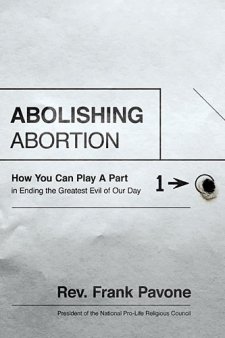
7 Quotes From “Abolishing Abortion” For The Church

Abolishing AbortionFather Frank Pavone writes persuasively and passionately about the role all of us can play in abolishing abortion throughout the world. One group that definitely needs to step to the forefront of this battle is the Church! Here are some quotes from Father Pavone specifically talking to Christians.

“People need to know that to oppose abortion does not mean to oppose those who have had one. … The Church has the perfect spiritual and psychological balance necessary for those who have been involved in an abortion. The last thing such a person needs to hear is, ‘What you did is no big deal.’ The nature of post-abortion grief is that the individual involved in the abortion has begun to realize precisely what a big deal it was. Now this person needs someone to tell her that she should not feel silly for feeling sad, that there is indeed reason for the grief in her heart, and that what her heart is telling her is true: her child was killed. A great disservice was done both to her and her child when someone convinced her that the abortion would be ‘no big deal.’ Accepting that line was a major act of denial. Healing can begin when she breaks out of denial and calls the evil what it is. … At the same time, the other line she does not need to here is, ‘You are rejected; there is no hope.’ As she realizes the evil that has occurred, she will be tempted to say this to herself. The Church, however, contradicts that despair with the clear message of forgiveness.” 

“Those in the pain of abortion are not helped by silence. Some pastors refrain from preaching about abortion out of the sincere desire to not hurt women who have had abortions. Yet that silence does not interpret itself. The person grieving over abortion can infer from our silence that we do not know her pain, or that we do not care, or that there is no hope. None of this is true. With clear and compassionate messages, pastors can break through the silence that led to a woman to this disastrous choice in the first place.”

“Those who attend church regularly are statistically the most likely to be pro-life and the most likely to be pro-life activists. Within America’s Christian churches there are people enough and resources enough to end abortion, armed as the pro-life movement is with the supernatural gifts of truth and grace. It is clear that the full activation of the Church is a critical step for ending abortion. This does not primarily mean creating new structures. It simply means infusing the existing structure with greater vigor and effectiveness.”

“The pro-life movement is not primarily a response to Roe v. Wade. It is a response to Jesus Christ. His teachings not only show us why we are to be pro-life but also show us how. They give us the virtues we need to have in doing this work.”

“The Church is the only institution that has a divine guarantee that it will prevail over the culture of death. ‘The gates of hell shall not prevail against it,’ the Lord Himself said (Matthew 16:18 KJV). Now, gates do not run out on the battlefield to attack the enemy. Rather, they stand still and defend the city against the enemy attacking it. To say that the gates of hell will not prevail against the Church is to say that it is the Church that takes the offense and storms the gates of hell to win ground for Jesus Christ. Gates of hell cannot withstand the power of heaven. The gates of death fall in the presence of eternal life. Sin melts in the presence of saving grace. Falsehood collapses in the presence of living truth. These are the tools with which Christ has equipped His Church.”

“Love is found on Calvary. Love’s best symbol is not the heart but the Cross. … What Christ revealed to the world through the Cross about the meaning of love, we must also reveal through our own sacrifice for those we love.”

“Abortion is the exact opposite of love. Loves says, ‘I sacrifice myself for the good of the other person.’ Abortion says, ‘I sacrifice the other person for the good of myself.’ And isn’t it amazing that the very same words used by the culture of death to justify abortion are the words used by our Lord to proclaim life and salvation and love: ‘This is My body!’ … ‘This is My body,’ Jesus said, ‘given for you’ (see Luke 22). He did not cling to His body so that we would die but rather gave it away so that we could live. These are the words that define our mission in the world: spouse saying to spouse, parents saying to children, clergy saying to their congregation, all of us saying to our brothers and sisters, ‘This is my body, my time, my efforts, my resources, my life—given for you, that you may live!’”

I have shared other quotes from Abolishing Abortion which you can read here and here.

And be sure to check out my book review of Abolishing Abortion here.

Links & Quotes

link quote

“Is it not said in Scripture, ‘If any man sin, we have an Advocate’? Why is Christ an advocate today? Only because we want an advocate every day. Does He not constantly intercede yonder before the eternal throne? Why does He do that? Because we want daily intercession. And it is because we are constantly sinning that He is constantly an advocate, constantly an intercessor.” —Charles Spurgeon

“The only right a Christian has is the right to give up his rights.” —Oswald Chambers

“Unbelief hinders Christ from working those works which show the glory. It seems a strange saying, and one which we could not have ventured to utter had it not been written down for us by inspired men. That a child’s hand held up against the sun should hinder it from shining; that a weathered leaf thrown into a stream should stay its flowing or dry up its source; that the breath of man, breathed up against the sky, should quench the light of its myriad stars—these things would not really be so marvelous as that man’s unbelief should prevent God’s power from being sent forth, and the Son of God from doing those things which would reveal the glory of the Father. Yet we find the strange truth thus recorded. The evangelist Matthew thus writes, ‘He did not many mighty works there, because of their unbelief’ (13:58); and Mark uses still stronger language, ‘He could there do no mighty work, saving that He laid His hands upon a few sick folk and heal them; and He marveled because of their unbelief ‘(6:5, 6).” —Horatius Bonar

A really nice story about our church’s move.

Despite what some people want to teach, here are 24 reasons to believe Hell is a reality.

George Muller was a faith giant. But check out what John Piper writes about him: Muller did not have the gift of faith.

Jon Bloom writes, “If we want to really know what’s going on in the world, we cannot depend on CNN or FoxNews. We will keep our eyes on the global church. She is at the center of history,” in his post entitled America’s one enduring legacy in history.

[VIDEO] Does free speech offend you?

Links & Quotes

link quote

“When something drops into your life that seems to threaten your future, remember this: The first shock waves of the bomb are not sin. The real danger is yielding to them. Giving in. Putting up no spiritual fight. And the root of that surrender is unbelief—a failure to fight for faith in future grace. A failure to cherish all that God promises to be for us in Jesus.” —John Piper

“The ultimate test of man’s conscience may be his willingness to sacrifice something today for future generations whose words of thanks will not be heard.” —Gaylord Nelson

My fellow pastors, may this be said of us: “Even now the Lord is raising up godly watchmen to speak for Him in these times. These shepherds are grieving, weeping and repenting as they seek God’s face. And I believe they’re hearing and understanding the Lord’s message behind the present events. Moreover, they’re not afraid to proclaim dire warnings, because they know they’ve heard from God. They’re compelled to speak of His purposes behind our calamities.” —David Wilkerson

“Who is doing exploits for God today? Where is the enemy being driven back? That is the great yearning of all spiritually-minded people. They are not enchanted with polished sermons and slick organizational technique. Where are the mighty men and women anointed by God to truly make a difference?” —Jim Cymbala

Good read for anyone in church leadership: 10 Fine Lines Of Church Leadership Tension.

Medical science validates what Scripture tells us: Unforgiveness can be lethal.

In the United States, roughly 10% of people struggle with dyslexia. Here are some helpful ways to make your materials more dyslexic-friendly for them.

J. Warner Wallace shares 6 pieces of evidence that point to our  universe having a beginning.

[VIDEO] Probably the best baby announcement I have seen yet—