When Fear Must Go

Listen to the podcast of this post by clicking on the player below, and you can also subscribe on AppleSpotify, or Audible.

I love the balancing thought of being humbly confident in God’s presence (or if you like: being confidently humble).

Humble to know I have nothing in myself that gives me access to God’s presence and love and power, but confident to know that God through Christ’s work on the Cross desires to have me with Him. 

C.S. Lewis wisely noted: “Humility is not thinking less of yourself, it’s thinking of yourself less.” Fear comes in when I’m thinking about me—how unworthy I am, how I messed up, how I wish I would have….

Fear leaves when I set my thoughts on Christ—how absolutely worthy He is, how He has accomplished everything for me, how He is working all things together for good. 

There is no fear in love—dread does not exist—but full-grown, complete, perfect love turns fear out of doors and expels every trace of terror! For fear brings with it the thought of punishment, and so he who is afraid has not reached the full maturity of love—is not yet grown into love’s complete perfection. (1 John 4:18)

It is humbly confident (and confidently humble) to keep my mind off me and take all my thoughts to His perfect love. That’s when fear must go!

“The mark of God’s people is not incapacitating fear, but rather contrite courageous confidence in God. … The good news of the Bible is not that we are not worms, but that God helps worms who trust Him.” —John Piper, commenting on Isaiah 41:14

►► Would you please prayerfully consider supporting this ministry? My Patreon supporters get behind-the-scenes access to exclusive materials. ◀︎◀︎

No Asterisks

This past Christmas I was quite surprised to receive a package in the mail. It was something I ordered as a Christmas gift for my wife. 

Sort of. 

It was actually half of what I thought I ordered. I went back online and discovered some “fine print” that I hadn’t really noticed earlier. 

You’ve probably experienced that too—asterisksfine print … footnotes … hidden fees … “limits and exclusions may apply” are all so frustrating!

Unfortunately, we get so used to these things that we begin to—consciously or subconsciously—plug them into places where they don’t actually belong. So even when Jesus Himself says something that sounds wonderful like, “I tell you the truth, if you have faith as small as a mustard seed, you can say to this mountain, ‘Move from here to there’ and it will move. Nothing will be impossible for you” (Matthew 17:20), we want to insert an asterisk. 

Or when He says, “And I will do whatever you ask in My name so that the Son may bring glory to the Father. You may ask Me for anything in My name, and I will do it” (John 14:13-14), we think we’re supposed to ask, “What’s the catch?” 

Christians are inserting asterisks where they don’t belong and, as a result, are praying timid prayers. 

Why do we pray this way? Perhaps we are…

  1. …fearful of being too bold. But in telling us how to pray, Jesus says God rewards our bold “shameless persistence” in prayer. 

I tell you, although he will not get up and supply him anything because he is his friend, yet because of his shameless persistence and insistence he will get up and give him as much as he needs. So I say to you, ask and keep on asking and it shall be given you; seek and keep on seeking and you shall find; knock and keep on knocking and the door shall be opened to you. (Luke 11:8-9 AMP) 

  1. …unsure that God hears us, cares for us, or even wants to answer us. But the Bible is quite clear that all of these things are true: He hears us, cares for us, and does want to give us what He has promised (1 John 5:14-15; Romans 8:32; Romans 4:20-21).  
  1. …ignorant of what/how to pray. T.M. Moore reminds us, “God has given us three great helps to assist us in our prayers. His Spirit groans for us; His Word guides us; and His Son governs and intercedes for us.” 
  1. …not looking for God’s answer. David said that after praying, he expectantly watched for God’s answer (Psalm 5:3). Indeed, the Aramaic word for prayer means “to set a trap.” 

“He is the God of limitless resources—the only limit comes from us. Our requests, our thoughts, and our prayers are too small, and our expectations are too low. God is trying to raise our vision to a higher level, call us to have greater expectations, and thereby bring us to greater appropriation. Shall we continue living in a way that mocks His will and denies His Word?” —A.B. Simpson 

Why are you hesitating to ask God for even a tiny amount when such vast resources are available? What would happen if you started to pray more boldly? What if you began to make mountain-moving requests? I dare you to try! 

Stop looking for the asterisks and start taking God at His word!

Join me next week as we continue our series on Boldly Praying, looking at some bold pray-ers in the Bible.

Continually Learning To Pray

Lord, teach us to pray… (Luke 11:1). 

This is a request I can continue to make. Jesus is in heaven interceding for me (Hebrews 7:25), and He has given me His Holy Spirit to help me pray (Romans 8:26). 

Jesus is the Perfect Pray-er, so He is the one to Whom I should continually say, “Lord, teach me to pray.”

The key thought Jesus presents is persistence (see Luke 11:8-10). Why? Because the One to Whom I persistently appeal has told me to! God is my Heavenly Father—He wants to give the best to His children. He even gives us “how much more”! 

I learn to pray by praying.

I have to begin to do it and then let the Holy Spirit instruct me. In the meantime, even my childlike prayers are clarified and amplified by the Spirit, they are used by Jesus to intercede on my behalf, and they are carried into the throne room of Almighty God as an incense before Him. He loves to hear from me, or else He would not have told me to keep on asking, keep on seeking, and keep on knocking.

To paraphrase a father who was in desperate need of Christ’s help, “Lord, I am praying; help me to keep on praying!” (see Mark 9:24) 

The Everlasting Hope In Our Everlasting Lord

It was for our benefit that God came to Earth in His First Advent, not in thunder, and lightning, and all the brilliance of His heavenly glory, but as a Baby. Otherwise, He would have been unapproachable by sinful man. 

But make no mistake about it—although born as a human baby, Jesus was still “Christ by highest heaven adored; Christ the everlasting Lord”! 

The thought of God being everlasting permeates the Scriptures:

  • He is everlasting Lord
  • He fulfills an everlasting covenant
  • so He is worthy of everlasting praise
  • His everlasting arms support us
  • and give us His everlasting love and everlasting kindness
  • His everlasting salvation gives us everlasting life, or rejecting it leads to our everlasting punishment
  • and in His presence is everlasting joy  

Charles Wesley captures this fully-God-fully-Man essence in his song Hark! The Herald Angels Sing by calling Jesus the everlasting Lord and then listing His humanness at His First Advent with phrases like offspring of a virgin’s womb, veiled in flesh, incarnate Deity, pleased as Man with men to appear, and Immanuel. 

Jesus came to earth as Man not because He was forced to, but because it fulfilled the everlasting covenant that God had planned. The writer of Hebrews explains beautifully how He became like us in all of our humanness so that He could be a merciful help to us (see Hebrews 2:10-18). 

When Matthew tells the birth story of Jesus, he includes a line pregnant with meaning: “All this took place to fulfill…” (Matthew 1:22). 

What “all this”? Just take a look at Christ’s genealogy in the opening verses of Matthew 1. You see Abraham who tried to “help” God fulfill the covenant by fathering a child with another woman; Jacob who swindled his birthright from Esau; Judah who fathered Perez through his widowed daughter-in-law, whom he thought was a prostitute; Rahab was a prostitute; Ruth was a non-Jewish foreigner; David committed adultery with Bathsheba and then had her husband killed, and from their relationship came Solomon; Solomon’s son split the kingdom in two; from Abijah to Jeconiah the kings became progressively more and more evil; from Jeconiah forward the kings were without a kingdom; and then Joseph was a prince without a throne or even the glimmer of a hope of a throne. 

Yet ALL THIS took place to fulfill God’s plan. All of history is His story! Every deed and misdeed was used by God to fulfill His everlasting plan of redemption. Jesus had a very human family tree so that none of us could be outside His merciful reach.

What’s your genealogy like? More good than bad? What about your own history? More mess ups than positives? Nothing in your genealogy—past or present—can ever stop our everlasting Lord from fulfilling His everlasting covenant with YOU (Romans 8:28)! 

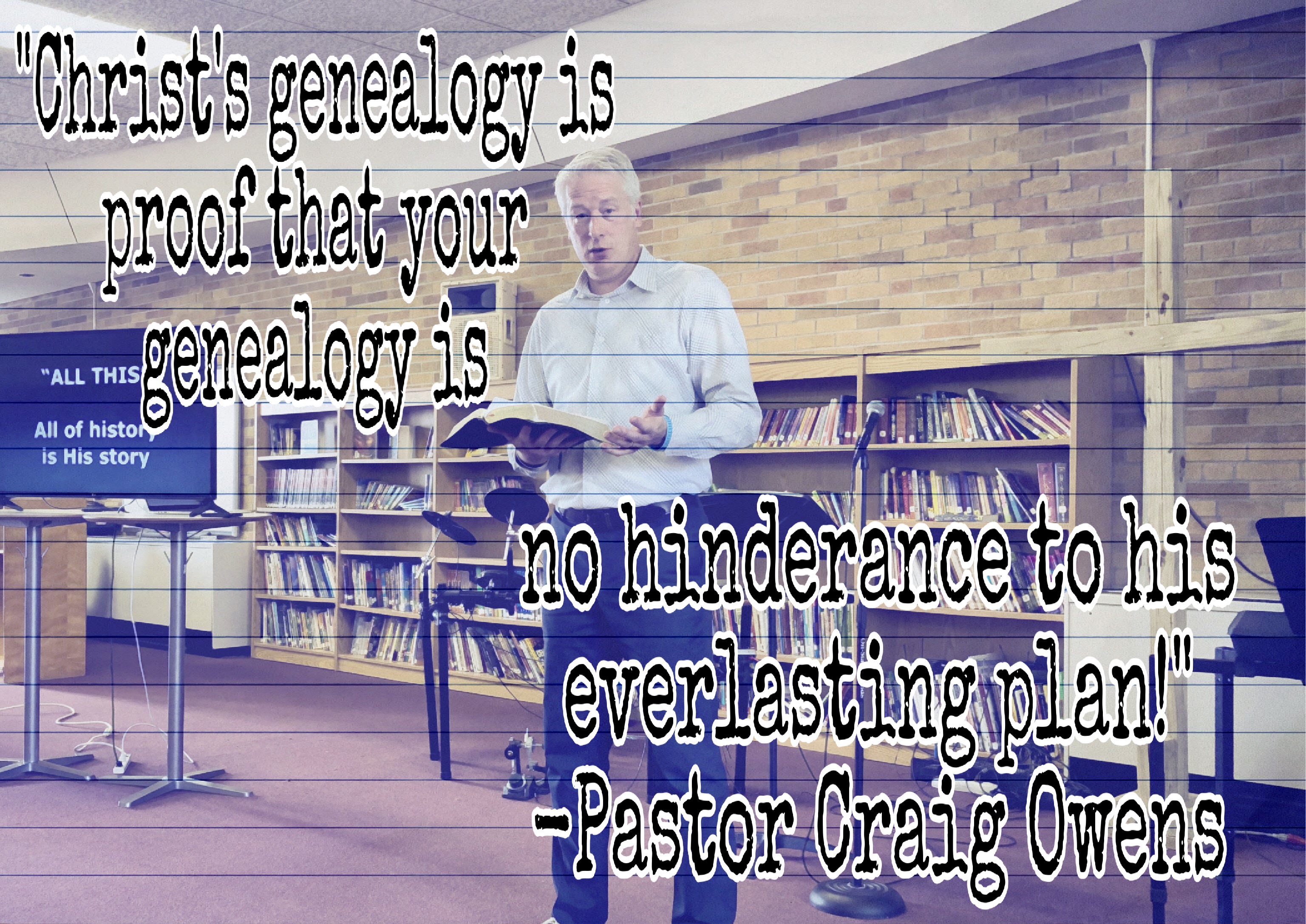
Christ’s genealogy is proof that your genealogy is no hindrance to His everlasting plan! 

It may appear He is late in time, but behold Him come at just the right time. Accept Him as your everlasting Lord, lean on His everlasting arms, and bask in His everlasting joy. 

Jesus—our Immanuel here—came so you could have all of God’s everlastingness! 

To take a look at the other stanzas of this Christmas carol, please click here.

First Reaction

“…Be patient in trouble, and keep on praying” (Romans 12:12).

When trouble comes, is our first response “I’ve got to do something” or “I’ve got to pray”?

Let’s make prayer our first reaction, not our last resort.

Amen!

The Value Of The Old Testament

“Jesus exalted the law of God, and made its importance more evident even than it had been before. In a word, ‘He magnified the law and made it honorable’ (Isaiah 42:21). …

“Let us beware of despising the Old Testament under any pretense whatever. Let us never listen to those who bid us throw it aside as an obsolete, antiquated, useless book. The religion of the Old Testament is the embryo of Christianity. The Old Testament is the Gospel in the bud. The New Testament is the Gospel in full flower. The Old Testament is the Gospel in the blade. The New Testament is the Gospel in full ear. …

“Let us, for another thing, beware of despising the law of the Ten Commandments. Let us not suppose for a moment that it is set aside by the Gospel, or that Christians have nothing to do with it. The coming of Christ did not alter the position of the Ten Commandments one hair’s breadth. If anything, it exalted and raised their authority (Romans 3:31). …

“In the last place, let us beware of supposing that the Gospel has lowered the standard of personal holiness, and that the Christian is not intended to be as strict and particular about his daily life as the Jew. … The more light we have, the more we ought to love God. The more clearly we see our own complete and full forgiveness in Christ, the more heartily we ought to work for His glory. …

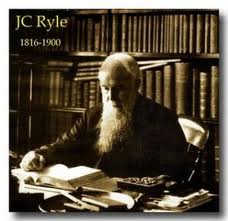
“Jesus shows us that the law, as expounded by Him, was a far more spiritual and heart-searching rule than most of the Jews supposed.” —J.C. Ryle, in Expository Thoughts On The Gospels

Thursdays With Oswald—How To Understand And Apply The Scriptures

This is a weekly series with things I’m reading and pondering from Oswald Chambers. You can read the original seed thought here, or type “Thursdays With Oswald” in the search box to read more entries.

How To Understand And Apply The Scriptures

     In order to understand the Sermon on the Mount, it is necessary to have the mind of the Preacher, and this knowledge can be gained by anyone who will receive the Holy Spirit (see Luke 11:13; John 20:22; Acts 19:2). The Holy Ghost alone can expound the teachings of Jesus Christ. The one abiding method of interpretation of the teachings of Jesus is the Spirit of Jesus in the heart of the believer applying His principles to the particular circumstances in which he is placed. “Be transformed by the renewing of your mind,” says Paul, “that you may prove,” i.e. make out, “what is that good, and acceptable, and perfect will of God” [Romans 12:2]. …

     Every mind has two compartments—conscious and subconscious. We say that the things we hear and read slip away from memory; they do not really, they pass into the subconscious mind. It is the work of the Holy Spirit to bring back into the conscious mind the things that are stored in the subconscious. In studying the Bible never think that because you do not understand it, therefore it is of no use. A truth may be of no use to you just now, but when the circumstances arise in which that truth is needed, the Holy Spirit will bring it back to your remembrance [John 14:26]. … 

     We do not hunt through the Bible for some precept to obey…but we live so in touch with God that the Holy Spirit can continually bring some word of His and apply it to the circumstances we are in. … The teaching of Jesus Christ comes with astonishing discomfort to begin with, because it is out of all proportion to our natural way of looking at things; but Jesus puts in a new sense of proportion, and slowly we form our way of walking and our conversation on the line of His precepts: Remember that our Lord’s teaching applies only to those who are His disciples.

From Studies On The Sermon On The Mount

What Chambers says about the Sermon on the Mount is true of any biblical passage we read: we need to have the Holy Spirit’s help to understand it and apply it to our unique life setting. 

Think of this—the same Holy Spirit who inspired the biblical writers is the exact same Spirit who will assist you in understanding that Word! Before I read the Bible I often pray: May the Spirit who inspired this Word now illuminate my mind to understand it and obey it. 

Try that prayer yourself and see how God’s Word is opened up to you. 

Thursdays With Oswald—Jeremiah 24

Oswald ChambersThis is a weekly series with things I’m reading and pondering from Oswald Chambers. You can read the original seed thought here, or type “Thursdays With Oswald” in the search box to read more entries.

Jeremiah 24

[These are notes from Oswald Chambers’ lecture on Jeremiah 24.] 

     The estimate a Christian must hold of his own value is what he is worth to God. You cannot judge whether you are right with God by His blessings because “He makes His sun to rise on the evil and on the good, and sends rain on the just and on the unjust” [Matthew 5:45]. God is not meant to bless us; the vital question is—What am I worth to God? In times of affliction am I giving way to self-pity? am I badgering the throne of God for Him to bless me, or am I saying, “Though He slay me, yet will I wait for Him” [Job 13:15]? … 

     The question, “What do you see, Jeremiah?” is the call for Jeremiah to state clearly to himself what it is he sees. ‘Two baskets of figs set before the temple of the Lord’—these symbolize the people as they appear before God. They have been trying to bring wrong things to the altar, and now God is saying He will destroy the evil and wrong out of the nation.

     “Therefore, I urge you, brothers, in view of God’s mercy, to offer your bodies as living sacrifices, holy and pleasing to God—this is your spiritual act of worship” (Romans 12:1). This verse refers to an abiding law, individually and nationally: we cannot consecrate to God anything that is sinful. We cannot present our bodies “a living sacrifice” to God unless we have been cleansed from sin; He won’t have them. The call in this verse is not for sanctification, but for the service of the sanctified. We could never begin to be of worth to God in service until we have been through what is represented in the atoning sacrifice of Our Lord Jesus Christ. That is why the majority of us are of no worth to God. We are of no value to God until we enter into the experience of instantaneous, continuous sanctification, then our “spiritual act of worship” is the offering of ourselves “as living sacrifices, holy and pleasing to God,” and we no more bother about ourselves.

From Notes On Jeremiah

This is, without a doubt, a challenging word from Oswald Chambers that deserves some time for us to thoughtfully consider it. 

Can God use me? Am I allowing the Holy Spirit to continually and instantaneously stamp the image of Jesus more clearly in my life? Or am I saying, “I’m good like this. I don’t need to go any further”? 

God wants to use us for His glory. Are we allowing ourselves to be in a place where we can be used “as living sacrifices, holy and pleasing to God”? 

7 More Prayers From “Praying The Promises”

In his book Praying The Promises, Max Lucado shows us how simply we can turn passages of Scripture into intimate and powerful prayers. Here are a few more prayers (the references in brackets are passages that formed the prayer).

Lord, in the midst of my storms, I may doubt Your presence. I may wonder if You are there and if You care. Don’t let me lose hope or lose heart. Deepen my belief in You, even during the storms. Don’t allow doubt to take over. Help me release control of my circumstances and surrender them to You. Jesus is interceding on my behalf, and I am so comforted by this truth. [Luke 22:32; Hebrews 7:25; Matthew 14:23-24]

God, teach me how to live free from condemnation. Teach me how to trust and believe in this promise: in Christ, I am no longer a slave to sin. Free me from guilt and shame. [Romans 3:23-25; Romans 6:6-7; Romans 8:1] 

Lord, thank You for the promise of a temporary tomb. Your power has no limits. You have conquered death. You have promised to make all things new. You are the God of restoration and redemption and regeneration. You are the God of resurrection. In my day-to-day life it can be difficult for me to maintain an eternal perspective. Sometimes I may get bogged down in the worries of today and forget that the best is yet to come. Restore in me the joy of my salvation, God. Renew my mind and my heart so that I will have an eternal perspective of all the worries of my day. They are nothing compared to spending eternity with You. And because of Your promise of resurrection, I do not have to fear death. I will live in faith, knowing that in Jesus, death has been swallowed up in victory. Amen. [Matthew 28:5-6; 2 Corinthians 4:16-18] 

Guide me today, Holy Spirit. Show me where You want me to go, whom You want me to talk to, what decision You want me to make. Help me discern Your voice over my own and others’. Walk closely with me and whisper truth to me. Forgive me when I listen to my own desires and ignore what You are telling me. [John 16:13-15; Galatians 5:25] 

You know all of my needs before I can even ask for them. Sometimes it’s tempting for me to believe I can rely on myself for what I need. Instead of trusting You to provide, I think I can look out for myself. I fear not having enough. And when I do have enough, it never feels like it. But You have promised to meet my needs out of Your glorious riches. Remind me of Your kind and generous provision. Thank You for taking care of me and meeting all of my needs. [Psalm 34:10; Matthew 6:8; Matthew 10:29-31]

Help me to keep eternity in mind, making the most of my days and showing others Your renewing love. [2 Corinthians 4:16-18; 2 Peter 3:13] 

Dear God, You are my unshakable hope. Your promises are unbreakable. You never waiver. You are faithful to the end. My hope cannot be anchored to anything less than Your promises. … Forgive me for those times when I don’t put my hope in You. May I rest in Your promises once again. May any fear, anxiety, or confusion I feel subside in light of You as my anchor. [Isaiah 40:31; Romans 15:13] 

You can check out my review of Praying The Promises by clicking here. I also shared some other prayers here and some quotes from this book here. 

Unlearning Limiting Fears

Did you know that you were only born with two fears: the fear of falling and the fear of loud noises? Yet the DSM-5 has a whole section to help mental health professionals diagnosis the specific phobia that may be limiting someone’s life. That might be because some places list upwards of 500 recognized phobias that constrict people’s lives! 

Since only two of our fears are innate fears, that means the rest of the fears that trouble us are learned fears. Since God repeatedly says “Fear not!” throughout Scripture, that must mean He also tells us how to overcome our fears. 

Christians—as aliens and strangers on this Earth—should have an alien response to earthly fears. So if we are going to unlearn some of the fears that have cramped our lives we will need to learn and relearn what God says to us.

Peter asks what might seem like a rhetorical question, “Who is going to harm you if are eager to do good?” Think about it: who wants to punish someone for doing the right thing? Apparently some people do because Peter goes on to add, “But even if you should suffer for what is right, you are blessed. Do not fear what they fear; do not be frightened” (1 Peter 3:13-14). 

So even if people insult Christians for doing things God’s right way, God’s blessing is on them. Sadly, people without God’s blessing on their lives often give in to the FOMO (fear of missing out) and they end up lashing out at those being blessed. That lashing out is directly rooted in their fears. 

Abraham Maslow proposed a hierarchy of needs that humans have, and obviously, there would be fears associated with any of those needs not being met. At least, that would be the Earthling response. Christians need to unlearn those fears by learning and relearning why God tells them to “Fear not!” 

  1. Fear of not having physiological needs met—Jesus tells us why we shouldn’t worry (Matthew 6:25-34). 
  2. Fear of not being kept safe—the psalmist tells us that God is our shield (Psalm 84:11).
  3. Fear of not fitting in with a certain social group—Jesus proudly call His followers His brothers and sisters (Hebrews 2:11-12).
  4. Fear of not being rewarded or recognized—Jesus says there are blessings for those that hang in with Him through persecution, including being called a co-heir alongside Him (Matthew 5:10-12; Romans 8:17).
  5. Fear of our life not having purpose—the apostle Paul reminds us that God chose us on purpose to be His example to the world (1 Corinthians 1:25-27). 

Since Jesus overcame all the things that could cause us fear, Peter counsels us to arm yourselves with this same attitude (1 Peter 4:1). The Greek word for arm yourselves only appears here, and it means for us to repeatedly remind ourselves of God’s truth. The Greek word for attitude is only here and in Hebrews 4:12, where we are reminded that the Word of God helps our minds unlearn, learn, and relearn God’s truth. 

Have the borders of your life been squeezed by your fears? Do you feel like you’re missing out on the “abundant life” that Jesus said you could have? The Word of God can help you unlearn those fears, and fellow Christians would love to come alongside you to help you continue to relearn that truth over and over again until your fears are banished from your life! 

Don’t let fear keep you from being all that God has planned for you to be! 

Please join me on Sunday as we continue our study of how Christians are to live as aliens and strangers while on Earth. If you’ve missed any messages in this series, you may find the complete list by clicking here.