For You are the fountain of life, the light by which we see. Psalm 36:9
“I was standing today in the dark toolshed. The sun was shining outside and through the crack at the top of the door there came a sunbeam. From where I stood that beam of light, with the specks of dust floating in it, was the most striking thing in the place. Everything else was almost pitch-black. I was seeing the beam, not seeing things by it. Then I moved so that the beam fell on my eyes. Instantly the whole previous picture vanished. I saw no toolshed, and (above all) no beam. Instead I saw, framed in the irregular cranny at the top of the door, green leaves moving on the branches of a tree outside and beyond that, 90 odd million miles away, the sun. Looking along the beam, and looking at the beam are very different experiences.” —C.S. Lewis
“So we can say that when we ‘look along’ the heavens and not just ‘at’ the heavens, they succeed in their aim of ‘declaring the glory of God.’ That is, we see the glory of God, not just the glory of the heavens. We don’t just stand outside and analyze the natural world as a beam, but we let the beam fall on the eyes of our heart, so that we see the source of the beauty—the original Beauty, God Himself. This is the essential key to unlocking the proper use of the physical world of sensation for spiritual purposes. All of God’s creation becomes a beam to be ‘looked along’ or a sound to be ‘heard along’ or a fragrance to be ‘smelled along’ or a flavor to be ‘tasted along’ or a touch to be ‘felt along.” —John Piper
This is a weekly series with things I’m reading and pondering from Oswald Chambers. You can read the original seed thought here, or type “Thursdays With Oswald” in the search box to read more entries.
Jeremiah 27-28
[These are notes from Oswald Chambers’ lecture on Jeremiah 27-28.]
God does not act according to His own precedents, therefore logic or a vivid past experience can never take the place of personal faith in a personal God. … God is constantly stirring up our nests that we may learn that the only simplicity there is is not the simplicity of a logical belief, but “the simplicity that is in Christ” [2 Corinthians 11:3]. …
Never try to explain God until you have obeyed Him…. The only bit of God we understand is the bit we have obeyed. … Never be surprised if there our whole areas of thinking that are not clear, they never will be until you obey (John 7:17). …
We never gain any knowledge by intellectual curiosity, but only as a relationship of simplicity to God is it maintained. In John 9 Our Lord was dealing with religious teachers who had known God’s way in the past but they were blind to His ways in the present. … Our Lord’s phrase “blind leaders of the blind” was used of those who built their teaching as to how God would act in the future on their knowledge of how He had acted in the past, instead of on a personal knowledge of God. …
We have to keep in unbroken touch with God and give every soul the same freedom and liberty before God as God gives us. …
No silence is so profound as the silence that falls on a soul that has quenched the Spirit of God by concentration on religious convictions. … Our only safety is in concentration on God with nothing between.
From Notes On Jeremiah
God is infinitely creative—He never has to repeat Himself. For proof, just look at the billions of unique snowflakes!
We must be very careful not to say, “God, You worked just like this last time so I expect You to work exactly the same way this time.” Let God be God; let Him do what He knows is best to do. Don’t tell God how He’s supposed to work, and don’t teach others to interact with God the same way you have interacted with God.
Let God be God—unique, inimitable, creative, sovereign, omnipotent, personal—with you and with others.
Oswald Chambers always gives me unique perspectives on passages of Scripture—even ones that I thought I already knew quite well. He does this again as he dives deep into one of the major prophets in his book Notes On Jeremiah.
These Notes are really his lecture notes from his classes at the Bible Training Institute. Once again, these classes were cut short by the outbreak of The Great War (what we now call World War I), so we only have his brilliant insights through Jeremiah chapter 29.
Chambers himself noted, “The conception of these studies is that man must look higher for the source of life and salvation than the experience of life. … Jesus Christ is the only One Who can throw light on the prophecies of Isaiah, and He is the only One Who throws any kind of light on the acute suffering and amazing misery of this prophet [Jeremiah].”
Indeed, many of Chambers’ lectures start with “the experience of life” that most of us have had (or are having at present), and then he tries to take us both higher and deeper. Using Jeremiah’s prophesies like a searchlight, Chambers shows how these Old Testament words find their ultimate relevance and fulfillment in the dazzling Advent of Jesus Christ.
Jeremiah was prophesying in the darkest days of Judah, just before the city was overthrown by the Babylonians. In the face of this darkness, Jeremiah shines out a light of Ultimate Hope. This is a valuable resource for Christians today who are living in sin-darkened days.
If you are looking for a great companion resource for your Bible reading time in Jeremiah, please add Notes On Jeremiah to your library.
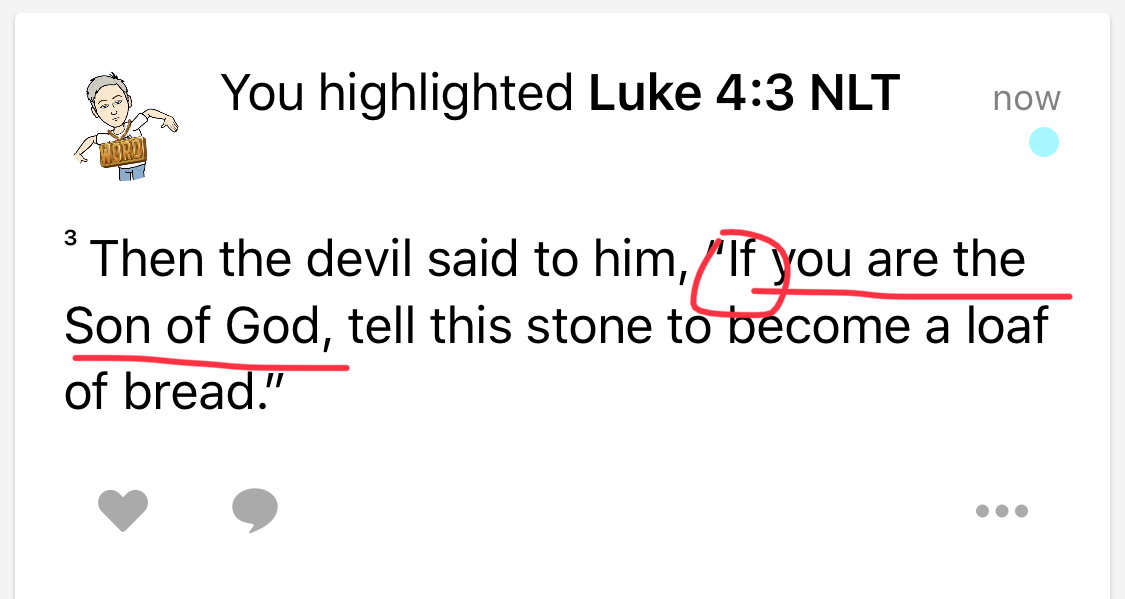
God announces to the world that Jesus is His Son, but as soon as the devil has an opportunity to tempt Jesus he begins with, “IFYou are the Son of God….”
“This is the bedrock of EVERY temptation. If satan can cause us to reject, doubt, or forget our original identity as beloved sons and daughters of the King, he can get us to fall for any number of tricks and non-satisfying pleasures.” —Honoring Christ In Human Rights (a YouVersion reading plan)
The devil has always been a slanderer and a prosecutor—always leveling charges against God’s children, trying to get them to feel unworthy of God’s love. He still does this today.
Don’t let him. It’s time to fight back!
How?
We read in Revelation: “For the accuser of our brothers and sisters, who accuses them before our God day and night, has been hurled down. They triumphed over him by the blood of the Lamb and by the word of their testimony” (Revelation 12:10-11).
Jesus—the Lamb of God—shed His blood for you. You have been purchased with an amount that is incalculable. You have so much worth to your Heavenly Father! You did nothing to earn this payment of blood, you just receive it by faith.
But we also need “the Word.” Notice that every time the devil attacked Jesus, He responded by saying, “It is written,” and then He quoted the Word (see Luke 4:1-12). We must do the same.
When the devil says you’re unworthy of God’s love, you say, “It is written, ‘There is no condemnation for me because I am covered by the blood of Jesus’” (Romans 8:1).
When the devil says God can’t or won’t help you, you say, “It is written, ‘If God did not spare His own Son, but gave Him up for me—how will He not also graciously give me everything I need?’” (Romans 8:32).
When the devil says you can’t resist his temptations for very much longer, you say, “It is written, ‘Greater is He that is in me than anything you’ve got. I have submitted myself to God and I will not give in to you, so you must flee from me!’” (1 John 4:4; James 4:7).
When the devil says you’re all alone in this world, you say, “It is written, ‘God said He would never leave me, and His Spirit is inside me right now and forever’” (Hebrews 13:5; John 14:16-18).
Dear friend, the blood of the Lamb covers you. Now use His Word to refute every single charge the devil tries to use to slander you.
This is a weekly series with things I’m reading and pondering from Oswald Chambers. You can read the original seed thought here, or type “Thursdays With Oswald” in the search box to read more entries.
Jeremiah 12
[These are notes from Oswald Chambers’ lecture on Jeremiah 12.]
Few suffer more seriously in character than the men and women who for one reason or another are exempt from frank, honest criticism. …
Progressive realization does not mean that God reveals Himself by inches, but that we realize His revelation of Himself by inches as we obey. …
God would have been “a wall of fire round about and…the glory in the midst” [Zechariah 2:5] if they had been obedient. The difference between God as a consuming fire and natural fire is just this, that the further you get away from God the more fiercely you feel His burnings, but when you are close to Him, you will find it is a glorious protection. …
The truth about God is Jesus Christ—light, life and love. Whatever is dark to us will, by means of our obedience, become as clear as the truth which we have made ours by obedience. The bit we do know is the most glorious, unfathomable delight conceivable, and that is going to be true about everything to do with God and us. The process is continual obedience.
From Notes On Jeremiah
God wants to reveal Himself to us, even if He has to be a consuming fire in order to do so!
God will burn up everything that keeps us from obeying Him—everything that takes our attention off of Him. He will burn up everything worthless so that we can know what is of incalculable worth; namely, Himself.
If you want to have more of God revealed to you, scrupulously obey the parts that have already been revealed to you.
This is a weekly series with things I’m reading and pondering from Oswald Chambers. You can read the original seed thought here, or type “Thursdays With Oswald” in the search box to read more entries.
Jeremiah 11
[These are notes from Oswald Chambers’ lecture on Jeremiah 11.]
Misapprehensions of God arise from not understanding that His way for us is obedience until we discern, not waiting to obey until we know. The only way to know God more fully is to obey what we have discerned, then we shall know something more. …
If we will obey, we are backed by Omnipotence; but if once we begin to be cunning and suspicious and to doubt, we are backed by diabolical inspiration as compelling on the wrong side as obedience is on the right. …
Unless we keep in touch with God by obedience it is possible to pray for a wrong thing. In this case [Jeremiah 11:9-11] the people have rebelled and do not intend to obey, they only pray because they are suffering, not because they want God’s will to be done in them. …
“My Lord and I” is a very beautiful sentiment, but before we know it as a living experience we have to fight our way through all the contradicting things to the un-afraid, simple life that trusts in God.
From Notes On Jeremiah
Most of us have an attitude that says, “As soon as I understand, I will fully believe.” But Oswald Chambers points out that the Scriptures teach that we are to be fully obedient to what has already been revealed to us in order to receive more revelation.
A loving God would not reveal things to us that we are not yet ready to obey. So if you want God to show you deeper things, obey what He’s already shown you.
…the twenty-four elders fell down before the Lamb. Each one had a harp, and they held gold bowls filled with incense, which are the prayers of God’s people (Revelation 5:8).
Then another angel with a gold incense burner came and stood at the altar. And a great amount of incense was given to him to mix with the prayers of God’s people as an offering on the gold altar before the throne. The smoke of the incense, mixed with the prayers of God’s holy people, ascended up to God from the altar where the angel had poured them out (Revelation 8:3-4).
No prayer is ever lost.
Every prayer is a weapon.
Every prayer is an incense of worship before God’s throne.
I may not see the result of my prayers immediately, but they are all known in Heaven, and they are being stored up for a day when God will unleash His power.
I must never think my prayers are trivial, temporary, or impotent.
This is a weekly series with things I’m reading and pondering from Oswald Chambers. You can read the original seed thought here, or type “Thursdays With Oswald” in the search box to read more entries.
Isaiah 6
[These are the notes on Oswald Chambers’ lecture on Isaiah 6.]
My vision of God depends upon the state of my character. Character determines revelation. … Until I am born again and enter the Kingdom of God I see only along the line of my prejudices. …
The purpose of the vision is to enable me to see “the arm of the Lord” behind all circumstances (see Isaiah 53:1). God never gives a man the power to say “I see” until his character proves itself worthy of its purification. What hinders the purging of our perception is that we will build our faith on our experiences instead of on the God who gave us the experiences. My experience is the evidence of my faith, never the ground of it, and is meant to reveal to me a God who is bigger than any experience. …
The symbol of the live coal ‘from off the altar’ represents the twofold nature of the substitution of Christ, not only Christ for me, but Christ in me. …
God only gives us visions of Himself for one purpose, that we may work them out into character. … After God has given us a time of face-to-face contact with Himself and then puts us into tumults, the temptation is to sit down and say “Where is the blessedness I had when I first knew the Lord?” The Spirit of God holds us steady until we learn to know God, and the details of our lives are established before Him, then nothing on the outside can move us.
From Notes On Isaiah
There are specific reasons God will give us a clearer revelation of Himself—
to purify godly character in us
to help us deal with our own sin
to see God at work in everyday affairs
to keep us energized through trying times
to make us more aware of what Jesus has done for us and in us
to be His messenger among needy people
God doesn’t give visions or revelations just to thrill us or give us an experience. God is perfectly purposeful in everything He does. His visions are for His glory.
This is a weekly series with things I’m reading and pondering from Oswald Chambers. You can read the original seed thought here, or type “Thursdays With Oswald” in the search box to read more entries.
His!
“They were Yours; You gave them to Me” (John 17:6). It is this aspect of a disciple’s life that is frequently forgotten. We are apt to think of ourselves as our own, of the work as our work. A great point in spiritual nobility has been reached when we can really say, “I am not my own.” … The Son of God is the Highest of all, yet the characteristic of His life was obedience. We have to learn that God is not meant for us, it is we who are meant for God. … “Do you not know…you are not your own” [1 Corinthians 6:19].
His! Does that apply to us? Have we realize that our body is not our own, but His—“the temple of the Holy Ghost”! Have we realized that our hearts and affections are not our own, but His? If so, we shall be careful over inordinate affection. Have we realized that all the ambitions of life are His? We are out for one thing only, for Jesus Christ’s enterprises. …
“Since you have kept My command to endure patiently” [Revelation 3:10]. This is not the patience of pessimism, nor of exhaustion, but the patience of joyfulness because God reigns. It may be illustrated by likening the saint to a bow and arrow in the hand of God. God is aiming at His mark, He stretches and strains until the saint says—“I cannot stand anymore,” but God does not heed. He goes on stretching until His purpose is in sight, then He lets fly, and the arrow reaches His mark. …
It takes the endurance which comes from a vision of God to go on without seeing results. We are not here for successful service, but to be faithful. Had Jesus any results? Before we go into work for Him we must learn that the disciple is not above his master. We cannot be discouraged if we belong to Him, for it was said of Him—“He shall not fail nor be discouraged” [Isaiah 42:4]. Discouragement is “disenchanted egotism.” “Things are not happening the way I expected they would, therefore I am going to give it all up.” To talk like that is a sure sign that we are not possessed by love for Him, but only by love for ourselves. Discouragement always comes when we insist on having our own way.
From So Send I You
Can Jesus say of you that you are His? Are you trying to make your own way, or are you simply following Jesus? Are you letting God stretch you until He is ready to release you, or are you becoming exhausted and discouraged in the waiting? Is your love for Jesus absolute, or does it come with conditions?
A little boy wanted to do something special for his family, so he thought he would do something he had seen his mother do dozens of times: bake a cake. Quickly he looked through a cookbook and got to work.
Dad was the first one to come home and heard an unusual clatter in the kitchen. Peeking around the corner he saw his son wearing his wife’s apron, slightly dusted in flour, and vigorously stirring a big bowl of batter.
“What are you doing, son” Dad asked.
Without looking up from his work the boy proudly answered, “I’m making a cake, Dad!”
Dad looked around the kitchen and saw all the proper ingredients out, so he was somewhat assured when he asked, “So how’s it going?”
The little boy paused and looked up at him, “Pretty good I think. I’m just having a little trouble with the ‘tbls” and ‘tsps.’”
For those of you who have done any baking, you know that “tbls” are tablespoons and “tsps” are teaspoons. If you get those mixed up, the cake might not turn out very well. For instance, adding a teaspoon of baking powder when the recipe calls for a tablespoon might result in a flat cake. Or adding a tablespoon of salt when the recipe asks for a teaspoon might making a rather salty cake.
Abbreviations only work if everyone is on the same page with you. If they’re not, it could be rather unsavory or maybe even dangerous.
In 1816, Joseph Mohr penned the words to what some have called the best-known Christmas carol in the world: Silent Night! Holy Night!
I’m not really sure how “silent” the night Jesus was born really was: a village so filled with people that no bedrooms were available, a mother in labor, a crying newborn, animals in a stable disturbed by the mother and child, singing angels, and curious shepherds. But let’s leave that part alone for a while.
Although it may not have been a silent night, it most assuredly was aHoly Night! That full title gives us the full impact of what happened at Christ’s First Advent.
Holy means something unlike anything else; someone or something devoted to God; something divine; something with God’s fingerprints all of it. I see at least three divinely holy things in this carol.
The virgin birth of Jesus.
Not only was the birth of Jesus a fulfillment of prophesy (see Isaiah 7:14 and Matthew 1:18-25), but it was also an indication of God’s miracle-working power. The fact the Luke gives so many specific details about that birth night (see Luke 2:1-2) also lets us know that this isn’t a “once upon a time” myth.
The involvement of angels in the affairs of humans.
Angels bring messages to key people before the birth of Jesus (Luke 1:11, 26; Matthew 1:20) and on the night of His birth (Luke 2:9-14). John also gives us a peek behind the scenes of the massive spiritual warfare taking place the night of Christ’s birth (see Revelation 12:1-5). Paul tells us that we, too, are involved in this spiritual battle, but that because of Christ’s Advent we’re more than conquerors through Jesus (Ephesians 6:12; Romans 8:37).
The full deity and the full humanity of Jesus.
Jesus was fully Man and fully God (see Philippians 2:5-7; Matthew 26:63-64; John 8:54-58). This is so important, because without this we would be lost. If Jesus wasn’t fully Man, He wouldn’t know how to help us; if He wasn’t fully God, He couldn’t help us.
So when you hear this carol playing, ask someone if they know the title. More than likely they will say, “Silent Night.” To which you can easily reply, “Actually it’s Silent Night! Holy Night! and I’d like to tell you three amazing, holy things that took place!”
Let’s never abbreviate away the miracles. It may or may not have been a Silent Night, but it most certainly was a Holy Night! These supernatural miracles surrounding Christ’s First Advent provided us freedom from sin, and a rock-solid hope of our eternal reward in Heaven at Christ’s Second Advent.