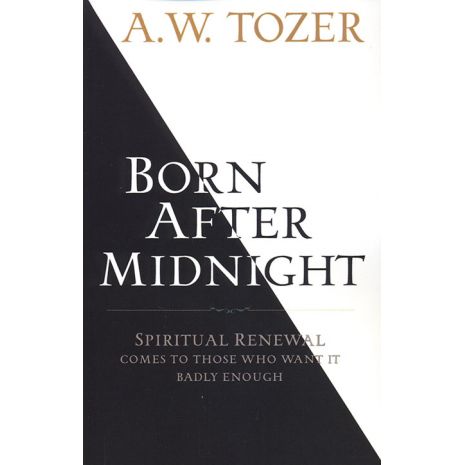
8 Quotes From “Born After Midnight”

A.W. Tozer’s writings are nearly five decades old, but they still ring with prophetic truth for this generation. Check out my book review of Born After Midnight by clicking here. Below are a few of the quotes from this book.

“It may be said without qualification that every man is as holy and as full of the Spirit as he wants to be. He may not be as full as he wishes he were, but he is most certainly as full as he wants to be. … The problem is not to persuade God to fill us, but to want God sufficiently to permit Him to do so.”

“In of book of Acts, faith was for each believer a beginning, not an end; it was a journey, not a bed in which to lie while waiting for the day of our Lord’s triumph. Believing was not a once-done act; it was more than an act, it was an attitude of heart and mind that inspired and enabled the believer to take up his cross and follow the Lamb whithersoever He went.”

“I am afraid we modern Christians are long on talk and short on conduct. … Our Lord and His apostles were long on deeds. The Gospels depict a Man walking in power, ‘who went about doing good, and healing all that were oppressed of the devil; for God was with Him’ (Acts 10:38). The moral relation between words and deeds appears quite plainly in the life and teachings of Christ; He did before He spoke, and all the doing gave validity to the speaking.”

“We settle for words in religion because deeds are too costly. It is easier to pray, ‘Lord, help me to carry my cross daily’ than to pick up the cross and carry it.”

“‘Whoever will be great among you, let him be your minister,’ said our Lord (Matthew 20:26), and from these words, we may properly conclude (and the context strongly supports the conclusion) that there is nothing wrong with the desire to be great provided (1) we seek the right kind of greatness; (2) we allow God to decide what is greatness; (3) we are willing to pay the full price that greatness demands; and (4) we are content to wait for the judgment of God to settle the whole matter of who is great at last.”

“God may allow his servant to succeed when He has disciplined him to a point where he does not need to succeed to be happy. The man who is elated by success and cast down by failure is still a carnal man. … God will allow His servant to succeed when he has learned that success does not make him dearer to God nor more valuable in the total scheme of things.”

“While we cannot determine circumstances, we can determine our reaction to them. And there is where the battle is to be fought and the victory won.”

“To ‘accept the universe’ does not mean that we are to accept evil conditions as inevitable and make no effort to improve them. So to teach would be to cancel the plain teaching of the Scriptures on that point. Where a situation is contrary to the will of God, and there are clear promises concerning it in the Scriptures, it is our privilege and obligation to pray and labor to bring about change.”

More quotes from this book are coming soon…

Much Needed God Time

“Jesus’ prayer time was not alone time but Father time. He was always escaping into boats, up mountains, to the water, into the desert—anywhere to grab a moment with God. These were not retreats. These were advances. The soul needs two things as a tree needs water and light: solitude and society. Together they form a barbell that the soul lifts to get strong and healthy.

“Solitude is not solo time but time with God. Solitude is a relationship word, another name for a relationship with the self and with the Source. Solitude is not a time-out from relationships, for relationship is central to solitude. Aloneness is not soulful sophistry but sophistication and maturity of relationship with God. A lot of ‘spiritual problems’ are not struggles with God but with self. A lot of mental torments and tossing and turnings of the soul could be solved by a good night’s sleep … or a good day’s diet … or a good long walk … or a good hug … or some deep solitude. But true spiritual struggle needs God-time.” —Leonard Sweet, The Bad Habits Of Jesus

For more quotes from this book click here and here.

Pour It Out!

“We can simply pour from the fullness of our heart the burdens of our spirit and the sorrow that seems to crush us. We can know that God hears, loves, understands, receives, and separates from our prayer everything that is in error, imperfect, or wrong. And then He presents the remainder, along with the incense of the great High Priest, before His throne on high.

“We may be assured that our prayer is heard, accepted, and answered in Christ’s name. … Do we truly know the power of our supernatural weapon of prayer? Do we dare to use it with the authority of a faith that not only asks but also commands? God baptizes us with holy boldness and divine confidence, for He is looking not for great people but for people who will dare to prove the greatness of their God!” —A.B. Simpson

[see Romans 8:26-27; Psalm 141:2; Revelation 5:8, 8:3-4]

12 Quotes From “A New Kind Of Apologist”

A New Kind Of Apologist is edited by Sean McDowell and contains a collection of fabulous essays to prepare Christian apologists to be effective in this current generation. You can read my full book review by clicking here. These quotes mainly deal with the attitude that a Christian apologist should adopt.

“Truth must be wedded to grace, and what we say is important…but how we say it is equally critical.” —Sean McDowell 

“To listen to a person will require that we temporarily set aside our objections to what a person is saying and allow him or her to speak openly without fear of being challenged.” —Tim Muelhoff

“Our character and relationships with others have a greater capacity for attracting those around us to the Christian message than do our arguments or rhetoric.” —Ken Wytsma & Rick Gerhart 

“If our beliefs are not expressed in love and by example, we miss the greatest command of all, which is loving God and loving others.” —Dan Kimball

“The Barna Research Group found that twentysomethings who stay in church were twice as likely to have a close personal friendship with an adult inside the church. Those who had an adult mentor at church, aside from the pastor, were almost three times as likely to stay as those who did not.” —Jeff Myers

“Any fully-orbed presentation of the truth about ourselves and God’s plan for us cannot be a disembodied, purely intellectual truth; it must truthfully reflect our nature as created beings.

“Part of being incarnate means that it is good and right for us to have emotions and express them—as our Lord did, for example, by weeping at the tomb of Lazarus and getting angry with the money changers in the temple. The fact that little children wanted to come to Him suggests that He had a welcoming physicality and a warm personality that they instinctively trusted and found attractive. He wasn’t just a walking dictionary of Christian theology.” —Holly Ordway

“At its core, apologetics is the art and science of defending the faith. However, practically understood, the work of the apologist is simply to answer with integrity, clarity, and compassion the questions critics are asking about the gospel (1 Peter 3:15). The context of this passage implies a lifestyle on the part of the apologist that engenders and welcomes questions from their audience. The encouragement of Peter seems to be that we avoid the telemarketer approach of simply enduring questions solely for the sake of closing the deal. Rather, Peter calls us to anticipate and patiently answer the questions of our unbelieving friends, family members, and neighbors in an uncompromising and yet humble manner.” —Christopher Brooks

“We must be Christians first and apologists second, which means our intellectual lives must be primarily shaped by seeking to understand the faith we live within rather than debating, disputing, or even persuading those who do not believe it.” —Matthew Anderson 

“It is our responsibility to share the message of hope through Christ ‘with gentleness and respect’ and ‘with grace,’ as Peter and Paul taught. The gospel message is already offensive to some. We need not make it more offensive by presenting it in a manner that lacks gentleness, respect, and grace.” —Mike Licona

“Truth without grace is abusive and arrogant. Grace without truth is mushy sentimentalism. … As much as possible, always deal with the person in grace and the issue itself in truth.” —Glenn T. Stanton

“Paul doesn’t say that we ought to know how to answer each question [see Colossians 4:5-6]. He specifically teaches us to answer each person. … Paul tells us that we aren’t in the question-answering business. We are in the people-answering business. Today’s apologist must understand that questions don’t need answers; people need answers. … I am convinced that the key to apologetics today is to identify what non-Christians thirst for most and show how the Christian faith alone can slake that thirst.” —Abdu Murray

“The manner in which we communicate the gospel is not a minor add-on to the gospel itself [see 1 Peter 3:15-16]. Very often it is the nature of the communication that determines whether the gospel gets a hearing at all. …

“It remains true that it is not arrogant to make truth claims, it is not arrogant to pursue a knowledge of that truth, and to argue that we’ve found it. It is important that the content of our message is a genuine reflection of the gospel, and that the manner in which we communicate it doesn’t become a stumbling block.” —Tanya Walker

More quotes from A New Kind Of Apologist will be coming soon. You can also follow me on Tumblr and Twitter to read great quotes every single day.

10 More Quotes From “Shade Of His Hand”

In Shade Of His Hand, Oswald Chambers is giving us his insight on the biblical book of Ecclesiastes. I typically share longer passages from Oswald Chambers’ works in my weekly “Thursdays With Oswald” posts. Here are a few shorter quotes from this book.

“In personal life, in church life and in national life, we try Jesus Christ’s teaching, but as soon as it becomes difficult we abandon it, or else we compromise.”

“Jesus Christ says, ‘Come unto Me… and I will give you rest,’ i.e., I will put you in the place where your eyes are open. And notice what Jesus Christ says we will look at—lilies and sparrows and grass. … The salvation of Jesus Christ enables a man to see for the first time in his life, and it is a wonderful thing.”

“The essential element in moral life is obedience and submission. If you want spiritual truth, obey the highest standard you know. ‘If any man will do His will, he shall know of the teaching, whether it be of God or whether I speak from Myself’ (John 7:17). Intellectually, curiosity is the thing; morally, obedience is what is needed.”

“Whenever our spiritual life is unsatisfactory it is because we have said to God—‘I won’t.’ … If Jesus Christ has done no mighty works for me it is either because I don’t believe He can, or I don’t want Him to. … Get to the place where you make the thing inevitable, burn your bridges behind you, make retreat impossible, then go ahead. Solomon’s counsel is wise—‘Trust in the Lord with all thine heart; and lean not unto thine own understanding.’ It is leaning to our own understanding that keeps the bridges behind.”

“When you are joyful, be joyful; when you are sad, be sad. If God has given you a sweet cup, don’t make it bitter; and if He has given you a bitter cup, don’t try and make it sweet; take things as they come. … Suffering, and the inevitable result of suffering, is the only way some of us can learn, and if we are shielded God will ultimately take the one who interferes by the scruff of the neck and remove him.”

“For a man to have doubts is not a sign that he is a bad man.”

“If your religion does not make you a better man, it is a rotten religion. The test of true religion is when it touches these four things—food, money, sex and mother earth. These things are the test of a right sane life with God, and the religion that ignores them or abuses them is not right. … A man needs to hold a right attitude to all these things by means of his personal relationship to God.” 

“We do not think on the basis of Christianity at all. We are taught to think like pagans for six days a week and to reverse the order for one day, consequently in critical moments we think as pagans and our religion is left in the limbo of the inarticulate.”

“It is only when a man is born from above of the Spirit of God that he finds the ‘want to’ is altered.”

“If you are the servant of men for their sake you will soon be heartbroken; but if you serve men for the sake of Jesus Christ, nothing can ever discourage you (cf. 2 Corinthians 4:5).”

To read more quotes from this book, click here. To check out my review of Shade Of His Hand, click here.

Love Beyond Imagining!

God has always been revealing Himself. Sometimes it’s in His Creation, or the conscience He placed inside every human, or the prophets who remind us of God’s ways. But ultimately God revealed His fullness in the Person of Jesus.

Nancy Guthrie wrote

“God has always wanted His people to know Him—not in a generic or shallow way, but personally, as He truly is. So He revealed Himself in a progressive way, not only through His name, but also through His glorious presence that dwelt in the Temple, through the Law, and through His mighty deeds on behalf of His people. But these revelations all led up to a definitive revelation in the Person of Jesus.

One of the ways the love of Jesus was revealed to us is in the story of Ruth and Boaz. This is one of my favorite Bible stories. It’s a short story, so please check it out when you have 10 minutes to read it.

Here’s the part of the story I want to share today. Ruth is…

  • a foreigner in Israel (she has no citizenship)
  • a widowed woman (she has no legal standing)
  • without money and no way to earn money, which means she is merely in survival mode
  • so far in debt that creditors are about to foreclose on the one remaining asset she and her mother-in-law have.

Ruth meets a man named Boaz, who is…

  • a rich land owner;
  • a “man of standing,” which can mean hero
  • well respected by the city leaders
  • a popular and successful employer
  • God-fearing and above-and-beyond obedient to God’s laws

Ruth, in an unexpected twist, asks Boaz to marry her!

Boaz has nothing to gain and everything to lose by agreeing to this marriage proposal, but he does it anyway!

In the language of the day, Ruth asks Boaz to “cover me with the corner of your robe.” This becomes the picture that Jesus will ultimately fulfill.

Not only does the corner of Christ’s robe heal people physically (Matthew 9:20-22; 14:34-36), but it also signifies His willingness to take in marriage anyone who is as utterly helpless as Ruth was.

Ruth had nothing but debts; we have nothing but debts. Ruth was barely surviving unless help came; we are headed for death without Jesus.

Boaz took Ruth as she was and gave her citizenship, legal standing, and riches. He covered her shame and allowed her to stand boldly in the city square.

Jesus takes us as we are and gives us citizenship in Heaven, a legal standing before Almighty God, all of His riches, and then…

All who are victorious will be clothed in white. I will never erase their names from the Book of Life, but I will announce before My Father and His angels that THEY ARE MINE! (Revelation 3:5)

Oh, how Jesus loves us!!

Proof Of Impossibilities

“Your religious life is every day to be a proof that God works impossibilities; your religious life is to be a series of impossibilities made possible and actual by God’s almighty power. That is what the Christian needs. He has an Almighty God that he worships, and he must learn to understand that he does not need a little of God’s power, but he needs—with reverence be it said—the whole of God’s omnipotence to keep him right, and to live like a Christian.” —Andrew Murray, in Absolute Surrender (emphasis mine)

10 Quotes From “Everything You Always Wanted To Know About God”

This book from Eric Metaxas is a great way to stimulate a conversation about spiritual questions, or a wonderful resource for you to read together with a friend who is on a spiritual journey of discovery. Check out my review of this book by clicking here, and then enjoy a few of the quotes I especially appreciated.

“We aren’t responsible for having answers to every question about God or the Bible posed to us, but we are responsible for how we answer, even if we don’t have a full answer.”

“Our culture is so obsessed with the physical and the material that we have lost the ability to think logically about anything outside that realm.”

“The bottom line is that those who follow God have to have genuine love and compassion for others, and if we recognize how profoundly messed up we ourselves are, we will have compassion for other people. So if people don’t have serious humility about their own state of affairs, they should probably keep their mouth shut. God doesn’t want His followers to add to the pain of the people He loves. He wants His children to treat others as people He desperately loves.”

“The idea of a moral structure that cuts God out of the picture is very attractive to humans because that puts us in control. But God wants us to understand that without a relationship with Him, moral behavior isn’t worth anything. Mere moral rectitude doesn’t fool God.”

“Religion in the negative sense of simply being a bunch of rules and rituals is pretty much the same as superstition. Without a relationship with God at its core, all religion devolves to superstition.”

“One of the most harmful things in human history is when people have confused fear-based superstition with faith in God.”

“Either Jesus was God and died on the Cross and then rose bodily from the dead, thereby destroying sin and death and making it possible for us to be with Him in paradise forever, or having faith in him is bogus. Period. Without the central events of Jesus’ crucifixion and resurrection, you simply don’t have Christianity. You can call it Christianity, but it’s not. All religions are not alike, so ultimately you have to choose.” 

“That’s always the case with sin. It never presents itself as sin. It’s always presented as a doorway to a higher consciousness, as a path to enlightenment meant, as the path to divinity—to becoming a god, or like God.”

“To try to earn God’s love is to miss the point entirely. He loves us already. We can’t be more loved by Him. So to try is like adding numbers to infinity. You can’t get higher than infinity, and His love for us is infinite.”

“Faith does not necessarily make us perfect, but perhaps it does have a way of making us more aware of our feelings.”

Something, Everything, Nothing, All

“Alas! is it not often true that our work comes between us and Jesus? What folly! The very work that He has to do in me, and I for Him, I take up in such a way that it separates me from Christ. Many a laborer in the vineyard has complained that he has too much work, and not time for close communion with Jesus, and that his usual work weakens his inclination for prayer, and that his too much intercourse with men darkens the spiritual life. Sad thought, that the bearing of fruit should separate the branch from the vine! That must be because we have looked upon our work as something other than the branch bearing fruit. May God deliver us from every false thought about the Christian life. …

“The relationship between the vine in the branches is such that hourly, daily, unceasingly there is the living connection maintained. The sap does not flow for a time, and then stop, and then flow again, but from moment to moment the sap flows from the vine to the branches. And just so, my Lord Jesus wants me to take that blessed position as a worker, and morning by morning and day by day and hour by hour and step by step, in every work I have to go out to just to abide before Him in the simple utter helplessness of one who knows nothing, and is nothing, and can do nothing. … If I am something, then God is not everything; but when I become nothing, God can become ALL.” —Andrew Murray, in Absolute Surrender (emphasis added)

7 Quotes From “On Calvary’s Hill”

Max Lucado has given us a treasure-trove of insights into the Passion Week! Here are a few quotes from On Calvary’s Hill, and also please check out my full review of this book by clicking here.

“Jesus knows what these men are about to do. By morning they will bury their heads in shame and look down at their feet in disgust. And when they do, He wants them to remember how His knees knelt before them and he washed their feet. . . . He forgave their sin before they even committed it. He offered mercy before they even sought it.”

“The next time the fog finds you, remember Jesus in the Garden. The next time you think that no one understands or cares, reread the fourteenth chapter of Mark and pay a visit to Gethsemane. And the next time you wonder if God really perceives the pain that prevails on this dusty planet, listen to Him pleading among the twisted trees. The next time you are called to suffer, pay attention. It may be the closest you’ll ever get to God. Watch closely. It could very well be that the hand that extends itself to lead you out of the fog is a pierced one.”

“How did Jesus endure the terror of the crucifixion? He went first to the Father with His tears. He modeled the words of Psalm 56:3: ‘When I am afraid, I put my trust in You’ (NLT). Do the same with yours. Don’t avoid life’s Gardens of Gethsemane. Enter them. Just don’t enter them alone. And while there, be honest. Pounding the ground is permitted. Tears are allowed. And if you sweat blood, you won’t be the first. Do what Jesus did; open your heart.”

“O Conquering One, I gladly open wide the gates of my life and ask You to enter. You see where the enemy has invaded and done his damage. Come, Lord Jesus, come, and speak Your words of truth and power into my life and cleanse my temple. In Your name, Jesus, amen.”

“The sinless One took on the face of a sinner so that we sinners could take on the face of a saint.”

“What you and I face daily, He never knew. Anxiety? He never worried! Guilt? He was never guilty! Fear? He never left the presence of God! Jesus never knew the fruits of sin . . . until He became sin for us. He did it for you. Just for you.”

“Jesus’ love does not depend on what we do for Him. Not at all. In the eyes of the King, you have value simply because you are.”