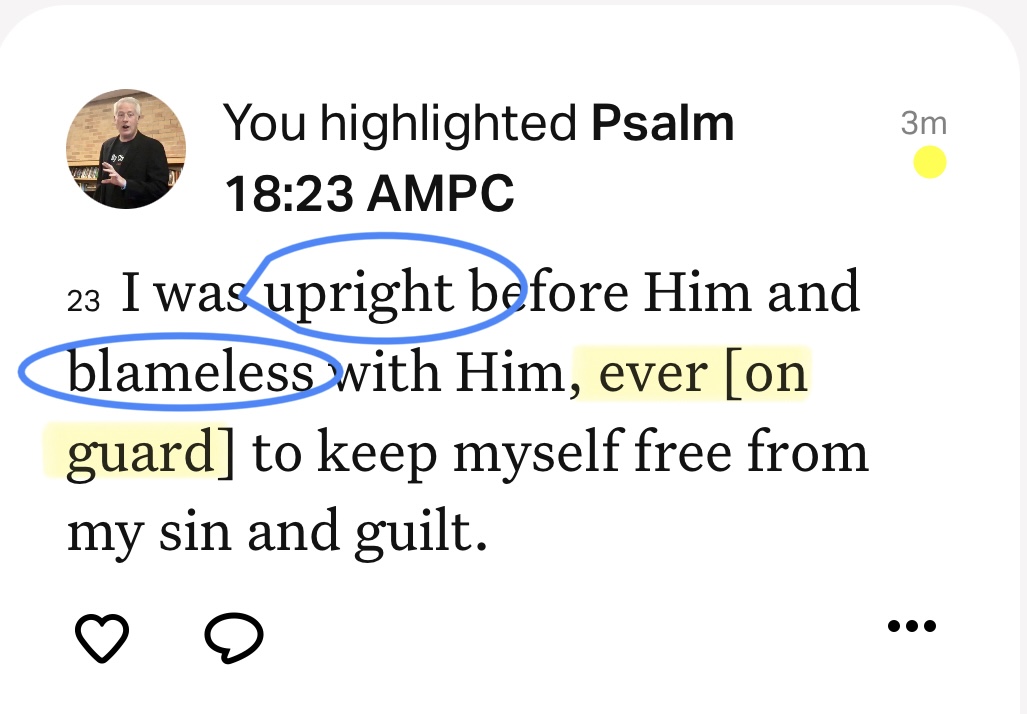
For I have kept the ways of the Lord and have not wickedly departed from my God. For all His ordinances were before me, and I put not away His statutes from me. I was upright before Him and blameless with Him, ever on guard to keep myself free from my sin and guilt. (Psalm 18:21-23 AMPC)
May we always be on guard against drifting away from the truth.
It is human nature to try to cut corners, to relax standards, to not be as careful as we once were. But we need to listen to the voice of the Holy Spirit that is calling us to blamelessness—being increasingly attentive to the standards shown us in God’s Word and in the example of the life of Jesus.
Part of being “ever on guard” is to continually raise our standards. Being challenged to meet a higher standard will keep us from the complacency that can lead to us slipping away.
Listen to the podcast of this post by clicking on the player below, and you can also subscribe on Apple, Spotify, or Audible.
Last week we saw that if we make prayer our priority, we can expect that our eyes will be opened to the answers that God has for us. Hagar and Eliezer seemed to get pretty quick answers. Nehemiah had to wait four months for the answer to his prayer.
We saw in Psalm 5 that David laid his requests before God first thing in the morning, and then he went out of his prayer closet in expectation of an answer (Psalm 5:1-3). But how long did he wait?
Psalm 6 may not happen historically right after Psalm 5, but listen to David’s heart, “Have mercy on me, LORD, for I am faint; heal me, LORD, for my bones are in agony. My soul is in deep anguish. How long, LORD, how long? (Psalm 6:2-3). And then again in Psalm 13:1-3, David asks, “How long?” four times in the first two verses!
When we read the training Jesus gave His disciples about prayer in Luke 11:9-10, we see how He implores them (and us) to keep on praying. It becomes even more emphatic in the Amplified Bible—
So I say to you, ask and keep on asking and it shall be given you; seek and keep on seeking and you shall find; knock and keep on knocking and the door shall be opened to you. For everyone who asks and keeps on asking receives; and he who seeks and keeps on seeking finds; and to him who knocks and keeps on knocking, the door shall be opened.
But once again we have to ask: how long are we to continue asking, seeking, and knocking? This is what Job asked in the middle of his trial (Job 6:8, 11-13).
Charles Spurgeon said, “God has measured the crosses of all His children: Israel in Egypt, 430 years; Joseph in prison, 3 years; Judah in Babylon, 70 years.” That means that God knows what He is doing, God knows His timing for answering, and that our part is to simply to continue to ask, seek, and knock as we throw our total trust on Him!
I remember my affliction and my wandering, the bitterness and the gall.I well remember them, and my soul is downcast within me.Yet this I call to mind and therefore I have hope.Because of the LORD’s great love we are not consumed, for His compassions never fail.They are new every morning; great is Your faithfulness.I say to myself, “The LORD is my portion; therefore I will wait for Him.” (Lamentations 3:19-24)
During these times of waiting, we need to keep recalling what we know:
God’s love is unfathomable—Romans 5:5, 8:38-39
God’s timing is perfect—Deuteronomy 32:4
God’s method is flawless—Romans 8:28
God’s gifts are good—Luke 11:11-13, 12:32
In Psalms 6 & 13, David doesn’t record any answers from God, but listen to this assurance from Jesus, “Blessed are those who mourn, for they will be comforted” (Matthew 5:4).
Jesus doesn’t tell us how or when God will bring us comfort, but He does assure us that we will be comforted!
In a couple of the examples from David, you can see this assurance as he continues his prayers (Psalm 6:2-4, 8-10; 13:1-6). Paul also experienced this confidence (2 Corinthians 12:7-10), and so did Jesus (Matthew 26:38-39, 50-54).
The writer of Hebrews assures us that Jesus was heard in His, “How long?” cries, and therefore He knows exactly how to intercede for us today as we lift up the same cry (Hebrews 5:7-8; 2:10, 14, 17-18)!
How long? Quite simply stated: Until God answers or until He lifts our burden.
In the meantime, the examples in Scripture and the assurance of Christ’s intercession for us us encourages us to…
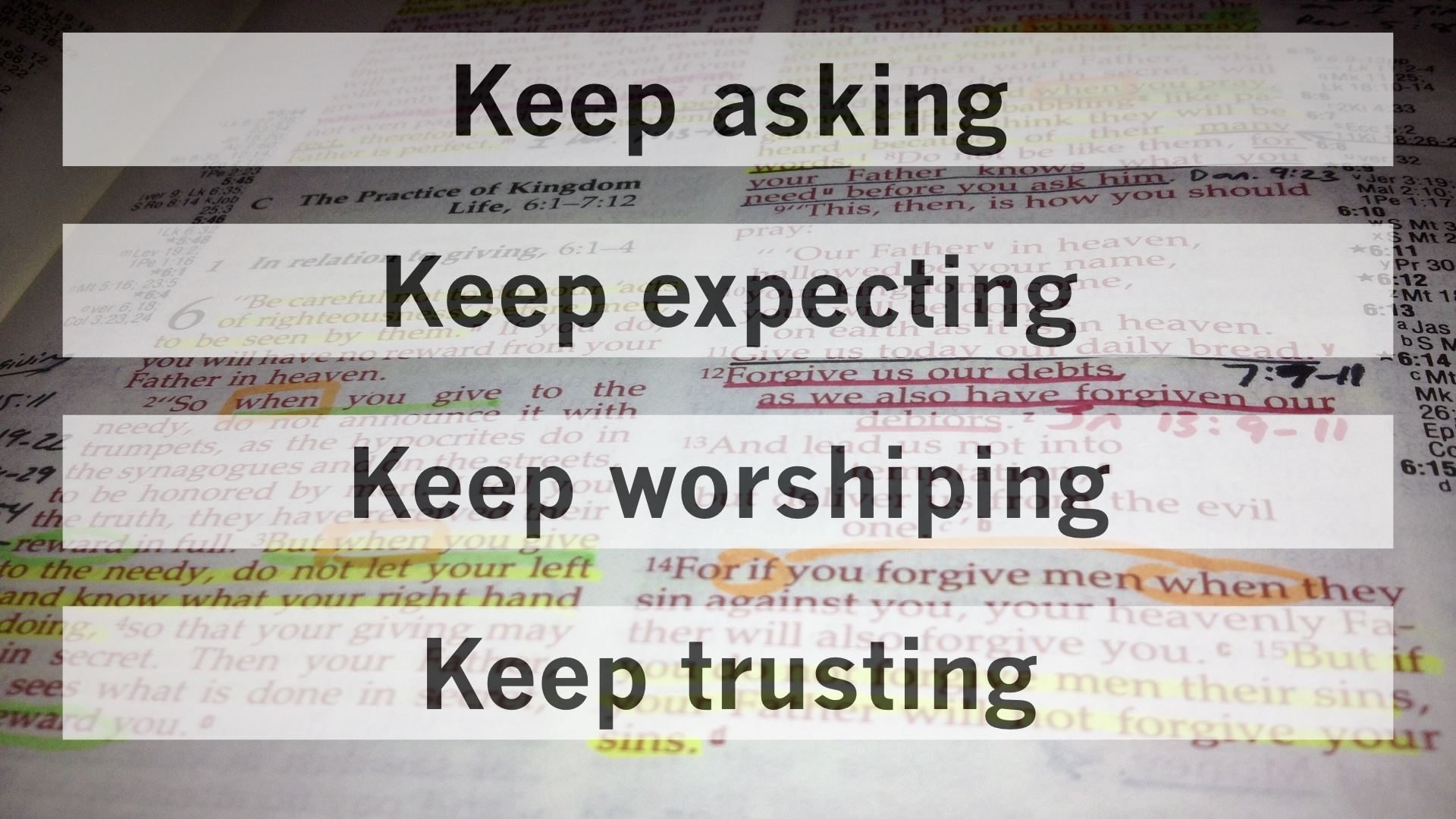
Keep asking with full confidence that God hears you
Keep expecting an answer
Keep worshiping God for Who He is
Keep trusting that your Heavenly Father wants to give you the very best!
This unity is seen during the outpouring of the Holy Spirit on the day of Pentecost recorded in Acts 2. But unity is not the same thing as conformity, as I shared in this message.
Listen to the podcast of this post by clicking on the player below, and you can also subscribe on Apple, Spotify, or Audible.
Last week I shared this thought with you from Pastor Tim Keller: “Your prayer must be firmly connected to and grounded in your reading of the Word. This wedding of Bible and prayer anchors your life down in the real God. … Without immersion in God’s words, our prayers may not be merely limited and shallow but also untethered from reality.”
“Untethered from reality” means that we determine the manner in which we come to God in prayer, the way prayer works, and the way God must respond to our prayer. But what we read in the Bible is the opposite of this (Isaiah 1:11-15).
I think there are two opposite and equal erroneous thoughts about how we approach prayer:
I’m not worthy to come into the presence of an all-holy God
I can waltz right into God’s presence whenever and however I please
Both are wrong and both are strategies the devil has used to keep us prayerless. Either we don’t go to God at all or our prayers are unheard because the Bible says that our arrogance has made our prayer ineffectual.
Our Prayer Book—the Bible—helps us find the balance. George Whitefield noted, “Reading the Bible is a good preparative for prayer, as prayer is an excellent means to render reading effectual.” So here’s what we read about those two errors.
I’m not worthy. God is unapproachable in His holiness, but Jesus has made it possible for us to enter in through His righteousness (1 Timothy 6:15-16; Isaiah 6:1-5; Hebrews 4:1, 14, 16; John 16:23-24).
I can come anyway I want to. Passages like Psalm 15:1-5 and Isaiah 58:2-4 make it clear that we cannot simply approach God in a way of our choosing.
Let’s unpack that second error a little more. We have to be clothed in righteousness in order to come into God’s presence, but we cannot be clothed in a righteousness that is apart from Jesus. When we say that we are praying in the name of Jesus, it means we are praying in the nature of Jesus and through the righteousness of Jesus. We must be wearing His righteous robe (Romans 3:22-24; Isaiah 61:10).
So I think we need to pray before we pray. Let’s try these actions which are tethered to the reality of our Prayer Book.
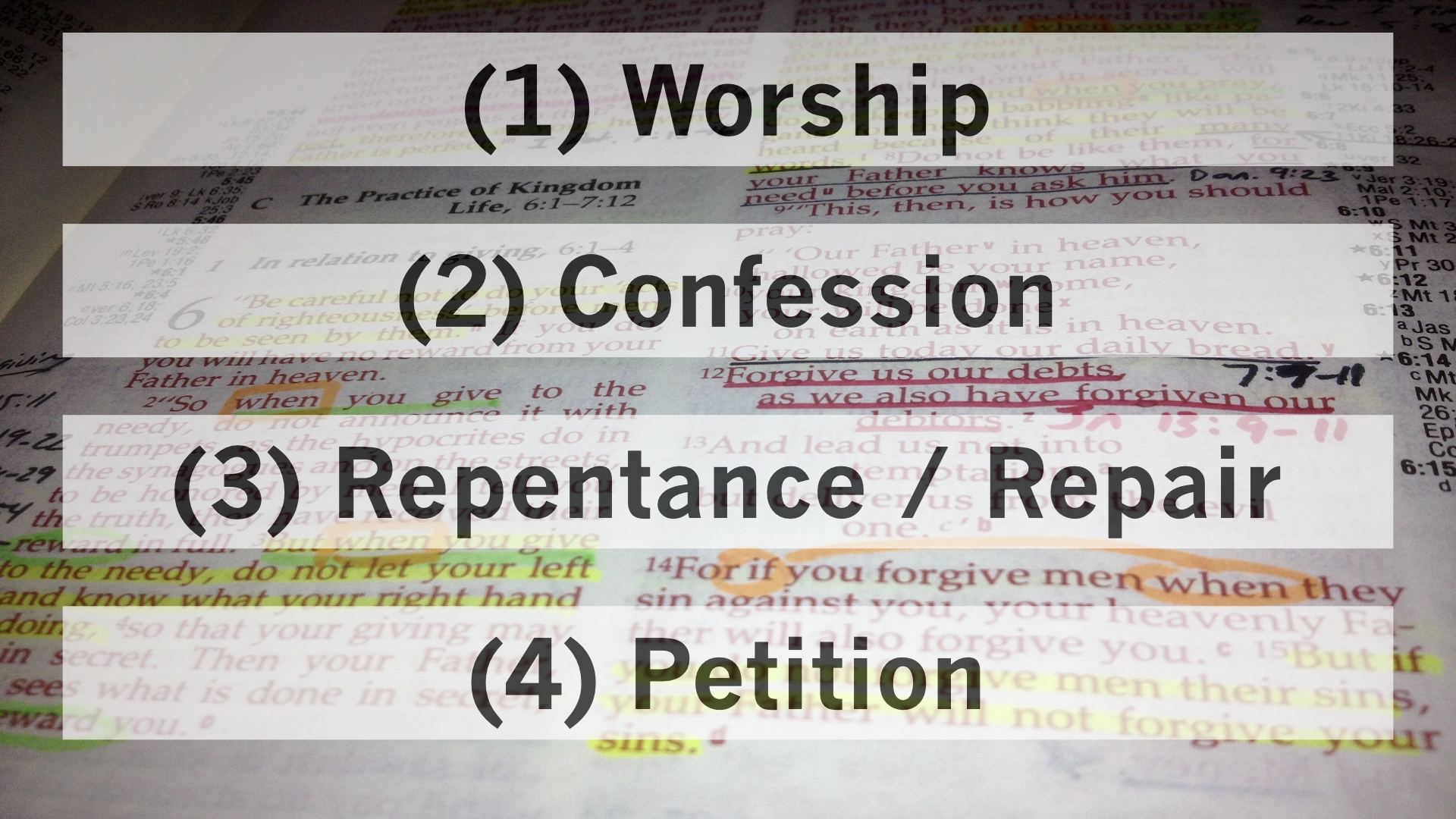
Worship. This is a deep pondering of who God is; it is humbly assigning Him the highest worth. In face, the Old English spelling of this word (“worthship”) gives us insight into what worship does. It is this kind of humility that God responds to (Isaiah 6:5-7; 57:15; Luke 18:9-14).
Confession. As we are worshiping, we will see our inadequacies (much like Isaiah did in Isaiah 6, or the tax collector did in Luke 18). We then need to confession these shortcomings. Dick Brogden wrote, “Confessed sin opens the portals of heaven into our darkness, and light and glory overwhelm shame. Confession is our glory for it lifts our heads and eradicates shame.” We see this so vividly lived out in the prayers of David (Psalm 139:23-24; 51:1-2; 19:12-14).
Repentance. I think we could also call this Repair. After confession where we have fallen short, we resolve now to both take a different path and repair what was damaged (Matthew 5:23-24; Mark 11:25-26; 1 Peter 3:7).
Petition. After worship, confession, and repentance / repair, our heart’s attitude is now in the place for God to heed our cries for His help (1 Peter 3:12).
Let’s learn to pray before we pray. Don’t just rush in and rush out of God’s presence. Take time to worship, confession any sins the Holy Spirit reveals, make things right, and then present your petitions.
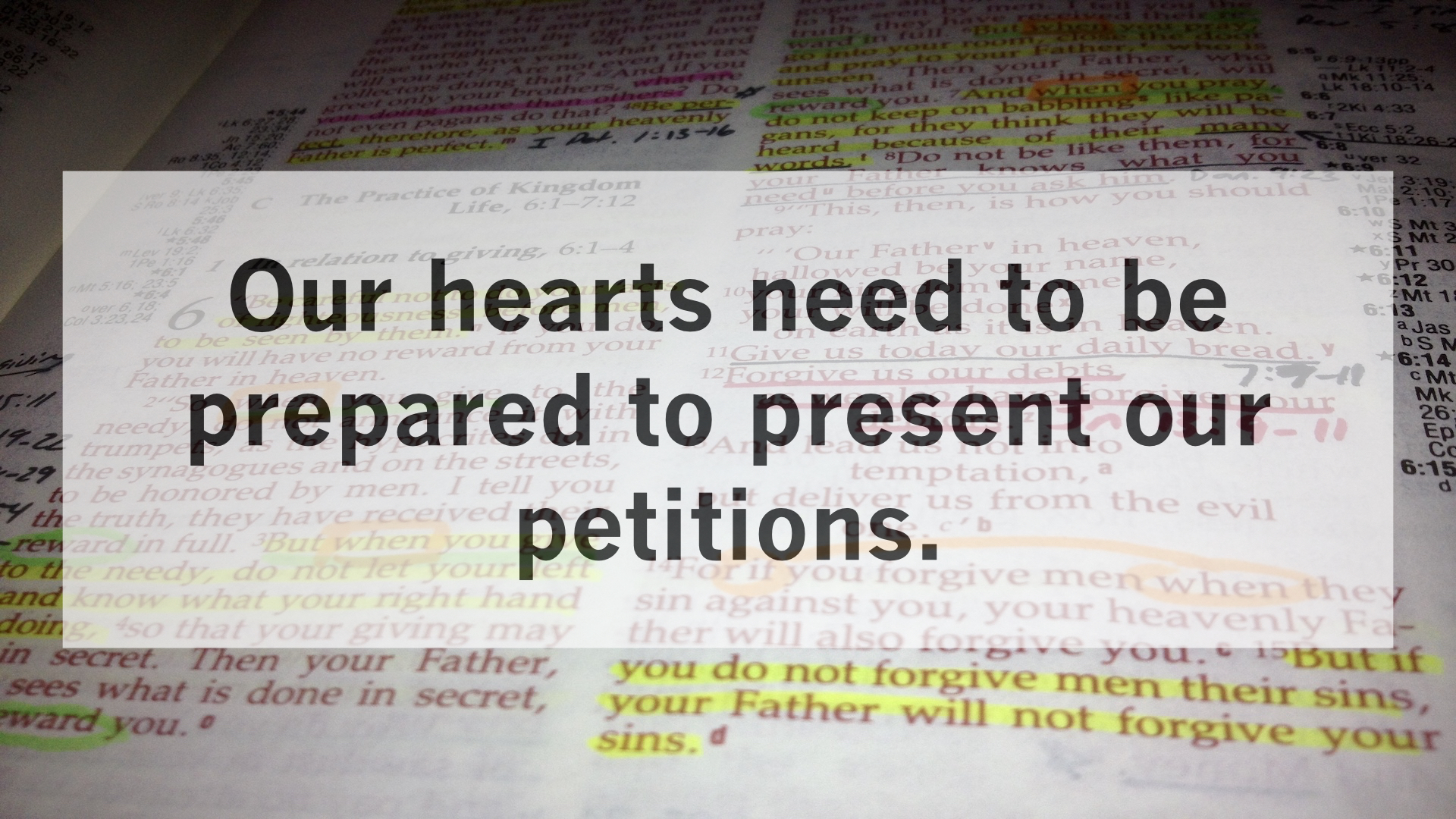
Our hearts need to be prepared to present our petitions. This is how we know that God will hear our voice.
Listen to the podcast of this post by clicking on the player below, and you can also subscribe on Apple, Spotify, or Audible.
Have you ever walked through a door that God so obviously opened just to get smacked by the people on the other side? Let’s talk about the lessons we can learn from that.
Listen to the podcast of this post by clicking on the player below, and you can also subscribe on Apple, Spotify, or Audible.
I take some time at the end of each calendar year for a quick recap of everything we have learned during this year at Calvary Assembly of God. I do this because I want to make sure we are all on the same page with each other before we move into a new year. And I also think it’s very important that we are continually reminded and reassured of what God has done for us. In our series on gratitude we talked about the dangers of forgetting to remember and re-tell the blessings of God. We see in the letters from the apostles both a re-telling of their own words, and reusing and amplifying the words of Jesus and other apostles.
You can click on the sermon series title to find a list of all of the sermons in that series. Clicking on those individual sermons will give you a short written recap of that message, and it will also give you the link to watch the video of the full sermon.
Kingdom Praying. Jesus made it clear time and time again that He came to reveal the Kingdom of God to us. He described what the Kingdom was like and told us that He came to be the means by which we could enter God’s Kingdom. He also told us how God’s children could access the power and privileges of our Heavenly Father through the means of prayer. He assured us with words like, “Do not be afraid, little flock, for your Father has been pleased to give you the Kingdom” (Luke 12:32). Jesus said quite simply that we had access to our Father through prayer. And then to make sure we didn’t miss out on this awesome privilege, He instructed us, “This, then, is how you should pray” (Matthew 6:8).
Jots and Tittles. As we get closer to the death and resurrection of Jesus, there are an increasing number of prophecies that are fulfilled in these events. Jesus appears to have been very attentive to making sure that each and every one of these prophecies were fulfilled to the smallest detail. Near the beginning of His public ministry, Jesus noted that not one iota—or “one jot or tittle” in the Old English vocabulary—of any of God’s promises would be left unfulfilled (Matthew 5:18). It’s amazing that Jesus so carefully attended to all of these, but it’s also important to ask ourselves what these fulfilled prophecies mean to us today.
Takin’ Him to the Streets. Just before Jesus ascended to Heaven, He told His followers that they would have the joyful responsibility of taking the good news of forgiveness and eternal life to all the highways and byways of every nation. Later on, Paul would get more specific about all of the groups to which he was taking the message of Jesus (see Luke 24:46-47; 1 Corinthians 9:20-22). That commission is still in effect for Christians today: We are to share the gospel with everyone—from easy street to skid row, from Wall Street to Main Street, and every street in between. The streets on which you live and work are different from the streets where I travel. In fact, all of us live on different streets, but everyone we meet on every street needs to hear about Jesus. In this new series of messages, we are going to learn how the Holy Spirit can help us be ready to take Jesus to those on each street where God sends us.
Ascending. Every year, Jews from around the world made four pilgrimages up to Jerusalem for various feasts and sacrifices. These journeys reminded them of God’s goodness as they went to the Temple to worship, and they helped refocus on God’s ways as they returned to their regular routines. Jerusalem is over 2500 feet above sea level, so the pilgrimage there was a physical workout as well as a spiritual workout. These workouts were beneficial for God’s people, preparing them to minister in their cities in the following months. The Book of Psalms contains 15 songs that these pilgrims would sing to and with each other as they traveled up to Jerusalem. These Psalms of Ascent are still instructive for Christians today.
Living in your Gift Zone. God created each and every human being uniquely. We all come in different shapes and sizes, but we all share one thing in common: He created each of us with a unique personality and a unique gift package. By unique, I truly mean that we are all one-of-a-kind creations that have never existed in all of history! Here’s another thing we all have in common: We usually live in a comfort zone that is far smaller than our gift zone. Living this way keeps us from soaring through life in the way that God intended. He wants each of us to know our gifts, and to use our gifts in a way that benefits our world and brings Him glory. It starts with believing that we are indeed gifted by our Creator. Then we must have the courage to step out of our comfort zone into the much larger gift zone God has given us.
Is that in the Bible? A meme that makes me chuckle every time I see it is a “quote” attributed to Abraham Lincoln in which he says, “The problem with quotes found on the internet is that they are often not true.” (Not to spoil the joke for you, but unless Lincoln knew how to time travel to the future, I don’t think he knew about the modern internet!). I love this meme because it captures something that so many people fall into: a quick acceptance of a statement without verifying its source or thinking through the implications of the statement’s truthfulness. In this series I think you may be surprised to discover just how many phrases we call biblical aren’t, and how many phrases there are that we never realized are actually in the Bible.
Be Thankful. It’s so easy to spot the negative things. It’s so easy to gripe about the bad stuff with others. It’s so easy to complain about what’s wrong with the world. But the Bible repeatedly calls the saints of God to rise above this downward pull of negativity. In fact, for those who have a relationship with their Heavenly Father, who call Jesus their Savior, and who call the Holy Spirit their Counselor, there is really only one way to live: Grateful!
Christ’s Advents. The word Advent means the appearing—something that bursts onto the scene. At this time of year we are actually thinking about TWO Advents. We look backward in gratitude to celebrate the first Advent of Jesus when He was born in a manger in Bethlehem. And then we look forward in joyful expectation to the second Advent of Jesus when He will return to earth again as King of kings. As Christians live in this time between the two Advents, our celebration and expectation should bring four noticeable attributes from our lives: hope, peace, joy, and love.
This next year promises to be another amazing time of learning and growing. If you live in northern Kent County and don’t have a home church, I would love for you to visit us!
Listen to the podcast of this post by clicking on the player below, and you can also subscribe on Apple, Spotify, or Audible.
The word Advent means the appearing—something that bursts onto the scene. At this time of year we are actually thinking about TWO Advents. We look backward in gratitude to celebrate the first Advent of Jesus when He was born in a manger in Bethlehem. And then we look forward in joyful expectation to the second Advent of Jesus when He will return to earth again as King of kings. As we will in this time between the Advents, there are four qualities that we should exemplify—the first is hope.
When the candle is lit, darkness disappears.
Darkness is not the opposite of light, it is the absence of light. In the same way, despair or hopelessness is the absence of hope.
Adam and Eve lived in perfection, but when they tried to do things their way—instead of obeying God’s way—their sin caused them despair. They tried to cover their nakedness, but with a hopeless covering of dying leaves. God came with a promise of full restoration, and illustrated it by covering them with the skin of a sacrificial animal (Genesis 3:7, 15, 21).
Job knew the hopelessness of self-covering and finality of earthly life, and even David—the man after God’s own heart knew this too (Job 6:11-13, 17:13-16; 1 Chronicles 29:15).
But Job and David both knew the hope they could have in their Redeemer (Job 19:25; Psalm 16).
Hope in both the Old and the New Testaments means a patient waiting, anticipating with pleasure, having a confident expectation. It’s a light shining in the darkness that cannot be extinguished—it’s hope that despair cannot darken (Isaiah 9:1-2, 6-7).
At His first Advent, Jesus appeared in our “clothing” so that He could become our sin and then clothe us in His righteousness (Hebrews 2:17; John 1:14; Romans 4:6-8; Hebrews 6:16-20). For this we look back in gratitude.
But we don’t live today merely in gratitude for Christ’s first Advent, but we also live in confident hope of Christ’s second Advent (Acts 1:11; John 14:1-3; 2 Corinthians 5:1-8; Revelation 22:7, 12, 20).
He came into this world of sin,
Made flesh and blood His dearest kin;
He died, that He might take us in,
And keep us till He comes again. —Scott Hubbard
How do we live out this confident hope—
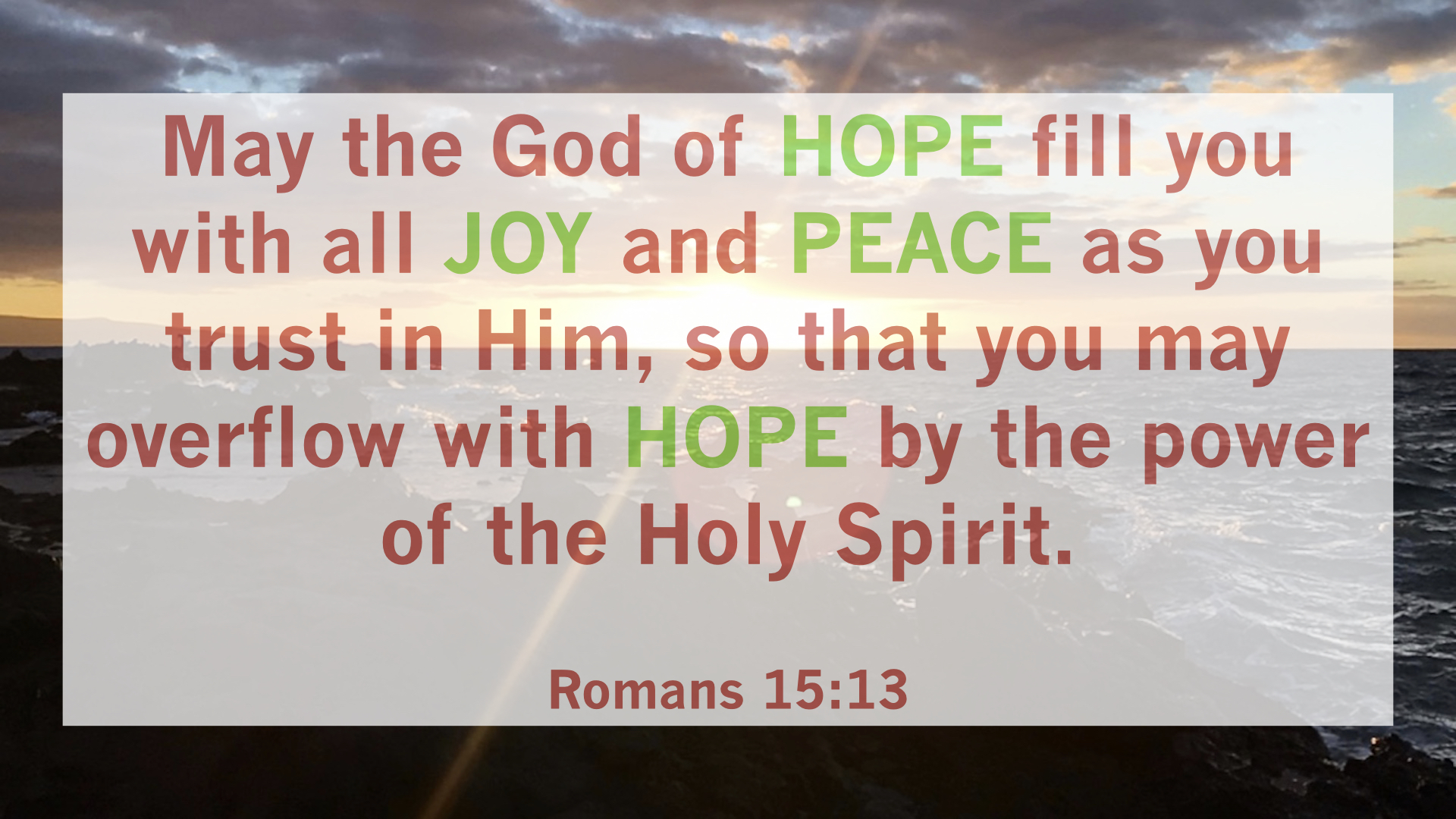
May the God of HOPE fill you with all JOY and PEACE as you trust in Him, so that you may overflow with HOPE by the power of the Holy Spirit. (Romans 15:13)
Follow along with all four of the Advent attributes by clicking here.
But this isn’t quid quo pro—we aren’t grateful people just so we can get something back for ourselves. We should be grateful people because…
(1) …God is good all the time and so we should be thankful to Him continually—1 Thessalonians 5:18
(2) …Jesus was grateful—1 Peter 2:23; Hebrews 12:2
(3) …God blesses thankful people—1 Peter 3:9; Luke 6:33
(4) …your thankfulness can benefit people you haven’t even met!
Near the end of his life, David wrote a hymn of thanksgiving, which he taught to Asaph (his worship leader) who then taught it to all the citizens (1 Chronicles 16:7-35). Throughout this song, notice how many times David sang about not only giving thanks but sharing our thankfulness with those around us.
In difficult times, people search for what delivered others in the past. A good example is Psalm 106, where the psalmist warns his readers about the dangers of forgetting to be thankful for God’s blessings. This psalm begins and ends with words taken right from David’s hymn of thanksgiving as an added reminder of what our gratitude should sound like (see vv. 1, 47-48).
One hundred years after David wrote this song, King Asa needed to look back to it. His father Abijah had been evil throughout his reign as king, so had his grandfather Rehoboam. His great-grandfather Solomon started off well, but turned away from God near the end of his life. So Asa looked all the way back to the thankful heart of his great-great grandfather David (1 Kings 15:11).
Jehoshaphat needed this same song 100 years after Asa (200 years after David wrote it) in 2 Chronicles 20. Enemies had surrounded Judah and Jehoshaphat called the people to prayer. Jahaziel, a direct descendant of David’s worship leader Asaph, calls the people to trust God to fight the battle for them. As the army marches out the next morning, they put the worship team at the front who sang David’s 200-year-old song of thanksgiving and God used that to ambush their enemies!
Your lifestyle of gratitude today—your songs of thanksgiving—could be a blessing to future generations that haven’t even been born yet!
We would do well to learn the lessons of the past and make sure we are always quickly turning our grumbling into a song of thankfulness.
As you do, you are…
Emulating the lifestyle of Jesus
Banking up blessings from God
Ambushing the enemy
Bringing a testimony to non-believers
Establishing a standard for future generations
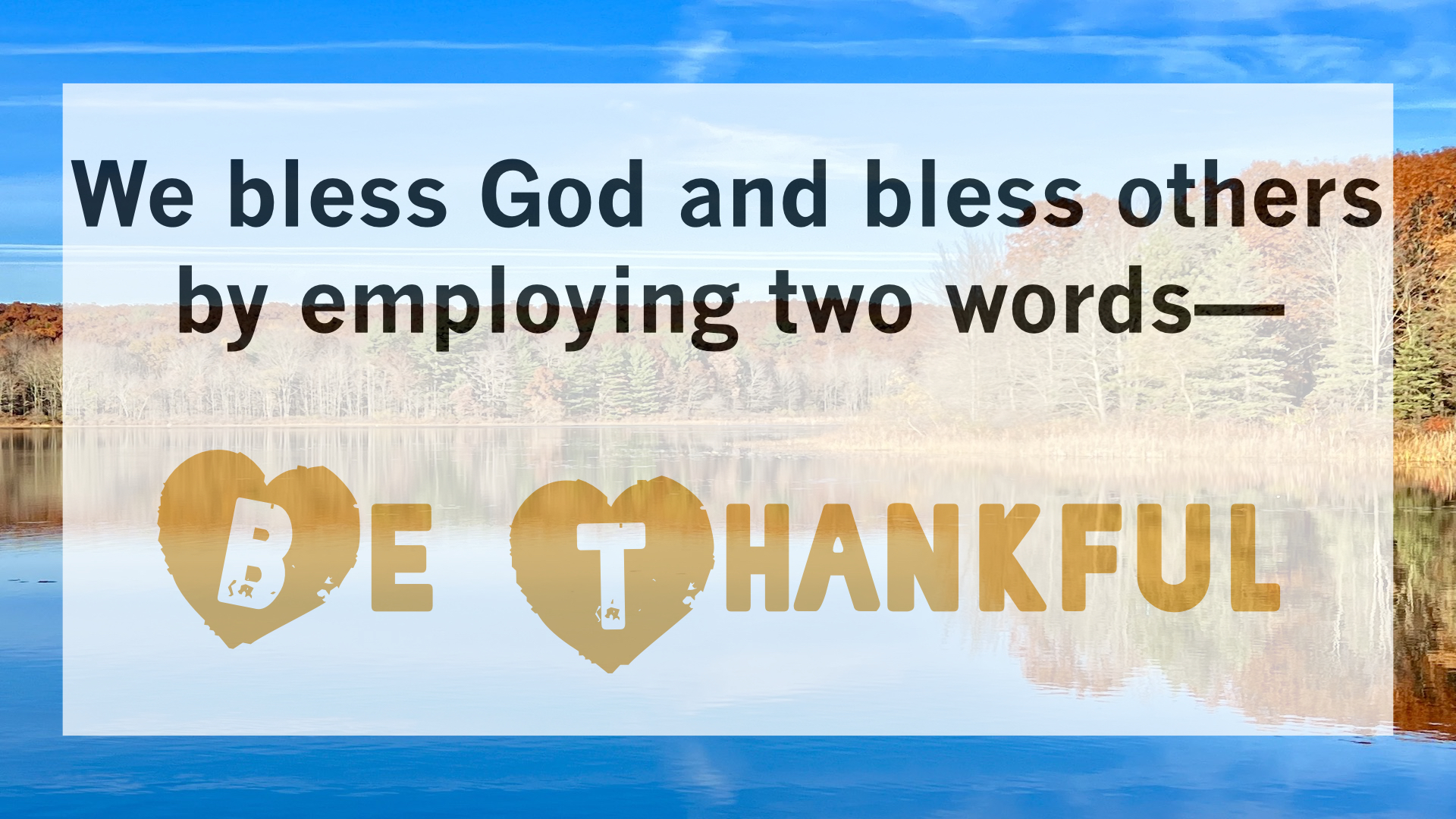
We bless God and bless others by employing two words: BE THANKFUL!
Listen to the podcast of this post by clicking on the player below, and you can also subscribe on Apple, Spotify, or Audible.
Let me remind you of something I covered last week:
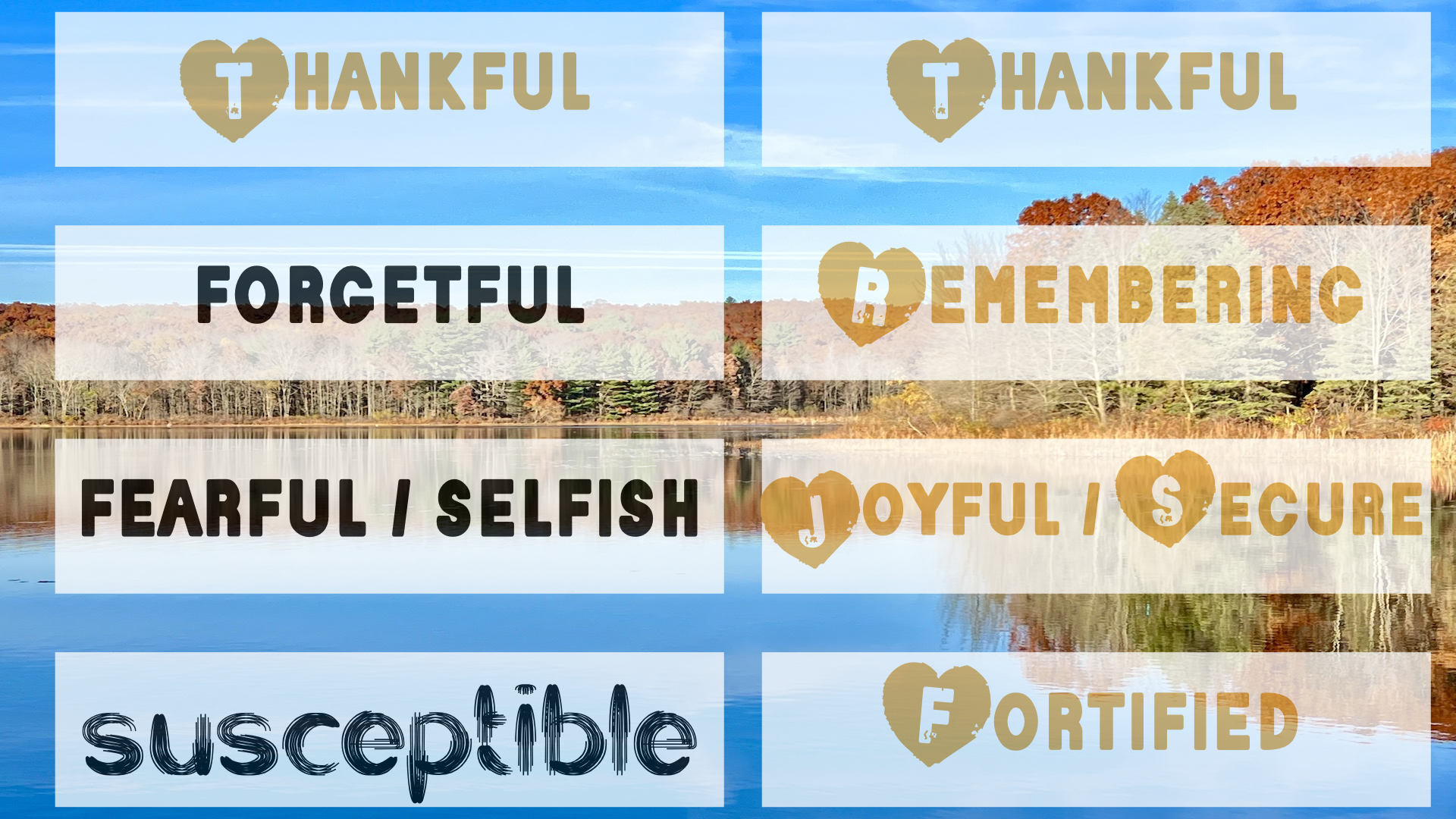
If we start out thankful but then forget about our blessings, we become fearful and selfish, which makes us susceptible to the sin of grumbling against God.
But if we start our thankful and then continually remember all that God has done for us, we remain joyful and secure, which fortifies us against giving in to the sin of grumbling against God.
As I have shared with you during this series, medical science has discovered so many connections between gratitude and wellbeing—mentally, physically, emotionally, and relationally. Here’s another important finding from medical science: Chronic stress impairs memory formation.
Remember this insight from George Santayana: “Those who do not learn from history are doomed to repeat it”?
But what if we cannot learn the lessons from history because we cannot remember and recall those lessons? That’s one of the ways chronic stress ravages our ability to be grateful. Stress literally clogs up the amygdala in our brain so that these lessons cannot be filed away for future use.
Where does this chronic stress come from? Stress can be a good thing—think of the stress we put on our lungs, heart, and muscles when we exercise. That good stress (eustress) prepares us to respond well in difficult situations.
But chronic stress is unhealthy. It begins to make us withdraw into ourselves. We become self-protective. We start to see potential problems even behind blessings.
Self-protective becomes self-focused, which is the exact opposite of the God-focus we looked at last week in Psalm 103:2. This also makes us want to isolate from people (see Psalm 42:1-4, especially the “used to” in v. 4).
Consider the example of David’s life. David is in a stressful state where I am sure it is becoming increasingly difficult for him to find praiseworthy things. He is becoming more and more self-protective and therefore self-focused.
Saul tries to kill him—1 Samuel 20:28-33
The Philistines have him trapped—21:10-13; Psalm 56
The people of Keilah reward David’s help with betrayal—23:10-12
David is in a desert place (literally!) and sold-out by the Ziphites—23:14, 19-20
Psalm 54 is written when David learns about the Ziphites’ plan. He begins to pour out his complaint to God in vv. 1-3, but then there is a totally different tone in vv. 4-7. What comes between is the word Selah—a pause to consider.
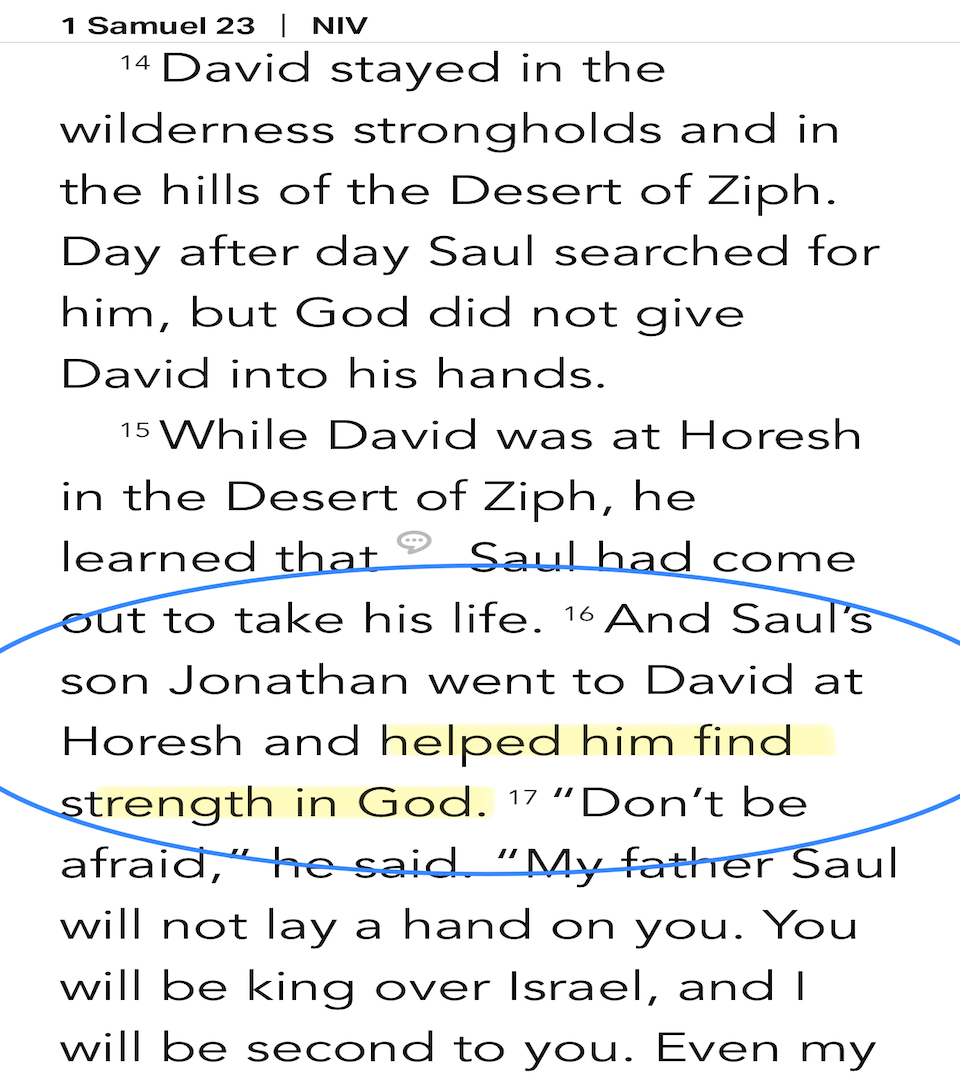
I believe at this time is when Jonathan shows up to encourages David—And Saul’s son Jonathan went to David at Horesh and helped him find strength in God (1 Samuel 23:16).
David learned this lesson well because when he’s in another tight spot, we read that David found strength in the Lord his God, which allowed him to encourage his distraught men to seek God’s help. It was with God’s help that they recovered everything single thing that had been taken from them (1 Samuel 30:1-18)!
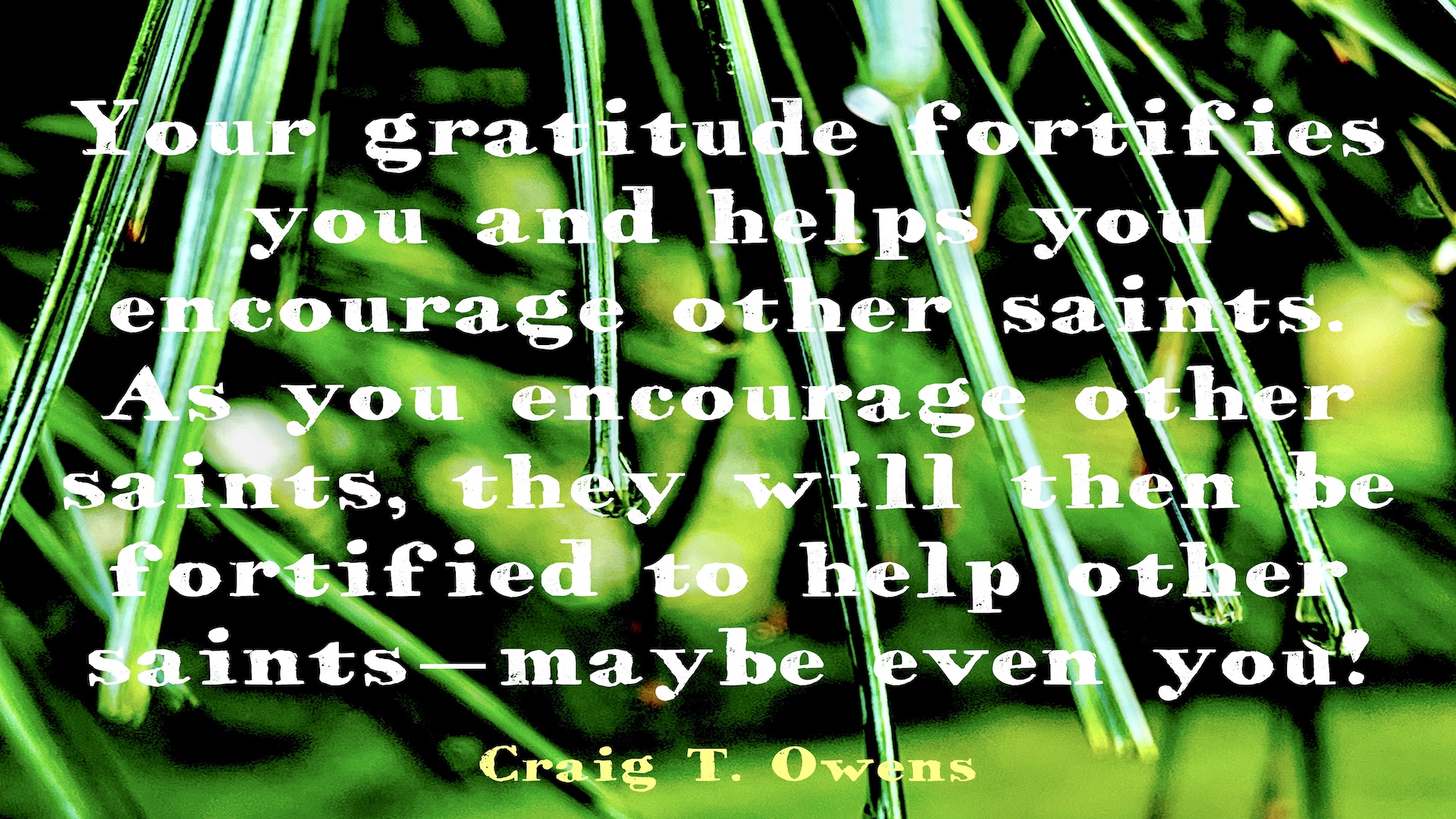
Your gratitude fortifies you and helps you encourage other saints. As you encourage other saints, they will then be fortified to help other saints—maybe even you!
I like how Eugene Peterson paraphrases 1 Thessalonians 5:11 in The Message: “So speak encouraging words to one another. Build up hope so you’ll all be together in this, no one left out, no one left behind. I know you’re already doing this; just keep on doing it.”
Your gratitude could make all the difference in someone else’s life, so “just keep on doing it”!
Listen to the podcast of this post by clicking on the player below, and you can also subscribe on Apple, Spotify, or Audible.
It is so much easier to complain than to compliment. We can slide into the negative conversations almost without thinking about it.
In one of the last things that Paul wrote to Timothy—as he’s in prison, quite possibly awaiting execution—he warns his friend against the darkness of the last days (2 Timothy 3:1-5). We need to engage our minds, our wills, and our emotions to not go with the flow of culture’s negativity.
Remember the wise words from George Santayana: “Those who do not learn from history are doomed to repeat it.” The apostle Paul said this before Mr. Santayana (1 Corinthians 10:1-6). We need to learn the lessons of the dangers of forgetfulness that leads us to ingratitude.
Even before Paul, the Old Testament is filled with repeated reminders to remember God’s blessings and gratefully look to Him to supply every need. Let’s unpack some lessons on the importance of gratitude from Israel’s history in Psalm 106.
In Psalm 106:7, the Israelites forget what God has done for them in Egypt. Now that they appear to be pinned between the Red Sea and the onrushing Egyptian army, their forgetfulness becomes grumbling against God (Exodus 14:10-12).
In Psalm 106:13-14, instead of being grateful for the miraculous supply of manna, the Israelites are grumbling about the meat they don’t have (Numbers 11:4-6).
Here’s the lesson for us to learn: God wants to teach us to be thankful for His daily provisions for us (Joshua 5:12; Matthew 6:11).
In Psalm 106:21, 28-29, the next generation of Israelites didn’t remember to be thankful because they had seldom heard their parents express gratitude (Judges 2:10-11).
Here’s the lesson for us to learn: Our daily thankfulness fortifies future generations (Psalm 37).
Here is the repeated pattern we see—
Thankfulness → Forgetfulness → Fearful / Selfish attitudes → Susceptible to the temptation to grumble against God
Thankfulness → Remembering → Joyful / Secure attitudes → Fortified against the temptation to grumble against God
Jim Cymbala said, “Ingratitude to God is the first step toward backsliding and departure from God. So, it is to our benefit to have a thankful heart toward God.”
Let’s put into practice this lesson from King David: “Praise the Lord, O my soul, and forget bot all His benefits” (Psalm 103:2).



 For I have kept the ways of the Lord and have not wickedly departed from my God. For all His ordinances were before me, and I put not away His statutes from me. I was upright before Him and blameless with Him, ever on guard to keep myself free from my sin and guilt. (Psalm 18:21-23 AMPC)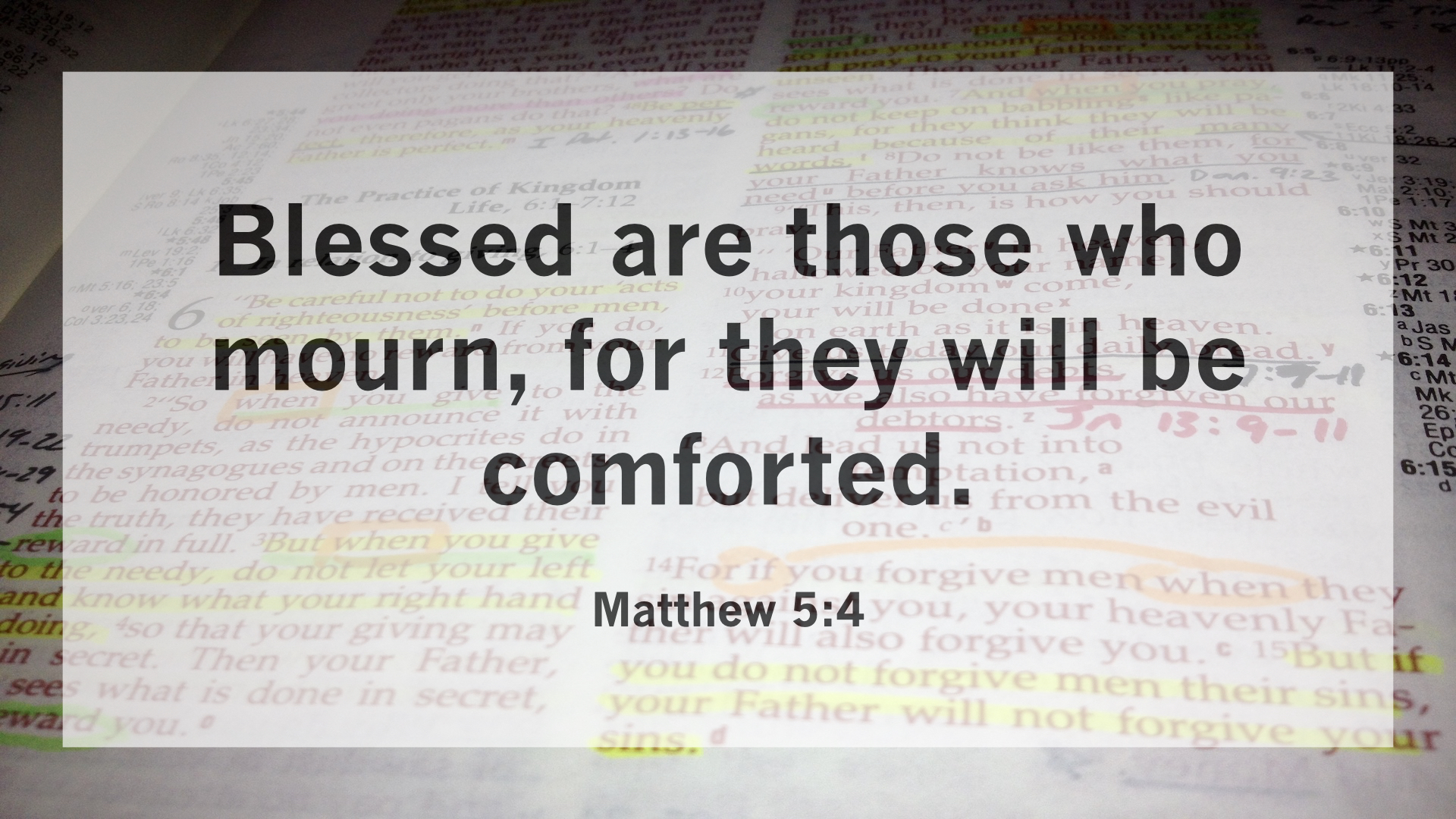







 Craig T. Owens